
林业科学 ›› 2026, Vol. 62 ›› Issue (6): 82-95.doi: 10.11707/j.1001-7488.LYKX20250578
李云鹤1,2,王思荣3,李逸洒1,2,陆灯盛1,2,*( )
)
收稿日期:2025-09-19
修回日期:2026-03-22
出版日期:2026-06-10
发布日期:2026-06-13
通讯作者:
陆灯盛
E-mail:ludengsheng@fjnu.edu.cn
基金资助:
Yunhe Li1,2,Sirong Wang3,Yisa Li1,2,Dengsheng Lu1,2,*()
Received:2025-09-19
Revised:2026-03-22
Online:2026-06-10
Published:2026-06-13
Contact:
Dengsheng Lu
E-mail:ludengsheng@fjnu.edu.cn
摘要:
目的: 融合机载与手持激光雷达(LiDAR)数据,探讨其在单木参数提取中的优势,分析机载和手持LiDAR数据在不同林分类型和林下植被条件下的适用性,为多源LiDAR数据在精细化森林调查中的应用提供科学依据。方法: 选取亚热带福建省3个典型区,基于采集的机载和手持LiDAR数据,采用自动分割与目视解译相结合的方式准确分割样地单木,提取相应的单木参数并评估2种数据估算单木材积的性能,分析林分类型和林分复杂性对单木参数提取精度的影响。结果: 1) 融合机载和手持LiDAR数据提取的单木胸径的相对均方根误差(rRMSE)为5.72%~5.84%,树高的rRMSE为7.36%~7.83%,与单独使用手持扫描数据相比,树高误差(rRMSE)减小3.29%~4.19%。2) 基于融合LiDAR数据,杉木在不同林下植被条件下均可获得高精度的单木胸径,rRMSE为7.05%,马尾松在林下植被简单条件下可获得较高精度的单木胸径,而阔叶林的单木胸径存在较大不确定性。3) 基于提取的单木胸径和树高计算单木材积的rRMSE为16.11%~17.18%,与单独使用手持扫描数据相比,单木材积误差减小4.21%~4.30%。结论: 融合机载与手持LiDAR数据估测单木参数的精度受林分类型和林下植被条件的影响,不同场景单木参数提取精度的评估可为后续激光雷达技术优化地面调查工作提供理论支撑。
中图分类号:
李云鹤,王思荣,李逸洒,陆灯盛. 融合机载与手持激光雷达数据的亚热带典型森林单木参数提取精度比较分析[J]. 林业科学, 2026, 62(6): 82-95.
Yunhe Li,Sirong Wang,Yisa Li,Dengsheng Lu. Comparative Analysis of Individual Tree Parameter Extraction Accuracy Using Integrated Data Collected by Airborne and Handheld LiDAR in Subtropical Typical Forests[J]. Scientia Silvae Sinicae, 2026, 62(6): 82-95.
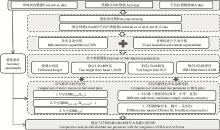
图1
基于手持和机载LiDAR 提取单木参数的技术路线 DBHHLS 和HHLS为基于HLS数据提取的胸径和树高,DBHfused LiDAR和Hfused LiDAR为基于融合LiDAR数据提取的胸径和树高。DBHHLS and HHLS refer to DBH and tree height extracted from HLS data, and DBHfused LiDAR and Hfused LiDAR refer to DBH and tree height derived from the fused LiDAR data."
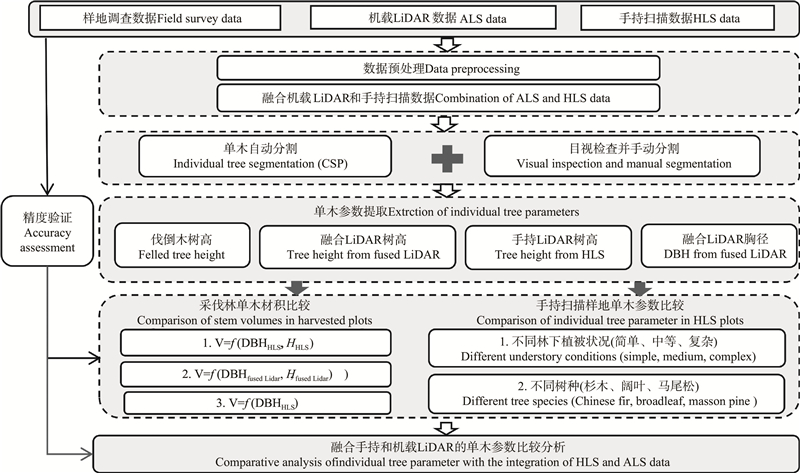

表1
研究使用的数据情况"
| 数据类型 Data type | 内容描述 Descriptions | 获取时间 Acquisition time | 用途 Purpose | |||||
| 研究区域 Study area | 林分类型 (样地数量) Forest types (number of plots) | 样地总株数Total number of stems | 实测株数Number of measured stems | 平均胸径 Average DBH/cm | 平均树高 Average tree height/m | |||
| 采伐样地内单木量测 Individual tree measurement in harvested plots | 白砂国有林场 Baisha State-Owned Forest Farm | 马尾松(1)Masson pine | 72 | 72 | 14.4 | 13.5 | 2024?02 | 基于融合LiDAR提取的单木参数的精度验证 Accuracy validation of individual tree parameters extracted from fused LiDAR data |
| 杉木(1) Chinese fir | 45 | 45 | 12.2 | 9.5 | ||||
| 手持扫描样地内单木 量测 Individual tree measurement in HLS plots | 白砂国有林场 Baisha State-Owned Forest Farm | 马尾松(4) Masson pine | 352 | 28 | 15.5 | \ | 2022?10?11 | 基于融合LiDAR数据,对手持扫描样地中不同林分类型和林下植被状况的单木参数提取结果进行精度验证和比较分析 Accuracy validation and comparative analysis of individual tree parameter extraction results for different forest types and understory conditions in HLS plots based on fused LiDAR data |
| 杉木(1)Chinese fir | 75 | 75 | 14.0 | \ | ||||
| 阔叶(2)Broadleaf | 70 | 52 | 16.1 | \ | ||||
| 水西国有林场 Shuixi State-Owned Forest Farm | 杉木(4)Chinese fir | 156 | 156 | 23.5 | \ | 2023?02 | ||
| 武夷山 国家公园 Wuyishan National Forest Park | 马尾松(2)Masson pine | 135 | 105 | 21.9 | \ | 2023?08 | ||
| 杉木(5)Chinese fir | 335 | 335 | 16.8 | \ | ||||
| 阔叶(4)Broadleaf | 306 | 74 | 12.3 | \ | ||||
| 手持激光扫描数据 HLS data | 白砂国有林场 手持扫描样地 HLS plots in Baisha State-Owned Forest Farm | HLS数据使用LiGripH120传感器采集,扫描视场角为280°× 360°,LiDAR测距精度可达到±3 cm,点频320 000 pts·s?1, 测量范围为120 m HLS data are acquired using LiGripH120 laser sensor. The device has a field of view of 280°×360°, LiDAR ranging accuracy reached up to ±3 cm, measuring up to 320 000 pts·s?1 in a single return mode within a maximum range of 120 m | 2022?10?11 | 单独基于手持扫描数据以及融合机载LiDAR数据提取采伐林与手持扫描样地单木参数 Individual tree parameters extracted separately from HLS data and fused LiDAR data in the harvested and HLS plots | ||||
| 白砂国有林场采伐林 Harvested stands in Baisha State-Owned Forest Farm | 2024?02 | |||||||
| 水西国有林场 Shuixi State-Owned Forest Farm | 2023?02 | |||||||
| 武夷山 国家公园 Wuyishan National Forest Park | 2023?08 | |||||||
| 机载激光扫描数据 ALS data | 白砂国有林场 Baisha State-Owned Forest Farm | 利用AEROS-912动力三角翼飞机搭载Riegl VUX-240机载激光雷达系统采集LiDAR数据,视场角75°,LiDAR测距精度可达到 0.2 cm,点云密度高于40 pt·m?2 LiDAR data are acquired using AEROS-912 aircraft equipped with a Riegl VUX-240 LiDAR system. The LiDAR system has a field of view of 75° and a ranging precision of up to 0.2 cm. The average point density is over 40 pt·m?2 | 2022?10?11 | 融合手持扫描数据提取采伐林与手持扫描样地单木参数 Extraction of individual tree parameters in harvested and HLS plots using fused LiDAR data | ||||
| 水西国有林场 Shuixi State-Owned Forest Farm | 2023?10 | |||||||
| 武夷山 国家公园 Wuyishan National Forest Park | 2022?12 | |||||||
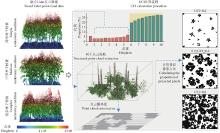
图2
基于融合LiDAR点云的林下植被复杂度评价指标计算流程示意"
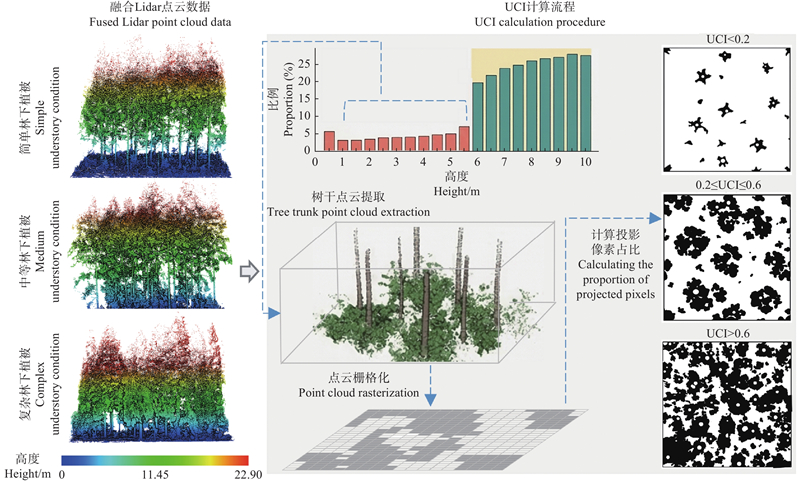
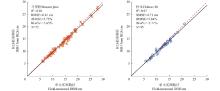
图3
手持LiDAR提取单木胸径与实测胸径之间的关系"
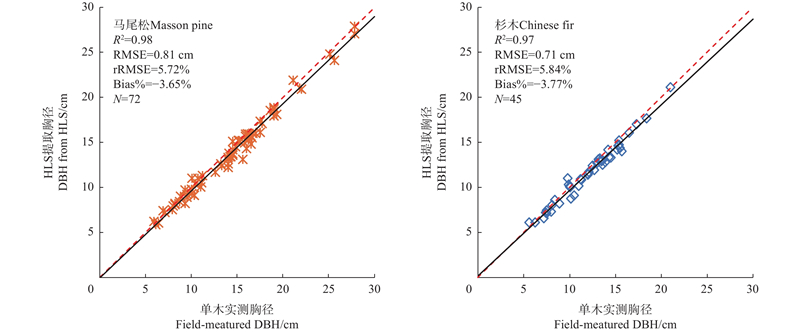
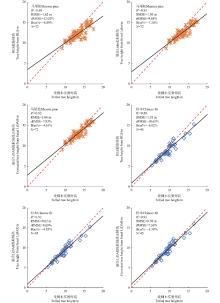
图4
基于手持扫描和融合LiDAR数据获取单木树高与伐倒木量测树高结果对比"
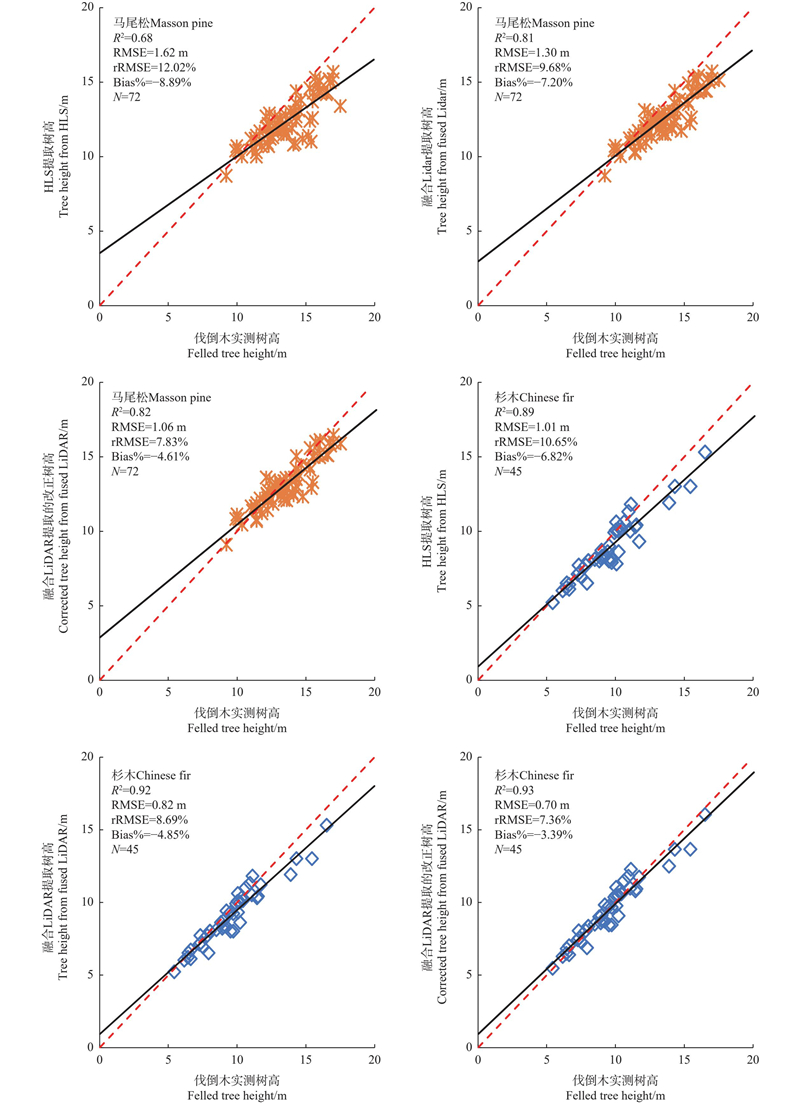
图5
基于采伐木实测胸径和树高比较一元和二元立木材积方程计算的单木材积"
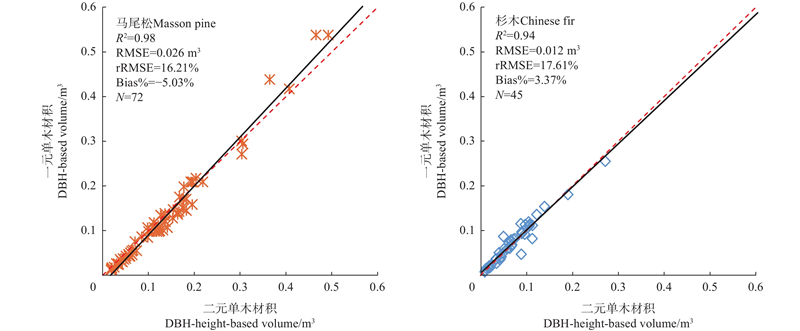
表2
基于伐倒木计算的单木材积评价手持与融合LiDAR数据提取的单木材积结果"
| 参数 Parameters | 马尾松Masson pine | 杉木Chinese fir | |||
| RMSE (rRMSE) | Bias (Bias%) | RMSE (rRMSE) | Bias (Bias%) | ||
| 手持扫描数据提取的树高和胸径 Tree height and DBH extracted from HLS data | 0.027 (20.32%) | –0.019 (–15.01%) | 0.014 (21.48%) | –0.010 (–14.64%) | |
| 融合数据提取的树高和胸径 Tree height and DBH extracted from fused LiDAR data | 0.021 (16.11%) | –0.014 (–10.91%) | 0.015 (17.18%) | –0.006 (–9.25%) | |
| 手持扫描数据提取的胸径 DBH extracted from HLS data | 0.027 (20.40%) | –0.017 (–12.64%) | 0.014 (20.25%) | –0.004 (–6.25%) | |
表3
单木分割结果①"
| 林分类型 Forest types | 林下植被状况 Understory conditions | 样地个数 Number of Plots | 实际株数 Number of measured trees | 自动分割Automated segmentation | 手动分割Manual segmentation | |||||||
| 株数 No. of trees | R (%) | P (%) | F1 (%) | 株数 No. of trees | R (%) | P (%) | F1 (%) | |||||
| 马尾松 Masson pine | 简单 Simple | 2 | 189 | 192 | 98.41 | 96.88 | 97.64 | 187 | 98.94 | 100 | 99.47 | |
| 中等 Medium | 2 | 129 | 135 | 91.47 | 87.41 | 89.39 | 127 | 95.35 | 96.85 | 96.09 | ||
| 复杂 Complex | 2 | 169 | 212 | 88.76 | 70.75 | 78.74 | 175 | 94.67 | 91.43 | 93.02 | ||
| 杉木 Chinese fir | 简单 Simple | 3 | 143 | 147 | 97.9 | 95.24 | 96.55 | 146 | 99.3 | 97.26 | 98.27 | |
| 中等 Medium | 4 | 225 | 252 | 92.00 | 82.14 | 86.79 | 220 | 95.56 | 97.73 | 96.63 | ||
| 复杂 Complex | 3 | 198 | 296 | 90.40 | 60.47 | 72.47 | 197 | 94.95 | 95.43 | 95.19 | ||
| 阔叶 Broadleaf | 简单 Simple | 2 | 107 | 99 | 88.79 | 95.96 | 92.23 | 103 | 93.46 | 97.09 | 95.24 | |
| 中等 Medium | 2 | 156 | 138 | 79.49 | 89.86 | 84.35 | 168 | 92.95 | 86.31 | 89.51 | ||
| 复杂 Complex | 2 | 113 | 204 | 75.22 | 41.67 | 53.63 | 111 | 84.96 | 86.49 | 85.71 | ||
表4
单木胸径提取结果"
| 林下植被状况 Understory conditions | 马尾松Masson pine | 杉木Chinese fir | 阔叶Broadleaf | |||||
| RMSE (rRMSE) | Bias (Bias%) | RMSE (rRMSE) | Bias (Bias%) | RMSE (rRMSE) | Bias (Bias%) | |||
| 简单 Simple | 1.37 (8.78%) | –0.62 (–3.99%) | 1.31 (7.38%) | –0.76 (–4.28%) | 2.06 (12.48%) | –1.02 (–6.21%) | ||
| 中等 Medium | 2.06 (11.27%) | 0.37 (2.00%) | 1.38 (7.18%) | –0.59 (–3.0%) | 1.86 (21.75%) | –0.35 (–5.32%) | ||
| 复杂 Complex | 1.55 (8.24%) | –0.90 (–4.78%) | 1.35 (6.55%) | –0.51 (–2.49%) | 4.43 (27.12%) | 1.40 (8.59%) | ||
| 总体 Total | 1.63 (9.43%) | –0.44 (–2.54%) | 1.35 (7.05%) | –0.63 (–3.25%) | 3.15 (19.85%) | 0.18 (1.12%) | ||
图6
基于手持和融合数据提取的不同林分类型的单木树高"
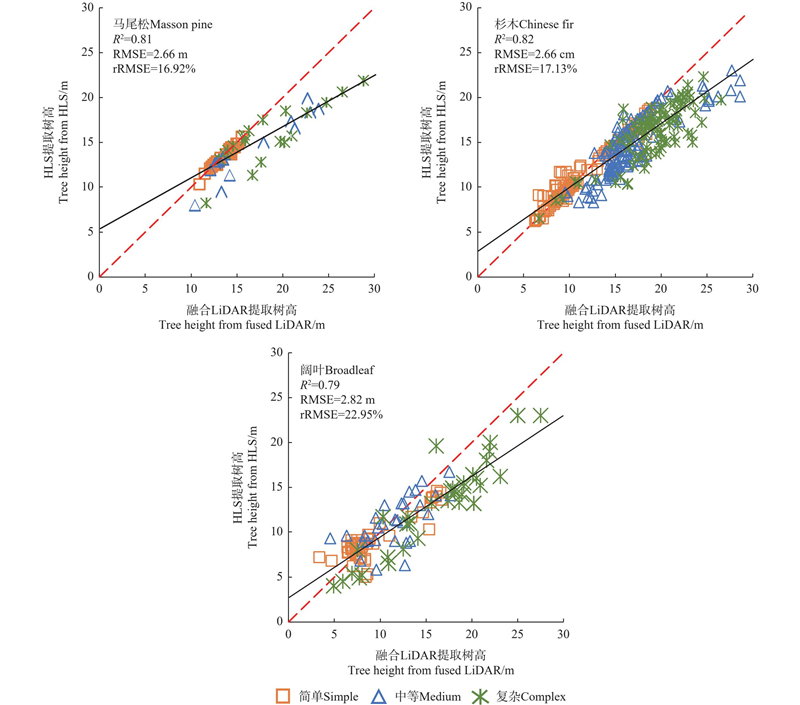
表5
利用融合数据提取的单木树高评价手持扫描数据提取的单木树高"
| 林下植被状况 Understory conditions | 马尾松Masson pine | 杉木Chinese fir | 阔叶Broadleaf | |||||
| RMSE (rRMSE) | Bias (Bias%) | RMSE (rRMSE) | Bias (Bias%) | RMSE (rRMSE) | Bias (Bias%) | |||
| 简单 Simple | 0.21 (1.60%) | –0.13 (–0.96%) | 0.95 (8.32%) | –0.06 (–0.55%) | 1.77 (19.02%) | –0.10 (–1.10%) | ||
| 中等 Medium | 2.69 (17.03%) | –1.89 (–11.96%) | 2.83 (17.05%) | –2.07 (–12.50%) | 2.50 (21.59%) | –0.48 (–4.13%) | ||
| 复杂 Complex | 4.15 (21.92%) | –3.17 (–16.70%) | 3.65 (19.13%) | –2.96 (–15.54%) | 3.74 (23.64%) | –3.01 (–19.01%) | ||
| 总体 Total | 2.66 (16.92%) | –1.45 (–9.22%) | 2.66 (17.13%) | –1.64 (–10.54%) | 2.82 (22.95%) | –1.29 (–10.49%) | ||
图7
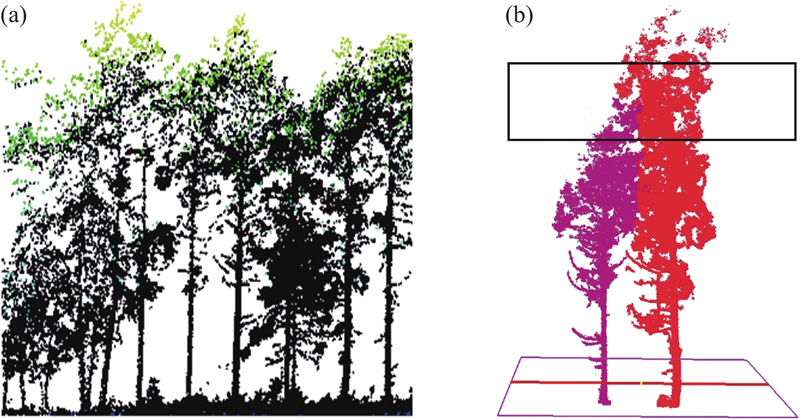
复杂林分状况下影响手持激光雷达数据树高提取的因素 a:林下植被遮挡导致树冠顶部点云扫描不完整(绿色的点是机载LiDAR 点云,黑色的点是手持激光雷达点云);b:单木树冠交叠导致单木分割有误(不同颜色表示分割的两棵单木)。"
|
邓云程, 王金亮, 刘钱威, 等. 提取林木胸径的F-LS算法. 遥感信息, 2022, 37 (5): 77- 84.
doi: 10.3969/j.issn.1000-3177.2022.05.012 |
|
|
Deng Y C, Wang J L, Liu Q W, et al. Tree DBH extraction based on F-LS algorithm. Remote Sensing Information, 2022, 37 (5): 77- 84.
doi: 10.3969/j.issn.1000-3177.2022.05.012 |
|
|
范光鹏, 许亮亮, 蔡会德, 等. 基于地基激光雷达点云的桉树单木参数提取与地上碳储量测定. 林业科学, 2026, 62 (3): 88- 99.
doi: 10.11707/j.1001-7488.LYKX20240701 |
|
|
Fan G P, Xu L L, Cai H D, et al. Extraction of individual Eucalyptus tree parameters and determination of aboveground carbon stock based on terrestrial LiDAR point clouds. Scientia Silvae Sinicae, 2026, 62 (3): 88- 99.
doi: 10.11707/j.1001-7488.LYKX20240701 |
|
| 国家林业局. 2014. 立木生物量模型及碳计量参数: 杉木(LY/T 2264—2014). 北京: 中国标准出版社. | |
| State Forestry Administration. 2014. Tree biomass models and related parameters to carbon accounting for Cunninghamia lanceolata (LY/T 2264—2014). Beijing: Standards Press of China. [in Chinese] | |
|
胡中洋, 陕 亮, 陈翔宇, 等. CHM与DSM相结合的无人机激光雷达单木分割. 林业科学, 2024, 60 (8): 14- 24.
doi: 10.11707/j.1001-7488.LYKX20230079 |
|
|
Hu Z Y, Shan L, Chen X Y, et al. Individual tree segmentation of UAV-LiDAR based on the combination of CHM and DSM. Scientia Silvae Sinicae, 2024, 60 (8): 14- 24.
doi: 10.11707/j.1001-7488.LYKX20230079 |
|
|
陆灯盛, 蒋先蝶, 李云鹤, 等. 基于激光雷达数据的森林生物量估测研究. 遥感学报, 2025, 29 (6): 2035- 2064.
doi: 10.11834/jrs.20255022 |
|
|
Lu D S, Jiang X D, Li Y H, et al. Forest biomass estimation with LiDAR data. National Remote Sensing Bulletin, 2025, 29 (6): 2035- 2064.
doi: 10.11834/jrs.20255022 |
|
| 王伟伟, 庞 勇, 杜黎明, 等. 超体素约简和谱聚类结合的机载LiDAR点云单木分割. 遥感学报, 2022, 26 (8): 1650- 1661. | |
| Wang W W, Pang Y, Du L M, et al. Individual tree segmentation for airborne LiDAR point cloud data using spectral clustering and supervoxel-based algorithm. Journal of Remote Sensing, 2022, 26 (8): 1650- 1661. | |
|
杨晨辉, 程寿民, 高谢雨, 等. 基于干形拟合的TLS长白落叶松树干参数提取. 林业科学, 2025, 61 (8): 154- 163.
doi: 10.11707/j.1001-7488.LYKX20240596 |
|
|
Yang C H, Cheng S M, Gao X Y, et al. Stem parameter estimation method for Larix olgensis based on TLS data of stem shape fitting. Scientia Silvae Sinicae, 2025, 61 (8): 154- 163.
doi: 10.11707/j.1001-7488.LYKX20240596 |
|
|
曾伟生. 杉木相容性立木材积表系列模型研建. 林业科学研究, 2014, 27 (1): 6- 10.
doi: 10.13275/j.cnki.lykxyj.2014.01.002 |
|
|
Zeng W S. Establishment of compatible tree volume equation system of Chinese fir. Forest Science Research, 2014, 27 (1): 6- 10.
doi: 10.13275/j.cnki.lykxyj.2014.01.002 |
|
|
Bauwens S, Bartholomeus H, Calders K, et al. Forest inventory with terrestrial LiDAR: A comparison of static and handheld mobile laser scanning. Forests, 2016, 7 (6): 127.
doi: 10.3390/f7060127 |
|
|
Brede B, Terryn L, Barbier N, et al. Non-destructive estimation of individual tree biomass: allometric models, terrestrial and UAV laser scanning. Remote Sensing of Environment, 2022, 280, 113180.
doi: 10.1016/j.rse.2022.113180 |
|
|
Cabo C, Del Pozo S, Rodríguez-Gonzálvez P, et al. Comparing terrestrial laser scanning (TLS) and wearable laser scanning (WLS) for individual tree modeling at plot level. Remote Sensing, 2018, 10 (4): 540.
doi: 10.3390/rs10040540 |
|
|
Dai W X, Yang B S, Liang X L, et al. Automated fusion of forest airborne and terrestrial point clouds through canopy density analysis. ISPRS Journal of Photogrammetry and Remote Sensing, 2019, 156, 94- 107.
doi: 10.1016/j.isprsjprs.2019.08.008 |
|
|
Dai W X, Kan H Y, Tan R C, et al. Multisource forest point cloud registration with semantic-guided keypoints and robust RANSAC mechanisms. International Journal of Applied Earth Observation and Geoinformation, 2022, 115, 103105.
doi: 10.1016/j.jag.2022.103105 |
|
|
de Conto T, Olofsson K, Görgens E B, et al. Performance of stem denoising and stem modelling algorithms on single tree point clouds from terrestrial laser scanning. Computers and Electronics in Agriculture, 2017, 143, 165- 176.
doi: 10.1016/j.compag.2017.10.019 |
|
|
Du L M, Pang Y, Wang Q, et al. A LiDAR biomass index-based approach for tree- and plot-level biomass mapping over forest farms using 3D point clouds. Remote Sensing of Environment, 2023, 290, 113543.
doi: 10.1016/j.rse.2023.113543 |
|
|
Duanmu J L, Xing Y Q. Annular neighboring points distribution analysis: a novel PLS stem point cloud preprocessing algorithm for DBH estimation. Remote Sensing, 2020, 12 (5): 808.
doi: 10.3390/rs12050808 |
|
|
Fekry R, Yao W, Cao L, et al. Ground-based/UAV-LiDAR data fusion for quantitative structure modeling and tree parameter retrieval in subtropical planted forest. Forest Ecosystems, 2022, 9, 100065.
doi: 10.1016/j.fecs.2022.100065 |
|
|
Hu Y, Xu X L, Wu F Y, et al. Estimating forest stocks volume in Hunan Province, China, by integrating in situ plot data, Sentinel-2 images, and linear and machine learning regression models. Remote Sensing, 2020, 12 (1): 186.
doi: 10.3390/rs12010186 |
|
|
Hyyppä E, Yu X W, Kaartinen H, et al. Comparison of backpack, handheld, under-canopy UAV, and above-canopy UAV laser scanning for field reference data collection in boreal forests. Remote Sensing, 2020, 12 (20): 3327.
doi: 10.3390/rs12203327 |
|
|
Jin S N, Zhang W M, Shao J, et al. Estimation of larch growth at the stem, crown, and branch levels using ground-based LiDAR point cloud. Journal of Remote Sensing, 2022, 2022, 9836979.
doi: 10.34133/2022/9836979 |
|
|
Jurjević L, Liang X, Gašparović M, et al. Is field-measured tree height as reliable as believed – Part Ⅱ. A comparison study of tree height estimates from conventional field measurement and low-cost close-range remote sensing in a deciduous forest. ISPRS Journal of Photogrammetry and Remote Sensing, 2020, 169, 227- 241.
doi: 10.1016/j.isprsjprs.2020.09.014 |
|
|
Li Y, Li G, Wang S, et al. Retrieval of Chinese fir tree parameters under different understory conditions with the integration of handheld and airborne LiDAR data. Geo-spatial Information Science, 2025, 28 (5): 2183- 2204.
doi: 10.1080/10095020.2024.2439399 |
|
|
Liang X L, Hyyppä J, Kaartinen H, et al. International benchmarking of terrestrial laser scanning approaches for forest inventories. ISPRS Journal of Photogrammetry and Remote Sensing, 2018, 144, 137- 179.
doi: 10.1016/j.isprsjprs.2018.06.021 |
|
|
Liang X L, Kankare V, Hyyppä J, et al. Terrestrial laser scanning in forest inventories. ISPRS Journal of Photogrammetry and Remote Sensing, 2016, 115, 63- 77.
doi: 10.1016/j.isprsjprs.2016.01.006 |
|
|
Liang X L, Wang Y S, Pyörälä J, et al. Forest in situ observations using unmanned aerial vehicle as an alternative of terrestrial measurements. Forest Ecosystems, 2019, 6 (1): 1- 16.
doi: 10.1186/s40663-019-0173-3 |
|
|
Liao K, Li Y H, Zou B Z, et al. Examining the role of UAV LidAR data in improving tree volume calculation accuracy. Remote Sensing, 2022, 14 (17): 4410.
doi: 10.3390/rs14174410 |
|
|
Lin W, Lu Y G, Li G Y, et al. A comparative analysis of modeling approaches and canopy height-based data sources for mapping forest growing stock volume in a northern subtropical ecosystem of China. GIScience & Remote Sensing, 2022, 59 (1): 568- 589.
doi: 10.1080/15481603.2022.2044139 |
|
|
Liu J C, Feng Z K, Mannan A, et al. Comparing non-destructive methods to estimate volume of three tree taxa in Beijing, China. Forests, 2019, 10 (2): 92.
doi: 10.3390/f10020092 |
|
|
Lu D S, Chen Q, Wang G X, et al. A survey of remote sensing-based aboveground biomass estimation methods in forest ecosystems. International Journal of Digital Earth, 2016, 9 (1): 63- 105.
doi: 10.1080/17538947.2014.990526 |
|
|
Lu D S, Jiang X D. A brief overview and perspective of using airborne LiDAR data for forest biomass estimation. International Journal of Image and Data Fusion, 2024, 15 (1): 1- 24.
doi: 10.1080/19479832.2024.2309615 |
|
|
Moe K, Owari T, Furuya N, et al. Comparing individual tree height information derived from field surveys, LiDAR and UAV-DAP for high-value timber species in Northern Japan. Forests, 2020, 11 (2): 223.
doi: 10.3390/f11020223 |
|
|
Oveland I, Hauglin M, Giannetti F, et al. Comparing three different ground based laser scanning methods for tree stem detection. Remote Sensing, 2018, 10 (4): 538.
doi: 10.3390/rs10040538 |
|
|
Qi Y, Coops N C, Daniels L D, et al. Comparing tree attributes derived from quantitative structure models based on drone and mobile laser scanning point clouds across varying canopy cover conditions. ISPRS Journal of Photogrammetry and Remote Sensing, 2022, 192, 49- 65.
doi: 10.1016/j.isprsjprs.2022.07.021 |
|
|
Seidel D, Annighöfer P, Ammer C, et al. Quantifying understory complexity in unmanaged forests using TLS and identifying some of its major drivers. Remote Sensing, 2021, 13 (8): 1513.
doi: 10.3390/rs13081513 |
|
|
Tao S L, Wu F F, Guo Q H, et al. Segmenting tree crowns from terrestrial and mobile LiDAR data by exploring ecological theories. ISPRS Journal of Photogrammetry and Remote Sensing, 2015, 110, 66- 76.
doi: 10.1016/j.isprsjprs.2015.10.007 |
|
|
Vorster A G, Evangelista P H, Stovall A E L, et al. Variability and uncertainty in forest biomass estimates from the tree to landscape scale: the role of allometric equations. Carbon Balance and Management, 2020, 15 (1): 8.
doi: 10.1186/s13021-020-00143-6 |
|
|
Wan P, Wang T J, Zhang W M, et al. Quantification of occlusions influencing the tree stem curve retrieving from single-scan terrestrial laser scanning data. Forest Ecosystems, 2019, 6 (1): 43.
doi: 10.1186/s40663-019-0203-1 |
|
|
Wang D, Liang X L, Mofack G I, et al. Individual tree extraction from terrestrial laser scanning data via graph pathing. Forest Ecosystems, 2021, 8, 1- 11.
doi: 10.1186/s40663-021-00340-w |
|
|
Wang Y S, Lehtomäki M, Liang X L, et al. Is field-measured tree height as reliable as believed: a comparison study of tree height estimates from field measurement, airborne laser scanning and terrestrial laser scanning in a boreal forest. ISPRS Journal of Photogrammetry and Remote Sensing, 2019, 147, 132- 145.
doi: 10.1016/j.isprsjprs.2018.11.008 |
|
|
Xie Y, Yang T, Wang X, et al. Applying a portable backpack LiDAR to measure and locate trees in a nature forest plot: Accuracy and error analyses. Remote Sensing, 2022, 14 (8): 1806.
doi: 10.3390/rs14081806 |
|
|
Yang J M, Yuan W W, Lu H C, et al. Assessing the performance of handheld laser scanning for individual tree mapping in an urban area. Forests, 2024, 15 (4): 575.
doi: 10.3390/f15040575 |
|
|
Zhao Y T, Im J, Zhen Z. Towards accurate individual tree parameters estimation in dense forest: optimized coarse-to-fine algorithms for registering UAV and terrestrial LiDAR data. GIScience & Remote Sensing, 2023, 60 (1): 2197281.
doi: 10.1080/15481603.2023.2197281 |
| [1] | 练一宁,卢昊,淮永建,徐海峰,霍朗宁,王智超. 点云语义引导的无人机激光雷达单木分割与参数估算[J]. 林业科学, 2026, 62(4): 106-117. |
| [2] | 段彩红,林辉,龙江平,杨培松,叶子林,张廷琛,李洵微,朱立新. 结合改进模拟连续变化检测与分类算法的桉树年龄和蓄积量遥感估测[J]. 林业科学, 2025, 61(4): 46-55. |
| [3] | 孔丹,庞勇,梁晓军,杜黎明,白羽. 基于分层叠加的机载LiDAR点云单木分割[J]. 林业科学, 2024, 60(3): 87-99. |
| [4] | 周相贝, 李春干, 代华兵, 余铸, 李振, 苏凯. 点云密度对机载激光雷达大区域亚热带森林参数估测精度的影响[J]. 林业科学, 2023, 59(9): 23-33. |
| [5] | 陈星京,冯林艳,张宇超,刘清旺,杨朝晖,符利勇,白晋华. 基于机载激光雷达的崇礼冬奥核心区林分地上生物量反演[J]. 林业科学, 2022, 58(10): 35-46. |
| [6] | 曾伟生,孙乡楠,王六如,王威,蒲莹. 基于机载激光雷达数据的森林蓄积量模型研建[J]. 林业科学, 2021, 57(2): 31-38. |
| [7] | 李春干,李振. 机载激光雷达大区域亚热带森林参数估测的普适性模型式[J]. 林业科学, 2021, 57(10): 23-35. |
| [8] | 耿林, 李明泽, 范文义, 王斌. 基于机载LiDAR的单木结构参数及林分有效冠的提取[J]. 林业科学, 2018, 54(7): 62-72. |
| [9] | 尤号田, 邢艳秋, 彭涛, 丁建华. 机载LiDAR航带旁向重叠对针叶林结构参数估测的影响[J]. 林业科学, 2018, 54(6): 109-118. |
| [10] | 李欢, 李明泽, 范文义, 王斌. 基于机载激光雷达的林隙结构参数提取[J]. 林业科学, 2018, 54(10): 98-107. |
| [11] | 严恩萍, 赵运林, 林辉, 莫登奎, 王广兴. 基于地统计学和多源遥感数据的森林碳密度估算[J]. 林业科学, 2017, 53(7): 72-84. |
| [12] | 段祝庚, 肖化顺, 袁伟湘. 基于离散点云数据的森林冠层高度模型插值方法[J]. 林业科学, 2016, 52(9): 86-94. |
| [13] | 曹林, 代劲松, 庞勇, 赵兵, 徐建新, 李增元. 集成LiDAR和辐射模型的植被遮挡下城市屋顶太阳能估算[J]. 林业科学, 2014, 50(2): 99-110. |
| [14] | 尹艳豹;唐守正;郎璞梅;高瑞馨. 多回波机载LiDAR数据提取林地DEM的判别分析方法[J]. 林业科学, 2011, 47(12): 106-113. |
| [15] | 赵峰 庞勇 李增元 张怀清 丰伟 刘清旺. 机载激光雷达和航空数码影像单木树高提取[J]. 林业科学, 2009, 12(10): 81-87. |
| 阅读次数 | ||||||
|
全文 |
|
|||||
|
摘要 |
|
|||||

