
Scientia Silvae Sinicae ›› 2025, Vol. 61 ›› Issue (10): 38-48.doi: 10.11707/j.1001-7488.LYKX20240493
• Frontiers and hot topics • Previous Articles
Luxiao Qian1,Xin Gao2,Jianxiong Lü1,Youming Dong1,Jingbo Shi1,*( )
)
Received:2024-08-19
Online:2025-10-25
Published:2025-11-05
Contact:
Jingbo Shi
E-mail:shijb@njfu.edu.cn
CLC Number:
Luxiao Qian,Xin Gao,Jianxiong Lü,Youming Dong,Jingbo Shi. A New Approach for Conditioning Solid Wood Samples: Optimization of Water-Addition-Equilibrium Method[J]. Scientia Silvae Sinicae, 2025, 61(10): 38-48.
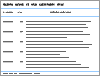
Table 1
The equilibrium temperature and time in the water-addition-equilibrium method"
| 平衡温度 Equilibrium temperatures (Te)/℃ | 平衡时间 Equilibrium time (τe)/h |
| 45 | 48,72,96 |
| 60 | 24,48,72 |
| 75 | 24,48,72 |
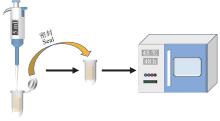
Fig.1
Schematic diagram of the operation of the water-addition-equilibrium method"
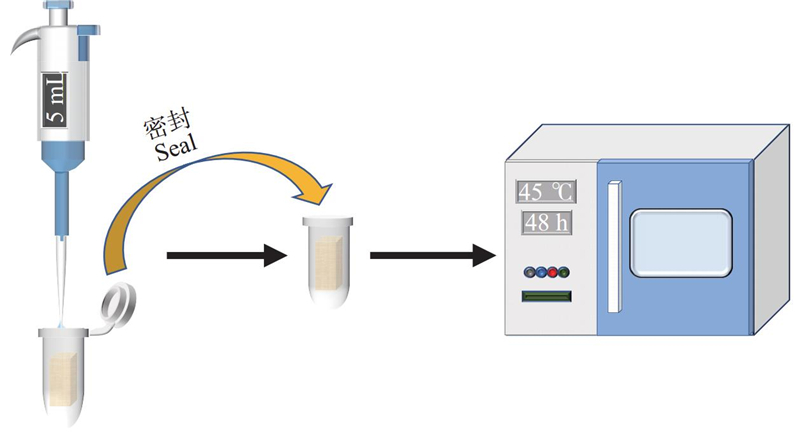
Table 2
Means and standard errors of obtained MC of poplar samples by water-addition-equilibrium method"
| 目标含水率 Target moisture content (%) | 平衡温度 Equilibrium temperature (Te)/℃ | 实际含水率 Actual moisture content (%) |
| 5 | 45 | 5.17±0.04 |
| 60 | 4.8±0.2 | |
| 75 | 5.1±0.6 | |
| 15 | 45 | 15.3±0.4 |
| 60 | 14.4±0.2 | |
| 75 | 14.0±1.0 | |
| 25 | 45 | 24.8±0.4 |
| 60 | 24.9±0.6 | |
| 75 | 23.9±0.6 |
Table 3
Means and standard errors of obtained MC of poplar samples by saturated salt solution method"
| 目标含水率 Target moisture content (%) | 实际含水率 Actual moisture content (%) |
| 6.5 | 4.61±0.08 |
| 18 | 14.3±0.2 |
| 30 | 29.0±0.2 |
Table 4
Equilibrium time for the water-addition-equilibrium and saturated salt solution methods"
| 平衡方法 Conditioning method | 平衡条件 Equilibrium condition | 平衡时间 Equilibrium time/d |
| 加水平衡法 Water-addition- equilibrium method | 45 ℃ | 3 |
| 60 ℃ | 2 | |
| 75 ℃ | 2 | |
| 饱和盐溶液法 Saturated salt solution method | 25 ℃, KCl饱和溶液 25 ℃, KCl saturated salt solution | 20 |
| 25 ℃, MgCl2饱和溶液 25 ℃, MgCl2 saturated salt solution | 20 | |
| 25 ℃, 蒸馏水 25 ℃, distilled water | 25 |
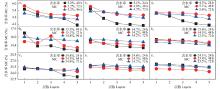
Fig.2
MC gradients of poplar samples under the target MC of 5%, 15% and 25% The equilibrium temperature of 45 ℃ (a1, b1, c1), 60 ℃ (a2, b2, c2), 75 ℃ (a3, b3, c3). The actual average MC of samples are shown in the figures."
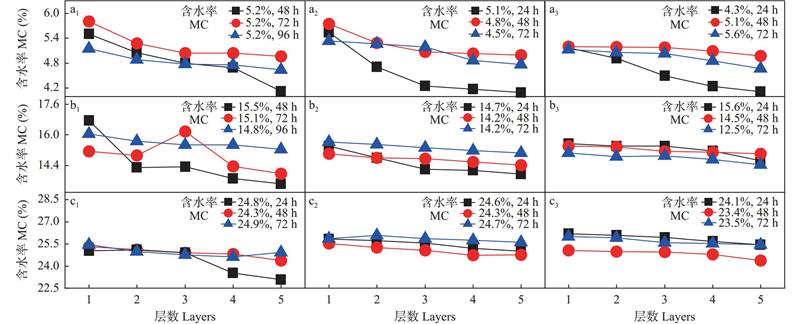
Fig.3
MC gradients of poplar samples under the target MC of 5%, 15% and 25%"
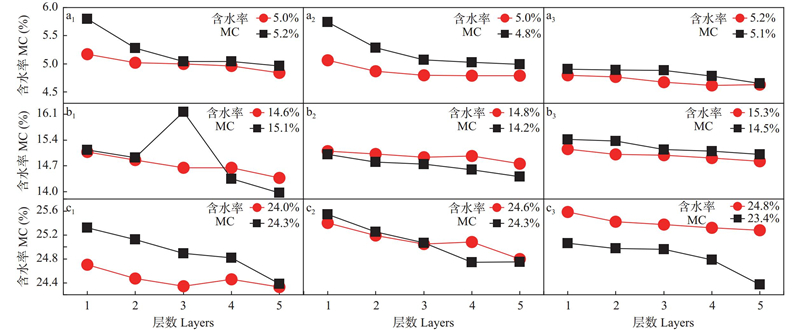
Fig.4
$ {T}_{2} $ profiles of empty samples represented by different colors under different NS values Different colors represent different patterns. a,16 scans; b, 32 scans; c, 64 scans; d, 128 scans."
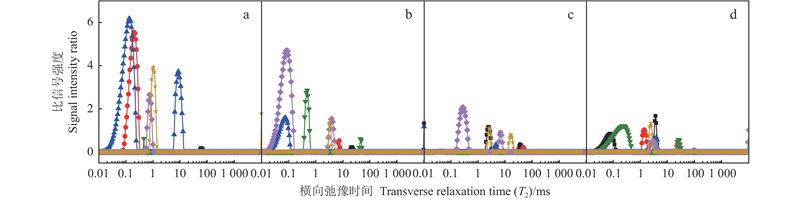
Fig.5
$ {T}_{2} $spectrum of poplar wood samples with the target MC of 5%"
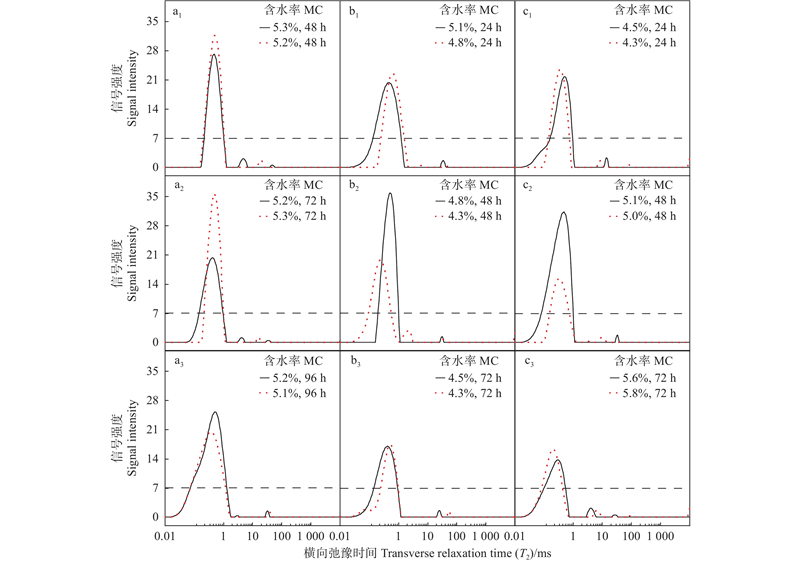
Fig.6
$ {T}_{2} $spectrum of poplar wood samples with the target MC of 15%"
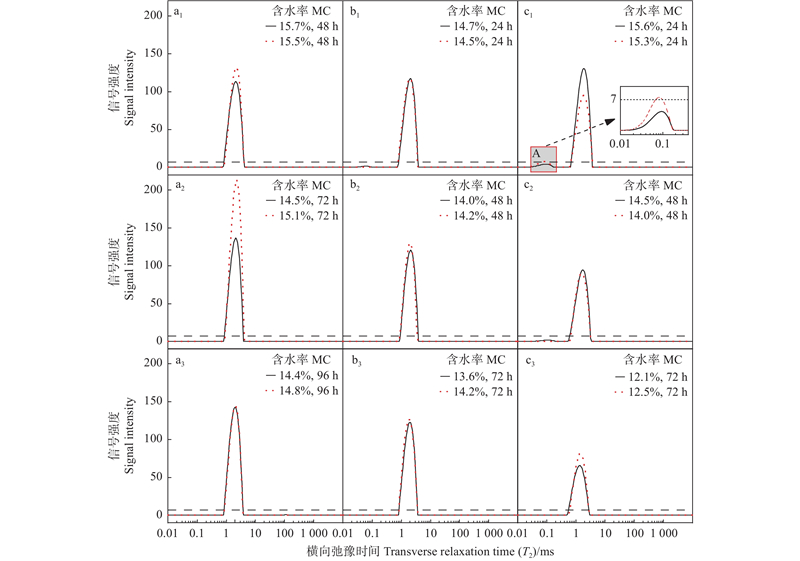
Fig.7
$ {T}_{2} $spectrum of poplar wood samples with the target MC of 25%"
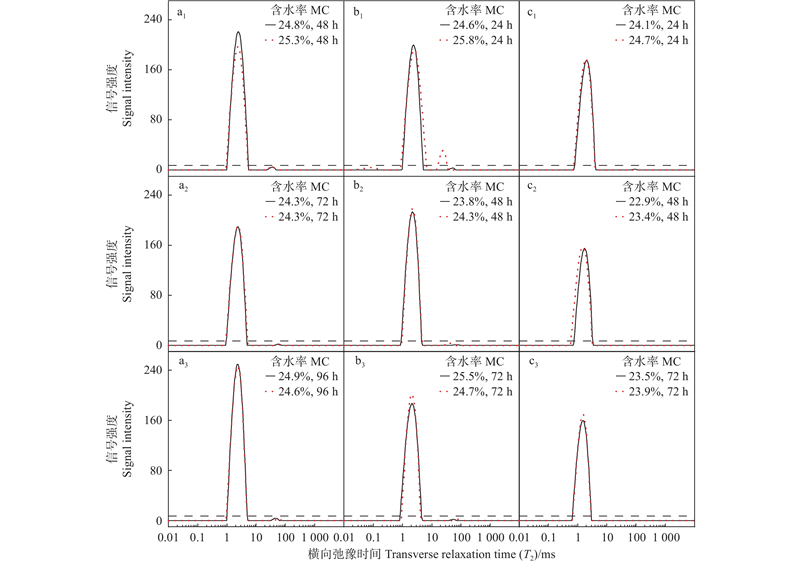
Table 5
$ {\mathit{T}}_{2} $ values of bound water in poplar samples at different equilibrium conditions and the corresponding F-test results"
| 目标含水率 Target moisture content (%) | 平衡温度 Equilibrium temperature (Te)/℃ | 平衡时间 Equilibrium time (τe)/h | 吸着水峰T2 T2 values of bound water/ms | 单个温度水平检验 Single temperature level test | 整体检验 The overall test | |||
| F | P | F | P | |||||
| 5 | 45 | 48 | 0.5±0.0 | 0.584 | 0.611 | 1.396 | 0.314 | |
| 72 | 0.46±0.04 | |||||||
| 96 | 0.43±0.08 | |||||||
| 60 | 24 | 0.55±0.08 | 0.779 | 0.534 | ||||
| 48 | 0.4±0.2 | |||||||
| 72 | 0.47±0.07 | |||||||
| 75 | 24 | 0.4±0.1 | 2.109 | 0.268 | ||||
| 48 | 0. 4±0.1 | |||||||
| 72 | 0.26±0.06 | |||||||
| 15 | 45 | 48 | 2.2±0.1 | 1.302 | 0.392 | 8.583 | 0.057 | |
| 72 | 2.2±0.1 | |||||||
| 96 | 2.0±0.1 | |||||||
| 60 | 24 | 2.0±0.1 | 1.302 | 0.392 | ||||
| 48 | 2.0±0.1 | |||||||
| 72 | 1.9±0.1 | |||||||
| 75a | 24 | 1.7±0.2 | 5.409 | 0.081 | ||||
| 48 | 1.65±0.08 | |||||||
| 72 | 1.4±0.1 | |||||||
| 25 | 45 | 48 | 2.4±0.0 | 4.510 | 0.065 | 0.088 | 0.918 | |
| 72 | 2.5±0.1 | |||||||
| 96 | 2.2±0.3 | |||||||
| 60a | 24 | 2.3±0.3 | 1.333 | 0.312 | ||||
| 48 | 2.25±0.00 | |||||||
| 72 | 2.17±0.09 | |||||||
| 75 | 24 | 2.03±0.08 | 0.337 | 0.799 | ||||
| 48 | 1.5±0.2 | |||||||
| 72 | 1.54±0.06 | |||||||
| 董海胜, 刘恒言, 徐 楠, 等. 基于低场核磁共振的预包装即食牛肉保质期预测模型研究. 食品工业科技, 2024, 45 (8): 301- 308. | |
| Dong H S, Liu H Y, Xu N, et al. Research on shelf life predicting model of prepackaged instant beef based on low-field nuclear magnetic resonance. Science and Technology of Food Industry, 2024, 45 (8): 301- 308. | |
| 高建民, 王喜明. 2018. 木材干燥学. 2版. 北京: 科学出版社. | |
| Gao J M, Wang X M. 2018. Wood drying. 2nd edition. Beijing: Science Press. [in Chinese] | |
|
高玉磊, 李新宇, 雷 鹏, 等. 利用TD-NMR技术研究杨木高温干燥过程水分分布. 波谱学杂志, 2016, 33 (3): 479- 490.
doi: 10.11938/cjmr20160313 |
|
|
Gao Y L, Li X Y, Lei P, et al. Water distribution in poplar during high-temperature drying process studied by time-domain nuclear magnetic resonance. Chinese Journal of Magnetic Resonance, 2016, 33 (3): 479- 490.
doi: 10.11938/cjmr20160313 |
|
| 高玉磊, 徐 康, 蒋佳荔, 等. 2018. 时域核磁共振技术在木材科学研究领域的应用. 世界林业研究, 31(5): 33−38. | |
| Gao Y L, Xu K, Jiang J L, et al. 2028. Application of time domain nuclear magnetic resonance technology to wood science research. World Forestry Research, 31(5): 33−38. [in Chinese] | |
| 李 婷. 2021. 基于PAMAM介导生物素化纳米探针的LF-NMR快速检测沙门氏菌. 南昌: 南昌大学. | |
| Li T. 2021. Rapid detection of Salmonella by LF-NMR based on PAMAM-mediated functionalized nanoparticle probe. Nanchang: Nanchang University. [in Chinese] | |
|
马大燕, 王喜明, 张明辉. 核磁共振研究木材吸着过程中水分吸附机理. 波谱学杂志, 2011, 28 (1): 135- 141.
doi: 10.3969/j.issn.1000-4556.2011.01.014 |
|
|
Ma D Y, Wang X M, Zhang M H. Mechanism of water sorption during adsorption process of wood studied by NMR. Chinese Journal of Magnetic Resonance, 2011, 28 (1): 135- 141.
doi: 10.3969/j.issn.1000-4556.2011.01.014 |
|
|
马尔妮, 王 望, 李 想, 等. 基于LFNMR的木材干燥过程中水分状态变化. 林业科学, 2017, 53 (6): 111- 117.
doi: 10.11707/j.1001-7488.20170613 |
|
|
Ma E N, Wang W, Li X, et al. The states of water in wood during drying process studied by low-field nuclear magnetic resonance (LFNMR). Scientia Silvae Sinicae, 2017, 53 (6): 111- 117.
doi: 10.11707/j.1001-7488.20170613 |
|
| 屈兰兰, 吴 月, 何 珊. 低场核磁共振技术在肉制品加工工艺中的应用. 农产品加工, 2024, (7): 88- 91. | |
| Qu L L, Wu Y, He S. Application of low field nuclear magnetic resonance technology in meat processing. Farm Products Processing, 2024, (7): 88- 91. | |
| 田虎楠. 2022. 煤系页岩瓦斯吸附-解吸特性核磁共振谱定量表征. 阜新: 辽宁工程技术大学. | |
| Tian H N. 2022. Quantitative characterization of gas adsorption and desorption characteristics of coal shale by nuclear magnetic resonance spectroscopy. Fuxin: Liaoning Technical University. [in Chinese] | |
| 王喜明. 2007. 木材干燥学. 3版. 北京: 中国林业出版社. | |
| Wang X M. 2007. Wood drying. 3rd edition. Beijing: China Forestry Publishing House. [in Chinese] | |
| 王立双. 2018. 基于近红外光谱的木材干缩湿胀研究. 北京: 北京林业大学. | |
| Wang S L. 2018. Study on hygroexpansion of wood based on near-infrared spectroscopy. Beijing: Beijing Forestry University. [in Chinese] | |
|
肖乾隆, 李 锦, 李 伍. 姚桥矿7号煤层垂向孔隙结构及分形特征研究. 中国煤炭地质, 2023, 35 (9): 1- 13, 26.
doi: 10.3969/j.issn.1674-1803.2023.09.01 |
|
|
Xiao Q L, Li J, Li W. Study on vertical pore structure and fractal characteristics of No. 7 coal seam in Yaoqiao coal mine. Coal Geology of China, 2023, 35 (9): 1- 13, 26.
doi: 10.3969/j.issn.1674-1803.2023.09.01 |
|
| 闫 越. 2015. 利用单边核磁共振研究木材的分层吸湿性. 呼和浩特: 内蒙古农业大学. | |
| Yan Y. 2015. The performance of moisture adsorption profiles in wood evaluated by NMR-MOUSE. Hohhot: Inner Mongolia Agricultural University. [in Chinese] | |
| 臧春龙, 王 坤, 付建新. 低场核磁共振技术在充填体材料的应用优势. 当代化工研究, 2024, (2): 73- 75. | |
| Zang C L, Wang K, Fu J X. Application status of low-field NMR in cementitious and mine filling materials. Modern Chemical Research, 2024, (2): 73- 75. | |
| 张 宇, 赵亚楠, 赵健翔, 等. 基于不同维度低场核磁共振技术的大豆含油率检测与判别. 农业工程学报, 2024, 40 (4): 337- 344. | |
| Zhang Y, Zhao Y N, Zhao J X, et al. Soybean oil content detection and discrimination based on different dimensional low-field nuclear magnetic resonance techniques. Transactions of the Chinese Society of Agricultural Engineering, 2024, 40 (4): 337- 344. | |
| 张黎阳. 2020. 餐厨垃圾厌氧消化后沼渣的好氧堆肥优化研究. 杭州: 浙江大学. | |
| Zhang L Y. 2020. Study on optimization of compost of food waste anaerobic digestion residue. Hangzhou: Zhejiang University. [in Chinese] | |
| 张明辉, 李新宇, 周云洁, 等. 利用时域核磁共振研究木材干燥过程水分状态变化. 林业科学, 2014, 50 (12): 109- 113. | |
| Zhang M H, Li X Y, Zhou Y J, et al. Water status change in wood drying studied by time-domain NMR. Scientia Silvae Sinicae, 2014, 50 (12): 109- 113. | |
| 张亚军. 2023. 基于低场核磁共振技术的生物膜污染形成与演化研究. 长春: 吉林大学. | |
| Zhang Y J. 2023. Research on the formation and evolution of biofilm contamination based on low-field magnetic resonance technology (LF-NMR). Changchun: Jilin University. [in Chinese] | |
| 赵芝弘. 2022. 基于质子探针的木材水分和孔隙的关系研究. 呼和浩特: 内蒙古农业大学. | |
| Zhao Z H. 2022. Study on the relationship between moisture and pore size in wood with proton probe. Hohhot: Inner Mongolia Agricultural University. [in Chinese] | |
|
朱晓风, 赵芝弘, 谭 蕊, 等. 利用单边核磁共振研究樟子松木材干燥水分迁移规律. 波谱学杂志, 2024, 41 (2): 173- 183.
doi: 10.11938/cjmr20233083 |
|
|
Zhu X F, Zhao Z H, Tan R, et al. Water migration characteristics of Pinus sylvestris during the drying process studied by single-sided nuclear magnetic resonance. Chinese Journal of Magnetic Resonance, 2024, 41 (2): 173- 183.
doi: 10.11938/cjmr20233083 |
|
|
Almeida G, Gagné S, Hernández R E. A NMR study of water distribution in hardwoods at several equilibrium moisture contents. Wood Science and Technology, 2007, 41 (4): 293- 307.
doi: 10.1007/s00226-006-0116-3 |
|
|
Arai C, Hosaka S, Murase K, et al. Measurements of the relative humidity of saturated aqueous salt solutions. Journal of Chemical Engineering of Japan, 1976, 9 (4): 328- 330.
doi: 10.1252/jcej.9.328 |
|
|
Araujo C D, Avramidis S, MacKay A L. Behaviour of solid wood and bound water as a function of moisture content. A proton magnetic resonance study. Holzforschung, 1994, 48 (1): 69- 74.
doi: 10.1515/hfsg.1994.48.1.69 |
|
| Araujo C D, MacKay A L, Hailey J R T, et al. Proton magnetic resonance techniques for characterization of water in wood: application to white spruce. Wood Science and Technology, 1992, 26 (2): 101- 113. | |
|
Beck G, Thybring E E, Thygesen L G, et al. Characterization of moisture in acetylated and propionylated radiata pine using low-field nuclear magnetic resonance (LFNMR) relaxometry. Holzforschung, 2018, 72 (3): 225- 233.
doi: 10.1515/hf-2017-0072 |
|
| Bovey F A, Mirau P A, Gutowsky H S. 1988. Nuclear magnetic resonance spectroscopy. Elsevier. | |
|
Cao S Y, Shi J B, Dong Y M, et al. Phase transition behavior of water in original, heat-treated and acetylated poplar woods. Industrial Crops and Products, 2024, 208, 117899.
doi: 10.1016/j.indcrop.2023.117899 |
|
|
Carr H Y, Purcell E M. Effects of diffusion on free precession in nuclear magnetic resonance experiments. Physical Review, 1954, 94 (3): 630- 638.
doi: 10.1103/PhysRev.94.630 |
|
| Cox J, McDonald P J, Gardiner B A. A study of water exchange in wood by means of 2D NMR relaxation correlation and exchange. Holzforschung, 2010, 64 (2): 259- 266. | |
| Flibotte S, Menon R S, MacKay A L, et al. Proton magnetic resonance of western red cedar. Wood and Fiber Science, 1990, 22, 362- 376. | |
| Gao X, Zhuang S Z, Jin J W, et al. Bound water content and pore size distribution in swollen cell walls determined by NMR technology. BioResources, 2015, 10 (4): 8208- 8224. | |
| Ge X, Zhao J, Zhang F, et al. 2019 A practical method to compensate for the effect of echo spacing on the shale NMR T2 spectrum. Earth and Space Science, 6(8): 1489−1497. | |
|
Hartley I D, Kamke F A, Peemoeller H. Absolute moisture content determination of aspen wood below the fiber saturation point using pulsed NMR. Holzforschung, 1994, 48 (6): 474- 479.
doi: 10.1515/hfsg.1994.48.6.474 |
|
|
Labbé N, De Jéso B, Lartigue J C, et al. Moisture content and extractive materials in maritime pine wood by low field 1H NMR. Holzforschung, 2002, 56 (1): 25- 31.
doi: 10.1515/HF.2002.005 |
|
| Lamason C, MacMillan B, Balcom B, et al. Water content measurement in black spruce and aspen sapwood with benchtop and portable magnetic resonance devices. Wood Material Science & Engineering, 2015, 10 (1): 86- 93. | |
|
Li J Y, Ma E N. 2D time-domain nuclear magnetic resonance (2D TD-NMR) characterization of cell wall water of Fagus sylvatica and Pinus taeda L. Cellulose, 2022, 29 (16): 8491- 8508.
doi: 10.1007/s10570-022-04789-y |
|
| MacMillan M B, Schneider M H, Sharp A R, et al. Magnetic resonance imaging of water concentration in low moisture content wood. Wood and Fiber Science, 2002, 34 (2): 276- 286. | |
| Mao Z P, Yu H, Wang Y F, et al. States of water and pore size distribution of cotton fibers with different moisture ratios. Industrial & Engineering Chemistry Research, 2014, 53 (21): 8927- 8934. | |
|
Meiboom S, Gill D. Modified spin-echo method for measuring nuclear relaxation times. Review of Scientific Instruments, 1958, 29 (8): 688- 691.
doi: 10.1063/1.1716296 |
|
|
Menon R S, MacKay A L, Hailey J R T, et al. An NMR determination of the physiological water distribution in wood during drying. Journal of Applied Polymer Science, 1987, 33 (4): 1141- 1155.
doi: 10.1002/app.1987.070330408 |
|
|
Nakamura K, Hatakeyama T, Hatakeyama H. Studies on bound water of cellulose by differential scanning calorimetry. Textile Research Journal, 1981, 51 (9): 607- 613.
doi: 10.1177/004051758105100909 |
|
|
Shi J B, Qian L X, Wang Z S, et al. An alternative approach for conditioning wood samples in nuclear magnetic resonance studies. Wood Science and Technology, 2024, 58 (4): 1409- 1425.
doi: 10.1007/s00226-024-01576-9 |
|
|
Wexler A, Hasegawa S. Relative humidity-temperature relationships of some saturated salt solutions in the temperature range 0 to 50 ℃. Journal of Research of the National Bureau of Standards, 1954, 53 (1): 19- 26.
doi: 10.6028/jres.053.003 |
|
|
Xu K, Lu J X, Gao Y L, et al. Determination of moisture content and moisture content profiles in wood during drying by low-field nuclear magnetic resonance. Drying Technology, 2017, 35 (15): 1909- 1918.
doi: 10.1080/07373937.2017.1291519 |
|
|
Xu K, Yuan S F, Gao Y L, et al. Characterization of moisture states and transport in MUF resin-impregnated poplar wood using low field nuclear magnetic resonance. Drying Technology, 2021, 39 (6): 791- 802.
doi: 10.1080/07373937.2020.1719503 |
| [1] | Wenjun Guo,Xinhao Li,Yun Tian,Yanli Sun,Xinmin Fang,Yuanmeng Dai,Wenjing Chen,Tingshan Li,Peng Liu,Xin Jia,Tianshan Zha. Characteristics and Trade-Offs of Leaf Functional Traits of Woody Plants with Different Life Forms in Mountainous Areas of Northeastern Beijing [J]. Scientia Silvae Sinicae, 2025, 61(9): 70-80. |
| [2] | Zhenghuang Shi,fangmiao Hou,Haokun Zhang,Guoxing Huang. Analysis of the Impact of the New Round of Collective Forest Tenure Reform on the Growth of Export Margins of China’s Wood-Based Forest Product [J]. Scientia Silvae Sinicae, 2025, 61(9): 211-222. |
| [3] | Jiaxing Chen,Zongying Fu,Yongyue Zhang,Ximing Wang,Yun Lu. Progress in the Research of Wood-Based Hydrogels Based on the Interaction between Wood and Water [J]. Scientia Silvae Sinicae, 2025, 61(5): 1-11. |
| [4] | Jiajia Zhang,Gaigai Du,Li Li,Songfeng Diao. Physiological Changes during the Rooting Process of Softwood Cuttings of Diospyros kaki [J]. Scientia Silvae Sinicae, 2025, 61(5): 98-107. |
| [5] | Ya Zhu,Xizhi Wu,Yuanshuo Huang. Visual Detection Method of Wood Sanding Surface Roughness Based on Local Autocorrelation Function Entropy [J]. Scientia Silvae Sinicae, 2025, 61(5): 199-206. |
| [6] | Quansheng Men,Dalie Liu. Research and Implementation of Shaping Methods of Wood Rod Lumber Units [J]. Scientia Silvae Sinicae, 2025, 61(3): 182-188. |
| [7] | Juan Guo,Lichao Jiao,Tuo He,Lingyu Ma,Xiaomei Jiang,Yafang Yin. New Research Progress on Quantitative Wood Anatomy [J]. Scientia Silvae Sinicae, 2025, 61(2): 204-218. |
| [8] | Zhihong Li,Wei Zhang,Xinkang Zhao,Jinping Shu,Haojie Wang. Phenotypic Variation of Bursaphelenchus xylophilus in Different Occurrence Areas of Zhejiang Province [J]. Scientia Silvae Sinicae, 2025, 61(1): 137-149. |
| [9] | Yan Chen,Surong Meng,Anmin Huang,Yingying Su,Bailing Sun. The Influence of Melamine-Urea-Glyoxal (MUG) Resin Impregnation Modification on the Physical and Mechanical Properties of Castanopsis hystrix Wood [J]. Scientia Silvae Sinicae, 2025, 61(1): 166-175. |
| [10] | Yingqi He,Lufei Wang,Yamei Zhang,Yanglun Yu,Wenji Yu. Effect of Compression Ratios on the Surface Hardness of Poplar Wood Scrimber [J]. Scientia Silvae Sinicae, 2024, 60(9): 141-149. |
| [11] | Liuyang Han,Juan Guo,Xiangna Han,Guanglan Xi,Xingling Tian,Ren Li,Jiabao Chen,Yafang Yin. Research Progress and Perspective of the Preservation State of Waterlogged Archaeological Wood [J]. Scientia Silvae Sinicae, 2024, 60(9): 183-198. |
| [12] | Yiyuan Zhang,Yuan Chen,Gaiyun Li,Yiqiang Wu. Modification of Wood Fiber Surface by Aldehyde Groups and Property Evaluation of Self-Bonding Fiberboards [J]. Scientia Silvae Sinicae, 2024, 60(8): 174-183. |
| [13] | Yuan Li,Zhu Li,Yamin Du,Jiali Jiang. Longitudinal Tensile Mechanical Behavior of Earlywood and Latewood of Pinus massoniana in the Hydrothermal Environment [J]. Scientia Silvae Sinicae, 2024, 60(8): 184-192. |
| [14] | Fangyu Yin,Yamin Du,Zhu Li,Jiali Jiang. Shrinkage and Swelling Behavior of Different Types of Tissues in Catalpa bungei Wood [J]. Scientia Silvae Sinicae, 2024, 60(7): 105-116. |
| [15] | Kong Yue,Xiang Li,Xinlei Shi,Xuekai Jiao,Peng Wu,Zhongfeng Zhang,Guoliang Dong,Yuanjin Fang. Effects of Thermal Pretreatment on Lateral Performance of Poplar Cross-Laminated Timber Shear Walls [J]. Scientia Silvae Sinicae, 2024, 60(7): 117-128. |
| Viewed | ||||||
|
Full text |
|
|||||
|
Abstract |
|
|||||
