
Scientia Silvae Sinicae ›› 2026, Vol. 62 ›› Issue (1): 144-155.doi: 10.11707/j.1001-7488.LYKX20240822
• Research papers • Previous Articles Next Articles
Haibin Wang1,Qinxing Shen1,Pengwei Ma2,Jiayin Song1,*( )
)
Received:2024-12-31
Revised:2025-08-20
Online:2026-01-25
Published:2026-01-14
Contact:
Jiayin Song
E-mail:jiayin1980@126.com
CLC Number:
Haibin Wang,Qinxing Shen,Pengwei Ma,Jiayin Song. Fruit Ripeness Detection Method of Blueberry Based on Improved YOLOv9[J]. Scientia Silvae Sinicae, 2026, 62(1): 144-155.
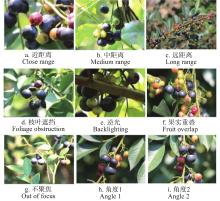
Fig.1
Photos of blueberries collected under natural conditions"
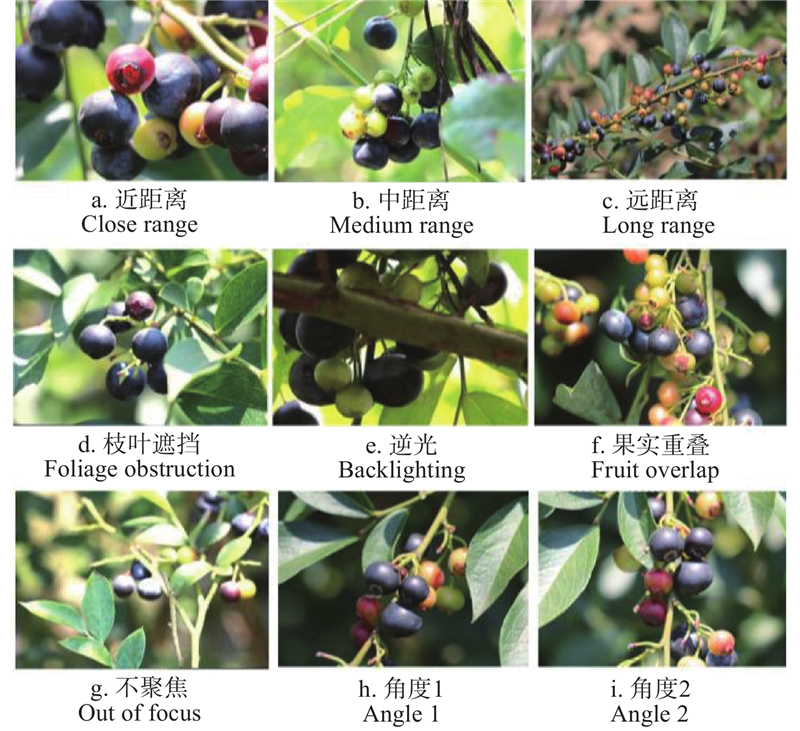
Table 1
Distribution of blueberry samples in different scenarios"
| 场景 Scenarios | 样本数量 Number of samples | 果实数量 Number of fruits |
| 不同距离 Different rangs | 125 | 3 542 |
| 枝叶遮挡 Foliage obstruction | 210 | 2 684 |
| 逆光 Backlighting | 145 | 2 030 |
| 果实重叠 Fruit overlap | 232 | 6 496 |
| 不聚焦 Out of focus | 168 | 1 512 |
| 不同角度 Different Angles | 120 | 1 683 |

Fig.2
Examples of partial data augmentation"
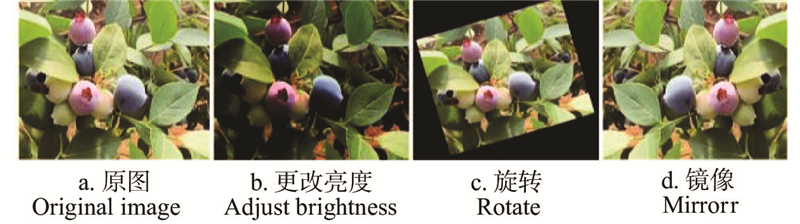
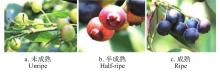
Fig.3
Classification of blueberry fruit ripeness"
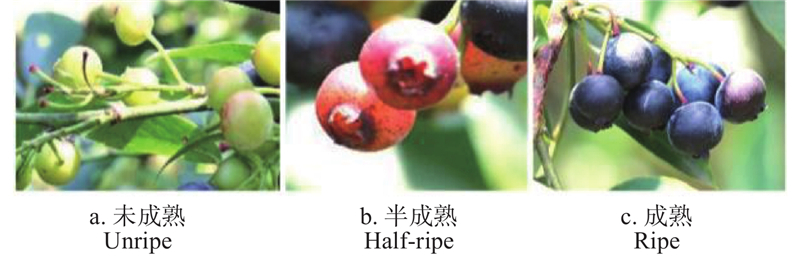
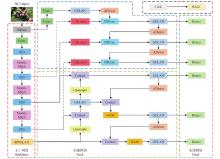
Fig.4
The improved YOLOv9 model structure"
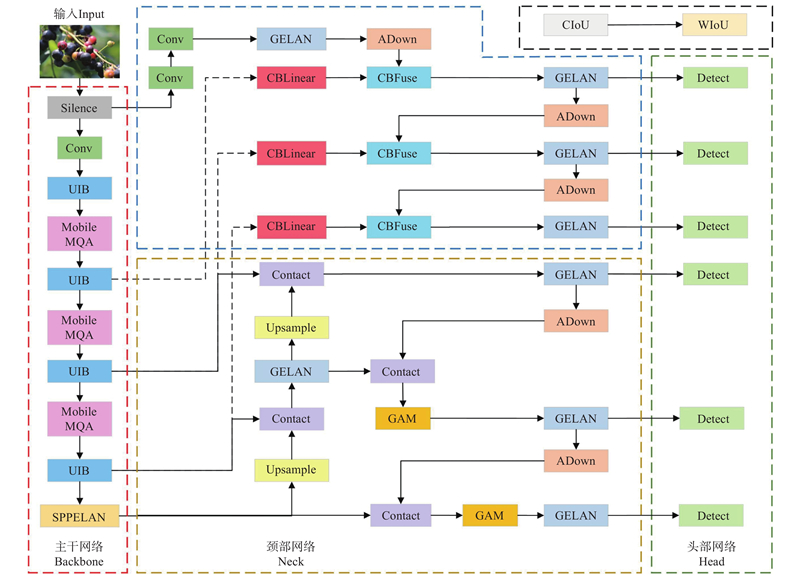
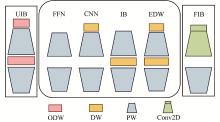
Fig.5
Universal inverted bottleneck(UIB) blocks"
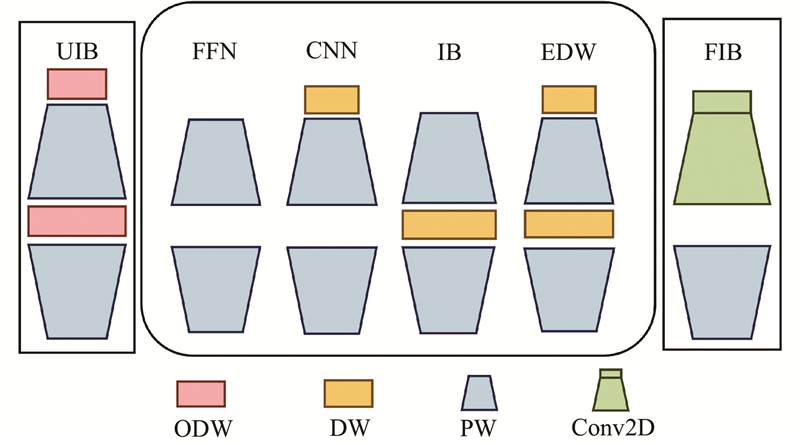
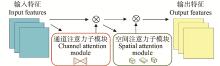
Fig.6
Globalattention mechanism structure"
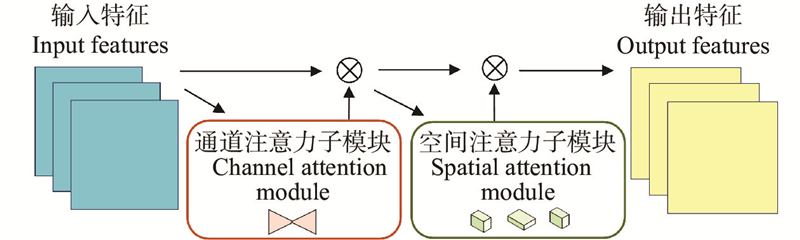
Fig.7
Channel attention submodule"
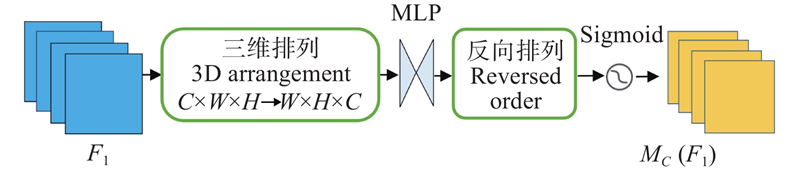
Fig.8
Spatial attention submodule"
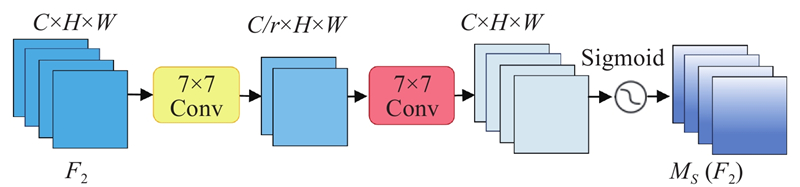
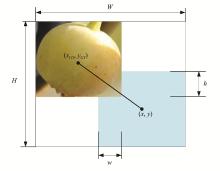
Fig.9
WIoU parameter diagram"
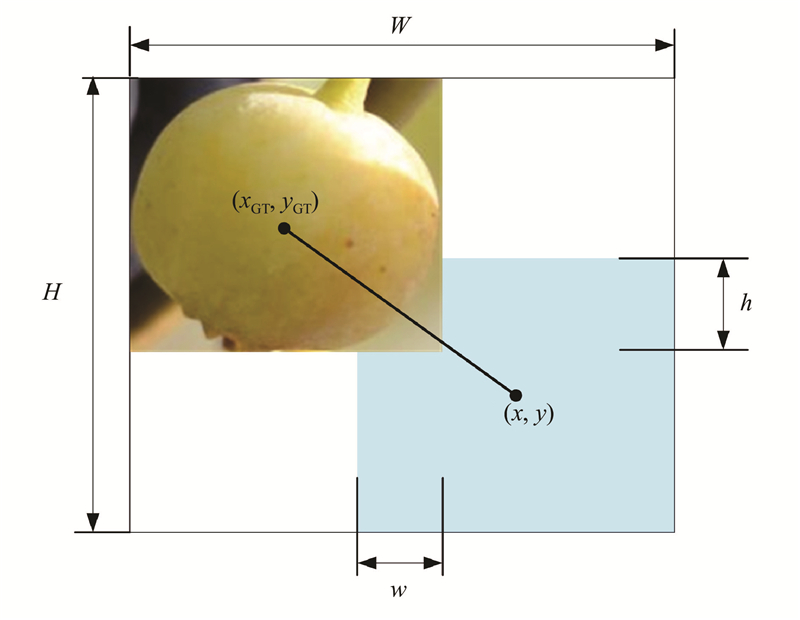
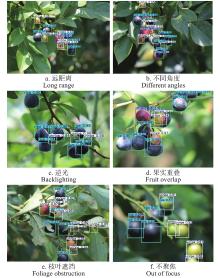
Fig.10
Detection example diagram"
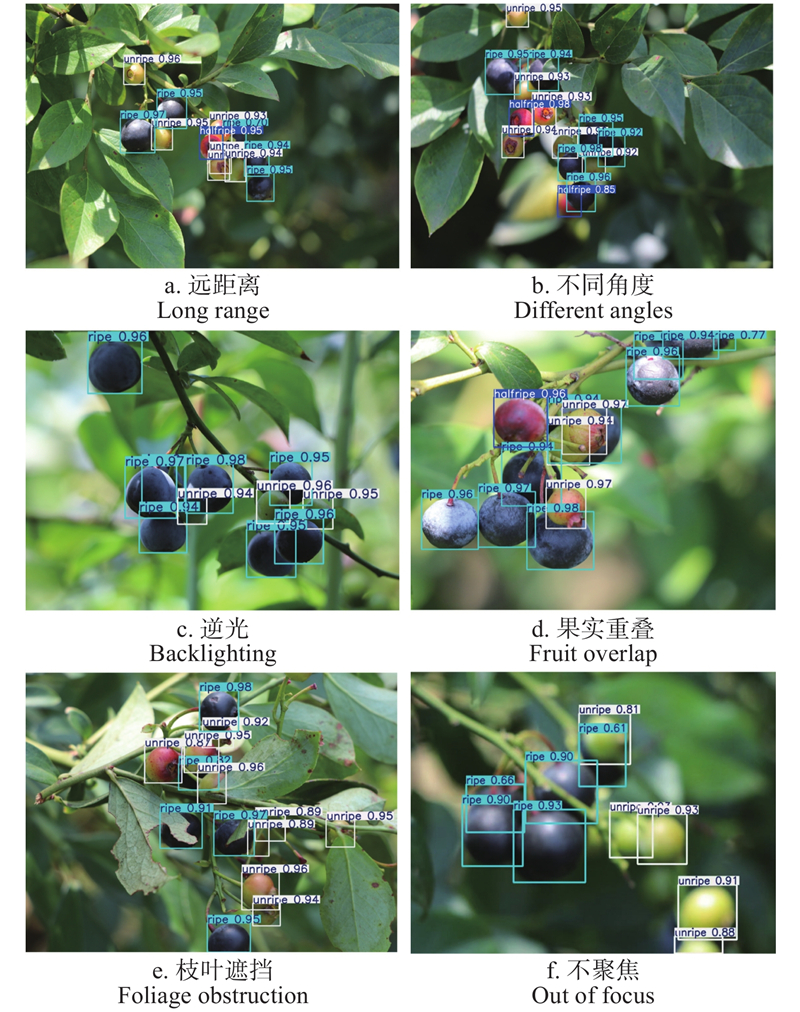
Table 2
Test results of different maturity levels (%)"
| 成熟度 Maturity | 精确率 Precision | 召回率 Recall | 平均精度均值 Average precision mean |
| 成熟 Ripe | 98.1 | 97.6 | 98.6 |
| 半成熟 Half-ripe | 98.3 | 96.7 | 97.9 |
| 未成熟 Unripe | 97.6 | 97.3 | 98.1 |
| 平均值 Average | 98.0 | 97.2 | 98.2 |
Table 3
Results of ablation experiments"
| 模型 model | 精确率 Precision (%) | 召回率 Recall (%) | 平均精 度均值 Average precision mean (%) | 内存占用量 Memory usage/MB | 帧率Frame rate/ (fps·s–1) |
| YOLOv9 | 95.9 | 94.8 | 96.7 | 58.7 | 75.3 |
| YOLOv9M | 96.4 | 94.1 | 96.3 | 42.3 | 96.2 |
| YOLOv9G | 97.1 | 96.3 | 97.4 | 62.4 | 70.6 |
| YOLOv9W | 96.2 | 94.9 | 96.9 | 58.8 | 78.3 |
| YOLOv9MG | 97.3 | 95.8 | 97.6 | 46.6 | 84.4 |
| YOLOv9MW | 96.5 | 94.6 | 96.8 | 42.4 | 97.6 |
| YOLOv9GW | 96.9 | 96.0 | 97.2 | 62.6 | 72.5 |
| YOLOv9MGW | 98.0 | 97.2 | 98.2 | 46.8 | 86.5 |
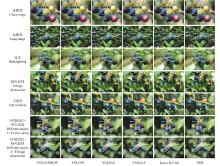
Fig.11
Comparison of different model detection"
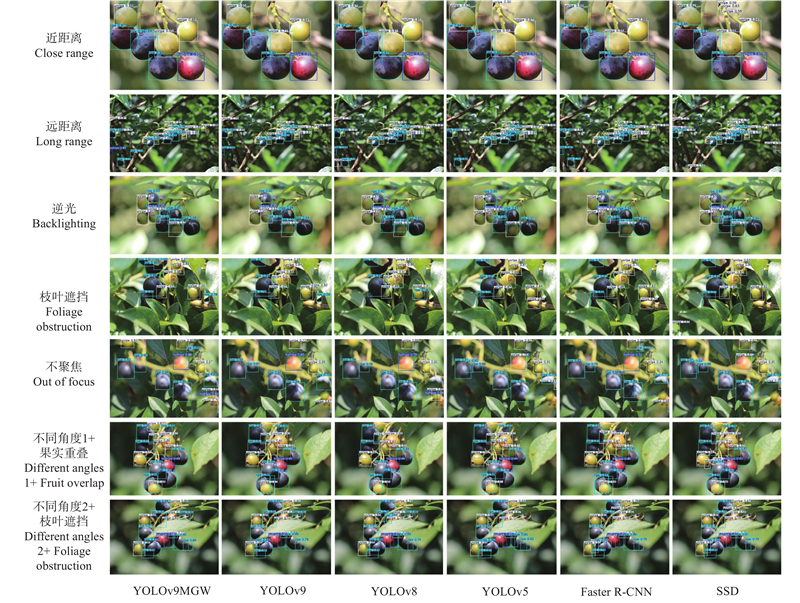
Table 4
Comparison of the performance of different object detection models in the test set"
| 模型 model | 精确率 Precision (%) | 召回率 Recall (%) | 平均精度 均值 Mean average precision(%) | 内存占 用量 Memory usage/MB | 帧率 Frame rate/ (fps·s–1) |
| Faster R-CNN | 90.2 | 88.2 | 92.6 | 149.5 | 14.1 |
| SSD | 89.3 | 87.5 | 91.4 | 87.3 | 54.6 |
| YOLOv5 | 92.5 | 91.6 | 94.2 | 56.2 | 76.2 |
| YOLOv8 | 94.7 | 93.4 | 95.5 | 40.5 | 95.6 |
| YOLOv9 | 95.9 | 94.8 | 96.7 | 58.7 | 75.3 |
| YOLOv9MGW | 98.0 | 97.2 | 98.2 | 46.8 | 86.5 |
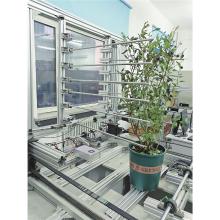
Fig.12
Blueberry harvesting experiment"
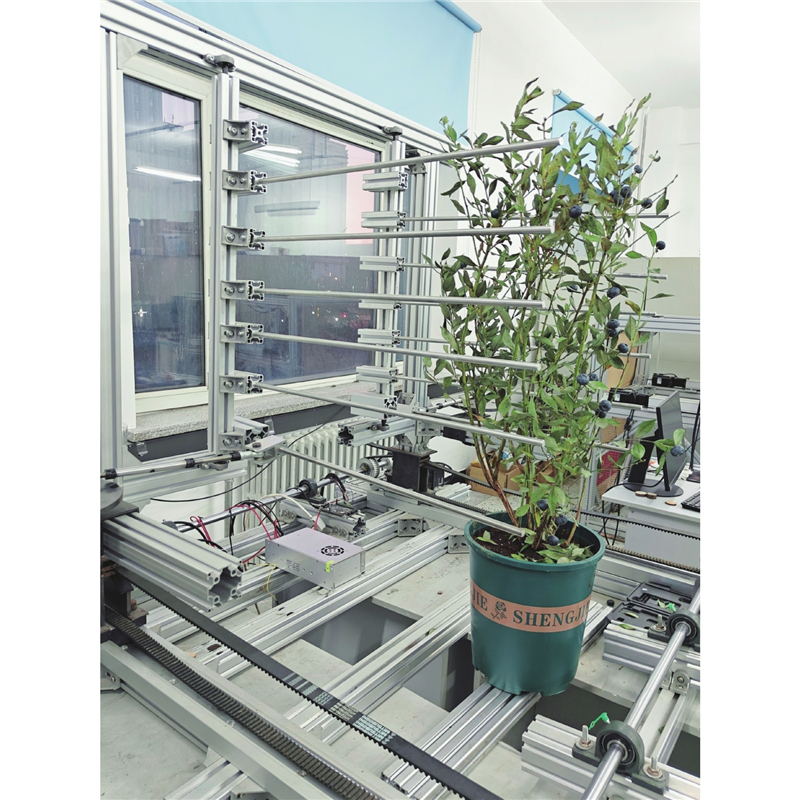
Table 5
Results of the blueberry harvesting experiment"
| 成熟果实比例 Mature fruit proportion(%) | 采摘装置转速 Harvesting device rotation speed/(r·min?1) | 采净率 Harvest efficiency(%) | 未成熟果实脱落率 Immature fruit drop rate(%) | 果实损伤率 Fruit damage rate(%) | 最佳转速 Optimal rotation speed/(r·min?1) |
| ≥90 | 120 | 97.2 | 1.94 | 1.36 | 125 |
| 125 | 98.4 | 2.15 | 1.48 | ||
| 130 | 98.7 | 2.40 | 1.62 | ||
| 85~90 | 125 | 97.5 | 2.20 | 1.60 | 130 |
| 130 | 98.3 | 2.32 | 1.72 | ||
| 135 | 98.6 | 2.56 | 1.85 | ||
| 80~85 | 135 | 98.0 | 2.40 | 1.86 | 140 |
| 140 | 98.3 | 2.60 | 2.02 | ||
| 145 | 98.5 | 2.78 | 2.24 |
| 鲍玉冬, 李志鹏, 郭艳玲, 等. 振动式蓝莓采摘机对果实收获的影响试验. 湖南农业大学学报(自然科学版), 2014, 40 (1): 96- 100. | |
| Bao Y D, Li Z P, Guo Y L, et al. Effects of vibrating based picking machine on blueberry fruit harvest. Journal of Hunan Agricultural University(Natural Sciences), 2014, 40 (1): 96- 100. | |
| 陈嘉瑶, 王 英, 梁冬泰, 等. 小型化轴向振动式蓝莓采摘机设计与试验. 机械设计, 2021, 38 (4): 37- 43. | |
| Chen J Y, Wang Y, Liang D T, et al. Design and experiment of the miniaturized axial-vibrating blueberry picker. Journal of Machine Design, 2021, 38 (4): 37- 43. | |
| 高友文, 周本君, 胡晓飞. 基于数据增强的卷积神经网络图像识别研究. 计算机技术与发展, 2018, 28 (8): 62- 65. | |
| Gao Y W, Zhou B J, Hu X F. Research on image recognition of convolution neural network based on data enhancement. Computer Technology and Development, 2018, 28 (8): 62- 65. | |
| 耿 雷, 郭艳玲, 王海滨. 高丛蓝莓采摘机采摘系统设计与试验. 农业机械学报, 2016, 47 (3): 67- 74. | |
| Geng L, Guo Y L, Wang H B. Picking system design and experiment for highbush blueberry picking machine. Transactions of the Chinese Society for Agricultural Machinery, 2016, 47 (3): 67- 74. | |
| 郭艳玲, 聂宏宇, 李志鹏, 等. 蓝莓采摘实验台的设计与试验研究. 农机化研究, 2020, 42 (6): 130- 135,141. | |
| Guo Y L, Nie H Y, Li Z P, et al. Design and experimental study of blueberry picking experiment platform. Journal of Agricultural Mechanization Research, 2020, 42 (6): 130- 135,141. | |
| 李 茂, 肖洋轶, 宗望远, 等. 基于改进YOLOv8模型的轻量化板栗果实识别方法. 农业工程学报, 2024, 40 (1): 201- 209. | |
| Li M, Xiao Y Y, Zong W Y, et al. Detecting chestnuts using improved lightweight YOLOv8. Transactions of the Chinese Society of Agricultural Engineering, 2024, 40 (1): 201- 209. | |
| 黎 鹏. 农业机械新技术的发展与应用研究. 南方农机, 2021, 52 (1): 66- 67. | |
| Li P. Research on the development and application of new technologies in agricultural machinery. China Southern Agricultural Machinery, 2021, 52 (1): 66- 67. | |
| 刘庆忠, 崔冬冬, 朱东姿. 世界及中国蓝莓产业现状. 落叶果树, 2024, 56 (4): 1- 7. | |
| Liu Q Z, Cui D D, Zhu D Z. Current situation of blueberry industry in the world and China. Deciduous Fruits, 2024, 56 (4): 1- 7. | |
| 刘拥民, 张 炜, 麻海志, 等. 基于注意力机制的轻量化YOLO v5s蓝莓检测算法. 河南农业科学, 2024, 53 (3): 151- 157. | |
| Liu Y M, Zhang W, Ma H Z, et al. Lightweight YOLO v5s blueberry detection algorithm based on attention mechanism. Journal of Henan Agricultural Sciences, 2024, 53 (3): 151- 157. | |
| 苗荣慧, 李港澳, 黄宗宝, 等. 基于YOLO v7-ST-ASFF的复杂果园环境下苹果成熟度检测方法. 农业机械学报, 2024, 55 (6): 219- 228. | |
| Miao R H, Li G, Huang Z B, et al. Maturity detection of apple in complex orchard environment based on YOLO v7-ST-ASFF. Transactions of the Chinese Society for Agricultural Machinery, 2024, 55 (6): 219- 228. | |
| 徐 潺, 范 艳, 张成玉, 等. 适用于山地手持式电动蓝莓采摘机的研制. 农机化研究, 2021, 43 (12): 133- 137. | |
| Xu C, Fan Y, Zhang C Y, et al. Research and development of hand-held pure electric blueberry picker suitable for mountainous regions. Journal of Agricultural Mechanization Research, 2021, 43 (12): 133- 137. | |
| 詹国祥, 周立昶, 常国政, 等. 关于推进蓝莓收获机械化的思考. 江苏农机化, 2023, 5, 28- 29. | |
| Zhan G X, Zhou L C, Chang G Z, et al. Thoughts on promoting the mechanization of blueberry harvesting. Jiangsu Agricultural Mechanization, 2023, 5, 28- 29. | |
| 张惠莉, 代晨龙, 任景龙, 等. 2024. 基于GhostNetV2改进YOLO v8模型的葡萄病害识别方法研究. 农业机械学报, https://link.cnki.net/urlid/11.1964.S.20240827.0948.004. | |
| Zhang H L, Dai C L, Ren J L, et al. 2024. Research on grape disease identification method based on GhostNetV2 improved YOLO v8 model. Transactions of the Chinese Society for Agricultural Machinery, https://link.cnki.net/urlid/11.1964.S.20240827.0948.004. [in Chinese] | |
| 张文静, 赵性祥, 丁睿柔, 等. 基于Faster R-CNN算法的番茄识别检测方法. 山东农业大学学报(自然科学版), 2021, 52 (4): 624- 630. | |
| Zhang W J, Zhao X X, Ding R R, et al. Detection and recognition method for tomato on FasterR-CNN algorit. Journal of Shandong Agricultural University(Natural Science Edition), 2021, 52 (4): 624- 630. | |
| Du S, Zhang B, Zhang P, et al. An improved bounding box regression loss function based on CIOU Loss for Multi-scale object detection. IEEE 2nd International Conference on Pattern Recognition and Machine Learning (PRML), 2021, 2021, 92- 98. | |
|
Gai R L, Chen N, Yuan H. A detection algorithm for cherry fruits based on the improved YOLO-v4 model. Neural Computing and Applications, 2023, 35 (19): 13895- 13906.
doi: 10.1007/s00521-021-06029-z |
|
|
Kalt W, Cassidy A, Howard L R, et al. Recent research on the health benefits of blueberries and their anthocyanins. Advances in Nutrition, 2020, 11 (2): 224- 236.
doi: 10.1093/advances/nmz065 |
|
|
Li S, Tao T, Zhang Y, et al. YOLO v7-CS: a YOLO v7-based model for lightweight bayberry target detection count. Agronomy, 2023b, 13 (12): 2952.
doi: 10.3390/agronomy13122952 |
|
|
Li Y D, Xue J X, Zhang M Y, et al. YOLOv5-ASFF: a multistage strawberry detection algorithm based on improved YOLOv5. Agronomy, 2023a, 13 (7): 1901.
doi: 10.3390/agronomy13071901 |
|
|
Lü X M, Wang H B, Xu G F, et al. Research on fruit picking test of blueberry harvesting machinery under transmission clearance. Heliyon, 2024, 10 (15): e34740.
doi: 10.1016/j.heliyon.2024.e34740 |
|
|
Qi E H. Enhanced classification of meat freshness using lightweight neural networks. BIO Web of Conferences, 2024, 124, 01019.
doi: 10.1051/bioconf/202412401019 |
|
| Qin D, Leichner C, Delakis M, et al. 2024. MobileNetV4: universal models for the mobile ecosystem. arXiv. https://arxiv.org/abs/2404.10518. | |
| Tan H C, Liu X P, Yin B C, et al. MHSA-Net: Multihead self-attention network for occluded person re-identification. IEEE Transactions on Neural Networks and Learning Systems, 2022, 34 (11): 8210- 8224. | |
| Vo H T, Mui K C, Thien N N, et al. Automating tomato ripeness classification and counting with YOLOv9. International Journal of Advanced Computer Science and Applications, 2024, 15 (4): 1120- 1128. | |
|
Wang C Y, Wang C F, Wang L L, et al. A lightweight cherry tomato maturity real-time detection algorithm based on improved YOLOV5n. Agronomy, 2023, 13 (8): 2106.
doi: 10.3390/agronomy13082106 |
|
| Wang C Y, Yeh I H, Liao H Y M. 2024. YOLOv9: Learning what you want to learn using programmable gradient information. arXiv: 2402.13616. | |
|
Wu X, Liang J, Yang Y, et al. SAW-YOLO: a multi-scale YOLO for small target Citrus pests detection. Agronomy, 2024, 14 (7): 1571.
doi: 10.3390/agronomy14071571 |
|
| Xiao F, Wang H, Xu Y, et al. A lightweight detection method for blueberry fruit maturity based on an improved YOLOv5 algorithm. Agriculture, 2024, 14 (1): 36. | |
| Xu M L, Yoon S, Fuentes A, et al. Style-consistent image translation: a novel data augmentation paradigm to improve plant disease recognition. Pattern Recognition, 2023, 137, 3361. | |
|
Yang W, Ma X, Hu W, et al. Lightweight blueberry fruit recognition based on multi-scale and attention fusion NCBAM. Agronomy, 2022, 12 (10): 2354.
doi: 10.3390/agronomy12102354 |
|
|
Zhang H, Dong Z X, Li B, et al. Multi-scale MLP-mixer for image classification. Knowledge-Based Systems, 2022, 258, 109792.
doi: 10.1016/j.knosys.2022.109792 |
|
|
Zu L L, Zhao Y P, Liu J Q, et al. Detection and segmentation of mature green tomatoes based on mask R-CNN with automatic image acquisition approach. Sensors, 2021, 21 (23): 7842.
doi: 10.3390/s21237842 |
| [1] | Honghong Yu,Jiameng Yang. Forest Horizontal Ecological Compensation Strategy and Its Stability Based on Three-Party Evolutionary Game: a Case of Chongqing City [J]. Scientia Silvae Sinicae, 2025, 61(3): 214-232. |
| [2] | Hongge Zhu,Yuchen Tian,Wen Ying,Yutong Zhang. Evolutionary Game and Cooperation Mechanism of Forest Tourism Development in Key State-Owned Forest Areas [J]. Scientia Silvae Sinicae, 2025, 61(10): 221-235. |
| [3] | Yongli Zhu,Jie Zhang. Flowering and Pollination Biology of Cultivated Michelia chapensis in Shanghai [J]. Scientia Silvae Sinicae, 2024, 60(6): 86-93. |
| [4] | Ziyang Wang,Yuwu Xiong,Ying Yang,Yunlong Yin,Chaoguang Yu. Reproductive and Developmental Anatomical Characteristics during Cross Breeding between Taxodium mucronatum and Taxodium distichum [J]. Scientia Silvae Sinicae, 2023, 59(2): 96-106. |
| [5] | Dongbo Xie,Yakai Lei,Yuchao Zhang,Qingwang Liu,Liyong Fu,Qiao Chen. Estimation of Canopy Cover in the Core Area of Winter Olympic Games Based on Airborne LiDAR Data [J]. Scientia Silvae Sinicae, 2022, 58(10): 24-34. |
| [6] | Dongbo Xie,Qingwang Liu,Yakai Lei,Hang Yu,Xuping Yang,Liyong Fu. Suitability Analysis of Single Tree Segmentation Algorithm in the Core Area of Winter Olympic Games Based on Airborne LiDAR Data [J]. Scientia Silvae Sinicae, 2022, 58(10): 121-130. |
| [7] | Zhiyi Zhang,Lin Xin,Erfa Qiu,Xiaoyang Xie,Xinyu Wang,Zhenkai Sun,Shasha Jiang,Jiao Zhao. Scenic Beauty Estimation in Four Seasons of the Forest Belt along the Winter Olympics Expressway [J]. Scientia Silvae Sinicae, 2021, 57(12): 43-56. |
| [8] | Guangshuang Duan,Qiuyan Wang,Xinyu Song,Huiru Zhang,Liyong Fu. Relative Growth Relations between Height and Diameter of Individual Korean Pine under Competitive Environment [J]. Scientia Silvae Sinicae, 2020, 56(10): 105-112. |
| [9] | Liang Yan, Shen Hailong, Gao Meiling, Fan Zhenyu, Zhu Kun, Chen Yang, Zhang Peng, Yang Ling. Content Dynamics of Endogenous Hormones in Different Seed Developmental Stages of Korean Pine [J]. Scientia Silvae Sinicae, 2016, 52(3): 105-111. |
| [10] | Xu Gangbiao, Liu Xiongsheng, Liang Wenbin. Megasporogenesis, Female Gametophyte Development and Embryogenesis in Critically Endangered Glyptostrobus pensilis [J]. Scientia Silvae Sinicae, 2015, 51(6): 50-62. |
| [11] | Tang Yanping, Fang Guofei, Su Yuanda, Ding Yuzhou, Zhang Tie, Xie Fei, Wang Tongsheng. Control of Apriona germari by Radiation Sterility Technology [J]. Scientia Silvae Sinicae, 2014, 50(9): 180-183. |
| [12] | Sun Fengbo;Fei Benhua;Jiang Zehui;Cheng Haitao;Yu Zixuan;Chang Xiangzhen. Dynamic Viscoelastic Properties of γ Rays Treated Bamboo Strip in Different Temperatures [J]. Scientia Silvae Sinicae, 2012, 48(3): 160-163. |
| [13] | Lin Xinchun;Yuan Xiaoliang;Lin Rao;Lou Yongfeng;Fang Wei. Megasporogenesis and Female Gametophytes Development of Phyllostachys violascens [J]. Scientia Silvae Sinicae, 2010, 46(5): 55-57. |
| [14] | Wuyun Tana;;Li Hongguo;Li Zhenguo;Bao Meirong;Tan Xiaofeng;. Isolation and Genetic Polymorphism Analysis of Pear SFBB-γ Genes [J]. Scientia Silvae Sinicae, 2010, 46(1): 147-151. |
| [15] | Zhang Lin;Tan Xiaofeng;Hu Jiao;Wuyun Tana;Yuan Deyi;He Xiaoyong;Long Hongxu;Li Xiugen. Molecular Cloning and Characterization of PbSFBB13-gamma from Chinese White Pear (Pyrus bretschneideri) [J]. Scientia Silvae Sinicae, 2009, 12(11): 36-43. |
| Viewed | ||||||
|
Full text |
|
|||||
|
Abstract |
|
|||||
