
林业科学 ›› 2026, Vol. 62 ›› Issue (1): 42-56.doi: 10.11707/j.1001-7488.LYKX20250296
刘娇1,2,杨爱霞3,李帅锋1,苏建荣1,*( )
)
收稿日期:2025-05-09
修回日期:2025-11-09
出版日期:2026-01-25
发布日期:2026-01-14
通讯作者:
苏建荣
E-mail:jianrongsu@vip.sina.com
基金资助:
Jiao Liu1,2,Aixia Yang3,Shuaifeng Li1,Jianrong Su1,*()
Received:2025-05-09
Revised:2025-11-09
Online:2026-01-25
Published:2026-01-14
Contact:
Jianrong Su
E-mail:jianrongsu@vip.sina.com
摘要:
目的: 构建生态系统健康评估框架与综合阻力面,识别川滇生态屏障区生态源地和关键节点,为研究区生态安全格局优化奠定基础,为生态保护与修复提供科学依据。方法: 基于2021年多源基础数据和“生态活力?组织力?恢复力?生态系统服务”框架,利用InVEST、Fragstats和TerrSet等软件,评估研究区生态系统健康空间分布,确定最优生态源保护方案;采用随机森林模型计算未来土地利用发展概率,结合自然和社会因子构建综合生态阻力面,应用电路理论模型构建研究区生态安全格局。结果: 2021年,研究区生态系统物理健康指数、活力、组织力和恢复力均呈现明显的空间分异。生态系统物理健康指数和活力平均值分别为0.533和0.546,呈南高北低分布,高值区主要分布在生态系统类型多样、野生生物资源丰富、植被覆盖率较高及水资源充足的南部、西南部、中部和北部;西北部和东部的生态系统物理健康和活力水平较低。组织力平均值为0.583,受地形阻隔影响,高值区多分布在地势平坦、交通连通性较好、植被覆盖度高、有河流穿越的区域;低值区集中于岷山、米仓山、邛崃山、大凉山和高黎贡山等地形复杂地区。恢复力平均值高达0.667,西部和西北部因过度放牧引发草地退化、盐碱化和沙化等问题而呈低值,城镇发达、耕地密集和湖泊所在地也为低值区。生态系统健康分布呈西部、西北部、东部和东南部较低,东北部、中部和南部较高的格局。综合生态阻力面平均值为32.716,与生态系统健康分布趋势相反。生态安全格局共包含210块生态源地,面积66 990.64 km2,占总面积的28.28%;生态廊道511条,总长度达5 951.475 km;在空间分布上呈现出西部密集、东部稀疏的特征。一般生态廊道(250条)长且分散,连接较远生态源;重要生态廊道(178条)短而密集,与一般廊道形成廊道网络;核心生态廊道(83条)连接面积较大源地。共识别出143个生态夹点和248个生态障碍点,主要分布于一般生态廊道上,以草地、其他用地和耕地为主。结论: 本研究揭示出川滇生态屏障区生态系统物理健康的区域差异,生态系统健康整体呈南北高、东西低分布格局。东北部、中部和南部是生态源地和夹点的集中分布区,应优先保护自然植被的完整性;阿坝州、甘孜州和香格里拉地区受自然与人为活动的影响显著,应重点修复;应进一步优化东北部和南部地区的空间规划,协调生态与经济的可持续发展。
中图分类号:
刘娇,杨爱霞,李帅锋,苏建荣. 基于生态系统健康的川滇生态屏障区生态安全格局构建[J]. 林业科学, 2026, 62(1): 42-56.
Jiao Liu,Aixia Yang,Shuaifeng Li,Jianrong Su. Construction of Ecological Security Pattern in Sichuan-Yunnan Ecological Barrier Area Based on Ecosystem Health[J]. Scientia Silvae Sinicae, 2026, 62(1): 42-56.
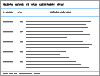
表1
数据来源"
| 研究参数Research parameters | 年份Year | 空间分辨率Spatial resolution | 数据来源Data sources |
| 土地利用/覆盖Land use/land cover(LULC) | 2021 | 30 m | 中国科学院空天信息创新研究院Aerospace Information Research Institute, Chinese Academy of Sciences |
| 数字高程模型Digital elevation model | 2019 | 30 m | NASA地球科学数据NASA Earth Science Data( |
| 年均气温、逐月降水数据集、逐月潜在蒸散发数据集Annual mean temperature, Monthly precipitation dataset, Monthly potential evapotranspiration dataset | 2021 | 1 000 m | 国家青藏高原科学数据中心National Qinghai-Tibet Plateau Science Data Center (http://data.tpdc.ac.cn) |
| 土壤数据Soil data | 2010— 2018 | 90 m | 国家科技基础条件平台——国家地球系统科学数据中心National Earth System Science Data Center, National Science & Technology Infrastructure of China ( |
| 归一化植被指数Normalized vegetation index(NDVI) | 2021 | 30 m | 采用2021年Landsat遥感影像计算Calculated with Landsat remote sensing images in 2021 |
| 净初级生产力Net primary productivity(NPP) | 2021 | 500 m | MYD17A3HGF数据集MYD17A3HGF dataset ( |
| 道路、湖泊、河流数据Road, lake, and river data | 2021 | 矢量数据 Vector data | OpenStreetMap( |
表2
土地利用类型生态恢复力系数和阻力系数"
| 项目Item | 耕地 Farmland | 林地 Forest | 草地 Grassland | 灌木地 Shrubland | 水域 Water | 建设用地 Built-up land | 交通运输用地 Transportation land | 其他 Other |
| 恢复力系数Resilience coefficient | 0.4 | 0.9 | 0.7 | 0.8 | 0.7 | 0.2 | 0.2 | 0.1 |
| 阻力系数Resistance coefficient | 0.6 | 1 | 0.6 | 0.6 | 0.8 | 0.3 | 0.3 | 0.2 |
表3
2021年每种土地利用类型的碳密度校正值"
| 土地利用类型 Land use type | 地上生 物量碳 Aboveground biomass carbon | 地下生 物量碳 Underground biomass carbon | 土壤有 机碳 Soil organic carbon | 死有 机碳 Dead organic matter carbon |
| 耕地Farmland | 0.411 1 | 2.734 1 | 93.437 7 | 0 |
| 林地Forest | 12.174 4 | 48.916 8 | 111.922 9 | 2.177 3 |
| 草地Grassland | 0.474 7 | 4.857 4 | 90.657 9 | 0.09 |
| 灌木地Shrubland | 4.662 7 | 5.828 4 | 89.205 | 0.924 2 |
| 水域Water | 0 | 0 | 0 | 0 |
| 建设用地Built-up land | 4.804 3 | 1.921 7 | 70.628 3 | 0 |
| 交通运输用地 Transportation land | 4.941 5 | 1.976 6 | 71.815 1 | 0 |
| 其他Other | 0 | 0 | 0 | 0 |
表4
不同风险情景下的权衡值与位序权重①"
| 情景Scenario | 风险Risk | 权衡Trae-off | w1 | w2 | w3 | w4 | w5 |
| 1 | 0 | 0 | 0.000 | 0.000 | 0.000 | 0.000 | 1.000 |
| 2 | 0.1 | 0.374 | 0.000 | 0.000 | 0.033 | 0.333 | 0.633 |
| 3 | 0.2 | 0.570 | 0.000 | 0.040 | 0.180 | 0.320 | 0.460 |
| 4 | 0.3 | 0.717 | 0.040 | 0.120 | 0.200 | 0.280 | 0.360 |
| 5 | 0.4 | 0.859 | 0.120 | 0.160 | 0.200 | 0.240 | 0.280 |
| 6 | 0.5 | 1.000 | 0.200 | 0.200 | 0.200 | 0.200 | 0.200 |
| 7 | 0.6 | 0.859 | 0.280 | 0.240 | 0.200 | 0.160 | 0.120 |
| 8 | 0.7 | 0.717 | 0.360 | 0.280 | 0.200 | 0.120 | 0.040 |
| 9 | 0.8 | 0.570 | 0.460 | 0.320 | 0.180 | 0.040 | 0.000 |
| 10 | 0.9 | 0.374 | 0.633 | 0.333 | 0.033 | 0.000 | 0.000 |
| 11 | 1 | 0 | 1.000 | 0.000 | 0.000 | 0.000 | 0.000 |
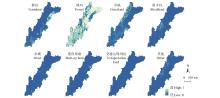
图1
各土地利用类型的土地发展概率"
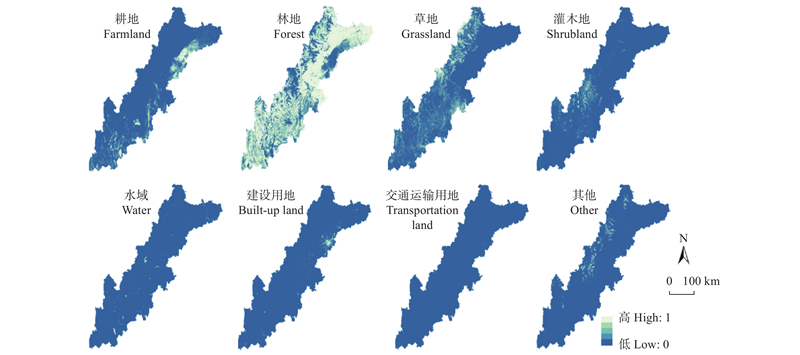
表5
生态阻力因素的权重和分级标准"
| 阻力因子Resistance factor | 权重 Weight | 相对阻力值Relative resistance value | ||||
| 10 | 30 | 50 | 70 | 90 | ||
| 土地发展概率因子 Land development probability factor | 0.416 7 | 基于公式(11)Calculation based on equation (11) | ||||
| 海拔Elevation/ m | 0.142 6 | <2 000 | 2 000–2 500 | 2 500–3 000 | 3 000–3 500 | >3 500 |
| 坡度Slope/ (°) | 0.056 7 | <8 | 8~15 | 15~25 | 25~35 | >35 |
| 地形起伏度Topographic relief/m | 0.074 5 | <100 | 100~200 | 200~300 | 300~400 | >400 |
| 植被覆盖度Vegetation coverage (%) | 0.158 8 | >0.8 | 0.6~0.8 | 0.4~0.6 | 0.2~0.4 | <0.2 |
| 距道路距离Distance from road/m | 0.083 3 | >5 000 | 2 000~5 000 | 1 000~2 000 | 500~1 000 | <500 |
| 土壤侵蚀量Amount of soil erosion/ (t·km?2) | 0.067 4 | <500 | 500~1 000 | 1 000~2 000 | 2 000~5 000 | >5 000 |
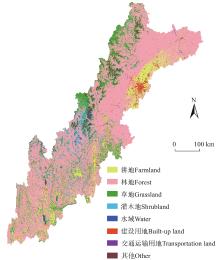
图2
土地利用类型的空间分布"
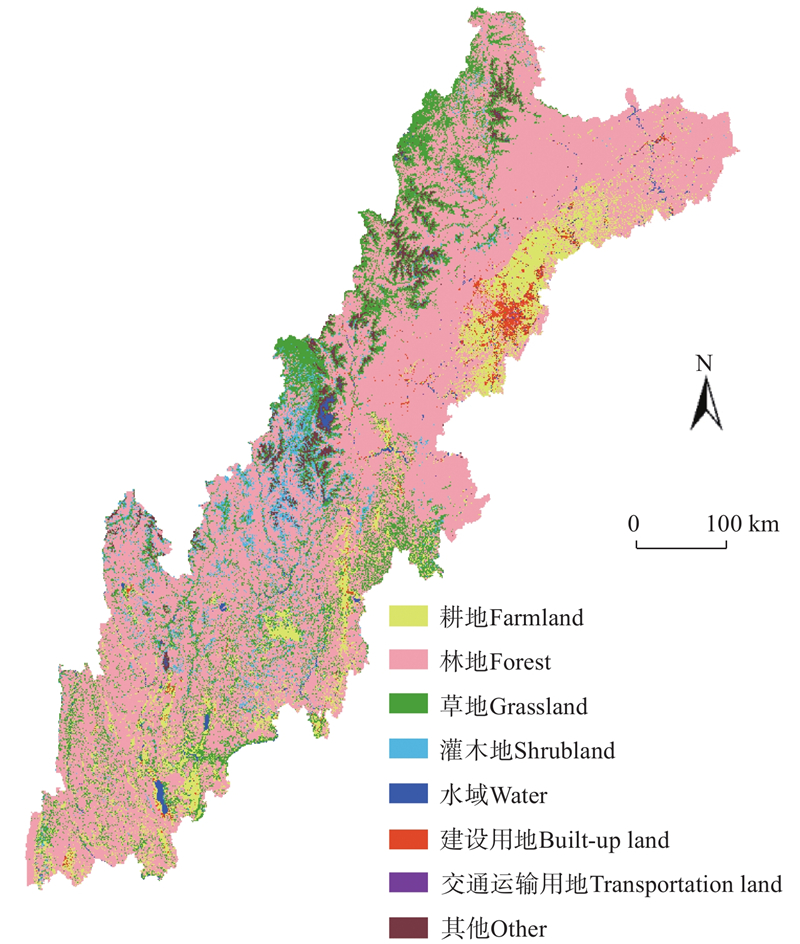
图3
研究区不同生态系统服务的空间分布"
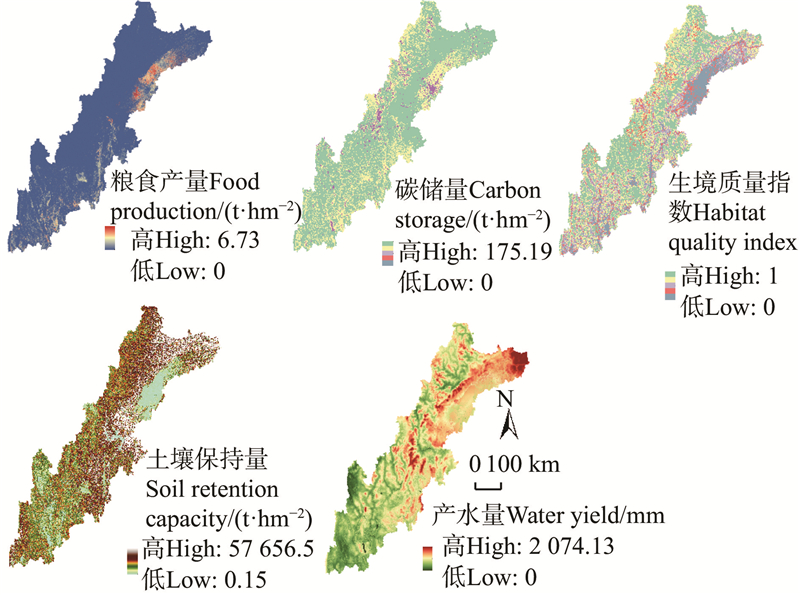
图4
研究区生态系统活力、组织力、恢复力和物理健康指数的空间分布"
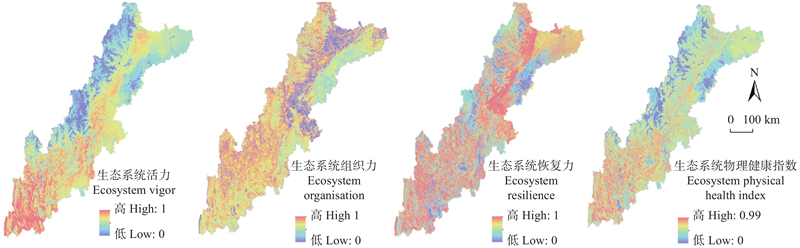

图5
川滇生态屏障区不同情景下生态系统健康指数的空间分布"
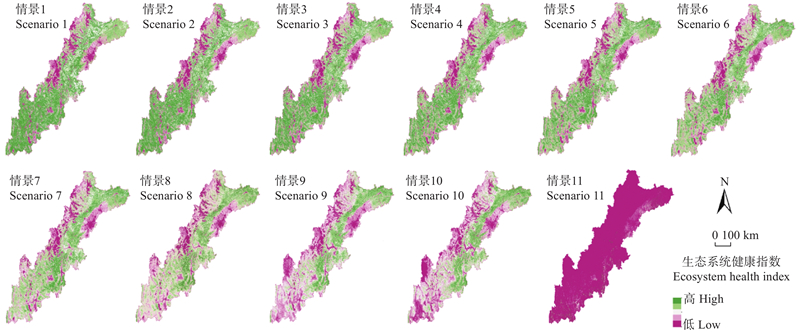
表6
不同情景下各生态系统服务的保护效率"
| 情景 Scenario | 生态系统物理健康Ecosystem physical health | 生态系统服务Ecosystem service | 平均保护效率 Average protection efficiency | ||||||
| 生态活力 Ecological vigor | 生态组织力 Ecological organization | 生态恢复力 Ecological resilience | 产水量 Water yield | 生境质量 指数Habitat quality index | 碳储量 Carbon storage | 土壤保持量 Soil retention capacity | |||
| 1 | 1.388 | 1.241 | 1.360 | 0.737 | 1.114 | 1.200 | 1.113 | 1.164 8 | |
| 2 | 1.371 | 1.246 | 1.359 | 0.780 | 1.134 | 1.201 | 1.153 | 1.177 6 | |
| 3 | 1.354 | 1.245 | 1.352 | 0.840 | 1.139 | 1.201 | 1.205 | 1.190 9 | |
| 4 | 1.338 | 1.243 | 1.346 | 0.895 | 1.141 | 1.200 | 1.231 | 1.199 2 | |
| 5 | 1.323 | 1.240 | 1.341 | 0.937 | 1.142 | 1.199 | 1.247 | 1.204 1 | |
| 6 | 1.300 | 1.231 | 1.333 | 0.995 | 1.144 | 1.197 | 1.270 | 1.209 9 | |
| 7 | 1.271 | 1.197 | 1.324 | 1.077 | 1.147 | 1.194 | 1.326 | 1.219 3 | |
| 8 | 1.234 | 1.130 | 1.310 | 1.181 | 1.148 | 1.189 | 1.410 | 1.228 7 | |
| 9 | 1.196 | 1.061 | 1.279 | 1.267 | 1.133 | 1.175 | 1.489 | 1.228 6 | |
| 10 | 1.177 | 1.028 | 1.224 | 1.293 | 1.100 | 1.148 | 1.498 | 1.209 7 | |
| 11 | 0.957 | 0.945 | 0.381 | 1.162 | 0.485 | 0.737 | 0.400 | 0.723 9 | |
图6
生态源斑块大小阈值的影响(A)和生态源的空间分布(B)"
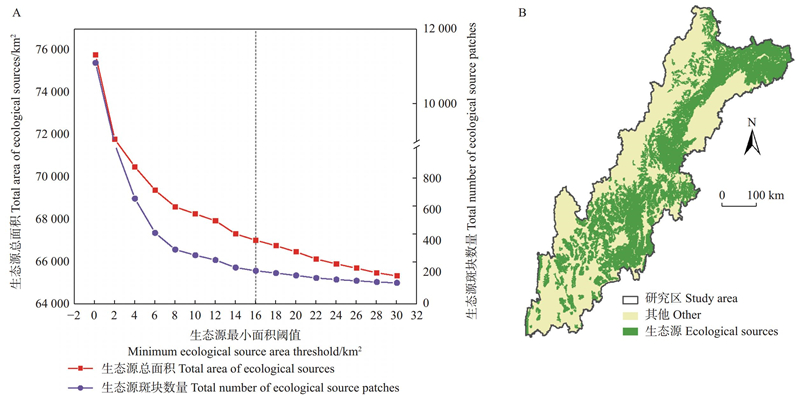
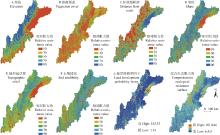
图7
研究区各生态阻力因子相对阻力值和综合阻力面"
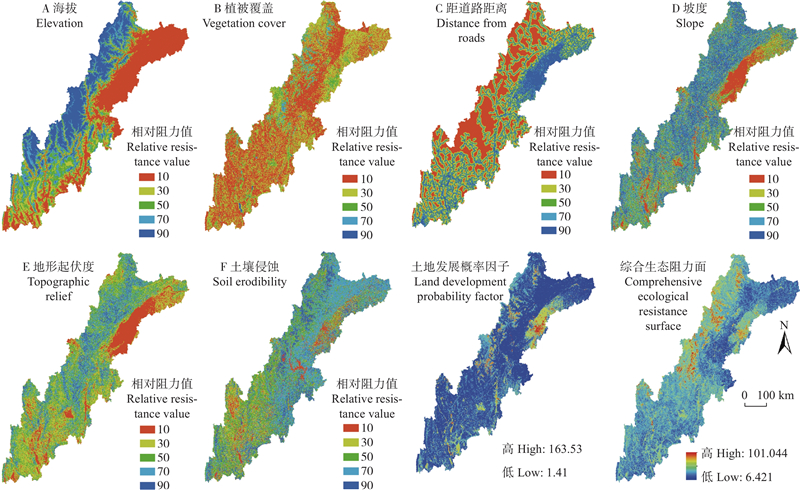
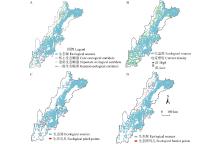
图8
研究区生态廊道(A)、电流密度(B)、生态夹点(C)和生态障碍点(D)的空间分布"

| 陈竹安, 况 达, 危小建, 等. 基于MSPA与MCR模型的余江县生态网络构建. 长江流域资源与环境, 2017, 26 (8): 1199- 1207. | |
| Chen Z A, Kuang D, Wei X J, et al. Construction of the ecological network in Yujiang County based on the MSPA and MCR models. Resources and Environment in the Yangtze Basin, 2017, 26 (8): 1199- 1207. | |
| 董文卓, 苏维词, 勾 容, 等. 生态系统服务和生态系统健康视角下的贵州省生态风险时空演变. 应用生态学报, 2025, 36 (4): 1211- 1221. | |
| Dong W Z, Su W C, Gou R, et al. Spatial and temporal evolution of ecological risk in Guizhou Province, China from the perspective of ecosystem services and ecosystem health. Chinese Journal of Applied Ecology, 2025, 36 (4): 1211- 1221. | |
| 傅伯杰, 王晓峰, 冯晓明, 等. 2017. 国家生态屏障区生态系统评估. 北京: 科学出版社. | |
| Fu B J, Wang X F, Feng X M, et al. 2017. Ecological system assessment of national ecological barrier areas. Beijing: Science Press. [in Chinese] | |
| 高彬嫔, 李 琛, 吴映梅, 等. 川滇生态屏障区景观生态风险评价及影响因素. 应用生态学报, 2021, 32 (5): 1603- 1613. | |
| Gao B P, Li C, Wu Y M, et al. Landscape ecological risk assessment and influencing factors in ecological conservation area in Sichuan-Yunnan provinces, China. Chinese Journal of Applied Ecologys, 2021, 32 (5): 1603- 1613. | |
| 黄 云, 徐黎亮, 郑博福, 等. 亚热带典型森林生产力及碳利用率的气候变化响应. 林业科学, 2025, 61 (3): 121- 134. | |
| Huang Y, Xu L L, Zheng B F, et al. Responses of productivity and carbon use efficiency of typical subtropical forests to climate change. Scientia Silvae Sinicae, 2025, 61 (3): 121- 134. | |
| 郎 燕, 刘 宁, 刘世荣. 气候和土地利用变化影响下生态屏障带水土流失趋势研究. 生态学报, 2021, 41 (13): 5106- 5117. | |
| Lang Y, Liu N, Liu S R. Changes in soil erosion and its driving factors under climate change and land use scenarios in Sichuan-Yunnan-Loess Plateau region and the southern Hilly Mountain Belt, China. Acta Ecologica Sinica, 2021, 41 (13): 5106- 5117. | |
| 刘斯媛, 罗 勇, 于 慧, 等. 川西北长江黄河源区生态安全格局构建及优化. 环境工程技术学报, 2023, 13 (4): 1315- 1324. | |
| Liu S Y, Luo Y, Yu H, et al. Construction and optimization of ccological security pattern in the source regions of the Yangtze River and the Yellow River in northwestem Sichuan. Journal of Environmental Engineering Technology, 2023, 13 (4): 1315- 1324. | |
| 王晓蓉, 崔 媛, 张 勇, 等. 1995—2019年香格里拉市高寒草甸景观格局和潜在生产力变化特征研究. 西南林业大学学报(自然科学), 2025, 45 (1): 106- 116. | |
| Wang X R, Cui Y, Zhang Y, et al. Changes in land-scape patterns and potential productivity of alpine meadows in Shangri-La from 1995 to 2019. Journal of Southwest Forestry University, 2025, 45 (1): 106- 116. | |
| 武 燕, 吴映梅, 李 琛, 等. 基于MAUP下川滇生态屏障区生态系统服务价值多尺度空间分异及地理探测响应. 水土保持研究, 2023, 30 (2): 333- 342. | |
| Wu Y, Wu Y M, Li C, et al. Multi-scale spatial differentiation and geographic detection response of ecosystem service value in Sichuan-Yunnan ecological barrier based on the modifiable areal unit problem. Research of Soil and Water Conservation, 2023, 30 (2): 333- 342. | |
| 许 峰, 尹海伟, 孔繁花, 等. 基于MSPA与最小路径方法的巴中西部新城生态网络构建. 生态学报, 2015, 35 (19): 6425- 6434. | |
| Xu F, Yin H W, Kong F H, et al. Developing ecological networks based on MSPA and the least-cost path method: a case study in bazhong western new district. Acta Ecologica Sinica, 2015, 35 (19): 6425- 6434. | |
| 易 浪, 孙 颖, 尹少华, 等. 生态安全格局构建: 概念、框架与展望. 生态环境学报, 2022, 31 (4): 845- 856. | |
| Yi L, Sun Y, Yin S H, et al. Construction of ecological security pattern: concept, framework and prospect. Ecology and Environmental Sciences, 2022, 31 (4): 845- 856. | |
| 杨时民, 李玉文, 吕玉哲. 扎龙湿地生态安全评价指标体系研究. 林业科学, 2006, 42 (5): 127- 132. | |
| Yang S M, Li Y W, Lü Y Z. The assessment index system of Zhalong wetland eco-security. Scientia Silvae Sinicae, 2006, 42 (5): 127- 132. | |
|
Bai J i, Sun R, Liu Y F, et al. Integrating ecological and recreational functions to optimize ecological security pattern in Fuzhou City. Scientific Reports, 2025, 15 (1): 778.
doi: 10.1038/s41598-024-84660-1 |
|
|
Cao W Y, Li X B, Lyu X, et al. To explore the effectiveness of various ecological security pattern construction methods in many growth situations in the future: a case study of the West Liaohe River Basin in Inner Mongolia. Science of the Total Environment, 2024, 948, 174607.
doi: 10.1016/j.scitotenv.2024.174607 |
|
|
Cai Y C, Li H, Li W C. Optimization of a “social-ecological” system pattern from the perspective of ecosystem service supply and demand: a case study of Jilin Province. Land, 2024, 13 (10): 1716.
doi: 10.3390/land13101716 |
|
|
Cong Z X, Yang S, Zhu B K, et al. Identification of key ecological restoration areas based on ecological security patterns and territorial spatial ecological restoration zoning: a case study of the middle and lower reaches of the Yellow River in China. Journal for Nature Conservation, 2025, 84, 126793.
doi: 10.1016/j.jnc.2024.126793 |
|
|
Das M, Das A, Mandal A. Research note: Ecosystem health (EH) assessment of a rapidly urbanizing metropolitan city region of eastern India: a study on Kolkata Metropolitan Area. Landscape and Urban Planning, 2020, 204, 103938.
doi: 10.1016/j.landurbplan.2020.103938 |
|
|
Du Z Y, Ji X B, Zhao W Y, et al. Integrating revised DPSIR and ecological security patterns to assess the health of alpine grassland ecosystems on the Qinghai-Tibet Plateau. Science of the Total Environment, 2024, 957, 177833.
doi: 10.1016/j.scitotenv.2024.177833 |
|
|
Fang J, Xu L Y, Lu Q. Ecological security patterns of Chinese lakes based on ecosystem service values assessment and human threat factors evaluation. Ecological Informatics, 2024, 82, 102754.
doi: 10.1016/j.ecoinf.2024.102754 |
|
|
Guo J, Feng P F, Xue H, et al. A framework of ecological security patterns in arid and semi-arid regions considering differences socioeconomic scenarios in ecological risk: case of Loess Plateau, China. Journal of Environmental Management, 2025a, 373, 123923.
doi: 10.1016/j.jenvman.2024.123923 |
|
|
Guo Y C, Xu D W, Xu J, et al. Multi-scale analysis of spatial and temporal evolution of ecosystem health in the Harbin-Changchun urban agglomeration, China. Sustainability, 2024, 16 (2): 837.
doi: 10.3390/su16020837 |
|
|
Guo Z Y, Zhu C X, Fan X, et al. Analysis of ecological network evolution in an ecological restoration area with the MSPA-MCR model: a case study from Ningwu County, China. Ecological Indicators, 2025b, 170, 113067.
doi: 10.1016/j.ecolind.2024.113067 |
|
|
Han J Z, Hu Z Q, Mao Z, et al. How to account for changes in carbon storage from Coal Mining and Reclamation in Eastern China? Taking Yanzhou Coalfield as an example to simulate and estimate. Remote Sensing, 2022, 14 (9): 2014.
doi: 10.3390/rs14092014 |
|
|
Han P Y, Hu H Z, Zhou J Y, et al. Integrating key ecosystem services to study the spatio-temporal dynamics and determinants of ecosystem health in Wuhan’s central urban area. Ecological Indicators, 2024, 166, 112352.
doi: 10.1016/j.ecolind.2024.112352 |
|
|
Hu J L, Qing G, Wang Y X, et al. Landscape ecological security of the Lijiang River Basin in China: spatiotemporal evolution and pattern optimization. Sustainability, 2024, 16 (13): 5777.
doi: 10.3390/su16135777 |
|
|
Huang X Y, Xiu L N, Lu Z X, et al. Ecological networks construction and optimization in the Longdong Loess Plateau: the advantages of self-organizing map and complex networks. Ecological Indicators, 2025, 170, 113138.
doi: 10.1016/j.ecolind.2025.113138 |
|
|
Huang Y, Gan X, Feng Y F, et al. A new framework for assessing ecosystem health with consideration of the sustainable supply of ecosystem services. Landscape Ecology, 2024, 39 (2): 37.
doi: 10.1007/s10980-024-01834-y |
|
|
Jia J, Guo W L, Xu L Y, et al. Multi scenario simulation of land use in Chaohu Lake Basin Based on PLUS model. Polish Journal of Environmental Studies, 2025, 34 (2): 1207- 1219.
doi: 10.15244/pjoes/187145 |
|
|
Jie Y, Wang S Y, Jie Z, et al. Optimisation of ecological security patterns in ecologically transition areas under the perspective of ecological resilience: a case of Taohe River. Ecological Indicators, 2024, 166, 112315.
doi: 10.1016/j.ecolind.2024.112315 |
|
|
Knaapen J P, Scheffer M, Harms B. Estimating habitat isolation in landscape planning. Landscape and Urban Planning, 1992, 23 (1): 1- 16.
doi: 10.1016/0169-2046(92)90060-D |
|
|
Lei J J, Li C S, Yang W N. Ecosystem health assessment and approaches to improve Sichuan Province based on an improved vigor organization resilience model. Ecological Indicators, 2023, 155, 110925.
doi: 10.1016/j.ecolind.2023.110925 |
|
|
Lewis S L, Maslin M A. Defining the Anthropocene. Nature, 2015, 519 (7542): 171- 180.
doi: 10.1038/nature14258 |
|
|
Li C, Qiao W F, Gao B P, et al. Unveiling spatial heterogeneity of ecosystem services and their drivers in varied landform types: Insights from the Sichuan-Yunnan ecological barrier area. Journal of Cleaner Production, 2024b, 442, 141158.
doi: 10.1016/j.jclepro.2024.141158 |
|
|
Li C, Wu Y M, Gao B P, et al. Multi-scenario simulation of ecosystem service value for optimization of land use in the Sichuan-Yunnan ecological barrier, China. Ecological Indicators, 2021b, 132, 108328.
doi: 10.1016/j.ecolind.2021.108328 |
|
|
Li C, Wu Y M, Gao B P, et al. Construction of ecological security pattern of national ecological barriers for ecosystem health maintenance. Ecological Indicators, 2023, 146, 109801.
doi: 10.1016/j.ecolind.2022.109801 |
|
|
Li J Y, Chen X, De Maeyer P, et al. Ecological security warning in Central Asia: integrating ecosystem services protection under SSPs-RCPs scenarios. Science of the Total Environment, 2024, 912, 168698.
doi: 10.1016/j.scitotenv.2023.168698 |
|
|
Li T, Li L, Tang M F, et al. Heterogeneous impacts of human activity intensity on regional ecological security patterns: the case of southwest China. Land, 2024d, 13 (12): 2172.
doi: 10.3390/land13122172 |
|
|
Li W J, Xie S Y, Wang Y, et al. Effects of urban expansion on ecosystem health in southwest China from a multi-perspective analysis. Journal of Cleaner Production, 2021a, 294, 126341.
doi: 10.1016/j.jclepro.2021.126341 |
|
|
Li W P, Liu Y D, Lin Q R, et al. Identification of ecological security pattern in the Qinghai-Tibet Plateau. Ecological Indicators, 2025b, 170, 113057.
doi: 10.1016/j.ecolind.2024.113057 |
|
|
Li X D, Tao H Y, Wang J, et al. Integrated evaluation of the ecological security pattern in central Beijing using InVEST, MSPA, and Multifactor indices. Land, 2025, 14 (1): 205.
doi: 10.3390/land14010205 |
|
|
Li Y Y, Qin L, Wang Y H, et al. Ecosystem health assessment of the largest lake wetland in the Yellow River basin using an improved vigor-organization-resilience-services model. Ecological Indicators, 2024a, 166, 112539.
doi: 10.1016/j.ecolind.2024.112539 |
|
| Lin X, Wang Z T, Bao Y. Integrating ecosystem stress into the assessment of ecosystem health in karst areas and exploring its driving factors. Ecological Indicators, 2024, 167, 112662. | |
|
Liu X Y, Su Y, Li Z G, et al. Constructing ecological security patterns based on ecosystem services trade-offs and ecological sensitivity: a case study of Shenzhen metropolitan area, China. Ecological Indicators, 2023, 154, 110626.
doi: 10.1016/j.ecolind.2023.110626 |
|
|
Ma J W, Ding X, Shu Y Q, et al. Spatio-temporal variations of ecosystem health in the Liuxi River Basin, Guangzhou, China. Ecological Informatics, 2022, 72, 101842.
doi: 10.1016/j.ecoinf.2022.101842 |
|
|
Ma Y, Chen H, Yang M, et al. Assessment of supply-demand relationships considering the interregional flow of ecosystem services. Environmental science and pollution research international, 2024, 31 (19): 27710- 27729.
doi: 10.1007/s11356-024-32904-y |
|
|
Nie H R, Zhao Y, Zhu J, et al. Ecological security pattern construction in typical oasis area based on ant colony optimization: a case study in Yili River Valley, China. Ecological Indicators, 2024, 169, 112770.
doi: 10.1016/j.ecolind.2024.112770 |
|
|
Pan Z Z, He J H, Liu D F, et al. Predicting the joint effects of future climate and land use change on ecosystem health in the middle reaches of the Yangtze River Economic Belt, China. Applied Geography, 2020, 124, 102293.
doi: 10.1016/j.apgeog.2020.102293 |
|
|
Peng J, Wang Y L, Wu J S, et al. Research progress on evaluation frameworks of regional ecological sustainability. Chinese Geographical Science, 2011, 21 (4): 496- 510.
doi: 10.1007/s11769-011-0490-0 |
|
|
Qiao W Y, Hu B, Guo Z, et al. Evaluating the sustainability of land use integrating SDGs and its driving factors: a case study of the Yangtze River Delta urban agglomeration, China. Cities, 2023, 143, 104569.
doi: 10.1016/j.cities.2023.104569 |
|
|
Qin X L, Ling H B, Shan Q J, et al. Construction of ecological security patterns in typical arid regions based on the synergy of efficient ecological water utilization and environmental quality enhancement. Catena, 2025, 249, 108713.
doi: 10.1016/j.catena.2025.108713 |
|
|
Ren S M, Zhao H, Zhang H L, et al. Influence of natural and social economic factors on landscape pattern indices: the case of the Yellow River Basin in Henan Province. Water, 2023, 15 (23): 4174.
doi: 10.3390/w15234174 |
|
|
Shi X Y, Zhao X Q, Pu J W, et al. Evolution modes, types, and social-ecological drivers of ecologically critical areas in the Sichuan-Yunnan ecological barrier in the last 15 years. International Journal of Environmental Research and Public Health, 2022, 19 (15): 9206.
doi: 10.3390/ijerph19159206 |
|
|
Shi Y, Fan X X, Chen H N, et al. Landscape pattern evolution and ecological security assessment based on land use changes in mining cities: a case study of Heihe City. Frontiers in Environmental Science, 2024, 12, 1488439.
doi: 10.3389/fenvs.2024.1488439 |
|
|
Shu R, Ma G Q, Zou Y B, et al. Bibliometric analysis of ecological security pattern construction: current status, evolution, and development trends. Ecological Indicators, 2024, 169, 112754.
doi: 10.1016/j.ecolind.2024.112754 |
|
|
Sturck J, Verburg P H. Multifunctionality at what scale? A landscape multifunctionality assessment for the European Union under conditions of land use change. Landscape Ecology, 2017, 32 (3): 481- 500.
doi: 10.1007/s10980-016-0459-6 |
|
|
Tang F, Fu M C, Wang L, et al. Land-use change in Changli County, China: predicting its spatio-temporal evolution in habitat quality. Ecological Indicators, 2020, 117, 106719.
doi: 10.1016/j.ecolind.2020.106719 |
|
| Tang X L, Zhao X, Bai Y F, et al. Carbon pools in China’s terrestrial ecosystems: new estimates based on an intensive field survey. Proceedings of the National Academy of Sciences of the United States of America, 2018, 115 (16): 4021- 4026. | |
|
Wang C X, Yu C Y, Chen T Q, et al. Can the establishment of ecological security patterns improve ecological protection? An example of Nanchang, China. Science of the Total Environment, 2020, 740, 140051.
doi: 10.1016/j.scitotenv.2020.140051 |
|
|
Wang T, Li H, Huang Y. The complex ecological network’s resilience of the Wuhan metropolitan area. Ecological Indicators, 2021, 130, 108101.
doi: 10.1016/j.ecolind.2021.108101 |
|
|
Wang X Y, Yao W F, Luo Q Z, et al. Spatial relationship between ecosystem health and urbanization in coastal mountain city, Qingdao, China. Ecological Informatics, 2024, 79, 102458.
doi: 10.1016/j.ecoinf.2023.102458 |
|
|
Wang Y C, Yang X, Zhang X J, et al. Spatiotemporal dynamic characteristics and conservation strategy of ecological security pattern in a rapidly urbanizing zone. Ecological Indicators, 2024, 166, 112457.
doi: 10.1016/j.ecolind.2024.112457 |
|
|
Wang Y, Zhou X G, Ding C, et al. Construction and optimization of the watershed-scale ecological network based on network characteristic analysis: a case study of the Lancang River Basin. Ecological Indicators, 2025, 171, 113164.
doi: 10.1016/j.ecolind.2025.113164 |
|
|
Williams J R, Renard K G, Dyke P T. EPIC: a new method for assessing erosion’s effect on soil productivity. Journal of Soil and Water Conservation, 1983, 38 (5): 381- 383.
doi: 10.1080/00224561.1983.12436327 |
|
|
Wu Q, Cao Y, Zhang Y J, et al. Linking ecosystem services trade-offs, human preferences and future scenario simulations to ecological security patterns: a novel methodology for reconciling conflicting ecological functions. Applied Geography, 2025, 176, 103534.
doi: 10.1016/j.apgeog.2025.103534 |
|
|
Wu S Y, Zhao C, Yang L, et al. Spatial and temporal evolution analysis of ecological security pattern in Hubei Province based on ecosystem service supply and demand analysis. Ecological Indicators, 2024, 162, 112051.
doi: 10.1016/j.ecolind.2024.112051 |
|
| Wu Y D, Han Z Y, Meng J J, et al. Circuit theory-based ecological security pattern could promote ecological protection in the Heihe River Basin of China. Environmental Science and Pollution Research, 2023, 30 (10): 27340- 27356. | |
|
Xiang K M, Chen L, Li W Y, et al. Construction and optimization strategy of ecological security pattern in county-level cities under spatial and temporal variation of ecosystem services: case study of Mianzhu, China. Land, 2024, 13 (7): 936.
doi: 10.3390/land13070936 |
|
|
Xiao Z L, Liu R, Gao Y H, et al. Spatiotemporal variation characteristics of ecosystem health and its driving mechanism in the mountains of southwest China. Journal of Cleaner Production, 2022, 345, 131138.
doi: 10.1016/j.jclepro.2022.131138 |
|
|
Xie X, Fang B, Xu H Z Y, et al. Study on the coordinated relationship between urban land use efficiency and ecosystem health in China. Land Use Policy, 2021, 102, 105235.
doi: 10.1016/j.landusepol.2020.105235 |
|
|
Yan L B, Yu L F, An M T, et al. Explanation of the patterns, spatial relationships, and node functions of biodiversity and island: an example of nature reserves in Guizhou, southwest China. Sustainability, 2019, 11 (22): 6197.
doi: 10.3390/su11226197 |
|
| Yang A X, Zhong B, Hu L F, et al. Assessment of land cover status and change in the world and “the Belt and Road” region from 2016 to 2020. Sensors, 2023, 23 (16): 7158. | |
|
Yang A X, Zhong B, Wang X L, et al. 30 m 5-yearly land cover maps of Qilian Mountain area (QMA_LC30) from 1990 to 2020. Scientific Data, 2024, 11 (1): 1339.
doi: 10.1038/s41597-024-03976-9 |
|
|
Yang J L, Xin Z B, Li X Y, et al. Vigor-organization-resilience framework for assessing ecosystem health in the Qinghai-Xizang Plateau. Ecosystem Health and Sustainability, 2024, 10, 0260.
doi: 10.34133/ehs.0260 |
|
|
Zhang F Y, Jia Y Y, Liu X L, et al. Application of MSPA-MCR models to construct ecological security pattern in the basin: a case study of Dawen River basin. Ecological Indicators, 2024, 160, 111887.
doi: 10.1016/j.ecolind.2024.111887 |
|
|
Zhang L L, Liu Q Y, Wang J, et al. Constructing ecological security patterns using remote sensing ecological index and circuit theory: A case study of the Changchun-Jilin-Tumen region. Journal of Environmental Management, 2025, 373, 123693.
doi: 10.1016/j.jenvman.2024.123693 |
|
|
Zhang P P, Song M J, Lu Q Q. Mapping ecological security patterns based on ecosystem service valuation in the Qinling-Daba Mountain area, China: a multi-scenario study for development and conservation tradeoffs. Land, 2024b, 13 (10): 1629.
doi: 10.3390/land13101629 |
|
|
Zhao C, Shao N, Yang S, et al. Integrated assessment of ecosystem health using multiple indicator species. Ecological Engineering, 2019, 130, 157- 168.
doi: 10.1016/j.ecoleng.2019.02.016 |
|
|
Zhao X Q, Yue Q F, Pei J C, et al. Ecological security pattern construction in karst area based on ant algorithm. International Journal of Environmental Research and Public Health, 2021, 18 (13): 6863.
doi: 10.3390/ijerph18136863 |
|
|
Zhou Y, Li X H, Liu Y S. Land use change and driving factors in rural China during the period 1995—2015. Land Use Policy, 2020, 99, 105048.
doi: 10.1016/j.landusepol.2020.105048 |
|
|
Zhou J J, Zhao Y R, Huang P, et al. Impacts of ecological restoration projects on the ecosystem carbon storage of inland river basin in arid area, China. Ecological Indicators, 2020b, 118, 106803.
doi: 10.1016/j.ecolind.2020.106803 |
|
|
Zhu X L, Qie R Q, Luo C, et al. Assessment and driving factors of wetland ecosystem service function in northeast China based on InVEST-PLUS model. Water, 2024, 16 (15): 2153.
doi: 10.3390/w16152153 |
|
|
Zhu Y C, Liu Y C, Xiao Y, et al. Construction of ecological security patterns incorporating multiple types of ecological service functions for developed coastal regions: a case study in Jinjiang Watershed, China. Land, 2024b, 13 (8): 1227.
doi: 10.3390/land13081227 |
| [1] | 叶洁楠,黄亦周,贾舒皓,张婷. 四川巴中地区生态源地识别及生态安全格局构建[J]. 林业科学, 2025, 61(11): 56-69. |
| [2] | 武金翠,周军,张宇,余晓燕,石雷,漆良华. 毛竹林固碳增汇价值的动态变化:以福建省为例[J]. 林业科学, 2020, 56(4): 181-187. |
| [3] | 马骏, 马朋, 李昌晓, 彭月, 魏虹. 基于土地利用的三峡库区(重庆段)生态系统服务价值时空变化[J]. 林业科学, 2014, 50(5): 17-26. |
| [4] | 魏晓燕, 毛旭锋, 夏建新. 自然保护区移民生态补偿定量研究——以内蒙古乌拉特国家级自然保护区为例[J]. 林业科学, 2013, 49(12): 157-163. |
| [5] | 王兵;任晓旭;胡文. 中国森林生态系统服务功能及其价值评估[J]. 林业科学, 2011, 47(2): 145-153. |
| [6] | 王懿祥;陆元昌 张守攻 白尚斌 刘宪钊. 森林生态系统健康评价现状及展望[J]. 林业科学, 2010, 46(2): 134-140. |
| [7] | 王兵 马向前 郭浩 王燕 冷泠. 中国杉木林的生态系统服务价值评估*[J]. 林业科学, 2009, 12(4): 124-130. |
| [8] | 李长荣. 武陵源自然保护区森林生态系统服务功能及价值评估[J]. 林业科学, 2004, 40(2): 16-20. |
| 阅读次数 | ||||||
|
全文 |
|
|||||
|
摘要 |
|
|||||

