
林业科学 ›› 2026, Vol. 62 ›› Issue (8): 71-85.doi: 10.11707/j.1001-7488.LYKX20260028
文炳南1,2,3,党龙1,2,3,杨琪铉2,邓柏林2,王永健2,张伟东3,姜春前1,白彦锋1,*( )
)
收稿日期:2026-01-14
修回日期:2026-07-05
出版日期:2026-08-10
发布日期:2026-08-20
通讯作者:
白彦锋
E-mail:baiyf@caf.ac.cn
基金资助:
Bingnan Wen1,2,3,Long Dang1,2,3,Qixuan Yang2,Bolin Deng2,Yongjian Wang2,Weidong Zhang3,Chunqian Jiang1,Yanfeng Bai1,*()
Received:2026-01-14
Revised:2026-07-05
Online:2026-08-10
Published:2026-08-20
Contact:
Yanfeng Bai
E-mail:baiyf@caf.ac.cn
摘要:
目的: 探究林窗大小和土层深度对马尾松次生林土壤理化性质、胞外酶活性及微生物代谢策略的交互影响,阐明林窗扰动下马尾松次生林土壤养分循环的土层分异规律,明确驱动土壤胞外酶活性及微生物代谢策略变化的关键环境因子。方法: 以湖南省慈利县天心阁林场退化马尾松次生林为研究对象,2018年12月,采用随机区组设计,按照无林窗对照(CK)、小林窗(S,68~75 m2)、中林窗(M,180~190 m2)和大林窗(L,445~480 m2)4种梯度设置4个区组。2024年5月,在各处理样地随机设置5个2 m×2 m样方,按0~2、2~5、5~10和10~20 cm土层分别采集枯落物和土壤样品,测定枯落物指标、土壤理化性质以及土壤胞外酶β-1,4-葡萄糖苷酶(BG)、纤维二糖水解酶(CBH)、乙酰葡糖胺糖苷酶(NAG)、酸性磷酸酶(ACP)活性。结合酶化学计量学与向量分析(向量长度,VL;向量角度,VA),利用双因素方差分析,评估林窗大小和土层深度对马尾松次生林土壤理化性质、胞外酶活性及微生物代谢策略的交互效应;通过冗余分析(RDA)和偏最小二乘法结构方程模型(PLS-SEM),识别土壤酶活性及其计量比变化的关键环境驱动因子。结果: 1) 与对照相比,中林窗可显著提高土壤pH值、含水量和无机氮含量;林窗大小和土层深度对土壤有机碳含量、全氮含量和矿物结合态有机碳含量的影响存在显著交互效应,且该交互效应随土层加深而减弱。2) 土壤酶活性的林窗响应呈现随土层加深而减弱的特征。林窗效应主要集中于0~10 cm土层,中林窗可显著提升CBH和ACP活性,但中林窗的促进作用在10~20 cm土层显著减弱。3) 研究区土壤微生物代谢普遍受磷限制(VA>45°),大林窗显著加剧微生物碳资源限制,表现为酶化学计量碳氮比(EC∶N)和向量长度(VL)显著升高,且磷限制程度随土层加深而增强。4) 土壤含水量是驱动酶活性空间变异的主导因子,土壤碳氮比是调控酶化学计量特征和微生物资源分配策略的关键因素。5) 结构方程模型显示,林窗大小和土层深度通过调控枯落物输入和土壤养分的垂直分布,导致土壤酶活性及其计量特征改变,进而影响微生物的碳、磷限制程度。结论: 林窗可显著改善马尾松次生林0~10 cm土层土壤微环境,进而影响土壤胞外酶活性及微生物代谢策略,其影响随土层加深逐渐减弱;中林窗是改善马尾松次生林土壤水分、氮素供应和促进土壤胞外酶活性的最优尺度,大林窗会加剧微生物资源胁迫;研究区土壤微生物普遍受磷限制,且土层深度越深土壤磷限制越强;土壤水分和土壤碳氮比是影响胞外酶活性及微生物代谢策略变化的关键环境因子。在森林经营与生态修复中,合理调控林窗大小可缓解微生物养分胁迫,有效提升退化马尾松林地下生态系统功能。
中图分类号:
文炳南,党龙,杨琪铉,邓柏林,王永健,张伟东,姜春前,白彦锋. 马尾松次生林土壤理化性质和胞外酶活性的林窗响应及其土层分异规律[J]. 林业科学, 2026, 62(8): 71-85.
Bingnan Wen,Long Dang,Qixuan Yang,Bolin Deng,Yongjian Wang,Weidong Zhang,Chunqian Jiang,Yanfeng Bai. Soil Physicochemical Properties and Extracellular Enzyme Activities in Secondary Pinus massoniana Forest in Response to Forest Gaps and Their Soil Layer Differentiation Characteristics[J]. Scientia Silvae Sinicae, 2026, 62(8): 71-85.

表1
林窗样地基本信息和枯落物性质①"
| 林窗类型 Forest gap type | 面积等级 Area grade (D/H) | 林窗面积 Forest gap area/m2 | UL-C/(g·kg–1) | UL-N/(g·kg–1) | SL-C/(g·kg–1) | SL-N/(g·kg–1) |
| S | 0.5 | 68~75 | 412.02 ± 29.38ab | 12.96 ± 0.76a | 427.55 ± 16.11a | 15.39 ± 0.81a |
| M | 1.0 | 180~190 | 464.11 ± 19.53a | 14.80 ± 1.06a | 428.10 ± 13.32a | 15.18 ± 0.87a |
| L | 1.5 | 445~480 | 432.17 ± 16.55ab | 14.43 ± 0.65a | 425.51 ± 16.61a | 14.74 ± 1.20ab |
| CK | 0 | 100 | 370.86 ± 11.59b | 13.01 ± 0.43a | 376.16 ± 11.15a | 11.43 ± 0.88b |
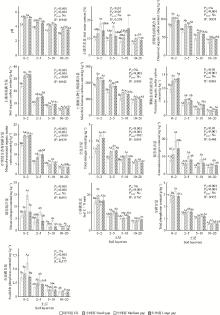
图1
林窗面积和土层深度对土壤理化性质的影响 PG:以林窗大小作为单一因素的显著性P值 The significance P-value using forest gap as a single factor. PD:以土层作为单一因素的显著性P值 The significance P-value using soil layer as a single factor PG×D:林窗大小与土层双因素交互的显著性P值 The significance P-value of the interaction between forest gap size and soil layer. Ns:没有显著性差异 No significance. 不同大写字母表示同一土层深度不同林窗大小间差异显著,不同小写字母表示同一林窗大小不同土层深度间差异显著(P<0.05)At the same soil depth, different uppercase letters indicate significant differences in different forest gap sizes; at the same forest gap size, different lowercase letters indicate significant differences at different soil depths (P<0.05)."
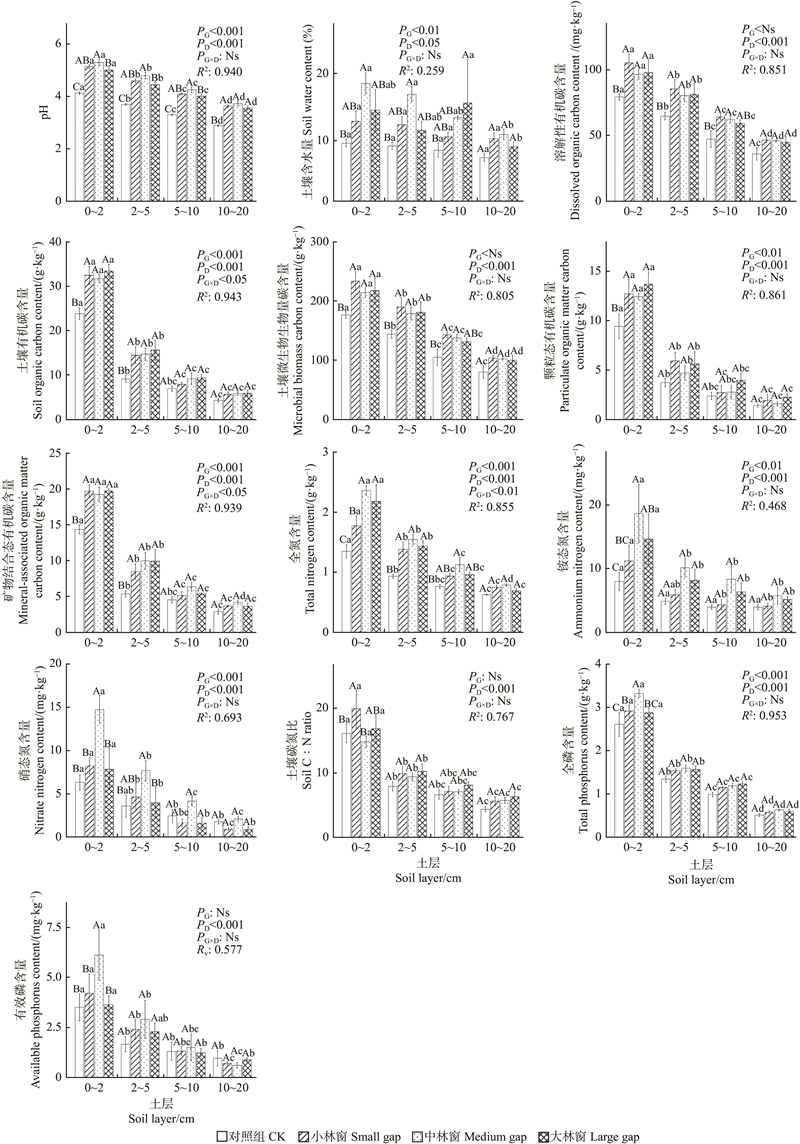
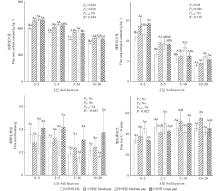
图2
林窗面积和土层深度对细根指标的影响 PG:以林窗大小作为单一因素的显著性P值 The significance P-value using forest gap as a single factor. PD:以土层作为单一因素的显著性P值 The significance P-value using soil layer as a single factor. PG×D:林窗大小与土层双因素交互的显著性P值 The significance P-value of the interaction between forest gap size and soil layer. Ns:没有显著性差异 No significance. 不同大写字母同一土层深度不同林窗大小间表示差异显著,不同小写字母表示同一林窗大小不同土层深度间差异显著(P<0.05)At the same soil depth, different uppercase letters indicate significant differences in different forest gap sizes; at the same forest gap size, different lowercase letters indicate significant differences at different soil depths (P<0.05)."
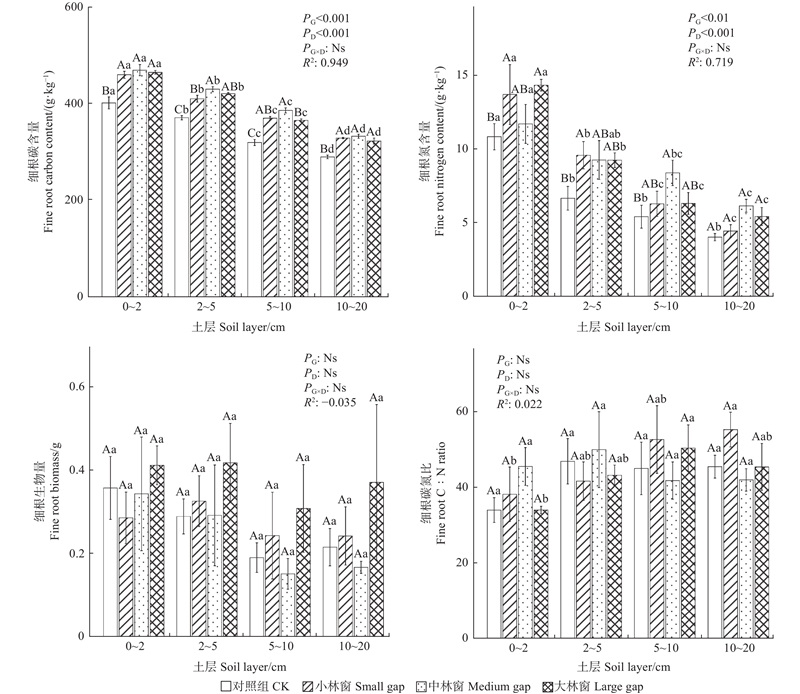
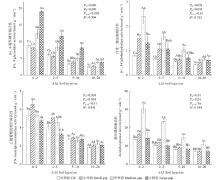
图3
不同林窗面积和土层深度的土壤胞外酶活性 PG:以林窗大小作为单一因素的显著性P值 The significance P-value using forest gap as a single factor. PD:以土层作为单一因素的显著性P值 The significance P-value using soil layer as a single factor. PG×D:林窗大小与土层双因素交互的显著性P值 The significance P-value of the interaction between forest gap size and soil layer. Ns:没有显著性差异 No significance. 不同大写字母表示同一土层深度不同林窗大小间差异显著,不同小写字母表示同一林窗大小不同土层深度间差异显著(P<0.05)At the same soil depth, different uppercase letters indicate significant differences in different forest gap sizes; at the same forest gap size, different lowercase letters indicate significant differences at different soil depths (P<0.05)."
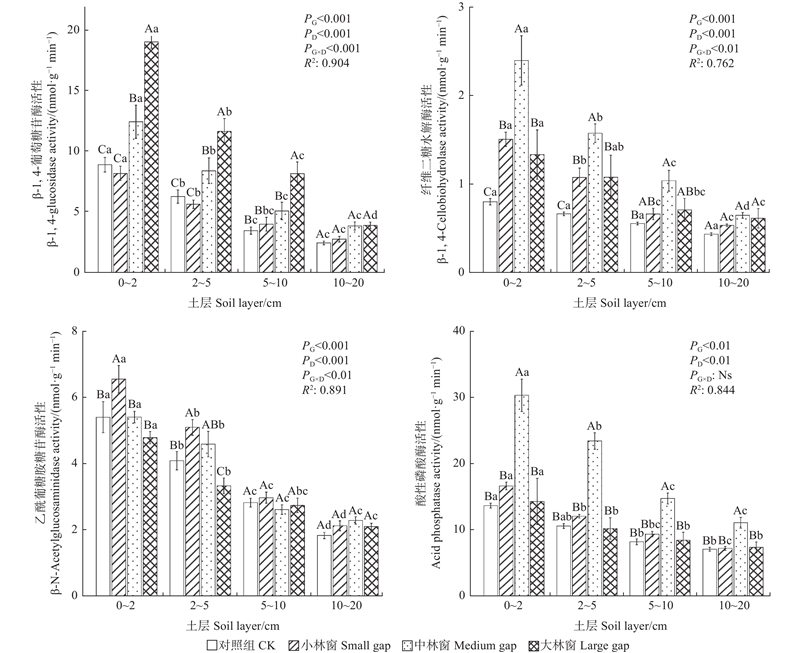

图4
不同林窗大小和土层深度的土壤胞外酶化学计量比 PG:以林窗大小作为单一因素的显著性P值 The significance P-value using forest gap as a single factor. PD:以土层作为单一因素的显著性P值 The significance P-value using soil layer as a single factor. PG×D:林窗大小与土层双因素交互的显著性P值 The significance P-value of the interaction between forest gap size and soil layer. Ns:没有显著性差异 No significance. 不同大写字母表示同一土层深度不同林窗大小间差异显著,不同小写字母表示同一林窗大小不同土层深度间差异显著(P<0.05)At the same soil depth, different uppercase letters indicate significant differences in different forest gap sizes; at the same forest gap size, different lowercase letters indicate significant differences at different soil depths (P<0.05)."
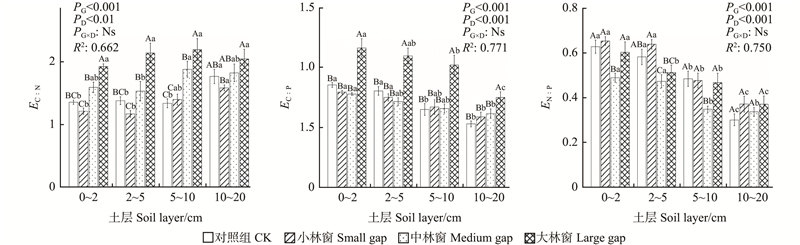
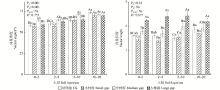
图5
不同林窗大小和土层深度的土壤胞外酶向量特征 PG:以林窗大小作为单一因素的显著性P值 The significance P-value using forest gap as a single factor. PD:以土层作为单一因素的显著性P值 The significance P-value using soil layer as a single factor. PG×D:林窗大小与土层双因素交互的显著性P值 The significance P-value of the interaction between forest gap size and soil layer. Ns:没有显著性差异 No significance. 不同大写字母表示同一土层深度不同林窗大小间差异显著,不同小写字母表示同一林窗大小不同土层深度间差异显著(P<0.05)At the same soil depth, different uppercase letters indicate significant differences in different forest gap sizes; at the same forest gap size, different lowercase letters indicate significant differences at different soil depths (P<0.05)."
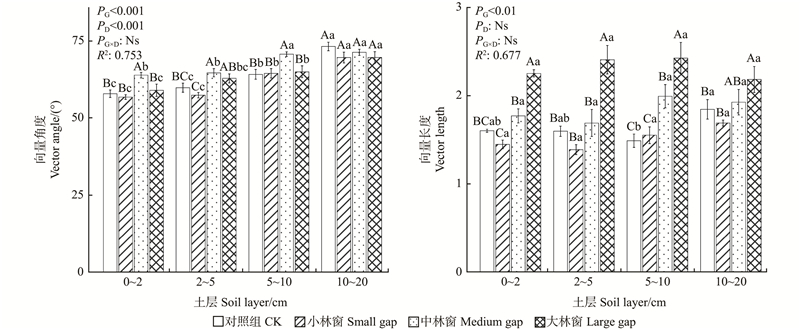
图6
土壤胞外酶化学计量矢量分析模型散点图"
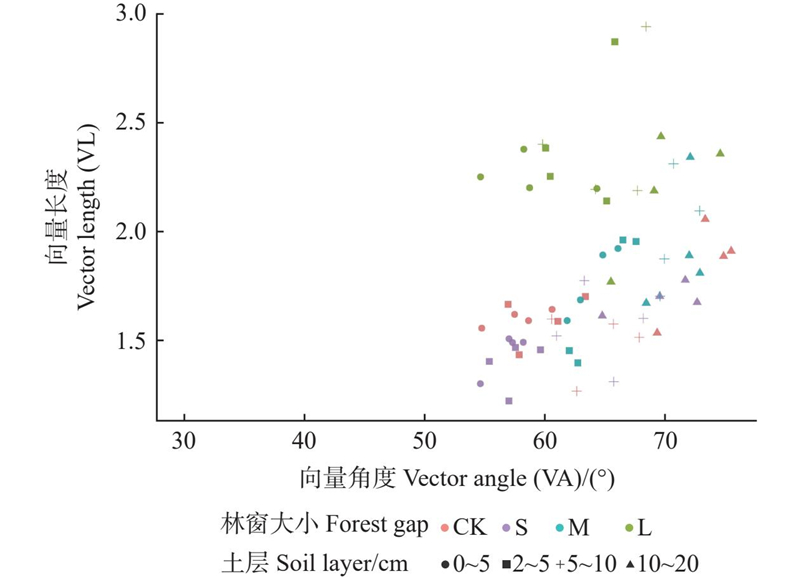
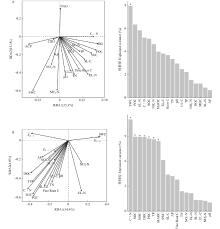
图7
土壤酶活性(A)及其化学计量特征(B)与土壤理化性质的冗余分析(RDA) *:P < 0.05。BG:β-1,4-葡萄糖苷酶活性 β-1,4-glucosidase activity;CBH:纤维二糖水解酶活性 β-1,4-Cellobiohydrolase activity;NAG:乙酰葡糖胺糖苷酶活性 β-N-Acetylglucosaminidase activity;ACP:酸性磷酸酶活性 Acid phosphatase activity;EC∶N:酶化学计量碳氮比 Enzyme stoichiometric C∶N ratio;EC∶P:酶化学计量碳磷比 Enzyme stoichiometric C∶P ratio;EN∶P:酶化学计量氮磷比 Enzyme stoichiometric N:P ratio;SWC:土壤含水量 Soil water content;SOC:土壤有机碳含量 Soil organic carbon content;POC:颗粒态有机碳含量 Particulate organic catter carbon content;MAOC:矿物结合态有机碳含量 Mineral-associated organic matter carbon content;DOC:土壤溶解性有机碳含量 Dissolved organic carbon content;MBC:土壤微生物生物量碳含量 Microbial biomass carbon content;C∶N:土壤碳氮比 Soil C∶N ratio;TP:全磷含量 Total phosphorus content;AP:有效磷含量 Available phosphorus content;TN:全氮含量 Total nitrogen content;NH4+-N:铵态氮含量 Ammonium nitrogen content;NO3–-N:硝态氮含量 Nitrate nitrogen content;Fine root C:细根碳含量 Fine root carbon;UL-C:未分解层枯落物碳含量 Carbon content of undecomposed litter layer;UL-N:未分解层枯落物氮含量Nitrogen content of undecomposed litter layer;SL-C:半分解层枯落物碳含量 Carbon content of semi-decomposed litter layer;SL-N:半分解层枯落物氮含量 Nitrogen content of semi-decomposed litter layer."
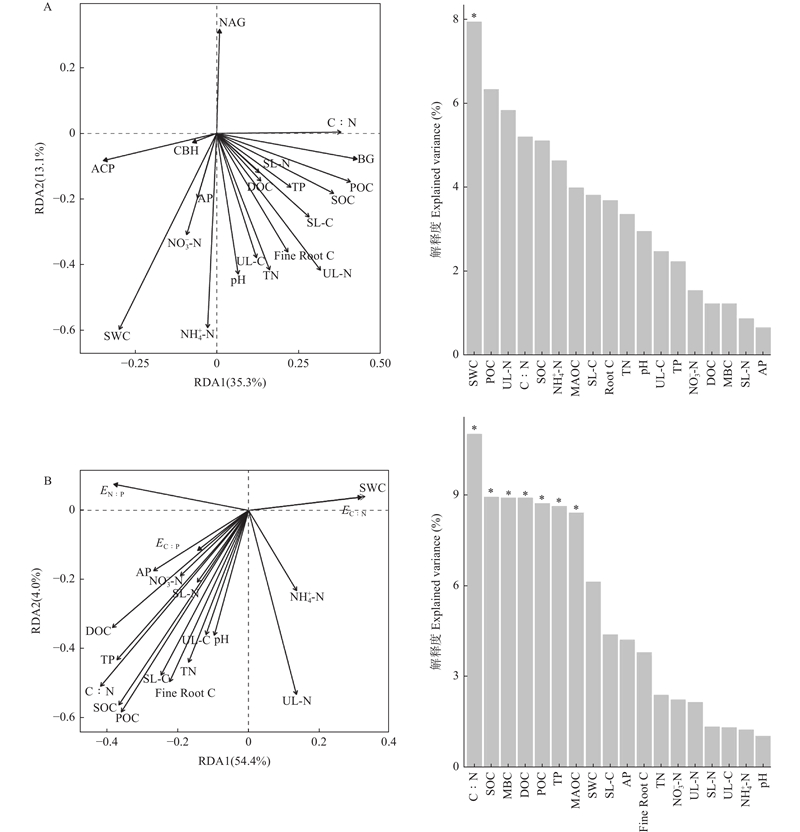
图8
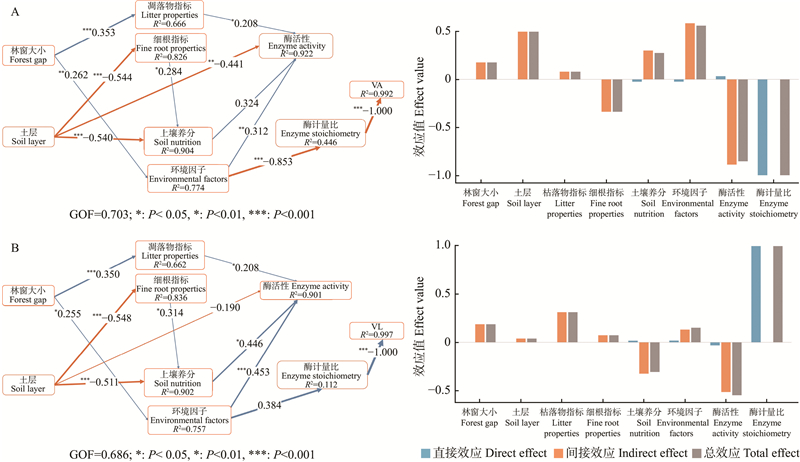
偏最小二乘路径建模(PLS-PM)分析影响土壤酶向量角度(A)和长度(B)的路径 GOF:拟合优度 Goodness of fit. 蓝色箭头表示正向效应,橙色箭头表示负向效应,箭头越粗代表效应越强。Blue arrows indicate positive effects, and orange arrows indicate negative effects; thicker arrows represent stronger effects."
| 鲍士旦. 2000. 土壤农化分析. 北京: 中国农业出版社. | |
| Bao S D. 2000. Soil agricultural chemistry analysis. Beijing: China Agriculture Press. [in Chinese] | |
|
曹 瑞, 杨万勤, 袁 吉, 等. 马尾松人工林土壤有机层和矿质土壤层酶活性随雨旱季的变化. 生态学报, 2022, 42 (19): 8031- 8040.
doi: 10.5846/stxb202003030396 |
|
|
Cao R, Yang W Q, Yuan J, et al. Changes of soil enzyme activities in soil organic layer and mineral soil layer in the masson pine plantation with critical periods. Acta Ecologica Sinica, 2022, 42 (19): 8031- 8040.
doi: 10.5846/stxb202003030396 |
|
|
陈露蔓, 吕 倩, 刘思泽, 等. 柏木低效人工林开窗初期草本层植物多样性及生态位. 应用与环境生物学报, 2021, 27 (5): 1178- 1185.
doi: 10.19675/j.cnki.1006-687x.2020.05025 |
|
|
Chen L M, Lü Q, Liu S Z, et al. Diversity and niche characteristics of herbaceous layer plants in the early stage of forest gap reconstruction of inefficient Cupressus funebris plantations. Chinese Journal of Applied and Environmental, 2021, 27 (5): 1178- 1185.
doi: 10.19675/j.cnki.1006-687x.2020.05025 |
|
|
陈雅轩, 张彧璠, 王佳乐, 等. 不同林龄华北落叶松土壤酶活性和碳氮磷化学计量变化. 生态学报, 2025, 45 (1): 25- 41.
doi: 10.20103/j.stxb.202403180556 |
|
|
Chen Y X, Zhang Y F, Wang J L, et al. Changes of soil enzyme activity and the stoichiometry of carbon, nitrogen, and phosphorus in Larix principis-rupprechtii plantations at different ages. Acta Ecologica Sinica, 2025, 45 (1): 25- 41.
doi: 10.20103/j.stxb.202403180556 |
|
| 段文标, 郭绮雯, 陈立新, 等. 阔叶红松混交林不同大小林隙地表温度和浅层土壤温度的时空异质性. 北京林业大学学报, 2019, 41 (9): 108- 121. | |
| Duan W B, Guo Q W, Chen L X, et al. Heterogeneity of soil surface temperature and shallow soil temperature in different size gaps of broadleaved Pinus koraiensis forest. Journal of Beijing Forestry University, 2019, 41 (9): 108- 121. | |
| 韩 畅, 宋 敏, 杜 虎, 等. 广西不同林龄杉木、马尾松人工林根系生物量及碳储量特征. 生态学报, 2017, 37 (7): 2282- 2289. | |
| Han C, Song M, Du H, et al. Root biomass and carbon storage of Cunninghamia lanceolata and Pinus massoniana plantations with different stand ages in Guangxi. Acta Ecologica Sinica, 2017, 37 (7): 2282- 2289. | |
| 胡 澳, 赵毅辉, 吴继来, 等. 采伐后植被自然恢复对马尾松次生林土壤有机碳及其活性组分的影响. 浙江农林大学学报, 2024, 41 (6): 1189- 1200. | |
| Hu A, Zhao Y H, Wu J L, et al. Effects of natural vegetation restoration after logging on soil organic carbon and its active components in Pinus massoniana secondary forest. Journal of Zhejiang A&F University, 2024, 41 (6): 1189- 1200. | |
|
简尊吉, 倪妍妍, 徐 瑾, 等. 马尾松人工林土壤碳氮磷生态化学计量学特征的纬度变化. 林业科学研究, 2022, 35 (2): 1- 8.
doi: 10.13275/j.cnki.lykxyj.2022.02.001 |
|
|
Jian Z J, Ni Y Y, Xu J, et al. Latitudinal variations of soil C, N and P eco-stoichiometry in Pinus massoniana plantations. Forest Research, 2022, 35 (2): 1- 8.
doi: 10.13275/j.cnki.lykxyj.2022.02.001 |
|
| 蒋 倩, 姚俊宇, 伍炫蓓, 等. 川西周公山柳杉人工林林窗大小对土壤理化性质和物种多样性的影响. 生态与农村环境学报, 2018, 34 (4): 326- 332. | |
| Jiang Q, Yao J Y, Wu X B, et al. Effects of size of gaps in Cryptomeria fortunei plantation on soil physicochemical properties and species diversity in Zhougong Mountain. Journal of Ecology and Rural Environment, 2018, 34 (4): 326- 332. | |
|
景家琪, 刘新平, 何玉惠, 等. 降水量对半干旱沙质草地土壤胞外酶活性的影响. 中国沙漠, 2025, 45 (4): 368- 377.
doi: 10.7522/j.issn.1000-694X.2025.00069 |
|
|
Jing J Q, Liu X P, He Y H, et al. Influence of precipitation on soil enzyme activity in sandy grasslands. Journal of Desert Research, 2025, 45 (4): 368- 377.
doi: 10.7522/j.issn.1000-694X.2025.00069 |
|
| 李建平, 欧 江, 宋小艳, 等. 马尾松人工林林窗土壤有效氮和氮转化酶活性的季节动态. 生态学杂志, 2015, 34 (9): 2598- 2604. | |
| Li J P, Ou J, Song X Y, et al. Seasonal variations of soil available nitrogen and nitrogen transformation enzyme activities in forest gaps of Pinus massoniana plantations. Chinese Journal of Ecology, 2015, 34 (9): 2598- 2604. | |
| 李文蕊, 张静淳, 陶晓君, 等. 2026. 不同林分密度思茅松人工林土壤胞外酶化学计量特征. 应用与环境生物学报, 32(5): 780–792. | |
| Li W R, Zhang J C, Tao X J, et al. 2025. Extracellular enzymatic stoichiometric characteristics in soil of Pinus kesiya var. langbianensis plantations with different stand densities. Chinese Journal of Applied and Environmental Biology, 32(5): 780–792. [in Chinese] | |
| 刘珊杉, 周文君, 况露辉, 等. 亚热带常绿阔叶林土壤胞外酶活性对碳输入变化及增温的响应. 植物生态学报, 2020, 44 (12): 1262- 1272. | |
| Liu S S, Zhou W J, Kuang L H, et al. Responses of soil extracellular enzyme activities to carbon input alteration and warming in a subtropical evergreen broad-leaved forest. Chinese Journal of Plant Ecology, 2020, 44 (12): 1262- 1272. | |
|
漆良华, 田慧敏, 王辉民, 等. 南方低质低效人工林质量改善与生态服务提升技术研究前瞻. 中国水土保持科学(中英文), 2024, 22 (5): 1- 8.
doi: 10.16843/j.sswc.2024132 |
|
|
Qi L H, Tian H M, Wang H M, et al. Prospects of research on quality improvement and ecological service enhancement technologies of low-quality and low-efficiency plantations in Southern China. Science of Soil and Water Conservation, 2024, 22 (5): 1- 8.
doi: 10.16843/j.sswc.2024132 |
|
| 齐梦娟, 石朔蓉, 姜春前, 等. 青冈栎次生林土壤活性有机碳对间伐强度的响应. 林业科学研究, 2021, 34 (6): 122- 129. | |
| Qi M J, Shi S R, Jiang C Q, et al. Response of soil labile organic carbon to thinning intensity in Cyclobalanopsis glauca secondary forest. Forest Research, 2021, 34 (6): 122- 129. | |
| 宋小艳, 张丹桔, 张 健, 等. 马尾松 (Pinus massoniana) 人工林林窗对土壤不同形态活性有机碳的影响. 生态学报, 2015, 35 (16): 5393- 5402. | |
| Song X Y, Zhang D J, Zhang J, et al. Effects of gap size in Pinus massoniana plantations on different soil labile organic carbon fractions. Acta Ecologica Sinica, 2015, 35 (16): 5393- 5402. | |
| 王 成, 庞学勇, 包维楷. 低强度林窗式疏伐对云杉人工纯林地表微气候和土壤养分的短期影响. 应用生态学报, 2010, 21 (3): 541- 548. | |
| Wang C, Pang X Y, Bao W K. Short-term effects of low-intensity thinning on surface microclimate and soil nutrients in Picea asperata plantation. Chinese Journal of Applied Ecology, 2010, 21 (3): 541- 548. | |
|
王 娜, 沈雅飞, 程瑞梅, 等. 三峡库区马尾松细根生产和周转及其影响因子. 应用生态学报, 2017, 28 (12): 3845- 3853.
doi: 10.13287/j.1001-9332.201712.010 |
|
|
Wang N, Shen Y F, Cheng R M, et al. Fine root production and turnover of Pinus massoniana and their influencing factors in the Three Gorges Reservoir Area. Chinese Journal of Applied Ecology, 2017, 28 (12): 3845- 3853.
doi: 10.13287/j.1001-9332.201712.010 |
|
| 王雪琳, 刘金福, 何中声, 等. 格氏栲林窗土壤微生物群落功能多样性季节动态特征. 北京林业大学学报, 2020, 42 (7): 77- 88. | |
| Wang X L, Liu J F, He Z S, et al. Seasonal dynamics of functional diversity of soil microbial community in Castanopsis carlesii forest gaps. Journal of Beijing Forestry University, 2020, 42 (7): 77- 88. | |
| 王永康, 邱静雯, 王 瑞, 等. 不同林窗面积对马尾松林内微环境的影响及土壤质量评价. 中南林业科技大学学报, 2025, 45 (5): 89- 102. | |
| Wang Y K, Qiu J W, Wang R, et al. Effects of different forest gap areas on the microenvironment of Pinus massoniana forest and soil quality evaluation. Journal of Central South University of Forestry & Technology, 2025, 45 (5): 89- 102. | |
| 肖华翠, 李靖雯, 夏 允, 等. 中亚热带不同母质发育森林土壤磷组分特征及其影响因素. 应用生态学报, 2021, 32 (1): 161- 170. | |
| Xiao H C, Li J W, Xia Y, et al. Characteristics and influencing factors of soil phosphorus fractions in forests developed from different parent materials in the central subtropics. Chinese Journal of Applied Ecology, 2021, 32 (1): 161- 170. | |
| 尹海锋, 刘思泽, 曾 杰, 等. 2026. 林窗改造下马尾松根系分解与土壤线虫功能群的互馈作用. 林业科学, 62(2): 85–96. | |
| Yin H F, Liu S Z, Zeng J, et al. 2025. The feedback interaction between root decomposition and soil nematode trophic groups in Pinus massoniana plantations under forest gap management. Scientia Silvae Sinicae, 62(2): 85–96. [in Chinese] | |
| 郑 蔚, 周嘉聪, 林伟盛, 等. 土壤增温对中亚热带杉木幼林不同深度土壤微生物胞外酶活性的影响. 应用生态学报, 2019, 30 (3): 832- 840. | |
| Zheng W, Zhou J C, Lin W S, et al. Effects of soil warming on soil microbial extracellular enzyme activities with different depths in a young Cunninghamia lanceolata plantation of subtropics. Chinese Journal of Applied Ecology, 2019, 30 (3): 832- 840. | |
| 朱念福, 吴绍发, 沈庆华, 等. 林窗对马尾松和杉木林乔木树种生长及组成多样性的影响. 生态学报, 2025, 45 (15): 7482- 7491. | |
| Zhu N F, Wu S F, Shen Q H, et al. Effects of forest gaps on the growth and species composition diversity of trees in forests of Pinus massoniana and Cunninghamia lanceolata. Acta Ecologica Sinica, 2025, 45 (15): 7482- 7491. | |
|
Allison S D. A trait-based approach for modelling microbial litter decomposition. Ecology Letters, 2012, 15 (9): 1058- 1070.
doi: 10.1111/j.1461-0248.2012.01807.x |
|
|
Baer T, Furrer G, Zimmermann S, et al. Long-term additions of ammonium nitrate to montane forest ecosystems may cause limited soil acidification, even in the presence of soil carbonate. Biogeosciences, 2023, 20 (22): 4577- 4589.
doi: 10.5194/bg-20-4577-2023 |
|
|
Chen J J, Zhu J, Wang Z W, et al. Canopy gaps control litter decomposition and nutrient release in subtropical forests. Forests, 2023, 14 (4): 673.
doi: 10.3390/f14040673 |
|
|
Chen S Y, Jiang C Q, Bai Y F, et al. Effects of forest gap on soil microbial communities in an evergreen broad-leaved secondary forest. Forests, 2022, 13 (12): 2015.
doi: 10.3390/f13122015 |
|
|
Chen W J, Zhang X, Wang Y Q, et al. Canopy density affects nutrient limitation and soil quality index in a secondary forest, in China. Plant and Soil, 2025, 514 (1): 905- 918.
doi: 10.1007/s11104-025-07429-z |
|
|
Cotrufo M F, Ranalli M G, Haddix M L, et al. Soil carbon storage informed by particulate and mineral-associated organic matter. Nature Geoscience, 2019, 12 (12): 989- 994.
doi: 10.1038/s41561-019-0484-6 |
|
|
Cui Y X, Bing H J, Moorhead D L, et al. Ecoenzymatic stoichiometry reveals widespread soil phosphorus limitation to microbial metabolism across Chinese forests. Communications Earth & Environment, 2022, 3 (1): 184.
doi: 10.1038/s43247-022-00523-5 |
|
|
Deng L, Peng C H, Huang C B, et al. Drivers of soil microbial metabolic limitation changes along a vegetation restoration gradient on the Loess Plateau, China. Geoderma, 2019, 353, 188- 200.
doi: 10.1016/j.geoderma.2019.06.037 |
|
|
Dobrowolska D, Veblen T T. Treefall-gap structure and regeneration in mixed Abies alba stands in central Poland. Forest Ecology and Management, 2008, 255 (8): 3469- 3476.
doi: 10.1016/j.foreco.2008.02.025 |
|
|
German D P, Weintraub M N, Grandy A S, et al. Optimization of hydrolytic and oxidative enzyme methods for ecosystem studies. Soil Biology and Biochemistry, 2011, 43 (7): 1387- 1397.
doi: 10.1016/j.soilbio.2011.03.017 |
|
|
Guerrieri R, Cáliz J, Mattana S, et al. Substantial contribution of tree canopy nitrifiers to nitrogen fluxes in European forests. Nature Geoscience, 2024, 17 (2): 130- 136.
doi: 10.1038/s41561-023-01364-3 |
|
|
Hou M T, Zhang G Q, Li Y L, et al. The effects of canopy gaps on soil nutrient properties: a meta-analysis. European Journal of Forest Research, 2024, 143 (3): 861- 873.
doi: 10.1007/s10342-024-01660-6 |
|
|
Jiang Y M, Lü M K, Lu Y M, et al. Lignin-microbial necromass carbon coupling drives the vertical stratification mechanism of deep soil carbon sequestration in subtropical forests. Journal of Applied Ecology, 2025, 62 (12): 3550- 3564.
doi: 10.1111/1365-2664.70215 |
|
|
Jiao S, Chen W M, Wang J L, et al. Soil microbiomes with distinct assemblies through vertical soil profiles drive the cycling of multiple nutrients in reforested ecosystems. Microbiome, 2018, 6 (1): 146.
doi: 10.1186/s40168-018-0526-0 |
|
|
Lenk A, Richter R, Kretz L, et al. Effects of canopy gaps on microclimate, soil biological activity and their relationship in a European mixed floodplain forest. Science of The Total Environment, 2024, 941, 173572.
doi: 10.1016/j.scitotenv.2024.173572 |
|
|
Liu J B, Chen J, Chen G S, et al. Enzyme stoichiometry indicates the variation of microbial nutrient requirements at different soil depths in subtropical forests. Plos One, 2020, 15 (2): e0220599.
doi: 10.1371/journal.pone.0220599 |
|
|
Liu S, Zhang X Y, Wang H M, et al. Phosphorus-transforming microbes enhance phosphatase catalytic efficiency to alleviate phosphorus limitation under nitrogen and phosphorus additions in subtropical forest soil. Soil Biology and Biochemistry, 2025, 209, 109915.
doi: 10.1016/j.soilbio.2025.109915 |
|
|
Mallik A U, Kreutzweiser D P, Spalvieri C M. Forest regeneration in gaps seven years after partial harvesting in riparian buffers of boreal mixedwood streams. Forest Ecology and Management, 2014, 312, 117- 128.
doi: 10.1016/j.foreco.2013.10.015 |
|
|
Men X X, Bao Y, Zhai D P, et al. Different regulatory mechanisms on carbon-degrading enzyme activities under short-term litter input manipulations in subalpine coniferous and broad-leaved forest soils. Soil Biology and Biochemistry, 2024, 196, 109512.
doi: 10.1016/j.soilbio.2024.109512 |
|
|
Ren Y, Wang Y, Zhang X L, et al. Enzymatic stoichiometry reveals the metabolic limitations of soil microbes under nitrogen and phosphorus addition in Chinese fir plantations. Microorganisms, 2024, 12 (8): 1716.
doi: 10.3390/microorganisms12081716 |
|
|
Saiya-Cork K R, Sinsabaugh R L, Zak D R. The effects of long term nitrogen deposition on extracellular enzyme activity in an Acer saccharum forest soil. Soil Biology and Biochemistry, 2002, 34 (9): 1309- 1315.
doi: 10.1016/S0038-0717(02)00074-3 |
|
|
Sinsabaugh R L, Hill B H, Follstad Shah J J. Ecoenzymatic stoichiometry of microbial organic nutrient acquisition in soil and sediment. Nature, 2009, 462 (7274): 795- 798.
doi: 10.1038/nature08632 |
|
|
Sinsabaugh R L, Lauber C L, Weintraub M N, et al. Stoichiometry of soil enzyme activity at global scale. Ecology Letters, 2008, 11 (11): 1252- 1264.
doi: 10.1111/j.1461-0248.2008.01245.x |
|
|
Stone M M, DeForest J L, Plante A F. Changes in extracellular enzyme activity and microbial community structure with soil depth at the Luquillo Critical Zone Observatory. Soil Biology and Biochemistry, 2014, 75, 237- 247.
doi: 10.1016/j.soilbio.2014.04.017 |
|
|
Tláskal V, Thiago Dobbler P, Bosch J, et al. Fragile foundations: succession patterns of bacterial communities in fine woody debris and soil under long-term microclimate influence. Environmental Microbiome, 2025, 20 (1): 101.
doi: 10.1186/s40793-025-00756-9 |
|
|
Tong R, Ji B Y, Wang G G, et al. Canopy gap impacts on soil organic carbon and nutrient dynamic: a meta-analysis. Annals of Forest Science, 2024, 81 (1): 12.
doi: 10.1186/s13595-024-01224-z |
|
|
Wang H C, Wang H, Crowther T W, et al. Metagenomic insights into inhibition of soil microbial carbon metabolism by phosphorus limitation during vegetation succession. ISME Communications, 2024, 4 (1): ycae128.
doi: 10.1093/ismeco/ycae128 |
|
|
Wang J P, Chen G R, Ji S H, et al. Close relationship between the gene abundance and activity of soil extracellular enzyme: evidence from a vegetation restoration chronosequence. Soil Biology and Biochemistry, 2023, 177, 108929.
doi: 10.1016/j.soilbio.2022.108929 |
|
|
Wang L, Li K, Guo J Y, et al. Extracellular enzyme stoichiometry reveals soil microbial carbon and phosphorus limitations in the Yimeng Mountain Area, China. Forests, 2022, 13 (5): 692.
doi: 10.3390/f13050692 |
|
|
Wu C P, Jiao J J, Chen M, et al. Gap size modulates soil-microbe-metabolite interactions across stand development stages in Cunninghamia lanceolata. Forest Ecology and Management, 2025, 596, 123104.
doi: 10.1016/j.foreco.2025.123104 |
|
|
Xu J X, Xue L, Su Z. Impacts of forest gaps on soil properties after a severe ice storm in a Cunninghamia lanceolata stand. Pedosphere, 2016, 26 (3): 408- 416.
doi: 10.1016/S1002-0160(15)60053-4 |
|
|
Yang Y G, Geng Y Q, Zhou H J, et al. Effects of gaps in the forest canopy on soil microbial communities and enzyme activity in a Chinese pine forest. Pedobiologia, 2017, 61, 51- 60.
doi: 10.1016/j.pedobi.2017.03.001 |
|
|
Yu Q S, Anthony M A, Gessler A, et al. Decadal nutrient addition reveals phosphorus limitation and its adaptive mechanisms in tropical rainforests. Soil Biology and Biochemistry, 2025, 211, 109976.
doi: 10.1016/j.soilbio.2025.109976 |
|
|
Yu X, Yang L, Fei S X, et al. Effect of soil layer and plant-soil interaction on soil microbial diversity and function after canopy gap disturbance. Forests, 2018, 9 (11): 680.
doi: 10.3390/f9110680 |
|
|
Zellweger F, De Frenne P, Lenoir J, et al. Forest microclimate dynamics drive plant responses to warming. Science, 2020, 368 (6492): 772- 775.
doi: 10.1126/science.aba6880 |
|
|
Zhu J J, Lu D L, Zhang W D. Effects of gaps on regeneration of woody plants: a meta-analysis. Journal of Forestry Research, 2014, 25 (3): 501- 510.
doi: 10.1007/s11676-014-0489-3 |
|
| Zhu J J, Zhang G Q, Wang G G, et al. 2015. On the size of forest gaps: Can their lower and upper limits be objectively defined? Agricultural and Forest Meteorology, 213: 64–76. |
| [1] | 罗斯生,罗碧珍,魏书精,胡海清,李小川,王振师,周宇飞,宋兆,钟映霞. 中度火灾一年后马尾松林土壤碳库特征[J]. 林业科学, 2022, 58(9): 25-35. |
| [2] | 张治军 张小全 王彦辉 罗云建 李志勇 曹磊. 重庆铁山坪马尾松林生态系统碳贮量及其分配特征*[J]. 林业科学, 2009, 12(5): 49-53. |
| 阅读次数 | ||||||
|
全文 |
|
|||||
|
摘要 |
|
|||||

