
林业科学 ›› 2026, Vol. 62 ›› Issue (3): 111-121.doi: 10.11707/j.1001-7488.LYKX20250174
杜月伟1,萨日娜1,金海炎2,胡艳波1,张弓乔1,刘文桢2,赵中华1,*( )
)
收稿日期:2025-03-26
修回日期:2025-06-30
出版日期:2026-03-15
发布日期:2026-03-12
通讯作者:
赵中华
E-mail:zzhwl@caf.ac.cn
基金资助:
Yuewei Du1, Sarina1,Haiyan Jin2,Yanbo Hu1,Gongqiao Zhang1,Wenzhen Liu2,Zhonghua Zhao1,*()
Received:2025-03-26
Revised:2025-06-30
Online:2026-03-15
Published:2026-03-12
Contact:
Zhonghua Zhao
E-mail:zzhwl@caf.ac.cn
摘要:
目的: 针对次生林发育阶段划分指标零散、阈值模糊的问题,构建基于林分状态特征的定量化划分方法,探讨发育阶段划分关键指标综合阈值,为次生林修复和全周期可持续经营提供科学依据。方法: 以甘肃小陇山林区不同类型锐齿槲栎次生林为研究对象,选取15个表征林分状态特征的指标,采用系统聚类法对不同类型锐齿槲栎次生林进行聚类,通过Kruskal-Wallis非参数检验筛选影响锐齿槲栎次生林聚类的因子,构建发育阶段划分指标体系;应用层次分析法(AHP)、熵权法(EWM)等确定关键指标综合权重,并结合拉格朗日乘数法计算综合值,给出基于林分状态特征的次生林发育阶段。结果: 1) 基于林分状态特征,采用系统聚类法(以均值距离为度量)将15块样地划分为4个类别,Kruskal-Wallis非参数检验显示,更新等级、蓄积量、林分直径分布q值、平均树高、建群种优势度、角尺度、混交度、Shannon-Wiener指数、Margalef指数、Simpson指数和Pielou指数达到统计学显著水平(P<0.05);2) 选择蓄积量、林分直径分布q值、平均树高、建群种优势度、角尺度、混交度、Shannon-Wiener指数、Margalef指数和更新等级9个指标构成次生林发育阶段划分指标体系,其综合权重分别为17.69%、8.76%、7.09%、14.07%、10.61%、10.75%、10.81%、14.33%和5.89%;基于林分状态特征的次生林发育阶段可划分为更新期(林隙期、郁闭期)、分化期、建成期和稳定期;3) 采用该方法对15块锐齿槲栎次生林样地进行发育阶段划分,2块样地处于更新期、8块样地处于分化期、3块样地处于建成期、2块样地处于稳定期。结论: 影响次生林发育阶段划分的关键因素是蓄积量、林分直径分布q值、平均树高、建群种优势度、角尺度、混交度、多样性指数和更新等级;基于林分状态特征可将次生林划分为4个发育阶段,该方法可为锐齿槲栎次生林的发育阶段划分及其精准经营提供理论依据。
中图分类号:
杜月伟,萨日娜,金海炎,胡艳波,张弓乔,刘文桢,赵中华. 基于林分状态特征的次生林发育阶段划分方法——以锐齿槲栎次生林为例[J]. 林业科学, 2026, 62(3): 111-121.
Yuewei Du, Sarina,Haiyan Jin,Yanbo Hu,Gongqiao Zhang,Wenzhen Liu,Zhonghua Zhao. Method for Dividing the Development Stages of Secondary Forests Based on Stand State Characteristics: a Case Study of Quercus aliena var. acuteserrata Secondary Forest[J]. Scientia Silvae Sinicae, 2026, 62(3): 111-121.

表1
各样地概况"
| 样地 Plot | 经营历史 Management history | 面积Area/ m2 | 树种组成 Tree species composition | 断面积Basal area/ (m2·hm?2) | 平均 胸径Average DBH/cm | 平均树高Average tree height/m | 密度 Density/ (tree·hm?2) | 更新 等级Regeneration level | 实生 比例Seedling proportion | 林层 Forest layer | 蓄积量Volume/ (m3·hm?2) |
| 1 | 1983年次生林综合培育 Comprehensive cultivation of secondary forests in 1983 | 50× 50 | 9锐齿槲栎1其他 9 Q. aliena var. acuteserrata, 1 other | 31.89 | 19.7 | 10.3 | 1 048 | 3 | 0.8 | 3 | 205.21 |
| 2 | 1983年次生林综合培育 Comprehensive cultivation of secondary forests in 1983 | 50× 50 | 7锐齿槲栎1春榆2其他 7 Q. aliena var. acuteserrata, 1 Ulmus davidiana var. japonica, 2 others | 32.79 | 19.9 | 11.1 | 1 052 | 2 | 0.93 | 3 | 212.48 |
| 3 | 1982年进行强度择伐 High-intensity selective cutting in 1982 | 35× 35 | 5白桦1锐齿槲栎4其他 5 Betula platyphylla, 1 Q. aliena var. acuteserrata, 4 others | 29.95 | 14.4 | 11.4 | 1 845 | 2 | 0.81 | 2 | 170.39 |
| 4 | 1982年进行强度择伐 High-intensity selective cutting in 1982 | 30× 30 | 5锐齿槲栎2白桦3其他 5 Q. aliena var. acuteserrata, 2 B. platyphylla, 3 others | 25.15 | 13.2 | 8.7 | 1 844 | 2 | 0.84 | 2 | 118.48 |
| 5 | 人为破坏后补植油松 Replanting Pinus tabuliformis after human damage | 40× 40 | 6锐齿槲栎2油松2其他 6 Q. aliena var. acuteserrata, 2 P. tabuliformis, 2 others | 27.18 | 11.9 | 8.0 | 2 438 | 1 | 0.27 | 3 | 128.77 |
| 6 | 人为破坏后补植油松 Replanting P. tabuliformis after human damage | 40× 40 | 5锐齿槲栎1槲树4其他 5 Q. aliena var. acuteserrata, 1 Q. dentata, 4 others | 22.03 | 13.8 | 10.1 | 1 463 | 2 | 0.37 | 2 | 120.55 |
| 7 | 1986年进行大强度择伐 High-intensity selective cutting in 1986 | 50× 50 | 3锐齿槲栎1铁木1华山松1华椴1水榆花楸3其他3 Q. aliena var. acuteserrata, 1 Ostrya japonica, 1 P. armandii, 1 Tilia chinensis, 1 Sorbus alnifolia, 3 others | 26.33 | 14.1 | 11.9 | 1 676 | 4 | 0.93 | 2 | 173.80 |
| 8 | 1945年火烧后自然恢复,1989年林冠下油松造林 Natural recovery post-1945 fire, with P. tabuliformis planted under canopy in 1989 | 30× 30 | 8锐齿槲栎1油松1其他 8 Q. aliena var. acuteserrata, 1 P. tabuliformis, 1 other | 31.76 | 20.6 | 11.9 | 956 | 1 | 0.65 | 3 | 225.87 |
| 9 | 1945年火烧后自然恢复,1989林冠下油松造林 Natural recovery post-1945 fire, with P. tabuliformis planted under canopy in 1989 | 30× 30 | 7锐齿槲栎2油松1其他 7 Q. aliena var. acuteserrata, 2 P. tabuliformis, 1 other | 27.00 | 20.2 | 12.4 | 844 | 2 | 0.65 | 2 | 192.57 |
| 10 | 1945年火烧后自然恢复,1991年林冠下油松造林 Natural recovery post-1945 fire, with P. tabuliformis planted under canopy in 1989 | 30× 30 | 9锐齿槲栎1其他 9 Q. aliena var. acuteserrata, 1 other | 31.48 | 20.5 | 13.9 | 956 | 2 | 0.65 | 2 | 230.59 |
| 11 | 1945年火烧后自然恢复 1992年林冠下油松造林 Natural recovery post-1945 fire, with P. tabuliformis planted under canopy in 1989 | 30× 30 | 8锐齿槲栎1油松1其他 8 Q. aliena var. acuteserrata, 1 P. tabuliformis, 1 other | 33.18 | 19.7 | 12.6 | 1 089 | 2 | 0.65 | 2 | 231.02 |
| 12 | 1988年次生林综合培育 Comprehensive cultivation of secondary forests in 1988 | 70× 70 | 5锐齿槲栎2山榆3其他 5 Q. aliena var. acuteserrata, 2 U. davidiana, 3 others | 26.98 | 20.6 | 13.6 | 810 | 3 | 0.43 | 3 | 222.27 |
| 13 | 1988年次生林综合培育 Comprehensive cultivation of secondary forests in 1988 | 70× 70 | 5锐齿槲栎1太白槭4其他 5 Q. aliena var. acuteserrata, 1 Acer giraldii, 4 others | 29.12 | 22.8 | 14.1 | 714 | 2 | 0.43 | 3 | 227.69 |
| 14 | 没有经营活动 No operation | 60× 60 | 4锐齿槲栎1漆树1华山松 4其他 4 Q. aliena var. acuteserrata, 1 Toxicodendron vernicifluum, 1 P. armandii, 4 others | 28.45 | 17.9 | 13.4 | 1 136 | 3 | 0.74 | 2 | 198.86 |
| 15 | 没有经营活动 No operation | 100× 100 | 5锐齿槲栎1鹅耳枥4其他 5 Q. aliena var. acuteserrata, 1 Carpinus turczaninowii, 4 others | 39.82 | 19.1 | 12.4 | 1 271 | 3 | 0.74 | 2 | 319.06 |
表2
林分状态指标值"
| 样地 Plot | 林分拥挤度 Stand crowding degree | q值 q-vaule | 建群种优势度 Dominance of constructive species | 角尺度 Uniform angle index | 混交度 Mingling | Shannon-Wiener指数 Shannon-Wiener index | Margalef指数 Margalef index | Pielou指数 Pielou index | Simpson指数 Simpson index |
| 1 | 0.847 | 1.140 | 0.753 | 0.494 | 0.558 | 1.631 | 3.053 | 0.564 | 0.642 |
| 2 | 0.805 | 1.147 | 0.719 | 0.492 | 0.708 | 2.335 | 4.846 | 0.701 | 0.799 |
| 3 | 0.615 | 1.313 | 0.572 | 0.523 | 0.699 | 2.033 | 3.318 | 0.691 | 0.774 |
| 4 | 1.280 | 1.322 | 0.544 | 0.523 | 0.636 | 1.873 | 3.521 | 0.366 | 0.736 |
| 5 | 0.690 | 1.376 | 0.568 | 0.543 | 0.427 | 1.613 | 3.185 | 0.538 | 0.640 |
| 6 | 0.704 | 1.201 | 0.498 | 0.529 | 0.521 | 2.173 | 3.666 | 0.714 | 0.800 |
| 7 | 0.719 | 1.228 | 0.470 | 0.528 | 0.762 | 2.560 | 4.306 | 0.777 | 0.895 |
| 8 | 0.624 | 1.084 | 0.845 | 0.462 | 0.744 | 1.590 | 1.963 | 0.723 | 0.726 |
| 9 | 0.656 | 1.080 | 0.774 | 0.477 | 0.799 | 1.669 | 1.963 | 0.760 | 0.744 |
| 10 | 0.661 | 1.097 | 0.786 | 0.481 | 0.609 | 1.392 | 2.005 | 0.633 | 0.608 |
| 11 | 0.660 | 1.093 | 0.694 | 0.474 | 0.715 | 1.778 | 2.817 | 0.772 | 0.750 |
| 12 | 0.623 | 1.150 | 0.600 | 0.495 | 0.842 | 2.723 | 6.016 | 0.760 | 0.898 |
| 13 | 0.701 | 1.089 | 0.596 | 0.527 | 0.771 | 2.627 | 5.975 | 0.733 | 0.881 |
| 14 | 0.550 | 1.220 | 0.518 | 0.502 | 0.803 | 2.823 | 6.485 | 0.765 | 0.881 |
| 15 | 0.502 | 1.181 | 0.620 | 0.538 | 0.713 | 3.064 | 6.855 | 0.787 | 0.930 |
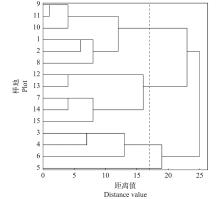
图1
系统聚类使用平均联接(组间)的谱系"
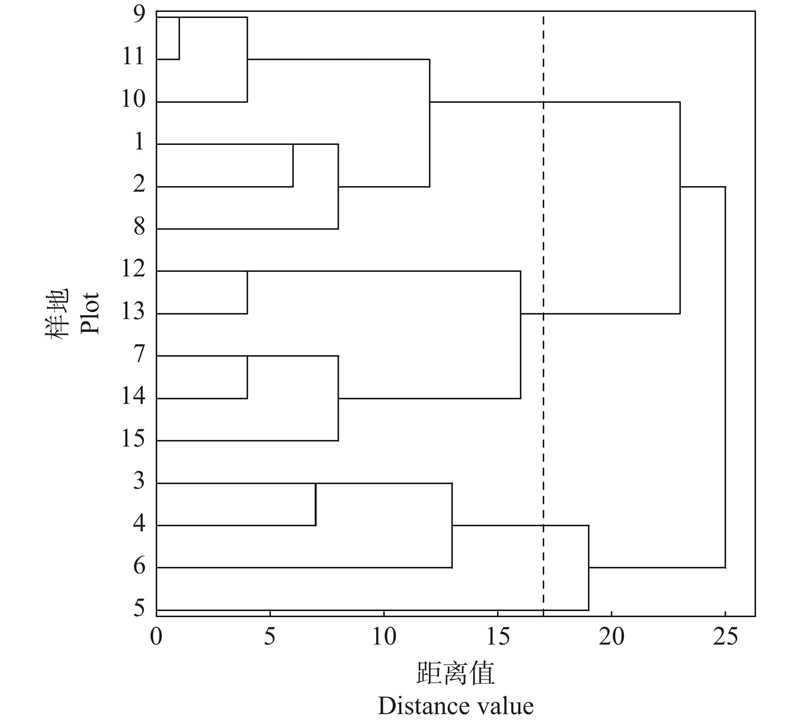
表3
林分状态检验结果及指标权重"
| 指标 Indicator | H值(Kruskal-Wallis) H value | P值 P-value | 层次分析 法AHP (%) | 熵权法 EWM (%) | 综合权重 Comprehensive weights (%) |
| 建群种优势度 Dominance of constructive species | 11.045 | 0.016 | 4.65 | 30.95 | 14.07 |
| Shannon-Wiener指数Shannon-Wiener index | 10.833 | 0.013 | 13.00 | 6.54 | 10.81 |
| Simpson指数Simpson index | 10.786 | 0.013 | — | — | — |
| Margalef指数Margalef index | 9.878 | 0.020 | 17.38 | 8.59 | 14.33 |
| Pielou指数Pielou index | 9.008 | 0.029 | — | — | — |
| q值q-vaule | 9.765 | 0.021 | 11.53 | 4.84 | 8.76 |
| 平均树高Average tree height | 8.858 | 0.031 | 7.55 | 4.84 | 7.09 |
| 角尺度Uniform angle index | 11.051 | 0.011 | 9.54 | 8.59 | 10.61 |
| 蓄积量Volume | 8.285 | 0.040 | 11.59 | 19.65 | 17.69 |
| 混交度Mingling | 8.114 | 0.044 | 6.16 | 13.63 | 10.75 |
| 更新等级Regeneration level | 7.940 | 0.047 | 10.63 | 2.37 | 5.89 |
| 断面积Basal area | 6.532 | 0.088 | — | — | — |
| 林层Forest layer | 3.500 | 0.321 | — | — | — |
| 实生比例Seedling proportion | 2.769 | 0.429 | — | — | — |
| 林分拥挤度 Stand crowding degree | 1.885 | 0.597 | — | — | — |
表4
林分发育阶段划分结果及特征"
| 时期 Stage | 综合阈值 Comprehensive threshold | 状态特征 State characteristics | |
| 更新期 Regeneration period | 林隙期 Gap period | [0~0.15) | 由于干扰形成大面积林窗,林分中存在建群种个体,出现更新幼苗、幼树,林木个体大小变异明显,树高和蓄积量较低;林木聚集分布,树种多样性较低,低度至中度混交 Large forest gaps formed due to disturbance, the stand contains individuals of the dominant species, with the presence of regenerating seedlings and saplings. There is significant variation in tree size, while tree height and stocking volume are relatively low. The trees exhibit an aggregated distribution pattern, with low species diversity and low to moderate mingling |
| 郁闭期 Canopy period | [0.15~0.3) | 林窗中更新大量幼树、幼苗,林分密度较大,林分开始郁闭,具有萌孽能力的建群种大量萌发,先锋树种偶尔占据优势,树高和蓄积量较低,林木个体大小差异加大,林木聚集分布,树种多样性上升,中度混交向强度混交过渡 There are abundant saplings and seedlings regenerated in forest gaps, with relatively high stand density. The canopy begins to close, and the dominant species with sprouting capacity vigorously regenerate, while pioneer species occasionally become dominant. The stand exhibits low tree height and stocking volume, size variation increases among individuals, tree distribution aggregates, species diversity rises, and a transition from moderate to intensive mingling | |
| 分化期 Differentiation period | — | [0.3~0.5) | 林分密度较大,树高和蓄积量相对较高,建群种优势度较高,先锋种优势下降或开始死亡,林木生长竞争激烈,开始分化;林木分布格局为聚集分布或随机分布,强度混交,树种多样性相对较低 The stand density is high with relatively greater tree height and stocking volume. Dominant species demonstrate higher dominance while pioneer species decline or begin to die off. Intense competition leads to noticeable differentiation in tree growth. The spatial distribution pattern shows aggregated or random arrangement with intensive species mingling but relatively low species diversity |
| 建成期 Establishment period | — | [0.5~0.7) | 林分密度降低,建群种优势度降低,树高和蓄积量相对较高,林木分布格局为随机分布为主,树种组成丰富,多样性高,混交程度由强度混交向极强度混交过渡,偶见先锋种大径级枯立(倒)木 The stand density decreases with reduced dominance of dominant species, with relatively high tree height and stocking volume. The spatial distribution pattern transitions is predominantly random, with enriched species composition and high diversity. The mingling degree progresses from intensive to extremely intensive mingling, with occasional occurrence of large-diameter snags (or windthrows) of pioneer species |
| 稳定期 Stable period | — | [0.7~1.0] | 林分密度相对较小,林分内大径木较多,建群种优势度较高,先锋种消失,蓄积量较高,林木分布格局为随机分布或轻度聚集,树种组成丰富,多样性,混交度为强度混交以上,有大量的枯立木或倒木 The stand exhibits relatively low density with abundant large-diameter trees. Dominant species maintain high dominance while pioneer species have completely disappeared. The stand shows high stocking volume with either random or slightly aggregated spatial distribution patterns. Species composition is rich and diverse, with mingling degrees above intensive level, and substantial presence of snags and downed logs |
表5
锐齿槲栎次生林综合值及发育阶段"
| 样地 Plot | 综合值 Comprehensive value | 发育阶段 Development Stages | 样地 Plot | 综合值 Comprehensive value | 发育阶段 Development Stages | |
| 1 | 0.452 | 分化期Differentiation period | 9 | 0.476 | 分化期Differentiation period | |
| 2 | 0.579 | 建成期Establishment period | 10 | 0.472 | 分化期Differentiation period | |
| 3 | 0.401 | 分化期Differentiation period | 11 | 0.407 | 分化期Differentiation period | |
| 4 | 0.378 | 分化期Differentiation period | 12 | 0.705 | 稳定期Stable period | |
| 5 | 0.284 | 更新期Regeneration period | 13 | 0.617 | 建成期Establishment period | |
| 6 | 0.292 | 更新期Regeneration period | 14 | 0.675 | 建成期Establishment period | |
| 7 | 0.499 | 分化期Differentiation period | 15 | 0.752 | 稳定期Stable period | |
| 8 | 0.366 | 分化期Differentiation period |
| 包 青, 郑晓光, 王广山, 等. 天然落叶松林分生长阶段划分与定向经营. 东北林业大学学报, 1997, 25 (1): 12- 14. | |
| Bao Q, Zheng X G, Wang G S, et al. The division of growth stages and aim-classification management of nature larch stand. Journal of Northeast Forestry University, 1997, 25 (1): 12- 14. | |
| 蔡学林, 张志云, 陈善民. 安远县杉木、马尾松人工林生长规律的研究. 江西农业大学学报, 1992, 14 (6): 37- 45. | |
| Cai X L, Zhang Z Y, Chen S M. A study on the growth patterns of China fir and masson’s pine plantations in Anyuan. Acta Agriculturae Universitis Jiangxiensis, 1992, 14 (6): 37- 45. | |
| 陈 莹, 董灵波, 刘兆刚. 帽儿山天然次生林主要林分类型最优树种组成. 北京林业大学学报, 2019, 41 (5): 118- 126. | |
| Chen Y, Dong L B, Liu Z G. Optimal species composition for the main forest types of secondary forest in Mao’ershan Mountain, northeastern China. Journal of Beijing Forestry University, 2019, 41 (5): 118- 126. | |
| 丛者福. 天山云杉林生长发育阶段龄级划分新探. 新疆农业科学, 1989, 26 (4): 28- 29. | |
| Cong Z F. A new study on age classification of Picea schrenkiana forest in growth and development stages. Xinjiang Agricultural Sciences, 1989, 26 (4): 28- 29. | |
| 董灵波, 马 榕, 田栋元, 等. 大兴安岭天然林不同演替阶段共优势种种群结构与动态. 应用生态学报, 2022, 33 (8): 2077- 2087. | |
| Dong L B, Ma R, Tian D Y, et al. Structure and dynamics of co⁃dominant species in different succession stages of natural forests in Daxing’an Mountains, China. Chinese Journal of Applied Ecology, 2022, 33 (8): 2077- 2087. | |
| 惠刚盈, Gadow K V, Albert M. 1999. 角尺度: 一个描述林木个体分布格局的结构参数. 林业科学, 35(1): 37−42. | |
| Hui G Y, Gadow K V, Albert M. 1999. The neighbourhood pattern: a new structure parameter for describing distribution of forest tree position. Scientia Silvae Sinicae, 35(1): 37−42. [in Chinese] | |
| 惠刚盈, 胡艳波, 徐 海, 等. 2007. 结构化森林经营. 北京: 中国林业出版社. | |
| Hui G Y, Hu Y B, Xu H, et al. 2007. Structure-based forest management. Beijing: China Forestry Publishing House. [in Chinese] | |
| 惠刚盈, 张弓乔, 赵中华, 等. 天然混交林最优林分状态的π值法则. 林业科学, 2016, 52 (5): 1- 8. | |
| Hui G Y, Zhang G Q, Zhao Z H, et al. A new rule of π-value of natural mixed forest optimal stand state. Scientia Silvae Sinicae, 2016, 52 (5): 1- 8. | |
| 贾 珂, 王新杰, 和敬渊, 等. 基于TWINSPAN分类的汪清县温带森林发育演替阶段分析. 南京林业大学学报(自然科学版), 2024, 48 (1): 179- 186. | |
| Jia K, Wang X J, He J Y, et al. Analyses of the temperate forests development and succession stage in Wangqing County based on TWINSPAN. Journal of Nanjing Forestry University (Natural Sciences Edition), 2024, 48 (1): 179- 186. | |
| 蒋有绪. 2001. 森林可持续经营与林业的可持续发展. 世界林业研究, 14(2): 1−8. | |
| Jiang Y X. 2001. Sustainable management and sustainable development of forestry. World Forestry Research, 14(2): 1−8. [in Chinese] | |
|
赖江山, 米湘成, 任海保, 等. 基于多元回归树的常绿阔叶林群丛数量分类: 以古田山24公顷森林样地为例. 植物生态学报, 2010, 34 (7): 761- 769.
doi: 10.3773/j.issn.1005-264x.2010.07.001 |
|
|
Lai J S, Mi X C, Ren H B, et al. Numerical classification of associations in subtropical evergreen broad-leaved forest based on multivariate regression trees: a case study of 24 hm2 Gutianshan forest plot in China. Chinese Journal of Plant Ecology, 2010, 34 (7): 761- 769.
doi: 10.3773/j.issn.1005-264x.2010.07.001 |
|
| 李婷婷, 陆元昌, 张显强, 等. 经营的马尾松森林类型发育演替阶段量化指标研究. 北京林业大学学报, 2014, 36 (3): 9- 17. | |
| Li T T, Lu Y C, Zhang X Q, et al. Quantitative indices to identify succession stages of managed Pinus massoniana forest. Journal of Beijing Forestry University, 2014, 36 (3): 9- 17. | |
| 陆元昌. 2006. 近自然森林经营的理论与实践. 北京: 科学出版社. | |
| Lu Y C. 2006. Theory and practice on sustainable management. Beijing: Science Press. [in Chinese] | |
| 倪靖峰, 吕世琪, 王占印, 等. 2024. 不同林龄华北落叶松优势木生长与空间结构的关联性. 陆地生态系统与保护学报 4(1): 1−10. | |
| Ni J F, Lv S Q, Wang Z Y, et al. 2024. Correlation between growth and spatial structure of dominant trees in Larix gmelinii var. principis-rupprechtii plantations at different ages. Terrestrial Ecosystem and Conservation, (1): 1−10. [in Chinese] | |
| 沈 浩, 姜 姜, 周 晨, 等. 江西石城不同起源阔叶林碳储量驱动因子分析. 南京林业大学学报(自然科学版), 2023, 47 (4): 185- 190. | |
| Shen H, Jiang J, Zhou C, et al. Research on factors driving carbon storage in broad-leaved forests of different origins from Shicheng, Jiangxi Province. Journal of Nanjing Forestry University (Natural Sciences Edition), 2023, 47 (4): 185- 190. | |
| 王建让. 秦岭林区锐齿栎林群落类型的初步研究. 植物生态学与地植物学学报, 1989 (3): 277- 281. | |
| Wang J R. Primary study on community types of Quercus aliena var. acuteserrata forest on Qinling Mountains. Acta Phytoecologica Et Geobotanica Sinica, 1989 (3): 277- 281. | |
|
温晓示, 陈彬杭, 张树斌, 等. 不同林龄、树种落叶松人工林径向生长与气候变化的关系. 植物生态学报, 2019, 43 (1): 27- 36.
doi: 10.17521/cjpe.2018.0155 |
|
|
Wen X S, Chen B H, Zhang S B, et al. Relationships of radial growth with climate change in larch plantations of different stand ages and species. Chinese Journal of Plant Ecology, 2019, 43 (1): 27- 36.
doi: 10.17521/cjpe.2018.0155 |
|
| 邬建国. 景观生态学: 概念与理论. 生态学杂志, 2000, 19 (1): 42- 52. | |
| Wu J G. Landscape ecology-concepts and theories. Chinese Journal of Ecology, 2000, 19 (1): 42- 52. | |
| 徐德鹏, 许芳泽, 孙海龙, 等. 天然混交林林分发育阶段划分方法的比较. 北京林业大学学报, 2024, 46 (7): 139- 152. | |
| Xu D P, Xu F Z, Sun H L, et al. Comparison of methods for dividing developmental stages of natural mixed forest stands. Journal of Beijing Forestry University, 2024, 46 (7): 139- 152. | |
| 翟明普, 沈国舫. 2016. 森林培育学. 北京: 中国林业出版社. | |
| Zhai M P, Shen G F. 2016. Forest cultivation. Beijing: China Forestry Publishing House. [in Chinese] | |
|
张高生, 王仁卿. 现代黄河三角洲植物群落数量分类研究. 北京林业大学学报, 2008, 30 (3): 31- 36.
doi: 10.3321/j.issn:1000-1522.2008.03.006 |
|
|
Zhang G S, Wang R Q. Quantitative classification of plant communities in the modern Yellow River Delta. Journal of Beijing Forestry University, 2008, 30 (3): 31- 36.
doi: 10.3321/j.issn:1000-1522.2008.03.006 |
|
|
张 骏, 葛 滢, 吴初平, 等. 封山育林对不同发育阶段杉木林植物多样性的影响. 浙江林业科技, 2015, 35 (5): 11- 15.
doi: 10.3969/j.issn.1001-3776.2015.05.003 |
|
|
Zhang J, Ge Y, Wu C P, et al. Influences of conservation for regeneration on plant diversity of ecological Cunninghamia lanceolata forest at different development stage in Zhejiang. Journal of Zhejiang Forestry Science and Technology, 2015, 35 (5): 11- 15.
doi: 10.3969/j.issn.1001-3776.2015.05.003 |
|
|
张凌峰, 刘兆刚, 董灵波. 帽儿山天然硬阔叶林发育阶段划分及林分结构特征. 北京林业大学学报, 2025, 47 (2): 10- 22.
doi: 10.12171/j.1000-1522.20240169 |
|
|
Zhang L F, Liu Z G, Dong L B. Development stage division and stand structure characteristics of natural hard broadleaved forest in Mao’er Mountain, Heilongjiang Province of northeastern China. Journal of Beijing Forestry University, 2025, 47 (2): 10- 22.
doi: 10.12171/j.1000-1522.20240169 |
|
|
张洋洋, 周清慧, 许骄阳, 等. 林龄对马尾松人工林林下植物与土壤种子库多样性的影响. 生态环境学报, 2021, 30 (11): 2121- 2129.
doi: 10.16258/j.cnki.1674-5906.2021.11.002 |
|
|
Zhang Y Y, Zhou Q H, Xu J Y, et al. Effects of forest ages on the diversity of understory plants and soil seed bank of Pinus massoniana plantations. Ecology and Environmental Sciences, 2021, 30 (11): 2121- 2129.
doi: 10.16258/j.cnki.1674-5906.2021.11.002 |
|
|
赵 蓉, 张 峰. 山西华北落叶松群落数量分类与排序. 山西农业科学, 2016, 44 (5): 646- 652.
doi: 10.3969/j.issn.1002-2481.2016.05.18 |
|
|
Zhao R, Zhang F. Classification and ordination of Larix principis-rupprechtii communities in Shanxi. Journal of Shanxi Agricultural Sciences, 2016, 44 (5): 646- 652.
doi: 10.3969/j.issn.1002-2481.2016.05.18 |
|
| 赵中华. 2009. 基于林分状态特征的森林自然度评价研究. 北京: 中国林业科学研究院. | |
| Zhao Z H. 2009. Evaluating forest naturalness based on stand state characteristics. Beijing: Chinese Academy of Forestry. [in Chinese] | |
| 赵中华, 惠刚盈. 2011. 基于林分状态特征的森林自然度评价: 以甘肃小陇山林区为例. 林业科学, 47(12): 9−16. | |
| Zhao Z H, Hui G Y. 2011. Forest naturalness evaluation method based on stand state characters: a case study of Gansu Xiaolongshan forests. Scientia Silvae Sinicae, 47(12): 9−16. [in Chinese] | |
|
周梦丽, 雷相东, 国 红, 等. 基于TWINSPAN分类的天然云冷杉−阔叶混交林发育阶段划分. 林业科学研究, 2019, 32 (3): 49- 55.
doi: 10.13275/j.cnki.lykxyj.2019.03.007 |
|
|
Zhou M L, Lei X D, Guo H, et al. Determining the development stage of natural spruce-fir-broadleaved mixed forest based on TWINSPAN. Forest Research, 2019, 32 (3): 49- 55.
doi: 10.13275/j.cnki.lykxyj.2019.03.007 |
|
|
Bonan G B. Forests and climate change: forcings, feedbacks, and the climate benefits of forests. Science, 2008, 320 (5882): 1444- 1449.
doi: 10.1126/science.1155121 |
|
| Clements F E. 1916. Plant succession; an analysis of the development of vegetation. Washington: Carnegie Institution of Washington. | |
| Cotta H. 1821. Anweisung zum Waldbau. Dresden: Arnoldischen Buchha. | |
|
Emborg J, Christensen M, Heilmann-Clausen J. The structural dynamics of Suserup Skov, a near-natural temperate deciduous forest in Denmark. Forest Ecology and Management, 2000, 126 (2): 173- 189.
doi: 10.1016/S0378-1127(99)00094-8 |
|
|
Feldmann E, Glatthorn J, Hauck M, et al. A novel empirical approach for determining the extension of forest development stages in temperate old-growth forests. European Journal of Forest Research, 2018, 137 (3): 321- 335.
doi: 10.1007/s10342-018-1105-4 |
|
| Gadow K. V. 1993. Zur Bestandesbeschreibung in der Forsteinrichtung. Forst und Holz, 48(21): 602–606. | |
| Glatthorn J, Feldmann E, Tabaku V, et al. 2018. Classifying development stages of primeval European beech forests: is clustering a useful tool? BMC Ecology, 18(1): 47. | |
|
Liverman D, Moran E F, Rinfus R R, et al. People and pixels: linking remote sensing and social science. Contemporary Sociology, 1999, 28 (3): 362.
doi: 10.2307/2654209 |
|
|
Král K, Vrška T, Hort L, et al. Developmental phases in a temperate natural spruce-fir-beech forest: determination by a supervised classification method. European Journal of Forest Research, 2010, 129 (3): 339- 351.
doi: 10.1007/s10342-009-0340-0 |
|
|
Oliver C D. Forest development in north America following major disturbances. Forest Ecology and Management, 1980, 3, 153- 168.
doi: 10.1016/0378-1127(80)90013-4 |
|
|
Pan Y D, Birdsey R A, Fang J Y, et al. A large and persistent carbon sink in the world’s forests. Science, 2011, 333 (6045): 988- 993.
doi: 10.1126/science.1201609 |
|
|
Perot T, Picard N. Mixture enhances productivity in a two-species forest: evidence from a modeling approach. Ecological Research, 2012, 27 (1): 83- 94.
doi: 10.1007/s11284-011-0873-9 |
|
| Rubin B D, Manion P D, Faber-Langendoen D. Diameter distributions and structural sustainability in forests. Forest Ecology and Management, 2006, 222 (1/2/3): 427- 438. | |
|
Saaty T L. How to make a decision: The analytic hierarchy process. European Journal of Operational Research, 1990, 48 (1): 9- 26.
doi: 10.1016/0377-2217(90)90057-I |
|
|
Saldarriaga J G, West D C, Tharp M L, et al. Long-term chronosequence of forest succession in the upper Rio Negro of Colombia and Venezuela. Journal of Ecology, 1988, 76 (4): 938- 958.
doi: 10.2307/2260625 |
|
|
Tansley A G. The use and abuse of vegetational concepts and terms. Ecology, 1935, 16 (3): 284- 307.
doi: 10.2307/1930070 |
|
| Tucker J M, Brondízio E S, Moran E F. Rates of forest regrowth in eastern Amazonia: a comparison of Altamira and Bragantina regions, Para State, Brazil. Interciencia, 1998, 23 (2): 64- 73. | |
|
Uhl C, Buschbacher R, Serrao E A S. Abandoned pastures in eastern Amazonia. I. patterns of plant succession. Journal of Ecology, 1988, 76 (3): 663- 681.
doi: 10.2307/2260566 |
|
|
Vaidya O S, Kumar S. Analytic hierarchy process: an overview of applications. European Journal of Operational Research, 2006, 169 (1): 1- 29.
doi: 10.1016/j.ejor.2004.04.028 |
|
|
Walker R, Moran E, Anselin L. Deforestation and cattle ranching in the Brazilian Amazon: external capital and household processes. World Development, 2000, 28 (4): 683- 699.
doi: 10.1016/S0305-750X(99)00149-7 |
|
|
Whittaker R H. A consideration of climax theory: the climax as a population and pattern. Ecological Monographs, 1953, 23 (1): 41- 78.
doi: 10.2307/1943519 |
|
|
Yamamoto S I. Forest gap dynamics and tree regeneration. Journal of Forest Research, 2000, 5 (4): 223- 229.
doi: 10.1007/BF02767114 |
|
|
Zeller L, Pretzsch H. Effect of forest structure on stand productivity in Central European forests depends on developmental stage and tree species diversity. Forest Ecology and Management, 2019, 434, 193- 204.
doi: 10.1016/j.foreco.2018.12.024 |
|
|
Zhu J J, Mao Z H, Hu L L, et al. Plant diversity of secondary forests in response to anthropogenic disturbance levels in montane regions of northeastern China. Journal of Forest Research, 2007, 12 (6): 403- 416.
doi: 10.1007/s10310-007-0033-9 |
| [1] | 刘迪,周超凡,雷相东,刘宪钊,张会儒,何潇. 蒙古栎次生林林下红松幼树开敞度优化方法[J]. 林业科学, 2025, 61(9): 39-47. |
| [2] | 张跃进,李沁谊,王好才,时伟宇. 中国西南喀斯特地区植被自然恢复演替典型群落土壤碳氮储量特征[J]. 林业科学, 2023, 59(7): 45-53. |
| [3] | 赵世魁,郭晋平,张芸香. 暖温带山地天然次生林演替序列根系呼吸速率对林地增温的响应[J]. 林业科学, 2023, 59(2): 10-21. |
| [4] | 罗斯生,罗碧珍,魏书精,胡海清,李小川,王振师,周宇飞,宋兆,钟映霞. 中度火灾一年后马尾松林土壤碳库特征[J]. 林业科学, 2022, 58(9): 25-35. |
| [5] | 胡雪凡,张会儒,段光爽,卢军. 基于交角和密集度的竞争指数构建及评价[J]. 林业科学, 2021, 57(4): 182-190. |
| [6] | 刘秀红,姜春前,徐睿,何潇,齐梦娟. 相容性单木生物量模型估计方法的比较——以青冈栎为例[J]. 林业科学, 2020, 56(9): 164-173. |
| [7] | 孙涛,贾志清,刘虎俊,尚雯,刘江,张立恒. 民勤荒漠绿洲过渡带不同发育阶段白刺灌丛沙堆点格局特征[J]. 林业科学, 2020, 56(7): 12-21. |
| [8] | 胡宗达,刘世荣,刘兴良,罗明霞,胡璟,李亚非,余昊,欧定华,吴德勇. 川西亚高山3种天然次生林土壤有机碳氮组分特征[J]. 林业科学, 2020, 56(11): 1-11. |
| [9] | 刘辉,牟长城,吴彬,张悦,井立杰. 黑龙江帽儿山温带森林类型土壤非生长季温室气体排放特征[J]. 林业科学, 2020, 56(10): 11-25. |
| [10] | 张晓红,张会儒,卢军,雷相东. 目标树抚育间伐对蒙古栎天然次生林生长的初期影响[J]. 林业科学, 2020, 56(10): 83-92. |
| [11] | 陈秀波, 朱德全, 赵晨晨, 张路路, 陈立新, 段文标. 凉水国家自然保护区不同林型红松林土壤nosZ型反硝化微生物群落组成和多样性分析[J]. 林业科学, 2019, 55(8): 106-117. |
| [12] | 陈金磊, 方晰, 辜翔, 李雷达, 刘兆丹, 王留芳, 张仕吉. 中亚热带2种森林群落组成、结构及区系特征[J]. 林业科学, 2019, 55(2): 159-172. |
| [13] | 任学敏, 朱雅, 陈兆进, 丁传雨, 李玉英, 杨改河. 太白山锐齿槲栎林乔木更新特征及其影响因子[J]. 林业科学, 2019, 55(1): 11-21. |
| [14] | 冯琦雅, 陈超凡, 覃林, 何亚婷, 王鹏, 段艺璇, 王雅菲, 何友均. 不同经营模式对蒙古栎天然次生林林分结构和植物多样性的影响[J]. 林业科学, 2018, 54(1): 12-21. |
| [15] | 杨青青, 杨众养, 陈小花, 余雪标, 薛杨, 王小燕. 热带海岸香蒲桃天然次生林群落优势种群种间联结性[J]. 林业科学, 2017, 53(9): 105-113. |
| 阅读次数 | ||||||
|
全文 |
|
|||||
|
摘要 |
|
|||||

