
林业科学 ›› 2026, Vol. 62 ›› Issue (1): 95-108.doi: 10.11707/j.1001-7488.LYKX20240532
王亚飞1,2,邹瑜1,2,朱叙存1,2,张树森1,3,李少然4,王烨5,贾黎明1,2,*( )
)
收稿日期:2024-09-13
修回日期:2025-09-15
出版日期:2026-01-25
发布日期:2026-01-14
通讯作者:
贾黎明
E-mail:jlm@bjfu.edu.cn
基金资助:
Yafei Wang1,2,Yu Zou1,2,Xucun Zhu1,2,Shusen Zhang1,3,Shaoran Li4,Ye Wang5,Liming Jia1,2,*()
Received:2024-09-13
Revised:2025-09-15
Online:2026-01-25
Published:2026-01-14
Contact:
Liming Jia
E-mail:jlm@bjfu.edu.cn
摘要:
目的: 明确毛白杨叶片?细根表型可塑性和生长节律对间伐的响应机制,为速生树种高效结构调控技术的优化提供理论参考。方法: 以华北平原8年生三倍体毛白杨S86人工林为研究对象,设置3种间伐强度:不间伐(NT)、隔行间伐(间伐强度50%,T50)、隔行隔株间伐(间伐强度75%,T75)。监测间伐后毛白杨生长指标和叶片、细根性状,分析毛白杨生长季内胸径、叶面积生长节律以及叶片、细根表型的可塑性,进而探究不同间伐强度下叶片、细根的生长策略以及与林木生长之间的耦联关系。结果: 1)间伐对叶片比叶面积(SLA)和比叶质量(LMA)存在显著影响,随着间伐强度的增加,叶片具有更小的SLA和更大的LMA。相比于间伐强度,土层深度对细根性状的影响更为显著,浅土层和深土层细根呈现完全相反的生长策略。2)间伐处理的胸径生长节律和叶面积变化规律均与NT相似:胸径生长开始于4月,停止于10月,呈“慢—快—慢”的单峰生长模式。毛白杨从3月中下旬开始展叶,4月初—5月初叶片进入快速生长发育阶段,5月初—8月初叶面积指数变化相对稳定,8月后开始落叶。3)间伐能够促进毛白杨胸径增长,并且可延长胸径高速率生长的时间(7—8月),10月末T75、T50胸径累计增长量相比于NT处理显著提高了91.57%和56.59%。此外,间伐能够调控林木自身形成更大的树冠促进林木生长,尤其是在间伐方向。4)叶片性状、根系性状分别解释了林木生长变异的88.25%、72.31%,叶片性状正向调节林木生长,而细根性状对于林木生长起到负向调控,其中LMA和细根生物量密度(FRBD)是解释度最高的表型参数。结论: 间伐后,毛白杨胸径的生长速率和叶片表型会发生可塑性变化,但不会改变胸径和叶面积的生长节律。间伐能够调整林木营养器官的比叶面积和比叶质量,采取“高投资?低收益”的单叶生长策略,并通过形成更大的树冠,更多的叶片数量促进毛白杨的直径生长。此外,间伐后的细根会更倾向于浅层化分布,并优先选择“改变其生物量分布特征并非形态特征”的生存策略获取水养资源。
中图分类号:
王亚飞,邹瑜,朱叙存,张树森,李少然,王烨,贾黎明. 毛白杨人工林叶片−细根表型及生长节律对间伐的可塑性响应[J]. 林业科学, 2026, 62(1): 95-108.
Yafei Wang,Yu Zou,Xucun Zhu,Shusen Zhang,Shaoran Li,Ye Wang,Liming Jia. Plastic Response of Leaf-Fine Root Phenotype and Growth Rhythm of Populus tomentosa Plantation to Thinning Intensity[J]. Scientia Silvae Sinicae, 2026, 62(1): 95-108.

表1
2023年试验林分信息情况①"
| 间伐处理 Thinning treatment | 林木保留株树 Reserved forest trees | 2023年3月 March 2023 | 2023年11月 November 2023 | |||
| 胸径DBH/cm | 树高 Height/m | 胸径DBH/cm | 树高 Height/m | |||
| NT | 1 666 | 13.81±0.44 | 14.17±0.43 | 14.15±0.26 | 17.15±0.44 | |
| T50 | 833 | 14.56±1.12 | 15.21±0.39 | 15.83±1.07 | 17.36±0.68 | |
| T75 | 417 | 13.63±0.81 | 14.49±0.25 | 15.17±0.85 | 16.94±0.26 | |
图1
不同间伐强度对毛白杨叶片性状的影响 A:叶片总含水量Total water content, TWC;B:叶片相对含水量Relative water content, RWC;C:干质量含水量Dry weight water content, DWWC;D:叶干物质的量Leaf dry matter content, LDMC;E:比叶面积Specific leaf area, SLA;F:比叶质量Leaf mass per area, LMA;NT:不间伐处理Non-thinning treatment;T50:间伐50%林木(隔行间伐)50% thinning of forest trees (alternating row thinning);T75:间伐75%林木(隔行隔株间伐)75% thinning of forest trees (alternating row and tree thinning);ns:表示差异不显著indicating an insignificant difference;不同小写字母表示不同处理间差异显著(P<0.05)。Different lowercase letters indicate significant differences between different treatments (P<0.05)."
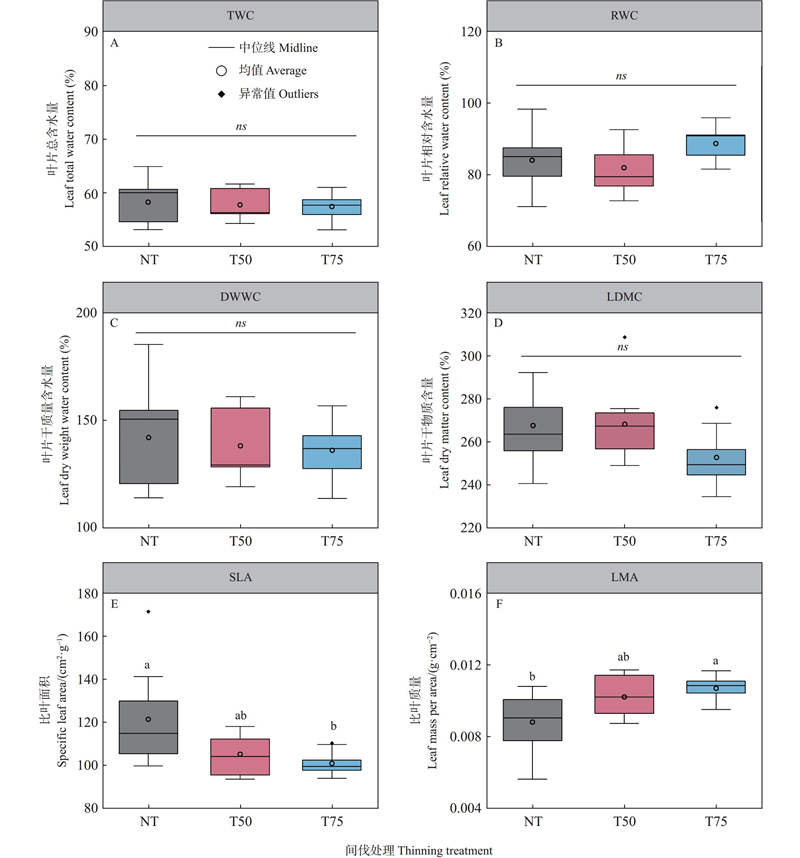
表2
间伐强度、土层深度及其交互作用对根系性状影响的双因素方差分析(P值)①"
| 根系功能性状 Root functional traits | 间伐强度 Thinning intensity (T) | 土层深度 Soil depth (S) | T×S |
| MRB | 0.108 | <0.001 | 0.889 |
| FRAD | 0.388 | <0.001 | 0.878 |
| FRBD | 0.108 | <0.001 | 0.677 |
| FRLD | 0.485 | 0.001 | 0.878 |
| FRVD | 0.377 | <0.001 | 0.637 |
| FRTD | 0.08 | <0.001 | 0.781 |
| SRA | 0.083 | 0.003 | 0.934 |
| SRL | 0.320 | 0.038 | 0.864 |
图2
不同间伐强度对毛白杨细根性状的影响 A:平均细根生物量Mean fine root biomass, MRB;B:细根表面积密度Fine root surface area density, FRAD;C:细根生物量密度Fine root biomass density,FRBD;D:细根根长密度Fine-root length density, FRLD;E:细根体积密度Fine root volume density, FRVD;F:细根组织密度Fine root tissue density, FRTD;G:比表面积Specific root surface area, SRA;H:比根长Speci?c root length, SRL。NT:不间伐处理Non-thinning treatment; T50:间伐50%林木(隔行间伐)50% thinning of forest trees (alternating row thinning); T75:间伐75%林木(隔行隔株间伐)75% thinning of forest trees (alternating row and tree thinning)."
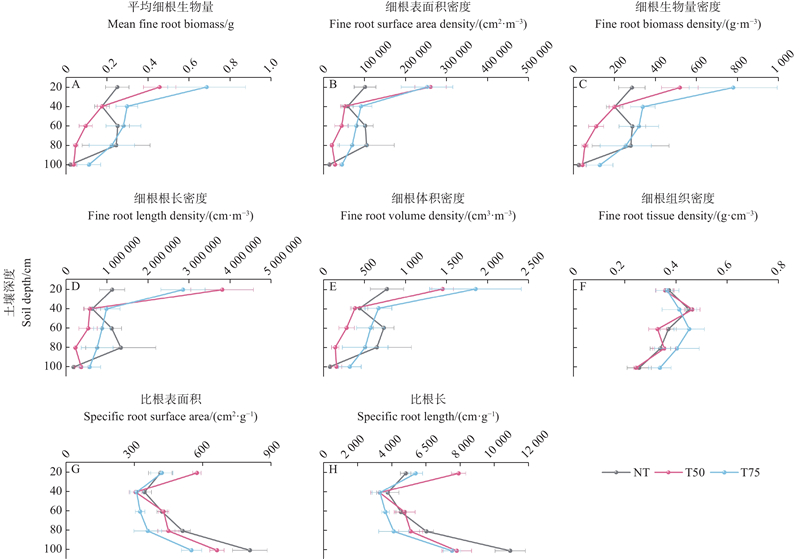

图3
不同间伐处理下毛白杨林木胸径增量、胸径累计生长量、RGR和LAI的动态变化 A:胸径增量DBH increment; B:相对增长率Relative growth rate, RGR; C:胸径累计生长量Cumulative DBH increment; D:叶面积指数Leaf area index, LAI; NT:不间伐处理Non-thinning treatment; T50:间伐50%林木(隔行间伐)50% thinning of forest trees (alternating row thinning); T75:间伐75%林木(隔行隔株间伐)75% thinning of forest trees (alternating row and tree thinning). 不同小写字母表示不同处理间差异显著(P<0.05),ns表示差异不显著。Different lowercase letters indicate significant differences between treatments (P<0.05), and ns indicates insignificant differences between treatments."
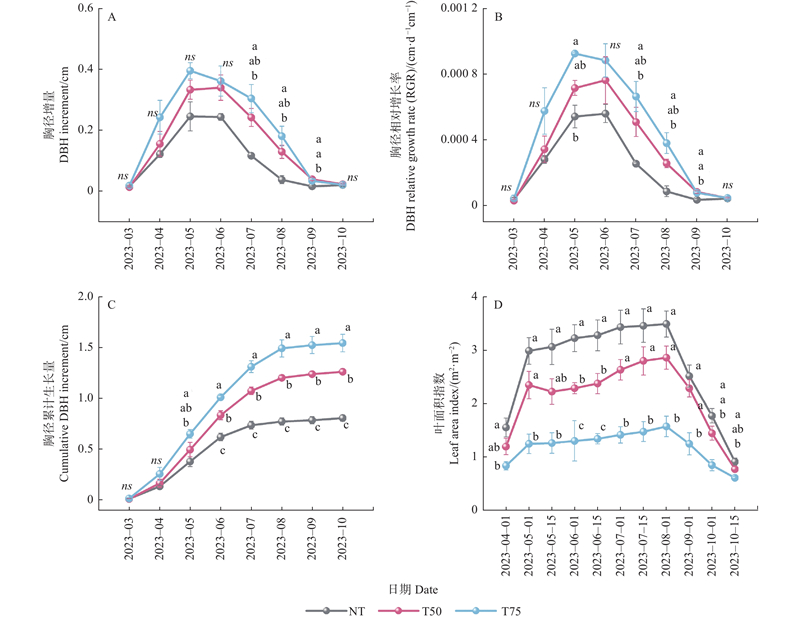
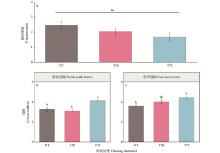
图4
不同间伐强度对毛白杨树高增量、冠幅的影响 A:树高增量Tree height increment; B:南北冠幅North-south crown width; C:东西冠幅East-west crown width; NT:不间伐处理Non-thinning treatment; T50:间伐50%林木(隔行间伐)50% thinning of forest trees (alternating row thinning); T75:间伐75%林木(隔行隔株间伐)75% thinning of forest trees (alternating row and tree thinning). 不同小写字母表示不同处理间差异显著(P<0.05),ns表示差异不显著。Different lowercase letters indicate significant differences between treatments (P<0.05), and ns indicates insignificant differences between treatments."

表3
2023年生长季末毛白杨不同间伐强度下林木生长及生产力①"
| 间伐处理 Thinning treatment | 密度 Density/ hm?2 | 胸径 DBH/cm | 树高 Tree height/m | 单株材积 Volume per tree / (m3·a?1) | 保留木蓄积量 Reserved timber volume/(m3·hm?2) | 总蓄积量 Total forest stock volume /(m3·hm?2) | 年林地生产力 Annual forest productivity /(m3·hm?2a?1) |
| NT | 1 666 | 14.15±0.26 | 17.15±0.44 | 0.11±0.01 | 181.44±8.15a | 181.44±8.15 | 22.68±1.02 |
| T50 | 833 | 15.83±1.07 | 17.36±0.68 | 0.14±0.02 | 116.47±18.44b | 194.19±29.73 | 24.27±3.72 |
| T75 | 417 | 15.17±0.85 | 16.94±0.26 | 0.12±0.02 | 51.91±6.45c | 146.63±14.61 | 18.33±1.83 |
图5
毛白杨叶片性状、细根性状和林木生长之间的相关性分析 A:叶片性状和细根性状之间的皮尔森相关分析 Pearson’s correlation analysis between leaf traits and fine root traits;B:叶片性状和林木生长之间的冗余分析 RDA between leaf traits and forest growth;C:细根性状和林木生长之间的冗余分析 RDA between fine root traits and forest growth. TWC:叶片总含水量 Total water content;RWC:叶片相对含水量 Relative water content;DWWC:干质量含水量 Dry weight water content;LDMC:叶干物质的量 Leaf dry matter content;SLA:比叶面积 Specific leaf area;LMA:比叶质量 Leaf mass per area;MRB:平均细根生物量 Mean fine root biomass;FRAD:细根表面积密度 Fine root surface area density;FRBD:细根生物量密度 Fine root biomass density;FRLD:细根根长密度 Fine root length density;FRVD:细根体积密度 Fine root volume density;FRTD:细根组织密度 Fine root tissue density;SRA:比表面积 Specific root surface area;SRL:比根长 Specific root length."
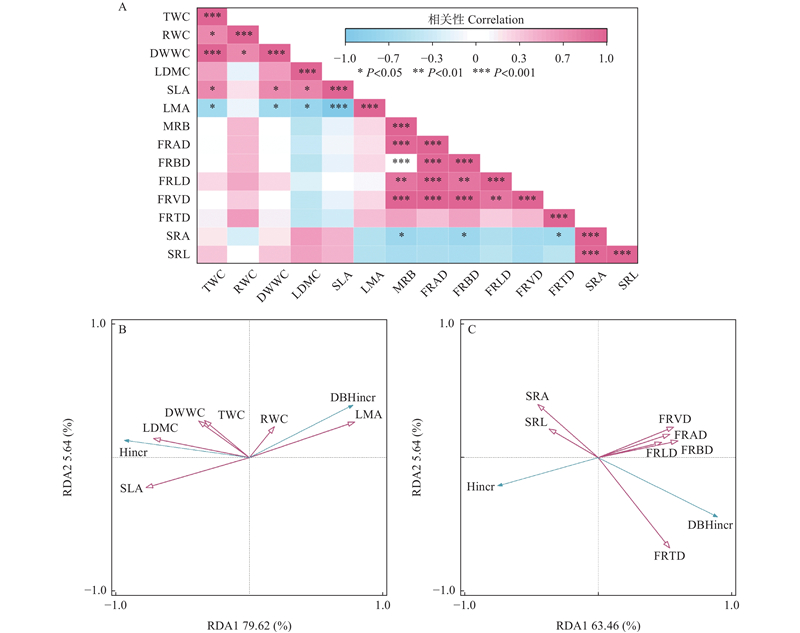
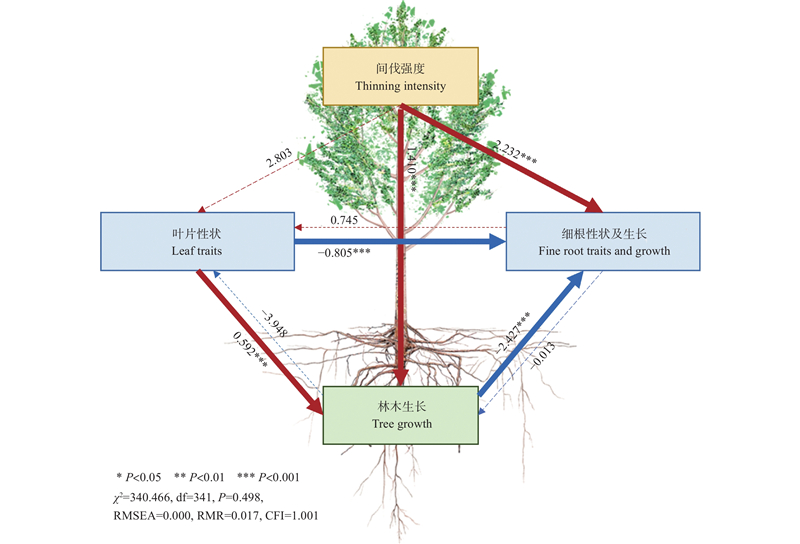
图6
毛白杨叶片性状、细根性状及生长、林木生长的结构方程模型 红色箭头为正向作用,蓝色箭头为负向作用,实线粗细表示显著性高低(P<0.05),虚线表示关系并不显著(P>0.05)。"
| 陈章水. 杨树二元立木材积表的编制. 林业科学研究, 1989, 2 (1): 78- 83. | |
| Chen Z S. Compilation of poplar two-dimensional standing wood volume table. Forestry Research, 1989, 2 (1): 78- 83. | |
| 何念鹏, 刘聪聪, 张佳慧, 等. 植物性状研究的机遇与挑战: 从器官到群落. 生态学报, 2018, 38 (19): 6787- 6796. | |
| He N P, Liu C C, Zhang J H, et al. Perspectives and challenges in plant traits: from organs to communities. Acta Ecologica Sinica, 2018, 38 (19): 6787- 6796. | |
| 贺曰林. 2021. 毛白杨S86人工林根区滴灌施肥及水氮调控机制研究. 北京: 北京林业大学. | |
| He Y L. 2021. Research on the drip irrigation-nitrogen fertigation and mechanism of water nitrogen regulation in root zone for Populus tomentosa S86 plantation. Beijing: Beijing Forestry University. [in Chinese] | |
|
何芸雨, 郭水良, 王 喆. 植物功能性状权衡关系的研究进展. 植物生态学报, 2019, 43 (12): 1021- 1035.
doi: 10.17521/cjpe.2019.0122 |
|
|
He Y Y, Guo S L, Wang Z. Research progress of trade-off relationships of plant functional traits. Chinese Journal of Plant Ecology, 2019, 43 (12): 1021- 1035.
doi: 10.17521/cjpe.2019.0122 |
|
|
刘明秀, 梁国鲁. 植物比叶质量研究进展. 植物生态学报, 2016, 40 (8): 847- 860.
doi: 10.17521/cjpe.2015.0428 |
|
|
Liu M X, Liang G L. Research progress on leaf mass per area. Chinese Journal of Plant Ecology, 2016, 40 (8): 847- 860.
doi: 10.17521/cjpe.2015.0428 |
|
| 王 烨, 李广德, 刘国彬, 等. 毛白杨人工林物候特征和生长对施肥的可塑性响应. 林业科学, 2023, 59 (5): 32- 40. | |
| Wang Y, Li G D, Liu G B, et al. Plasticity responses of phenological characteristics and tree growth of Populus tomentosa plantation to fertilization. Scientia Silvae Sinicae, 2023, 59 (5): 32- 40. | |
|
席本野, 邸 楠, 曹治国, 等. 树木吸收利用深层土壤水的特征与机制: 对人工林培育的启示. 植物生态学报, 2018, 42 (9): 885- 905.
doi: 10.17521/cjpe.2018.0083 |
|
|
Xi B Y, Di N, Cao Z G, et al. Characteristics and underlying mechanisms of plant deep soil water uptake and utilization: Implication for the cultivation of plantation trees. Chinese Journal of Plant Ecology, 2018, 42 (9): 885- 905.
doi: 10.17521/cjpe.2018.0083 |
|
| 邢鸿林, 赵彩鸿, 沈 忱, 等. 红皮云杉人工林树冠特征与生长形质的关系及间伐与修枝对其影响. 西北林学院学报, 2024, 39 (2): 91- 96. | |
| Xing H L, Zhao C H, Shen C, et al. Relationship between canopy morphological characteristics and growth characters of Picea koraiensis in plantations and the effect of thinning and pruning on them. Journal of Northwest Forestry University, 2024, 39 (2): 91- 96. | |
| 杨红青, 王亚飞, 贾黎明. 短轮伐期毛白杨S86纸浆林生长对沟灌水肥耦合的响应. 北京林业大学学报, 2023, 45 (3): 68- 78. | |
| Yang H Q, Wang Y F, Jia L M. Response of pulp plantation growth of Populus tomentosa S86 in short rotation period to coupling of water and fertilizer in furrow irrigation. Journal of Beijing Forestry University, 2023, 45 (3): 68- 78. | |
| 尤健健, 张文辉, 邓 磊, 等. 间伐对黄龙山油松中龄林细根空间分布和形态特征的影响. 生态学报, 2017, 37 (9): 3065- 3073. | |
| You J J, Zhang W H, Deng L, et al. Effects of thinning intensity on fine root biomass and morphological characteristics of middle-aged Pinus tabulaeformis plantations in the Huanglong Mountains. Acta Ecologica Sinica, 2017, 37 (9): 3065- 3073. | |
| 郑鸣鸣, 任正标, 王友良, 等. 间伐强度对杉木中龄林生长和结构的影响. 森林与环境学报, 2020, 40 (4): 369- 376. | |
| Zheng M M, Ren Z B, Wang Y L, et al. Effect of thinning intensity on the growth and structure of a middle-aged Chinese fir forest. Journal of Forest and Environment, 2020, 40 (4): 369- 376. | |
|
Adriano E, Laclau J P, Rodrigues J D. Deep rooting of rainfed and irrigated orange trees in Brazil. Trees, 2017, 31 (1): 285- 297.
doi: 10.1007/s00468-016-1483-5 |
|
| Asaye Z, Zewdie S. Fine root dynamics and soil carbon accretion under thinned and un-thinned Cupressus lusitanica stands in, Southern Ethiopia. Plant and Soil, 2013, 366 (1/2): 261- 271. | |
| Bakker M R, Augusto L, Achat D L. Fine root distribution of trees and understory in mature stands of maritime pine (Pinus pinaster) on dry and humid sites. Plant and Soil, 2006, 286 (1): 37- 51. | |
|
Baraloto C, Paine C E T, Poorter L, et al. Decoupled leaf and stem economics in rain forest trees. Ecology Letters, 2010, 13 (11): 1338- 1347.
doi: 10.1111/j.1461-0248.2010.01517.x |
|
|
Barber K R, Leeds-Harrison P B, Lawson C S. Soil aeration status in a lowland wet grassland. Hydrological Processes, 2004, 18 (2): 329- 341.
doi: 10.1002/hyp.1378 |
|
|
Benedetti-Ruiz S, Loewe-Muñoz V, Del Río R, et al. Effect of thinning on growth and shape of Castanea sativa adult tree plantations for timber production in Chile. Forest Ecology and Management, 2023, 530, 120762.
doi: 10.1016/j.foreco.2022.120762 |
|
|
Bhandari S K, Veneklaas E J, Mccaw L, et al. Effect of thinning and fertilizer on growth and allometry of Eucalyptus marginata. Forest Ecology and Management, 2021a, 479, 118594.
doi: 10.1016/j.foreco.2020.118594 |
|
|
Bhandari S K, Veneklaas E J, McCaw L, et al. Investigating the effect of neighbour competition on individual tree growth in thinned and unthinned eucalypt forests. Forest Ecology and Management, 2021b, 499, 119637.
doi: 10.1016/j.foreco.2021.119637 |
|
|
Cadotte M W, Cavender-Bares J, Tilman D, et al. Using phylogenetic, functional and trait diversity to understand patterns of plant community productivity. PLoS One, 2009, 4 (5): e5695.
doi: 10.1371/journal.pone.0005695 |
|
|
Coleman M D, Aubrey D P. Stand development and other intrinsic factors largely control fine-root dynamics with only subtle modifications from resource availability. Tree Physiology, 2018, 38 (12): 1805- 1819.
doi: 10.1093/treephys/tpy033 |
|
|
Coonen E J, Sillett S C. Separating effects of crown structure and competition for light on trunk growth of Sequoia sempervirens. Forest Ecology and Management, 2015, 358, 26- 40.
doi: 10.1016/j.foreco.2015.08.035 |
|
|
Cornwell W K, Ackerly D D. Community assembly and shifts in plant trait distributions across an environmental gradient in coastal California. Ecological Monographs, 2009, 79 (1): 109- 126.
doi: 10.1890/07-1134.1 |
|
| Coyle D R, Coleman M D. Forest production responses to irrigation and fertilization are not explained by shifts in allocation. Forest Ecology and Management, 2005, 208 (1/2/3): 137- 152. | |
|
Dang P, Gao Y, Liu J L, et al. Effects of thinning intensity on understory vegetation and soil microbial communities of a mature Chinese pine plantation in the Loess Plateau. Science of the Total Environment, 2018, 630, 171- 180.
doi: 10.1016/j.scitotenv.2018.02.197 |
|
|
Deng C, Zhang S G, Lu Y C, et al. Thinning effects on forest evolution in Masson pine (Pinus massoniana Lamb.) conversion from pure plantations into mixed forests. Forest Ecology and Management, 2020, 477, 118503.
doi: 10.1016/j.foreco.2020.118503 |
|
|
Di N, Liu Y, Mead D J, et al. Root-system characteristics of plantation-grown Populus tomentosa adapted to seasonal fluctuation in the groundwater table. Trees, 2018, 32 (1): 137- 149.
doi: 10.1007/s00468-017-1619-2 |
|
|
Dighton J, Helmisaari H S, Maghirang M, et al. Impacts of forest post thinning residues on soil chemistry, fauna and roots: Implications of residue removal in Finland. Applied Soil Ecology, 2012, 60, 16- 22.
doi: 10.1016/j.apsoil.2012.02.023 |
|
|
Ding J X, Wang Q T, Ge W J, et al. Coordination of leaf and root economic space in alpine coniferous forests on the Tibetan Plateau. Plant and Soil, 2024, 496, 555- 568.
doi: 10.1007/s11104-023-06381-0 |
|
|
Freschet G T, Roumet C, Comas L H, et al. Root traits as drivers of plant and ecosystem functioning: current understanding, pitfalls and future research needs. New Phytologist, 2021, 232 (3): 1123- 1158.
doi: 10.1111/nph.17072 |
|
|
Freschet G T, Violle C, Bourget M Y, et al. Allocation, morphology, physiology, architecture: the multiple facets of plant above- and below-ground responses to resource stress. New Phytologist, 2018, 219 (4): 1338- 1352.
doi: 10.1111/nph.15225 |
|
| Gratani L. Plant phenotypic plasticity in response to environmental factors. Advances in Botany, 2014, 2014, 208747. | |
|
Hamelin C, Gagnon D, Truax B. Aboveground biomass of glossy buckthorn is similar in open and understory environments but architectural strategy differs. Forests, 2015, 6 (4): 1083- 1093.
doi: 10.3390/f6041083 |
|
|
Han Q M. Height-related decreases in mesophyll conductance, leaf photosynthesis and compensating adjustments associated with leaf nitrogen concentrations in Pinus densiflora. Tree Physiology, 2011, 31 (9): 976- 984.
doi: 10.1093/treephys/tpr016 |
|
|
He M Z, Dijkstra F A. Drought effect on plant nitrogen and phosphorus: a meta-analysis. New Phytologist, 2014, 204 (4): 924- 931.
doi: 10.1111/nph.12952 |
|
|
He Y L, Xi B Y, Li G D, et al. Influence of drip irrigation, nitrogen fertigation, and precipitation on soil water and nitrogen distribution, tree seasonal growth and nitrogen uptake in young triploid poplar (Populus tomentosa) plantations. Agricultural Water Management, 2021, 243, 106460.
doi: 10.1016/j.agwat.2020.106460 |
|
|
Hikosaka K, Shigeno A. The role of Rubisco and cell walls in the interspecific variation in photosynthetic capacity. Oecologia, 2009, 160 (3): 443- 451.
doi: 10.1007/s00442-009-1315-z |
|
|
Kambach S, Sabatini F M, Attorre F, et al. Climate-trait relationships exhibit strong habitat specificity in plant communities across Europe. Nature Communications, 2023, 14, 712.
doi: 10.1038/s41467-023-36240-6 |
|
|
Kirfel K, Leuschner C, Hertel D, et al. Influence of root diameter and soil depth on the xylem anatomy of fine- to medium-sized roots of mature beech trees in the top- and subsoil. Frontiers in Plant Science, 2017, 8, 1194.
doi: 10.3389/fpls.2017.01194 |
|
|
Kong X, Zhang S S, Wang A Y, et al. Trees in cooler regions are more vulnerable to thermal stress: evidence from temperate poplar plantations in northern China during the 2022 heatwaves. Agricultural and Forest Meteorology, 2024, 356, 110181.
doi: 10.1016/j.agrformet.2024.110181 |
|
|
Li D D, Fernández J E, Li X, et al. Tree growth patterns and diagnosis of water status based on trunk diameter fluctuations in fast-growing Populus tomentosa plantations. Agricultural Water Management, 2020, 241, 106348.
doi: 10.1016/j.agwat.2020.106348 |
|
|
Liu J Q, Li D D, Fernández J E, et al. Variations in water-balance components and carbon stocks in poplar plantations with differing water inputs over a whole rotation: implications for sustainable forest management under climate change. Agricultural and Forest Meteorology, 2022, 320, 108958.
doi: 10.1016/j.agrformet.2022.108958 |
|
| Liu T R, Peng D L, Tan Z J, et al. 2023. Do stand density and month regulate soil enzymes and the stoichiometry of differently aged Larix principis-rupprechtii plantations? Catena, 220: 106683. | |
|
López B C, Sabate S, Gracia C A. Thinning effects on carbon allocation to fine roots in a Quercus ilex forest. Tree Physiology, 2003, 23 (17): 1217- 1224.
doi: 10.1093/treephys/23.17.1217 |
|
|
Ma Z Q, Guo D L, Xu X L, et al. Evolutionary history resolves global organization of root functional traits. Nature, 2018, 555 (7694): 94- 97.
doi: 10.1038/nature25783 |
|
|
Maurice J, Laclau J P, Re D S, et al. Fine root isotropy in Eucalyptus grandis plantations. Towards the prediction of root length densities from root counts on trench walls. Plant and Soil, 2010, 334, 261- 275.
doi: 10.1007/s11104-010-0380-8 |
|
|
McCormack M L, Dickie I A, Eissenstat D M, et al. Redefining fine roots improves understanding of below-ground contributions to terrestrial biosphere processes. New Phytologist, 2015, 207 (3): 505- 518.
doi: 10.1111/nph.13363 |
|
| McCormack M L, Guo D L. Impacts of environmental factors on fine root lifespan. Frontiers in Plant Science, 2014, 5, 205. | |
| Meng L C, Cui Z, Huang Z, et al. Thinning effects on forest production and rainfall redistribution: reduced soil water deficit and improved sustainability of semiarid plantation forestlands. Land Degradation & Development, 2022, 33 (16): 3163- 3173. | |
| Moreau G, Chagnon C, Achim A, et al. Opportunities and limitations of thinning to increase resistance and resilience of trees and forests to global change. Forestry, 2022, 95 (5): 595- 615. | |
| Mulia R, Dupraz C. 2006. Unusual fine root distributions of two deciduous tree species in southern France: what consequences for modelling of tree root dynamics? Plant and Soil, 281: 71–85. | |
| Niinemets Ü. 2007. Photosynthesis and resource distribution through plant canopies. Plant, Cell & Environment, 30(9): 1052–1071. | |
|
Noguchi K, Han Q M, Araki M G, et al. Fine-root dynamics in a young hinoki cypress (Chamaecyparis obtusa) stand for 3 years following thinning. Journal of Forest Research, 2011, 16 (4): 284- 291.
doi: 10.1007/s10310-010-0221-x |
|
|
Osnas J L D, Lichstein J W, Reich P B, et al. Global leaf trait relationships: mass, area, and the leaf economics spectrum. Science, 2013, 340 (6133): 741- 744.
doi: 10.1126/science.1231574 |
|
|
Park J, Kim T, Moon M, et al. Effects of thinning intensities on tree water use, growth, and resultant water use efficiency of 50-year-old Pinus koraiensis forest over four years. Forest Ecology and Management, 2018, 408, 121- 128.
doi: 10.1016/j.foreco.2017.09.031 |
|
|
Ruel J C, Larouche C, Achim A. Changes in root morphology after precommercial thinning in balsam fir stands. Canadian Journal of Forest Research, 2003, 33 (12): 2452- 2459.
doi: 10.1139/x03-178 |
|
|
Sankey T, Tatum J. Thinning increases forest resiliency during unprecedented drought. Scientific Reports, 2022, 12 (1): 9041.
doi: 10.1038/s41598-022-12982-z |
|
|
Santiago L S, Wright S J. Leaf functional traits of tropical forest plants in relation to growth form. Functional Ecology, 2007, 21 (1): 19- 27.
doi: 10.1111/j.1365-2435.2006.01218.x |
|
|
Sugiura D, Tateno M. Concentrative nitrogen allocation to sun-lit branches and the effects on whole-plant growth under heterogeneous light environments. Oecologia, 2013, 172 (4): 949- 960.
doi: 10.1007/s00442-012-2558-7 |
|
|
Sun K, Sun R J, Li Y B, et al. Plant economic strategies in two contrasting forests. BMC Plant Biology, 2023, 23, 366.
doi: 10.1186/s12870-023-04375-9 |
|
| Susana B R, Veronica L M, Rodrigo D R, et al. 2023. Effect of thinning on growth and shape of Castanea sativa adult tree plantations for timber production in Chile. Forest Ecology and Management, 530: 120762. | |
|
Toledo-Aceves T, Bonilla-Moheno M, Sosa V J, et al. Leaf functional traits predict shade tolerant tree performance in cloud forest restoration plantings. Journal of Applied Ecology, 2022, 59 (9): 2274- 2286.
doi: 10.1111/1365-2664.14128 |
|
|
Valladares F, Sanchez-Gomez D, Zavala M A. Quantitative estimation of phenotypic plasticity: bridging the gap between the evolutionary concept and its ecological applications. Journal of Ecology, 2006, 94 (6): 1103- 1116.
doi: 10.1111/j.1365-2745.2006.01176.x |
|
|
Vargas R, Allen E B, Allen M F. Effects of vegetation thinning on above- and belowground carbon in a seasonally dry tropical forest in Mexico. Biotropica, 2009, 41 (3): 302- 311.
doi: 10.1111/j.1744-7429.2009.00494.x |
|
| Westoby M, Wright I J. Land-plant ecology on the basis of functional traits. Trends in Ecology & Evolution, 2006, 21 (5): 261- 268. | |
|
Wright I J, Cannon K. Relationships between leaf lifespan and structural defences in a low-nutrient, sclerophyll flora. Functional Ecology, 2001, 15 (3): 351- 359.
doi: 10.1046/j.1365-2435.2001.00522.x |
|
|
Wright I J, Reich P B, Westoby M, et al. The world-wide leaf economics spectrum. Nature, 2004, 428 (6985): 821- 827.
doi: 10.1038/nature02403 |
|
|
Xi B Y, Wang Y, Jia L M, et al. Characteristics of fine root system and water uptake in a triploid Populus tomentosa plantation in the North China Plain: implications for irrigation water management. Agricultural Water Management, 2013, 117, 83- 92.
doi: 10.1016/j.agwat.2012.11.006 |
|
|
Xu T Y, Niu X, Wang B, et al. Variations in leaf functional traits and photosynthetic parameters of Cunninghamia lanceolata provenances. Forests, 2023, 14 (9): 1708.
doi: 10.3390/f14091708 |
|
|
Yücesan Z, Özçelik S, Oktan E. Effects of thinning on stand structure and tree stability in an afforested oriental beech (Fagus orientalis Lipsky) stand in northeast Turkey. Journal of Forestry Research, 2015, 26 (1): 123- 129.
doi: 10.1007/s11676-015-0028-x |
|
|
Zou S Y, Li D D, Di N, et al. Stand development modifies effects of soil water availability on poplar fine-root traits: evidence from a six-year experiment. Plant and Soil, 2022, 480, 165- 184.
doi: 10.1007/s11104-022-05568-1 |
| [1] | 李倩,张帆,孟祥雪,吴小云,庞建壮,许行,张志强. 基于分解重构与机器学习的华北平原杨树人工林净碳交换模拟[J]. 林业科学, 2025, 61(12): 72-82. |
| [2] | 徐磊,吴小云,律江,石云,朱梦洵,许行,张志强. 散射辐射比例对华北平原杨树人工林生态系统能量分配的影响[J]. 林业科学, 2024, 60(3): 100-110. |
| [3] | 万家鸣,律江,石云,许行,张志强. 散射辐射对杨树人工林生态系统总初级生产力的影响[J]. 林业科学, 2023, 59(5): 1-10. |
| [4] | 赵蕊蕊,刘勇,王凯. 生物炭和有机肥对毛白杨人工林地木质分解及土壤养分循环相关酶活性的影响[J]. 林业科学, 2023, 59(11): 1-11. |
| [5] | 叶钰倩, 赵家豪, 刘畅, 关庆伟. 间伐强度对马尾松人工林根际与非根际土壤中性糖特征的影响[J]. 林业科学, 2019, 55(8): 28-35. |
| [6] | 徐雪蕾, 孙玉军, 周华, 张鹏, 胡杨, 王新杰. 间伐强度对杉木人工林林下植被和土壤性质的影响[J]. 林业科学, 2019, 55(3): 1-12. |
| [7] | 郑婧, 佘维维, 白宇轩, 张宇清, 秦树高, 吴斌. 氮素和水分添加对毛乌素沙地油蒿群落优势植物叶片性状的影响[J]. 林业科学, 2018, 54(10): 164-171. |
| [8] | 王文波, 王延平, 王华田, 马雪松, 伊文慧. 杨树人工林连作与轮作对土壤氮素细菌类群和氮素代谢的影响[J]. 林业科学, 2016, 52(5): 45-54. |
| [9] | 朱玉杰, 董希斌. 大兴安岭地区落叶松用材林不同抚育间伐强度经营效果评价[J]. 林业科学, 2016, 52(12): 29-38. |
| [10] | 龚固堂, 牛牧, 慕长龙, 陈俊华, 黎燕琼, 朱志芳, 郑绍伟. 间伐强度对柏木人工林生长及林下植物的影响[J]. 林业科学, 2015, 51(4): 8-15. |
| [11] | 许坛, 王华田, 朱婉芮, 王延平, 李传荣, 姜岳忠. 连作杨树细根根序形态及解剖结构[J]. 林业科学, 2015, 51(1): 119-126. |
| [12] | 傅建平, 兰再平, 孙尚伟, 刘俊琴, 张勇. 滴灌条件下杨树人工林土壤的水分运移[J]. 林业科学, 2013, 49(6): 25-29. |
| [13] | 周建云;李荣;张文辉;何景峰. 不同间伐强度下辽东栎种群结构特征与空间分布格局[J]. 林业科学, 2012, 48(4): 149-155. |
| [14] | 李荣;张文辉;何景峰;周建云. 辽东栎伐桩萌苗的发育规律[J]. 林业科学, 2012, 48(3): 82-87. |
| [15] | 王静;梁军;焦一杰;张星耀. 杨树人工林林木个体大小比数与溃疡病发生程度的关系[J]. 林业科学, 2012, 48(11): 57-62. |
| 阅读次数 | ||||||
|
全文 |
|
|||||
|
摘要 |
|
|||||

