
林业科学 ›› 2025, Vol. 61 ›› Issue (11): 200-214.doi: 10.11707/j.1001-7488.LYKX20240565
黄安胜1,*( ),薛泽茜2,郭铭杰1,许毓坤3
收稿日期:2024-09-30
修回日期:2025-03-25
出版日期:2025-11-25
发布日期:2025-12-11
通讯作者:
黄安胜
E-mail:haszgfj@163.com
基金资助:
Ansheng Huang1,*(),Zexi Xue2,Mingjie Guo1,Yukun Xu3
Received:2024-09-30
Revised:2025-03-25
Online:2025-11-25
Published:2025-12-11
Contact:
Ansheng Huang
E-mail:haszgfj@163.com
摘要:
目的: 探究乡村数字化对林业新质生产力的影响机制,为推动数字技术在林业领域的有效应用、实现林业高质量发展提供理论依据。方法: 基于2012—2022年中国31个省份面板数据,分别构建乡村数字化和林业新质生产力评价指标体系,运用双向固定效应模型分析乡村数字化对林业新质生产力的影响机制及其空间异质性。结果: 1) 2012—2022年,中国乡村数字化水平呈持续上升趋势;林业新质生产力水平呈波动增长态势,整体而言仍有较大提升空间。2) 中国乡村数字化对林业新质生产力具有显著促进作用,且存在明显地区差异,其作用强度呈现西部>中部>东部的梯度特征,西部地区的后发优势明显。3) 乡村数字化对林业新质生产力的影响机制表现为“数字+科技”双轮驱动态势,而受数字化与绿色化不同步矛盾制约,对林业绿色生产力的影响目前并不显著。结论: 发展乡村数字化能够在不同程度上促进林业新质生产力提升;绿色生产力是未来提升林业新质生产力的重要突破口和着力点,政府应坚持绿色生态发展原则,加大乡村数字基础设施建设投入,通过数字技术和数据要素的双轮驱动实现绿色生产力的跃迁;同时,需因地制宜实施动态化、差异化的地区间林业发展策略,如探索基于空间异质性的林业数字化政策梯度补偿机制、探索数字“林长制”治理体系等,以推动林业高质量发展。
中图分类号:
黄安胜,薛泽茜,郭铭杰,许毓坤. 乡村数字化对林业新质生产力的影响[J]. 林业科学, 2025, 61(11): 200-214.
Ansheng Huang,Zexi Xue,Mingjie Guo,Yukun Xu. Impact of Rural Digitalization on the Forestry New Quality Productivity[J]. Scientia Silvae Sinicae, 2025, 61(11): 200-214.
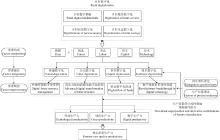
图1
乡村数字化影响林业新质生产力的理论分析框架"
表1
林业新质生产力指标体系"
| 一级指标 Primary index | 二级指标 Secondary index | 三级指标 Tertiary index | 指标说明 Index specification | 属性Attribute |
| 科技 生产力 Technological productivity | 科技投入 Investment in science and technology | 飞播造林 Aerial seeding afforestation | 飞播造林面积 Aerial seeding afforestation area/hm2 | + |
| 科研机构 Scientific research institutions | 科研机构数量 Number of scientific research institutions | + | ||
| 科技活动 Scientific and technological activities | R&D人员全时当量×(林业产业总产值/地区生产总值) R&D personnel full-time equivalent×(total output value of the forestry industry/gross regional product) | + | ||
| 人才支撑 Talent support | 科技人员 Scientific and technical staff | 科技人员数量 Number of scientific and technical staff | + | |
| 专技人员Specialized staff | 县级林业工作站专业技术人员数量/林草 系统从业人员数量 Number of specialized staff in forestry workstations at the county level/number of employees in forestry and grassland systems (%) | + | ||
| 财政支持 Financial support | 资金投入 Funding investment | 资金投入 Funding investment/104 yuan | + | |
| 活动经费 Funding of activities | R&D经费×(林业产业总产值/地区生产总值) R&D funding×(gross output value of forestry industry/gross regional product)/104 yuan | + | ||
| 科技推广 Promotion of technology | 科技推广环境 Science and technology promotion environment | 乡镇林业工作站加挂科技推广站牌子数量 The number of township forestry workstations designated as science and technology promotion stations | + | |
| 科技推广范围 Scope of technology promotion | 乡镇林业工作站本年度科技推广面积 The area of township forestry workstations designated for science and technology promotion in the current year/hm2 | + | ||
| 绿色 生产力 Green productivity | 资源节约 Resource conservation | 烧柴采伐强度 Intensity of firewood harvesting | 农民烧柴采伐量/造林面积 Farmer's firewood harvesting/afforestation area/(104 m3·hm?2) | ? |
| 林业生产 Forestry production | 林业产业总产值/造林面积 Gross output value of forestry industry/afforestation area/ (104 yuan·hm?2) | + | ||
| 森林资源 Forest resources | 森林覆盖率 Forest coverage (%) | + | ||
| 林业碳汇量 Forestry carbon sequestration/108 m3 | + | |||
| 环境修复 Environmental remediation | 退化林修复 Degraded forest restoration | 退化林修复面积 Area of degraded forest restoration/hm2 | + | |
| 湿地修复 Wetland restoration | 湿地保护与修复投资 Investments in wetland conservation and restoration/104 yuan | + | ||
| 生化防治 Biochemical control | 有害生物防治 Pest control | 林业有害生物防治率 Forestry pest control rate (%) | + | |
| 林草有害生物防治投资 Investment in forest and grass pest control/104 yuan | + | |||
| 化学农药防治 Chemical pesticide control | 化学农药防治面积 Chemical pesticide control area/hm2 | ? | ||
| 数字 生产力 Digital productivity | 数字基础设施 Digital infrastructure | 数字信息化 Digital informatization | 林业信息化投资 Forestry informatization investment/104 yuan | + |
| 产业辐射作用 Industrial radiation | 产业带动效益 Industry drives benefits | 直接带动的其他产业产值 Output value of other industries driven by the forestry industry/104 yuan | + | |
| 产业链延伸 Extension of the industrial chain | 林业第二产业产值/林业产业总产值 Output value of forestry secondary industry/gross output value of forestry industry (%) | + | ||
| 林业第三产业产值/林业产业总产值 Output value of forestry tertiary industry/gross output value of forestry industry (%) | + |
表2
乡村数字化指标体系"
| 一级指标 Primary index | 二级指标 Secondary index | 指标说明 Index specification |
| 乡村数字基础 Rural digital fundamentals | 经济基础 Economic | 农林牧渔业增加值 Added value of agriculture, forestry, animal husbandry and fishery/108 yuan |
| 第一产业增加值占地区生产总值比例 Proportion of added value of primary industry in gross regional product (%) | ||
| 网络与数字基础设施 Network and digital infrastructure | 开通互联网宽带业务的行政村比例 Proportion of administrative villages with Internet broadband services (%) | |
| 互联网宽带接入用户量 Number of Internet broadband access users/104 households | ||
| 农村宽带接入用户量 Number of rural broadband access users/104 households | ||
| 农村居民平均每百户年末计算机拥有量 Average number of computers per 100 rural households at the end of the year | ||
| 农村居民平均每百户年末移动电话拥有量 Average number of mobile phones per 100 rural households at the end of the year | ||
| 农村广播节目综合人口覆盖率 Comprehensive population coverage of rural radio programmes (%) | ||
| 村庄道路长度 Length of village roads/km | ||
| 乡村服务数字化 Digitalization of rural services | 人力资源投入 Human resources investment | 城镇信息传输、软件和信息技术服务业就业人员数量 Number of employed persons in town information transmission, software and information technology service/104 people |
| 网络通讯成效 Internet communication effectiveness | 农村投递路线 Rural delivery routes/km | |
| 已通邮的行政村比例 Proportion of administrative villages with postal services (%) | ||
| 消费匹配水平 Consumption matching level | 镇区及乡村消费品零售额占全社会消费品零售额的比例 Proportion of retail sales of consumer goods in towns and villages to total retail sales of consumer goods (%) | |
| 医疗保障 Medical coverage | 医疗器具农村居民消费价格指数 Rural consumer price index for medical appliances | |
| 乡村经济数字化 Digitalization of rural economy | 农业数字化 Digitalization of agriculture | 农业机械总动力 Total power of agricultural machinery/104 kW |
| 电子商务销售额 E-commerce sales/108 yuan | ||
| 数字产业化 Digital industrialization | 数字普惠金融指数 Digital Financial Inclusion Index | |
| 淘宝村数量 Number of Taobao villages | ||
| 有电子商务交易活动的企业数比例 Proportion of enterprises with e-commerce transaction activities (%) | ||
| 每百家企业拥有网站数量 Number of websites per 100 companies | ||
| 乡村生态数字化 Digitalization of rural ecology | 环境监测 Environmental monitoring | 农业气象观测业务站点数量 Number of agrometeorological observation stations |
| 农村污水处理投入 Rural sewage treatment investment/104 yuan | ||
| 农村用电量 Rural electricity consumption/108 kW·h |
表3
各变量衡量指标及描述性统计"
| 变量类型 Variable type | 变量名称 Variable name | 衡量指标 Measurement index | 变量符号 Variable symbol | 平均值 Average value | 最大值 Max. | 最小值 Min. | 标准差 Standard deviation |
| 被解释变量 Explained variable | 林业新质生产力 Forestry new quality productivity | 林业新质生产力综合指数 Composite index of forestry new quality productivity | Fnqp | 0.089 | 0.309 | 0.011 | 0.048 |
| 解释变量 Explaining variable | 乡村数字化 Rural digitalization | 乡村数字化综合指数 Composite index of rural digitalization | Digit | 0.180 | 0.643 | 0.034 | 0.108 |
| 控制变量 Control variables | 封山育林情况 Mountain closure and afforestation | 封山育林面积 Area of mountain closure for afforestation | Clo | 55.322 | 376.870 | 0.000 | 55.572 |
| 水土流失治理水平 Soil erosion control level | 森林水土流失治理面积 Forest soil erosion control area | Sec | 4 134.081 | 16 678.720 | 0.000 | 3 333.382 | |
| 森林受害情况 Forest damage | 受害森林面积 Area of affected forests | Dam | 0.413 | 16.780 | 0.000 | 1.134 | |
| 水利建设水平 Water conservancy construction level | 森林有效灌溉面积 Area of effective irrigation of forests | Wcc | 2 164.098 | 6 666.390 | 109.240 | 1 721.964 |
表4
中国31个省份乡村数字化水平和林业新质生产力水平"
| 地区Region | 省份 Province | 乡村数字化水平 Rural digitalization level | 林业新质 生产力水平 Forestry new quality productivity level | 地区Region | 省份 Province | 乡村数字化水平 Rural digitalization level | 林业新质 生产力水平 Forestry new quality productivity level |
| 东部 Eastern | 北京Beijing | 0.184 | 0.038 | 中部 Central | 山西Shanxi | 0.121 | 0.038 |
| 天津Tianjin | 0.072 | 0.020 | 内蒙古 Inner Mongolia | 0.126 | 0.153 | ||
| 河北Hebei | 0.274 | 0.083 | 吉林Jilin | 0.115 | 0.064 | ||
| 辽宁Liaoning | 0.148 | 0.058 | 黑龙江Heilongjiang | 0.151 | 0.080 | ||
| 上海Shanghai | 0.160 | 0.054 | 安徽Anhui | 0.206 | 0.098 | ||
| 江苏Jiangsu | 0.385 | 0.107 | 江西Jiangxi | 0.149 | 0.126 | ||
| 浙江Zhejiang | 0.348 | 0.137 | 河南Henan | 0.274 | 0.077 | ||
| 福建Fujian | 0.197 | 0.122 | 湖北Hubei | 0.212 | 0.108 | ||
| 山东Shandong | 0.365 | 0.134 | 湖南Hunan | 0.205 | 0.145 | ||
| 广东Guangdong | 0.420 | 0.162 | 西部 Western | 重庆Chongqing | 0.115 | 0.053 | |
| 广西Guangxi | 0.164 | 0.100 | 四川Sichuan | 0.264 | 0.136 | ||
| 海南Hainan | 0.081 | 0.042 | 贵州Guizhou | 0.125 | 0.091 | ||
| 东部平均Eastern average | 0.233 | 0.088 | 云南Yunnan | 0.162 | 0.103 | ||
| 中部平均Central average | 0.173 | 0.099 | 西藏Xizang | 0.059 | 0.076 | ||
| 西部平均Western average | 0.124 | 0.082 | 陕西Shaanxi | 0.143 | 0.118 | ||
| 全国平均National average | 0.180 | 0.089 | 甘肃Gansu | 0.118 | 0.139 | ||
| 青海Qinghai | 0.068 | 0.027 | |||||
| 宁夏Ningxia | 0.067 | 0.027 | |||||
| 新疆Xinjiang | 0.119 | 0.052 | |||||
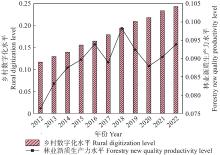
图2
2012—2022年中国乡村数字化水平和林业新质生产力水平"
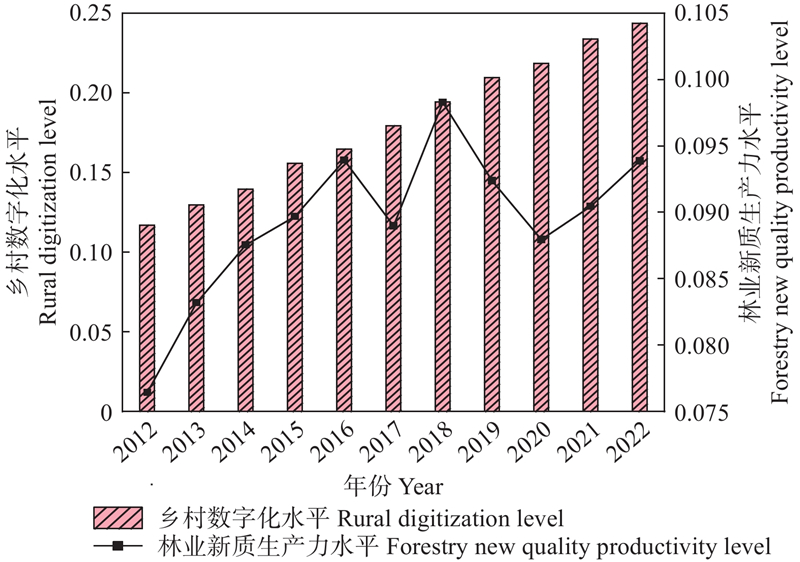
表5
豪斯曼检验①"
| 变量名称Variable name | 随机效应模型 Random effect (RE) | 固定效应模型 Fixed effects (FE) |
| Digit | 0.155*** (0.026) | 0.179*** (0.031) |
| Clo | 0.078*** (0.015) | 0.053*** (0.016) |
| Sec | 0.009 (0.020) | ?0.134*** (0.039) |
| Dam | 0.053** (0.025) | 0.022 (0.025) |
| Wcc | 0.010 (0.018) | 0.008 (0.048) |
| 常数项Constant | 0.043*** (0.009) | 0.079*** (0.015) |
| N | 341 | 341 |
| R2 | — | 0.140 |
| Hausman | 38.53 (0.000 0) | |
表6
乡村数字化对林业新质生产力的影响检验①"
| 变量名称Variable name | (1) | (2) | (3) | (4) | (5) |
| Digit | 0.161*** | 0.139** | 0.124** | 0.125** | 0.123** |
| (0.048) | (0.048) | (0.047) | (0.047) | (0.047) | |
| Clo | 0.063*** | 0.054** | 0.056*** | 0.056*** | |
| (0.017) | (0.016) | (0.017) | (0.017) | ||
| Sec | ?0.162*** | ?0.158*** | ?0.155*** | ||
| (0.042) | (0.043) | (0.044) | |||
| Dam | 0.021 | 0.020 | |||
| (0.026) | (0.026) | ||||
| Wcc | ?0.014 | ||||
| (0.049) | |||||
| 常数项Constant | 0.006 | 0.006 | 0.011 | 0.011 | 0.011 |
| (0.011) | (0.011) | (0.011) | (0.011) | (0.011) | |
| 个体固定效应Entity fixed effects | 是Yes | 是Yes | 是Yes | 是Yes | 是Yes |
| 时间固定效应Time fixed effects | 是Yes | 是Yes | 是Yes | 是Yes | 是Yes |
| N | 341 | 341 | 341 | 341 | 341 |
| R2 | 0.734 | 0.746 | 0.758 | 0.759 | 0.759 |
| 调整R2 Adjust R2 | 0.698 | 0.711 | 0.723 | 0.723 | 0.722 |
表7
内生性检验和稳健性检验①"
| 内生性检验Endogeneity test | 稳健性检验Robustness test | |||||
| 变量名称 Variable name | (1) | (2) | 变量名称 Variable name | (3) | (4) | |
| 滞后一期 Lag one phase | 工具变量法 Instrumental variable method | 改变样本范围 Change the sample range | 变量缩尾处理 Variable tailing | |||
| L.Digit | 0.132* | 0.250*** | Digit | 0.160** | 0.121** | |
| (0.056) | (0.037) | (?0.05) | (?0.046) | |||
| 控制变量 Control variables | 控制 Control | 控制 Control | 控制变量 Control variables | 控制 Control | 控制 Control | |
| 常数项 Constant | 0.019 | 0.020* | 常数项 Constant | 0.004 | 0.011 | |
| (0.012) | (0.009) | (?0.011) | (?0.01) | |||
| 不可识别检验 Underidentification test | — | 9.735** | 个体固定效应 Entity fixed effects | 是Yes | 是Yes | |
| 弱工具变量检验 Weak tool variable identification test | — | 241.851[16.380] | 时间固定效应 Time fixed effects | 是Yes | 是Yes | |
| N | 310 | 310 | N | 319 | 341 | |
| R2 | 0.744 | 0.457 | R2 | 0.753 | 0.797 | |
| 调整R2 Adjust R2 | 0.714 | 0.766 | ||||
表8
机制分析和异质性分析①"
| 变量名称 Variable name | 机制分析Mechanism analysis | 异质性分析Heterogeneity analysis | |||||
| (1) | (2) | (3) | (4) | (5) | (6) | ||
| 科技 生产力 Technological productivity | 绿色 生产力 Green productivity | 数字 生产力 Digital productivity | 东部地区 Eastern region | 中部地区 Central region | 西部地区 Western region | ||
| Digit | 0.113* | 0.062 | 0.221* | 0.095** | 0.275** | 0.657** | |
| (0.053) | (0.049) | (0.088) | (0.040) | (0.104) | (0.285) | ||
| 控制变量 Control variables | 控制 Control | 控制 Control | 控制 Control | 控制 Control | 控制 Control | 控制 Control | |
| 常数项 Constant | ?0.009 | ?0.060*** | 0.019 | 0.015* | 0.025 | 0.057* | |
| (0.012) | (0.011) | (0.020) | (0.008) | (0.032) | (0.024) | ||
| 个体固定效应 Entity fixed effects | 是Yes | 是Yes | 是Yes | 是Yes | 是Yes | 是Yes | |
| 时间固定效应 Time fixed effects | 是Yes | 是Yes | 是Yes | 是Yes | 是Yes | 是Yes | |
| N | 341 | 341 | 341 | 132 | 99 | 110 | |
| R2 | 0.743 | 0.853 | 0.859 | 0.900 | 0.903 | 0.619 | |
| 调整R2 Adjust R2 | 0.704 | 0.830 | 0.837 | 0.876 | 0.873 | 0.511 | |
| 英)阿尔弗雷德·马歇尔. 1983. 经济学原理. 北京: 商务印书馆. | |
| Alfred Marshall. 1983. Principles of economics. Beijing: The Commercial Press. [in Chinese] | |
|
白永秀, 张 佳, 王泽润. 乡村数字化的内涵特征、理论机制与推进策略. 宁夏社会科学, 2022 (5): 111- 119.
doi: 10.3969/j.issn.1002-0292.2022.05.013 |
|
|
Bai Y X, Zhang J, Wang Z R. The connotation, characteristics, theoretical mechanism and promotion strategy of rural digitization. Ningxia Social Sciences, 2022 (5): 111- 119.
doi: 10.3969/j.issn.1002-0292.2022.05.013 |
|
| 陈秋华. 关于建立具有自我发展机制的林业生产力体系的思考. 林业经济问题, 1991, 11 (2): 28- 32. | |
| Chen Q H. Thoughts on establishing forestry productivity system with self-development mechanism. Issues of Forestry Economics, 1991, 11 (2): 28- 32. | |
| 陈秀英, 刘 胜, 沈 鸿. 以数字化转型赋能提升新质生产力. 新疆社会科学, 2024 (2): 41- 45. | |
| Chen X Y, Liu S, Shen H. Empowering with digital transformation to enhance new quality productivity. Social Sciences in Xinjiang, 2024 (2): 41- 45. | |
| 丁敬达, 李 晓, 邱均平. 内生增长理论视域下数据要素驱动新质生产力发展的路径探讨. 现代情报, 2024, 44 (11): 4- 8. | |
| Ding J D, Li X, Qiu J P. Exploring the path of data elements driving the development of new quality productive forces from the perspective of endogenous growth theory. Journal of Modern Information, 2024, 44 (11): 4- 8. | |
| 范 欣, 宋晓雨. 生产要素创新性配置赋能新质生产力发展的作用机理与实现路径. 华南师范大学学报(社会科学版), 2025 (2): 120- 135, 207. | |
| Fan X, Song X Y. The mechanism and implementation path of innovative allocation of production factors empowering the development of new quality productive forces. Journal of South China Normal University (Social Science Edition), 2025 (2): 120- 135, 207. | |
| 美)菲利普·阿吉翁, (美)彼 得·霍依特. 2004. 内生增长理论. 北京: 北京大学出版社, 23. | |
| Philippe A, Peter H. 2004. Endogenous growth theory. Beijing: Peking University Press, 23. [in Chinese] | |
|
付舒斐, 朱丽萌, 吕添贵, 等. 乡村数字化转型对耕地绿色利用效率的影响机制及门槛效应研究. 中国土地科学, 2024, 38 (4): 90- 100.
doi: 10.11994/zgtdkx.20240422.143046 |
|
|
Fu S F, Zhu L M, Lyu T G, et al. Research on the influencing mechanism and threshold effect of rural digital transformation on cultivated land green use efficiency. China Land Science, 2024, 38 (4): 90- 100.
doi: 10.11994/zgtdkx.20240422.143046 |
|
| 傅元海, 熊 豪. 数字化转型改善资源配置的理论逻辑与路径选择. 经济学家, 2024 (9): 74- 86. | |
| Fu Y H, Xiong H. The theoretical logic and path selection for digital transformation to enhance resource allocation. Economist, 2024 (9): 74- 86. | |
| 盖宏伟, 张文雅. 乡村数字化转型与治理悬浮: 基于复杂适应系统理论的分析框架. 天津行政学院学报, 2023, 25 (4): 41- 49. | |
| Gai H W, Zhang W Y. Rural digital transformation and governance suspension: an analytical framework based on the theory of complex adaptive system. Journal of Tianjin Administration Institute, 2023, 25 (4): 41- 49. | |
| 高保生. 2005. 我国首次确定林业生产力区域发展战略. 人民日报, 2005−07−27. | |
| Gao B S. 2005. The regional development strategy of forestry productivity was determined for the first time in China. People’s Daily, 2005−07−27. [in Chinese] | |
| 何世祯, 马紫媛, 戴永务. 促进新型林业经营主体数字化转型与农户增收. 宏观经济管理, 2024, 40 (4): 70- 77. | |
| He S Z, Ma Z Y, Dai Y W. Promote the digital transformation of new forestry management entities and increase the income of farmers. Macroeconomic Management, 2024, 40 (4): 70- 77. | |
|
柯水发, 万深玮, 孔凡斌, 等. 中国林业新质生产力的形成逻辑、时空演变与障碍因子分析. 林业科学, 2025, 61 (3): 199- 213.
doi: 10.11707/j.1001-7488.LYKX20240307 |
|
|
Ke S F, Wan S W, Kong F B, et al. Formation logic, spatial & temporal evolution and obstacle factors analysis of China’s forestry new quality productive forces. Scientia Silvae Sinicae, 2025, 61 (3): 199- 213.
doi: 10.11707/j.1001-7488.LYKX20240307 |
|
| 孔凡斌, 陆 雨, 徐彩瑶. 2024. 数字新质生产力促进山区林业产业高质量发展的作用机制. 林业科学, https://link.cnki.net/urlid/11.1908.S.20241126.1641.008. | |
| Kong F B, Lu Y, Xu C Y. 2024. Mechanisms of digital new productivity in promoting high-quality development of forestry industry in mountainous areas. Scientia Silvae Sinicae, https://link.cnki.net/urlid/11.1908.S.20241126.1641.008. [in Chinese] | |
| 金绍荣, 任赞杰. 乡村数字化对农业绿色全要素生产率的影响. 改革, 2022 (12): 102- 118. | |
| Jin S R, Ren Z J. The impact of rural digitalization on agricultural green total factor productivity. Reform, 2022 (12): 102- 118. | |
|
李 程. 农村地区林业管理信息化建设的问题与对策. 农业经济, 2017 (8): 28- 30.
doi: 10.3969/j.issn.1001-6139.2017.08.010 |
|
|
Li C. Problems and countermeasures of forestry management informatization construction in rural areas. Agricultural Economy, 2017 (8): 28- 30.
doi: 10.3969/j.issn.1001-6139.2017.08.010 |
|
| 李春茹, 黄君录. 数字治理赋能乡村共同体建设的实践经验及价值指向: 基于苏南L村的考察. 南京农业大学学报(社会科学版), 2024, 24 (1): 23- 34. | |
| Li C R, Huang J L. Practical experience and value orientation of digital governance empowering rural community construction: investigation based on L village in southern Jiangsu. Journal of Nanjing Agricultural University (Social Sciences Edition), 2024, 24 (1): 23- 34. | |
|
李 沁. 山西省临汾西山地区林业生产力布局研究. 林业资源管理, 2008 (4): 44- 47.
doi: 10.3969/j.issn.1002-6622.2008.04.013 |
|
|
Li Q. Study on the layout of forestry productivity in Xishan area of Linfen municipality, Shanxi Province. Forest Resources Management, 2008 (4): 44- 47.
doi: 10.3969/j.issn.1002-6622.2008.04.013 |
|
| 李旭辉, 陈梦伟. 中国乡村数字化转型: 测度、区域差异及推进路径. 农业经济问题, 2023, 44 (11): 89- 104. | |
| Li X H, Chen M W. Digital transformation in rural China: measurement, regional differences, and advancement paths. Issues in Agricultural Economy, 2023, 44 (11): 89- 104. | |
| 李勇斌, 刘殿国. 农业保险促进农业新质生产力发展的作用机制研究. 金融与经济, 2024 (7): 38- 49. | |
| Li Y B, Liu D G. Research on the mechanism of agricultural insurance to promote the development of agricultural new quality productivity. Finance and Economy, 2024 (7): 38- 49. | |
| 廖文梅, 郑希贤, 蒋丽雯, 等. 2024. 林业新质生产力促进森林生态产品价值实现效率的影响机制. 林业科学, https://link.cnki.net/urlid/11.1908.S.20241126.1710.012. | |
| Liao W M, Zheng X X, Jiang L W, et al. 2024. Impact mechanism of new-quality productive forces in forestry on the efficiency of forest ecological product value realization. Scientia Silvae Sinicae, https://link.cnki.net/urlid/11.1908.S.20241126.1710.012. [in Chinese] | |
| 刘延鹤, 傅万四, 张 彬, 等. 林业机器人发展现状与未来趋势. 世界林业研究, 2020, 33 (1): 38- 43. | |
| Liu Y H, Fu W S, Zhang B, et al. Development state and future trend of forestry robot. World Forestry Research, 2020, 33 (1): 38- 43. | |
| 罗光强, 宋新宇. 2024. 中国农业新质生产力: 生成机理、时空特征与区域差异. 中国农业资源与区划, http://kns.cnki.net/kcms/detail/11.3513.s.20240624.1845.020.html. | |
| Luo G Q, Song X Y. 2024. The production mechanisms, spatial and temporal characteristics, and regional differences of agricultural new quality productivity in China. Chinese Journal of Agricultural Resources and Regional Planning, http://kns.cnki.net/kcms/detail/11.3513.s.20240624.1845.020.html. [in Chinese] | |
| 马国勇, 刘 欣, 刘艳迪. 2024. 山水林田湖草保护修复效率对林业新质生产力发展的影响及机制. 林业科学, https://link.cnki.net/urlid/11.1908.S.20241127.0919.002. | |
| Ma G Y, Liu X, Liu Y D. 2024. Mechanism and path of influence of the protection and restoration efficiency of mountains, waters, forests, fields, lakes and grasses on forestry new quality productivity. https://link.cnki.net/urlid/11.1908.S.20241127.0919.002. [in Chinese] | |
| 宋虹桥, 张夏恒. 数字化转型赋能新质生产力: 机理、挑战与路径选择. 北京理工大学学报(社会科学版), 2024, 26 (6): 41- 51, 73. | |
| Song H Q, Zhang X H. Empowering new quality productivity through digital transformation: mechanisms, challenges and path selection. Journal of Beijing Institute of Technology (Social Sciences Edition), 2024, 26 (6): 41- 51, 73. | |
| 宋振江, 冷明妮, 周 波, 等. 中国农业新质生产力: 评价体系构建、动态演进及政策启示. 农林经济管理学报, 2024, 23 (4): 425- 434. | |
| Song Z J, Leng M N, Zhou B, et al. New quality agricultural productive force in China: evaluation system construction, dynamic evolution and policy implications. Journal of Agro-Forestry Economics and Management, 2024, 23 (4): 425- 434. | |
| 孙久文, 张 翱. 数字经济时代的数字乡村建设: 意义、挑战与对策. 西北师大学报(社会科学版), 2023, 60 (1): 127- 134. | |
| Sun J W, Zhang A. Digital rural construction in the era of digital economy: significance, challenges and countermeasures. Journal of Northwest Normal University(Social Sciences), 2023, 60 (1): 127- 134. | |
|
汤志伟, 方 錄, 韩 啸. 数字乡村建设的内在机制: 数字化转型视角. 科技管理研究, 2023, 43 (8): 173- 182.
doi: 10.3969/j.issn.1000-7695.2023.8.021 |
|
|
Tang Z W, Fang L, Han X. Internal mechanism of digital rural construction: from the perspective of digital transformation. Science and Technology Management Research, 2023, 43 (8): 173- 182.
doi: 10.3969/j.issn.1000-7695.2023.8.021 |
|
| 王 勃. 2024. 习近平总书记强调的“新质生产力”. 学习时报, https://www.workercn.cn/c/2024-03-18/8189181.shtml. | |
| Wang B. 2024. General secretary Xi Jinping’s emphasis on“new quality productivity”. Study Times, https://www.workercn.cn/c/2024-03-18/8189181.shtml. [in Chinese] | |
| 吴义强. 加速形成新质生产力 引领竹产业高质量发展. 世界竹藤通讯, 2024, 22 (2): 1- 4. | |
| Wu Y Q. Accelerating the formation of new quality productive forces to lead high-quality development of bamboo industry in China. World Bamboo and Rattan, 2024, 22 (2): 1- 4. | |
| 谢文帅, 宋冬林, 毕怡菲. 中国数字乡村建设: 内在机理、衔接机制与实践路径. 苏州大学学报(哲学社会科学版), 2022, 43 (2): 93- 103. | |
| Xie W S, Song D L, Bi Y F. China's digital village construction: internal mechanism, cohesion mechanism, and practice path. Journal of Soochow University (Philosophy & Social Science Edition), 2022, 43 (2): 93- 103. | |
|
徐彩瑶, 任 燕, 翟 郡, 等. 数字乡村建设对浙江省山区26县林业产业发展升级的影响. 林业科学, 2024, 60 (5): 67- 88.
doi: 10.11707/j.1001-7488.LYKX20230522 |
|
|
Xu C Y, Ren Y, Zhai J, et al. Impact of digital rural construction on development and upgrading of forestry industry of 26 counties in mountainous regions of Zhejiang province. Scientia Silvae Sinicae, 2024, 60 (5): 67- 88.
doi: 10.11707/j.1001-7488.LYKX20230522 |
|
| 许晓东, 赖静娴, 傅清媛. 林业新质生产力推动林业高质量发展转型研究: 基于马克思主义政治经济学视角. 林业经济问题, 2024, 44 (2): 113- 119. | |
| Xu X D, Lai J X, Fu Q Y. The transformation of new quality productive forces in forestry to promote the high-quality development of forestry based on Marxist political economy perspective. Issues of Forestry Economics, 2024, 44 (2): 113- 119. | |
|
薛龙飞, 罗小锋, 吴贤荣. 中国四大林区固碳效率: 测算、驱动因素及收敛性. 自然资源学报, 2016, 31 (8): 1351- 1363.
doi: 10.11849/zrzyxb.20150985 |
|
|
Xue L F, Luo X F, Wu X R. Carbon sequestration efficiency of four forest regions in China: measurement, driving factors and convergence. Journal of Natural Resources, 2016, 31 (8): 1351- 1363.
doi: 10.11849/zrzyxb.20150985 |
|
| 杨博文. “资源诅咒”抑或“制度失灵”?基于中国林业碳汇交易制度的分析. 中国农村观察, 2021, 42 (5): 51- 70. | |
| Yang B W. “Resource curse” or “institutional failure”? An analysis based on China’s forestry carbon sequestration and trading system. China Rural Survey, 2021, 42 (5): 51- 70. | |
|
杨 杨, 刘 腾. 共同在场、适应性治理与数字乡村韧性建设. 农业经济, 2022, 44 (11): 46- 48.
doi: 10.3969/j.issn.1001-6139.2022.11.016 |
|
|
Yang Y, Liu T. Joint presence, adaptive governance and digital village resilience construction. Agricultural Economy, 2022, 44 (11): 46- 48.
doi: 10.3969/j.issn.1001-6139.2022.11.016 |
|
|
于丽艳, 史晨宇, 杨 鑫, 等. 乡村数字化对中国农业韧性的影响机制: 基于耦合协调度和中介效应模型的实证. 中国农业大学学报, 2023, 28 (7): 308- 320.
doi: 10.11841/j.issn.1007-4333.2023.07.26 |
|
|
Yu L Y, Shi C Y, Yang X, et al. Impact mechanism of rural digitization on China’s agricultural resilience: an empirical study based on the coupling coordination degree and mediating effect models. Journal of China Agricultural University, 2023, 28 (7): 308- 320.
doi: 10.11841/j.issn.1007-4333.2023.07.26 |
|
| 张启航, 张亚连, 谭桂菲, 等. 中国林业碳汇效率时空演化特征: 基于三阶段超效率SBM-DEA模型. 生态学报, 2024, 44 (15): 6769- 6782. | |
| Zhang Q H, Zhang Y L, Tan G F, et al. Spatio-temporal evolutionary characteristics of forestry carbon sink eficiency in China based on a three-stage super-efficiency SBM-DEA model. Acta Ecologica Sinica, 2024, 44 (15): 6769- 6782. | |
|
张夏恒, 肖 林. 数字化转型赋能新质生产力涌现: 逻辑框架、现存问题与优化策略. 学术界, 2024, 39 (1): 73- 85.
doi: 10.3969/j.issn.1002-1698.2024.01.006 |
|
|
Zhang X H, Xiao L. Digital transformation enables the emergence of new quality productivity: logical framework, existing problems and optimization strategies. Academics, 2024, 39 (1): 73- 85.
doi: 10.3969/j.issn.1002-1698.2024.01.006 |
|
| 赵成伟, 许竹青. 高质量发展视阈下数字乡村建设的机理、问题与策略. 求是学刊, 2021, 48 (5): 44- 52. | |
| Zhao C W, Xu Z Q. Mechanisms, problems, and strategies of digital villages construction under the threshold of high-quality development. Seeking Truth, 2021, 48 (5): 44- 52. |
| [1] | 徐彩瑶,钱一莹,孔凡斌,柯水发,王浩. 乡村数字化影响林业新质生产力发展的理论逻辑与作用机制[J]. 林业科学, 2025, 61(6): 159-182. |
| [2] | 张少鹏,付瑶,朱洪革,赵梦涵. 天然林资源保护政策对重点国有林区林业新质生产力的影响——基于林业绿色全要素生产率视角[J]. 林业科学, 2025, 61(6): 183-195. |
| [3] | 朱洪革,赵梦涵,张少鹏. 国有林管理体制转型对林业新质生产力发展的影响机制[J]. 林业科学, 2025, 61(5): 207-221. |
| [4] | 李洪敏,张雨晨,米红,马国勇. 林业数智化对林业新质生产力的影响机制[J]. 林业科学, 2025, 61(11): 181-199. |
| [5] | 赵亚楠,赵亚峰,王红梅,马彦平,李志丽. 荒漠草原灌丛转变土壤水分与地上生物量空间异质性及阈值响应[J]. 林业科学, 2021, 57(12): 1-12. |
| [6] | 孔正红 董卉卉 陈 希 王开运; 李宏庆. 崇明岛沿岸防护林结构与功能空间异质性分析[J]. 林业科学, 2009, 12(4): 60-64. |
| [7] | 于澎涛 徐德应 王彦辉. 应用官司河分布式水文模型模拟流域降雨—径流过程[J]. 林业科学, 2003, 39(1): 1-9. |
| 阅读次数 | ||||||
|
全文 |
|
|||||
|
摘要 |
|
|||||

