
林业科学 ›› 2025, Vol. 61 ›› Issue (11): 181-199.doi: 10.11707/j.1001-7488.LYKX20240573
李洪敏1,张雨晨1,米红1,2,*( ),马国勇1()
收稿日期:2024-09-30
修回日期:2025-03-04
出版日期:2025-11-25
发布日期:2025-12-11
通讯作者:
米红
E-mail:spsswork@zju.edu.cn;374183628@qq.com
基金资助:
Hongmin Li1,Yuchen Zhang1,Hong Mi1,2,*(),Guoyong Ma1()
Received:2024-09-30
Revised:2025-03-04
Online:2025-11-25
Published:2025-12-11
Contact:
Hong Mi
E-mail:spsswork@zju.edu.cn;374183628@qq.com
摘要:
目的: 在新一轮数智化革命与林业发展加速融合的背景下,探究林业数智化对林业新质生产力的影响机制,为林业数智化推动林业新质生产力发展提供科学依据。方法: 基于2011—2022年中国29个省份面板数据,构建林业数智化和林业新质生产力评价指标体系,采用基于相对熵距离的动态改进TOPSIS法测度其发展水平,运用双向固定效应模型、中介效应模型、门槛效应模型和空间杜宾模型等方法分析林业数智化对林业新质生产力的影响机制。结果: 1) 中国29个省份的林业新质生产力和林业数智化水平呈波动上升趋势,且区域差异明显;2) 林业数智化能够显著促进林业新质生产力发展,林业数智化对林业新质生产力发展的促进作用存在基于林业产业结构升级的门槛效应;3) 林业数智化可通过推动林业产业结构升级、生产要素配置创新和林业生态效益提升间接促进林业新质生产力发展;4) 林业数智化对林业新质生产力的正向影响在东部地区、林业数智化高水平地区和林业加工制造型地区更为显著;5) 林业新质生产力存在显著的空间集聚特征,林业数智化对林业新质生产力存在正向的空间溢出效应。结论: 中国29个省份林业数智化对林业新质生产力发展具有显著的促进作用。需加强林业技术研发创新,加大林业数智化投入和专业人才培养力度,促进林业生产要素升级与产业结构优化,提升生态效益;需强化邻近地区林业产业合作交流,推动区域协同发展;同时,政策制定需结合区域特征、数智化水平和产业结构差异,实施针对性措施,以林业数智化赋能林业新质生产力发展。
中图分类号:
李洪敏,张雨晨,米红,马国勇. 林业数智化对林业新质生产力的影响机制[J]. 林业科学, 2025, 61(11): 181-199.
Hongmin Li,Yuchen Zhang,Hong Mi,Guoyong Ma. Impact Mechanisms of Forestry Digitalization and Intellectualization on Forestry New Quality Productive Forces[J]. Scientia Silvae Sinicae, 2025, 61(11): 181-199.
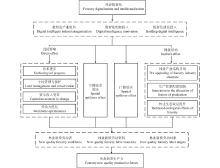
图1
林业数智化影响林业新质生产力的理论分析框架"
表1
林业新质生产力评价指标体系"
| 目标层 Target level | 一级指标 Primary index | 二级指标 Secondary index | 三级指标 Tertiary index | 指标释义 Interpretation of indicators | 属性 Attributes |
| 林业新质生产力 Forestry new quality productive forces | 林业新质 劳动者 New quality forestry workforce | 劳动者素质 Quality of workers | 专业素质 Professional quality | 林业专业技术人员数量与从业人数之比 Number of forestry professional technicians as a proportion of the number of employees | + |
| 文化素质 Educational quality | 林业站从业人员大专以上学历人员数量 Specificity of junior college or above for forestry station staff at the basic level | + | |||
| 劳动生产率 Labor productivity | 林业从业人员 平均产值 Average value of production of forest workers | 林业总产值/林业从业人员数量 Gross forestry output/number of forestry employees | + | ||
| 林业系统职工年均工资 Average annual wages in the forestry system employees | 林业系统在岗职工年平均工资 Average number of wages of forestry employees | + | |||
| 林业新质劳动资料 New quality forestry labor resources | 物质生产资料 Material production resources | 传统基础设施 Traditional infrastructure | 自然保护区面积与行政区域面积之比 Share of nature reserves in administrative regions | + | |
| 各地区林业站数量 Number of district forestry stations | + | ||||
| 数字基础设施 Digital infrastructure | 林业站计算机装备数量 Number of forestry stations equipped with computers | + | |||
| 能源消耗 Energy consumption | 地区能源消费总量×(地区林业产业生产总值/地区生产总值) Total regional energy consumption × (regional forest industry GDP/regional GDP) | ? | |||
| 无形生产资料 Intangible production resources | 数字化发展 Digital development | 农村数字普惠金融发展指数 Rural digital inclusive finance development index | + | ||
| 与数字经济相关的关键词词频 Number of word frequencies for keywords related to the digital economy | + | ||||
| 科技创新 Technological innovation | 林草科技投入额 Forestry and grassland science and technology inputs | + | |||
| 林业新质 劳动对象New quality forestry labor targets | 生态保护 Ecological protection | 林业生态服务 Forestry ecosystem services | 林业生态服务产值 Value of forestry ecosystem services | + | |
| 林业资源 Forestry resources | 森林覆盖率 Rate of forest cover | + | |||
| 产业发展 Industrial development | 新质产业 New quality industry | 林业旅游休闲康养产值 Forestry tourism and recreation output | + | ||
| 林业产业结构优化 Optimization of the forestry industry structure | 林业第三产业与第二产业产值之比 Ratio of tertiary to secondary forestry production value | + | |||
| 地区产业发展 Regional industrial development | 林业产值占地区生产总值比重 Share of forestry output in GDP | + |
表2
林业数智化评价指标体系"
| 目标层 Target level | 一级指标 Primary index | 二级指标 Secondary index | 指标释义 Interpretation of indicators | 属性Attributes |
| 林业数智化Forestry digitalization and intellectualization | 数智化产业组织 Digital intelligence industry | 产业转型升级 Industrial transformation and upgrading | 林业第三产业占生产总值之比 Ratio of forestry tertiary sector to GDP | + |
| 专业技术产业 Specialized technology industry | 林业专业技术服务产值 Value of forestry professional and technical services | + | ||
| 数字产业 Digital industry | 地区淘宝村数量 Number of Taobao villages in the region | + | ||
| 数智化科技创新 Digital intelligence technology and innovation | 科技教育 Science and technology education | 林业科技教育投资 Investment in forestry science and technology education | + | |
| 专业技术人员 Specialized technology staff | 林业专业技术人员数量 Number of forestry professional technicians | + | ||
| 绿色创新 Green innovation | 绿色专利授权数量 Number of green patents granted | + | ||
| 数智化建设投入 Building digital intelligence | 数字化建设 Digital construction | 农村宽带覆盖率 Rural broadband coverage | + | |
| 光纤密度 Optical fiber density | + | |||
| 林业站通讯设备装备数量 Number of forestry stations equipped with communications equipment | + | |||
| 信息化建设 Information construction | 林业信息化建设投入 Forestry information construction investment | + |
表3
变量描述性统计"
| 变量名称 Variables name | 样本量 Sample size | 平均值 Mean | 标准差 Standard deviation | 最大值 Max. | 最小值 Min. |
| 林业新质生产力 Forestry new quality productive forces | 348 | 0.362 | 0.223 | 0.899 | 0.039 |
| 林业数智化 Forestry digitalization and intellectualization | 348 | 0.340 | 0.221 | 0.987 | 0.011 |
| 林业产业结构升级 The upgrading of forestry industrial structure | 348 | 1.690 | 0.276 | 2.355 | 1.018 |
| 生产要素配置创新 The innovation of production factor allocation | 348 | 0.347 | 0.222 | 0.971 | 0.032 |
| 林业生态效益提升 The enhancement of forestry ecological efficiency | 348 | 48.854 | 24.980 | 129.061 | 9.631 |
| 经济发展水平 Level of economic development | 348 | 10.765 | 0.474 | 12.142 | 9.464 |
| 对外开放程度 Opening-up degree | 348 | 0.264 | 0.289 | 1.464 | 0.008 |
| 城镇化水平 Level of urbanization | 348 | 0.581 | 0.118 | 0.896 | 0.338 |
| 财政支林力度 Financial support for forests | 348 | 440.612 | 850.673 | 14.666 |
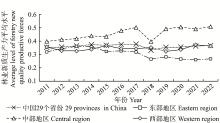
图2
2011—2022年中国29个省份林业新质生产力平均水平"
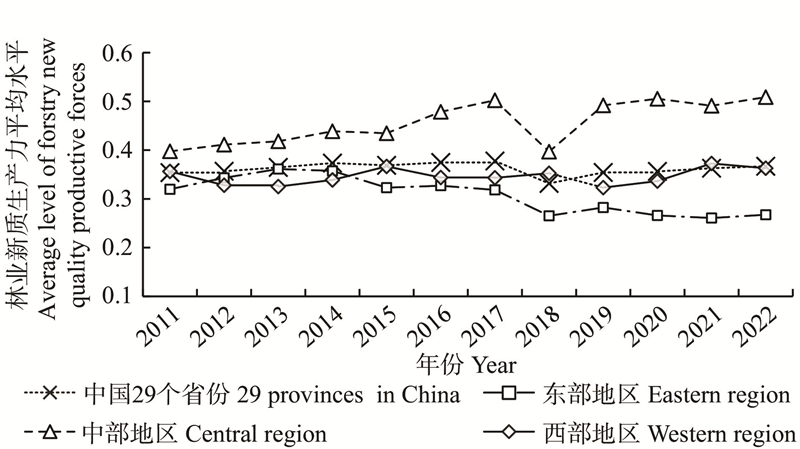
图3
2011—2022年中国29个省份林业数智化平均水平"
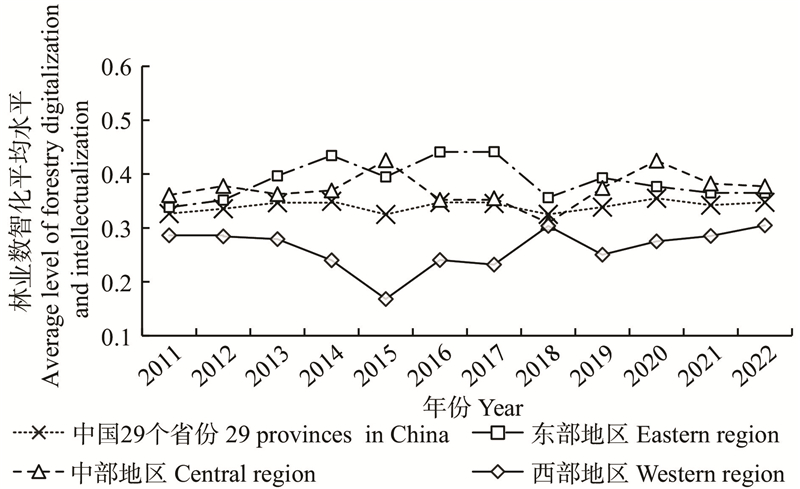
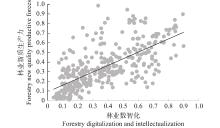
图4
林业新质生产力与林业数智化的拟合关系"
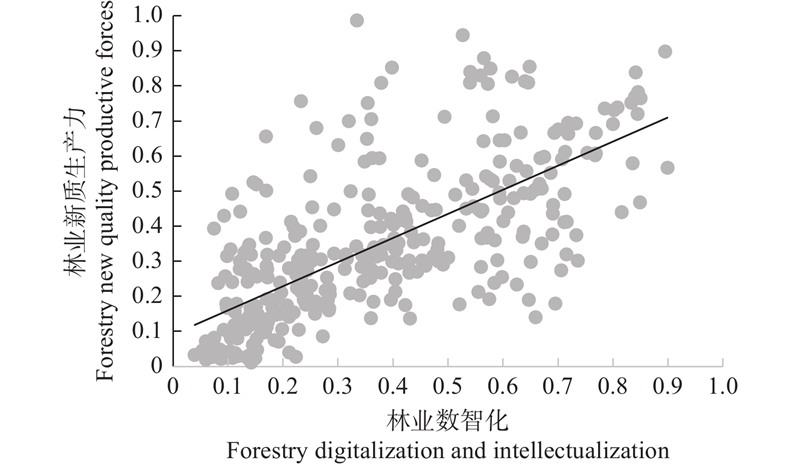
表4
基准回归分析①"
| 变量 Variables | 被解释变量:林业新质生产力 Dependent variable: forestry new quality productive forces | ||
| (1) | (2) | (3) | |
| 林业数智化 Forestry digitalization and intellectualization | 0.415*** (0.043) | 0.378*** (0.046) | 0.370*** (0.043) |
| 经济发展水平 Level of economic development | 0.224*** (0.055) | 0.608*** (0.077) | |
| 对外开放程度 Opening-up degree | 0.329*** (0.064) | 0.136* (0.082) | |
| 城镇化水平 Level of urbanization | ?1.072*** (0.325) | ?0.267 (0.416) | |
| 财政支林力度 Financial support for forests | 0.000 (0.000) | 0.000 (0.000) | |
| 地区固定效应 Regional fixed effect | 是Yes | 是Yes | 是Yes |
| 时间固定效应 Time fixed effect | 否No | 否No | 是Yes |
| 观测值 Observations | 348 | 348 | 348 |
| R2 | 0.482 | 0.323 | 0.364 |
表5
稳健性检验结果①"
| 变量 Variables | 缩尾处理 Shrink tail treatment | 变量滞后一期 Variables lagged by one period |
| 林业数智化 Forestry digitalization and intellectualization | 0.366*** (0.044) | 0.117** (0.051) |
| 经济发展水平 Level of economic development | 0.597*** (0.080) | 0.711*** (0.091) |
| 对外开放程度 Opening-up degree | 0.110 (0.085) | 0.151* (0.090) |
| 城镇化水平 Level of urbanization | ?0.201 (0.421) | ?0.414 (0.460) |
| 财政支林力度 Financial support for forests | 0.000 (0.000) | 0.000** (0.000) |
| 地区固定效应 Regional fixed effect | 是Yes | 是Yes |
| 时间固定效应 Time fixed effect | 是Yes | 是Yes |
| 观测值 Observations | 348 | 348 |
| R2 | 0.352 | 0.266 |
表6
内生性检验结果①"
| 变量 Variables | 林业新质生产力 Forestry new quality productive forces |
| 系数Ratio | |
| 林业数智化 Forestry digitalization and intellectualization | 0.875*** (0.137) |
| 不可识别检验 Non-identifiability test | 16.98*** |
| 弱工具变量检验 Weak instrumental variables test | 290.108*** |
表7
异质性分析结果①"
| 变量 Variables | 东部地区 Eastern region | 中部地区 Central region | 西部地区 Western region | 林业数智化 高水平地区 High-level region of forestry digitalization and intellectualization | 林业数智化 低水平地区 Less-developed region of forestry digitalization and intellectualization | 林业资源 利用型地区 Forestry resource utilization region | 林业加工制造型地区Forestry processing- manufacturing region |
| 林业数智化 Forestry digitalization and intellectualization | 0.446*** (0.087) | 0.370*** (0.074) | 0.158** (0.075) | 0.359*** (0.057) | 0.364*** (0.061) | 0.333*** (0.056) | 0.369*** (0.067) |
| 经济发展水平 Level of economic development | 0.536*** (0.167) | 0.565*** (0.181) | 0.470*** (0.114) | 0.347*** (0.089) | 0.424*** (0.061) | 0.594*** (0.072) | 0.699*** (0.172) |
| 对外开放程度 Opening-up degree | ?0.013 (0.149) | ?0.288 (0.431) | ?0.089 (0.219) | 0.422*** (0.088) | ?0.280** (0.122) | 0.114 (0.086) | 0.023 (0.170) |
| 城镇化水平 Level of urbanization | ?0.244 (0.703) | 0.193 (1.135) | ?0.027 (0.697) | ?1.421*** (0.533) | 1.555*** (0.379) | 0.198 (0.432) | ?0.425 (?2.44) |
| 财政支林力度 Financial support for forests | ?0.000 (0.000) | 0.000* (0.000) | 0.000** (0.000) | 0.000 (0.000) | ?0.000*** (0.000) | ?0.000 (0.000) | 0.000 (0.000) |
| 地区固定效应 Regional fixed effect | 是Yes | 是Yes | 是Yes | 是Yes | 是Yes | 是Yes | 是Yes |
| 时间固定效应 Time fixed effect | 是Yes | 是Yes | 是Yes | 是Yes | 是Yes | 是Yes | 是Yes |
| 观测值 Observations | 132 | 96 | 120 | 174 | 174 | 174 | 174 |
| R2 | 0.414 | 0.665 | 0.337 | 0.329 | 0.651 | 0.477 | 0.425 |
表8
机制检验回归结果①"
| 变量 Variables | 林业产业 结构升级 Upgrading the structure of the forestry industry | 林业新质 生产力 Forestry new quality productive forces | 生产要素 配置创新 Factors of production configuration innovation | 林业新质 生产力 Forestry new quality productive forces | 林业生态效益提升 Forestry eco-efficiency enhancement | 林业新质 生产力 Forestry new quality productive forces |
| 林业数智化 Forestry digitalization and intellectualization | 0.581*** (0.069) | 0.474*** (0.038) | 0.115** (0.057) | 0.697*** (0.044) | 3.842*** (0.472) | 0.562*** (0.044) |
| 林业产业结构升级 Upgrading the structure of the forestry industry | 0.418*** (0.027) | |||||
| 生产要素配置创新 Factors of production configuration innovation | 0.176*** (0.041) | |||||
| 林业生态效益提升 Forestry eco-efficiency enhancement | 0.040*** (0.005) | |||||
| 经济发展水平 Level of economic development | 0.028 (0.034) | ?0.017 (0.045) | 0.562 (0.040) | |||
| 对外开放程度 Opening-up degree | 0.038 (0.036) | ?0.032 (0.046) | ?0.009 (0.043) | |||
| 城镇化水平 Level of urbanization | ?0.933*** (0.162) | ?0.462** (0.207) | ?0.335* (0.192) | |||
| 财政支林力度 Financial support for forests | 0.000 (0.284) | 0.000* (0.000) | ?0.000 (0.000) | |||
| 地区固定效应 Regional fixed effect | 是Yes | 是Yes | 是Yes | 是Yes | 是Yes | 是Yes |
| 时间固定效应 Time fixed effect | 是Yes | 是Yes | 是Yes | 是Yes | 是Yes | 是Yes |
| Sobel test | 0.243*** | 0.020*** | 0.155*** | |||
| Ind_eff test (P-val) | 间接效应成立 Indirect effects are established 0.000 | 间接效应成立 Indirect effects are established 0.068 | 间接效应成立 Indirect effects are established 0.000 | |||
| 观测值 Observations | 348 | 348 | 348 | 348 | 348 | 348 |
| R2 | 0.328 | 0.742 | 0.259 | 0.584 | 0.370 | 0.641 |
表9
门槛效应检验"
| 门槛变量 Threshold variables | 门槛类型 Threshold type | 门槛值 Threshold value | F | P |
| 林业产业 结构升级 Upgrading the structure of the forestry industry | 第一门槛值 First threshold value | 1.919 | 62.21 | 0.000 |
| 第二门槛值 Second threshold value | 1.888 | 10.54 | 0.357 | |
| 第三门槛值 Third threshold value | 1.767 | 6.23 | 0.490 |
表10
门槛回归结果①"
| 变量 Variables | 林业新质生产力 Forestry new quality productive forces |
| 林业产业结构升级≤1.919 Upgrading the structure of the forestry industry≤1.919 | 0.266** (0.042) |
| 林业产业结构升级>1.919 Upgrading the structure of the forestry industry>1.919 | 0.493*** (0.043) |
| 地区固定效应 Regional fixed effect | Yes |
| 时间固定效应 Time fixed effect | Yes |
| 观测值 Observations | 348 |
| R2 | 0.471 |
表11
2011—2022年中国29个省份林业新质生产力和林业数智化全局莫兰指数(Moran’s I)①"
| 年Year | 林业新质生产力 Forestry new quality productive forces | 林业数智化 Forestry digitalization and intellectualization | |||
| Moran’s I | z | Moran’s I | z | ||
| 2011 | 0.228*** | 2.117 | 0.081 | 0.960 | |
| 2012 | 0.267*** | 2.396 | 0.155 | 1.544 | |
| 2013 | 0.251*** | 2.262 | 0.166 | 1.628 | |
| 2014 | 0.306*** | 2.698 | 0.224 | 2.099** | |
| 2015 | 0.314*** | 2.762 | 0.404 | 3.574*** | |
| 2016 | 0.334*** | 2.922 | 0.220 | 2.041** | |
| 2017 | 0.345*** | 3.009 | 0.270 | 2.427** | |
| 2018 | 0.499*** | 4.287 | 0.165 | 1.617 | |
| 2019 | 0.493*** | 4.203 | 0.299 | 2.685*** | |
| 2020 | 0.566*** | 4.755 | 0.352 | 3.065*** | |
| 2021 | 0.550*** | 4.616 | 0.184 | 1.736* | |
| 2022 | 0.503*** | 4.230 | 0.170 | 1.634 | |
表12
空间计量模型设定检验"
| 检验方法 Test methods | 统计量 Statistic | P | |
| LM检验 空间误差 LM test Spatial error | 拉格朗日乘子 Lagrange multiplier | 114.771 | 0.000 |
| 稳健拉格朗日乘子 Robust Lagrange multiplier | 33.660 | 0.000 | |
| LM检验 空间滞后 LM test Spatial lag | 拉格朗日乘子 Lagrange multiplier | 140.712 | 0.000 |
| 稳健拉格朗日乘子 Robust Lagrange multiplier | 59.601 | 0.000 | |
| Hausman检验 Hausman test | Ho: 系数差异非系统性 Ho: difference in coefficients not systematic | 61.450 | 0.000 |
| Wald检验 Wald test | SDM能否转化为SAR Can SDM be converted to SAR | 57.190 | 0.000 |
| SDM能否转化为SEM Can SDM be converted to SEM | 55.640 | 0.000 | |
| LR 检验 LR test | SDM能否转化为SAR Can SDM be converted to SAR | 52.940 | 0.000 |
| SDM能否转化为SEM Can SDM be converted to SEM | 51.320 | 0.000 | |
表13
SDM 模型的参数估计结果和效应分解结果①"
| 变量 Variables | Main | Wx | 直接效应 Direct effect | 间接效应 Indirect effect | 总效应 Total effects |
| 林业数智化 Forestry digitalization and intellectualizationes | 0.343*** (0.038) | 0.203** (0.080) | 0.340*** (0.039) | 0.174** (0.071) | 0.515*** (0.072) |
| 经济发展水平 Level of economic development | 0.470*** (0.079) | 0.328** (0.140) | 0.458*** (0.067) | 0.282** (0.138) | 0.739*** (0.138) |
| 对外开放程度 Opening-up degree | 0.203*** (0.076) | 0.478*** (0.140) | 0.202** (0.083) | 0.416*** (0.134) | 0.618*** (0.143) |
| 城镇化水平 Level of urbanization | ?0.640* (0.368) | ?1.231* (0.732) | ?0.611 (0.409) | ?1.036 (0.541) | ?1.647*** (0.626) |
| 财政支林力度 Financial support for forests | 0.000 (0.000) | 0.000*** (0.000) | 0.000 (0.000) | 0.000** (0.000) | 0.000*** (0.000) |
| R2 | 0.163 | ||||
|
鲍丙飞, 曾子洋, 肖文海, 等. 重点生态功能区转移支付对生态产业发展的空间效应: 以江西省80个县为例. 自然资源学报, 2022, 37 (10): 2720- 2735.
doi: 10.31497/zrzyxb.20221017 |
|
|
Bao B F, Zeng Z Y, Xiao W H, et al. The spatial effect of transfer payments for key ecological function zones on the development of ecological industry: a case study of 80 counties in Jiangxi Province. Journal of Natural Resources, 2022, 37 (10): 2720- 2735.
doi: 10.31497/zrzyxb.20221017 |
|
| 贝淑华, 王 圆, 沈 杰. 创新对林业高质量发展水平的影响研究. 林业经济, 2023, 45 (8): 5- 19. | |
| Bei S H, Wang Y, Shen J. Research on the influence of innovation on the high-quality development level of forestry. Forestry Economics, 2023, 45 (8): 5- 19. | |
| 曹 林, 周 凯, 申 鑫, 等. 智慧林业发展现状与展望. 南京林业大学学报(自然科学版), 2022, 46 (6): 83- 95. | |
| Cao L, Zhou K, Shen X, et al. The status and prospects of smart forestry. Journal of Nanjing Forestry University (Natural Sciences Edition), 2022, 46 (6): 83- 95. | |
| 车宗菊. 2024. 智慧林业在林业发展中的应用研究. 当代农机, (6): 46, 49. | |
| Che Z J. 2024. Study on the application of smart forestry in forestry development. Contemporary Farm Machinery, (6): 46, 49. [in Chinese] | |
|
陈 熙. 林业高质量发展与乡村振兴耦合协调性分析: 以中、西南地区为例. 科技和产业, 2024, 24 (7): 28- 32.
doi: 10.3969/j.issn.1671-1807.2024.07.006 |
|
|
Chen X. Analysis of the coupling and coordination of high-quality forestry development and rural revitalization: a case study of central and southwest China. Science Technology and Industry, 2024, 24 (7): 28- 32.
doi: 10.3969/j.issn.1671-1807.2024.07.006 |
|
| 陈 剑, 刘运辉. 数智化使能运营管理变革: 从供应链到供应链生态系统. 管理世界, 2021, 37 (11): 227- 240, 14. | |
| Chen J, Liu Y H. Operations management innovation enabled by digitalization and intellectualization: from supply chain to supply chain ecosystem. Journal of Management World, 2021, 37 (11): 227- 240, 14. | |
|
冯 蕊. 智慧林业管理技术在林业资源管理中的应用研究. 林业科技情报, 2024, 56 (2): 137- 139.
doi: 10.3969/j.issn.1009-3303.2024.02.040 |
|
|
Feng R. Research on the application of intelligent forestry management technology in forestry resource management. Forestry Science and Technology Information, 2024, 56 (2): 137- 139.
doi: 10.3969/j.issn.1009-3303.2024.02.040 |
|
|
付凌晖. 我国产业结构高级化与经济增长关系的实证研究. 统计研究, 2010, 27 (8): 79- 81.
doi: 10.3969/j.issn.1002-4565.2010.08.011 |
|
|
Fu L H. An empirical research on industry structure and economic growth. Statistical Research, 2010, 27 (8): 79- 81.
doi: 10.3969/j.issn.1002-4565.2010.08.011 |
|
| 韩文龙, 张瑞生, 赵 峰. 新质生产力水平测算与中国经济增长新动能. 数量经济技术经济研究, 2024, 41 (6): 5- 25. | |
| Han W L, Zhang R S, Zhao F. The measurement of new quality productivity and new driving force of the Chinese economy. Journal of Quantitative & Technological Economics, 2024, 41 (6): 5- 25. | |
| 韩皓爽, 万荣荣. 森林生态质量评估方法研究进展. 生态科学, 2021, 40 (4): 212- 222. | |
| Han H S, Wan R R. A review on the methods of ecological evaluation of forest quality. Ecological Science, 2021, 40 (4): 212- 222. | |
| 胡美玲, 朱震锋, 吴翔宇. 数字普惠金融对林业经济高质量发展的影响. 林业经济问题, 2024, 44 (4): 419- 427. | |
| Hu M L, Zhu Z F, Wu X Y. The impact of digital inclusive finance on the high-quality development level of forestry economy. Issues of Forestry Economics, 2024, 44 (4): 419- 427. | |
| 姜雪梅, 牛志伟, 王 会, 等. 林业生态建设与保护投资对林业产业发展的影响. 生态经济, 2023, 39 (8): 112- 121. | |
| Jiang X M, Niu Z W, Wang H, et al. Influence of forestry ecological construction and protection investment on the development of forestry industry. Ecological Economy, 2023, 39 (8): 112- 121. | |
| 孔凡斌, 程文杰, 徐彩瑶. 数字经济发展能否提高森林生态产品价值转化效率: 基于浙江省丽水市的实证分析. 中国农村经济, 2023 (5): 163- 184. | |
| Kong F B, Cheng W J, Xu C Y. Does the development of digital economy improve the value transformation efficiency of forest ecological products: an EmpiricalAnalysis in Lishui, Zhejiang Province. Chinese Rural Economy, 2023 (5): 163- 184. | |
| 孔凡斌, 杜 丽. 新时期集体林权制度改革政策进程与综合绩效评价: 基于福建、江西、浙江和辽宁四省的改革实践. 农业技术经济, 2009 (6): 96- 105. | |
| Kong F B, Du L. Policy process and comprehensive performance evaluation of collective forest right system reform in the new era: based on the reform practice in Fujian, Jiangxi, Zhejiang and Liaoning provinces. Journal of Agrotechnical Economics, 2009 (6): 96- 105. | |
|
孔凡斌, 陆 雨, 徐彩瑶. 数字经济发展、森林生态产品价值实现与城乡收入差距. 林业科学, 2024, 60 (5): 1- 21.
doi: 10.11707/j.1001-7488.LYKX20230570 |
|
|
Kong F B, Lu Y, Xu C Y. Digital economy development, value realization of forest ecological products, and urban-rural income gap. Scientia Silvae Sinicae, 2024, 60 (5): 1- 21.
doi: 10.11707/j.1001-7488.LYKX20230570 |
|
|
雷孝龙. 新时代背景下林业高质量发展的有效策略研究. 造纸装备及材料, 2024, 53 (6): 115- 117.
doi: 10.3969/j.issn.1672-3066.2024.06.038 |
|
|
Lei X L. Study on effective strategies for high-quality forestry development in the new era. Papermaking Equipment & Materials, 2024, 53 (6): 115- 117.
doi: 10.3969/j.issn.1672-3066.2024.06.038 |
|
| 李 超, 王 悦, 马 修, 等. 新质生产力理念下黑龙江省林业产业发展路径跃迁研究. 中国林业经济, 2023 (6): 64- 71. | |
| Li C, Wang Y, Ma X, et al. Research on the path transition of the development of the forestry industry in Heilongjiang Province under the new quality productivity. China Forestry Economics, 2023 (6): 64- 71. | |
|
李美娟, 刘佳鸿, 杨隆浩, 等. 基于相对熵距离的动态改进理想解法及其应用研究. 系统科学与数学, 2023, 43 (1): 174- 185.
doi: 10.12341/jssms22193 |
|
|
Li M J, Liu J H, Yang L H, et al. Dynamic improved topsis based on relative entropy distance and its application research. Journal of Systems Science and Mathematical Sciences, 2023, 43 (1): 174- 185.
doi: 10.12341/jssms22193 |
|
| 李 阳, 陈海龙, 田茂再. 新质生产力水平的统计测度与时空演变特征研究. 统计与决策, 2024, 40 (9): 11- 17. | |
| Li Y, Chen H L, Tian M Z. Statistical measurement and spatiotemporal evolution characteristics of new quality productive force level. Statistics & Decision, 2024, 40 (9): 11- 17. | |
|
李欣儒. 林业技术进步对林业产业结构优化的影响. 林业科技情报, 2021, 53 (4): 74- 75.
doi: 10.3969/j.issn.1009-3303.2021.04.025 |
|
|
Li X R. Influence of China’s forestry technological progress on the optimization of forestry industrial structure. Forestry Science and Technology Information, 2021, 53 (4): 74- 75.
doi: 10.3969/j.issn.1009-3303.2021.04.025 |
|
| 李献群. 智慧林业在基层林业管理中的应用探究. 智慧农业导刊, 2024, 4 (17): 6- 9. | |
| Li X Q. Exploration of the application of smart forestry in grassroots forestry management. Journal of Smart Agriculture, 2024, 4 (17): 6- 9. | |
| 刘 鹤. 2022. 把实施扩大内需战略同深化供给侧结构性改革有机结合起来. 人民日报, 2022-11-04(6). | |
| Liu H. 2022. Combining the implementation of the strategy of expanding domestic demand with the deepening of supply-side structural reforms. People’s Daily. 2022-11-04(6). [in Chinese] | |
| 刘友金, 冀有幸. 发展新质生产力须当拼在数字经济新赛道. 湖南科技大学学报(社会科学版), 2024, 27 (1): 89- 99. | |
| Liu Y J, Ji Y X. The development of new quality productivity must be integrated into the new track of the digital economy. Journal of Hunan University of Science and Technology (Social Science Edition), 2024, 27 (1): 89- 99. | |
| 卢 江, 郭子昂, 王煜萍. 新质生产力发展水平、区域差异与提升路径. 重庆大学学报(社会科学版), 2024, 30 (3): 1- 17. | |
| Lu J, Guo Z A, Wang Y P. Levels of development of new quality productivity, regional differences and paths to enhancement. Journal of Chongqing University (Social Science Edition), 2024, 30 (3): 1- 17. | |
| 路亚欣, 张彩虹. 绿色信贷、技术创新对中国林业产业结构的交互影响. 林业经济问题, 2022, 42 (5): 524- 531. | |
| Lu Y X, Zhang C H. The interaction of green credit and technology innovation on the forestry industry structure in China. Issues of Forestry Economics, 2022, 42 (5): 524- 531. | |
|
罗斌元, 陈艳霞. 数智化如何赋能经济高质量发展: 兼论营商环境的调节作用. 科技进步与对策, 2022, 39 (5): 61- 71.
doi: 10.6049/kjjbydc.2021040437 |
|
|
Luo B Y, Chen Y X. How can digital intelligence enable high-quality economic development: a study on the regulatory role of business environment. Science & Technology Progress and Policy, 2022, 39 (5): 61- 71.
doi: 10.6049/kjjbydc.2021040437 |
|
| 宁攸凉, 沈伟航, 宋 超, 等. 林业产业高质量发展推进策略研究. 农业经济问题, 2021, 42 (2): 117- 122. | |
| Ning Y L, Shen W H, Song C, et al. Studying on the promotion strategies of high-quality development of forestry industry. Issues in Agricultural Economy, 2021, 42 (2): 117- 122. | |
|
彭兴松, 马 娟. 新质生产力助力林草产业高质量发展浅析. 现代园艺, 2024 (16): 54- 56.
doi: 10.3969/j.issn.1006-4958.2024.16.016 |
|
|
Peng X S, Ma J. Analysis on the new quality productivity helping the high quality development of forest and grass industry. Contemporary Horticulture, 2024 (16): 54- 56.
doi: 10.3969/j.issn.1006-4958.2024.16.016 |
|
| 田明华, 黄 雨, 王富炜, 等. 欠发达地区乡村旅游减贫的门槛效应研究: 基于安徽省15个欠发达县面板数据. 林业经济, 2022, 44 (6): 65- 81. | |
| Tian M H, Huang Y, Wang F W, et al. The threshold effect of rural tourism in poverty reduction in underdeveloped areas: based on panel data of 15 underdeveloped counties in Anhui Province. Forestry Economics, 2022, 44 (6): 65- 81. | |
| 唐要家, 王 蜡, 唐春晖. 人工智能如何提升企业全要素生产率: 基于技术创新和技术应用视角. 财经问题研究, 2025 (1): 87- 100. | |
| Tang Y J, Wang L, Tang C H. How does artificial intelligence improve enterprises’ total factor productivity: based on the perspective of technological innovation and technology application. Research on Financial and Economic Issues, 2025 (1): 87- 100. | |
| 王 珏. 新质生产力: 一个理论框架与指标体系. 西北大学学报(哲学社会科学版), 2024, 54 (1): 35- 44. | |
| Wang J. New productive forces: a theoretical frame and index system. Journal of Northwest University (Philosophy and Social Sciences Edition), 2024, 54 (1): 35- 44. | |
| 王 珂, 郭晓曦. 中国新质生产力水平、区域差异与时空演进特征. 统计与决策, 2024, 40 (9): 30- 36. | |
| Wang K, Guo X X. Measurement and spatiotemporal evolution of China’s new quality productive force level. Statistics & Decision, 2024, 40 (9): 30- 36. | |
| 王雅晖, 王怡然, 杨金霖, 等. 林业产业专业化、多样化集聚对林业全要素生产率的影响. 林业经济问题, 2022, 42 (2): 142- 150. | |
| Wang Y H, Wang Y R, Yang J L, et al. Impact of specialized and diversified agglomeration of forestry industry on forestry total factor productivity. Issues of Forestry Economics, 2022, 42 (2): 142- 150. | |
|
温忠麟, 叶宝娟. 中介效应分析: 方法和模型发展. 心理科学进展, 2014, 22 (5): 731- 745.
doi: 10.3724/SP.J.1042.2014.00731 |
|
|
Wen Z L, Ye B J. Analyses of mediating effects: the development of methods and models. Advances in Psychological Science, 2014, 22 (5): 731- 745.
doi: 10.3724/SP.J.1042.2014.00731 |
|
| 武春友, 梁 潇, 房士吉. 城市化对产业结构演进的作用机理研究: 基于中国省际面板数据的实证. 中国软科学, 2010 (suppl.2): 389- 395. | |
| Wu C Y, Liang X, Fang S J. Research on the urbanization effecting mechanism of industrial structure evolution: based on the panel data empirical analysis. China Soft Science, 2010 (suppl.2): 389- 395. | |
| 魏秀华, 杨建州, 曹 玮. 人力资本、产业结构与林业经济增长的交互效应: 基于南方集体林区的实证分析. 福建论坛(人文社会科学版), 2019 (12): 144- 153. | |
| Wei X H, Yang J Z, Cao W. Interactive effects of human capital, industrial structure and forestry economic growth: an empirical analysis based on southern collective forest areas. Fujian Tribune, 2019 (12): 144- 153. | |
|
徐 政, 郑霖豪, 程梦瑶. 新质生产力赋能高质量发展的内在逻辑与实践构想. 当代经济研究, 2023 (11): 51- 58.
doi: 10.3969/j.issn.1005-2674.2023.11.006 |
|
|
Xu Z, Zheng L H, Cheng M Y. The internal logic and practical concept of new quality productivity empowering high-quality development. Contemporary Economic Research, 2023 (11): 51- 58.
doi: 10.3969/j.issn.1005-2674.2023.11.006 |
|
| 向红玲, 陈昭玖, 廖文梅, 等. 南方集体林区林业发展驱动机制及技术效率影响因素分析. 林业经济, 2021, 43 (8): 5- 21. | |
| Xiang H L, Chen Z J, Liao W M, et al. Analysis on driving mechanism of forestry development and influencing factors of technical efficiency in collective forest regions in South China. Forestry Economics, 2021, 43 (8): 5- 21. | |
| 徐林明, 李美娟. 动态综合评价中的数据预处理方法研究. 中国管理科学, 2020, 28 (1): 162- 169. | |
| Xu L M, Li M J. A data preprocessing method in dynamic comprehensive evaluation. Chinese Journal of Management Science, 2020, 28 (1): 162- 169. | |
| 徐旭初, 杨 威, 吴 彬. 乡村数字经济赋能农业全要素生产率提升的多元路径: 基于浙江省县级数据的组态分析. 中国农村经济, 2024 (10): 84- 103. | |
| Xu X C, Yang W, Wu B. Multiple pathways for rural digital economy empowering agricultural total factor productivity: a configuration analysis based on county-level data from Zhejiang Province. Chinese Rural Economy, 2024 (10): 84- 103. | |
|
许 谭, 祝彦杰, 徐 锋, 等. 基于物联网技术的智慧林业高质量发展策略. 现代农业研究, 2023, 29 (7): 123- 125.
doi: 10.3969/j.issn.1674-0653.2023.07.034 |
|
|
Xu T, Zhu Y J, Xu F, et al. High quality development strategy of intelligent forestry based on internet of things technology. Modern Agriculture Research, 2023, 29 (7): 123- 125.
doi: 10.3969/j.issn.1674-0653.2023.07.034 |
|
| 许晓东, 赖静娴, 傅清媛. 林业新质生产力推动林业高质量发展转型研究: 基于马克思主义政治经济学视角. 林业经济问题, 2024, 44 (2): 113- 119. | |
| Xu X D, Lai J X, Fu Q Y. The transformation of new quality productive forces in forestry to promote the high-quality development of forestry: based on Marxist political economy perspective. Issues of Forestry Economics, 2024, 44 (2): 113- 119. | |
| 薛 亮, 黄 新, 任 超. 物联网技术在林业中的应用研究综述. 传感器与微系统, 2019, 38 (11): 1- 3, 7. | |
| Xue L, Huang X, Ren C. Review on application research of IoT technology in forestry. Transducer and Microsystem Technologies, 2019, 38 (11): 1- 3, 7. | |
|
颜 彤, 董自光. 数智化时代下林业发展问题与策略研究. 造纸装备及材料, 2023, 52 (11): 148- 150.
doi: 10.3969/j.issn.1672-3066.2023.11.049 |
|
|
Yan T, Dong Z G. Research on forestry development problems and strategies in the age of digital intelligence. Papermaking Equipment & Materials, 2023, 52 (11): 148- 150.
doi: 10.3969/j.issn.1672-3066.2023.11.049 |
|
|
阳 杨, 郭佳钦, 王少国. 新质生产力、创业活跃度与城市高质量发展. 科技进步与对策, 2024, 41 (22): 1- 12.
doi: 10.6049/kjjbydc.L2024XZ645 |
|
|
Yang Y, Guojia Q, Wang S G. New quality productive forces, entrepreneurial activity and high-quality urban development. Science & Technology Progress and Policy, 2024, 41 (22): 1- 12.
doi: 10.6049/kjjbydc.L2024XZ645 |
|
| 勇 强, 李 群. 2023. 中国特色生态文明建设与林业发展报告(2022—2023). 北京: 社会科学文献出版社. | |
| Yong Q, Li Q. 2023. Report on the development of ecological civilization with Chinese characteristics and forestry. Beijing: Social Sciences Literature Publishing House. [in Chinese] | |
| 袁宝龙, 张 壬. 新质生产力赋能中国林业高质量发展: 理论逻辑、现实困境与实践进路. 世界林业研究, 2024, 37 (4): 1- 8. | |
| Yuan B L, Zhang R. New quality productive forces enabling high-quality development of China’s forestry: theoretical logic, realistic dilemma and practical progress. World Forestry Research, 2024, 37 (4): 1- 8. | |
|
张 彭. 数字新质生产力与全球价值链嵌入: 理论机制与实证检验. 当代经济研究, 2024 (5): 75- 86.
doi: 10.3969/j.issn.1005-2674.2024.05.009 |
|
|
Zhang P. Digital new quality productive forces and global value chain embedding: theoretical mechanism and empirical test. Contemporary Economic Research, 2024 (5): 75- 86.
doi: 10.3969/j.issn.1005-2674.2024.05.009 |
|
| 张 云, 柏培文. 数智化如何影响双循环参与度与收入差距: 基于省级—行业层面数据. 管理世界, 2023, 39 (10): 58- 83. | |
| Zhang Y, Bai P W. How digital intelligence affects dual circulation participation and income inequality: based on provincial-industry data. Journal of Management World, 2023, 39 (10): 58- 83. | |
| 张建龙. 全面提升林草科技工作水平 引领林草事业高质量发展和现代化建设. 时事报告(党委中心组学习), 2019 (5): 82- 95. | |
| Zhang J L. Comprehensively improving forestry and grassland science and technology leading the high-quality development and modernization of forestry and grassland industry. Current Affairs Report (Party Center Group Study, 2019 (5): 82- 95. | |
| 张 寅. 智慧林业在现代林业管理中的应用. 南方农机, 2024, 55 (S1): 145- 148. | |
| Zhang Y. Application of smart forestry in modern forestry management. China Southern Agricultural Machinery, 2024, 55 (S1): 145- 148. | |
| 张胜利, 代金玲, 卢秀琴, 等. 内蒙古农业大学智慧林业人才培养模式探索. 智慧农业导刊, 2024, 4 (17): 22- 25. | |
| Zhang S L, Dai J L, Lu X Q, et al. Exploration of personnel training model for smart forestry talents of Inner Mongolia agricultural university. Journal of Smart Agriculture, 2024, 4 (17): 22- 25. | |
| 赵希元. 浙江加强创新发展 不断提高林业新质生产力. 浙江林业, 2024 (7): 10- 11. | |
| Zhao X Y. Zhejiang strengthens innovation and development, and constantly improves the productivity of new forestry quality. Zhejiang Forestry, 2024 (7): 10- 11. | |
| 周 文, 许凌云. 论新质生产力: 内涵特征与重要着力点. 改革, 2023 (10): 1- 13. | |
| Zhou W, Xu L Y. On new quality Pr oductivity: connotative char acter istics and impor tant focus. Reform, 2023 (10): 1- 13. | |
|
朱教君, 王高峰, 张怀清, 等. 关于“气候智慧林业” 研究的思考. 林业科学, 2024, 60 (7): 1- 7.
doi: 10.11707/j.1001-7488.LYKX20240433 |
|
|
Zhu J J, Wang G G, Zhang H Q, et al. On the research of climate-smart forestry. Scientia Silvae Sinicae, 2024, 60 (7): 1- 7.
doi: 10.11707/j.1001-7488.LYKX20240433 |
|
| 朱红根, 席 玮, 陈 翩. 乡村振兴驱动城乡经济融合的理论机理与效应. 安徽大学学报(哲社版), 2024, 48 (4): 177- 188. | |
| Zhu H G, Xi W, Chen P. Theoretical mechanisms and effects of rural revitalization driving urban-rural economic integration. Journal of Anhui University (Philosophy and Social Sciences Edition), 2024, 48 (4): 177- 188. | |
|
翟 郡, 杨红强, 徐彩瑶, 等. 浙江省数字经济与林业产业融合发展水平测度及影响因素. 林业科学, 2024, 60 (5): 22- 34.
doi: 10.11707/j.1001-7488.LYKX20230477 |
|
|
Zhai J, Yang H Q, Xu C Y, et al. Measurement and influencing factors of the level of integrated development of digital economy and forestry industry in Zhejiang Province. Scientia Silvae Sinicae, 2024, 60 (5): 22- 34.
doi: 10.11707/j.1001-7488.LYKX20230477 |
|
|
Geem Z W, Kim J H, Loganathan G V. A new heuristic optimization algorithm: harmony search. Simulation, 2001, 76 (2): 60- 68.
doi: 10.1177/003754970107600201 |
| [1] | 张少鹏,付瑶,朱洪革,赵梦涵. 天然林资源保护政策对重点国有林区林业新质生产力的影响——基于林业绿色全要素生产率视角[J]. 林业科学, 2025, 61(6): 183-195. |
| [2] | 朱洪革,赵梦涵,张少鹏. 国有林管理体制转型对林业新质生产力发展的影响机制[J]. 林业科学, 2025, 61(5): 207-221. |
| [3] | 黄安胜,薛泽茜,郭铭杰,许毓坤. 乡村数字化对林业新质生产力的影响[J]. 林业科学, 2025, 61(11): 200-214. |
| 阅读次数 | ||||||
|
全文 |
|
|||||
|
摘要 |
|
|||||

