
林业科学 ›› 2026, Vol. 62 ›› Issue (2): 186-203.doi: 10.11707/j.1001-7488.LYKX20240671
• 研究论文 • 上一篇
崔王斌1,周宏平1,2,*( ),张洋1,2,王艳艳1,许林云1,2,范高鸣1
收稿日期:2024-11-11
修回日期:2025-10-23
出版日期:2026-02-25
发布日期:2026-03-04
通讯作者:
周宏平
E-mail:hpzhou@njfu.edu.cn
基金资助:
Wangbin Cui1,Hongping Zhou1,2,*(),Yang Zhang1,2,Yanyan Wang1,Linyun Xu1,2,Gaoming Fan1
Received:2024-11-11
Revised:2025-10-23
Online:2026-02-25
Published:2026-03-04
Contact:
Hongping Zhou
E-mail:hpzhou@njfu.edu.cn
摘要:
目的: 探究不同尺寸核桃树受迫振动时的响应情况,解决核桃振动采收过程中效率低下、果实采净率低等问题。方法: 利用地面三维激光扫描仪采集核桃树点云数据,对采集到的树体点云数据进行预处理后提取树木骨架,采用NX软件对核桃树进行三维拟合重建,建立不同尺寸参数的核桃树三维模型。通过实测频谱对核桃树材料特性参数进行修正,实际与仿真共同出现的共振频率中最大相对误差仅为0.22%,确保三维模型的准确性。应用Ansys对核桃树树体三维模型进行谐响应分析,探究激振频率、激振力、激振高度3个参数对振动加速度的影响,分析不同尺寸核桃树在不同频率下的位移和加速度响应情况;结合挂果枝位移、加速度响应和谐响应云图上核桃树的响应情况进一步探究不同尺寸核桃树的适宜采收频率。结果: 核桃树的加速度响应峰值随直径、高度和冠幅增加而降低,较高树体和大冠幅对高频振动的响应较弱,表明树体的几何特性显著影响其振动特性。对核桃树振动采收参数进行响应面分析并优化,得到核桃树振动采收的最优振动参数组合,在最优振动参数激振下核桃采收率均在90%以上,表明该振动频率参数可为核桃树振动采收装置工作时的参数设置提供参考。结论: 根据本研究描述的核桃树建模方法可以实现对核桃树细小侧枝的重建,且重建出来的整树模型具有更为真实的生长形态特征;不同直径、不同高度、不同冠幅的核桃树振动响应不同,适宜振动频率范围为10~20 Hz,可根据树形结构参数进一步确定该频率范围。
中图分类号:
崔王斌,周宏平,张洋,王艳艳,许林云,范高鸣. 基于点云建模的核桃树振动参数优化与试验[J]. 林业科学, 2026, 62(2): 186-203.
Wangbin Cui,Hongping Zhou,Yang Zhang,Yanyan Wang,Linyun Xu,Gaoming Fan. Optimisation and Testing of Vibration Parameters of Walnut Trees Based on Point Cloud Modelling[J]. Scientia Silvae Sinicae, 2026, 62(2): 186-203.
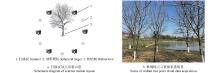
图1
核桃树点云数据的获取"
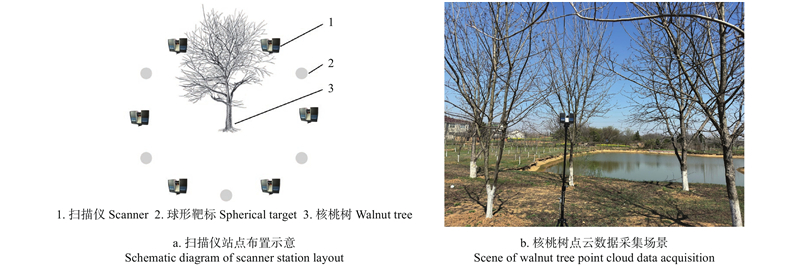
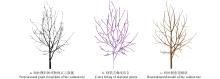
图2
核桃树三维重建过程"
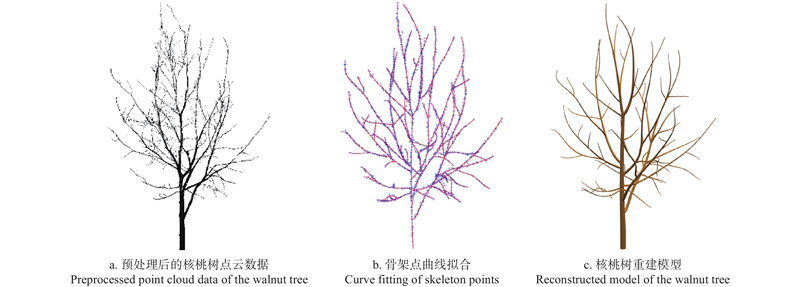
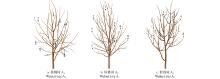
图3
3株核桃树重建模型"
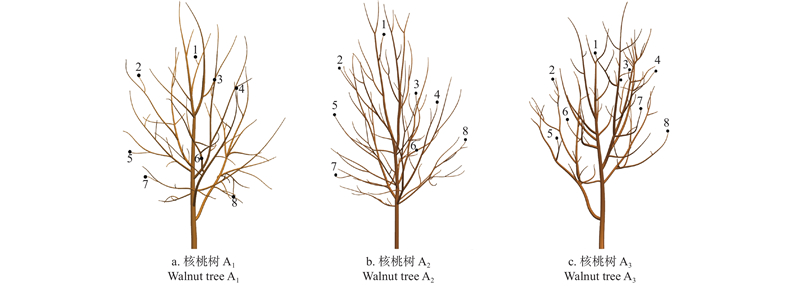
表1
核桃树参数"
| 编号ID | 根部直径 Basal diameter/cm | 整树高度 Tree height/m | 冠幅 Crown width/m |
| A1 | 31.2 | 13.2 | 9.3 |
| A2 | 19.1 | 11.7 | 6.7 |
| A3 | 15.5 | 7.4 | 4.8 |
| B1 | 18.4 | 13.2 | 9.3 |
| B2 | 24.6 | 13.2 | 9.3 |
| C1 | 31.2 | 11.5 | 9.3 |
| C2 | 31.2 | 12.4 | 9.3 |
| D1 | 31.2 | 13.2 | 7.8 |
| D2 | 31.2 | 13.2 | 8.6 |
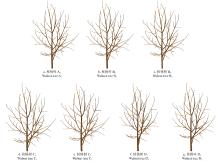
图4
不同尺寸参数核桃树有限元模型"
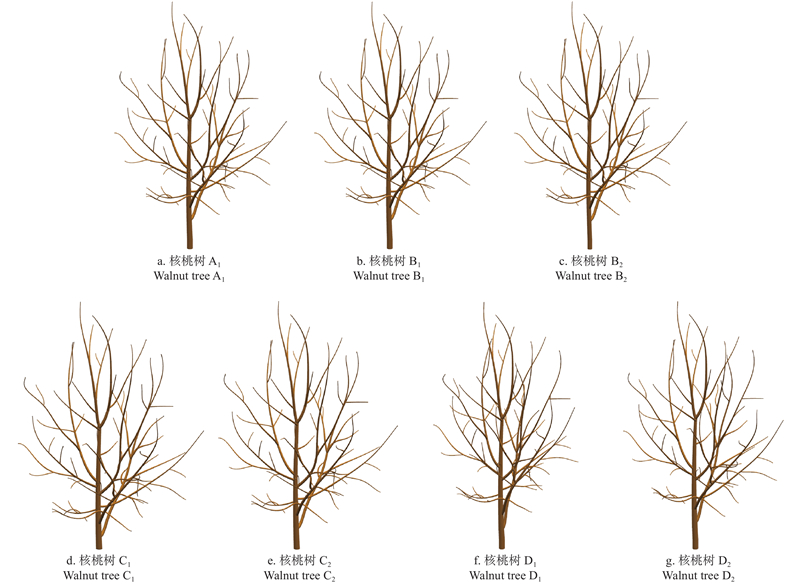
图5
频谱测试"
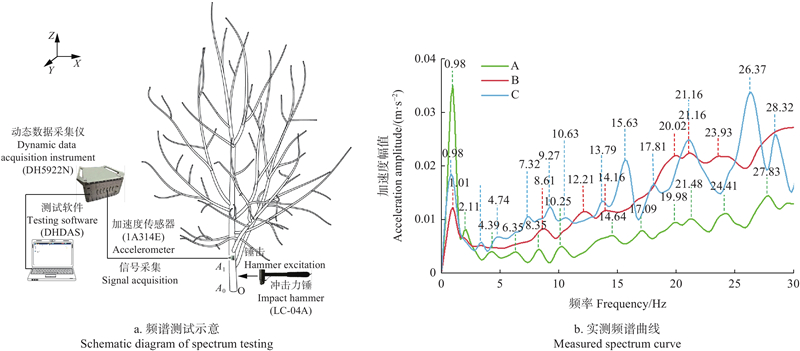
图6
三点弯曲试验"
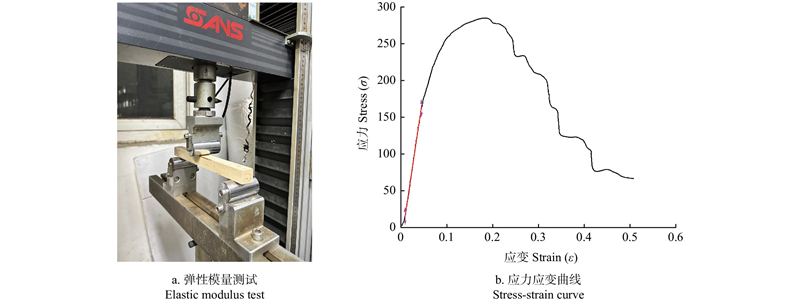
表2
核桃树的物理性质"
| 材料Material | 弹性模量Elastic modulus/ | 密度Density/(kg·m?3) | 泊松比Poisson’ s ratio | 阻尼比Damping ratio |
| 核桃树Walnut tree | 4 702 | 1 019 | 0.35 | 0.056 |
图7
核桃果实脱落加速度测试"
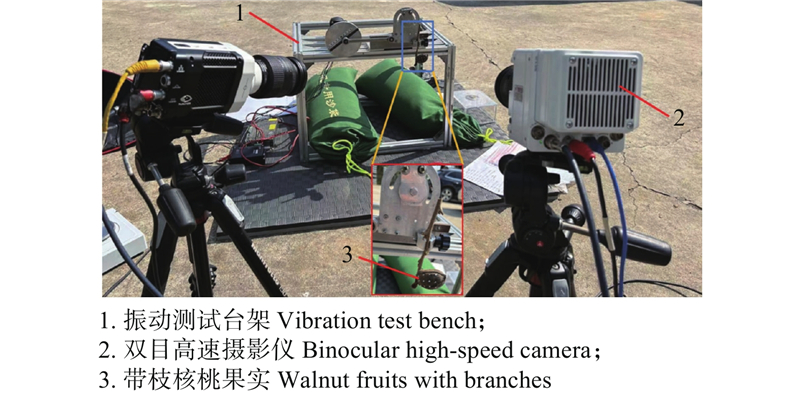
表3
核桃树的固有频率"
| A1 | 测试Test | 阶次Mode order | 1 | 2 | 3 | 4 | 5 | 6 | 7 | 8 | 9 | 10 | 11 | 12 |
| 频率Frequency | 0.98 | 2.11 | 4.39 | 6.35 | 8.35 | 10.25 | 14.64 | 17.09 | 19.98 | 21.48 | 24.41 | 27.83 | ||
| 仿真Simulation | 阶次Mode order | 2 | 5 | 10 | 16 | 22 | 28 | 42 | 50 | 57 | 61 | 69 | 77 | |
| 频率Frequency | 0.98 | 2.11 | 4.39 | 6.36 | 8.35 | 10.24 | 14.65 | 17.07 | 19.98 | 21.46 | 24.42 | 27.85 | ||
| A2 | 测试Test | 阶次Mode order | 1 | 2 | 3 | 4 | 5 | 6 | 7 | |||||
| 频率Frequency | 1.01 | 8.61 | 12.21 | 14.16 | 20.02 | 21.16 | 23.93 | |||||||
| 仿真Simulation | 阶次Mode order | 3 | 13 | 21 | 25 | 38 | 41 | 46 | ||||||
| 频率Frequency | 1.01 | 8.61 | 12.22 | 14.14 | 20.05 | 21.19 | 23.97 | |||||||
| A3 | 测试Test | 阶次Mode order | 1 | 2 | 3 | 4 | 5 | 6 | 7 | 8 | 9 | 10 | 11 | |
| 频率Frequency | 0.98 | 4.74 | 7.32 | 9.27 | 10.63 | 13.79 | 15.63 | 17.81 | 21.16 | 26.37 | 28.32 | |||
| 仿真Simulation | 阶次Mode order | 2 | 5 | 8 | 11 | 13 | 15 | 19 | 23 | 28 | 35 | 38 | ||
| 频率Frequency | 0.98 | 4.74 | 7.32 | 9.25 | 10.63 | 13.79 | 15.64 | 17.83 | 21.16 | 26.33 | 28.31 |
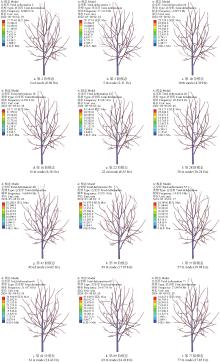
图8
核桃树A1的自由模态响应云图 图中红色曲线为核桃树平衡位置。The red curve in the figure represents the equilibrium position of the walnut tree."

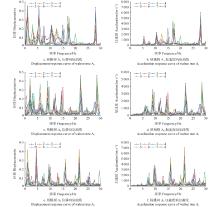
图9
不同核桃树谐响应分析响应曲线"
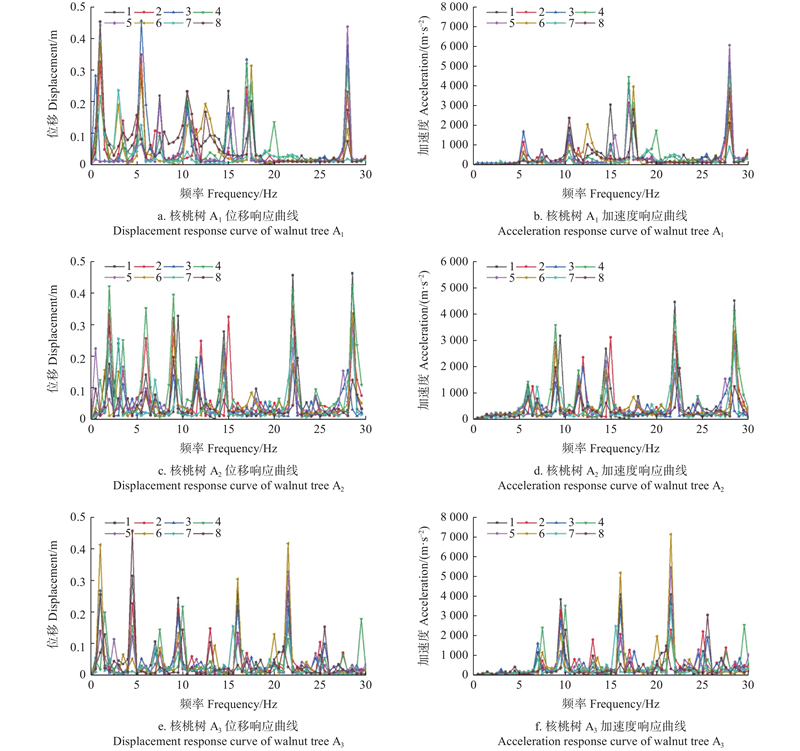
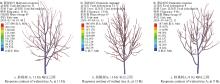
图10
不同核桃树谐响应典型变形云图 图中红色曲线为核桃树平衡位置。The red curve in the figure represents the equilibrium position of the walnut tree."
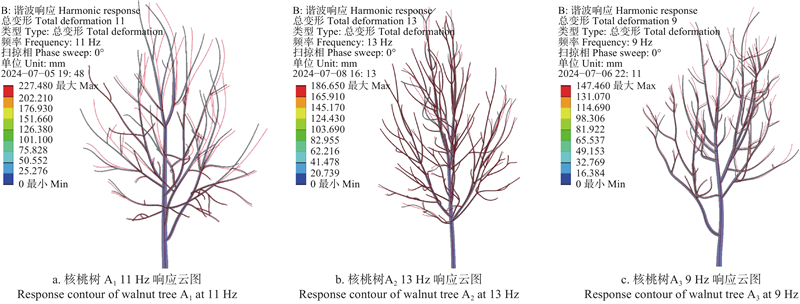
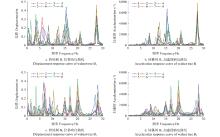
图11
不同直径核桃树谐响应分析响应曲线"
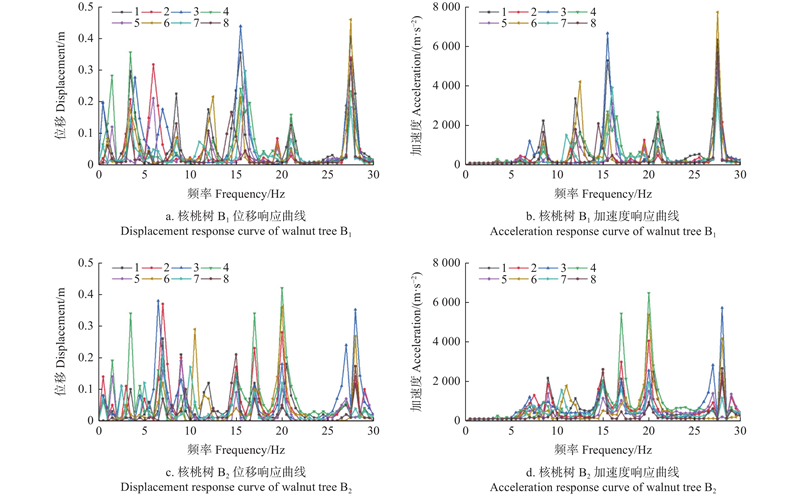
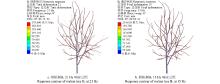
图12
不同直径核桃树谐响应典型变形云图 图中红色曲线为核桃树平衡位置。The red curve in the figure represents the equilibrium position of the walnut tree."
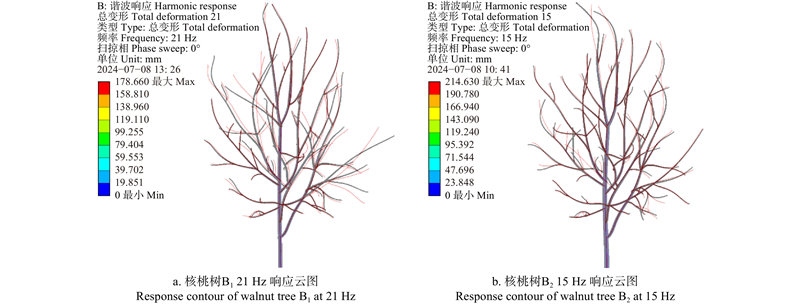
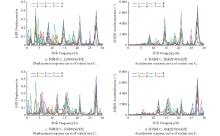
图13
不同高度核桃树谐响应分析响应曲线"
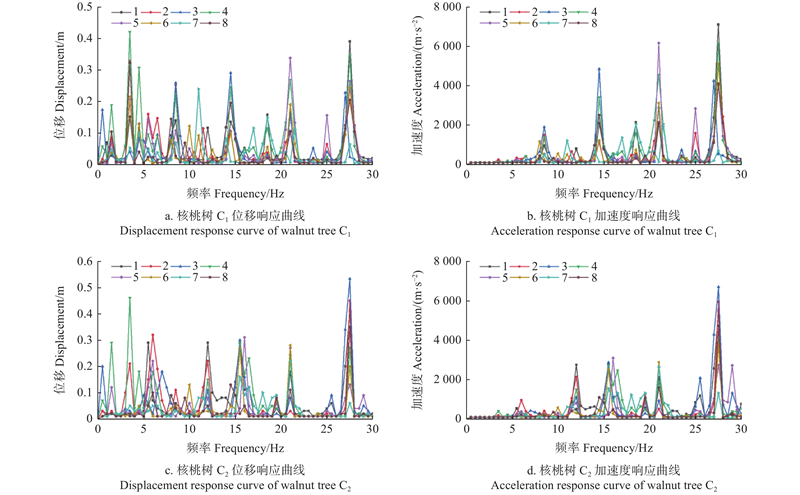
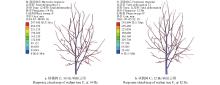
图14
不同高度核桃树谐响应典型变形云图 图中红色曲线为核桃树平衡位置。The red curve in the figure represents the equilibrium position of the walnut tree."
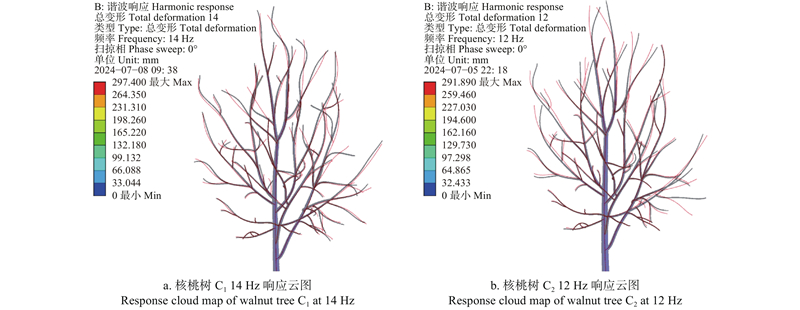
图15
不同冠幅核桃树谐响应分析响应曲线"
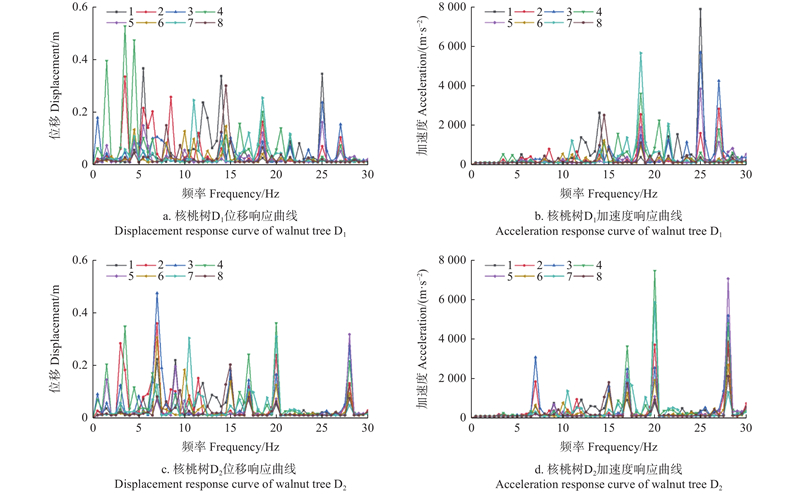
图16
不同高度核桃树谐响应典型变形云图 图中红色曲线为核桃树平衡位置。"
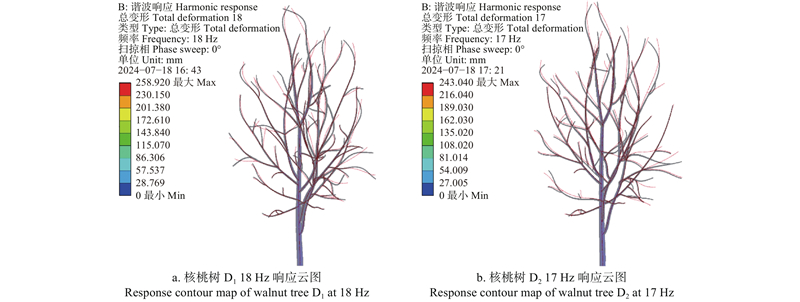
表4
试验因素编码"
| 树号 Tree number | 编码 Code | 振动频率 Vibration frequency (A)/Hz | 激振力 Excitation force (B)/N | 激振高度 Excitation height (C)/m |
| A1 | ?1 | 10 | 3 000 | 0.4 |
| 0 | 14 | 3 500 | 0.8 | |
| 1 | 18 | 4 000 | 1.2 | |
| A2 | ?1 | 8 | 3 000 | 0.4 |
| 0 | 12 | 3 500 | 0.8 | |
| 1 | 16 | 4 000 | 1.2 | |
| A3 | ?1 | 7 | 3 000 | 0.4 |
| 0 | 12 | 3 500 | 0.8 | |
| 1 | 17 | 4 000 | 1.2 |
表5
方差分析①"
| 树号Tree number | 来源Source | 平方和Sum of squares | 自由度Degrees of freedom | 均方和Mean square | F | P |
| A1 | 模型Model | 2.484E+06 | 9 | 2.649E+05 | 138.28 | <0.000 1** |
| 残差Residual | 5 556.5 | 7 | 793.79 | |||
| 失拟项Lack of fit | 4 126.5 | 3 | 3.85 | 0.113 0 | ||
| 纯误差Pure error | 1 430 | 4 | 357.5 | |||
| 总和Total | 2.489E+06 | 16 | ||||
| A2 | 模型Model | 2.311E+06 | 9 | 2.568E+05 | 15.02 | <0.000 1** |
| 残差Residual | 1.197E+05 | 7 | 17 095.89 | |||
| 失拟项Lack of fit | 81 097.25 | 3 | 27 032.42 | 2.8 | 0.172 4 | |
| 纯误差Pure error | 38 574 | 4 | 9 643.5 | |||
| 总和Total | 2.431E+06 | 16 | ||||
| A3 | 模型Model | 3.085E+06 | 9 | 3.428E+05 | 15.33 | <0.000 1** |
| 残差Residual | 1.565E+05 | 7 | 22 357.61 | |||
| 失拟项Lack of fit | 74 973.25 | 3 | 24 991.08 | 1.23 | 0.409 3 | |
| 纯误差Pure error | 81 530 | 4 | 20 382.5 | |||
| 总和Total | 3.241E+06 | 16 |
表6
拟合统计量分析"
| 树号Tree number | 决定系数Coefficient of determination ( | 校正系数Correction coefficient | 预测系数Prediction coefficient | 变异系数Coefficient of variation (%) | 精密度Precision |
| A1 | 0.997 8 | 0.994 9 | 0.972 6 | 2.36 | 58.807 5 |
| A2 | 0.950 8 | 0.887 5 | 0.441 4 | 10.41 | 13.219 |
| A3 | 0.951 7 | 0.889 6 | 0.590 6 | 12.51 | 12.754 |
图17
核桃树A1各因素交互作用影响响应面"
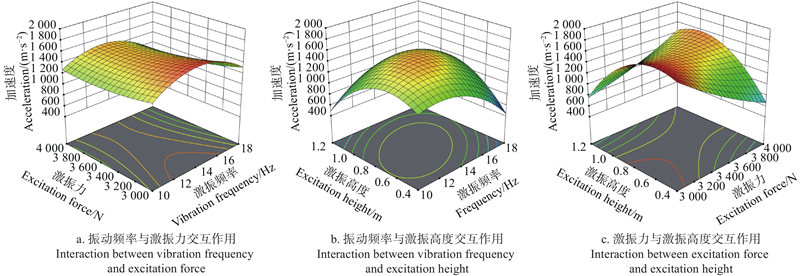
图18
核桃树A2各因素交互作用影响响应面"
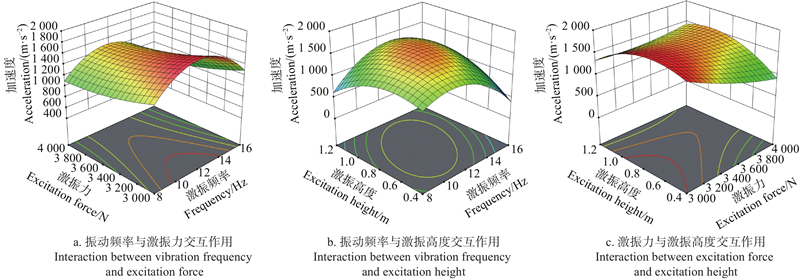
图19
核桃树A3各因素交互作用影响响应面"
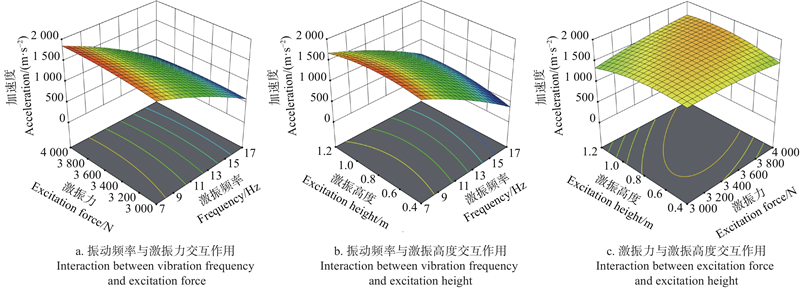
表7
最优振动参数"
| 树号 Tree number | 激振频率 Excitation frequency/Hz | 激振力 Excitation force/N | 激振高度 Excitation height/m | 响应值 Response level /(m·s?2) |
| A1 | 11.4 | 3 452.4 | 0.7 | 1 404.0 |
| A2 | 11.2 | 3 891.4 | 1.0 | 1 493.8 |
| A3 | 9.4 | 3 946.6 | 0.6 | 1 616.2 |
图20
田间验证试验"
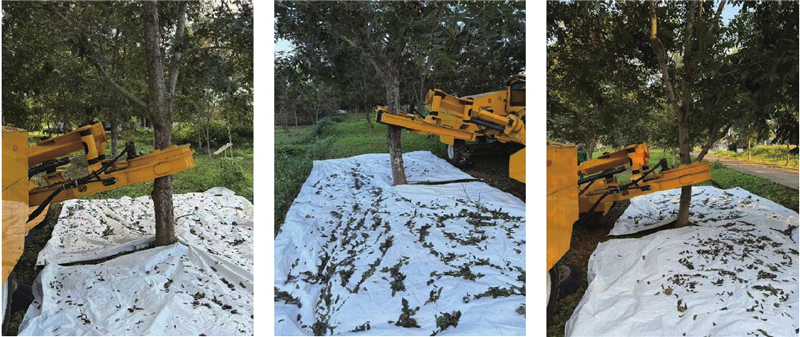
表8
落果数量统计"
| 树号 Tree number | 落果数 Number of fallen fruits | 未脱落数 Number of retained fruits | 核桃采收率 Walnut harvesting rate (%) |
| A1 | 1 649 | 37 | 97.8 |
| A2 | 658 | 43 | 93.9 |
| A3 | 436 | 17 | 96.2 |
| 陈世林. 2020,. 激光雷达单木参数提取与生物量估算研究. 北京: 北京林业大学. | |
| Chen S L. 2020,. Research on extraction of single tree parameters and biomass estimation based on LiDAR. Beijing: Beijing Forestry University. [in Chinese] | |
|
崔王斌, 周宏平, 许林云, 等. 我国林果机械振动式采收装备及理论研究进展. 世界林业研究, 2023, 36 (6): 64- 70.
doi: 10.13348/j.cnki.sjlyyj.2023.0096.y |
|
|
Cui W B, Zhou H P, Xu L Y, et al. Research progress in mechanically vibratory harvesting equipment of forest fruit and its theory in China. World Forestry Research, 2023, 36 (6): 64- 70.
doi: 10.13348/j.cnki.sjlyyj.2023.0096.y |
|
| 范雷刚, 王春耀, 刘梦霞, 等. 振动参数对果树采收影响的试验研究. 农机化研究, 2016, 38 (10): 165- 168. | |
| Fan L G, Wang C Y, Liu M X, et al. Experimental study on the impact of vibration parameters on fruit trees. Journal of Agricultural Mechanization Research, 2016, 38 (10): 165- 168. | |
| 国家统计局. 2023,. 中国统计年鉴. 北京: 中国统计出版社. | |
| National Bureau of Statistics of China. 2023,. China statistical yearbook. Beijing: China Statistics Press. [in Chinese] | |
|
霍林涛, 刘 英, 杨雨图, 等. 基于多平台激光雷达数据集成的森林资源调查研究进展. 世界林业研究, 2022, 35 (6): 49- 55.
doi: 10.13348/j.cnki.sjlyyj.2022.0081.y |
|
|
Huo L T, Liu Y, Yang Y T, et al. Research progress in forest resource inventory based on multi-platform LiDAR data integration. World Forestry Research, 2022, 35 (6): 49- 55.
doi: 10.13348/j.cnki.sjlyyj.2022.0081.y |
|
|
李苑鑫, 吴楚航, 邢艳秋. 基于地基激光雷达人工蒙古栎削度-二元材积方程的构建. 森林工程, 2025, 41 (1): 162- 173.
doi: 10.7525/j.issn.1006-8023.2025.01.013 |
|
|
Li Y X, Wu C H, Xing Y Q. Construction of a taper-binary volume equation for plantation mongolian oak based on TLS data. Forest Engineering, 2025, 41 (1): 162- 173.
doi: 10.7525/j.issn.1006-8023.2025.01.013 |
|
|
林 欢, 许林云, 周宏平, 等. 机械采收作业中银杏树频谱特性与振动响应关系研究. 农业工程学报, 2017, 33 (17): 51- 57.
doi: 10.11975/j.issn.1002-6819.2017.17.007 |
|
|
Lin H, Xu L Y, Zhou H P, et al. Relationship between frequency spectrum characteristics and vibration responses of Ginkgo biloba trees during mechanical harvesting operation. Transactions of the Chinese Society of Agricultural Engineering, 2017, 33 (17): 51- 57.
doi: 10.11975/j.issn.1002-6819.2017.17.007 |
|
|
林 欢, 许林云, 宣 言, 等. 基于有限元的多级Y型银杏树模态分析与试验. 林业工程学报, 2020, 5 (1): 148- 155.
doi: 10.13360/j.issn.2096-1359.201903032 |
|
|
Lin H, Xu L Y, Xuan Y, et al. Modal analysis and experimental study of the multistage Y-type Ginkgo tree using the finite element method. Journal of Forestry Engineering, 2020, 5 (1): 148- 155.
doi: 10.13360/j.issn.2096-1359.201903032 |
|
|
刘 浩, 戴 宁. 基于树干振动原理的核桃采收机设计. 机械制造与自动化, 2023, 52 (1): 226- 229.
doi: 10.19344/j.cnki.issn1671-5276.2023.01.055 |
|
|
Liu H, Dai N. Design of walnut harvester based on trunk vibration. Machine Building & Automation, 2023, 52 (1): 226- 229.
doi: 10.19344/j.cnki.issn1671-5276.2023.01.055 |
|
|
刘洪杰, 李峻藤, 杨 欣, 等. 手持摇枝式酸枣振动采摘装置设计与试验. 农业机械学报, 2024, 55 (9): 194- 204, 215.
doi: 10.6041/j.issn.1000-1298.2024.09.016 |
|
|
Liu H J, Li J T, Yang X, et al. Design and experiment of hand-held shaking branch type jujube vibration picker. Transactions of the Chinese Society for Agricultural Machinery, 2024, 55 (9): 194- 204, 215.
doi: 10.6041/j.issn.1000-1298.2024.09.016 |
|
| 骆钰波, 黄洪宇, 唐丽玉, 等. 基于地面激光雷达点云数据的森林树高、胸径自动提取与三维重建. 遥感技术与应用, 2019, 34 (2): 243- 252. | |
| Luo Y B, Huang H Y, Tang L Y, et al. Tree height and diameter extraction with 3D reconstruction in a forest based on TLS. Remote Sensing Technology and Application, 2019, 34 (2): 243- 252. | |
|
孟庆年, 张洪德, 胡玉祥, 等. 三维激光扫描仪在树木参数快速获取中的应用. 测绘通报, 2022 (Suppl.2): 143- 146.
doi: 10.13474/j.cnki.11-2246.2022.0575 |
|
|
Meng Q N, Zhang H D, Hu Y X, et al. Application of 3D laser scanner in the rapid acquisition of tree parameters. Bulletin of Surveying and Mapping, 2022 (Suppl.2): 143- 146.
doi: 10.13474/j.cnki.11-2246.2022.0575 |
|
| 茹 煜, 范高鸣, 许林云, 等. 2025. 柔性摇臂振动式核桃采收机设计及其振动性能. 林业科学, 61(4): 180−195. | |
| Ru Y, Fan G M, Xu L Y, et al. 2025. Design and vibration performance of a flexible rocker-arm walnut vibrating harvester. Scientia Silvae Sinicae, 61(4): 180−195. [in Chinese]) | |
| 散鋆龙, 杨会民, 王学农, 等. 振动方式和频率对杏树振动采收响应的影响. 农业工程学报, 2018, 34 (8): 10- 17. | |
| San Y L, Yang H M, Wang X N, et al. Effects of vibration mode and frequency on vibration harvesting of apricot trees. Transactions of the Chinese Society of Agricultural Engineering, 2018, 34 (8): 10- 17. | |
| 尚书旗, 李成鹏, 何晓宁, 等. 高酸苹果振动式采摘机设计与试验. 农业机械学报, 2023, 54 (3): 115- 125, 168. | |
| Shang S Q, Li C P, He X N, et al. Design and experiment of high-acid apple vibrating picker. Transactions of the Chinese Society for Agricultural Machinery, 2023, 54 (3): 115- 125, 168. | |
|
帅鹏程, 安健硕, 徐道春, 等. 深纹核桃侧枝摇振采摘振动参数. 森林工程, 2025, 41 (4): 853- 860.
doi: 10.7525/j.issn.1006-8023.2025.04.019 |
|
|
Shuai P C, An J S, Xu D C, et al. Study on vibration parameters of branch-shaking for harvesting of deep-striped walnut. Forest Engineering, 2025, 41 (4): 853- 860.
doi: 10.7525/j.issn.1006-8023.2025.04.019 |
|
|
伍德林, 赵恩龙, 姜 山, 等. 基于能量传递规律的油茶树冠层振动参数优化与试验. 农业机械学报, 2022, 53 (8): 23- 33.
doi: 10.6041/j.issn.1000-1298.2022.08.003 |
|
|
Wu D L, Zhao E L, Jiang S, et al. Optimization and experiment of canopy vibration parameters of Camellia oleifera based on energy transfer characteristics. Transactions of the Chinese Society for Agricultural Machinery, 2022, 53 (8): 23- 33.
doi: 10.6041/j.issn.1000-1298.2022.08.003 |
|
| 吴金明. 激光雷达测绘技术应用. 中国科技信息, 2023 (7): 78- 79. | |
| Wu J M. Application of LiDAR surveying and mapping technology. China Science and Technology Information, 2023 (7): 78- 79. | |
|
杨 欣, 姜尊豪, 李建平, 等. 摇枝式加工型苹果采摘振动参数仿真优化与试验. 农业机械学报, 2024, 55 (5): 28- 39.
doi: 10.6041/j.issn.1000-1298.2024.05.003 |
|
|
Yang X, Jiang Z H, Li J P, et al. Simulation optimization and experiment of vibration parameters of apple picking by shaking branch processing. Transactions of the Chinese Society for Agricultural Machinery, 2024, 55 (5): 28- 39.
doi: 10.6041/j.issn.1000-1298.2024.05.003 |
|
| 尹逊春. 2020,. 振动式核桃采摘机的设计与优化. 哈尔滨: 哈尔滨商业大学. | |
| Yin X C. 2020,. Design and optimization of a vibrating walnut picker. Harbin: Harbin University of Commerce. [in Chinese] | |
|
张 军, 张 絮, 牧昊天, 等. 单偏心式油橄榄振动采收机仿真优化与试验. 农业机械学报, 2023, 54 (11): 114- 123.
doi: 10.6041/j.issn.1000-1298.2023.11.011 |
|
|
Zhang J, Zhang X, Mu H T, et al. Simulation optimization and test of single eccentric olive vibrating harvester. Transactions of the Chinese Society for Agricultural Machinery, 2023, 54 (11): 114- 123.
doi: 10.6041/j.issn.1000-1298.2023.11.011 |
|
| 张玉湘萌, 丁 羽, 李景耀, 等. 核桃采收机械的研究现状及发展趋势. 南方农机, 2023, 54 (8): 33- 35. | |
| Zhang Y X M, Ding Y, Li J Y, et al. Research status and development trend of walnut harvesting machinery. China Southern Agricultural Machinery, 2023, 54 (8): 33- 35. | |
|
赵永辉, 刘雪妍, 吕 勇, 等. 基于激光点云数据的单木骨架三维重构. 森林工程, 2024, 40 (1): 128- 134.
doi: 10.3969/j.issn.1006-8023.2024.01.015 |
|
|
Zhao Y H, Liu X Y, Lü Y, et al. 3D reconstruction of single wood skeleton based on laser point cloud data. Forest Engineering, 2024, 40 (1): 128- 134.
doi: 10.3969/j.issn.1006-8023.2024.01.015 |
|
|
赵 月, 刘亚秋, 徐 妍, 等. 林木果球采收机械臂动力学参数辨识及补偿. 森林工程, 2023, 39 (2): 150- 160.
doi: 10.3969/j.issn.1006-8023.2023.03.018 |
|
|
Zhao Y, Liu Y Q, Xu Y, et al. Dynamic parameter identification and compensation of forest fruit ball harvesting manipulator. Forest Engineering, 2023, 39 (2): 150- 160.
doi: 10.3969/j.issn.1006-8023.2023.03.018 |
|
|
Bu L X, Hu G R, Chen C K, et al. Experimental and simulation analysis of optimum picking patterns for robotic apple harvesting. Scientia Horticulturae, 2020, 261, 108937.
doi: 10.1016/j.scienta.2019.108937 |
|
|
Castro-García S, Blanco-Roldán G L, Gil-Ribes J A. Vibrational and operational parameters in mechanical cone harvesting of stone pine (Pinus pinea L. ). Biosystems Engineering, 2012, 112 (4): 352- 358.
doi: 10.1016/j.biosystemseng.2012.05.007 |
|
|
Niu Z J, Xu Z, Deng J T, et al. Optimal vibration parameters for olive harvesting from finite element analysis and vibration tests. Biosystems Engineering, 2022, 215, 228- 238.
doi: 10.1016/j.biosystemseng.2022.01.002 |
|
|
Pu Y J, Wang S M, Yang F Z, et al. Recent progress and future prospects for mechanized harvesting of fruit crops with shaking systems. International Journal of Agricultural and Biological Engineering, 2023, 16 (1): 1- 13.
doi: 10.25165/j.ijabe.20231601.7954 |
|
|
Sellier D, Fourcaud T, Lac P. A finite element model for investigating effects of aerial architecture on tree oscillations. Tree Physiology, 2006, 26 (6): 799- 806.
doi: 10.1093/treephys/26.6.799 |
|
|
Stovall A E L, Anderson-Teixeira K J, Shugart H H. Assessing terrestrial laser scanning for developing non-destructive biomass allometry. Forest Ecology and Management, 2018, 427, 217- 229.
doi: 10.1016/j.foreco.2018.06.004 |
|
|
Wei J, Yang G Y, Yan H, et al. Rigid-flexible coupling simulation and experimental vibration analysis of pistachio tree for optimal mechanized harvesting efficiency. Mechanics of Advanced Materials and Structures, 2021, 28 (22): 2360- 2369.
doi: 10.1080/15376494.2020.1734889 |
|
|
Wu D L, Zhao E L, Fang D, et al. Determination of vibration picking parameters of Camellia oleifera fruit based on acceleration and strain response of branches. Agriculture, 2022, 12 (8): 1222.
doi: 10.3390/agriculture12081222 |
|
|
Yu Y J, Cao Y, Lai Q H, et al. Design and operation parameters of vibrating harvester for Coffea arabica L. Agriculture, 2023, 13 (3): 700.
doi: 10.3390/agriculture13030700 |
|
|
Zhang P, Yan D, Cai X N, et al. Multidirectional dynamic response and swing shedding of grapes: an experimental and simulation investigation under vibration excitation. Agronomy, 2023, 13 (3): 869.
doi: 10.3390/agronomy13030869 |
|
|
Zhou J, Xu L Y, Zhao J W, et al. Effective excitation conditions for the intense motion of the Ginkgo seed-stem system during mechanical vibration harvesting. Biosystems Engineering, 2022, 215, 239- 248.
doi: 10.1016/j.biosystemseng.2022.01.014 |
|
|
Zhuo P, Li Y X, Wang B S, et al. Analysis and experimental study on vibration response characteristics of mechanical harvesting of jujube. Computers and Electronics in Agriculture, 2022, 203, 107446.
doi: 10.1016/j.compag.2022.107446 |
| [1] | 茹煜,徐国鹏,范高鸣,李秋洁,易永魁,丁莉,周宏平. 基于可编程逻辑控制器的核桃振动采收控制系统设计与仿真[J]. 林业科学, 2025, 61(8): 11-24. |
| [2] | 茹煜,范高鸣,许林云,张海锋,周宏平,施明宏,王艳艳,崔王斌,徐国鹏. 柔性摇臂振动式核桃采收机设计及其振动性能[J]. 林业科学, 2025, 61(4): 180-195. |
| [3] | 付勇;严善春;李小平. 响应面法优化黄粉虫幼虫油脂提取工艺[J]. 林业科学, 2010, 46(8): 125-129. |
| 阅读次数 | ||||||
|
全文 |
|
|||||
|
摘要 |
|
|||||

