
林业科学 ›› 2026, Vol. 62 ›› Issue (9): 221-238.doi: 10.11707/j.1001-7488.LYKX20260134
• 综合评述 • 上一篇
朱晶晶1,2,郑嘉瑞1,2,3,孙佳星1,2,张威威1,2,3,许锋1,2,3,*( ),丛欣4,陈强文5,杨伟1,4
收稿日期:2026-03-06
修回日期:2026-07-17
出版日期:2026-09-10
发布日期:2026-09-16
通讯作者:
许锋
E-mail:xufeng@yangtzeu.edu.cn
基金资助:
Jingjing Zhu1,2,Jiarui Zheng1,2,3,Jiaxing Sun1,2,Weiwei Zhang1,2,3,Feng Xu1,2,3,*(),Xin Cong4,Qiangwen Chen5,Wei Yang1,4
Received:2026-03-06
Revised:2026-07-17
Online:2026-09-10
Published:2026-09-16
Contact:
Feng Xu
E-mail:xufeng@yangtzeu.edu.cn
摘要:
木本饲料是一类以具有饲用价值的木本植物幼嫩枝叶、花、果实、种子及其加工副产物?为主要利用对象的新型饲料资源,兼具较高的营养价值和显著的生态功能,在缓解传统草本饲料资源约束和推动畜牧业绿色转型方面具有重要意义。随着生态农业和低碳养殖理念的发展,木本饲料研究已由早期资源调查和单一利用逐步向栽培、加工调控和饲喂应用协同发展的方向转变,系统梳理木本饲料的分类特征、植物学和营养学特性、栽培技术及其在畜禽生产中的应用效果,对推动木本饲料科学利用和产业化发展具有重要价值。近年来,木本饲料研究主要集中在资源特性、栽培、加工和饲喂应用等方面。基于植物生活型、饲用部位以及饲用功能与营养特征,对木本饲料资源进行了系统分类,明确了其高生物量、高蛋白、高矿物质和富含多种生物活性物质等特点。通过优良品种选育、合理种植模式和科学田间管理,木本饲料的生物量和营养品质得到提升;青贮、制粉制粒和气爆等加工技术则有效改善了适口性和养分利用率。大量动物试验表明,合理添加木本饲料可改善反刍动物生产性能和瘤胃发酵功能,并提高家禽的免疫和抗氧化能力。此外,木本饲料在林牧结合、农业废弃物资源化利用和生态循环农业体系中也展现出良好应用前景。尽管木本饲料研究已取得一定进展,但在规模化推广和精准应用方面仍存在不足。未来,需进一步加强优质种质资源筛选、栽培和加工调控机制研究,明确不同畜禽的适宜添加水平和长期饲用安全性,并推动木本饲料在生态养殖体系中的综合利用。
中图分类号:
朱晶晶,郑嘉瑞,孙佳星,张威威,许锋,丛欣,陈强文,杨伟. 木本饲料栽培、加工及其在畜牧业中的应用研究进展[J]. 林业科学, 2026, 62(9): 221-238.
Jingjing Zhu,Jiarui Zheng,Jiaxing Sun,Weiwei Zhang,Feng Xu,Xin Cong,Qiangwen Chen,Wei Yang. Research Progress on the Cultivation, Processing and Application of Woody Forage in Animal Husbandry[J]. Scientia Silvae Sinicae, 2026, 62(9): 221-238.
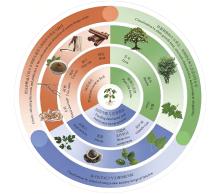
图1
木本饲料的分类"
表1
几类典型木本饲料和草本饲料常规营养成分含量"
| 饲料类型 Forage type | 饲料名称 Forage name | 粗蛋白 Crude protein | 粗脂肪 Ether extracts | 粗纤维 Crude fibre | 中性洗涤纤维 Neutral detergent fibre | 酸性洗涤纤维 Acid detergent fibre | 参考文献 References |
| 木本饲料 Woody forage | 构树 B. papyrifera | 15~26 | 2~11 | 9~15 | 25~44 | 17~23 | 左鑫等, 张红等, |
| 饲料桑 M. alba | 14~34 | 2~8 | 13~16 | 21~46 | 10~43 | 寇宇斐, | |
| 沙棘 H. rhamnoides | 18~22 | 4~6 | 12~15 | 34~39 | 27~33 | 邸俊龙等, 周蔓等, | |
| 胡枝子 L. bicolor | 13~23 | 1~6 | 12~40 | 33~44 | 24~34 | 王清郦等, 马敏等, | |
| 辣木 M. oleifera | 18~21 | 3~8 | 7~17 | 26~35 | 11~24 | 罗会英等, 张昕彤等, | |
| 柠条 C. korshinskii | 3~19 | 1~7 | 23~53 | 51~63 | 40~49 | 孙姗姗等, 郭国庆等, | |
| 草本饲料 Herbal forage | 紫花苜蓿 M. sativa | 15~25 | 3~6 | 24~28 | 38~42 | 22~34 | 粟绍媛等, |
| 黑麦草 L. perenne | 11~19 | 2~6 | 13~23 | 38~39 | 20~40 | 李小坤等, 李富宁等, | |
| 饲用玉米 Z. mays | 7-9 | 1~2 | 2~4 | 42~57 | 21~28 | 郑美等, 白露, | |
| 甜高粱 Sorghum bicolor ‘Dochna’ | 4~8 | 1~3 | 34~42 | 53~66 | 29~41 | 李俊峰等, 许明爽等, |
表2
常见木本饲料的抗营养因子含量"
| 研究对象 Research subjects | 总单宁 Total tannins | 水解单宁 Hydrolyzed tannins | 缩合单宁 Condensed tannins | 皂苷 Saponin | 植酸 Phytic acid | 参考文献 References |
| 构树叶 B. papyrifera leaves | 16.92 | 3.13 | 13.79 | 24.06 | 1.27 | Wang et al |
| 桑叶 M. alba leaves | 7.70 | — | — | 82.00 | 16.10 | Dongmeza et al., |
| 全株柠条 Whole C. korshinskii | 7.67 | 2.15 | 5.52 | 141.53 | — | 王宁伟等, |
| 辣木叶 M. oleifera leaves | 12.32 | 2.61 | 9.70 | 88.89 | 26.40 | 杨富裕等, 王飞等, |
| 榆树叶 U. pumila leaves | 15.67 | 12.80 | 2.87 | — | — | Beigh et al., |
表3
常见木本饲料对反刍动物生产性能的影响"
| 饲料类型 Feed type | 研究对象 Research subjects | 添加比例 Add ratio | 日采食量 Daily food intake/ (kg·d –1) | 日增质量 Daily weight gain/ (kg·d ?1) | 饲料转化 率Feed conversion ratio (%) | 参考文献 References |
| 构树青贮 B. papyrifera silage | 肉牛 Beef cattle | 在混合饲料添加15%构树发酵饲料 Add 15% fermented mulberry tree feed to the mixed feed | 8.45 | 1.18 | 0.14 | Tao et al., |
| 桑树叶粉 M. alba leaf powder | 绵羊 Sheep | 用桑叶粉替代约24%的常规饲料 Replace approximately 24% of conventional feed with mulberry leaf powder | 1.673 | 0.26 | 6.04 | Sun et al., |
| 杜仲叶粉 E. ulmoides leaf powder | 肉牛 Beef cattle | 日粮添加0.1%杜仲叶粉 Add 0.1% eucommia leaf powder to the daily diet | 12.09 | 1.57 | 7.70 | 张莉等, |
| 辣木叶粉 M. oleifera leaf powder | 幼羊 Goat kid | 在山羊幼崽混合饲料添加25%辣木叶粉 Add 25% moringa leaf powder to the mixed feed for goat kids | 0.37 | 0.04 | 8.39 | Wankhede et al., |
| 柠条 C. korshinskii | 滩羊 Tan sheep | 在全混合饲粮中使用柠条替代苜蓿饲喂 Feeding caragana in total mixed rations as a substitute for alfalfa | 1.39 | 0.14 | 9.28 | 乔彦源 等, |
|
白 露. 饲用玉米的营养特性及其青贮技术的研究进展. 养殖与饲料, 2025, 24 (6): 25- 28.
doi: 10.13300/j.cnki.cn42-1648/s.2025.06.006 |
|
|
Bai L. Progress on studying the nutritional characteristics and silage technology of forage maize. Animal Breeding and Feed, 2025, 24 (6): 25- 28.
doi: 10.13300/j.cnki.cn42-1648/s.2025.06.006 |
|
| 曾 艳. 2007. 桑树营养特性及平衡施肥效应研究. 南宁: 广西大学. | |
| Ceng Y. 2007. Study on nutrient chaeacteristic of mulberry and balanced fertilization effect. Nanning: Guangxi University. [in Chinese] | |
|
陈月锋, 宋占华, 刘天宏, 等. 自走式杂交构树收割机设计及试验. 农业工程, 2023, 13 (7): 89- 96.
doi: 10.19998/j.cnki.2095-1795.2023.07.013 |
|
|
Chen Y F, Song Z H, Liu T H, et al. Design and experiment of self-propelled hybrid Broussonetia papyrifera harvester. Agricultural Engineering, 2023, 13 (7): 89- 96.
doi: 10.19998/j.cnki.2095-1795.2023.07.013 |
|
|
崔 勤, 徐国强, 吴瑞敏. 构树叶营养成分研究. 养殖与饲料, 2008, 7 (6): 102.
doi: 10.3969/j.issn.1671-427X.2008.06.050 |
|
|
Cui Q, Xu G Q, Wu R M. Study on the nutritional components of Broussonetia papyrifera leaves. Animals Breeding and Feed, 2008, 7 (6): 102.
doi: 10.3969/j.issn.1671-427X.2008.06.050 |
|
| 邓小雁, 鲁 录. 2026. 不同灌溉方式对紫花苜蓿生产性能、营养成分及发酵品质的影响. 中国饲料, (8): 122−126. | |
| Deng X Y, Lu L. 2026. Effects of different irrigation methods on the production performance, nutritional components and fermentation quality of alfalfa. China Feed, (8): 122−126. [in Chinese] | |
|
邸俊龙, 张 骞. 陕西省榆林市沙棘叶及果渣营养成分分析及体内消化测定. 畜牧与饲料科学, 2015, 36 (5): 29- 31.
doi: 10.3969/j.issn.1672-5190.2015.05.012 |
|
|
Di J L, Zhang Q. Nutrient composition analysis and in vivo digestion determination of seabuckthorn leaves and pomace in Yulin City, Shaanxi Province. Animal Husbandry and Feed Science, 2015, 36 (5): 29- 31.
doi: 10.3969/j.issn.1672-5190.2015.05.012 |
|
| 丁武蓉, 干友民, 郭旭生, 等. 添加糖蜜对胡枝子青贮品质的影响. 中国畜牧杂志, 2008, 44 (1): 61- 64. | |
| Ding W R, Gan Y M, Guo X S, et al. Effect of molasses on fermentation quality of ensiled Lespedeza bicolor. Chinese Journal of Animal Science, 2008, 44 (1): 61- 64. | |
|
丁梓钊, 肖长峰, 许云英, 等. 替代性非常规饲料原料在家禽养殖中的应用研究进展. 上海农业学报, 2024, 40 (5): 142- 152.
doi: 10.15955/j.issn1000-3924.2024.05.19 |
|
|
Ding Z Z, Xiao C F, Xu Y Y, et al. Research progress on the application of alternative unconventional feed ingredients in poultry breeding. Acta Agriculturae Shanghai, 2024, 40 (5): 142- 152.
doi: 10.15955/j.issn1000-3924.2024.05.19 |
|
|
杜周和, 左艳春, 吴建梅, 等. 饲料桑生长动态及刈割期研究. 中国草地学报, 2023, 45 (4): 82- 89.
doi: 10.16742/j.zgcdxb.20220169 |
|
|
Du Z H, Zuo Y C, Wu J M, et al. Study on the growth dynamics and harvesting time of forage mulberry. Chinese Journal of Grassland, 2023, 45 (4): 82- 89.
doi: 10.16742/j.zgcdxb.20220169 |
|
| 弓 剑. 2004. 柠条叶粉对羊的饲用价值的研究. 咸阳: 西北农林科技大学. | |
| Gong J. 2004. Research on feeding value of peashrub leaf meal to sheep and goat. Xianyang: Northwest A&F University. [in Chinese] | |
| 龚利福, 程 香, 姜 塽, 等. 2021. 构树叶作为动物饲料的应用研究进展. 现代畜牧兽医, (3): 93−96. | |
| Gong L F, Cheng X, Jiang S, et al. 2021. Advances in the application of Broussonetia papyrifera leaves as animal feed. Modern Journal of Animal Husbandry and Veterinary Medicine, (3): 93−96. [in Chinese] | |
|
郭国庆, 刘 洋, 包文祺, 等. 柠条发酵饲料的开发及其在反刍动物生产中的应用. 饲料研究, 2025, 48 (20): 177- 181.
doi: 10.13557/j.cnki.issn1002-2813.2025.20.031 |
|
|
Guo G Q, Liu Y, Bao W Q, et al. Development of Caragana korshinskii fermented feed and its application in ruminant production. Feed Research, 2025, 48 (20): 177- 181.
doi: 10.13557/j.cnki.issn1002-2813.2025.20.031 |
|
| 郭建军, 李晓滨, 齐雪梅, 等. 2011. 饲料中添加桑叶对奶牛产奶量和奶品质的影响. 黑龙江畜牧兽医, (2): 96−97. | |
| Guo J J, Li X B, Qi X M, et al. 2011. Effect of adding mulberry leaves to feed on milk yield and milk quality of dairy cows. Heilongjiang Animal Science and Veterinary Medicine, (2): 96−97. [in Chinese] | |
|
韩哲宇, 毕小兵, 史海涛, 等. 构树青贮饲料开发利用技术研究进展. 动物营养学报, 2021, 33 (9): 4898- 4908.
doi: 10.3969/j.issn.1006-267x.2021.09.011 |
|
|
Han Z Y, Bi X B, Shi H T, et al. Research advances in exploitation and utilization technology of Broussonetia papyrifera silage. Chinese Journal of Animal Nutrition, 2021, 33 (9): 4898- 4908.
doi: 10.3969/j.issn.1006-267x.2021.09.011 |
|
|
黄 静, 赵 娜, 郭万正, 等. 发酵桑枝叶粉对蛋鸡生产性能、蛋品质、肠道组织形态的影响. 草地学报, 2024, 32 (4): 1259- 1266.
doi: 10.11733/j.issn.1007-0435.2024.04.031 |
|
|
Huang J, Zhao N, Guo W Z, et al. Effects of fermented mulberry branch and leaf meal on production performance, egg quality and intestinal tissue morphology of laying hens. Acta Agrestia Sinica, 2024, 32 (4): 1259- 1266.
doi: 10.11733/j.issn.1007-0435.2024.04.031 |
|
|
黄 林, 周 斌, 傅张琴, 等. 杜仲叶提取物的生物学功能及其在畜禽养殖中的应用研究进展. 中国畜牧杂志, 2022, 58 (6): 60- 65.
doi: 10.19556/j.0258-7033.20210513-03 |
|
|
Huang L, Zhou B, Fu Z Q, et al. Research progress on the biological functions of extracts from Eucommia ulmoides leaf and its application in animal production. Chinese Journal of Animal Science, 2022, 58 (6): 60- 65.
doi: 10.19556/j.0258-7033.20210513-03 |
|
| 黄孟霖. 2022. 不同调制方法对饲用燕麦青贮品质的影响. 贵阳: 贵州大学. | |
| Huang M L. 2022. Effects of different preparation methods on silage quality of feed oat. Guiyang: Guizhou University. [in Chinese] | |
|
黄咏明, 卢素芳, 徐爱春, 等. 构树对环境胁迫的响应机制研究进展. 湖北农业科学, 2019, 58 (21): 5- 10.
doi: 10.14088/j.cnki.issn0439-8114.2019.21.001 |
|
|
Huang Y M, Lu S F, Xu A C, et al. Research progress on response mechanisms of Broussonetia papyrifera to environmental stresses. Hubei Agricultural Sciences, 2019, 58 (21): 5- 10.
doi: 10.14088/j.cnki.issn0439-8114.2019.21.001 |
|
| 嵇晨晨, 魏婧萱, 丁 莹. 2023. “双碳”目标下畜牧业减碳增汇的实施路径研究. 可持续发展, (2): 751−759. | |
| Ji C C, Wei J X, Ding Y. 2023. Research on the implementation path of carbon reduction and sink increase in animal husbandry under the “dual-carbon” target. Sustainable Development, (2): 751−759. [in Chinese] | |
|
纪 迅, 李金贵. 桑叶及其提取物在家禽养殖中的研究进展. 饲料研究, 2020, 43 (6): 141- 144.
doi: 10.13557/j.cnki.issn1002-2813.2020.06.037 |
|
|
Ji X, Li J G. Research progress of mulberry leaves and their extracts in poultry farming. Feed Research, 2020, 43 (6): 141- 144.
doi: 10.13557/j.cnki.issn1002-2813.2020.06.037 |
|
| 贾 畅. 2021. 黄土丘陵区沙棘人工林生态系统碳通量的观测与模拟. 咸阳: 西北农林科技大学. | |
| Jia C. 2021. Observation and simulation of carbon flux of Hippophaer hamnoides plantation in the Loess Hilly Region. Xianyang: Northwest A&F University. [in Chinese] | |
|
贾利君, 刘文春, 张丹丹, 等. 柠条的营养特性及其在反刍动物上的应用进展. 饲料研究, 2025, 48 (14): 174- 177.
doi: 10.13557/j.cnki.issn1002-2813.2025.14.030 |
|
|
Jia L J, Liu W C, Zhang D D, et al. Nutritional properties of Caragana korshinskii and its application progress in ruminants. Feed Research, 2025, 48 (14): 174- 177.
doi: 10.13557/j.cnki.issn1002-2813.2025.14.030 |
|
|
蒋桂芝, 阿红昌, 刘昌芬. 西双版纳辣木主要病虫害研究初报. 热带农业科技, 2006, 29 (4): 6- 9.
doi: 10.3969/j.issn.1672-450X.2006.04.003 |
|
|
Jiang G Z, A H C, Liu C F. Main diseases and pests on Moringa trees in Xishaungbanna. Tropical Agricultural Science & Technology, 2006, 29 (4): 6- 9.
doi: 10.3969/j.issn.1672-450X.2006.04.003 |
|
| 蒋中海. 2002. 黑龙江桦树汁的研究. 食品工业科技, 23(10): 62−63. | |
| Jiang Z H. 2002. Study on the circh juice in Heilongjiang, 23(10): 62−63. [in Chinese] | |
| 靳 可. 2025. 饲粮添加杜仲叶粉对生长期临武鸭的生长性能、抗氧化及肠道功能的影响研究. 新乡: 河南科技学院. | |
| Jin K. 2025. Effects of dietary supplementation with Eucommia ulmoides leaf powder on growth performance, antioxidant status, and intestinal function in Linwu ducks during the growing period. Xinxiang: Henan Institute of Science and Technology. [in Chinese] | |
| 寇宇斐. 2021. 饲料桑的营养动态及其对育肥湖羊生产性能的影响. 兰州: 兰州大学. | |
| Kou Y F. 2021. Nutrition dynamics of mulberry and its effect on production performance of fattening Hu sheep. Lanzhou: Lanzhou University. [in Chinese] | |
|
李富宁, 张洁玉, 姚 娜. 饲用黑麦草的生理指标分析及其对养殖效益的影响. 中国饲料, 2025 (20): 109- 112.
doi: 10.15906/j.cnki.cn11-2975/s.20252028 |
|
|
Li F N, Zhang J Y, Yao N. Research on the physiological indicator analysis and the impact on feeding economic benefits of ryegrass for forage. China Feed, 2025 (20): 109- 112.
doi: 10.15906/j.cnki.cn11-2975/s.20252028 |
|
| 李俊峰, 李俊良, 张彩霞, 等. 2024. 不同盐碱地对甜高粱农艺性状及营养品质的影响. 中国奶牛, (12): 54−59. | |
| Li J F, Li J L, Zhang C X, et al. 2024. The impact of different saline-alkali soils on the agronomic traits and nutritional quality of sweet sorghum. China Dairy Cattle, (12): 54−59. [in Chinese] | |
|
李 珂, 张振军, 杜玉霞, 等. 引种果桑和叶桑叶片中营养功能成分含量及其抗氧化活性. 食品工业科技, 2024, 45 (20): 232- 239.
doi: 10.13386/j.issn1002-0306.2023100104 |
|
|
Li K, Zhang Z J, Du Y X, et al. Analysis of nutrient functional components and antioxidant activity in leaves of introduced fruit and leaf mulberries. Science and Technology of Food Industry, 2024, 45 (20): 232- 239.
doi: 10.13386/j.issn1002-0306.2023100104 |
|
| 李 茂, 字学娟, 周汉林. 2011. 我国木本饲料研究进展. 中国饲料, (17): 34−38. | |
| Li M, Zi X J, Zhou H L. 2011. Research advance on woody forage in China. China Feed, (17): 34−38. [in Chinese] | |
| 李万仓. 2010. 构树叶活性成分分析及抑菌作用研究. 武汉: 华中科技大学. | |
| Li W C. 2010. Study of active ingredients of Broussonetia papyrifera leaves and effects of bacteriostasis. Wuhan: Huazhong University of Science and Technology. [in Chinese] | |
| 李小坤, 鲁剑巍, 刘晓伟, 等. 配方施肥对一年生黑麦草产草量及品质的影响. 草业科学, 2011, 28 (9): 1666- 1670. | |
| Li X K, Lu J W, Liu X W, et al. Effect of fertilization on the yield and forage quality of annual ryegrass. Pratacultural Science, 2011, 28 (9): 1666- 1670. | |
| 李艳芝. 2011. 构树叶对蛋鸡生产性能、蛋品质、血液生化指标及免疫功能的影响. 保定: 河北农业大学. | |
| Li Y Z. 2011. Effects of leaves of Broussonetia papyrifera on production performance, egg quality, serum biochemical parameters and immunity of laying hens. Baoding: Hebei Agricultural University. [in Chinese] | |
|
李忠喜, 张江涛, 王新建, 等. 浅谈我国木本饲料的开发与利用. 世界林业研究, 2007, 20 (4): 49- 53.
doi: 10.3969/j.issn.1001-4241.2007.04.010 |
|
|
Li Z X, Zhang J T, Wang X J, et al. Discussion on exploitation and utilization of woody forage in China. World Forestry Research, 2007, 20 (4): 49- 53.
doi: 10.3969/j.issn.1001-4241.2007.04.010 |
|
| 林国强, 蒋健钊, 宁国信, 等. 2020. 桑枝叶作为动物饲料的应用研究进展. 黑龙江畜牧兽医, (15): 56−60. | |
| Lin G Q, Jiang J Z, Ning G X, et al. 2020. Research progress on application of mulberry branches and leaves as animal feed. Heilongjiang Animal Science and Veterinary Medicine, (15): 56−60. [in Chinese] | |
|
凌 浩, 郭水强, 李鑫垚, 等. 青贮桑叶替代青贮玉米对奶山羊生产性能、乳品质、养分表观消化率、瘤胃发酵参数和血清生化指标的影响. 动物营养学报, 2021, 33 (6): 3389- 3399.
doi: 10.3969/j.issn.1006-267x.2021.06.040 |
|
|
Ling H, Guo S Q, Li X Y, et al. Effects of silage mulberry leaves instead of silage corn on performance, milk quality, nutrient apparent digestibilities, rumen fermentation parameters and serum biochemical indexes of dairy goats. Chinese Journal of Animal Nutrition, 2021, 33 (6): 3389- 3399.
doi: 10.3969/j.issn.1006-267x.2021.06.040 |
|
|
刘 果, 尚秀华, 张沛健, 等. 卡亚和杂交构树的饲用营养价值及其比较分析. 热带作物学报, 2023, 44 (2): 419- 428.
doi: 10.3969/j.issn.1000-2561.2023.02.021 |
|
|
Liu G, Shang X H, Zhang P J, et al. Comparative analysis on feed nutritive value of Cnidoscolus aconitifolius and hybrid Broussonetia papyrifera. Chinese Journal of Tropical Crops, 2023, 44 (2): 419- 428.
doi: 10.3969/j.issn.1000-2561.2023.02.021 |
|
|
刘继峰, 宋月鹏, 高 昂. 饲草料收获加工机械关键切割部件研究现状及趋势. 中国农机化学报, 2025, 46 (1): 112- 119.
doi: 10.13733/j.jcam.issn.2095-5553.2025.01.017 |
|
|
Liu J F, Song Y P, Gao A. Research status and trends of key cutting components for forage harvesting and processing machinery. Journal of Chinese Agricultural Mechanization, 2025, 46 (1): 112- 119.
doi: 10.13733/j.jcam.issn.2095-5553.2025.01.017 |
|
|
刘书华, 盛颖霏, 张一艺, 等. 构树的资源化利用研究进展. 世界生态学, 2024, 13 (4): 524- 529.
doi: 10.12677/ije.2024.134067 |
|
|
Liu S H, Sheng Y F, Zhang Y Y, et al. Research progress on resource utilization of Broussonetia papyrifera. International Journal of Ecology, 2024, 13 (4): 524- 529.
doi: 10.12677/ije.2024.134067 |
|
|
刘晓婧, 张颖超, 杨富裕. 乳酸菌添加剂对3种典型木本饲料青贮效果的影响. 饲料工业, 2019, 40 (2): 16- 21.
doi: 10.13302/j.cnki.fi.2019.02.004 |
|
|
Liu X J, Zhang Y C, Yang F Y. Effects of lactic acid bacteria additives on the fermentation quality of three woody forages. Feed Industry, 2019, 40 (2): 16- 21.
doi: 10.13302/j.cnki.fi.2019.02.004 |
|
|
刘怡琳, 时艺霖, 张自强, 等. 木本饲料在畜牧业中的应用研究进展. 家畜生态学报, 2020, 41 (5): 82- 86.
doi: 10.3969/j.issn.1673-1182.2020.05.016 |
|
|
Liu Y L, Shi Y L, Zhang Z Q, et al. Application of woody forage in animal husbandry. Acta Ecologae Animalis Domastici, 2020, 41 (5): 82- 86.
doi: 10.3969/j.issn.1673-1182.2020.05.016 |
|
|
刘玥玥, 刘志杰, 王奇林, 等. 单宁对反刍动物生产性能、瘤胃发酵及微生物区系影响的研究进展. 畜牧兽医学报, 2026, 57 (4): 1864- 1875.
doi: 10.11843/j.issn.0366-6964.2026.04.008 |
|
|
Liu Y Y, Liu Z J, Wang Q L, et al. Research progress on the effects of tannins on ruminant production performance, rumen fermentation and microflora. Acta Veterinaria et Zootechnica Sinica, 2026, 57 (4): 1864- 1875.
doi: 10.11843/j.issn.0366-6964.2026.04.008 |
|
|
罗会英, 金 杰, 邓红山, 等. 辣木营养价值及在畜禽养殖方面的应用研究进展. 草业科学, 2023, 40 (11): 2937- 2947.
doi: 10.11829/j.issn.1001-0629.2022-0911 |
|
|
Luo H Y, Jin J, Deng H S, et al. Research progress on the nutritional value of Moringa oleifera and its application in livestock and poultry breeding. Pratacultural Science, 2023, 40 (11): 2937- 2947.
doi: 10.11829/j.issn.1001-0629.2022-0911 |
|
|
马 敏, 赵 微, 李成云. 长白山地区5种可利用饲草营养成分及单宁含量动态分析. 饲料工业, 2015, 36 (21): 13- 19.
doi: 10.13302/j.cnki.fi.2015.21.004 |
|
|
Ma M, Zhao W, Li C Y. The dynamic analysis of nutrient and tannin content of five kinds of available forage in Changbai Mountain region. Feed Industry, 2015, 36 (21): 13- 19.
doi: 10.13302/j.cnki.fi.2015.21.004 |
|
|
马 荣, 何 静, 张紫钰, 等. 桑树、构树、辣木在动物生产中的应用研究进展. 饲料工业, 2026, 47 (3): 144- 149.
doi: 10.13302/j.cnki.fi.2026.03.020 |
|
|
Ma R, He J, Zhang Z Y, et al. Research progress on application of mulberry, paper mulberry and moringa in animal production. Feed Industry, 2026, 47 (3): 144- 149.
doi: 10.13302/j.cnki.fi.2026.03.020 |
|
| 普天磊, 金 杰, 邓红山, 等. 辣木不同部位饲用品质比较研究. 中国草食动物科学, 2023, 43 (6): 17- 22. | |
| Pu T L, Jin J, Deng H S, et al. Comparative study on feeding quality of different parts of Moringa oleifera. China Herbivore Science, 2023, 43 (6): 17- 22. | |
|
乔彦源, 许 越, 刘统高, 等. 柠条对滩羊生长性能、屠宰性能和肉品质的影响. 饲料研究, 2025, 48 (18): 1- 5.
doi: 10.13557/j.cnki.issn1002-2813.2025.18.001 |
|
|
Qiao Y Y, Xu Y, Liu T G, et al. Effects of Caragana korshinskii on growth performance, slaughter performance, and meat quality of Tan sheep. Feed Research, 2025, 48 (18): 1- 5.
doi: 10.13557/j.cnki.issn1002-2813.2025.18.001 |
|
|
任保兰, 马志亮, 赵春攀, 等. 不同复配基质对辣木老叶产量及品质的影响. 热带农业科技, 2022, 45 (4): 28- 33.
doi: 10.16005/j.cnki.tast.2022.04.007 |
|
|
Ren B L, Ma Z L, Zhao C P, et al. Effect of different composite substrates on yield and quality of Moringa old leaves. Tropical Agricultural Science & Technology, 2022, 45 (4): 28- 33.
doi: 10.16005/j.cnki.tast.2022.04.007 |
|
|
司丙文, 徐文财, 张小利, 等. 不同添加剂对杂交构树青贮发酵品质的影响. 动物营养学报, 2018, 30 (11): 4670- 4675.
doi: 10.3969/j.issn.1006-267x.2018.11.044 |
|
|
Si B W, Xu W C, Zhang X L, et al. Influence of different additives on fermentation quality of hybrid paper mulberry silage. Chinese Journal of Animal Nutrition, 2018, 30 (11): 4670- 4675.
doi: 10.3969/j.issn.1006-267x.2018.11.044 |
|
|
苏飞保, 王振华, 翟改霞, 等. 柠条机械化收获技术与装备研究现状及发展趋势. 农业工程, 2021, 11 (10): 20- 27.
doi: 10.3969/j.issn.2095-1795.2021.10.005 |
|
|
Su F B, Wang Z H, Zhai G X, et al. Research status and development trend of Caragana korshinskii mechanized harvesting technology and equipment. Agricultural Engineering, 2021, 11 (10): 20- 27.
doi: 10.3969/j.issn.2095-1795.2021.10.005 |
|
| 苏立城. 2024. 不同栽培措施对黄梁木生长及饲料品质的影响. 广州: 华南农业大学. | |
| Su L C. 2024. Effect of different cultivation measures on the growth and feed quality of Neolamarckia cadamb. Guangzhou: South China Agricultural University. [in Chinese] | |
|
苏立城, 周 玮, 陈晓阳, 等. 木本饲料资源开发利用的现状与展望. 饲料研究, 2020, 43 (4): 107- 110.
doi: 10.13557/j.cnki.issn1002-2813.2020.04.028 |
|
|
Su L C, Zhou W, Chen X Y, et al. Current situation and prospect of development and utilization of woody feed resources. Feed Research, 2020, 43 (4): 107- 110.
doi: 10.13557/j.cnki.issn1002-2813.2020.04.028 |
|
| 粟绍媛, 吴小敏, 朱 欣, 等. 2024年贵州省草食动物常用饲草营养检测分析. 贵州畜牧兽医, 2025, 49 (5): 43- 47. | |
| Su S Y, Wu X M, Zhu X, et al. 2024 analysis of common forage nutrition for herbivorous animals of Guizhou Province. Guizhou Journal of Animal Husbandry&Veterinary Medicine, 2025, 49 (5): 43- 47. | |
| 孙建昌, 杨 艳, 方小平, 等. 贵州木本饲料植物资源及开发利用研究. 贵州林业科技, 2006, 34 (3): 1- 4, 44. | |
| Sun J C, Yang Y, Fang X P, et al. The resource of woody fodder plants and its development and utilization in Guizhou Province. Guizhou Forestry Science and Technology, 2006, 34 (3): 1- 4, 44. | |
| 孙姗姗, 刘新平, 何玉惠, 等. 我国固沙植物资源化利用研究进展. 世界林业研究, 2020, 33 (6): 74- 79. | |
| Sun S S, Liu X P, He Y H, et al. Research advance in sand-fixing plant resources utilization in China. World Forestry Research, 2020, 33 (6): 74- 79. | |
| 孙士文. 2022. 辣木叶对肉仔鸡生产性能、养分代谢、抗氧化及免疫机能的影响. 长春: 吉林农业大学. | |
| Sun S W. 2020. Effect of Moringa oleifera leaf on performance, nutrient metabolism, antioxidant and immune function in broilers. Changchun: Jilin Agricultural University. [in Chinese] | |
| 王 芳, 乔 璐, 张庆庆, 等. 桑叶蛋白氨基酸组成分析及营养价值评价. 食品科学, 2015, 36 (1): 225- 228. | |
| Wang F, Qiao L, Zhang Q Q, et al. Amino acid composition and nutritional evaluation of mulberry leaves. Food Science, 2015, 36 (1): 225- 228. | |
|
王 飞, 雷福红, 赵春攀, 等. 酶菌发酵对辣木茎叶青贮营养品质、抗营养因子及抗氧化能力的影响. 饲料研究, 2025, 48 (18): 117- 121.
doi: 10.13557/j.cnki.issn1002-2813.2025.18.022 |
|
|
Wang F, Lei F H, Zhao C P, et al. Effects of enzymatic-bacterial fermentation on nutritional quality, anti-nutritional factors, and antioxidant capacity of Moringa oleifera stems and leaves silage. Feed Research, 2025, 48 (18): 117- 121.
doi: 10.13557/j.cnki.issn1002-2813.2025.18.022 |
|
| 王改芳, 张 烨. 不同青贮剂对紫花苜蓿青贮品质的影响. 饲料工业, 2026, 47 (10): 131- 135. | |
| Wang G F, Zhang Y. Effects of different silage additives on silage quality of alfalfa. Feed Industry, 2026, 47 (10): 131- 135. | |
|
王红林, 左艳春, 周晓康, 等. 高密度草本化栽培对饲料桑全株产量及品质的影响. 草业科学, 2020, 37 (5): 952- 962.
doi: 10.11829/j.issn.1001-0629.2019-0445 |
|
|
Wang H L, Zuo Y C, Zhou X K, et al. Influence of high planting density herbal cultivating on yield and quality of whole-plant mulberry (Morus alba). Pratacultural Science, 2020, 37 (5): 952- 962.
doi: 10.11829/j.issn.1001-0629.2019-0445 |
|
| 王宁伟, 沈亿莹, 王学凯, 等. 2026. 柠条青贮饲料品质评估及抗营养因子降解研究. 草学, (2): 32−35. | |
| Wang N W, Shen Y Y, Wang X K, et al. 2026. An evaluation of silage quality and antinutritional factors degradation in Caragana korshinskii silage. Journal of Grassland and Forage Science, (2): 32−35. [in Chinese] | |
| 王清郦, 赵淑芬, 孙启忠, 等. 胡枝子属植物遗传多样性及其应用价值研究进展. 草业科学, 2012, 29 (11): 1771- 1777. | |
| Wang Q L, Zhao S F, Sun Q Z, et al. Progress on genetic diversity and application value of Lespedeza plants. Pratacultural Science, 2012, 29 (11): 1771- 1777. | |
| 王文颖, 张健男, 孙 阎. 沙棘枝叶和果渣的加工及在畜禽养殖中的应用. 饲料研究, 2021, 44 (12): 142- 144. | |
| Wang W Y, Zhang J N, Sun Y. The processing of branches, leaves and pomace of Hippophae rhamnoides L. and its application in livestock and poultry breeding. Feed Research, 2021, 44 (12): 142- 144. | |
| 王 翔, 胡凤杨, 杨秋玲, 等. 杜仲叶的营养评价及体外抗氧化活性分析. 食品工业科技, 2019, 40 (21): 290- 299. | |
| Wang X, Hu F Y, Yang Q L, et al. Nutritional evaluation and antioxidant activity analysis in vitro of Eucommia ulmoides leaves. Science and Technology of Food Industry, 2019, 40 (21): 290- 299. | |
| 王梓贞, 王 闯, 李 琪. 2015. 我国发展木本饲料的前景和展望. 饲料与畜牧, (5): 38−40. | |
| Wang Z Z, Wang C, Li Q. 2015. Prospect and prospect of developing woody feed in China. Animal Agriculture, (5): 38−40. [in Chinese] | |
| 位 晓, 曹 志, 毛培利. 刺槐无性系生态适应性差异研究. 山东林业科技, 2017, 47 (5): 31- 34, 38. | |
| Wei X, Cao Z, Mao P L. Studies on the differences in ecological adaptability of Robinia pseudoacacia clones. Journal of Shandong Forestry Science and Technology, 2017, 47 (5): 31- 34, 38. | |
| 魏中锋. 构树饲用化研究进展. 山东畜牧兽医, 2020, 41 (2): 46- 48. | |
| Wei Z F. Research progress on forage of Broussonetia papyrifera. Shandong Journal of Animal Science and Veterinary Medicine, 2020, 41 (2): 46- 48. | |
| 吴大林, 郭 静, 石鸿辉. 构树作为新型蛋白饲料的研究进展. 中国猪业, 2017, 12 (5): 56- 59. | |
| Wu D L, Guo J, Shi H H. Research progress of Broussonetia papyrifera as a new protein feed. China Swine Industry, 2017, 12 (5): 56- 59. | |
| 徐进益, 陈 超, 王海瑾, 等. 木本饲料青贮及利用研究进展. 中国畜牧兽医, 2021, 48 (8): 2838- 2852. | |
| Xu J Y, Chen C, Wang H J, et al. Research progress on silage and utilization of woody feed. China Animal Husbandry&Veterinary Medicine, 2021, 48 (8): 2838- 2852. | |
| 徐 萌, 潘明月, 黄 润, 等. 2025. 槐叶的生物学功能及其在动物生产中的研究进展. 中国饲料, (17): 161−165. | |
| Xu M, Pan M Y, Huang R, et al. 2025. Biological functions of Sophora Japonica leaves and its research progress in animal production. China Feed, (17): 161−165. [in Chinese] | |
| 许明爽, 何 敏, 张建国. 不同品种甜高粱在广东种植的饲用价值研究. 饲料研究, 2024, 47 (14): 141- 145. | |
| Xu M S, He M, Zhang J G. Study on feeding value of different sweet sorghum varieties grown in Guangdong. Feed Research, 2024, 47 (14): 141- 145. | |
| 杨富裕, 王宁伟, 倪奎奎, 等. 2024. 一种降解单宁和皂苷的植物乳植杆菌及其应用. 北京: 中国农业大学. | |
| Yang F Y, Wang N W, Ni K K, et al. 2024. A plant-derived lactobacillus strain capable of degrading tannins and saponins and its applications. Beijing: China Agricultural University.[in Chinese] | |
| 杨雨晴, 朱常锐, 覃颖婷, 等. 桑叶粉对蛋鸡生产性能、蛋品质及免疫功能的影响研究. 蚕业科学, 2025, 51 (1): 68- 78. | |
| Yang Y Q, Zhu C R, Qin Y T, et al. Effects of mulberry leaf powder on the production performance, egg quality and immune function of laying hens. Acta Sericologica Sinica, 2025, 51 (1): 68- 78. | |
| 姚 芳, 倪吾钟, 杨肖娥. 桑树的种质资源、生态适应性及其应用前景. 科技通报, 2004, 20 (4): 289- 292, 297. | |
| Yao F, Ni W Z, Yang X E. Genotype resources and ecological adaptation of mulberry plants(Morus indica L. )and their application foreground. Bulletin of Science and Technology, 2004, 20 (4): 289- 292, 297. | |
| 于鑫鑫, 王长平. 木本植物银合欢的饲用价值研究进展. 饲料研究, 2021, 44 (5): 141- 144. | |
| Yu X X, Wang C P. Research progress on feeding value of woody feeding plant Leucaena leucocephala. Feed Research, 2021, 44 (5): 141- 144. | |
| 张凤云, 钟凤林, 黄慧燕, 等. 木本蔬菜的研究现状及前景展望. 亚热带植物科学, 2011, 40 (4): 85- 88. | |
| Zhang F Y, Zhong F L, Huang H Y, et al. The research situation and prospect of woody vegetables. Subtropical Plant Science, 2011, 40 (4): 85- 88. | |
| 张 红, 陈凤鸣, 黄兴国, 等. 2020. 构树叶的营养价值及其在动物生产中的应用研究进展. 动物营养学报, (9): 4086−4092. | |
| Zhang H, Chen F M, Huang X G, et al. 2020. Nutritional value of Broussonetia papyrifera leaf and its application in animal production. Chinese Journal of Animal Nutrition, (9): 4086−4092. [in Chinese] | |
| 张 莉, 李勇生, 牛 琼, 等. 2024. 日粮中添加不同水平杜仲叶提取物对肉牛生长性能、血清生化指标及血清免疫指标的影响. 中国饲料, (16): 61−64. | |
| Zhang L, Li Y S, Niu Q, et al. 2024. Effects of different levels of Eucommia ulmoides leaf extract on growth performance, serum biochemical indices and serum immune indices of beef cattle. China Feed, (16): 61−64. [in Chinese] | |
| 张梦洁. 2020. 不同种植密度对黄梁木产量及饲用品质的影响. 广州: 华南农业大学. | |
| Zhang M G. 2020. Effect of planting density on growth yield and feed value of forage Neolamarckia cadamba. Guangzhou: South China Agricultural University. [in Chinese] | |
| 张 婉, 赵运林, 唐永成, 等. 构树对干旱、盐碱和重金属胁迫的适应机制研究进展. 植物学研究, 2017, 6 (5): 325- 332. | |
| Zhang W, Zhao Y L, Tang Y C, et al. Adaptation mechanism of paper mulberry (Broussonetia papyrifera) to environmental stress. Botanical Research, 2017, 6 (5): 325- 332. | |
| 张昕彤, 高 琳, 张俊杰, 等. 辣木叶片营养成分与抗营养因子的季节变化规律. 江苏农业科学, 2025, 53 (7): 207- 213. | |
| Zhang X T, Gao L, Zhang J J, et al. Seasonal variation patterns of nutrient composition and anti-nutritional factors in Moringa oleifera leaves. Jiangsu Agricultural Sciences, 2025, 53 (7): 207- 213. | |
| 张 钊, 吕宗浩, 张光友, 等. 2024. 葛藤营养价值及在动物生产中的应用. 现代畜牧科技, (9): 86−88. | |
| Zhang Z, Lü Z H, Zhang G Y, et al. 2024. Nutritional value of kudzu and its application in animal production. Modern Animal Husbandry Science&Technology, (9): 86−88. [in Chinese] | |
| 张子晨, 宋元达. 木质纤维素材料综合利用生物技术研究进展. 广东农业科学, 2021, 48 (1): 150- 159. | |
| Zhang Z C, Song Y D. Research progress in biotechnology for comprehensive utilization of lignocellulosic materials. Guangdong Agricultural Sciences, 2021, 48 (1): 150- 159. | |
|
曾继娟, 朱 强, 白建国, 等. 胡枝子饲用营养价值分析. 中国草食动物科学, 2021, 41 (2): 79- 81.
doi: 10.3969/j.issn.2095-3887.2021.02.017 |
|
|
Zeng J J, Zhu Q, Bai J G, et al. Analysis of feeding nutritional value of Lespedeza for animal feed. China Herbivore Science, 2021, 41 (2): 79- 81.
doi: 10.3969/j.issn.2095-3887.2021.02.017 |
|
| 赵国先, 李彦猛, 薛晓霜, 等. 日粮中添加紫穗槐籽实对蛋鸡生产性能及蛋品质的影响. 饲料工业, 2016, 37 (9): 1- 5. | |
| Zhao G X, Li Y M, Xue X S, et al. Effect of Amorpha fruticosa added in diets on production performance and egg quality of laying hens. Feed Industry, 2016, 37 (9): 1- 5. | |
| 郑 美. 2021. 青贮时间对不同品种玉米饲用品质及微生物多样性的影响. 呼和浩特: 内蒙古大学. | |
| Zheng M. 2021. Effects of silage time on feeding quality and microbial diversity of different maize varieties. Hohhot: Inner Mongolia University.[in Chinese] | |
| 郑玉龙, 李东霞, 杨富裕, 等. 2018. 木本饲料与燕麦混合青贮发酵品质的研究. 草学, (增刊1): 1−2, 13. | |
| Zheng Y L, Li D X, Yang F Y, et al. 2018. Study on fermentation quality of mixture silage of wood grass and oats. Journal of Grassland and Forage Science, (suppl.1): 1−2, 13. [in Chinese] | |
| 周东来, 刘 凡, 杨 琼, 等. 桑叶水提物对鳜生长、脂质代谢、抗氧化能力和肝脏肠道健康的影响. 中国水产科学, 2023, 30 (2): 206- 217. | |
| Zhou D L, Liu F, Yang Q, et al. Effects of mulberry leaf water extract on growth, lipid metabolism, antioxidant capacity, and liver and intestinal health of Siniperca chuatsi. Journal of Fishery Sciences of China, 2023, 30 (2): 206- 217. | |
| 周根来, 王铖铖, 郑昕宇, 等. 两种常见木本饲料在单胃动物生产中应用的研究进展. 饲料研究, 2022, 45 (14): 146- 149. | |
| Zhou G L, Wang C C, Zheng X Y, et al. Research progress on application of two common woody forage in production of monogastric animals. Feed Research, 2022, 45 (14): 146- 149. | |
|
周 蔓, 安晓萍, 王 园, 等. 沙棘叶活性成分提取工艺、生物学功能及其在动物生产中的应用研究进展. 饲料研究, 2026, 49 (2): 152- 157.
doi: 10.13557/j.cnki.issn1002-2813.2026.02.027 |
|
|
Zhou M, An X P, Wang Y, et al. Research progress on active ingredients extraction process, biological functions, and applications in animal production of sea buckthorn leaves. Feed Research, 2026, 49 (2): 152- 157.
doi: 10.13557/j.cnki.issn1002-2813.2026.02.027 |
|
| 周思顺, 林 豪, 孔鲁闽, 等. 桑叶提取物对花鲈抗氧化能力和非特异性免疫的影响. 水生生物学报, 2024, 48 (9): 1483- 1493. | |
| Zhou S S, Lin H, Kong L M, et al. Mulberry leaf extract on antioxidative capacity and non-specific immune of Lateolabrax maculatus. Acta Hydrobiologica Sinica, 2024, 48 (9): 1483- 1493. | |
| 周 玮, 陈晓阳, 骈瑞琪, 等. 世界木本饲料开发利用现状. 广东农业科学, 2011, 38 (2): 126- 129. | |
| Zhou W, Chen X Y, Pian R Q, et al. A review of the exploitation and utilization of woody forage. Guangdong Agricultural Sciences, 2011, 38 (2): 126- 129. | |
| 左 鑫, 陈 哲, 谢 强, 等. 不同产地构树叶粉和构树枝叶粉营养成分及其鹅代谢能的测定. 动物营养学报, 2018, 30 (7): 2823- 2830. | |
| Zuo X, Chen Z, Xie Q, et al. Determination of nutrients and metabolic energy of geese in Broussonetia papyrifera leaves powder and Broussonetia papyrifera twig leaves powder from different areas. Chinese Journal of Animal Nutrition, 2018, 30 (7): 2823- 2830. | |
| Abdul Aziz M, Masmoudi K. Molecular breakthroughs in modern plant breeding techniques. Horticultural Plant Journal, 2025, 11 (1): 15- 41. | |
| Abd El-Hack M E, El-Saadony M T, Saad A M, et al. Essential oils and their nanoemulsions as green alternatives to antibiotics in poultry nutrition: a comprehensive review. Poultry Science, 2022, 101 (2): 101584. | |
| Aganga A A, Tshwenyane S O. Feeding values and anti-nutritive factors of forage tree legumes. Pakistan Journal of Nutrition, 2003, 2 (3): 170. | |
| Behera B C, Sethi B K, Mishra R R, et al. Microbial cellulases-diversity & biotechnology with reference to mangrove environment: a review. Journal of Genetic Engineering and Biotechnology, 2017, 15 (1): 197- 210. | |
| Beigh Y A, Ganai A M, Ali Ahmad H, et al. Chemical composition and nutritional evaluation of elm (Ulmus wallichiana) as browse for bakerwal goats (Capra hircus). Agroforestry Systems, 2020, 94 (4): 1367- 1379. | |
| Chen Q W, Yu L, Chao W, et al. Comparative physiological and transcriptome analysis reveals the potential mechanism of selenium accumulation and tolerance to selenate toxicity of Broussonetia papyrifera. Tree Physiology, 2022, 42 (12): 2578- 2595. | |
| Cristóbal C V, Hernández P A M, Diaz E C, et al. Leucaena leucocephala (lam.) de wit especie clave para Una producción bovina sostenible en el trópico. Tropical and Subtropical Agroecosystems, 2019, 22 (2): 331- 357. | |
| Dongmeza E, Steinbronn S, Francis G, et al. Investigations on the nutrient and antinutrient content of typical plants used as fish feed in small scale aquaculture in the mountainous regions of northern Vietnam. Animal Feed Science and Technology, 2009, 149 (1/2): 162- 178. | |
| Du W J, Xu W J, Hu Y, et al. Editorial: crosslinking of feed nutrients, microbiome and production in ruminants. Frontiers in Veterinary Science, 2025, 12, 1610490. | |
| Du Z, Sun L, Chen C, et al. Exploring microbial community structure and metabolic gene clusters during silage fermentation of paper mulberry, a high-protein woody plant. Animal Feed Science and Technology, 2021, 275, 114766. | |
| Du Z M, Yamasaki S, Oya T, et al. Cellulase–lactic acid bacteria synergy action regulates silage fermentation of woody plant. Biotechnology for Biofuels and Bioproducts, 2023a, 16 (1): 125. | |
| Du Z M, Yang F Y, Fang J C, et al. Silage preparation and sustainable livestock production of natural woody plant. Frontiers in Plant Science, 2023b, 14, 1253178. | |
| Džermeikaitė K, Krištolaitytė J, Antanaitis R. Relationship between dairy cow health and intensity of greenhouse gas emissions. Animals, 2024, 14 (6): 829. | |
| Geng Y F, Hu G X, Ranjitkar S, et al. Prioritizing fodder species based on traditional knowledge: a case study of mithun (Bos frontalis) in Dulongjiang area, Yunnan Province, southwest China. Journal of Ethnobiology and Ethnomedicine, 2017, 13 (1): 24. | |
| Guo L F, Liao Y L, Deng S M, et al. Genome-wide analysis of NAC transcription factors and exploration of candidate genes regulating selenium metabolism in Broussonetia papyrifera. Planta, 2024, 260 (1): 1. | |
| Guo L N, Wang Y, Wang X K, et al. Dynamic fermentation quality and bacterial community structure of paper mulberry silage from three regions of China. Chemical and Biological Technologies in Agriculture, 2023, 10 (1): 51. | |
| He L W, Lü H J, Xing Y Q, et al. Intrinsic tannins affect ensiling characteristics and proteolysis of Neolamarckia cadamba leaf silage by largely altering bacterial community. Bioresource Technology, 2020, 311, 123496. | |
| Hirth S, Drlička I, Paterson M, et al. Polycultural food production in temperate woodlands: multifactorial benefits and political-economic barriers. Land Use Policy, 2025, 156, 107620. | |
| Hua J L, Xu T F, Shen Q W, et al. Productive and metabolic increments of the inclusion of Broussonetia papyrifera to replace maize silage in growing goats. Czech Journal of Animal Science, 2020, 65 (8): 303- 310. | |
| Huyen N T, Wanapat M, Navanukraw C. Effect of mulberry leaf pellet (MUP) supplementation on rumen fermentation and nutrient digestibility in beef cattle fed on rice straw-based diets. Animal Feed Science and Technology, 2012, 175 (1/2): 8- 15. | |
| Jiang C X, Ding L M, Dong Q M, et al. Effects of root extracts of three traditional Chinese herbs as dietary supplements on dry matter intake, average daily gain, rumen fermentation and ruminal microbiota in early weaned yak calves. Animal Feed Science and Technology, 2021, 278, 115002. | |
| Jones T S, Jones K R. Sustainable rabbit production for the Caribbean: the role of multipurpose trees and forages as an alternative feedstuff. Animals, 2026, 16 (6): 948. | |
| Kefelegn G A, Desta B. Ximenia Americana: economic importance, medicinal value, and current status in Ethiopia. The Scientific World Journal, 2021, 2021 (1): 8880021. | |
| Kujoana T C, Mabelebele M, Sebola N A. Role of dietary fats in reproductive, health, and nutritional benefits in farm animals: a review. Open Agriculture, 2024, 9, 20220244. | |
| Kyawt Y Y, Aung M, Xu Y, et al. Dynamic changes of rumen microbiota and serum metabolome revealed increases in meat quality and growth performances of sheep fed bio-fermented rice straw. Journal of Animal Science and Biotechnology, 2024, 15 (1): 34. | |
| Li J B, Wang L, Ackah M, et al. The competing endogenous RNAs regulatory genes network mediates leaf shape variation and main effector gene function in mulberry plant (Morus alba). International Journal of Molecular Sciences, 2023, 24 (23): 16860. | |
| Li Y, Huang R H, Zhang W W, et al. Medicinal potential of Broussonetia papyrifera: chemical composition and biological activity analysis. Plants, 2025, 14 (4): 523. | |
| Liu L C, Hu X T, Li L X, et al. Understanding China’s agricultural non-carbon-dioxide greenhouse gas emissions: subnational insights and global trade dynamics. Environmental Impact Assessment Review, 2024, 106, 107487. | |
| Liu Y, Ji D F, Turgeon R, et al. Physiological and proteomic responses of mulberry trees (Morus alba L. ) to combined salt and drought stress. International Journal of Molecular Sciences, 2019, 20 (10): 2486. | |
| Liu Y Y, Li Y H, Xiao Y, et al. Mulberry leaf powder regulates antioxidative capacity and lipid metabolism in finishing pigs. Animal Nutrition, 2021, 7 (2): 421- 429. | |
| Mavrommatis A, Tsiplakou E, Zerva A, et al. Microalgae as a sustainable source of antioxidants in animal nutrition, health and livestock development. Antioxidants, 2023, 12 (10): 1882. | |
| Moursy M A M, ElFetyany M, Meleha A M I, et al. Productivity and profitability of modern irrigation methods through the application of on-farm drip irrigation on some crops in the northern nile delta of egypt. Alexandria Engineering Journal, 2023, 62, 349- 356. | |
| Ntsongota Z, Ikusika O, Jaja I F. The role of phytogenic feed additives in growth and immune response in livestock production: a global systematic review. Frontiers in Animal Science, 2025, 6, 1703112. | |
| Olagaray K E, Bradford B J. Plant flavonoids to improve productivity of ruminants: a review. Animal Feed Science and Technology, 2019, 251, 21- 36. | |
| Oppong S K, Kemp P D, Douglas G B. Browse shrubs and trees as fodder for ruminants: a review on management and quality. Journal of Science and Technology (Ghana), 2008, 28 (1): 65- 75. | |
| Osakabe Y, Kajita S, Osakabe K. Genetic engineering of woody plants: current and future targets in a stressful environment. Physiologia Plantarum, 2011, 142 (2): 105- 117. | |
| Papanastasis V P, Yiakoulaki M D, Decandia M, et al. Integrating woody species into livestock feeding in the Mediterranean areas of Europe. Animal Feed Science and Technology, 2008, 140 (1/2): 1- 17. | |
| Pargi Sanjay J, Gupta P, Balas P R, et al. Comparison between manual harvesting and mechanical harvesting. Journal of Scientific Research and Reports, 2024, 30 (6): 917- 934. | |
| Paul B K, Koge J, Maass B L, et al. Tropical forage technologies can deliver multiple benefits in Sub-Saharan Africa. A meta-analysis. Agronomy for Sustainable Development, 2020, 40 (4): 22. | |
| Peng C Y, May A, Abeel T. Unveiling microbial biomarkers of ruminant methane emission through machine learning. Frontiers in Microbiology, 2023, 14, 1308363. | |
| Pepeta B N, Hassen A, Tesfamariam E H. Quantifying the impact of different dietary rumen modulating strategies on enteric methane emission and productivity in ruminant livestock: a meta-analysis. Animals, 2024, 14 (5): 763. | |
| Rohela G K, Shukla P, Muttanna, et al. 2020. Mulberry (Morus spp. ): an ideal plant for sustainable development. Trees, Forests and People, 2: 100011. | |
| Sandoval-Gio J J. Effect of cutting intervals and heights in forage productivity of Moringa oleifera. Revista Bio Ciencias, 2015, 3 (3): 187- 194. | |
| Shi L Y, Zhang Y T, Zhang L J, et al. Arbor‒shrub mixed vegetation restoration strategies enhanced soil organic carbon storage and stability via fine root and fungal characteristics in limestone hills. Plant and Soil, 2025, 514 (1): 153- 170. | |
| Siddiqui R, Raza M, Mondal B C, et al. Mulberry leaf powder as protein alternative for poultry: a review. Archives of Current Research International, 2024, 24 (5): 777- 784. | |
| Silva M D A, de Souza Carneiro M S, Pinto A P, et al. Avaliação da composição químico-bromatológica das silagens de forrageiras lenhosas do semiárido brasileiro. Semina: Ciências Agrárias, 2015, 36 (1): 571. | |
| Stefanoni W, Latterini F, Pari L. Perennial grass species for bioenergy production: the state of the art in mechanical harvesting. Energies, 2023, 16 (5): 2303. | |
| Su Y Y, Chen G S, Cai Y, et al. Effects of Broussonetia papyrifera-fermented feed on the growth performance and muscle quality of Hu sheep. Canadian Journal of Animal Science, 2020, 100 (4): 771- 780. | |
| Sun H, Luo Y, Zhao F F, et al. The effect of replacing wildrye hay with mulberry leaves on the growth performance, blood metabolites, and carcass characteristics of sheep. Animals, 2020, 10 (11): 2018. | |
| Tang T, Tong F L, Zhao S N, et al. Effects of fermented Broussonetia papyrifera on growth, intestinal antioxidant, inflammation and microbiota of grass carp (Ctenopharyngodon idella). Aquaculture Reports, 2021, 20, 100673. | |
| Tao H, Si B W, Xu W C, et al. Effect of Broussonetia papyrifera L. silage on blood biochemical parameters, growth performance, meat amino acids and fatty acids compositions in beef cattle. Asian-Australasian Journal of Animal Sciences, 2020, 33 (5): 732- 741. | |
| Tranchina M, Burgess P, Cella F G, et al. Exploring agroforestry limiting factors and digitalization perspectives: insights from a European multi-actor appraisal. Agroforestry Systems, 2024, 98 (7): 2499- 2515. | |
| Wang J, Deng L F, Chen M X, et al. Phytogenic feed additives as natural antibiotic alternatives in animal health and production: a review of the literature of the last decade. Animal Nutrition, 2024, 17, 244- 264. | |
| Wang L X, Gao H Q, Sun C, et al. Protective application of Morus and its extracts in animal production. Animals, 2022a, 12 (24): 3541. | |
| Wang N W, Wang Y, Lin Y L, et al. Effect of lactic acid bacteria and wheat bran on the fermentation quality and bacterial community of Broussonetia papyrifera silage. Chemical and Biological Technologies in Agriculture, 2023, 10 (1): 130. | |
| Wang N W, Xiong Y, Wang X K, et al. Effects of Lactobacillus plantarum on fermentation quality and anti-nutritional factors of paper mulberry silage. Fermentation, 2022b, 8 (4): 144. | |
| Wang W, Hao Y Y, Luo C L, et al. Effects of different additives on the chemical composition, fermentation profile, in vitro and in situ digestibility of paper mulberry silage. Fermentation, 2022c, 8 (9): 435. | |
| Wang X K, Liu H, Xie Y X, et al. Effect of sucrose and lactic acid bacteria additives on fermentation quality, chemical composition and protein fractions of two typical woody forage silages. Agriculture, 2021, 11 (3): 256. | |
| Wankhede S D, Dutta N, Tambe M B, et al. Effect of dietary inclusion of Moringa oleifera foliage on nutrient metabolism, metabolic profile, immunity and growth performance of goat kids. Emerging Animal Species, 2022, 3, 100005. | |
| Wu Z H, Liang C Y, Huang R C, et al. 2022. Replacing alfalfa hay with paper mulberry (Broussonetia papyrifera L.) silage in diets do not affect the production performance of the low lactating dairy cows. Animal Feed Science and Technology, 294: 115477. | |
| Xiong Y, Zhou H Z, Wang R H, et al. Targeted metabolomics analysis of fatty acids in lamb meat for the authentication of paper mulberry silage as a substitute for alfalfa silage. Chemical and Biological Technologies in Agriculture, 2024, 11 (1): 160. | |
| Yang C, Yu S F, Chen W K. Land synergy management under the mode of forage cultivation and raising livestock. Procedia Engineering, 2017, 174, 910- 917. | |
| Yang F Y, Guo X S, Ni K K. 2022. Research progress on forage production, processing and utilization in China. Singapore: China Agricultural Science & Technology Press Ltd. | |
| Zeng X N, Zhang X Y, Chen B, et al. Dietary four different woody forages differentially affect the growth, feed utilization, apparent digestibility, intestinal morphology and microbiota composition in nile tilapia (Oreochromis niloticus). Aquaculture Reports, 2021, 21, 100786. | |
| Zhang Y C, Li D X, Wang X K, et al. Fermentation dynamics and diversity of bacterial community in four typical woody forages. Annals of Microbiology, 2019, 69 (3): 233- 240. | |
| Zhao M L, Peng X J, Chen N Z, et al. Genome-wide identification of the TCP gene family in Broussonetia papyrifera and functional analysis of BpTCP8, 14 and 19 in shoot branching. Plants, 2020, 9 (10): 1301. | |
| Zhao S G, Li G D, Zheng N, et al. Steam explosion enhances digestibility and fermentation of corn stover by facilitating ruminal microbial colonization. Bioresource Technology, 2018, 253, 244- 251. | |
| Zheng X K, Wang Y X, Li S M, et al. The effect of Broussonetia papyrifera silage on the growth performance, blood physiological parameters, serum biochemical parameters, immune response, antioxidant capacity, and rumen bacteria of Kazakh lamb. Animals, 2025, 15 (1): 78. | |
| Zhu C Y, Chen Q W, Guo L F, et al. Genome-wide identification of MYB gene family and exploration of selenium metabolism-related candidates in paper mulberry (Broussonetia papyrifera). Plant Cell Reports, 2025, 44 (4): 84. | |
| Zhu G F, Liu H, Xie Y C, et al. Postharvest processing and storage methods for Camellia oleifera seeds. Food Reviews International, 2020, 36 (4): 319- 339. |
| [1] | 李晓松,杨恒聪,卢琦,雷加强,肖春蕾,崔桂鹏. 基于遥感大数据的“三北”可持续发展评估:指标、数据与方法[J]. 林业科学, 2026, 62(7): 50-60. |
| [2] | 唐雪飞,蒲婷婷,李豫杰,范嘉铭,周梦瑶,范国强. 泡桐研究进展与展望[J]. 林业科学, 2025, 61(7): 114-128. |
| [3] | 陈玉洁,刘世荣. 世界林业科学研究前沿动态与趋势展望——基于国际林业研究组织联盟第二十六届世界大会述评[J]. 林业科学, 2025, 61(7): 140-145. |
| [4] | 乔谦, 程甜甜, 燕语, 于永畅, 武冲, 刘庆忠, 张林, 刘燕. 青檀叶片饲用营养价值分析与优良无性系筛选[J]. 林业科学, 2024, 60(2): 55-64. |
| [5] | 孔凡斌, 阮华, 廖文梅, 秦克清. 农村劳动力转移对农户林业社会化服务需求的影响——基于1 407户农户生产环节的调查[J]. 林业科学, 2018, 54(6): 132-142. |
| [6] | 支玲;杨明;卿向阳;徐慧丽;刘燕;赵玉涛. 西部退耕还林工程可持续发展能力评价——以云南省鹤庆县、贵州省织金县和四川省朝天区为例[J]. 林业科学, 2010, 46(5): 161-168. |
| [7] | 谢屹;李伟 温亚利;胡崇德. 构建我国自然保护区区域共管体系的思考——以太白山自然保护区为例[J]. 林业科学, 2007, 43(6): 111-116. |
| [8] | 昌敦虎 叶文虎. 退耕还林工程与贫困地区的可持续发展—贵州省古胜村退耕还林工程的“本土化+制度化”[J]. 林业科学, 2005, 41(5): 169-174. |
| [9] | 胡坚强 任光凌 梅艳 朱育晓 董源. 论“天人合一”与林业可持续发展[J]. 林业科学, 2004, 40(5): 56-61. |
| [10] | 马阿滨 王伟英 孙宝刚. 黑龙江森工林区可持续发展指标体系与评价研究[J]. 林业科学, 2004, 40(2): 68-74. |
| [11] | 王永清. 国有林区可持续发展管理体制的调整和重构研究[J]. 林业科学, 2003, 39(4): 118-126. |
| [12] | 黄选瑞 张玉珍 周怀钧 滕起和 卢占山. 对中国林业可持续发展问题的基本认识[J]. 林业科学, 2000, 36(4): 85-91. |
| [13] | 洪菊生,侯元兆. 分类经营是热带林业可持续发展的重要途径[J]. 林业科学, 1999, 35(1): 104-110. |
| [14] | 范少辉. 从文明进步的角度看可持续发展与森林可持续经营[J]. 林业科学, 1999, 35(1): 111-116. |
| [15] | 俞新妥 叶功富 李大岔. 杉木栽培制度的理论探讨[J]. , 1994, 30(1): 11-17. |
| 阅读次数 | ||||||
|
全文 |
|
|||||
|
摘要 |
|
|||||

