
林业科学 ›› 2026, Vol. 62 ›› Issue (9): 209-220.doi: 10.11707/j.1001-7488.LYKX20260013
• 综合评述 • 上一篇
焦昱华,张青峰,周传龙,刘金成*( )
)
收稿日期:2026-01-07
修回日期:2026-04-01
出版日期:2026-09-10
发布日期:2026-09-16
通讯作者:
刘金成
E-mail:jinchengl@nwafu.edu.cn
基金资助:
Yuhua Jiao,Qingfeng Zhang,Chuanlong Zhou,Jincheng Liu*()
Received:2026-01-07
Revised:2026-04-01
Online:2026-09-10
Published:2026-09-16
Contact:
Jincheng Liu
E-mail:jinchengl@nwafu.edu.cn
摘要:
森林作为陆地生态系统的最大碳库,精准评估其碳汇能力是维持全球碳平衡的关键。然而,森林生态系统碳汇具有高度时空异质性,其精准量化面临着巨大挑战。智慧林业通过集成多源信息技术可为突破传统静态监测局限、实现动态模拟和精准管理提供创新路径。本研究系统梳理森林碳汇估算方法,总结发展趋势,确定研究热点,并结合智慧林业发展带来的机遇与挑战进行综合评述。全球森林碳汇估算研究的发文量呈指数级增长,形成以中、美为核心,西欧、东亚为支撑的空间格局;森林碳汇估算方法已由早期依赖地面调查和经验统计,逐步发展到过程机理模型、遥感驱动模型、生态系统服务模型及人工智能(AI)融合估算法的综合应用;研究热点存在显著的国内外差异,国际研究侧重全球尺度的气候响应机理,国内研究则更聚焦于服务“双碳”目标的区域高精度制图。森林碳汇评估研究已进入多技术融合、多尺度协同的新阶段。未来研究应重点解决尺度转换误差和模型可解释性不足等问题:将边缘计算用于森林碳汇的动态监测和风险预警,加强生态过程机理与深度学习方法的耦合,并推动卫星、航空和地面观测数据在数字孪生平台中的协同应用,以提高森林碳汇估算的时效性、准确性和决策支持能力。
中图分类号:
焦昱华,张青峰,周传龙,刘金成. 智慧林业背景下森林碳汇估算:进展、挑战与展望[J]. 林业科学, 2026, 62(9): 209-220.
Yuhua Jiao,Qingfeng Zhang,Chuanlong Zhou,Jincheng Liu. Forest Carbon Sink Estimation under Smart Forestry: Progress, Challenges, and Prospects[J]. Scientia Silvae Sinicae, 2026, 62(9): 209-220.

表1
森林碳汇估算方法的代表性模型及典型应用尺度"
| 方法类别 Method category | 代表性方法/模型 Representative method/model | 典型应用尺度 Typical application scale |
| 地面调查与经验统计法 Ground survey and experience-based statistical method | 生物量膨胀因子法 Biomass expansion factor method | 样地、林分 Plot,stand |
| 异速生长方程 Allometric equation | 样地、林分 Plot,stand | |
| 蓄积量–生物量转换+生长/收获表 Growth stock–biomass conversion + growth/harvest table | 林场、区域 Forest farm,area | |
| IPCC增量–损失法 IPCC increment-loss method | 国家、流域、省域 Country,river basin,provincial region | |
| CBM-CFS3 模型 CBM-CFS3 model | 国家、省域、经营区 Nation,province,business region | |
| 过程机理模型法 Process mechanism model method | Biome-BGC/FOREST-BGC模型 Biome-BGC/FOREST-BGC model | 小流域、区域、全球 Small watershed,regional,global |
| CENTURY 模型 CENTURY model | 草地、农田–林地复合系统、区域 Grassland,farmland–forestland composite system,region | |
| 3-PG模型 3-PG model | 林分、地区 Forest stand,region | |
| DGVM(LPJ/LPJ-GUESS/ORCHIDEE)模型 DGVM (LPJ/LPJ-GUESS/ORCHIDEE) model | 大区域、全球 Large area,global | |
| 遥感驱动模型法 Remote sensing-driven modeling method | 光学指数经验反演 Optical index empirical inversion | 流域、区域 Basin,region |
| LiDAR/SAR结构参数反演 LiDAR/SAR structure parameter inversion | 样地、区域 Plots,areas | |
| CASA模型 CASA model | 区域、全球 Region,global | |
| 多源遥感融合AGB/碳产品 Multi-source remote sensing fusion AGB/carbon products | 大区域、全球 Large area,global | |
| 生态系统服务模型 Ecosystem services model | InVEST模型 InVEST model | 流域、省域、景观尺度 River basin,provincial region,landscape scale |
| ARIES模型 ARIES model | 区域、国家 Region,country | |
| i-Tree Eco/Canopy/Landscape模型 i-Tree Eco/Canopy/Landscape model | 城市、城镇绿地 Urban and rural green spaces | |
| 人工智能融合估算法 Artificial intelligence fusion estimation method | RF、XGBoost、SVM等模型 RF,XGBoost,and SVM models | 样地、区域 Plots,areas |
| CNN/U-Net/LSTM等模型 CNN/U-Net/LSTM models | 场景、流域、区域 Scene,watershed,region | |
| 机理–AI融合 Mechanism–AI integration | 区域、全球 Region,global |
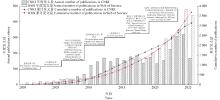
图1
不同数据库年度发文量及政策背景"
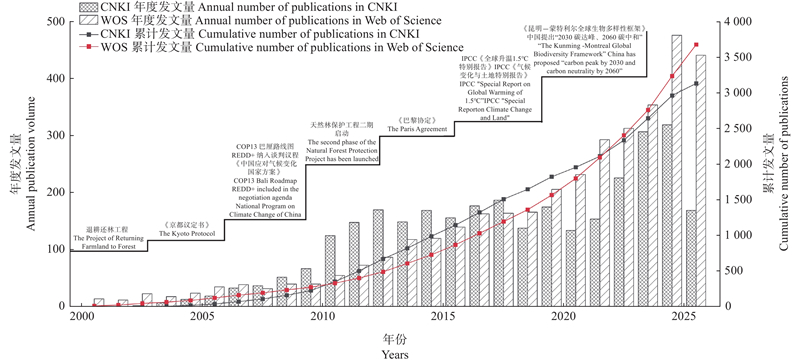
表2
国内外研究热点主题①"
| 研究热点主题 Research hot topics | 关注程度Degree of attention | |||
| 国外文献 Abroad literature | 文献占比 Proportion (%) | 国内文献 Domestic literature | 文献占比 Proportion (%) | |
| 森林碳储量精细反演 Fine-scale inversion of forest carbon storage | ● | 27.62 | ● | 11.45 |
| 生态系统碳储量格局及其驱动机制 The pattern of carbon storage in ecosystems and its driving mechanisms | ○ | 2.65 | ○ | 3.18 |
| 森林碳汇潜力与增汇空间评估 Assessment of forest carbon sink potential and carbon sequestration space | ○ | 3.54 | ⊕ | 5.60 |
| 森林生态系统服务功能 Forest ecosystem service functions | ● | 20.42 | ● | 45.69 |
| 城市森林与城市绿地碳汇 Urban forest and urban green space carbon sinks | ○ | 1.92 | ○ | 4.07 |
| 特殊森林类型的碳汇功能 The carbon sink function of special forest types | ⊕ | 15.53 | ⊕ | 5.41 |
| 森林碳汇过程模型 Forest carbon sink process model | ○ | 0.84 | ○ | 1.34 |
| 土地利用/覆盖变化 Land use/cover change | ⊕ | 12.14 | ⊕ | 9.13 |
| 土壤碳与湿地/森林交错区碳储量 Soil carbon and carbon storage in the transition zone between wetlands and forests | ⊕ | 12.20 | ● | 10.14 |
| 碳交易与政策评估 Carbon trading and policy evaluation | ○ | 3.14 | ○ | 4.01 |
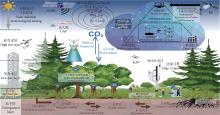
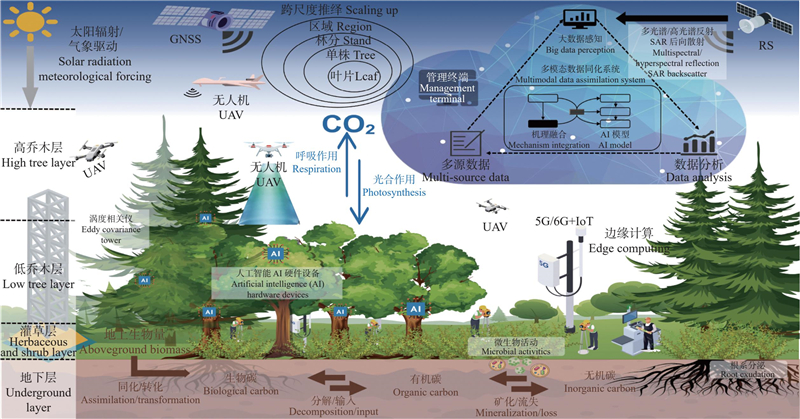
图2
森林碳汇“空–天–地”一体化监测评估体系场景"
|
曹 林, 周 凯, 申 鑫, 等. 智慧林业发展现状与展望. 南京林业大学学报(自然科学版), 2022, 46 (6): 83- 95.
doi: 10.12302/j.issn.1000-2006.202209052 |
|
|
Cao L, Zhou K, Shen X, et al. Development status and prospects of smart forestry. Journal of Nanjing Forestry University (Natural Sciences Edition), 2022, 46 (6): 83- 95.
doi: 10.12302/j.issn.1000-2006.202209052 |
|
|
陈尔学, 李增元, 庞 勇, 等. 基于极化合成孔径雷达干涉测量的平均树高提取技术. 林业科学, 2007, 43 (4): 66- 70.
doi: 10.3321/j.issn:1001-7488.2007.04.011 |
|
|
Chen E X, Li Z Y, Pang Y, et al. Polarimetric SAR interferometry based mean tree height extraction technique. Scientia Silvae Sinicae, 2007, 43 (4): 66- 70.
doi: 10.3321/j.issn:1001-7488.2007.04.011 |
|
|
刘金成, 冯仲科, 杨立岩, 等. 实时动态多功能双目立体摄影测树仪设计. 农业工程学报, 2018, 34 (22): 61- 68.
doi: 10.11975/j.issn.1002-6819.2018.22.008 |
|
|
Liu J C, Feng Z K, Yang L Y, et al. Design of real-time dynamic multifunctional binocular stereo photogrammetric dendrometer. Transactions of the Chinese Society of Agricultural Engineering, 2018, 34 (22): 61- 68.
doi: 10.11975/j.issn.1002-6819.2018.22.008 |
|
| 刘金成, 郭义军, 曾 嘉, 等. 基于树冠最高点和地面树干中心的森林影像点云配准方法. 农业工程学报, 2024a, 40 (15): 127- 134. | |
| Liu J C, Guo Y J, Zeng J, et al. Registration method of forest image point clouds based on canopy highest points and ground trunk centers. Transactions of the Chinese Society of Agricultural Engineering, 2024a, 40 (15): 127- 134. | |
| 刘金成, 王海明, 何亚琼, 等. 无人机技术在精准林业中的应用与挑战. 农业工程学报, 2024b, 40 (5): 14- 24. | |
| Liu J C, Wang H M, He Y Q, et al. Applications and challenges of UAV technology in precision forestry. Transactions of the Chinese Society of Agricultural Engineering, 2024b, 40 (5): 14- 24. | |
| 刘新杰, 刘良云. 叶绿素荧光的GOSAT卫星遥感反演. 遥感学报, 2013, 17 (6): 1518- 1532. | |
| Liu X J, Liu L Y. Retrieval of chlorophyll fluorescence from GOSAT TANSO-FTS data. Journal of Remote Sensing, 2013, 17 (6): 1518- 1532. | |
|
毛 军, 王立平, 高永龙, 等. 北京八达岭林场人工林生态服务功能评估. 北京师范大学学报(自然科学版), 2024, 60 (2): 224- 232.
doi: 10.12202/j.0476-0301.2023064 |
|
|
Mao J, Wang L P, Gao Y L, et al. Assessment of ecological service functions of plantations in Badaling Forest Farm, Beijing. Journal of Beijing Normal University (Natural Science), 2024, 60 (2): 224- 232.
doi: 10.12202/j.0476-0301.2023064 |
|
| 聂鹏程, 张 慧, 耿洪良, 等. 农业物联网技术现状与发展趋势. 浙江大学学报(农业与生命科学版), 2021, 47 (2): 135- 146. | |
| Nie P C, Zhang H, Geng H L, et al. Current status and development trend of agricultural IoT technology. Journal of Zhejiang University (Agriculture and Life Sciences), 2021, 47 (2): 135- 146. | |
|
欧阳志云, 朱春全, 杨广斌, 等. 生态系统生产总值核算: 概念、核算方法与案例研究. 生态学报, 2013, 33 (21): 6747- 6761.
doi: 10.5846/stxb201310092428 |
|
|
Ouyang Z Y, Zhu C Q, Yang G B, et al. Gross ecosystem product: concept, accounting framework and case study. Acta Ecologica Sinica, 2013, 33 (21): 6747- 6761.
doi: 10.5846/stxb201310092428 |
|
|
庞 勇, 李增元, 陈尔学, 等. 激光雷达技术及其在林业上的应用. 林业科学, 2005, 41 (3): 129- 136.
doi: 10.3321/j.issn:1001-7488.2005.03.022 |
|
|
Pang Y, Li Z Y, Chen E X, et al. LiDAR remote sensing technology and its application in forestry. Scientia Silvae Sinicae, 2005, 41 (3): 129- 136.
doi: 10.3321/j.issn:1001-7488.2005.03.022 |
|
| 朴世龙, 何 悦, 王旭辉, 等. 中国陆地生态系统碳汇估算: 方法、进展、展望. 中国科学: 地球科学, 2022, 52 (6): 1010- 1020. | |
| Piao S L, He Y, Wang X H, et al. Estimation of China’s terrestrial ecosystem carbon sink: methods, progress and prospects. Science China Earth Sciences, 2022, 52 (6): 1010- 1020. | |
| 苏雅楠, 陈圣乾, 冯 敏, 等. 陆地地表水卫星遥感监测进展与展望. 科学通报, 2024, 69 (22): 3268- 3282. | |
| Su Y N, Chen S Q, Feng M, et al. Progress and prospect of satellite remote sensing monitoring of terrestrial surface water. Chinese Science Bulletin, 2024, 69 (22): 3268- 3282. | |
| 吴小丹, 闻建光, 肖 青, 等. 面向公里级遥感像元的地面观测理论与方法: 以数值型陆表参数为例. 遥感学报, 2025, 29 (5): 1227- 1244. | |
| Wu X D, Wen J G, Xiao Q, et al. Ground observation theory and method for kilometer-scale remote sensing pixels: a case study of numerical land surface parameters. National Remote Sensing Bulletin, 2025, 29 (5): 1227- 1244. | |
|
于贵瑞, 牛 栋, 王秋凤. 《联合国气候变化框架公约》谈判中的焦点问题. 资源科学, 2001, 23 (6): 10- 16.
doi: 10.3321/j.issn:1007-7588.2001.06.003 |
|
|
Yu G R, Niu D, Wang Q F. Focal issues in the negotiation of the United Nations Framework Convention on Climate Change. Resources Science, 2001, 23 (6): 10- 16.
doi: 10.3321/j.issn:1007-7588.2001.06.003 |
|
| 于贵瑞, 张雷明, 孙晓敏. 中国陆地生态系统通量观测研究网络(ChinaFLUX)的主要进展及发展展望. 地理科学进展, 2014, 33 (7): 903- 917. | |
| Yu G R, Zhang L M, Sun X M. Progress and prospects of the Chinese terrestrial ecosystem flux observation and research network (China FLUX). Progress in Geography, 2014, 33 (7): 903- 917. | |
|
赵苗苗, 赵师成, 张丽云, 等. 大数据在生态环境领域的应用进展与展望. 应用生态学报, 2017, 28 (5): 1727- 1734.
doi: 10.13287/j.1001-9332.201705.001 |
|
|
Zhao M M, Zhao S C, Zhang L Y, et al. Application progress and prospect of big data in the field of ecological environment. Chinese Journal of Applied Ecology, 2017, 28 (5): 1727- 1734.
doi: 10.13287/j.1001-9332.201705.001 |
|
|
周坚华, 胡永红, 周一凡, 等. 城镇绿地植被固碳量遥感测算模型的设计. 生态学报, 2010, 30 (20): 5653- 5665.
doi: 10.20103/j.stxb.2010.20.028 |
|
|
Zhou J H, Hu Y H, Zhou Y F, et al. Design of remote sensing measurement model for vegetation carbon sequestration in urban green space. Acta Ecologica Sinica, 2010, 30 (20): 5653- 5665.
doi: 10.20103/j.stxb.2010.20.028 |
|
| 朱宁宁, 杨必胜, 董 震. 森林植被碳储量的遥感估测流程与方法. 遥感学报, 2025, 29 (1): 134- 146. | |
| Zhu N N, Yang B S, Dong Z. Process and method of remote sensing estimation of forest vegetation carbon storage. National Remote Sensing Bulletin, 2025, 29 (1): 134- 146. | |
|
Ali I, Greifeneder F, Stamenkovic J, et al. Review of machine learning approaches for biomass and soil moisture retrievals from remote sensing data. Remote Sensing, 2015, 7 (12): 16398- 16421.
doi: 10.3390/rs71215841 |
|
|
Baccini A, Goetz S J, Walker W S, et al. Estimated carbon dioxide emissions from tropical deforestation improved by carbon-density maps. Nature Climate Change, 2012, 2 (3): 182- 185.
doi: 10.1038/nclimate1354 |
|
|
Bastin J F, Finegold Y, Garcia C, et al. The global tree restoration potential. Science, 2019, 365 (6448): 76- 79.
doi: 10.1126/science.aax0848 |
|
|
Bastos A, Ciais P, Friedlingstein P, et al. Direct and seasonal legacy effects of the 2018 heat wave and drought on European ecosystem productivity. Science Advances, 2020, 6 (24): eaba2724.
doi: 10.1126/sciadv.aba2724 |
|
|
Bauer P, Dueben P D, Hoefler T, et al. The digital revolution of earth-system science. Nature Computational Science, 2021, 1 (2): 104- 113.
doi: 10.1038/s43588-021-00023-0 |
|
|
Breiman L. Random forests. Machine Learning, 2001, 45 (1): 5- 32.
doi: 10.1023/A:1010933404324 |
|
| Brown S. 1997. Estimating biomass and biomass change of tropical forests: a primer. FAO Forestry Paper No. 134. Rome: Food and Agriculture Organization of the United Nations. | |
|
Chave J, Andalo C, Brown S, et al. Tree allometry and improved estimation of carbon stocks and balance in tropical forests. Oecologia, 2005, 145 (1): 87- 99.
doi: 10.1007/s00442-005-0100-x |
|
|
Chen C, Park T, Wang X H, et al. China and India lead in greening of the world through land-use management. Nature Sustainability, 2019, 2 (2): 122- 129.
doi: 10.1038/s41893-019-0220-7 |
|
|
Contreras F, Cayuela M L, Sánchez-Monedero M A, et al. Multi-source remote sensing for large-scale biomass estimation in Mediterranean olive orchards using GEDI LiDAR and machine learning. Biogeosciences, 2025, 22 (23): 7625- 7646.
doi: 10.5194/bg-22-7625-2025 |
|
|
Dubayah R, Armston J, Healey S P, et al. GEDI launches a new era of biomass inference from space. Environmental Research Letters, 2022, 17 (9): 095001.
doi: 10.1088/1748-9326/ac8694 |
|
|
Dubayah R, Blair J B, Goetz S, et al. The global ecosystem dynamics investigation: high-resolution laser ranging of the earth’s forests and topography. Science of Remote Sensing, 2020, 1, 100002.
doi: 10.1016/j.srs.2020.100002 |
|
|
Duncanson L, Armston J, Disney M, et al. Aboveground biomass density models for NASA’s global ecosystem dynamics investigation (GEDI) LiDAR mission. Remote Sensing of Environment, 2022, 270, 112845.
doi: 10.1016/j.rse.2021.112845 |
|
| Eggleston H S, Buendia L, Miwa K, et al. 2006. 2006 IPCC guidelines for national greenhouse gas inventories. Hayama, Japan: Institute for Global Environmental Strategies. | |
|
Fang J Y, Chen A P, Peng C H, et al. Changes in forest biomass carbon storage in China between 1949 and 1998. Science, 2001, 292 (5525): 2320- 2322.
doi: 10.1126/science.1058629 |
|
|
Friend A D, Lucht W, Rademacher T T, et al. Carbon residence time dominates uncertainty in terrestrial vegetation responses to future climate and atmospheric CO2. Proceedings of the National Academy of Sciences of the United States of America, 2014, 111 (9): 3280- 3285.
doi: 10.1073/pnas.1222477110 |
|
|
Gong Z, Ge W Y, Guo J Q, et al. Satellite remote sensing of vegetation phenology: progress, challenges, and opportunities. ISPRS Journal of Photogrammetry and Remote Sensing, 2024, 217, 149- 164.
doi: 10.1016/j.isprsjprs.2024.08.011 |
|
|
Guo B Q, Fang M J, Yang L L, et al. Remapping carbon storage change in retired farmlands on the Loess Plateau in China from 2000—2021 in high spatiotemporal resolution. Earth System Science Data, 2026, 18 (1): 429- 441.
doi: 10.5194/essd-18-429-2026 |
|
|
Hochreiter S, Schmidhuber J. Long short-term memory. Neural Computation, 1997, 9 (8): 1735- 1780.
doi: 10.1162/neco.1997.9.8.1735 |
|
|
Karpatne A, Atluri G, Faghmous J H, et al. Theory-guided data science: a new paradigm for scientific discovery from data. IEEE Transactions on Knowledge and Data Engineering, 2017, 29 (10): 2318- 2331.
doi: 10.1109/TKDE.2017.2720168 |
|
|
Karniadakis G E, Kevrekidis I G, Lu L, et al. Physics-informed machine learning. Nature Reviews Physics, 2021, 3 (6): 422- 440.
doi: 10.1038/s42254-021-00314-5 |
|
|
Kim J, Kang Y, Kim D, et al. Carbon storage and sequestration analysis by urban park grid using i-Tree Eco and drone-based modeling. Forests, 2024, 15 (4): 683.
doi: 10.3390/f15040683 |
|
|
Kirschbaum M U, Paul K I. Modelling C and N dynamics in forest soils with a modified version of the CENTURY model. Soil Biology and Biochemistry, 2002, 34 (3): 341- 354.
doi: 10.1016/S0038-0717(01)00189-4 |
|
|
Krinner G, Viovy N, de Noblet-Ducoudré N, et al. A dynamic global vegetation model for studies of the coupled atmosphere-biosphere system. Global Biogeochemical Cycles, 2005, 19 (1): GB1015.
doi: 10.1029/2003gb002199 |
|
|
Kurz W, Dymond C, White T, et al. CBM-CFS3: a model of carbon dynamics in forestry and land-use change implementing IPCC standards. Ecological Modelling, 2009, 220 (4): 480- 504.
doi: 10.1016/j.ecolmodel.2008.10.018 |
|
|
Landsberg J J, Waring R H. A generalised model of forest productivity using simplified concepts of radiation-use efficiency, carbon balance and partitioning. Forest Ecology and Management, 1997, 95 (3): 209- 228.
doi: 10.1016/S0378-1127(97)00026-1 |
|
|
Lang N, Jetz W, Schindler K, et al. A high-resolution canopy height model of the earth. Nature Ecology & Evolution, 2023, 7 (11): 1778- 1789.
doi: 10.1038/s41559-023-02206-6 |
|
|
LeCun Y, Bengio Y, Hinton G. Deep learning. Nature, 2015, 521 (7553): 436- 444.
doi: 10.1038/nature14539 |
|
|
Liu J C, Chen Z, Zhao Z Y. Assessing the accuracy of forest above-ground biomass and carbon storage estimation by meta-analysis based on close-range remote sensing. Forestry Research, 2025a, 5, e017.
doi: 10.48130/forres-0025-0017 |
|
|
Nowak D J, Crane D E, Stevens J C, et al. A ground-based method of assessing urban forest structure and ecosystem services. Arboriculture & Urban Forestry, 2008, 34 (6): 347- 358.
doi: 10.48044/jauf.2008.048 |
|
|
Ouyang Z, Zheng H, Xiao Y, et al. Improvements in ecosystem services from investments in natural capital. Science, 2016, 352 (6292): 1455- 1459.
doi: 10.1126/science.aaf2295 |
|
|
Raissi M, Perdikaris P, Karniadakis G E. Physics-informed neural networks: a deep learning framework for solving forward and inverse problems involving nonlinear partial differential equations. Journal of Computational Physics, 2019, 378, 686- 707.
doi: 10.1016/j.jcp.2018.10.045 |
|
|
Rammer W, Thom D, Baumann M, et al. The individual-based forest landscape and disturbance model iLand: overview, progress, and outlook. Ecological Modelling, 2024, 495, 110785.
doi: 10.1016/j.ecolmodel.2024.110785 |
|
|
Reichstein M, Camps-Valls G, Stevens B, et al. Deep learning and process understanding for data-driven earth system science. Nature, 2019, 566 (7743): 195- 204.
doi: 10.1038/s41586-019-0912-1 |
|
| Running S W, Hunt E R. 1993. Generalization of a forest ecosystem process model for other biomes, BIOME-BGC, and an application for global-scale models // Ehleringer J R, Field C B. Scaling physiological processes, leaf to globe. San Diego: Academic Press, 141–158. | |
|
Sa R, Nie Y, Chumachenko S, et al. Biomass estimation and saturation value determination based on multi-source remote sensing data. Remote Sensing, 2024, 16 (12): 2250.
doi: 10.3390/rs16122250 |
|
|
Saatchi S S, Harris N L, Brown S, et al. Benchmark map of forest carbon stocks in tropical regions across three continents. Proceedings of the National Academy of Sciences of the United States of America, 2011, 108 (24): 9899- 9904.
doi: 10.1073/pnas.1019576108 |
|
|
Sitch S, Smith B, Prentice I C, et al. Evaluation of ecosystem dynamics, plant geography and terrestrial carbon cycling in the LPJ dynamic global vegetation model. Global Change Biology, 2003, 9 (2): 161- 185.
doi: 10.1046/j.1365-2486.2003.00569.x |
|
|
Somogyi Z, Cienciala E, Mäkipää R, et al. Indirect methods of large-scale forest biomass estimation. European Journal of Forest Research, 2007, 126 (2): 197- 207.
doi: 10.1007/s10342-006-0125-7 |
|
|
Villa F, Bagstad K J, Voigt B, et al. A methodology for adaptable and robust ecosystem services assessment. PLoS ONE, 2014, 9 (3): e91001.
doi: 10.1371/journal.pone.0091001 |
|
|
Wang X Y, Gong Z, Liu J C. Quantitative assessment of vegetation carbon sequestration in typical natural secondary forests of the Loess Plateau: incorporating the influences of human activities and climate variations. Journal of Environmental Management, 2025, 388, 126000.
doi: 10.1016/j.jenvman.2025.126000 |
|
|
West T A, Wunder S, Sills E O, et al. Action needed to make carbon offsets from forest conservation work for climate change mitigation. Science, 2023, 381 (6660): 873- 877.
doi: 10.1126/science.ade3535 |
|
|
Yu Y, Pan Y, Yang X G, et al. Spatial scale effect and correction of forest aboveground biomass estimation using remote sensing. Remote Sensing, 2022, 14 (12): 2828.
doi: 10.3390/rs14122828 |
|
|
Zeng J, Liu J C, Li L M, et al. Combining random forest and Monte Carlo method to determine the driving factors and uncertainty of forest age prediction in northwest China. Chinese Geographical Science, 2026, 36 (1): 144- 156.
doi: 10.1007/s11769-025-1589-z |
|
|
Zhang H X, Ye Z X, Qin X Y, et al. Improving regional forest biomass estimation with a UAV-driven hierarchical framework: a case study in Chinese fir plantations. IEEE Journal of Selected Topics in Applied Earth Observations and Remote Sensing, 2026, 19, 5758- 5773.
doi: 10.1109/JSTARS.2026.3658146 |
| [1] | 韩学正,何念鹏,蔡伟祥,李维刚. 基于林木生长过程的森林生态系统碳汇长期预测方法——理论基础与构架分析[J]. 林业科学, 2026, 62(7): 230-239. |
| [2] | 熊世梅,谭炳香,许文强,李骁尧,庞丽峰,胡冰. 基于无人机多光谱和激光雷达数据的荒漠梭梭林地上生物量估算[J]. 林业科学, 2026, 62(6): 96-108. |
| [3] | 周晟,蒋馥根,陈帅,龙依,王彬彬,宋子戈,孙华. 联合星−空激光雷达和Sentinel-2数据的森林地上生物量估测方法[J]. 林业科学, 2026, 62(3): 74-87. |
| [4] | 胡兴涛,张怀清,杨廷栋,张京,蒋娴. 林草元宇宙技术体系与应用[J]. 林业科学, 2026, 62(2): 25-39. |
| [5] | 施正煌,侯方淼,张浩昆,黄国星. 新一轮集体林权制度改革对中国木质林产品出口边际增长的影响分析[J]. 林业科学, 2025, 61(9): 211-222. |
| [6] | 张宇娇,赵恒谦,付含聪,刘哿,皇甫霞丹,刘轩绮. 基于无人机遥感多特征的单木地上生物量反演模型[J]. 林业科学, 2025, 61(8): 129-141. |
| [7] | 袁泽雨,许行,任怡,许杨,庞建壮,吴小云,张翰遥,张志强. 2001—2021年“三北”工程区植被韧性分布特征及其驱动因素[J]. 林业科学, 2025, 61(7): 182-191. |
| [8] | 陈玉洁,刘世荣. 世界林业科学研究前沿动态与趋势展望——基于国际林业研究组织联盟第二十六届世界大会述评[J]. 林业科学, 2025, 61(7): 140-145. |
| [9] | 崔泽宇,张怀清,刘洋,张京,杨廷栋,傅汝饶. 树木三维建模与可视化模拟技术进展与应用[J]. 林业科学, 2025, 61(6): 1-12. |
| [10] | 杨菲菲,张王菲,赵磊,赵含,姬永杰,王梦金. 基于GF-1数据的二阶段遥感特征优选与森林地上生物量反演模型[J]. 林业科学, 2025, 61(4): 9-19. |
| [11] | 葛晓宁,许新桥,张怀清,张京,杨杰,崔泽宇,傅汝饶,梁金洁,邹添华,王林龙,刘洋. 林木基因型-环境互作算法研究进展与思考[J]. 林业科学, 2025, 61(3): 1-15. |
| [12] | 陈汝婷,迟德富. 病虫害干扰对森林碳汇影响的研究进展[J]. 林业科学, 2025, 61(2): 1-11. |
| [13] | 李倩,张帆,孟祥雪,吴小云,庞建壮,许行,张志强. 基于分解重构与机器学习的华北平原杨树人工林净碳交换模拟[J]. 林业科学, 2025, 61(12): 72-82. |
| [14] | 朱教君,王高峰,张怀清,高添. 关于“气候智慧林业”研究的思考[J]. 林业科学, 2024, 60(7): 1-7. |
| [15] | 潘丹,罗璐薏,季凯文,孔凡斌. 农村电子商务发展对林区内部收入差距与共同富裕的影响[J]. 林业科学, 2024, 60(5): 35-50. |
| 阅读次数 | ||||||
|
全文 |
|
|||||
|
摘要 |
|
|||||

