
林业科学 ›› 2026, Vol. 62 ›› Issue (9): 1-12.doi: 10.11707/j.1001-7488.LYKX20260484
• 前沿热点 • 下一篇
黄锐洲1,冯铭淳1,董畅2,郑妍妍3,刘家辉1,甘广树1,方素琴2,许涵1,*( )
收稿日期:2026-07-29
修回日期:2026-08-11
出版日期:2026-09-10
发布日期:2026-09-16
通讯作者:
许涵
E-mail:ywfj@163.com
基金资助:
Ruizhou Huang1,Mingchun Feng1,Chang Dong2,Yanyan Zheng3,Jiahui Liu1,Guangshu Gan1,Suqin Fang2,Han Xu1,*()
Received:2026-07-29
Revised:2026-08-11
Online:2026-09-10
Published:2026-09-16
Contact:
Han Xu
E-mail:ywfj@163.com
摘要:
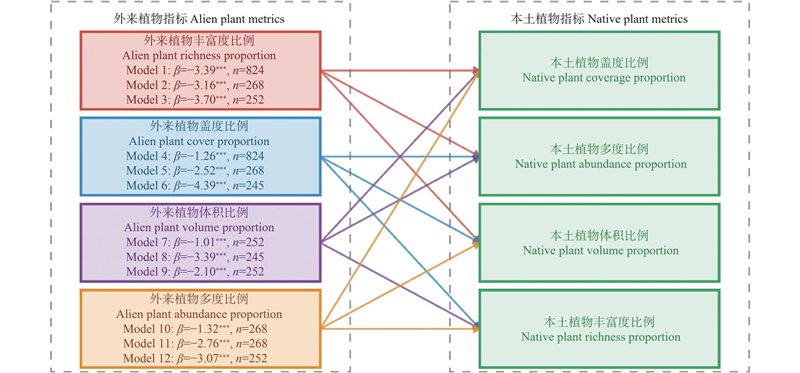
目的: 探究外来植物成功入侵依赖的物种属性特征和空间占据优势,并评估其对本土植物群落造成的生态影响,揭示其入侵机制,为外来植物的科学防控提供理论支撑。方法: 在广东省建立824个样方(1 m × 1 m),首先,基于物种水平,从科属分类、地理来源、引入时间、引入途径、功能性状5个属性特征,以物种丰富度作为入侵性表征指标,综合评估外来植物的入侵性;然后,采用贝叶斯系统发育广义线性混合效应模型,在植株水平上分析外来植物与本土植物盖度、基径、株高和地上部分体积的差异;最后,检验外来植物任一指标(丰富度、盖度、地上部分体积、多度)的群落占比增加是否显著抑制本土植物其他3个指标的群落占据比例,以此衡量外来植物对本土植物的生态危害情况。结果: 1) 外来植物来源广泛,但多来源于美洲,且主要隶属于大科大属(菊科,大戟属、番薯属、茄属),表明外来物种具有环境预适应性。外来植物的引入时间主要集中于1840年(第一次鸦片战争)至1949年(中华人民共和国成立)期间,引入途径以观赏植物引入为主,反映人为引入活动的重要影响。外来植物的生长型以草本植物、单一生长型植物以及多年生草本植物为主,反映外来植物的快速生长、资源定向利用、长期定殖能力等“理想杂草”优势。2) 外来植物的盖度显著高于本土植物(P<0.001),但其基径、株高和地上部分体积与本土植物相比均无显著差异,反映外来植物的横向扩张策略和盖度优势。3) 外来植物对本土植物群落结构具有系统性压制作用。外来植物任一指标(丰富度、盖度、地上部分体积、多度)群落占比增加,均会显著压制本土植物其他3个指标的群落占据比例(P<0.001)。结论: 本研究从多个维度揭示外来植物能够成功入侵并压制本土植物群落的驱动机制,即人为引入活动构成了入侵的初级驱动力,环境预适应性奠定了跨域定殖的基础,“理想杂草”的广适性表型确保了种群的持久和扩散,横向扩张的盖度优势提供了系统性压制本土植物群落的实现途径。
中图分类号:
黄锐洲,冯铭淳,董畅,郑妍妍,刘家辉,甘广树,方素琴,许涵. 外来植物多维度解析:物种特征、空间占据能力与其生态影响[J]. 林业科学, 2026, 62(9): 1-12.
Ruizhou Huang,Mingchun Feng,Chang Dong,Yanyan Zheng,Jiahui Liu,Guangshu Gan,Suqin Fang,Han Xu. Multidimensional Analysis of Alien Plants: Species Traits, Spatial Occupancy, and Ecological Impacts[J]. Scientia Silvae Sinicae, 2026, 62(9): 1-12.
表1
研究地点与样方的空间分布"
| 区域 Region | 样地数 Number of sites | 样方数 Number of sample plots | 经度范围 Longitude range (E)/(°) | 纬度范围 Latitude range (N)/(°) |
| 粤东 Eastern Guangdong | 6 | 86 | ||
| 粤西 Western Guangdong | 5 | 127 | ||
| 珠三角 Pearl River Delta | 20 | 278 | ||
| 粤北 Northern Guangdong | 22 | 333 | ||
| 合计 Total | 53 | 824 |

图1
824个样方中的外来植物的科属组成 图中各科、属名称前数值,代表该类群的物种丰富度占比和物种丰富度。"
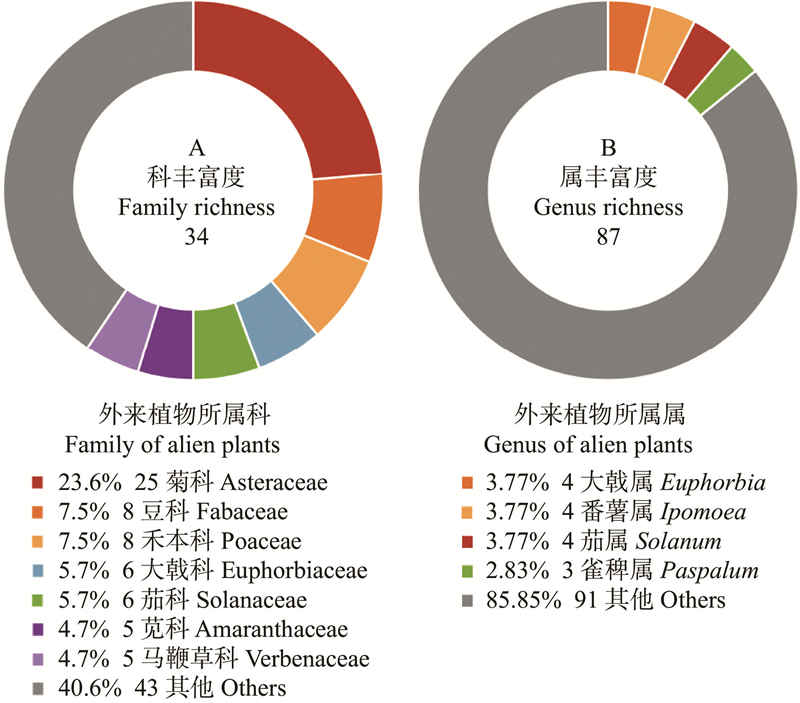
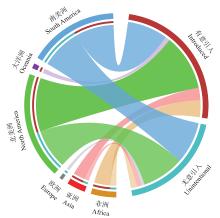
图2
824个样方中外来植物的地理来源"

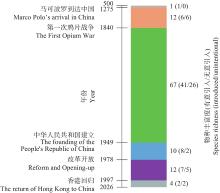
图3
824个样方中的外来植物进入中国的时间"
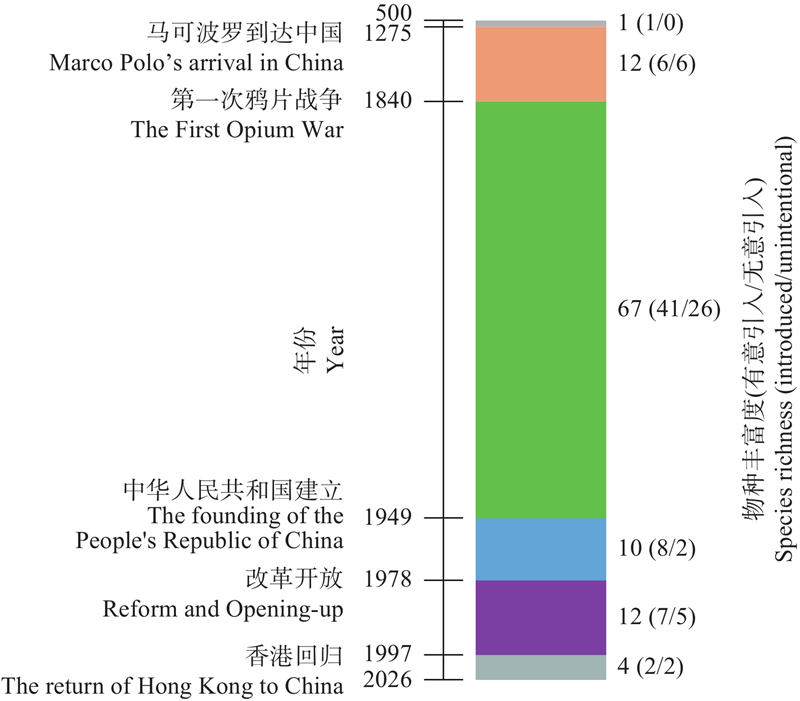
图4
824个样方中外来植物的引入途径"
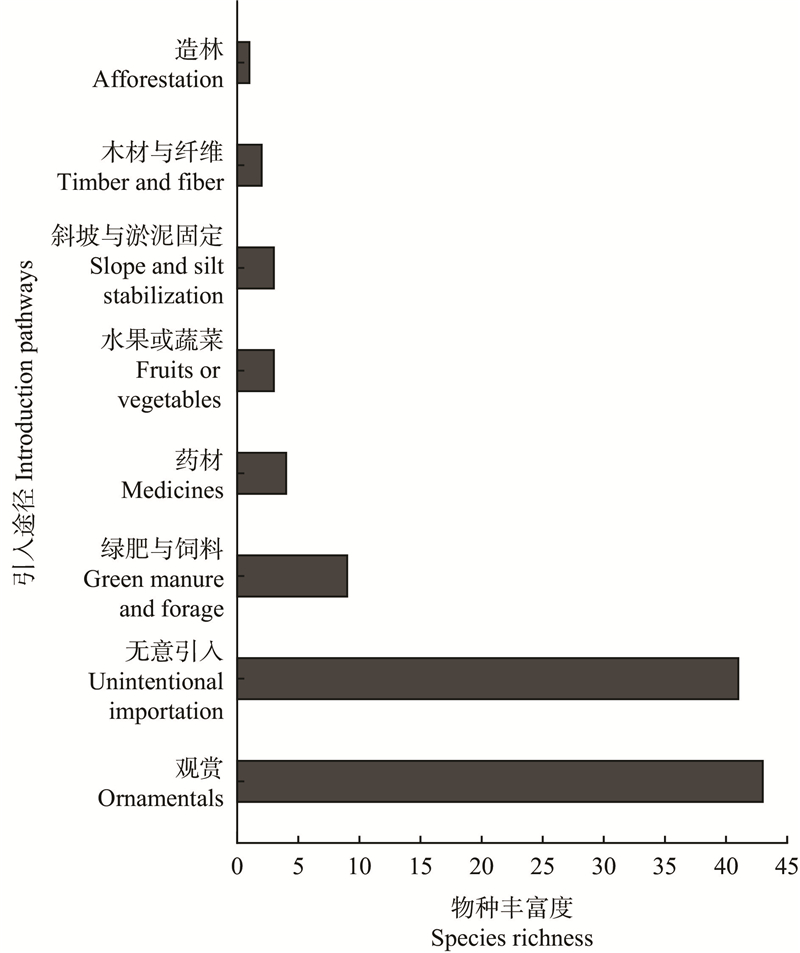
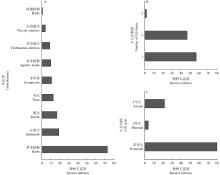
图5
在824个样方中外来植物的生长型与生存时间"
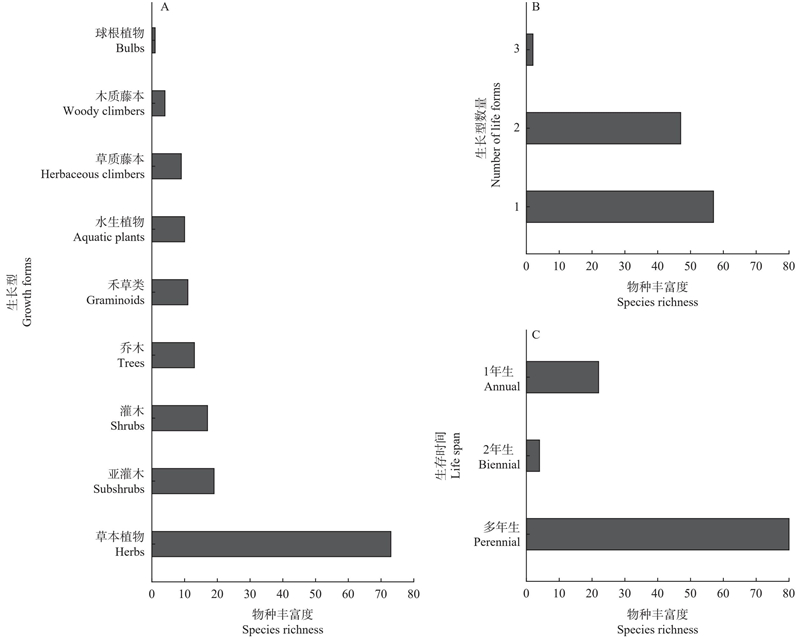

图6
外来与本土植物植株占据生态空间的能力对比 图中圆点和误差棒分别代表贝叶斯系统发育广义线性混合效应模型预测的后验均值及其95%可信区间。"
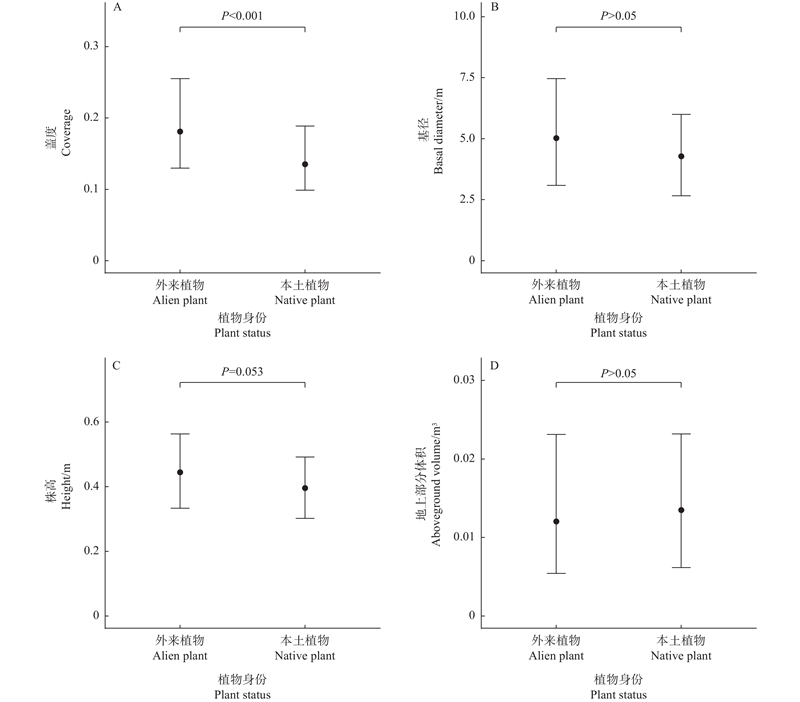
图7
外来植物对本土植物的影响 图中展示12个广义线性混合效应模型(Model 1–12)的对应关系,左侧虚线框内为解释变量(外来植物群落指标),右侧虚线框内为响应变量(本土植物群落指标),从左侧各变量发出的箭头由上至下依次对应Model 1–12。植物体积比例指植物地上部分的体积比例。β:广义线性混合效应模型在logit链接尺度上的固定效应估计值。n:模型拟合所用的样方总数。"
|
段婷婷, 何文亮, 杨嘉琦, 等. 湛江市外来植物入侵状况. 生物安全学报, 2022, 31 (3): 245- 251.
doi: 10.3969/j.issn.2095-1787.2022.03.008 |
|
|
Duan T T, He W L, Yang J Q, et al. Analysis of the alien invasive plants in Zhanjiang City, Guangdong Province, China. Journal of Biosafety, 2022, 31 (3): 245- 251.
doi: 10.3969/j.issn.2095-1787.2022.03.008 |
|
|
耿守保, 孙中宇, 张 敏, 等. 广东省陆地生物多样性热点区域及其胁迫因素. 热带地理, 2023, 43 (3): 359- 371.
doi: 10.13284/j.cnki.rddl.003636 |
|
|
Geng S B, Sun Z Y, Zhang M, et al. Terrestrial biodiversity hotspots and their threats in Guangdong Province. Tropical Geography, 2023, 43 (3): 359- 371.
doi: 10.13284/j.cnki.rddl.003636 |
|
|
郭亚男, 王瑞江. 华南地区外来入侵和归化植物分析. 热带亚热带植物学报, 2023, 31 (5): 715- 726.
doi: 10.11926/jtsb.4644 |
|
|
Guo Y N, Wang R J. Analysis on the alien invasive and naturalized plants in south China. Journal of Tropical and Subtropical Botany, 2023, 31 (5): 715- 726.
doi: 10.11926/jtsb.4644 |
|
| 何家庆. 2012. 中国外来植物. 上海: 上海科学技术出版社. | |
| He J Q. 2012. Exotic plants in China. Shanghai: Shanghai Scientific & Technical Publishers. [in Chinese] | |
| 金效华, 林秦文, 赵 宏. 2020. 中国外来入侵植物志.4卷. 上海: 上海交通大学出版社. | |
| Jin X H, Lin Q W, Zhao H. 2020. Alien invisive flora of China. Volume 4. Shanghai: Shanghai Jiaotong University Press. [in Chinese] | |
| 林秦文, 肖 翠, 马金双. 2022. 中国外来植物数据集. 生物多样性, 30(5): 22127. | |
| Lin Q W, Xiao C, Ma J S. 2022. A dataset on catalogue of alien plants in China. Biodiversity Science, 30(5): 22127. [in Chinese] | |
| 刘全儒, 张 勇, 齐淑艳. 2020. 中国外来入侵植物志. 3卷. 上海: 上海交通大学出版社. | |
| Liu Q R, Zhang Y, Qi S Y. 2020. Alien invisive flora of China. Volume 3. Shanghai: Shanghai Jiaotong University Press. [in Chinese] | |
| 刘晓娟, 马克平. 植物功能性状研究进展. 中国科学(生命科学), 2015, 45 (4): 325- 339. | |
| Liu X J, Ma K P. Analysis of the alien invasive plants in Zhanjiang City, Guangdong Province, China. Scientia Sinica Vitae, 2015, 45 (4): 325- 339. | |
|
刘艳杰, 黄 伟, 杨 强, 等. 近十年植物入侵生态学重要研究进展. 生物多样性, 2022, 30 (10): 22438.
doi: 10.17520/biods.2022438 |
|
|
Liu Y J, Huang W, Yang Q, et al. Research advances of plant invasion ecology over the past 10 years. Biodiversity Science, 2022, 30 (10): 22438.
doi: 10.17520/biods.2022438 |
|
| 马金双, 李惠茹. 2018. 中国外来入侵植物名录. 北京: 高等教育出版社. | |
| Ma J S, Li H R. 2018. The checklist of the alien invasive plants in China. Beijing: Higher Education Press. [in Chinese] | |
| 王瑞江, 王发国, 曾宪锋. 2020. 中国外来入侵植物志 2卷. 上海: 上海交通大学出版社. | |
| Wang R J, Wang F G, Zeng X F. 2020. Alien invisive flora of China. Volume 2. Shanghai: Shanghai Jiaotong University Press. [in Chinese] | |
|
王世雄, 何跃军, 王文颖. 基于功能性状多维性理解外来物种入侵的达尔文归化难题. 生物安全学报, 2023, 32 (3): 193- 201.
doi: 10.3969/j.issn.2095-1787.2023.03.001 |
|
|
Wang S X, He Y J, Wang W Y. Understanding Darwin’s naturalization conundrum of alien species invasion based on the multidimensional nature of functional traits. Journal of Biosafety, 2023, 32 (3): 193- 201.
doi: 10.3969/j.issn.2095-1787.2023.03.001 |
|
|
王 忠, 董仕勇, 罗燕燕, 等. 广州外来入侵植物. 热带亚热带植物学报, 2008, 16 (1): 29- 38.
doi: 10.11926/jtsb.3681 |
|
|
Wang Z, Dong S Y, Luo Y Y, et al. Invasive plants in Guangzhou, China. Journal of Tropical and Subtropical Botany, 2008, 16 (1): 29- 38.
doi: 10.11926/jtsb.3681 |
|
| 严 靖, 唐赛春, 李惠茹, 等. 2020. 中国外来入侵植物志. 5卷. 上海: 上海交通大学出版社. | |
| Yan J, Tang S C, Li H R, et al. 2020. Alien invisive flora of China. Volume 5. Shanghai: Shanghai Jiaotong University Press. [in Chinese] | |
|
严 靖, 闫小玲, 李惠茹, 等. 华东地区归化植物的组成特征、引入时间及时空分布. 生物多样性, 2021, 29 (4): 428- 438.
doi: 10.17520/biods.2020335 |
|
|
Yan J, Yan X L, Li H R, Du C, et al. Composition, time of introduction and spatial-temporal distribution of naturalized plants in East China. Biodiversity Science, 2021, 29 (4): 428- 438.
doi: 10.17520/biods.2020335 |
|
| 严 靖, 闫小玲, 马金双. 2016. 中国外来入侵植物彩色图鉴. 上海: 上海科学技术出版社. | |
| Yan J, Yan X L, Ma J S. 2016. Illustrations of alien invasive plants in China. Shanghai: Shanghai Scientific & Technical Publishers. [in Chinese] | |
|
闫小玲, 刘全儒, 寿海洋, 等. 中国外来入侵植物的等级划分与地理分布格局分析. 生物多样性, 2014, 22 (5): 667- 676.
doi: 10.3724/SP.J.1003.2014.14069 |
|
|
Yan X L, Liu Q R, Shou H Y, et al. The categorization and analysis on the geographic distribution patterns of Chinese alien invasive plants. Biodiversity Science, 2014, 22 (5): 667- 676.
doi: 10.3724/SP.J.1003.2014.14069 |
|
| 闫小玲, 王樟华, 李惠茹, 等. 2020. 中国外来入侵植物志. 1卷. 上海: 上海交通大学出版社. | |
| Yan X L, Wang Z H, Li H R, et al. 2020. Alien invisive flora of China. Volume 1. Shanghai: Shanghai Jiaotong University Press. [in Chinese] | |
|
Baker H G. The evolution of weeds. Annual Review of Ecology and Systematics, 1974, 5 (1): 1- 24.
doi: 10.1146/annurev.es.05.110174.000245 |
|
|
Brooks M E, Kristensen K, van Benthem K J, et al. glmmTMB balances speed and flexibility among packages for zero-inflated generalized linear mixed modeling. The R Journal, 2017, 9 (2): 378.
doi: 10.32614/rj-2017-066 |
|
|
Cao Z Y, Wu Z F, Kuang Y Q, et al. Coupling an intercalibration of radiance-calibrated nighttime light images and land use/cover data for modeling and analyzing the distribution of GDP in Guangdong, China. Sustainability, 2016, 8 (2): 108.
doi: 10.3390/su8020108 |
|
|
Dawson W. Release from belowground enemies and shifts in root traits as interrelated drivers of alien plant invasion success: a hypothesis. Ecology and Evolution, 2015, 5 (20): 4505- 4516.
doi: 10.1002/ece3.1725 |
|
|
Diagne C, Leroy B, Vaissière A C, et al. High and rising economic costs of biological invasions worldwide. Nature, 2021, 592 (7855): 571- 576.
doi: 10.1038/s41586-021-03405-6 |
|
|
Divíšek J, Pyšek P, Richardson D M, et al. Naturalized and invasive species integrate differently in the trait space of local plant communities. Ecology Letters, 2025, 28 (11): e70235.
doi: 10.1111/ele.70235 |
|
|
Fan S Y, Fristoe T S, Li S P, et al. Ecological similarities and dissimilarities between donor and recipient regions shape global plant naturalizations. Nature Communications, 2025, 16, 10485.
doi: 10.1038/s41467-025-65455-y |
|
|
Fan S Y, Yang Q, Li S P, et al. A latitudinal gradient in Darwin’s naturalization conundrum at the global scale for flowering plants. Nature Communications, 2023, 14, 6244.
doi: 10.1038/s41467-023-41607-w |
|
|
Feng J M, Zhang Z, Nan R Y. The roles of climatic factors in spatial patterns of alien invasive plants from America into China. Biodiversity and Conservation, 2011, 20 (14): 3385- 3391.
doi: 10.1007/s10531-011-0122-0 |
|
|
Fridley J D. Plant invasions across the northern hemisphere: a deep-time perspective. Annals of the New York Academy of Sciences, 2013, 1293 (1): 8- 17.
doi: 10.1111/nyas.12107 |
|
|
Fristoe T S, Bleilevens J, Kinlock N L, et al. Evolutionary imbalance, climate and human history jointly shape the global biogeography of alien plants. Nature Ecology & Evolution, 2023, 7 (10): 1633- 1644.
doi: 10.1038/s41559-023-02172-z |
|
|
Frost C M, Allen W J, Courchamp F, et al. Using network theory to understand and predict biological invasions. Trends in Ecology & Evolution, 2019, 34 (9): 831- 843.
doi: 10.1016/j.tree.2019.04.012 |
|
| Garbowski M, Laughlin D C, Blumenthal D M, et al. 2024. Naturalized species drive functional trait shifts in plant communities. Proceedings of the National Academy of Sciences of the United States of America, 121(40): e2403120121. | |
|
Gioria M, Osborne B A. Resource competition in plant invasions: emerging patterns and research needs. Frontiers in Plant Science, 2014, 5, 501.
doi: 10.3389/fpls.2014.00501 |
|
|
Gregory D, White M, Catford J A. Similar drivers but distinct patterns of woody and herbaceous alien plant invasion. NeoBiota, 2025, 103, 31- 52.
doi: 10.3897/neobiota.103.164914 |
|
|
Hao Q, Ma J S. Invasive alien plants in China: an update. Plant Diversity, 2023, 45 (1): 117- 121.
doi: 10.1016/j.pld.2022.11.004 |
|
|
Heger T, Pahl A T, Botta-Dukát Z, et al. Conceptual frameworks and methods for advancing invasion ecology. AMBIO, 2013, 42 (5): 527- 540.
doi: 10.1007/s13280-012-0379-x |
|
|
Holden E M, Cahill J F Jr. Plant trait dissimilarity increases competitive interactions among co-occurring plants. Functional Ecology, 2024, 38 (7): 1464- 1474.
doi: 10.1111/1365-2435.14561 |
|
|
Huang Z Y, Lin M, Chen G Q. Common agricultural weeds among alien invasive plants in China: species lists and their practical managing strategies. Heliyon, 2025, 11 (2): e41772.
doi: 10.1016/j.heliyon.2025.e41772 |
|
|
Hulme P E, Brundu G, Carboni M, et al. Integrating invasive species policies across ornamental horticulture supply chains to prevent plant invasions. Journal of Applied Ecology, 2018, 55 (1): 92- 98.
doi: 10.1111/1365-2664.12953 |
|
|
Jin Y, Qian H. V. PhyloMaker2: An updated and enlarged R package that can generate very large phylogenies for vascular plants. Plant Diversity, 2022, 44 (4): 335- 339.
doi: 10.1016/j.pld.2022.05.005 |
|
| Keser L H, Visser E J W, Dawson W, et al. 2015. Herbaceous plant species invading natural areas tend to have stronger adaptive root foraging than other naturalized species. Frontiers in Plant Science, 6. | |
|
Kong J, Hu C, Qie Y D, et al. Shifts in composition, origin, and distribution of invasive alien plants in Guangxi, China, over 50 years. Diversity, 2026, 18 (1): 44.
doi: 10.3390/d18010044 |
|
|
Lau J A, Funk J L. How ecological and evolutionary theory expanded the ‘ideal weed’ concept. Oecologia, 2023, 203, 251- 266.
doi: 10.1007/s00442-023-05397-8 |
|
|
Lavorel S, Garnier E. Predicting changes in community composition and ecosystem functioning from plant traits: revisiting the holy grail. Functional Ecology, 2002, 16 (5): 545- 556.
doi: 10.1046/j.1365-2435.2002.00664.x |
|
|
Lenzner B, Latombe G, Schertler A, et al. Naturalized alien floras still carry the legacy of european colonialism. Nature Ecology & Evolution, 2022, 6 (11): 1723- 1732.
doi: 10.1038/s41559-022-01865-1 |
|
| Liu Y P, Scheiner S M, Hogan J A, et al. 2025. Nonnative tree invaders lead to declines in native tree species richness. Proceedings of the National Academy of Sciences of the United States of America, 122(17): e2424908122. | |
|
Ni M, Deane D C, Li S, et al. Invasion success and impacts depend on different characteristics in non-native plants. Diversity and Distributions, 2021, 27 (7): 1194- 1207.
doi: 10.1111/ddi.13267 |
|
|
Park D S, Feng X, Maitner B S, et al. Darwin’s naturalization conundrum can be explained by spatial scale. Proceedings of the National Academy of Sciences of the United States of America, 2020, 117 (20): 10904- 10910.
doi: 10.1073/pnas.1918100117 |
|
|
Pei J, Niu Z, Wang L, et al. Spatial-temporal dynamics of carbon emissions and carbon sinks in economically developed areas of China: a case study of Guangdong Province. Scientific Reports, 2018, 8, 13383.
doi: 10.1038/s41598-018-31733-7 |
|
|
Pérez G, Vilà M, Gallardo B. Potential impact of four invasive alien plants on the provision of ecosystem services in Europe under present and future climatic scenarios. Ecosystem Services, 2022, 56, 101459.
doi: 10.1016/j.ecoser.2022.101459 |
|
|
Poppenwimer T, Mayrose I, DeMalach N. Revising the global biogeography of annual and perennial plants. Nature, 2023, 624 (7990): 109- 114.
doi: 10.1038/s41586-023-06644-x |
|
|
Pyšek P, Hulme P E, Meyerson L A, et al. Hitting the right target: taxonomic challenges for, and of, plant invasions. AoB Plants, 2013, 5, plt042.
doi: 10.1093/aobpla/plt042 |
|
|
Pyšek P, Hulme P E, Simberloff D, et al. Scientists’ warning on invasive alien species. Biological Reviews, 2020, 95 (6): 1511- 1534.
doi: 10.1111/brv.12627 |
|
| Pyšek P, Pergl J, Essl F, et al. Naturalized alien flora of the world: species diversity, taxonomic and phylogenetic patterns, geographic distribution and global hotspots of plant invasion. Preslia, 2017, 89 (3): 203- 274. | |
|
Ren W J, Peng J, Shrestha N, et al. Potential distribution and future shifts of invasive alien plants in China under climate change. Global Ecology and Conservation, 2025, 60, e03601.
doi: 10.1016/j.gecco.2025.e03601 |
|
|
Richards C L, Bossdorf O, Muth N Z, et al. Jack of all trades, master of some? On the role of phenotypic plasticity in plant invasions. Ecology Letters, 2006, 9 (8): 981- 993.
doi: 10.1111/j.1461-0248.2006.00950.x |
|
|
Sáradi N, Reis B P, Csákvári E, et al. Restorative seeding controls annual invasive species, but perennials can thrive in the long term despite treatments in sand grassland restoration. Biological Invasions, 2025, 27 (6): 154.
doi: 10.1007/s10530-025-03613-5 |
|
|
Schaffner U, Steinbach S, Sun Y, et al. Biological weed control to relieve millions from Ambrosia allergies in Europe. Nature Communications, 2020, 11 (1): 1745.
doi: 10.1038/s41467-020-15586-1 |
|
|
Seebens H, Bacher S, Blackburn T M, et al. Projecting the continental accumulation of alien species through to 2050. Global Change Biology, 2021, 27 (5): 970- 982.
doi: 10.1111/gcb.15333 |
|
|
Seebens H, Meyerson L A, Richardson D M, et al. Biological invasions: a global assessment of geographic distributions, long-term trends, and data gaps. Biological Reviews, 2025, 100 (6): 2542- 2583.
doi: 10.1111/brv.70058 |
|
|
Stanisci A, Acosta A T R, Di Iorio A, et al. Leaf and root trait variability of alien and native species along Adriatic coastal dunes (Italy). Plant Biosystems, 2010, 144 (1): 47- 52.
doi: 10.1080/11263500903454252 |
|
|
Thorne M S, Skinner Q D, Smith M A, et al. Evaluation of a technique for measuring canopy volume of shrubs. Journal of Range Management, 2002, 55 (3): 235- 241.
doi: 10.2458/azu_jrm_v55i3_thorne |
|
|
van Kleunen M, Dawson W, Essl F, et al. Global exchange and accumulation of non-native plants. Nature, 2015, 525 (7567): 100- 103.
doi: 10.1038/nature14910 |
|
|
van Kleunen M, Essl F, Pergl J, et al. The changing role of ornamental horticulture in alien plant invasions. Biological Reviews, 2018, 93 (3): 1421- 1437.
doi: 10.1111/brv.12402 |
|
| van Kleunen M, Pyšek P, Dawson W, et al. The global naturalized alien flora (GloNAF) database. Ecology, 2019, 100 (1): e02542. | |
|
van Kleunen M, Weber E, Fischer M. A meta-analysis of trait differences between invasive and non-invasive plant species. Ecology Letters, 2010, 13 (2): 235- 245.
doi: 10.1111/j.1461-0248.2009.01418.x |
|
| Violle C, Navas M-L, Vile D, et al. 2007. Let the concept of trait be functional! Oikos, 116(5): 882−892. | |
|
Wang H Y, Yang M, Ma X H, et al. The ecological risks and invasive potential of introduced ornamental plants in China. Plants, 2025, 14 (9): 1361.
doi: 10.3390/plants14091361 |
|
|
Weber E, Sun S G, Li B. Invasive alien plants in China: diversity and ecological insights. Biological Invasions, 2008, 10 (8): 1411- 1429.
doi: 10.1007/s10530-008-9216-3 |
|
| Wu Z Y, Raven P H, Hong D Y. 1994—2013. Flora of China, Vols. 1–25. Beijing: Science Press. | |
| Yan X, Li Z Y, Gregg W P, et al. 2001. Invasive species in China: an overview. Biodiversity and Conservation, 10(8): 1317−1341. | |
|
Yang Y B, Liu X, Wu J H, et al. A comprehensive county-level distribution database of alien and invasive plants in China. Ecology, 2025, 106 (5): e70084.
doi: 10.1002/ecy.70084 |
| [1] | 徐瑞晶,王艺,黄川腾,蔡春菊,范少辉,刘广路. 持续干旱时间对黄藤幼苗功能性状的影响[J]. 林业科学, 2026, 62(9): 165-176. |
| [2] | 曹明嵘,周振渊,贾东旭,刘成功,黄秦军,李金花. 杨树杂交子代耐旱性MGIDI及FAI-BLUP指数多性状评价[J]. 林业科学, 2026, 62(8): 144-157. |
| [3] | 任雪莹,许智荣,王璇,李重仪,赵秀海,何怀江,张春雨,张新娜. 蒙古栎多器官功能性状的协同与权衡关系及其对土壤碳氮含量的响应[J]. 林业科学, 2026, 62(8): 43-54. |
| [4] | 王军辉,丁昌俊,王君,李伟,薛良交,罗克明,钮世辉,陈金慧,张伟溪,吴蔼民,张苗苗,赵曦阳,殷恒福. 2025年中国林木遗传育种研究进展[J]. 林业科学, 2026, 62(6): 1-14. |
| [5] | 李思缘,高胜,胡建军,凌杰,陈赢男. Bt转基因杨杂交子代苗期生长性状综合评价与筛选[J]. 林业科学, 2026, 62(6): 154-165. |
| [6] | 张正宇,范雅倩,孙琪,段巧丽,韩莹莹,鲍伟东. 北京松山国家级自然保护区流浪犬入侵对野生动物活动节律的影响[J]. 林业科学, 2026, 62(6): 205-215. |
| [7] | 王绍坤,李晶,崔丽娟. 盐生植物根系性状对滨海湿地微生物脱氮过程的影响机制研究进展[J]. 林业科学, 2026, 62(4): 1-11. |
| [8] | 周星鲁,张磊,李清河,胡建军. 美洲黑杨杂交子代生长及材性性状遗传变异分析[J]. 林业科学, 2026, 62(4): 130-141. |
| [9] | 高文强,雷相东,何潇,李玉堂. 东北温带森林类型和发育阶段的树种多样性−地上生物量关系分异性[J]. 林业科学, 2026, 62(4): 55-67. |
| [10] | 邓敏,何怀江,吴相菊,张新娜,张春雨,赵秀海. 东北温带森林幼苗生长受生物量分配权衡和性状影响[J]. 林业科学, 2026, 62(3): 48-60. |
| [11] | 华夏辉,丁显印,吴绍泽,黄琴韵,刁姝,吴亚荻,栾启福. 基于生长因子的湿地松人工幼林地上生物量模型[J]. 林业科学, 2026, 62(3): 211-222. |
| [12] | 刘世荣,陈远其,聂秀青,明安刚,王晖. 树种多样性对森林生态系统多功能性和韧性的影响[J]. 林业科学, 2026, 62(1): 1-18. |
| [13] | 郭臣臣,李旗,李思缘,王泽民,陈赢男,韦素云,胡建军. 杨树杂交子代苗期动态生长性状的全基因组选择[J]. 林业科学, 2026, 62(1): 32-41. |
| [14] | 王亚飞,邹瑜,朱叙存,张树森,李少然,王烨,贾黎明. 毛白杨人工林叶片−细根表型及生长节律对间伐的可塑性响应[J]. 林业科学, 2026, 62(1): 95-108. |
| [15] | 郭文俊,李鑫豪,田赟,孙艳丽,房新民,代远萌,陈文婧,李廷山,刘鹏,贾昕,查天山. 北京东北部山区不同生活型木本植物叶功能性状特征及其权衡关系[J]. 林业科学, 2025, 61(9): 70-80. |
| 阅读次数 | ||||||
|
全文 |
|
|||||
|
摘要 |
|
|||||

