
林业科学 ›› 2026, Vol. 62 ›› Issue (10): 93-106.doi: 10.11707/j.1001-7488.LYKX20260232
孔令乾1,姚玉秀2,宋长杰3,程宝栋4,*( )
)
收稿日期:2026-04-20
修回日期:2026-07-22
出版日期:2026-10-10
发布日期:2026-10-17
通讯作者:
程宝栋
E-mail:baodongcheng@163.com
基金资助:
Lingqian Kong1,Yuxiu Yao2,Changjie Song3,Baodong Cheng4,*()
Received:2026-04-20
Revised:2026-07-22
Online:2026-10-10
Published:2026-10-17
Contact:
Baodong Cheng
E-mail:baodongcheng@163.com
摘要:
目的: 实证考察国家公园体制试点建设对生物多样性的因果效应及其作用机制,回应国家公园试点能否有效促进生物多样性保护的争议,为完善国家公园空间布局与生物多样性保护政策体系提供科学依据。方法: 利用中国观鸟数据构建鸟类丰富度指标,基于2011—2023年266个地级及以上城市相关数据,采用双重差分法(DID)系统评估国家公园体制试点建设对鸟类生物多样性的影响。使用PSM-DID缓解样本选择偏差,通过平行趋势检验、安慰剂检验和排除同期相关政策干扰,验证结果稳健性。异质性分析则从地理区位、鸟类濒危程度、迁徙习性3个维度展开。通过机制分析识别出栖息地保护质量、政府环境治理和公众环保意识3条传导路径。通过构建城市层面的邻接关系,检验国家公园试点的空间溢出效应。结果: 1) 国家公园体制试点建设对鸟类生物多样性的影响在1%水平上显著为正。经PSM-DID、安慰剂检验以及排除同期政策干扰后,上述结果保持稳健。2) 异质性分析发现,在国家公园体制试点建设对鸟类生物多样性的影响中,中西部地区的促进效应显著强于东部地区,非濒危鸟类种群的提升幅度大于濒危鸟类,留鸟群落的多样性改善效果优于候鸟群落。3) 机制分析表明,国家公园体制试点建设通过提高森林覆盖率与湿地质量、强化地方政府环境治理责任、提升公众环保意识3条渠道促进生物多样性保护。4) 拓展性分析发现,国家公园体制试点建设具有显著的正向空间溢出效应,能有效带动周边相邻城市的鸟类多样性改善。结论: 国家公园体制试点建设是促进鸟类生物多样性保护的有效路径。面向深化推进阶段,应着力优化国家公园的空间布局体系,构建栖息地保护、政府治理与公众参与三维协同的长效驱动机制。在区域战略上,宜优先在中西部地区布局新建园区,并针对濒危物种与候鸟群落制定差异化专项保护方案。同时,需打破行政边界壁垒,构建跨区域的生态廊道协同保护网络,以充分释放国家公园试点的空间溢出效应,实现保护绩效的系统性提升。
中图分类号:
孔令乾,姚玉秀,宋长杰,程宝栋. 国家公园建设的生物多样性保护效应——基于中国观鸟数据的考察[J]. 林业科学, 2026, 62(10): 93-106.
Lingqian Kong,Yuxiu Yao,Changjie Song,Baodong Cheng. Impacts of National Park Construction on Biodiversity: An Investigation Based on Birding Data in China[J]. Scientia Silvae Sinicae, 2026, 62(10): 93-106.

表1
变量描述性统计"
| 变量 Variables | 样本量 Sample size | 平均值 Mean | 标准差 Standard deviation | 最小值 Min. | 最大值 Max. |
| 生物多样性 Biodiversity | 2 680 | –0.107 | 1.074 | ?4.629 | 4.578 |
| 政府干预程度 Government intervention level | 2 759 | 15.151 | 0.763 | 12.433 | 18.384 |
| 金融发展水平 Financial development level | 2 759 | 2.853 | 1.394 | 0.502 | 14.420 |
| 文化设施水平 Cultural facilities level | 2 759 | 7.664 | 1.161 | 0.002 | 19.114 |
| 产业结构水平 Industrial structure level | 2 759 | 0.067 | 0.044 | 0 | 0.749 |
| 基础设施水平 Infrastructure level | 2 759 | 7.748 | 1.488 | 3.378 | 11.273 |
| 经济发展水平 Economic development level | 2 759 | 6.366 | 3.583 | 1.409 | 18.327 |
| 平均坡度 Average slope | 2 620 | 11.026 | 5.691 | 1.592 | 27.139 |
| 平均高程 Average elevation | 2 620 | 506.381 | 597.488 | 7.337 | 3 128.234 |
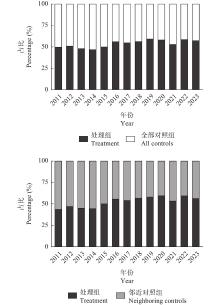
图1
鸟类丰富度百分比堆积图"
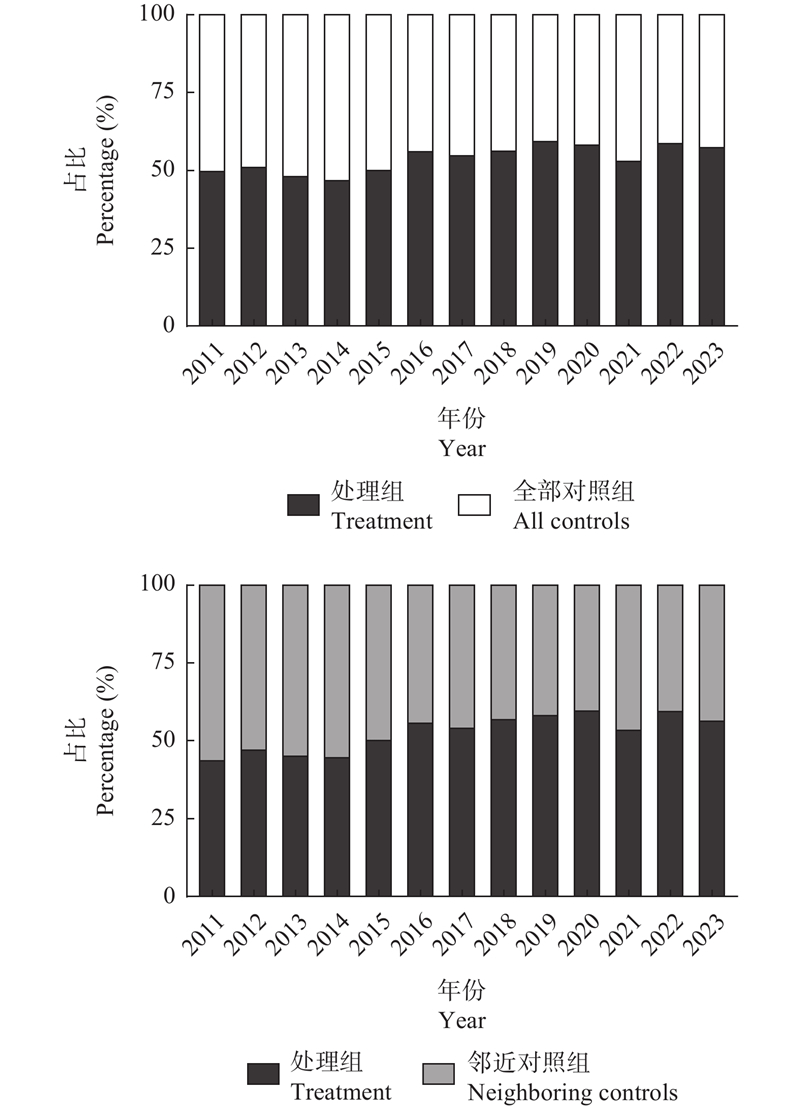
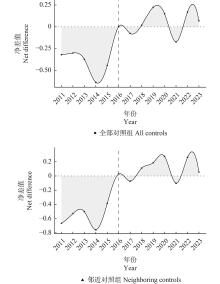
图2
各年份鸟类丰富度净差值"
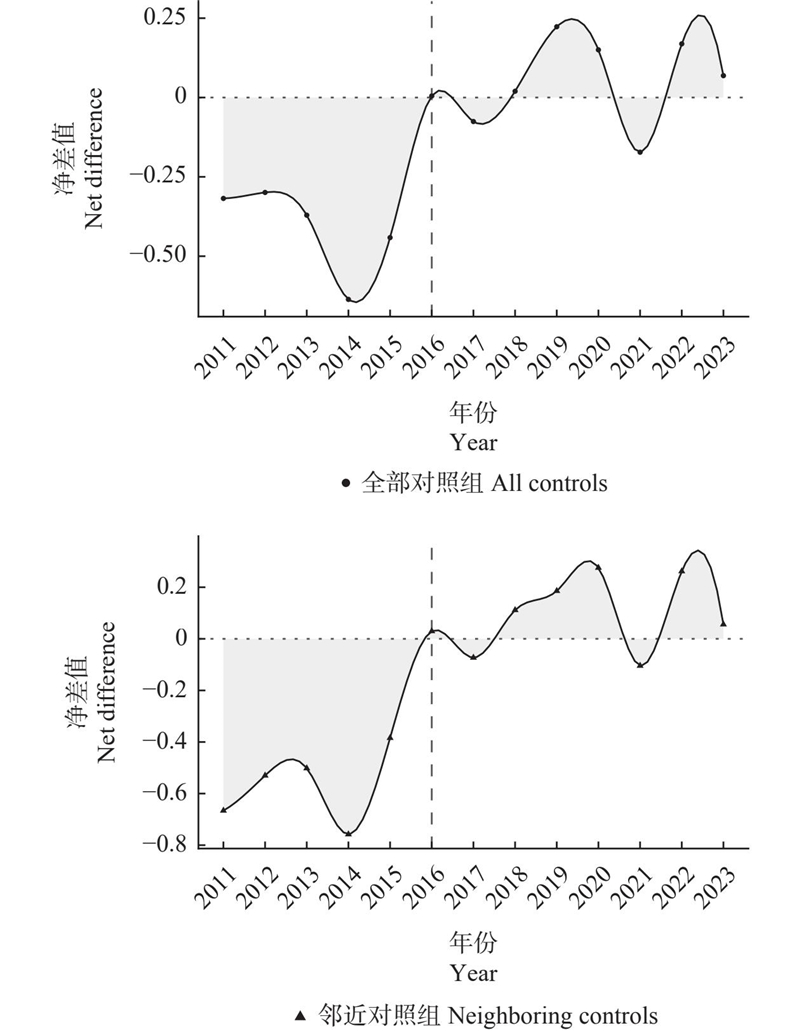
表2
基准回归结果①"
| 变量Variables | (1) | (2) |
| 鸟类丰富度 Bird species richness | 鸟类丰富度 Bird species richness | |
| 国家公园体制试点 National park system pilot | 0.466*** (0.104) | 0.495*** (0.105) |
| 控制变量 Control variables | 否No | 是Yes |
| 时间固定效应 Time fixed effects | 是Yes | 是Yes |
| 城市固定效应 City fixed effects | 是Yes | 是Yes |
| 观测值 Observations | 2 539 | 2 518 |
| R2 | 0.368 | 0.370 |
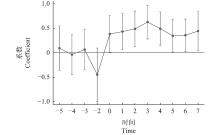
图3
平行趋势检验"
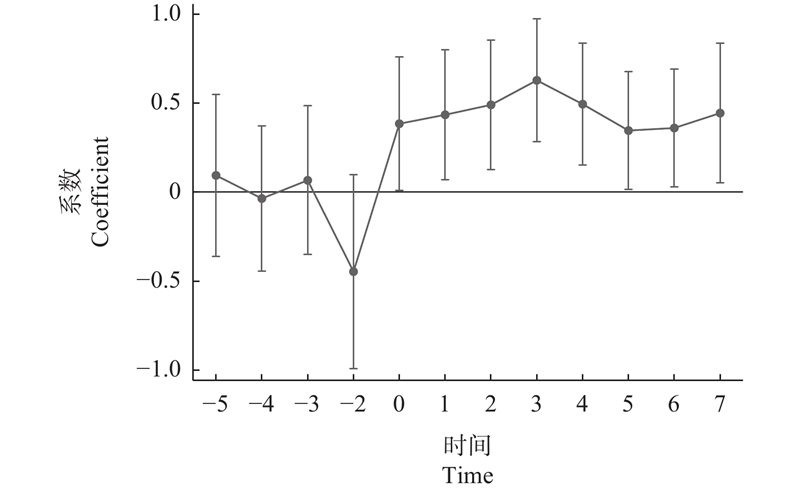
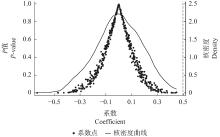
图4
安慰剂检验"
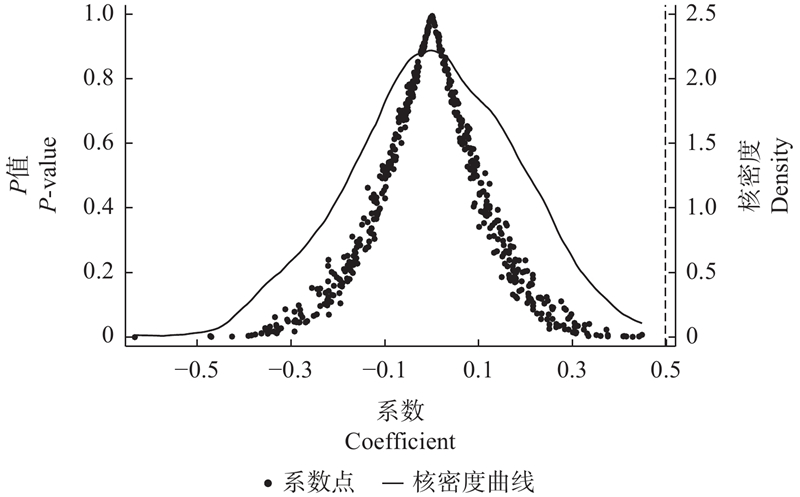
表3
稳健性检验和内生性分析①"
| 变量Variables | (1) | (2) | (3) | (4) | (5) |
| 倾向得分匹配 PSM-DID | 魅力城市 Attractive city | 低碳城市 Low-carbon city | 生态文明示范区 Demonstration zone | 新冠疫情 COVID-19 | |
| 国家公园体制试点 National park system pilot | 0.533** (0.209) | 0.511*** (0.113) | 0.587*** (0.153) | 0.586*** (0.136) | 0.526*** (0.121) |
| 控制变量 Control variables | 是Yes | 是Yes | 是Yes | 是Yes | 是Yes |
| 时间固定效应 Time fixed effects | 是Yes | 是Yes | 是Yes | 是Yes | 是Yes |
| 城市固定效应 City fixed effects | 是Yes | 是Yes | 是Yes | 是Yes | 是Yes |
| 观测值 Observations | 438 | 2 384 | 1 831 | 1 972 | 1 498 |
| R2 | 0.645 | 0.371 | 0.381 | 0.366 | 0.408 |
表4
识别策略与模型设定的再验证和内生性分析①"
| 变量Variables | (1) | (2) | (3) | (4) | |||
| 更换对照组 Alternative control group | 多期DID Staggered DID | Logit模型 Logit model | 预期效应 Expected effect | ||||
| 国家公园体制试点 National park system pilot | 0.309** (0.151) | 0.409*** (0.104) | 0.651** (0.129) | 0.510*** (0.121) | |||
| 控制变量 Control variables | 是Yes | 是Yes | 是Yes | 是Yes | |||
| 时间固定效应 Time fixed effects | 是Yes | 是Yes | 是Yes | 是Yes | |||
| 城市固定效应 City fixed effects | 是Yes | 是Yes | 是Yes | 是Yes | |||
| 观测值 Observations | 492 | 2 518 | 1 991 | 2 518 | |||
| R2 | 0.443 | 0.369 | 0.444 | 0.370 |
表5
异质性分析①"
| 变量Variables | (1) | (2) | (3) | (4) | (5) | (6) | |||||
| 东部地区 Eastern | 中西部地区 Central and western | 非濒危鸟类 Non-endangered bird species | 濒危鸟类 Endangered bird species | 留鸟 Resident birds | 候鸟 Migratory birds | ||||||
| 国家公园体制试点 National park system pilot | 0.362* (0.193) | 0.584*** (0.130) | 0.262** (0.130) | ?0.104 (0.181) | 0.269** (0.118) | ?0.195 (0.157) | |||||
| 控制变量 Control variables | 是Yes | 是Yes | 是Yes | 是Yes | 是Yes | 是Yes | |||||
| 时间固定效应 Time fixed effects | 是Yes | 是Yes | 是Yes | 是Yes | 是Yes | 是Yes | |||||
| 城市固定效应 City fixed effects | 是Yes | 是Yes | 是Yes | 是Yes | 是Yes | 是Yes | |||||
| 观测值 Observations | 1 078 | 1 440 | 2 533 | 2 019 | 2 421 | 2 170 | |||||
| R2 | 0.380 | 0.386 | 0.367 | 0.417 | 0.387 | 0.388 |
表6
机制检验和空间溢出效应检验①"
| 变量Variables | (1) | (2) | (3) | (4) | (5) | ||||
| 森林质量 Forest quality | 湿地质量 Wetland quality | 政府环境治理 Government environmental governance | 公众环保意识 Public environmental awareness | 鸟类丰富度 Bird species richness | |||||
| 国家公园体制试点 National park system pilot | 0.016** (0.009) | 0.012* (0.007) | 0.202* (0.105) | 0.096** (0.043) | — | ||||
| 邻接城市Adjacent cities | — | — | — | — | 0.291** (0.122) | ||||
| 控制变量Control variables | 是Yes | 是Yes | 是Yes | 是Yes | 是Yes | ||||
| 时间固定效应Time fixed effects | 是Yes | 是Yes | 是Yes | 是Yes | 是Yes | ||||
| 城市固定效应City fixed effects | 是Yes | 是Yes | 是Yes | 是Yes | 是Yes | ||||
| 观测值Observations | 1 801 | 2 592 | 1 936 | 2 510 | 2 309 | ||||
| R2 | 0.991 | 0.919 | 0.876 | 0.940 | 0.370 |
|
黄宝荣. 健全国家公园治理体系, 高质量推动世界最大的国家公园体系建设. 中国科学院院刊, 2024, 39 (2): 219- 229.
doi: 10.16418/j.issn.1000-3045.20230618001 |
|
|
Huang B R. Improve governance system of national parks, build the world’s largest national park system with high quality. Bulletin of Chinese Academy of Sciences, 2024, 39 (2): 219- 229.
doi: 10.16418/j.issn.1000-3045.20230618001 |
|
| 黄群慧. 2018. 改革开放40年中国的产业发展与工业化进程. 中国工业经济, (9): 5−23. | |
| Huang Q H. 2018. China’s industrial development and industrialization process during the 40 years of reform and opening-up. China Industrial Economics, (9): 5−23. [in Chinese] | |
| 李 虹, 邹 庆. 环境规制、资源禀赋与城市产业转型研究: 基于资源型城市与非资源型城市的对比分析. 经济研究, 2018, 53 (11): 182- 198. | |
| Li H, Zou Q. Environmental regulations, resource endowments and urban industry transformation: comparative analysis of resource-based and non-resource-based cities. Economic Research Journal, 2018, 53 (11): 182- 198. | |
|
李亦欣, 李圆圆, 张杨心怡, 等. 《生物多样性公约》资金问题最新进展及展望. 生物多样性, 2023, 31 (4): 21- 26.
doi: 10.17520/biods.2023077 |
|
|
Li Y X, Li Y Y, Zhang Y X Y, et al. The progress and prospect of the financial arrangements under the Convention on Biological Diversity. Biodiversity Science, 2023, 31 (4): 21- 26.
doi: 10.17520/biods.2023077 |
|
| 刘文彬, 贾俊雪. 2025. “为增长而竞争”与地方政府债务风险: 来自融资平台新名单数据的经验证据. 中国软科学, (6): 215−224. | |
| Liu W B, Jia J X. 2025. Competition for growth and local government debt risk: empirical evidence from the new list data of financing platforms. China Soft Science, (6): 215−224. [in Chinese] | |
|
刘 钊, 孔令乾, 张俊飚. 绿色金融与生物多样性: 基于中国观鸟数据的考察. 经济学(季刊), 2025, 25 (3): 565- 580.
doi: 10.13821/j.cnki.ceq.2025.03.02 |
|
|
Liu Z, Kong L Q, Zhang J B. Green finance and biodiversity: empirical research based on Chinese bird watching data. China Economic Quarterly, 2025, 25 (3): 565- 580.
doi: 10.13821/j.cnki.ceq.2025.03.02 |
|
| 潘莹莹, 杨雪冬. 2023. “顶层设计”的落地路径: 以我国国家公园建设为例. 社会科学, (12): 111−124. | |
| Pan Y Y, Yang X D. 2023. “Top-level design” and its implementation in China: a study based on the construction of national parks in China. Journal of Social Sciences, (12): 111−124. [in Chinese] | |
|
王静玮, 章锦河, 胡泉旭, 等. 国家公园生态旅游访客心理契约的测量与评价研究: 以青海湖国家公园为例. 地理研究, 2025, 44 (2): 450- 467.
doi: 10.11821/dlyj020240401 |
|
|
Wang J W, Zhang J H, Hu Q X, et al. Measurement and evaluation of the visitor psychological contract for national park ecotourism: a case study of Qinghai Lake National Park. Geographical Research, 2025, 44 (2): 450- 467.
doi: 10.11821/dlyj020240401 |
|
|
魏辅文, 平晓鸽, 胡义波, 等. 中国生物多样性保护取得的主要成绩、面临的挑战与对策建议. 中国科学院院刊, 2021, 36 (4): 375- 383.
doi: 10.16418/j.issn.1000-3045.20210305001 |
|
|
Wei F W, Ping X G, Hu Y B, et al. Main achievements, challenges, and recommendations of biodiversity conservation in China. Bulletin of Chinese Academy of Sciences, 2021, 36 (4): 375- 383.
doi: 10.16418/j.issn.1000-3045.20210305001 |
|
| 魏 钰, 雷光春. 从生物群落到生态系统综合保护: 国家公园生态系统完整性保护的理论演变. 自然资源学报, 2019, 34 (9): 1820- 1832. | |
| Wei Y, Lei G C. From biocenosis to ecosystem: The theory trend of conserving ecosystem integrity in National Parks. Journal of Natural Resources, 2019, 34 (9): 1820- 1832. | |
|
吴凯杰. 国家公园法应作为自然保护地法体系中的“标杆法”. 中南大学学报(社会科学版), 2022, 28 (5): 19- 28.
doi: 10.11817/j.issn.1672-3104.2022.05.003 |
|
|
Wu K J. The National Park law as the model law in the natural protected areas law system. Journal of Central South University (Social Sciences), 2022, 28 (5): 19- 28.
doi: 10.11817/j.issn.1672-3104.2022.05.003 |
|
| 许佳彬, 李翠霞. 2023. “规模效应”还是“拥挤效应”? 奶牛养殖产业集聚对环境效率的非线性影响研究. 农业技术经济, (10): 22−43. | |
| Xu J B, Li C X. 2023. “Scale effect” or “crowding effect”? study on the nonlinear influence of dairy farming industry agglomeration on environmental efficiency. Journal of Agrotechnical Economics, (10): 22−43. [in Chinese] | |
|
杨 虹, 朱 臻, 沈月琴, 等. 国家公园体制试点区设立是否能改善当地社区农户收入?基于钱江源国家公园的实证分析. 中国人口·资源与环境, 2025, 35 (1): 193- 204.
doi: 10.12062/cpre.20241128 |
|
|
Yang H, Zhu Z, Shen Y Q, et al. Does the establishment of national park system pilot areas improve the incomes of farmers in local communitie: based on empirical data from Qianjiangyuan National Park. China Population Resources and Environment, 2025, 35 (1): 193- 204.
doi: 10.12062/cpre.20241128 |
|
| 张宇彤, 朱洪革, 蔡颖莉. 2024. 国家公园建设与社区发展的隐性冲突分析: 基于东北虎豹国家公园的田野调查. 中国农村观察, (5): 93−115. | |
| Zhang Y T, Zhu H G, Cai Y L. 2024. The implicit conflicts between national park construction and community development: a field survey based on the northeast China Tiger and Leopard National Park. China Rural Survey, (5): 93−115. [in Chinese] | |
|
赵新全, 徐世晓, 赵 亮, 等. 三江源国家公园生物多样性保护创新及实践. 中国科学院院刊, 2023, 38 (12): 1833- 1844.
doi: 10.16418/j.issn.1000-3045.20230920004 |
|
|
Zhao X Q, Xu S X, Zhao L, et al. Innovation and practice on biodiversity conservation in Sanjiangyuan National Park. Bulletin of Chinese Academy of Sciences, 2023, 38 (12): 1833- 1844.
doi: 10.16418/j.issn.1000-3045.20230920004 |
|
|
赵雪琴, 吴 岚, 王玉玉, 等. 北京温榆河公园不同建成时间城市绿地鸟类群落组成的空间变化与栖息地质量评价. 生态学杂志, 2023, 42 (12): 3008- 3018.
doi: 10.13292/j.1000-4890.202310.016 |
|
|
Zhao X Q, Wu L, Wang Y Y, et al. Spatial variations of bird community composition and habitat quality evaluation of urban green space at different construction times in Wenyu River Park in Beijing. Chinese Journal of Ecology, 2023, 42 (12): 3008- 3018.
doi: 10.13292/j.1000-4890.202310.016 |
|
|
郑倩倩, 唐承财, 韩 莹, 等. 国家公园社区共同富裕的影响机制和实现路径: 以神农架国家公园为例. 自然资源学报, 2024, 39 (12): 2924- 2945.
doi: 10.31497/zrzyxb.20241212 |
|
|
Zheng Q Q, Tang C C, Han Y, et al. Influence mechanism and realization pathway for community common prosperity of national parks: a case study of Shennongjia National Park. Journal of Natural Resources, 2024, 39 (12): 2924- 2945.
doi: 10.31497/zrzyxb.20241212 |
|
|
钟超慧, 陈甲豪, 杨 涵, 等. 基于核归一化植被指数的中国西部四省自然保护区保护成效评估. 生态学报, 2025, 45 (3): 1199- 1209.
doi: 10.20103/j.stxb.202403260630 |
|
|
Zhong C H, Chen J H, Yang H, et al. Assessment of conservation effectiveness in nature reserves of four provinces in western China based on kernel normalized difference vegetation index data. Acta Ecologica Sinica, 2025, 45 (3): 1199- 1209.
doi: 10.20103/j.stxb.202403260630 |
|
| 朱 臻, 柴金露, 宁 可. 2022. 国家公园体制试点设立对野生动物肇事及农户适应性行为的影响. 中国农村经济, (11): 82−101. | |
| Zhu Z, Chai J L, Ning K. 2022. The impacts of the establishment of national park system pilots on wildlife incidents and farmers’ adaptive behaviors. Chinese Rural Economy, (11): 82−101. [in Chinese] | |
|
Brei M, Pérez-Barahona A, Strobl E. Environmental pollution and biodiversity: light pollution and sea turtles in the Caribbean. Journal of Environmental Economics and Management, 2016, 77, 95- 116.
doi: 10.1016/j.jeem.2016.02.003 |
|
|
Brodie J F, Mohd-Azlan J, Chen C, et al. Landscape-scale benefits of protected areas for tropical biodiversity. Nature, 2023, 620 (7975): 807- 812.
doi: 10.1038/s41586-023-06410-z |
|
|
Cai X Q, Lu Y, Wu M Q, et al. Does environmental regulation drive away inbound foreign direct investment? Evidence from a quasi-natural experiment in China. Journal of Development Economics, 2016, 123, 73- 85.
doi: 10.1016/j.jdeveco.2016.08.003 |
|
|
Cardinale B J, Duffy J E, Gonzalez A, et al. Biodiversity loss and its impact on humanity. Nature, 2012, 486 (7401): 59- 67.
doi: 10.1038/nature11148 |
|
|
Cimatti M, Chaplin-Kramer R, Di Marco M. The role of high-biodiversity regions in preserving nature’s contributions to people. Nature Sustainability, 2023, 6 (11): 1385- 1393.
doi: 10.1038/s41893-023-01179-5 |
|
|
Dabbous A, Horn M, Croutzet A. Measuring environmental awareness: an analysis using Google search data. Journal of Environmental Management, 2023, 346, 118984.
doi: 10.1016/j.jenvman.2023.118984 |
|
|
De Vos K, Janssens C, Jacobs L, et al. African food system and biodiversity mainly affected by urbanization via dietary shifts. Nature Sustainability, 2024, 7 (7): 869- 878.
doi: 10.1038/s41893-024-01362-2 |
|
|
Eneji V C O, Qi G B, Okpiliya F I, et al. Problems of public participation in biodiversity conservation: the Nigerian scenario. Impact Assessment and Project Appraisal, 2009, 27 (4): 301- 307.
doi: 10.3152/146155109X479431 |
|
|
Faaborg J, Holmes R T, Anders A D, et al. Recent advances in understanding migration systems of New World land birds. Ecological Monographs, 2010, 80 (1): 3- 48.
doi: 10.1890/09-0395.1 |
|
|
Flammer C, Giroux T, Heal G M. Biodiversity finance. Journal of Financial Economics, 2025, 164, 103987.
doi: 10.1016/j.jfineco.2024.103987 |
|
|
Fontana S, Sattler T, Bontadina F, et al. How to manage the urban green to improve bird diversity and community structure. Landscape and Urban Planning, 2011, 101 (3): 278- 285.
doi: 10.1016/j.landurbplan.2011.02.033 |
|
|
Frank E, Sudarshan A. The social costs of keystone species collapse: evidence from the decline of vultures in India. American Economic Review, 2024, 114 (10): 3007- 3040.
doi: 10.1257/aer.20230016 |
|
|
Kong F H, Yin H W, Nakagoshi N, et al. Urban green space network development for biodiversity conservation: identification based on graph theory and gravity modeling. Landscape and Urban Planning, 2010, 95 (1/2): 16- 27.
doi: 10.1016/j.landurbplan.2009.11.001 |
|
|
Liang Y N, Rudik I, Zou E Y, et al. Conservation cobenefits from air pollution regulation: Evidence from birds. Proceedings of the National Academy of Sciences of the United States of America, 2020, 117 (49): 30900- 30906.
doi: 10.3386/w27415 |
|
| Lisovski S, Hoye B J, Conklin J R, et al. 2024. Predicting resilience of migratory birds to environmental change. Proceedings of the National Academy of Sciences of the United States of America, 121(19): e2311146121. | |
|
Liu Y, Zhao W W, Zhang Z J, et al. The role of nature reserves in conservation effectiveness of ecosystem services in China. Journal of Environmental Management, 2023, 342, 118228.
doi: 10.1016/j.jenvman.2023.118228 |
|
| Lu Y, Tao Z G, Zhang Y. 2013. How do exporters respond to antidumping investigations? Journal of International Economics, 91(2): 290–300. | |
|
Marques A, Martins I S, Kastner T, et al. Increasing impacts of land use on biodiversity and carbon sequestration driven by population and economic growth. Nature Ecology & Evolution, 2019, 3 (4): 628- 637.
doi: 10.1038/s41559-019-0824-3 |
|
| McDonald R I, Mansur A V, Ascensão F, et al. Research gaps in knowledge of the impact of urban growth on biodiversity. Nature Sustainability, 2020, 3 (1): 16- 24. | |
|
Meng L N, Liu P F, Zhou Y G, et al. Blaming the wind? The impact of wind turbine on bird biodiversity. Journal of Development Economics, 2025, 172, 103402.
doi: 10.1016/j.jdeveco.2024.103402 |
|
|
Ohashi H, Hasegawa T, Hirata A, et al. Biodiversity can benefit from climate stabilization despite adverse side effects of land-based mitigation. Nature Communications, 2019, 10, 5240.
doi: 10.1038/s41467-019-13241-y |
|
| Orr M C, Hughes A C, Chesters D, et al. 2021. Global patterns and drivers of bee distribution. Current Biology, 31(3): 451−458. | |
| Ren Q, He C Y, Huang Q X, et al. 2022. Impacts of urban expansion on natural habitats in global drylands. Nature Sustainability, 5(10): 869−878. | |
|
Root T L, Price J T, Hall K R, et al. Fingerprints of global warming on wild animals and plants. Nature, 2003, 421 (6918): 57- 60.
doi: 10.1038/nature01333 |
|
| Simkin R D, Seto K C, McDonald R I, et al. 2022. Biodiversity impacts and conservation implications of urban land expansion projected to 2050. Proceedings of the National Academy of Sciences of the United States of America, 119(12): e2117297119. | |
|
Stein B A, Scott C, Benton N. Federal lands and endangered species: the role of military and other federal lands in sustaining biodiversity. BioScience, 2008, 58 (4): 339- 347.
doi: 10.1641/B580409 |
|
| Venkataraman K. 2012. Biodiversity and its conservation. Proceedings of the National Academy of Sciences, India Section B: Biological Sciences, 82(2): 271−282. | |
|
Wang W, Feng C T, Liu F Z, et al. Biodiversity conservation in China: a review of recent studies and practices. Environmental Science and Ecotechnology, 2020, 2, 100025.
doi: 10.1016/j.ese.2020.100025 |
|
|
Whittaker R J, Fernández-Palacios J M, Matthews T J, et al. Island biogeography: taking the long view of nature’s laboratories. Science, 2017, 357 (6354): eaam8326.
doi: 10.1126/science.aam8326 |
|
|
Wu Y L, Xie L, Yuan Z W, et al. Investigating public biodiversity conservation awareness based on the propagation of wildlife-related incidents on the Sina Weibo social media platform. Environmental Research Letters, 2020, 15 (9): 094082.
doi: 10.1088/1748-9326/ab9ed1 |
|
|
Yang X N, Gu T C, Wang S J. Effectiveness of nature reserves in China: Human footprint and ecosystem services perspective. Applied Geography, 2024, 171, 103359.
doi: 10.1016/j.apgeog.2024.103359 |
|
|
Zu Ermgassen S O S E, Hawkins I, Lundhede T, et al. The current state, opportunities and challenges for upscaling private investment in biodiversity in Europe. Nature Ecology & Evolution, 2025, 9 (3): 515- 524.
doi: 10.1038/s41559-024-02632-0 |
| [1] | 韩学正,何念鹏,蔡伟祥,李维刚. 基于林木生长过程的森林生态系统碳汇长期预测方法——理论基础与构架分析[J]. 林业科学, 2026, 62(7): 230-239. |
| [2] | 赵敏欣,由嘉禾,周阳,李香,李硕,杜晓娟,鹿德林,李凯. 北京油松人工林蛾类多样性及其与环境因子的关系[J]. 林业科学, 2026, 62(5): 120-130. |
| [3] | 林昕怡,周星鲁,张磊,王丽娟,安新民,胡建军. 转BtCry1Ac基因杨树的生物安全性评价[J]. 林业科学, 2026, 62(2): 134-146. |
| [4] | 林丽梅,陈炜诺,陈钦萍,黄安胜. 森林可持续管理对“四库”安全的作用机制与实证分析[J]. 林业科学, 2026, 62(2): 214-229. |
| [5] | 刘娇,杨爱霞,李帅锋,苏建荣. 基于生态系统健康的川滇生态屏障区生态安全格局构建[J]. 林业科学, 2026, 62(1): 42-56. |
| [6] | 杨凯捷,丛巍巍,陆森,冯益明,王锋. 温带榆树稀树草原碳通量变化特征及环境因子的影响[J]. 林业科学, 2025, 61(9): 12-21. |
| [7] | 熊晓燕,李彩霞,柴国奇,陈龙,贾翔,雷令婷,张晓丽. 联合UAV-LiDAR和GEDI数据的区域森林地上生物量估算[J]. 林业科学, 2025, 61(8): 142-153. |
| [8] | 于贵瑞,郭珂歆,郝天象. 新时期林业生态经济体系构建的初步探索[J]. 林业科学, 2025, 61(7): 8-22. |
| [9] | 禹丝思,蔡尚书,张生瑞,黄嘉诚,金崑. 松嫩鹤乡国家公园创建潜力区土地生境质量演化及多情景预测[J]. 林业科学, 2025, 61(7): 208-219. |
| [10] | 白晓航,陈洁萍. 城市森林公园生态系统文化服务的公众偏好与感知[J]. 林业科学, 2025, 61(6): 99-108. |
| [11] | 陈汝婷,迟德富. 病虫害干扰对森林碳汇影响的研究进展[J]. 林业科学, 2025, 61(2): 1-11. |
| [12] | 唐延龄,韩巧玲,赵玥,刘卫平,郑一力,赵燕东,徐钐钐. 基于多尺度序列特征融合的林区害虫检测算法[J]. 林业科学, 2025, 61(2): 21-30. |
| [13] | 朱粟锋,勾蒙蒙,赵海平,刘常富,简尊吉,朱建华,肖文发. 基于CBM-CFS3模型的不同采伐情景下马尾松人工林生态系统碳动态[J]. 林业科学, 2025, 61(12): 24-33. |
| [14] | 李倩,张帆,孟祥雪,吴小云,庞建壮,许行,张志强. 基于分解重构与机器学习的华北平原杨树人工林净碳交换模拟[J]. 林业科学, 2025, 61(12): 72-82. |
| [15] | 叶洁楠,黄亦周,贾舒皓,张婷. 四川巴中地区生态源地识别及生态安全格局构建[J]. 林业科学, 2025, 61(11): 56-69. |
| 阅读次数 | ||||||
|
全文 |
|
|||||
|
摘要 |
|
|||||

