
林业科学 ›› 2026, Vol. 62 ›› Issue (11): 61-71.doi: 10.11707/j.1001-7488.LYKX20260433
陈轶群1,刘世荣1,*( ),夏琦2,张萌3,王树梅4
收稿日期:2026-07-08
修回日期:2026-10-13
出版日期:2026-11-10
发布日期:2026-11-20
通讯作者:
刘世荣
E-mail:Liusr@caf.ac.cn
基金资助:
Yiqun Chen1,Shirong Liu1,*(),Qi Xia2,Meng Zhang3,Shumei Wang4
Received:2026-07-08
Revised:2026-10-13
Online:2026-11-10
Published:2026-11-20
Contact:
Shirong Liu
E-mail:Liusr@caf.ac.cn
摘要:
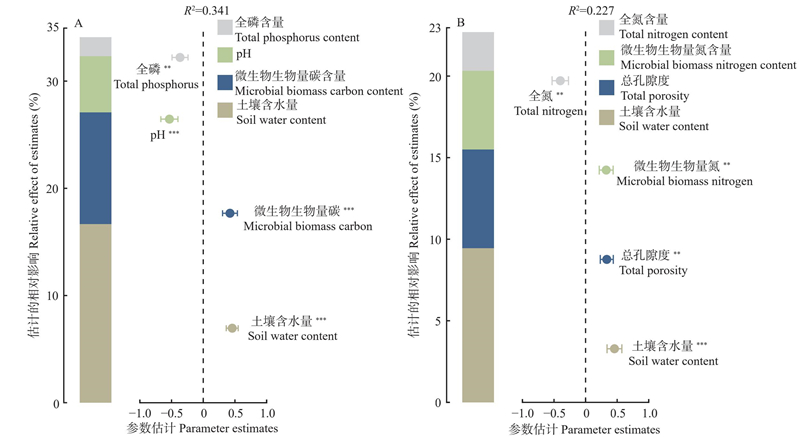
目的: 探究二代杉木人工林林分发育过程中土壤植物源和微生物源残体碳的变化特征及其驱动因素,为认识人工林土壤有机碳(SOC)的来源和固存机制、评估其碳汇提升潜力提供科学依据。方法: 在我国亚热带杉木人工林5个典型分布区(四川、湖南、广东、江西、福建),选取不同发育阶段的二代杉木人工林,采用空间代替时间方法,分析土壤植物源和微生物源残体碳随林分发育的变化特征,并识别其主要驱动因素。结果: 1) 土壤总木质素酚和香草基酚含量及其对SOC的贡献随林分发育呈先降低后升高的变化趋势,并在成熟林阶段达到最低值(P<0.05);丁香基酚和肉桂基酚含量及其对SOC的贡献则呈先升高后降低再升高的变化趋势,并在中龄林阶段达到最高值(P<0.05);2) 土壤真菌残体碳、细菌残体碳和微生物源残体碳含量及其对SOC的贡献随林分发育呈先降低后升高的变化趋势,并在近熟林阶段达到最低值(P<0.01);3) 植物源肉桂基酚和微生物源真菌残体碳是SOC的核心组分,分别解释SOC含量变异的17.81%和11.05%,且均与SOC含量呈显著正相关(P<0.01);4) 随林分发育,土壤含水量和微生物生物量碳共同正向驱动肉桂基酚含量变化,解释率分别为16.69%和10.40%;土壤pH值和全磷含量则对肉桂基酚含量产生显著负向影响,解释率分别为5.24%和1.77%;5) 随林分发育,土壤含水量、总孔隙度和微生物生物量氮对真菌残体碳含量产生正向影响,解释率分别为9.46%、6.05%和4.82%;全氮含量则对真菌残体碳含量产生显著负向影响,解释率为2.37%。结论: 植物源肉桂基酚和微生物源真菌残体碳是亚热带二代杉木人工林SOC积累的关键组分,二者随林分发育的变化与土壤水分、孔隙结构、微生物生物量和养分状况密切相关。在杉木人工林中后期经营中,应合理调控林分密度和林下植被,同时优化养分管理并科学施加氮肥,以促进植物源和微生物源残体碳积累,提升土壤固碳能力。
中图分类号:
陈轶群,刘世荣,夏琦,张萌,王树梅. 二代杉木人工林土壤植物源和微生物源残体碳随林分发育阶段的变化及驱动因素[J]. 林业科学, 2026, 62(11): 61-71.
Yiqun Chen,Shirong Liu,Qi Xia,Meng Zhang,Shumei Wang. Changes in Soil Plant- and Microbial-Derived Necromass Carbon in Second-Generation Chinese Fir Plantations with Stand Development Stages and Their Drivers[J]. Scientia Silvae Sinicae, 2026, 62(11): 61-71.
表1
杉木人工林5个典型分布区的样地基本信息"
| 地点 Site | 经度 Longitude (E) | 纬度 Latitude (N) | 海拔 Altitude/m | 年均气温 Mean annual temperature/℃ | 年均降水量 Mean annual precipitation/mm | 土壤类型 Soil type | 坡度 Slope/(°) | 龄组 Age class | 林龄Stand age/a | 平均胸径 Mean diameter at breast height/cm | 平均树高 Mean tree height/m | 林分密度 Stand density/ (tree?hm?2) | 主要林下植被 Main understory vegetation |
| 四川省宜宾市筠连县 国有林场 Junlian State-owned Forest Farm Yibin City, Sichuan Province | 104°40′ | 28°45′ | 410 ± 30 | 16.9 | 1 053.5 | 黄壤 Yellow soil | 19 ± 6 | 幼龄 Young | 6 | 5.77 ± 0.76 | 6.50 ± 0.74 | 3 078 ± 64 | 鱼腥草Houttuynia cordata, 方竹Chimonobambusa quadrangularis, 狗脊蕨Woodwardia japonica, 芒萁Dicranopteris pedata, 檵木Loropetalum chinense, 淡竹叶Lophatherum gracile |
| 600 ± 29 | 25 ± 9 | 中龄Middle-aged | 12 | 10.91 ± 0.41 | 8.32 ± 0.21 | 2 567 ± 15 | |||||||
| 580 ± 34 | 17 ± 3 | 近熟Near-mature | 24 | 18.65 ± 0.83 | 12.45 ± 0.26 | 1 689 ± 37 | |||||||
| 530 ± 19 | 24 ± 8 | 成熟 Mature | 30 | 22.96 ± 0.48 | 13.89 ± 0.06 | 957 ± 26 | |||||||
| 460 ± 25 | 25 ± 10 | 过熟Over-mature | 52 | 25.1 ± 0.61 | 14.05 ± 0.39 | 545 ± 30 | |||||||
| 湖南会同杉木林生态系统国家野外科学观测研究站 Huitong Long-term Ecological Research Station for Chinese fir Plantations, Hunan Province | 109°45′ | 26°50′ | 375 ± 5 | 17.2 | 1 454.1 | 黄壤 Yellow soil | 24 ± 4 | 幼龄 Young | 9 | 3.40 ± 0.20 | 1.84 ± 0.11 | 3 119 ± 242 | 白叶莓Rubus innominatus, 芒草Miscanthus sinensis, 杜茎山Maesa japonica, 狗脊蕨Woodwardia japonica, 地桃花Urena lobata, 常山Dichroa febrifuga |
| 400 ± 15 | 25 ± 6 | 中龄Middle-aged | 17 | 10.02 ± 0.52 | 6.78 ± 0.38 | 3 106 ± 150 | |||||||
| 413 ±12 | 27 ± 13 | 近熟Near-mature | 22 | 12.91 ± 1.02 | 10.11 ± 1.16 | 3 294 ± 231 | |||||||
| 467 ± 17 | 28 ± 8 | 成熟 Mature | 35 | 16.94 ± 0.54 | 14.57 ± 0.50 | 2 113 ± 16 | |||||||
| 404 ± 7 | 28 ± 9 | 过熟Over-mature | 38 | 26.44 ± 1.00 | 18.69 ± 1.21 | 738 ± 19 | |||||||
| 广东省云浮市国有同乐林场 Tongle State-owned Forest Farm, Yunfu City, Guangdong Province | 111°23′ | 23°12′ | 479 ± 12 | 22.9 | 1 652.5 | 红壤Red soil | 27 ± 1 | 幼龄 Young | 5 | 7.91 ± 1.78 | 5.27 ± 1.38 | 2 800 ± 92 | 杜鹃Rhododendron simsii, 五节芒Miscanthus floridulus, 梅叶冬青Ilex asprella, 乌毛蕨Blechnum orientale, 檵木Loropetalum chinense, 桃金娘Rhodomyrtus tomentosa, 芒萁Dicranopteris pedata, 狗脊蕨Woodwardia japonica |
| 401 ± 24 | 29 ± 4 | 中龄Middle-aged | 18 | 13.18 ± 1.03 | 10.65 ± 1.39 | 2 010 ± 78 | |||||||
| 297 ± 13 | 30 ± 6 | 近熟Near-mature | 22 | 18.15 ± 1.12 | 15.35 ± 1.30 | 1 800 ± 26 | |||||||
| 360 ± 32 | 31 ± 2 | 成熟 Mature | 30 | 17.42 ± 1.00 | 15.43 ± 1.17 | 1 500 ± 46 | |||||||
| 520 ± 43 | 28 ± 2 | 过熟Over-mature | 40 | 20.68 ± 0.77 | 17.98 ± 0.83 | 1 200 ± 36 | |||||||
| 江西省新余市大岗山森林生态系统国家野外科学观测研究站 Dagangshan National Field Scientific Observation and Research Station for Forest Ecosystem, Xinyu City, Jiangxi Province | 114°40′ | 27°40′ | 360 ± 15 | 18.1 | 1 597.1 | 红壤 Red soil | 23 ± 4 | 幼龄 Young | 5 | 3.28 ± 0.21 | 2.74 ± 0.09 | 4 708 ± 89 | 檵木Loropetalum chinense, 芒萁Dicranopteris pedata, 狗脊蕨Woodwardia japonica, 金星蕨Parathelypteris glanduligera, 淡竹叶Lophatherum gracile, 荩草Arthraxon hispidus |
| 400 ± 32 | 18 ± 9 | 中龄Middle-aged | 12 | 13.33 ± 0.88 | 9.41 ± 1.10 | 3 288 ± 56 | |||||||
| 430 ± 34 | 17 ± 5 | 近熟Near-mature | 22 | 15.93 ± 0.91 | 14.89 ± 0.95 | 2 783 ± 45 | |||||||
| 510 ± 53 | 19 ± 2 | 成熟 Mature | 30 | 18.40 ± 1.06 | 16.01 ± 1.48 | 1 472 ± 25 | |||||||
| 470 ± 12 | 25 ± 3 | 过熟Over-mature | 40 | 22.84 ± 0.79 | 17.59 ± 1.67 | 833 ± 26 | |||||||
| 福建省三明森林生态系统国家野外科学观测研究站 Sanming Forest Ecosystem and Global Change Research Station, Fujian Province | 117°36′ | 26°19′ | 410 ± 13 | 19.7 | 1 735.9 | 红壤 Red soil | 27 ± 2 | 幼龄 Young | 8 | 12.68 ± 0.31 | 12.96 ± 0.38 | 3 500 ± 35 | 毛冬青Ilex pubescens, 芒萁Dicranopteris pedata, 檵木Loropetalum chinense, 桃金娘Rhodomyrtus tomentosa, 寒莓Rubus buergeri, 杜鹃Rhododendron simsii, 狗脊蕨Woodwardia japonica, 五节芒Miscanthus floridulus, 荩草Arthraxon hispidus |
| 370 ± 45 | 32 ± 5 | 中龄Middle-aged | 18 | 16.03 ± 0.31 | 18.20 ± 0.22 | 2 678 ± 56 | |||||||
| 320 ± 21 | 27 ± 4 | 近熟Near-mature | 21 | 19.28 ± 0.39 | 23.09 ± 1.33 | 2 088 ± 43 | |||||||
| 350 ± 54 | 25 ± 2 | 成熟 Mature | 28 | 25.77 ± 0.48 | 24.77 ± 0.39 | 1 036 ± 12 | |||||||
| 390 ± 12 | 31 ± 1 | 过熟Over-mature | 55 | 22.38 ± 0.58 | 24.41 ± 0.54 | 809 ± 35 |
表2
不同发育阶段林分土壤理化性质指标的变化①"
| 指标 Index | 幼龄 Young | 中龄 Middle-aged | 近熟 Near-mature | 成熟 Mature | 过熟 Over-mature |
| pH | 3.19 ± 0.19b | 3.47 ± 0.13ab | 3.59 ± 0.05ab | 3.28 ± 0.13ab | 3.69 ± 0.03a |
| SWC | 0.28 ± 0.03a | 0.36± 0.03a | 0.26 ± 0.03a | 0.28 ± 0.02a | 0.30 ± 0.03a |
| SD/(g·cm?3) | 1.52 ± 0.03a | 1.45 ± 0.03a | 1.55 ± 0.05a | 1.54 ± 0.04a | 1.55 ± 0.03a |
| TOPO (%) | 42.94 ± 1.30a | 45.25 ± 0.99a | 41.50 ± 1.79a | 41.88 ± 1.39a | 41.56 ± 0.97a |
| SOC/(g·kg?1) | 14.06 ± 0.59ab | 18.06 ± 1.05a | 14.95 ± 1.12ab | 14.05 ± 0.64ab | 13.78 ± 1.28b |
| TN/(g·kg?1) | 0.94 ± 0.10b | 1.41 ± 0.12ab | 1.39 ± 0.12ab | 1.36 ± 0.15ab | 1.48 ± 0.12a |
| TP/(g·kg?1) | 0.38 ± 0.04a | 0.29 ± 0.05a | 0.29 ± 0.03a | 0.38 ± 0.06a | 0.27 ± 0.03a |
| C∶N | 16.95 ± 1.42a | 14.09 ± 1.33ab | 11.09 ± 0.53b | 12.59 ± 1.69ab | 9.70 ± 0.86b |
| N∶P | 2.99 ± 0.45b | 7.31 ± 1.12a | 5.10 ± 0.31ab | 5.64 ± 0.89ab | 6.41 ± 0.80a |
| 0.5Feo + Alo/(g·kg?1) | 2.71± 0.29a | 3.51± 0.38a | 3.12± 0.47a | 2.99 ± 0.33a | 4.44 ± 0.72a |
| MBC/(mg·kg?1) | 73.00 ± 4.94b | 163.01 ± 6.79a | 100.80 ± 10.40b | 95.19 ± 5.38b | 183.26 ± 10.72a |
| MBN/(mg·kg?1) | 9.25 ± 0.78b | 14.06 ± 1.08b | 9.93 ± 1.04b | 9.90 ± 0.94b | 32.76 ± 4.23a |
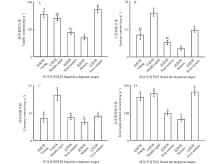
图1
土壤木质素酚及其各组分含量随林分发育阶段的变化 不同小写字母表示差异显著(P<0.05)"
图2
土壤木质素酚及其各组分对土壤有机碳的贡献随林分发育阶段的变化 VSC:香草基酚对有机碳的贡献Contribution of vanillyl phenols to soil organic carbon;SSC:丁香基酚对有机碳的贡献Contributions of syringyl phenols to soil organic carbon;CSC:肉桂基酚对有机碳的贡献Contributions of cinnamyl phenols to soil organic carbon;TSC:总木质素酚对有机碳的贡献Contributions of total lignin phenols to soil organic carbon. 不同小写字母表示差异显著(P<0.05)Different lowercase letters denote significant differences(P<0.05)."
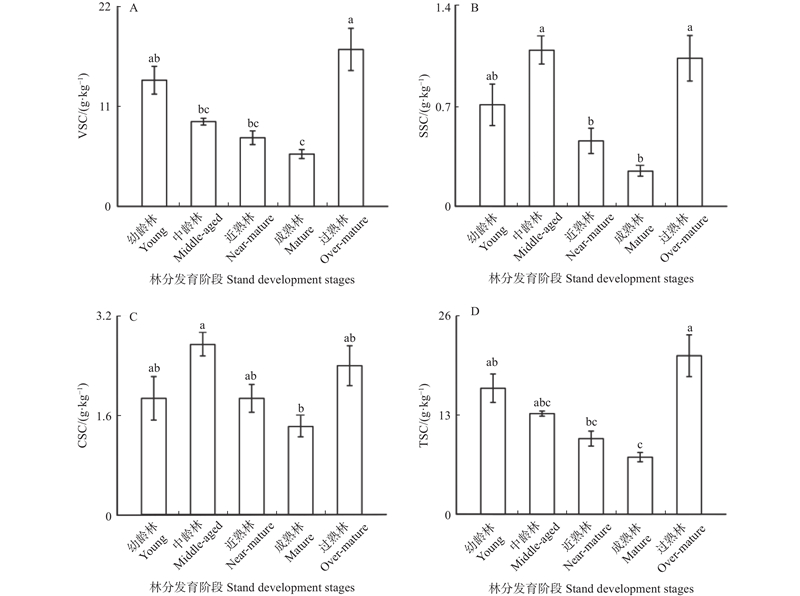
图3
土壤微生物源残体碳含量随林分发育阶段的变化 不同小写字母表示差异显著(P<0.05) Different lowercase letters denote significant differences(P<0.05)."
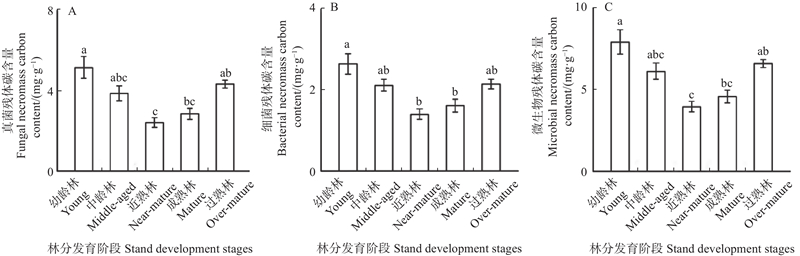
图4
土壤微生物源残体碳对土壤有机碳的贡献随林分发育阶段的变化 FSC:真菌残体碳对有机碳的贡献Contributions of fungal necromass carbon to soil organic carbon;BSC:细菌残体碳对有机碳的贡献Contributions of bacterial necromass carbon to soil organic carbon;MSC:微生物残体碳对有机碳的贡献Contributions of microbial necromass carbon to soil organic carbon. 不同小写字母表示差异显著(P<0.05)Different lowercase letters denote significant differences(P<0.05)."
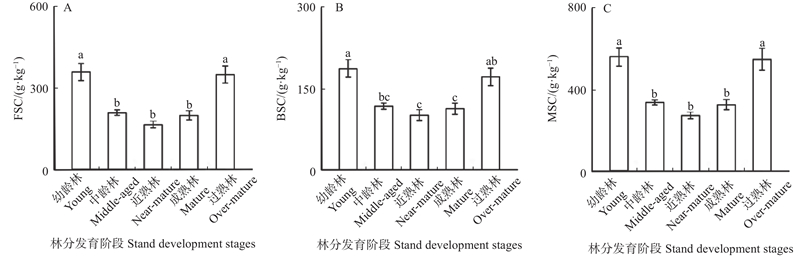
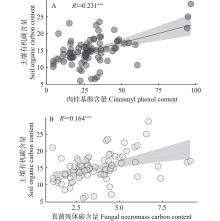
图5
土壤有机碳与重要影响因子的线性回归分析 图A和B分别表示肉桂基酚含量和真菌残体碳含量与土壤有机碳含量的线性回归分析。R2:校正后的R2值;**:P<0.01;***:P<0.001。"
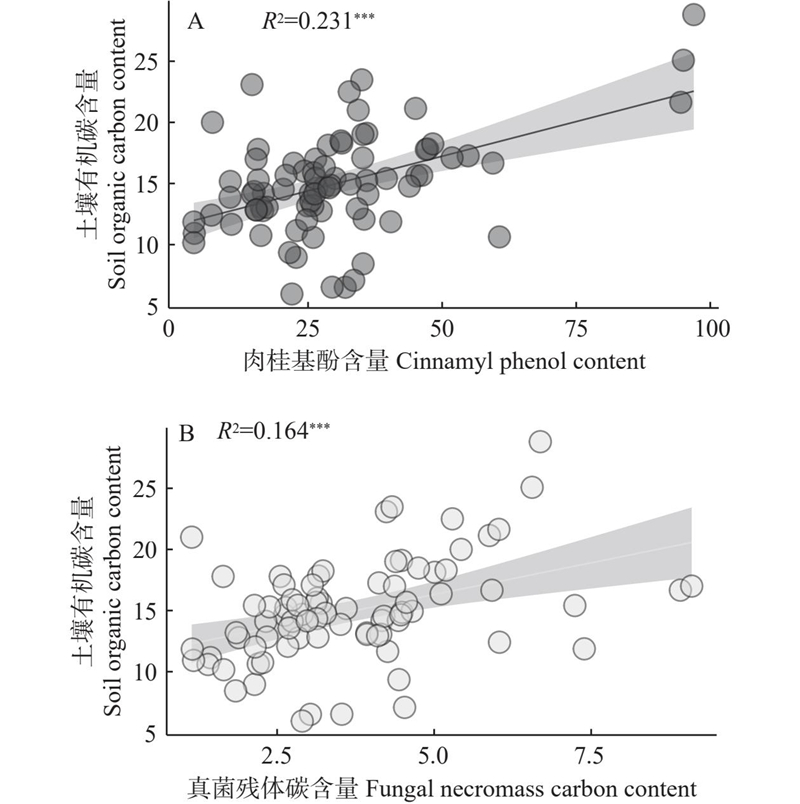
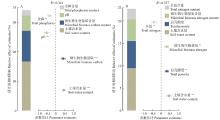
图6
肉桂基酚(A)和真菌残体碳(B)的主要驱动因子及其相对贡献率 柱状图表示各变量对模型总R2的相对贡献占比,R2:校正后的R2值;**:P<0.01;***:P<0.001。"
|
陈佳颍, 汪鸿波, 孟京辉, 等. 中国人工针叶林退化及修复研究进展. 世界林业研究, 2025, 38 (4): 99- 105.
doi: 10.13348/j.cnki.sjlyyj.2025.0070.y |
|
|
Chen J Y, Wang H B, Meng J H, et al. Research progress on degradation and restoration of planted coniferous forests in China. World Forestry Research, 2025, 38 (4): 99- 105.
doi: 10.13348/j.cnki.sjlyyj.2025.0070.y |
|
|
杜淑辉, 褚建民, 段俊光, 等. 木质素酚类物质对内蒙古退化草地土壤有机碳的影响. 植物生态学报, 2025, 49 (1): 30- 41.
doi: 10.17521/cjpe.2024.0072 |
|
|
Du S H, Chu J M, Duan J G, et al. Influence of lignin phenols on soil organic carbon in degraded grasslands in Nei Mongol, China. Chinese Journal of Plant Ecology, 2025, 49 (1): 30- 41.
doi: 10.17521/cjpe.2024.0072 |
|
|
胡建文, 刘常富, 勾蒙蒙, 等. 林龄对马尾松人工林微生物残体碳积累的影响机制. 应用生态学报, 2024, 35 (1): 153- 160.
doi: 10.13287/j.1001-9332.202401.041 |
|
|
Hu J W, Liu C F, Gou M M, et al. Influencing mechanism of stand age to the accumulation of microbial residue carbon in the Pinus massoniana plantations. Chinese Journal of Applied Ecology, 2024, 35 (1): 153- 160.
doi: 10.13287/j.1001-9332.202401.041 |
|
|
李清鑫, 张 珊, 张复茂, 等. 基于文献计量学的植物地下碳输入对土壤有机碳贡献的研究进展. 土壤通报, 2024, 55 (6): 1777- 1788.
doi: 10.19336/j.cnki.trtb.2024022702 |
|
|
Li Q X, Zhang S, Zhang F M, et al. Research progress on the contribution of plant belowground carbon input to soil organic carbon based on bibliometrics. Chinese Journal of Soil Science, 2024, 55 (6): 1777- 1788.
doi: 10.19336/j.cnki.trtb.2024022702 |
|
|
刘世荣, 陈远其, 聂秀青, 等. 树种多样性对森林生态系统多功能性和韧性的影响. 林业科学, 2026, 62 (1): 1- 18.
doi: 10.11707/j.1001-7488.LYKX20260001 |
|
|
Liu S R, Chen Y Q, Nie X Q, et al. Effects of tree species diversity on multifunctionality and resilience of forest ecosystems. Scientia Silvae Sinicae, 2026, 62 (1): 1- 18.
doi: 10.11707/j.1001-7488.LYKX20260001 |
|
| 刘 勇, 李国雷. 不同林龄油松人工林叶凋落物分解特性. 林业科学研究, 2008, 21 (4): 500- 505. | |
| Liu Y, Li G L. Decomposition characteristics affected by forest age in Pinus tabulaeformis plantations. Forest Research, 2008, 21 (4): 500- 505. | |
|
马进鹏, 吴梦瑶, 张雅琪, 等. 宁夏不同草地类型土壤微生物残体碳积累特征及其影响因素. 生态学报, 2024, 44 (20): 9300- 9313.
doi: 10.20103/j.stxb.202403220592 |
|
|
Ma J P, Wu M Y, Zhang Y Q, et al. Accumulation and influencing factors of soil microbial necromass carbon in different grassland types of Ningxia, China. Acta Ecologica Sinica, 2024, 44 (20): 9300- 9313.
doi: 10.20103/j.stxb.202403220592 |
|
| 潘根兴, 丁元君, 陈硕桐, 等. 从土壤腐殖质分组到分子有机质组学认识土壤有机质本质. 地球科学进展, 2019, 34 (5): 451- 470. | |
| Pan G X, Ding Y J, Chen S T, et al. Exploring the nature of soil organic matter from humic substances isolation to SOMics of molecular assemblage. Advances in Earth Science, 2019, 34 (5): 451- 470. | |
|
汪景宽, 徐英德, 丁 凡, 等. 植物残体向土壤有机质转化过程及其稳定机制的研究进展. 土壤学报, 2019, 56 (3): 528- 540.
doi: 10.11766/trxb201811140559 |
|
|
Wang J K, Xu Y D, Ding F, et al. Process of plant residue transforming into soil organic matter and mechanism of its stabilization: a review. Acta Pedologica Sinica, 2019, 56 (3): 528- 540.
doi: 10.11766/trxb201811140559 |
|
| 杨 阳, 王宝荣, 窦艳星, 等. 植物源和微生物源土壤有机碳转化与稳定研究进展. 应用生态学报, 2024, 35 (1): 111- 123. | |
| Yang Y, Wang B R, Dou Y X, et al. Advances in the research of transformation and stabilization of soil organic carbon from plant and microbe. Chinese Journal of Applied Ecology, 2024, 35 (1): 111- 123. | |
|
张佳佳, 曾立雄, 雷 蕾, 等. 丛枝菌根途径的土壤有机碳固存机制研究进展. 生态学报, 2024, 44 (12): 4945- 4955.
doi: 10.20103/j.stxb.202208112282 |
|
|
Zhang J J, Zeng L X, Lei L, et al. Research progress on soil organic carbon sequestration mechanism by arbuscular mycorrhizal pathway. Acta Ecologica Sinica, 2024, 44 (12): 4945- 4955.
doi: 10.20103/j.stxb.202208112282 |
|
|
Angst G, Messinger J, Greiner M, et al. Soil organic carbon stocks in topsoil and subsoil controlled by parent material, carbon input in the rhizosphere, and microbial-derived compounds. Soil Biology and Biochemistry, 2018, 122, 19- 30.
doi: 10.1016/j.soilbio.2018.03.026 |
|
|
Bai Y F, Cotrufo M F. Grassland soil carbon sequestration: current understanding, challenges, and solutions. Science, 2022, 377 (6606): 603- 608.
doi: 10.1126/science.abo2380 |
|
|
Bates D, Mächler M, Bolker B, et al. Fitting linear mixed-effects models using lme4. Journal of Statistical Software, 2015, 67 (1): 1- 48.
doi: 10.18637/jss.v067.i01 |
|
| Berg B, McClaugherty C. 2020. Plant litter: decomposition, humus formation, carbon sequestration. Cham: Springer International Publishing. | |
|
Brookes P C, Landman A, Pruden G, et al. Chloroform fumigation and the release of soil nitrogen: a rapid direct extraction method to measure microbial biomass nitrogen in soil. Soil Biology and Biochemistry, 1985, 17 (6): 837- 842.
doi: 10.1016/0038-0717(85)90144-0 |
|
|
Chen X L, Ni X Y, Zheng G C, et al. Changes in plant lignin components and microbial necromass matter with subtropical forest restoration. Geoderma, 2024, 445, 116875.
doi: 10.1016/j.geoderma.2024.116875 |
|
|
Cheng K, Yang H T, Tao S L, et al. Carbon storage through China’s planted forest expansion. Nature Communications, 2024, 15, 4106.
doi: 10.1038/s41467-024-48546-0 |
|
|
de Goede S P C, Hannula S E, Jansen B, et al. Fungal-mediated soil aggregation as a mechanism for carbon stabilization. The ISME Journal, 2025, 19, wraf074.
doi: 10.1093/ismejo/wraf074 |
|
|
DeLancey E M, See C R, Heckman K, et al. Long-term nitrogen fertilization inhibits carbon and nitrogen loss during late-stage fungal necromass decomposition. Functional Ecology, 2024, 38 (11): 2402- 2414.
doi: 10.1111/1365-2745.70102/v1/review1 |
|
|
Engelking B, Flessa H, Joergensen R G. Shifts in amino sugar and ergosterol contents after addition of sucrose and cellulose to soil. Soil Biology and Biochemistry, 2007, 39 (8): 2111- 2118.
doi: 10.1016/j.soilbio.2007.03.020 |
|
|
Feng X J, Simpson M J. Temperature and substrate controls on microbial phospholipid fatty acid composition during incubation of grassland soils contrasting in organic matter quality. Soil Biology and Biochemistry, 2009, 41 (4): 804- 812.
doi: 10.1016/j.soilbio.2009.01.020 |
|
|
Guo Y Q, Hastie T, Tibshirani R. Regularized linear discriminant analysis and its application in microarrays. Biostatistics, 2007, 8 (1): 86- 100.
doi: 10.1093/biostatistics/kxj035 |
|
|
He X M, Liu Q, Cao H Q, et al. Variations in soil organic C stocks, sources, and composition during the development of Larix principis-rupprechtii plantations: evidence from spectroscopic, microbial, and lignin analyses. Catena, 2025, 258, 109262.
doi: 10.1016/j.catena.2025.109262 |
|
|
Jia X Y, Ge W Y, Han J Q, et al. Peak carbon sequestration rate reached on the Loess Plateau plantations. Communications Earth and Environment, 2026, 7, 423.
doi: 10.1038/s43247-026-03419-w |
|
|
Joergensen R G. Amino sugars as specific indices for fungal and bacterial residues in soil. Biology and Fertility of Soils, 2018, 54 (5): 559- 568.
doi: 10.1007/s00374-018-1288-3 |
|
|
Kögel-Knabner I. The macromolecular organic composition of plant and microbial residues as inputs to soil organic matter. Soil Biology and Biochemistry, 2002, 34 (2): 139- 162.
doi: 10.1016/s0038-0717(01)00158-4 |
|
| Kuznetsova A, Brockhoff P B, Christensen R H B. 2017. lmerTest package: tests in linear mixed effects models. Journal of Statistical Software, 82(13): 1–26. | |
|
Lai J S, Zou Y, Zhang J L, et al. Generalizing hierarchical and variation partitioning in multiple regression and canonical analyses using the rdacca. hp R package. Methods in Ecology and Evolution, 2022, 13 (4): 782- 788.
doi: 10.1111/2041-210X.13800 |
|
|
Lal R. Soil carbon sequestration impacts on global climate change and food security. Science, 2004, 304 (5677): 1623- 1627.
doi: 10.1126/science.1097396 |
|
|
Lavallee J M, Soong J L, Cotrufo M F. Conceptualizing soil organic matter into particulate and mineral-associated forms to address global change in the 21st century. Global Change Biology, 2020, 26 (1): 261- 273.
doi: 10.1111/gcb.14859 |
|
|
Lei J J, Xie F F, Peng Y Y, et al. Temporal dynamics of microbial residues and their role in soil organic carbon sequestration across a chronosequence of Chinese fir plantations in subtropical China. Catena, 2026, 267, 110025.
doi: 10.1016/j.catena.2026.110025 |
|
|
Li M H, Cherubini P, Dobbertin M, et al. Responses of leaf nitrogen and mobile carbohydrates in different Quercus species/provenances to moderate climate changes. Plant Biology, 2013, 15, 177- 184.
doi: 10.1111/j.1438-8677.2012.00579.x |
|
|
Liang C, Amelung W, Lehmann J, et al. Quantitative assessment of microbial necromass contribution to soil organic matter. Global Change Biology, 2019, 25 (11): 3578- 3590.
doi: 10.1111/gcb.14781 |
|
|
Liang C, Schimel J P, Jastrow J D. The importance of anabolism in microbial control over soil carbon storage. Nature Microbiology, 2017, 2, 17105.
doi: 10.1038/nmicrobiol.2017.105 |
|
|
Ma T, Zhu S, Wang Z, et al. Divergent accumulation of microbial necromass and plant lignin components in grassland soils. Nature Communications, 2018, 9 (1): 3480.
doi: 10.1038/s41467-018-05891-1 |
|
|
Otto A, Shunthirasingham C, Simpson M J. A comparison of plant and microbial biomarkers in grassland soils from the Prairie Ecozone of Canada. Organic Geochemistry, 2005, 36 (3): 425- 448.
doi: 10.1016/j.orggeochem.2004.09.008 |
|
|
Otto A, Simpson M J. Sources and composition of hydrolysable aliphatic lipids and phenols in soils from western Canada. Organic Geochemistry, 2006, 37 (4): 385- 407.
doi: 10.1016/j.orggeochem.2005.12.011 |
|
|
Pei Y M, Lei P F, Xiang W H, et al. Effect of stand age on fine root biomass, production and morphology in Chinese fir plantations in subtropical China. Sustainability, 2018, 10 (7): 2280.
doi: 10.3390/su10072280 |
|
|
Prescott C E. The influence of the forest canopy on nutrient cycling. Tree Physiology, 2002, 22 (15/16): 1193- 1200.
doi: 10.1093/treephys/22.15-16.1193 |
|
|
Prescott C E, Vesterdal L. Decomposition and transformations along the continuum from litter to soil organic matter in forest soils. Forest Ecology and Management, 2021, 498, 119522.
doi: 10.1016/j.foreco.2021.119522 |
|
|
Shao P S, Liang C, Lynch L, et al. Reforestation accelerates soil organic carbon accumulation: evidence from microbial biomarkers. Soil Biology & Biochemistry, 2019, 131, 182- 190.
doi: 10.1016/j.soilbio.2019.01.012 |
|
| Speckert T C, Wiesenberg G L B. 2023. Source or decomposition of soil organic matter: what is more important with increasing forest age in a subalpine setting? Frontiers in Forests and Global Change, 6: 1290922. | |
|
Thevenot M, Dignac M F, Rumpel C. Fate of lignins in soils: a review. Soil Biology & Biochemistry, 2010, 42 (8): 1200- 1211.
doi: 10.1016/j.soilbio.2010.03.017 |
|
|
Vance E D, Brookes P C, Jenkinson D S. An extraction method for measuring soil microbial biomass C. Soil Biology & Biochemistry, 1987, 19 (6): 703- 707.
doi: 10.1016/0038-0717(87)90052-6 |
|
|
Wang B R, An S S, Liang C, et al. Microbial necromass as the source of soil organic carbon in global ecosystems. Soil Biology & Biochemistry, 2021a, 162, 108422.
doi: 10.1016/j.soilbio.2021.108422 |
|
|
Wang C Q, Xue L, Jiao R Z. Soil organic carbon fractions, C-cycling associated hydrolytic enzymes, and microbial carbon metabolism vary with stand age in Cunninghamia lanceolata (Lamb. ) Hook plantations. Forest Ecology and Management, 2021b, 482, 118887.
doi: 10.1016/j.foreco.2020.118887 |
|
|
Wang X H, Fan A L, Dijkstra F A, et al. Declines in rhizosphere priming and decomposition of mineral-associated organic matter during plantation development. Soil Biology & Biochemistry, 2026, 219, 110175.
doi: 10.1016/j.soilbio.2026.110175 |
|
| Wu G P, Li X, Huang W J, et al. 2025. Divergent accumulation of soil amino sugars and lignin phenols during Castanopsis hystrix plantation restoration. Journal of Plant Ecology, 18(6): 1–23. | |
|
Xi M J, Zeng X Y, Yang Y, et al. Soil moisture mediates the effect of plant belowground carbon allocation on the decomposition of root litter in a subtropical forest. Journal of Ecology, 2025, 113, 206- 219.
doi: 10.1111/1365-2745.14453 |
|
|
Xia Q, Liu S R, Nie X Q, et al. Divergent factors shape the stability of Pinus massoniana rhizosphere organic carbon in subtropical mixed plantations. Journal of Forestry Research, 2026, 37 (1): 67.
doi: 10.1007/s11676-026-02010-5 |
|
|
Xu S, Song X, Zeng H, et al. Soil microbial necromass carbon in forests: a global synthesis of patterns and controlling factors. Soil Ecology Letter, 2024, 6, 240237.
doi: 10.1007/s42832-024-0237-3 |
|
|
Yuan Y, Li J, Yao L. Soil microbial community and physicochemical properties together drive soil organic carbon in Cunninghamia lanceolata plantations of different stand age. PeerJ, 2022, 10, e13873.
doi: 10.7717/peerj.13873 |
|
| Zhang R, Wan J, Xiang W, et al. Unraveling the divergent contributions of plant- and microbial-derived carbon to soil organic carbon during subtropical vegetation restoration. Land Degradation & Development, 2025, 37 (7): 2981- 2995. | |
|
Zhang X D, Amelung W. Gas chromatographic determination of muramic acid, glucosamine, mannosamine, and galactosamine in soils. Soil Biology & Biochemistry, 1996, 28 (9): 1201- 1206.
doi: 10.1016/0038-0717(96)00117-4 |
|
|
Zhou L, Sun Y J, Saeed S, et al. The difference of soil properties between pure and mixed Chinese fir (Cunninghamia lanceolata) plantations depends on tree species. Global Ecology and Conservation, 2020, 22, e01009.
doi: 10.1016/j.gecco.2020.e01009 |
|
|
Zhu E, Liu Z, Wang S, et al. Organic carbon and lignin protection by metal oxides versus silicate clay: comparative study based on wetland and upland soils. Journal of Geophysical Research: Biogeosciences, 2023, 128, e2023J.
doi: 10.1029/2023jg007474 |
| [1] | 王智慧,韦铄星,徐惠飞,唐秀剑,周白玫,蒙鑫,罗华龙,陆秋洁. 近自然经营对杉木人工林种内与种间竞争关系的影响[J]. 林业科学, 2026, 62(9): 62-72. |
| [2] | 陈宇轩,刘佳军,李姗,刘晓彤. 毛竹扩展过程中土壤碳组分变化特征及其对有机碳积累的影响[J]. 林业科学, 2026, 62(8): 86-96. |
| [3] | 吴小婷,焦洁洁,许崇华,赫凤彩,徐侠. 抚育间伐影响森林土壤有机碳的研究进展[J]. 林业科学, 2026, 62(7): 240-252. |
| [4] | 刘林,孙洪刚. 江西分宜杉木人工林生物量与死亡有机质碳库动态耦合对轮伐期和林地期望价值的影响[J]. 林业科学, 2026, 62(5): 16-26. |
| [5] | 胡宇欣,江怡航,刘振华,朱光玉,张建国,张雄清. 杉木纯林林下补植模式对土壤质量和微生物群落的影响[J]. 林业科学, 2026, 62(3): 61-73. |
| [6] | 覃玉珊,黄证伊,潘宇钦,王小红,陈光水,姚晓东. 生长季和非生长季杉木细根非结构性碳水化合物随林龄的变化[J]. 林业科学, 2026, 62(11): 11-19. |
| [7] | 胡建文,刘常富,勾蒙蒙,雷蕾,陈会玲,张佳佳,朱粟锋,斛如媛,肖文发. 马尾松人工林土壤有机碳及其组分对林龄的响应及驱动因素[J]. 林业科学, 2025, 61(6): 75-84. |
| [8] | 张佳佳,肖文发,雷蕾,杨鑫,胡建文,杨洪炳,廖倚凌,曾立雄. 柑橘园覆盖光叶苕子促进土壤颗粒有机碳净积累[J]. 林业科学, 2025, 61(2): 74-84. |
| [9] | 周龙,张麦芳,董强,朱慧男,刘金良. 油松纯林、辽东栎纯林与油松-辽东栎混交林土壤微生物源碳变化特征[J]. 林业科学, 2025, 61(12): 34-48. |
| [10] | 魏光普,张文君,朱治衡,高雅娴,于晓燕. 基于kNDVI的内蒙古自治区2004—2023年植被覆盖度时空变化及气候驱动因子[J]. 林业科学, 2025, 61(11): 80-91. |
| [11] | 李祎,单博文,杨丽,覃钧,石雷. 近20年来肥城市林地时空变化及其驱动因子[J]. 林业科学, 2024, 60(7): 40-46. |
| [12] | 杨阳,王宝荣,孙慧,周媛媛,乔江波,宋怡,张萍萍,李自民,王云强,安韶山. 地球关键带土壤微生物介导有机碳转化研究进展[J]. 林业科学, 2024, 60(7): 165-174. |
| [13] | 白雪娟,翟国庆,刘敬泽. 13C稳定同位素在陆地生态系统植物-微生物-土壤碳循环中的应用[J]. 林业科学, 2024, 60(7): 175-190. |
| [14] | 沈琛琛,肖文发,朱建华,曾立雄,陈吉臻,黄志霖. 基于机器学习算法的华中天然林土壤有机碳特征与关键影响因子[J]. 林业科学, 2024, 60(3): 65-77. |
| [15] | 吕梓晴, 段爱国. 不同产区杉木生物量与碳储量模型[J]. 林业科学, 2024, 60(2): 1-11. |
| 阅读次数 | ||||||
|
全文 |
|
|||||
|
摘要 |
|
|||||

