
林业科学 ›› 2026, Vol. 62 ›› Issue (9): 62-72.doi: 10.11707/j.1001-7488.LYKX20260095
王智慧1,3,韦铄星1,3,*( ),徐惠飞2,唐秀剑2,周白玫2,蒙鑫1,3,罗华龙2,陆秋洁1,3
收稿日期:2026-02-10
修回日期:2026-03-15
出版日期:2026-09-10
发布日期:2026-09-16
通讯作者:
韦铄星
E-mail:gxlkywsx@163.com
基金资助:
Zhihui Wang1,3,Shuoxing Wei1,3,*(),Huifei Xu2,Xiujian Tang2,Baimei Zhou2,Xin Meng1,3,Hualong Luo2,Qiujie Lu1,3
Received:2026-02-10
Revised:2026-03-15
Online:2026-09-10
Published:2026-09-16
Contact:
Shuoxing Wei
E-mail:gxlkywsx@163.com
摘要:
目的: 探究不同近自然经营模式对杉木人工林种内与种间竞争关系的调控效应,明确总竞争指数随胸径的变化规律,并筛选最优经营模式,为培育稳定、高效、可持续的杉木异龄混交林提供科学依据和技术支撑。方法: 在广西国有七坡林场,以杉木人工纯林为对象,采取间伐与补植相结合的方式开展近自然经营。设置6种经营处理:D1、D2(带状混交,间伐带宽12和15 m),J1、J2(均匀混交,间伐强度60%和70%),T1、T2(团状混交,间伐团直径12和16 m);另设对照CK。补植树种为交趾黄檀、香合欢、红椿、红锥和金丝李。对经营5 年后的林分进行样地每木调查,获取林木生长数据和位置信息,采用Voronoi图确定杉木对象木竞争单元;利用Hegyi单木竞争模型,分析各经营模式的主要竞争树种组成及其物种竞争指数(CIs),计算对象木种内竞争指数(CIAintra)、种间竞争指数(CIAinter)和总竞争指数(CIAtotal);并运用多种函数模型拟合总竞争指数(CIAtotal)与对象木胸径的关系。结果: 1) 带状混交模式的乔木层径级结构呈倒J形,而团状混交模式和均匀混交模式均呈双峰形,CK呈单峰形;各模式径级分布范围均大于CK,可有效补齐更新层(2~4 cm)林木空缺,同时显著提升小径级(4~12 cm)和中大径级(20~32 cm)林木数量。2) 各经营模式的主要竞争树种依然是杉木(CIs=40.97)和马尾松(CIs=12.36),但红椿(CIs=7.31)、交趾黄檀(CIs=6.17)、香合欢(CIs=5.96)和红锥(CIs=5.37)等补植珍贵树种也逐渐进入演替层,开始具备一定竞争能力。3) 近自然经营模式可有效调节林分竞争强度,其中带状混交(D1、D2)和均匀混交(J1、J2)显著降低杉木种内竞争指数,间伐带宽或强度越大效果越明显;团状混交(T1、T2)显著提升杉木种间竞争指数,间伐团直径越大提升幅度越大;总竞争指数在各经营模式中表现为T2>T1>CK>D1>J1>D2>J2,其中仅J2模式(70%强度均匀间伐+补植)与CK间差异显著;均匀混交模式(J1、J2)均以种间竞争为主,而带状、团状混交模式仅在大宽度(D2)或大直径间伐(T2)处理下以种间竞争为主。4) 总竞争指数与对象木胸径的关系因经营模式而异。在均匀混交中,二者服从幂函数关系,总竞争指数随胸径增大而减小,当对象木胸径达到35 cm时降幅趋缓,竞争与胸径的关系趋于稳定;在带状、团状混交模式和CK中,二者服从二次多项式关系,总竞争指数随胸径增大而先降后增,当对象木胸径分别达到44、30和28 cm时,总竞争指数开始回升,说明此阶段林分竞争激化,需在回升拐点前实施疏伐。结论: 近自然经营可有效缓解杉木人工林种内竞争压力,促进补植珍贵树种与杉木的种间竞争,从而优化林分竞争格局。均匀混交模式表现最佳,可稳定林分长期竞争态势,是该区域杉木纯林近自然改造的推荐模式。
中图分类号:
王智慧,韦铄星,徐惠飞,唐秀剑,周白玫,蒙鑫,罗华龙,陆秋洁. 近自然经营对杉木人工林种内与种间竞争关系的影响[J]. 林业科学, 2026, 62(9): 62-72.
Zhihui Wang,Shuoxing Wei,Huifei Xu,Xiujian Tang,Baimei Zhou,Xin Meng,Hualong Luo,Qiujie Lu. Effects of Close-to-Nature Management on Intraspecific and Interspecific Competition in Cunninghamia lanceolata Plantations[J]. Scientia Silvae Sinicae, 2026, 62(9): 62-72.
表1
杉木人工林近自然经营模式基本情况"
| 模式 编号 Model number | 经营措施 Pattern of mixture | 间伐缓冲 距离 Thinning buffer distance/m | 间伐 强度 Thinning intensity (%) | 补植树种与比例 Enrichment planting species and proportion | 补植区域 Enrichment planting area | 补植株 行距 Replanting spacing |
| D1 | 12 m宽度带状间伐+补植 12 m-wide strip thinning+ enrichment planting | 8 | 60 | 2红锥∶2金丝李∶4交趾黄檀∶2香合欢 2 C. hystrix∶2 G. paucinervis∶ 4 D. cochinchinensis∶2 A. odoratissima | 间伐带 Thinning strips | 3 m×3 m |
| D2 | 15 m宽度带状间伐+补植 15 m-wide strip thinning+ enrichment planting | 8 | 65 | 2红锥∶3金丝李∶2红椿∶2香合欢 2 C. hystrix∶3 G. paucinervis∶ 2 T. sinensis∶2 A. odoratissima | ||
| J1 | 60%强度均匀间伐+补植 60% intensity uniform thinning+ enrichment planting | — | 60 | 1红锥∶1金丝李∶4交趾黄檀∶2 红椿∶2香合欢 1 C. hystrix∶1 G. paucinervis∶4 D. cochinchinensis∶2 T. sinensis∶2 A. odoratissima | 林下 Understory | |
| J2 | 70%强度均匀间伐+补植 70% intensity uniform thinning+ enrichment planting | — | 70 | 1红锥∶2交趾黄檀∶2红椿∶4香合欢 1 C. hystrix∶2 D. cochinchinensis∶ 2 T. sinensis∶4 A. odoratissima | ||
| T1 | 12 m直径团状间伐+补植 12 m-diameter group thinning+ enrichment planting | 8 | 28 | 1金丝李∶5红锥∶4香合欢 1 G. paucinervis∶5 C. hystrix∶ 4 A. odoratissima | 间伐团 Thinning gap | |
| T2 | 16 m直径团状间伐+补植 16 m-diameter group thinning+enrichment planting | 4 | 56 | 2红锥∶2交趾黄檀∶3红椿∶3香合欢 2 C. hystrix∶2 D. cochinchinensis∶ 3 T. sinensis∶3 A. odoratissima | ||
| CK | — | — | — | — | — | — |

图1
各混交模式示意图"


图2
边缘矫正后的Voronoi图示例"


图3
乔木层径级结构 将D1与D2合并为带状混交、J1与J2合并为均匀混交、T1与T2合并为团状混交进行径级结构分析。"
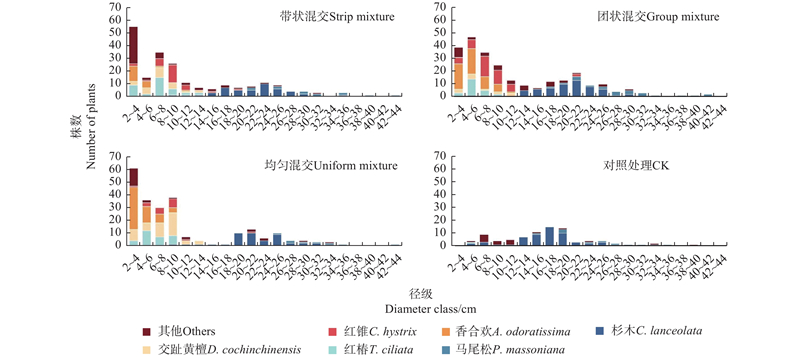
表2
主要竞争木的生长指标与物种竞争指数"
| 指标 Indicator | 杉木 C. lanceolata | 马尾松 P. massoniana | 红椿 T. ciliata | 交趾黄檀 D. cochinchinensis | 香合欢 A. odoratissima | 红锥 C. hystrix |
| 株数 Number of plants | 66 | 23 | 35 | 31 | 48 | 25 |
| 物种竞争指数 Species competition index (CIs) | 40.97 | 12.36 | 7.31 | 6.17 | 5.96 | 5.37 |
| 平均胸径 Mean diameter at breast height/cm | 21.21 | 27.49 | 6.20 | 6.83 | 4.65 | 8.01 |
| 平均树高 Mean tree height/m | 15.14 | 16.09 | 5.62 | 7.12 | 5.65 | 7.64 |

图4
各经营模式主要竞争木组成、物种竞争指数及生长指标 CK:对照 Control check;D1和D2:12 和15 m宽度带状间伐+补植模式 The 12 and 15 m width strip thinning and enrichment planting model;J1和J2:60%和70%强度均匀间伐+补植模式 The 60% and 70% intensity uniform thinning and enrichment planting model;T1和T2:12和16 m直径团状间伐+补植模式 The 12 and 16 m diameter patch thinning and enrichment planting model."
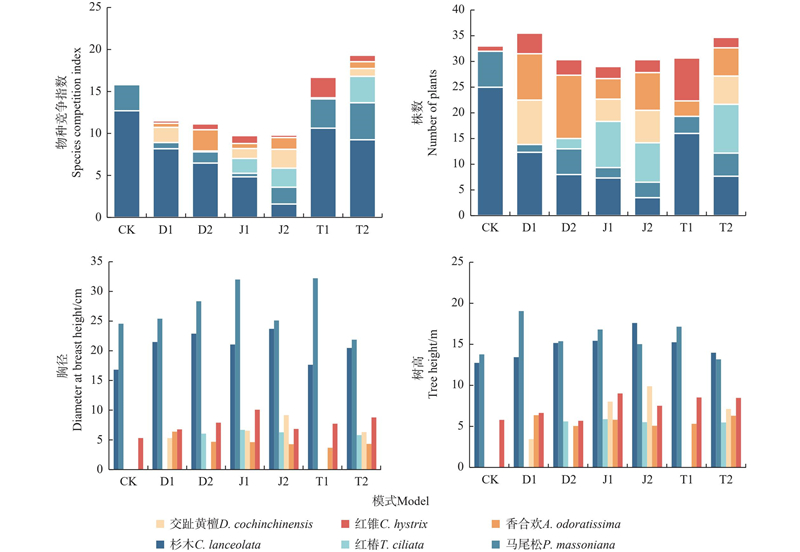
表3
杉木对象木种内、种间竞争指数①"
| 指标 Indicator | D1 | D2 | J1 | J2 | T1 | T2 | CK |
| 种内竞争指数(CIAintra) Intraspecific competition index | 0.55±0.03 bcd | 0.39±0.14 ce | 0.32±0.10 de | 0.11±0.08 e | 0.70±0.09 ab | 0.62±0.09 ac | 0.85±0.11 a |
| 种间竞争指数(CIAinter) Interspecific competition index | 0.37±0.04 bf | 0.41±0.10 be | 0.58±0.12 bd | 0.59±0.10 bc | 0.62±0.08 ab | 0.87±0.10 a | 0.34±0.09 cdef |
| 总竞争指数(CIAtotal) Total competition index | 0.91±0.06 bcd | 0.84±0.14 ce | 0.90±0.10 cf | 0.69±0.13 def | 1.32±0.18 ab | 1.48±0.19 a | 1.17±0.10 ac |
表4
总竞争指数与杉木对象木胸径的拟合模型①"
| 模式 Model | 最优函数 Optimal function | 拟合方程 Fitting equation | R2 | 显著性 Significance |
| 带状混交 Strip mixture | 二次多项式函数 Quadratic polynomial function | y = 0.002x2 - 0.158x + 3.473 4 | 0.224 5 | P<0.01 |
| 团状混交 Group mixture | 二次多项式函数 Quadratic polynomial function | y = 0.010 1x2 -0.526 5x + 7.793 6 | 0.188 1 | P<0.01 |
| 均匀混交 Uniform mixture | 幂函数 Power function | y = 85.747x–1.501 | 0.408 6 | P<0.01 |
| 对照处理 CK | 二次多项式函数 Quadratic polynomial function | y = 0.005 5x2 -0.264 8x + 4.268 | 0.193 9 | P<0.01 |

图5
总竞争指数与对象木胸径的关系"

表5
杉木对象木总竞争指数的模型预测结果"
| 胸径 Diameter at breast height/cm | 带状混交 Strip mixture | 均匀混交 Intimate mixture | 团状混交 Group mixture | 对照处理 CK |
| 5 | 2.73 | 7.66 | 5.41 | 3.08 |
| 10 | 2.09 | 2.71 | 3.54 | 2.17 |
| 15 | 1.55 | 1.47 | 2.17 | 1.53 |
| 20 | 1.11 | 0.96 | 1.30 | 1.17 |
| 25 | 0.77 | 0.68 | 0.94 | 1.09 |
| 30 | 0.53 | 0.52 | 1.09 | 1.27 |
| 35 | 0.39 | 0.41 | 1.74 | 1.74 |
| 40 | 0.35 | 0.34 | 2.89 | 2.48 |
| 45 | 0.41 | 0.28 | 4.55 | 3.49 |
| 50 | 0.57 | 0.24 | 6.72 | 4.78 |
|
曹小玉, 李际平, 陈 磊, 等. 基于加权Voronoi图的杉木生态公益林种内、种间竞争. 生态学杂志, 2016, 35 (9): 2553- 2561.
doi: 10.13292/j.1000-4890.201609.029 |
|
|
Cao X Y, Li J P, Chen L, et al. Intraspecific and interspecific competition analysis of Cunninghamia lanceolata ecological forest based on weighted Voronoi diagram. Chinese Journal of Ecology, 2016, 35 (9): 2553- 2561.
doi: 10.13292/j.1000-4890.201609.029 |
|
|
陈振华, 陈青来, 王 胤, 等. 马尾松+红锥、杂交松+红锥混交幼林种间关系. 广西林业科学, 2013, 42 (2): 169- 172.
doi: 10.3969/j.issn.1006-1126.2013.02.015 |
|
|
Chen Z H, Chen Q L, Wang Y, et al. Interspecific relationships of Castanopsis hystrix with masson pine and hybrid pine in young mixed plantations. Guangxi Forestry Science, 2013, 42 (2): 169- 172.
doi: 10.3969/j.issn.1006-1126.2013.02.015 |
|
| 邓力豪. 2022. 舟山群岛常绿阔叶林群落特征研究. 长沙: 中南林业科技大学. | |
| Deng L H. 2022. Study on community characteristics of evergreen broad-leaved forest in Tsoongi Zhoushan Islands. Changsha: Central South University of Forestry. [in Chinese] | |
| 封 磊, 洪 伟, 吴承祯, 等. 2008. 杉木–观光木人工混交林种内和种间竞争研究. 西北植物学报, 28(1): 141–146. | |
| Feng L, Hong W, Wu C Z, et al. 2008. Intraspecific and interspecific competition in Cunninghamia lanceolata and Tsoongiodendron odorum mixed artificial forest. Acta Botanica Boreali-Occidentalia Sinica, 28(1): 141–146. [in Chinese] | |
|
洪子辰, 杨源广, 刘禹豪, 等. 武夷山国家公园不同海拔甜槠群落结构变化分析. 生态学报, 2026, 46 (6): 2861- 2876.
doi: 10.20103/j.stxb.202505231292 |
|
|
Hong Z C, Yang Y G, Liu Y H, et al. Analysis on changes of community structure of Castanopsis eyrei at different altitudes in Wuyishan National Park. Acta Ecologica Sinica, 2026, 46 (6): 2861- 2876.
doi: 10.20103/j.stxb.202505231292 |
|
|
霍倩倩, 宋洋洋, 冯 斌, 等. 高丹草与田菁不同行比带状种植模式下饲草产量与品质研究. 中国草地学报, 2025, 47 (7): 83- 95.
doi: 10.16742/j.zgcdxb.20240402 |
|
|
Huo Q Q, Song Y Y, Feng B, et al. Study on forage yield and quality under strip planting patterns with different row ratios of sorghum-sudangrass and Sesbania. Chinese Journal of Grassland, 2025, 47 (7): 83- 95.
doi: 10.16742/j.zgcdxb.20240402 |
|
|
江怡航, 刘振华, 张建国, 等. 杉木–闽楠近自然改造下杉木大径材出材量的影响因子. 应用生态学报, 2025, 36 (10): 3026- 3032.
doi: 10.13287/j.1001-9332.202510.001 |
|
|
Jiang Y H, Liu Z H, Zhang J G, et al. Influencing factors of large-diameter timber yield of Cunninghamia lanceolata under the close-to-nature sil-viculture stands mixed with Phoebe bournei. Chinese Journal of Applied Ecology, 2025, 36 (10): 3026- 3032.
doi: 10.13287/j.1001-9332.202510.001 |
|
|
李际平, 房晓娜, 封 尧, 等. 基于加权Voronoi图的林木竞争指数. 北京林业大学学报, 2015, 37 (3): 61- 68.
doi: 10.13332/j.1000--1522.20140310 |
|
|
Li J P, Fang X N, Feng Y, et al. Tree competition indexes based on weighted Voronoi diagram. Journal of Beijing Forestry University, 2015, 37 (3): 61- 68.
doi: 10.13332/j.1000--1522.20140310 |
|
|
刘 静, 赵铭臻, 王利艳, 等. 间伐保留密度和套种对杉木中龄林材种结构的影响. 森林与环境学报, 2021, 41 (6): 593- 600.
doi: 10.13324/j.cnki.jfcf.2021.06.005 |
|
|
Liu J, Zhao M Z, Wang L Y, et al. Effects of thinning reserve density and interplanting on timber assortment structure of a middle-aged Chinese fir forest. Journal of Forest and Environment, 2021, 41 (6): 593- 600.
doi: 10.13324/j.cnki.jfcf.2021.06.005 |
|
|
刘世荣, 陈远其, 聂秀青, 等. 树种多样性对森林生态系统多功能性和韧性的影响. 林业科学, 2026, 62 (1): 1- 18.
doi: 10.11707/j.1001-7488.LYKX20260001 |
|
|
Liu S R, Chen Y Q, Nie X Q, et al. Effects of tree species diversity on multifunctionality and resilience of forest ecosystems. Scientia Silvae Sinicae, 2026, 62 (1): 1- 18.
doi: 10.11707/j.1001-7488.LYKX20260001 |
|
|
陆志星, 王智慧, 韦铄星, 等. 桂西北喀斯特地区不同植被恢复模式植物群落结构与多样性特征. 中南林业科技大学学报, 2022, 42 (9): 115- 126.
doi: 10.14067/j.cnki.1673-923x.2022.09.013 |
|
|
Lu Z X, Wang Z H, Wei S X, et al. Plant community structure and diversity characteristics of different vegetation restoration modes in the karst region of northwest Guangxi, China. Journal of Central South University of Forestry & Technology, 2022, 42 (9): 115- 126.
doi: 10.14067/j.cnki.1673-923x.2022.09.013 |
|
| 吕海龙, 董希斌. 基于主成分分析的小兴安岭低质林不同皆伐改造模式评价. 林业科学, 2011, 47 (12): 172- 178. | |
| Lü H L, Dong X B. Evaluation of clear-cutting improvement methods of low-quality forests in Xiaoxing’an Mountains based on principal component analysis. Scientia Silvae Sinicae, 2011, 47 (12): 172- 178. | |
|
梅路俊. 人工混交林营林技术应用与种间关系调节分析. 林业勘查设计, 2023, 52 (02): 5- 8.
doi: 10.3969/j.issn.1673-4505.2023.02.003 |
|
|
Mei L J. Application of forest management technology in artificial mixed forest and regulation analysis of interspecific relationship. Forest Investigation Design, 2023, 52 (02): 5- 8.
doi: 10.3969/j.issn.1673-4505.2023.02.003 |
|
|
邵雅琪, 施秀珍, 王子晴, 等. 杉木不同套种模式对土壤氮素及反硝化作用的影响. 福建师范大学学报(自然科学版), 2026, 42 (1): 72- 79.
doi: 10.12046/j.issn.1000-5277.2025090027 |
|
|
Shao Y Q, Shi X Z, Wang Z Q, et al. Effects of different interplanting patterns of Chinese fir on soil nitrogen and denitrification. Journal of Fujian Normal University (Natural Science Edition), 2026, 42 (1): 72- 79.
doi: 10.12046/j.issn.1000-5277.2025090027 |
|
|
沈国舫. 关于现代林草业可持续发展的几点战略思考. 林业科学, 2025, 61 (7): 1- 7.
doi: 10.11707/j.1001-7488.LYKX20250325 |
|
|
Sen G F. Some strategic considerations on the sustainable development of modern forestry and grassland sector. Scientia Silvae Sinicae, 2025, 61 (7): 1- 7.
doi: 10.11707/j.1001-7488.LYKX20250325 |
|
| 谭 茜. 2025. 基于竞争指数的马尾松树冠特征研究及模型研建. 贵阳: 贵州大学. | |
| Tan Q. 2025. Research on crown characteristics and model development of Pinus massoniana based on competition index. Guiyang: Guizhou University. [in Chinese] | |
|
唐嘉锴, 陶 胜, 张 攀. 近自然森林经营理论在岐山国有林场示范基地中的应用. 农业与技术, 2021, 41 (12): 64- 67.
doi: 10.19754/j.nyyjs.20210630016 |
|
|
Tang J K, Tao S, Zhang P. Application of close-to-nature forest management theory in the demonstration base of Qishan State-Owned Forest Farm. Agriculture and Technology, 2021, 41 (12): 64- 67.
doi: 10.19754/j.nyyjs.20210630016 |
|
|
田卫卫, 柴宗政, 孙彩丽. 近自然经营对马尾松林不同发展阶段竞争关系的影响. 东北林业大学学报, 2021, 49 (12): 15- 20.
doi: 10.3969/j.issn.1000-5382.2021.12.003 |
|
|
Tian W W, Chai Z Z, Sun C L. Impact of close-to-nature management on the competition relationship of Pinus massoniana forests at different ages. Journal of Northeast Forestry University, 2021, 49 (12): 15- 20.
doi: 10.3969/j.issn.1000-5382.2021.12.003 |
|
| 王晓明, 陆元昌, 邢海涛, 等. 2017. 马尾松–大叶栎混交林皆伐作业法的设计. 林业资源管理, (6): 47–53. | |
| Wang X M, Lu Y C, Xing H T, et al. 2017. The design of the Pinus massoniana-Quercus griffithii mixed forest clear-cutting silviculture system. Forest and Grassland Resources Research, (6): 47–53. [in Chinese] | |
|
辛云玲, 朱清科, 罗舒元, 等. 陕北黄土区水土保持林林分空间结构特征. 中国水土保持科学, 2020, 18 (5): 17- 25.
doi: 10.16843/j.sswc.2020.05.003 |
|
|
Xin Y L, Zhu Q K, Luo S Y, et al. Spatial structure characteristics of soil and water conservation forest in the loess area of northern Shaanxi. Science of Soil and Water Conservation, 2020, 18 (5): 17- 25.
doi: 10.16843/j.sswc.2020.05.003 |
|
|
邢海涛, 陆元昌, 刘宪钊, 等. 基于近自然改造的马尾松林分竞争强度研究. 北京林业大学学报, 2016, 38 (9): 42- 54.
doi: 10.13332/j.1000-1522.20160023 |
|
|
Xing H T, Lu Y C, Liu X Z, et al. Competition intensity of Pinus massoniana stand based on close-to-nature management. Journal of Beijing Forestry University, 2016, 38 (9): 42- 54.
doi: 10.13332/j.1000-1522.20160023 |
|
|
姚慧芳, 卢 杰, 曾加芹, 等. 藏东南川滇高山栎天然林的种内与种间竞争指数的海拔差异. 林业科学, 2022, 58 (8): 53- 62.
doi: 10.11707/j.1001-7488.20220806 |
|
|
Yao H F, Lu J, Zeng J Q, et al. Altitudinal differences in intraspecific and interspecific competition index of natural forests of Quercus aquifolioides in southeast Tibet. Scientia Silvae Sinicae, 2022, 58 (8): 53- 62.
doi: 10.11707/j.1001-7488.20220806 |
|
|
殷鸣放, 薛 娟, 宁良智, 等. 基于近自然林业经营的不同密度林木竞争关系比较分析. 西北林学院学报, 2013, 28 (5): 149- 153, 199.
doi: 10.3969/j.issn.1001-7461.2013.05.29 |
|
|
Yin M F, Xue J, Ning L Z, et al. Comparative study on competition relationship of the forests with different densities based on near-nature forestry management. Journal of Northwest Forestry University, 2013, 28 (5): 149- 153, 199.
doi: 10.3969/j.issn.1001-7461.2013.05.29 |
|
|
余云钦, 林文俊, 陈世品, 等. 武夷山不同海拔针阔混交林种群数量特征及优势树种空间点格局比较. 福建农林大学学报(自然科学版), 2023, 52 (5): 649- 659.
doi: 10.13323/j.cnki.j.fafu(nat.sci.).2023.05.010 |
|
|
Yu Y X, Lin W J, Chen S P, et al. Comparison of population quantity characteristics and spatial point pattern of dominant tree species in typical coniferous and broad-leaved mixed forest in Wuyi Mountain. Journal of Fujian Agriculture and Forestry University (Natural Science Edition), 2023, 52 (5): 649- 659.
doi: 10.13323/j.cnki.j.fafu(nat.sci.).2023.05.010 |
|
|
张 浩, 刘万生, 王彦琦, 等. 东北三大硬阔种内和种间竞争关系. 植物研究, 2024, 44 (6): 870- 878.
doi: 10.7525/j.issn.1673-5102.2024.06.008 |
|
|
Zhang H, Liu W S, Wang Y Q, et al. Intraspecific and interspecific competitions of the three hardwood tree species in northeast China. Bulletin of Botanical Research, 2024, 44 (6): 870- 878.
doi: 10.7525/j.issn.1673-5102.2024.06.008 |
|
|
张华锋, 陈思宇, 刘 刚, 等. 松材线虫病疫木卫生伐对马尾松纯林林分结构的影响. 浙江农林大学学报, 2020, 37 (4): 745- 751.
doi: 10.11833/j.issn.2095-0756.20190487 |
|
|
Zhang H F, Chen S Y, Liu G, et al. Effects of sanitation cutting pine wilt diseased trees on the stand structure of pure Pinus massoniana plantation. Journal of Zhejiang A& F University, 2020, 37 (4): 745- 751.
doi: 10.11833/j.issn.2095-0756.20190487 |
|
|
周红敏, 惠刚盈, 赵中华, 等. 林分空间结构分析中样地边界木的处理方法. 林业科学, 2009, 45 (2): 1- 5.
doi: 10.3321/j.issn:1001-7488.2009.02.001 |
|
|
Zhou H M, Hui G Y, Zhao Z H, et al. Treatment methods of plot boundary trees in spatial forest structure analysis. Scientia Silvae Sinicae, 2009, 45 (2): 1- 5.
doi: 10.3321/j.issn:1001-7488.2009.02.001 |
|
|
周文嵩, 韩海荣, 康峰峰, 等. 山西太岳山华北落叶松人工林种内与种间关系. 生态学杂志, 2017, 36 (2): 335- 342.
doi: 10.13292/j.1000-4890.201702.011 |
|
|
Zhou W S, Han H R, Kang F F, et al. Intra-and inter-specific interactions of Larix principis-rupprechtii plantation in Mt. Taiyue, Shanxi, China. Chinese Journal of Ecology, 2017, 36 (2): 335- 342.
doi: 10.13292/j.1000-4890.201702.011 |
|
|
周雨飞, 罗 超, 李 生, 等. 亚热带马尾松林阔叶化改造对林分结构的影响. 北京林业大学学报, 2025, 47 (1): 11- 21.
doi: 10.12171/j.1000-1522.20240292 |
|
|
Zhou Y F, Luo C, Li S, et al. Effects of broadleaved transformation on stand structure of Pinus massoniana forest in subtropical area. Journal of Beijing Forestry University, 2025, 47 (1): 11- 21.
doi: 10.12171/j.1000-1522.20240292 |
|
|
邹丰虎, 周 雯, 柴宗政. 近自然经营对马尾松林优势树种生态位及种间关系的影响. 西部林业科学, 2024, 53 (1): 55- 65.
doi: 10.16473/j.cnki.xblykx1972.2024.01.008 |
|
|
Zou F H, Zhou W, Chai Z Z. Influence of close-to-nature management on the ecological niche and interspecific relationships of dominant tree species in Pinus massoniana forests. Journal of West China Forestry Science, 2024, 53 (1): 55- 65.
doi: 10.16473/j.cnki.xblykx1972.2024.01.008 |
|
|
Britton T G, Richards S A, Hovenden M J. Quantifying neighbour effects on tree growth: are common ‘competition’ indices biased?. Journal of Ecology, 2023, 111 (6): 1270- 1280.
doi: 10.1111/1365-2745.14095 |
|
|
Chen B, Liu K, Wang C, et al. Tree allometry responses to competition and complementarity in mixed-species plantations of Betula alnoides. Forest Ecosystems, 2024, 11, 100207.
doi: 10.1016/j.fecs.2024.100207 |
|
|
Clark J S. Individuals and the variation needed for high species diversity in forest trees. Science, 2010, 327 (5969): 1129- 1132.
doi: 10.1126/science.1183506 |
|
|
Farooq T H, Shakoor A, Wu X, et al. Perspectives of plantation forests in the sustainable forest development of China. iForest-Biogeosciences and Forestry, 2021, 14 (2): 166- 174.
doi: 10.3832/ifor3551-014 |
|
|
Fichtner A, Härdtle W, Li Y, et al. From competition to facilitation: how tree species respond to neighbourhood diversity. Ecology letters, 2017, 20 (7): 892- 900.
doi: 10.1111/ele.12786 |
|
| Gsell O. A generic approach to spatial individual-based modelling and simulation of plantcommunities. Mathematical & Computational Forestry & Natural, 2014, 6 (18): 36- 47. | |
| Hegyi F. 1974. A simulation model for managing jack-pine stands//Fries J. Growth models for tree and stand simulation. Stockholm: Royal College of Forestry, 74–90. | |
|
Ji Y, Zhang P, Shen H. Competition intensity affects growing season nutrient dynamics in Korean pine trees and their microhabitat soil in mixed forest. Forest Ecology and Management, 2023, 539, 121018.
doi: 10.1016/j.foreco.2023.121018 |
|
|
Qiao X, Yan X, Tao L, et al. Size-asymmetric and spatially structured competition shapes Populus euphratica stands in the lower Tarim river riparian zone. Ecological Indicators, 2025, 181, 114465.
doi: 10.1016/j.ecolind.2025.114465 |
|
|
Shan R, Chen H Y H, Feng G, et al. Increasing water availability strengthens conspecific negative density dependence but weakens heterospecific negative density dependence in Japanese old-growth forests. Forest Ecosystems, 2026, 16, 100460.
doi: 10.1016/j.fecs.2026.100460 |
|
|
Usui T, Angert A L. Competition enables rapid adaptation to a warming range edge in a model plant community. Science, 2026, 392 (6802): eads4664.
doi: 10.1126/science.ads4664 |
|
|
Yang S, Mao K, Yang H, et al. Stand characteristics and ecological benefits of Chinese fir, Chinese cedar, and mixed plantations in the mountainous areas of the Sichuan Basin. Forest Ecology and Management, 2023, 544, 121168.
doi: 10.1016/j.foreco.2023.121168 |
|
|
Zhang H, Feng H, Qu X, et al. Species mixing promotes plant biomass accumulation and nutrient cycling in forest plantations. Communications Biology, 2026, 9 (1): 348.
doi: 10.1038/s42003-026-09646-3 |
|
|
Zhou D, Zhao S Q, Liu S, et al. A meta-analysis on the impacts of partial cutting on forest structure and carbon storage. Biogeosciences Discussions, 2013, 10 (1): 787- 813.
doi: 10.5194/bgd-10-787-2013 |
| [1] | 刘军,欧阳勋志,潘萍,郑怡,郑李平,刘畅. 树种多样性对天然马尾松林种内和种间竞争关系的影响[J]. 林业科学, 2026, 62(6): 71-81. |
| [2] | 刘林,孙洪刚. 江西分宜杉木人工林生物量与死亡有机质碳库动态耦合对轮伐期和林地期望价值的影响[J]. 林业科学, 2026, 62(5): 16-26. |
| [3] | 胡宇欣,江怡航,刘振华,朱光玉,张建国,张雄清. 杉木纯林林下补植模式对土壤质量和微生物群落的影响[J]. 林业科学, 2026, 62(3): 61-73. |
| [4] | 尹海锋,刘思泽,曾杰,苏宇,余安卫,李贤伟. 林窗改造下马尾松根系分解与土壤线虫功能群的互馈作用[J]. 林业科学, 2026, 62(2): 85-96. |
| [5] | 于贵瑞,郭珂歆,郝天象. 新时期林业生态经济体系构建的初步探索[J]. 林业科学, 2025, 61(7): 8-22. |
| [6] | 黄栋才,郭鑫,王得祥,王韵淑,张欣,霍雪莹. 不同经营方法对秦岭华北落叶松林分生长和林下植被的影响[J]. 林业科学, 2024, 60(8): 57-66. |
| [7] | 吕梓晴, 段爱国. 不同产区杉木生物量与碳储量模型[J]. 林业科学, 2024, 60(2): 1-11. |
| [8] | 张琦,叶尔江·拜克吐尔汉,王娟. 东北鼠李雌雄异株个体对种间竞争响应的性别差异[J]. 林业科学, 2023, 59(11): 33-41. |
| [9] | 姚慧芳,卢杰,曾加芹,罗大庆,张新生,王超,于德水. 藏东南川滇高山栎天然林的种内与种间竞争指数的海拔差异[J]. 林业科学, 2022, 58(8): 53-62. |
| [10] | 陈嘉琪,赵光宇,李仰龙,董玉红,厚凌宇,焦如珍. 杉木人工林土壤磷素形态及含量的林龄变化[J]. 林业科学, 2022, 58(5): 10-17. |
| [11] | 王淑真,梁晶晶,包明琢,潘菲,周垂帆. 不同林龄杉木林土壤磷形态与解磷菌变化[J]. 林业科学, 2022, 58(2): 58-69. |
| [12] | 武承旭,刘福,孔祥波,张苏芳,张真. 云南松3种切梢小蠹梢转干期竞争共存的时空生态位[J]. 林业科学, 2020, 56(3): 90-99. |
| [13] | 胡华英, 张虹, 曹升, 殷丹阳, 周垂帆, 何宗明. 杉木人工林土壤施用生物炭对细菌群落结构及多样性的影响[J]. 林业科学, 2019, 55(8): 184-193. |
| [14] | 王超群, 焦如珍, 董玉红, 厚凌宇, 赵京京, 赵世荣. 不同林龄杉木人工林土壤微生物群落代谢功能差异[J]. 林业科学, 2019, 55(5): 36-45. |
| [15] | 杨安娜, 陆云峰, 张俊红, 吴家森, 徐金良, 童再康. 杉木人工林土壤养分及酸杆菌群落结构变化[J]. 林业科学, 2019, 55(1): 119-127. |
| 阅读次数 | ||||||
|
全文 |
|
|||||
|
摘要 |
|
|||||

