
林业科学 ›› 2026, Vol. 62 ›› Issue (9): 13-27.doi: 10.11707/j.1001-7488.LYKX20260105
• 前沿热点 • 上一篇
周梦瑶,魏歌,范宇轩,李恩茜,唐雪飞*( ),范国强*()
收稿日期:2026-01-05
修回日期:2026-04-16
出版日期:2026-09-10
发布日期:2026-09-16
通讯作者:
唐雪飞,范国强
E-mail:Tangxf5@henau.edu.cn;zlxx64@henau.edu.cn
基金资助:
Mengyao Zhou,Ge Wei,Yuxuan Fan,Enxi Li,Xuefei Tang*(),Guoqiang Fan*()
Received:2026-01-05
Revised:2026-04-16
Online:2026-09-10
Published:2026-09-16
Contact:
Xuefei Tang,Guoqiang Fan
E-mail:Tangxf5@henau.edu.cn;zlxx64@henau.edu.cn
摘要:
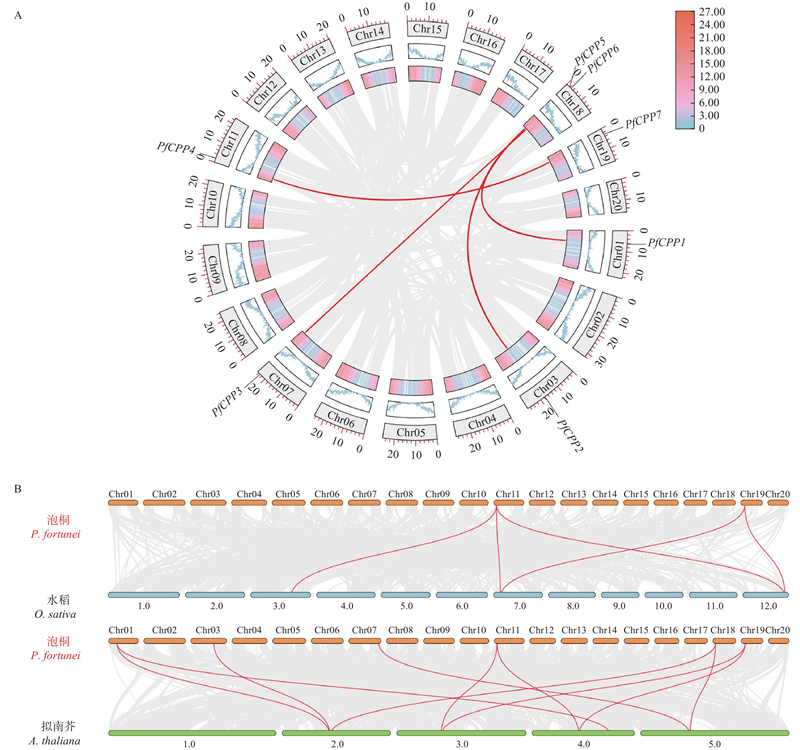
目的: 系统解析白花泡桐CPP基因家族的分子特征及其在抗逆响应中的各种功能,为泡桐抗逆种质创制和高值化利用提供理论依据和基因资源。方法: 基于白花泡桐全基因组数据,综合运用生物信息学、转录组学、分子生物学等手段,系统鉴定PfCPP基因家族成员,并对其理化性质、基因结构、进化关系、顺式作用元件以及响应生物(植原体侵染)和非生物(干旱、盐)胁迫的表达模式进行深入分析。通过RT-qPCR验证关键基因的表达趋势,并结合亚细胞定位和蛋白互作预测探究其潜在功能。结果: 共鉴定到7个PfCPP基因(PfCPP1–PfCPP7),分属3个亚家族,非均匀地分布于6条染色体上。顺式作用元件分析表明,该家族基因富含光响应、激素调控和逆境胁迫相关元件;共线性分析表明,片段重复是该家族扩张的主要方式;表达谱分析显示,PfCPP成员在不同胁迫下呈现特异性的表达分化:植原体侵染显著诱导PfCPP2/3/4/5/7上调,干旱胁迫下,PfCPP1–4上调而PfCPP5–7下调;盐胁迫下仅显著诱导PfCPP7上调。RT-qPCR结果验证了转录组数据的可靠性。亚细胞定位显示PfCPP4定位于细胞核,蛋白互作预测和分子对接结果表明PfCPP4/7可能通过与MYB类转录因子互作发挥调控功能。结论: 本研究系统鉴定白花泡桐PfCPP基因家族,揭示其结构特征和进化规律。PfCPP基因在不同逆境胁迫下表现出差异化的表达模式,表明其在泡桐抗逆响应中具有重要调控作用,且可能通过与MYB蛋白互作形成调控网络,协同调节泡桐的生长发育和逆境适应。
中图分类号:
周梦瑶,魏歌,范宇轩,李恩茜,唐雪飞,范国强. 白花泡桐CPP转录因子家族的鉴定及其响应多种逆境的表达模式分析[J]. 林业科学, 2026, 62(9): 13-27.
Mengyao Zhou,Ge Wei,Yuxuan Fan,Enxi Li,Xuefei Tang,Guoqiang Fan. Genome-Wide Identification of the CPP Transcription Factor Family in Paulownia fortunei and Analysis of Their Expression Patterns in Response to Multiple Stresses[J]. Scientia Silvae Sinicae, 2026, 62(9): 13-27.

表S1
拟南芥、水稻和泡桐中CPP基因的蛋白质ID"
| 拟南芥A. thaliana | |
| AtCPP1 | AT2G20110 |
| AtCPP2 | AT3G04850 |
| AtCPP3 | AT3G16160 |
| AtCPP4 | AT3G22760 |
| AtCPP5 | AT3G22780 |
| AtCPP6 | AT4G14770 |
| AtCPP7 | AT4G29000 |
| AtCPP8 | AT5G25790 |
| 水稻O. sativa | |
| OsCPP1 | LOC_Os01g55580 |
| OsCPP2 | LOC_Os02g17460 |
| OsCPP3 | LOC_Os03g43730 |
| OsCPP4 | LOC_Os04g09560 |
| OsCPP5 | LOC_Os05g43380 |
| OsCPP6 | LOC_Os05g51040 |
| OsCPP7 | LOC_Os06g22670 |
| OsCPP8 | LOC_Os07g07974 |
| OsCPP9 | LOC_Os08g28214 |
| OsCPP10 | LOC_Os12g41210 |
| OsCPP11 | LOC_Os12g41230 |
| 泡桐P. fortunei | |
| PfCPP1 | Pfo01g004380.1 |
| PfCPP2 | Pfo03g006650.1 |
| PfCPP3 | Pfo07g014910.1 |
| PfCPP4 | Pfo11g002630.1 |
| PfCPP5 | Pfo18g002590.1 |
| PfCPP6 | Pfo18g003730.1 |
| PfCPP7 | Pfo19g004140.1 |
表S2
转录组测序数据来源信息"
| 登录号Accession number |
| SRR11787883 |
| SRR11787894 |
| SRR11787905 |
| SRR11787916 |
| SRR11787922-SRR11787928 |
| SRR11787938 |
| SRR11787942-SRR11787944 |
| SRR11787949 |
| SRR11787960 |
| SRR11787971 |
| PRJNA221355 |
| PRJNA289582 |
表S3
泡桐PfCPP基因qRT-PCR引物"
| 引物Primer | 序列Sequence (5'?3') |
| PfCPP3-F | GTGGGGTTCGTAGACGTTGT |
| PfCPP3-R | CGGTAGTGATTTTGGCCCCT |
| PfCPP4-F | AATCTGGAGGGGGTAAGCCA |
| PfCPP4-R | GCTCCCGCCATCTCAAAAAC |
| PfCPP5-F | AACTGCCGCGTCGTAAAATG |
| PfCPP5-R | GGCGTTATTGCAGGCGATTT |
| PfCPP6-F | CACCTAATCGGCCTGCTCAA |
| PfCPP6-R | CAGGTGGCTCGATGATGTGT |
| PfCPP7-F | CTTGCAACACGCAAGCAGAT |
| PfCPP7-R | GTCTTGCTGGAGTCATCCCC |
| PfActin-F | AATGGAATCTGCTGGAAT |
| PfActin-R | ACTGAGGACAATGTTACC |
表S5
qRT-PCR反应程序①"
| 步骤Steps | 温度Temperature/℃ | 时间Time/s |
| 预变性Pre-denaturation | 95 | 30 |
| 变性Transsexual | 95 | 5 |
| 退火Annealing | 58 | 10 |
| 延伸Extension | 72 | 30 |
| 溶解曲线Dissolution curve | 机器自定义Machine customisation | 机器自定义Machine customisation |
表S6
引物序列信息"
| 序号 No. | 基因载体 Gene vector | 正向引物序列 Forward primer sequence | 反向引物序列 Reverse primer sequence |
| 1 | pSAK277-PfCPP4 | GTGGATCCAAAGAATTCATGGGGGAGGGGGGTGAG | CTCCTTTACCCATGAATTCCTGATTAGGGGTGAGGGAAGG |
表1
白花泡桐PfCPP基因家族的理化性质分析"
| 基因 ID Gene ID | 基因名称 Gene name | 染色体 Chromosome | 氨基酸数目 Number of amino acid | 分子量 Molecular weight/kDa | 等电点 pI | 总平均亲水系数 GRAVY | 亚细胞定位 Subcellular location |
| Pfo01g004380.1 | PfCPP1 | Chr01 | 461 | 49.92 | 8.38 | –0.68 | 细胞核Nucleus |
| Pfo03g006650.1 | PfCPP2 | Chr03 | 609 | 65.89 | 8.53 | –0.67 | 细胞核Nucleus |
| Pfo07g014910.1 | PfCPP3 | Chr07 | 949 | 102.80 | 5.97 | –0.58 | 细胞核Nucleus |
| Pfo11g002630.1 | PfCPP4 | Chr11 | 793 | 86.49 | 5.58 | –0.65 | 细胞核Nucleus |
| Pfo18g002590.1 | PfCPP5 | Chr18 | 536 | 58.87 | 8.60 | –0.60 | 细胞核Nucleus |
| Pfo18g003730.1 | PfCPP6 | Chr18 | 942 | 102.33 | 5.65 | –0.62 | 细胞核Nucleus |
| Pfo19g004140.1 | PfCPP7 | Chr19 | 794 | 86.71 | 5.37 | –0.70 | 细胞核Nucleus |

图1
白花泡桐、拟南芥和水稻CPP家族蛋白系统进化树"

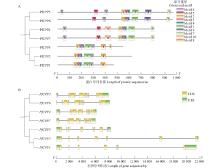
图2
白花泡桐PfCPP基因家族的保守基序和基因结构分析 A: PfCPP蛋白的保守基序 Conserved motifs of PfCPP proteins; B: PfCPP家族的基因结构 Gene structures of the PfCPP family; CDS: 编码序列 Coding sequence; UTR: 非翻译区 Untranslated region."


图S1
白花泡桐PfCPP基因家族的蛋白结构域及顺式作用元件分析 A:PfCPP蛋白的结构域;B:PfCPP家族的顺式作用元件。A: Domain architectures of PfCPP proteins; B: Cis-acting elements in the promoter regions of PfCPP genes."


图3
PfCPP基因启动子顺式作用元件的热图分析 图中每个单元格的颜色深浅表示特定基因PfCPP中某一顺式元件的数量,根据注释对顺式作用元件进行分类统计。The color intensity of each cell represents the number of a specific cis-acting element in the promoter of a given PfCPP gene, Cis-acting elements are classified and counted based on their functional annotations."


图4
PfCPP基因家族共线性分析 A:白花泡桐PfCPP基因的物种内线性分析(红色线条表示CPP基因间的共线性对,灰色线条显示基因组内的其他共线性关系,色卡范围 0.00~27.00,蓝色代表低基因密度,橙红色代表高基因密度);B:白花泡桐、水稻及拟南芥的跨物种共线性分析。A: Intraspecific synteny analysis of the PfCPP genes in P. fortunei. (Red lines denote syntenic pairs among CPP genes, whereas grey lines represent other syntenic relationships within the genome. The color chart ranges from 0.00 to 27.00, where blue indicates low gene density and orange-red indicates high gene density). B: Interspecific synteny analysis between P. fortunei and O. sativa, as well as A. thaliana."
图S2
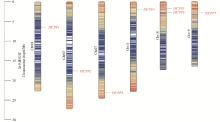
PfCPP基因家族染色体定位 PfCPP基因的染色体分布图,矩形条代表染色体及其编号,基因位置沿染色体方向标注。Chromosomal distribution map of the PfCPP genes, Rectangular bars represent chromosomes (with their numbers labeled), and gene positions are annotated according to chromosomal orientation."


图5
Rif试剂处理下病健苗表达热图及RT-qPCR分析 A:Rif处理PfCPP基因的转录组热图(PF:健康白花泡桐;PFI:植原体侵染白花泡桐;PFIL100_5为100 mg·L–1 Rif处理植原体侵染白花泡桐5天;PFIL 100_10为100 mg·L–1 Rif处理植原体侵染白花泡桐10天;转录组数据得到的log2FC值经标准化处理,色卡由蓝色至红色表示表达由低到高);B:白花泡桐PfCPP基因在植原体胁迫下的RT-qPCR表达分析[3个生物学重复的标准差(SD值)用以表示误差线;采用单因素方差分析进行显著性检验;其中* P<0.05, ** P<0.01,*** P<0.001,**** P<0.000 1]. A: Transcriptome heatmap of PfCPP genes under Rif treatment (PF: healthy P. fortunei; PFI: P. fortunei infected with phytoplasma; PFIL100_5 indicates phytoplasma-infected P. fortunei treated with 100 mg·L–1 Rif for 5 days; PFIL100_10 indicates phytoplasma-infected P. fortunei treated with 100 mg·L–1 Rif for 10 days; In all heat maps, log2FC values derived from transcriptome data, and the color chart from blue to red represents the expression from low to high); B: RT-qPCR expression analysis of PfCPP genes under phytoplasma stress [ Error bars represent the standard deviation (SD) of three biological replicates; Statistical significance is determined using one-way ANOVA (* P<0.05, ** P<0.01, *** P<0.001, **** P<0.000 1, respectively)]."
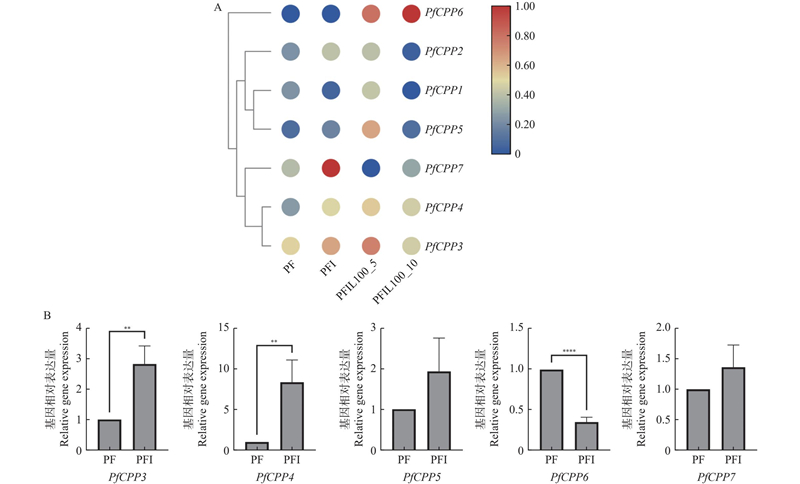

图6
非生物胁迫下白花泡桐PfCPP基因的表达谱 A:干旱胁迫下白花泡桐PfCPP基因的转录组热图;B:盐胁迫下白花泡桐PfCPP基因的转录组热图。转录组数据得到的 log2FC值经标准化处理,颜色由蓝色(低表达)过渡至红色(高表达)。A: Transcriptome heat map of PfCPP genes in P. fortunei under drought stress; B: Transcriptome heat map of PfCPP genes in P. fortunei under salt stress. In all heat maps, log2FC values derived from transcriptome data are scaled from blue (low expression) to red (high expression)."


图7
亚细胞定位 PfCPP4-GFP为融合载体;PfCPP4-GFP is the fusion vector."
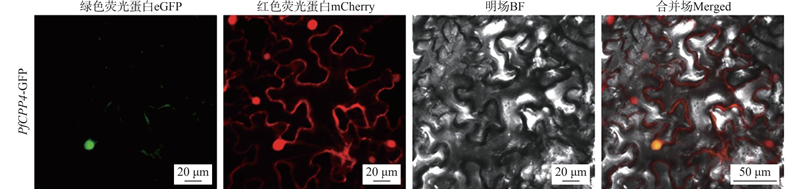

图8
白花泡桐PfCPP基因的蛋白预测 A:PfCPP4/7的分子对接 Molecular docking of PfCPP4/7; B:PfCPP蛋白三级结构 PfCPP protein tertiary structure."


图S3
PfCPP蛋白互作网络"

表S4
qRT-PCR扩增体系"
| 组分Component | 体积Volume/μL |
| cDNA | 1 |
| 2× qPCR Master Mix | 10 |
| 正向引物Forward primer | 0.4 |
| 反向引物Reverse primer | 0.4 |
| ddH2O | 加到20 Add to 20 |
| 巩 克, 王希胤. 3个伞形科植物CPP基因家族的比较基因组学分析. 种子科技, 2021, 39 (16): 11- 13, 16. | |
| Gong K, Wang X Y. Comparative genomic analysis of CPP gene families in three umbelliferae plants. Seed Science and Technology, 2021, 39 (16): 11- 13, 16. | |
|
黄 静, 郑 晶, 胡乐佳, 等. 陆地棉CPP转录因子家族全基因组鉴定及分析. 分子植物育种, 2022, 20 (14): 4556- 4566.
doi: 10.13271/j.mpb.020.004556 |
|
|
Huang J, Zheng J, Hu L J, et al. Genome-wide identification and analysis of CPP transcription factor family in Gossypium hirsutum L. Molecular Plant Breeding, 2022, 20 (14): 4556- 4566.
doi: 10.13271/j.mpb.020.004556 |
|
| 蒋建平. 1990. 泡桐栽培学. 北京: 中国林业出版社. | |
| Jiang J P. 1990. Cultivation of Paulownia. Beijing: China Forestry Publishing House. [in Chinese] | |
| 李可鑫, 赵 微, 徐林琳, 等. 温度胁迫对白桦丛生苗次生产物合成及抗逆酶积累的影响. 北京林业大学学报, 2021, 43 (7): 31- 39. | |
| Li K X, Zhao W, Xu L L, et al. Effects of temperature stress on the accumulation of secondary metabolites and defensive enzymes in multiple shoots of Betula platyphylla. Journal of Beijing Forestry University, 2021, 43 (7): 31- 39. | |
| 潘冉冉, 位明明, 王亚杰, 等. 巴西橡胶树HbCPP1基因的克隆与表达分析. 植物生理学报, 2018, 54 (5): 763- 772. | |
| Pan R R, Wei M M, Wang Y J, et al. Cloning and expression analysis of HbCCP1 in rubber tree (Hevea brasiliensis). Plant Physiology Journal, 2018, 54 (5): 763- 772. | |
| 唐雪飞, 蒲婷婷, 李豫杰, 等. 泡桐研究进展与展望. 林业科学, 2025, 61 (7): 114- 128. | |
| Tang X F, Pu T T, Li Y J, et al. Research progress and prospect of Paulownia. Scientia Silvae Sinicae, 2025, 61 (7): 114- 128. | |
| 王园龙. 2016. 干旱胁迫对不同种(品种)泡桐基因表达的影响. 郑州: 河南农业大学. | |
| Wang Y L. 2016. The influence of gene expression in different species (varieties) of Paulownia under drought stress. Zhengzhou: Henan Agricultural University. [in Chinese] | |
|
杨如兴, 王鹏杰, 陈芝芝, 等. 茶树CPP转录因子家族的全基因组鉴定及分析. 西北植物学报, 2019, 39 (6): 1024- 1032.
doi: 10.7606/j.issn.1000-4025.2019.06.1024 |
|
|
Yang R X, Wang P J, Chen Z Z, et al. Genome-wide identification and analysis of CPP transcription factor family in tea plants. Acta Botanica Boreali-Occidentalia Sinica, 2019, 39 (6): 1024- 1032.
doi: 10.7606/j.issn.1000-4025.2019.06.1024 |
|
| 张培源. 2023. 干旱胁迫下不同倍性鄂川泡桐的生理特性及代谢组学研究. 郑州: 河南农业大学. | |
| Zhang P Y. 2023. Physiological characteristics and metabolomics of different ploidy Paulownia albiphloea under drought stress. Zhengzhou: Henan Agricultural University. [in Chinese] | |
| 张旭丽, 王瑞军, 郗小倩, 等. 干旱胁迫及复水对黄芪幼苗生长、生理特性及次生代谢产物积累的影响. 作物杂志, 2024 (5): 204- 211. | |
| Zhang X L, Wang R J, Xi X Q, et al. Effects of drought stress and rehydration on growth, physiological characteristics and accumulation of secondary metabolites in Astragalus mongholicus seedlings. Crops, 2024 (5): 204- 211. | |
| 张兆涵, 范梓晗, 焦 蕊, 等. 低温胁迫下林木的生理响应特征. 温带林业研究, 2024, 7 (1): 38- 41,46. | |
| Zhang Z H, Fan Z H, Jiao R, et al. Physiological response characteristics of trees under low temperature stress. Journal of Temperate Forestry Research, 2024, 7 (1): 38- 41,46. | |
| 赵才美, 黄兴奇, 殷富有, 等. 水稻NAC转录因子家族的研究进展. 植物科学学报, 2020, 38 (2): 278- 287. | |
| Zhao C M, Huang X Q, Yin F Y, et al. Research progress on NAC transcription factor family in Oryza sativa L. Plant Science Journal, 2020, 38 (2): 278- 287. | |
|
Cai H S, Tian S, Liu C L, et al. Identification of a MYB3R gene involved in drought, salt and cold stress in wheat (Triticum aestivum L. ). Gene, 2011, 485 (2): 146- 152.
doi: 10.1016/j.gene.2011.06.026 |
|
|
Cao Y B, Sun G L, Zhai X Q, et al. Genomic insights into the fast growth of Paulownias and the formation of Paulownia witches' broom. Molecular Plant, 2021, 14 (10): 1668- 1682.
doi: 10.1016/j.molp.2021.06.021 |
|
|
Chen C J, Wu Y, Li J W, et al. TBtools-Ⅱ: a “one for all, all for one” bioinformatics platform for biological big-data mining. Molecular Plant, 2023, 16 (11): 1733- 1742.
doi: 10.1016/j.molp.2023.09.010 |
|
|
Fan G Q, Dong Y P, Deng M J, et al. Plant-pathogen interaction, circadian rhythm, and hormone-related gene expression provide indicators of phytoplasma infection in Paulownia fortunei. International Journal of Molecular Sciences, 2014, 15 (12): 23141- 23162.
doi: 10.3390/ijms151223141 |
|
|
Fan G Q, Wang L M, Dong Y P, et al. Genome of Paulownia (Paulownia fortunei) illuminates the related transcripts, miRNA and proteins for salt resistance. Scientific Reports, 2017, 7 (1): 1285.
doi: 10.1038/s41598-017-01360-9 |
|
|
Fan G Q, Xu E K, Deng M J, et al. Phenylpropanoid metabolism, hormone biosynthesis and signal transduction-related genes play crucial roles in the resistance of Paulownia fortunei to Paulownia witches’ broom phytoplasma infection. Genes & Genomics, 2015, 37 (11): 913- 929.
doi: 10.1007/s13258-015-0321-2 |
|
| Finn R D, Mistry J, Schuster-Böckler B, et al. 2006. Pfam: clans, web tools and services. Nucleic Acids Research, 34(Database issue): D247-D251. | |
|
Gu L, Kang T Y, Zeng T, et al. Comprehensive identification and expression analysis of the CPP gene family in maize (Zea mays L.). BMC Plant Biology, 2025, 25, 731.
doi: 10.1186/s12870-025-06783-5 |
|
|
Guo N, Zhai X Q, Fan G Q. Chemical composition, health benefits and future prospects of Paulownia flowers: a review. Food Chemistry, 2023, 412, 135496.
doi: 10.1016/j.foodchem.2023.135496 |
|
|
Hauser B A, He J Q, Park S O, et al. TSO1 is a novel protein that modulates cytokinesis and cell expansion in Arabidopsis. Development, 2000, 127 (10): 2219- 2226.
doi: 10.1242/dev.127.10.2219 |
|
|
Jakubowski M. Cultivation potential and uses of Paulownia wood: a review. Forests, 2022, 13 (5): 668.
doi: 10.3390/f13050668 |
|
|
Jangpangi D, Patni B, Chandola V, et al. Medicinal plants in a changing climate: understanding the links between environmental stress and secondary metabolite synthesis. Frontiers in Plant Science, 2025, 16, 1587337.
doi: 10.3389/fpls.2025.1587337 |
|
|
Jiang W Q, Li N, Zhang D P, et al. Elevated temperature and drought stress significantly affect fruit quality and activity of anthocyanin-related enzymes in jujube (Ziziphus jujuba Mill. cv. ‘Lingwuchangzao’). PLoS One, 2020, 15 (11): e0241491.
doi: 10.1371/journal.pone.0241491 |
|
|
Liu D, Meng S, Xiang Z H, et al. An R1R2R3 MYB transcription factor, MnMYB3R1, regulates the polyphenol oxidase gene in mulberry (Morus notabilis). International Journal of Molecular Sciences, 2019, 20 (10): 2602.
doi: 10.3390/ijms20102602 |
|
|
Liu R L, Feng Y Z, Li Q Y, et al. Genome-wide analysis of CPP transcription factor family in endangered plant Phoebe bournei and its response to adversity. Plants, 2025, 14 (5): 803.
doi: 10.3390/plants14050803 |
|
|
Liu Z C, Rumming M P, Meyerowitz E M. TSO1 functions in cell division during Arabidopsis flower development. Development, 1997, 124 (3): 665- 672.
doi: 10.1242/dev.124.3.665 |
|
| Lu T, Dou Y C, Zhang C. 2013. Fuzzy clustering of CPP family in plants with evolution and interaction analyses. BMC Bioinformatics, 14(S13): S10. | |
|
Lugli L, Mezzalira G, Lambardi M, et al. Paulownia spp. a bibliometric trend analysis of a global multi-use tree. Horticulturae, 2023, 9 (12): 1352.
doi: 10.3390/horticulturae9121352 |
|
|
Nakabayashi R, Yonekura-Sakakibara K, Urano K, et al. Enhancement of oxidative and drought tolerance in Arabidopsis by overaccumulation of antioxidant flavonoids. The Plant Journal, 2014, 77 (3): 367- 379.
doi: 10.1111/tpj.12388 |
|
|
Netshimbupfe M H, Berner J, Van Der Kooy F, et al. Influence of drought and heat stress on mineral content, antioxidant activity and bioactive compound accumulation in four African Amaranthus species. Plants (Basel), 2023, 12 (4): 953.
doi: 10.3390/plants12040953 |
|
|
Permatasari N A, Pöhnl T, Neugart S. Impact of drought, salinity, and their combination on growth, mineral content, and plant secondary metabolites of tomatoes (Solanum lycopersicum L.). Physiologia Plantarum, 2026, 178 (1): e70725.
doi: 10.1111/ppl.70725 |
|
|
Rakhimzhanova A, Kasapoğlu A G, Sapakova A, et al. Expression analysis and characterization of the CPP gene family of Melatonin-treated common bean cultivars under different abiotic stresses. South African Journal of Botany, 2023, 160, 282- 294.
doi: 10.1016/j.sajb.2023.07.013 |
|
| Schrödinger L L C. 2020. The PyMOL molecular graphics system, Version 2.0. New York: Schrödinger, LLC. | |
| Song X Y, Zhang Y Y, Wu F C, et al. 2016. Genome-wide analysis of the maize (Zea may L.) CPP-like gene family and expression profiling under abiotic stress. Genetics and Molecular Research, 15(3). | |
|
Sun Y Q, Jia X Y, Chen D X, et al. Genome-wide identification and expression analysis of cysteine-rich polycomb-like protein (CPP) gene family in tomato. International Journal of Molecular Sciences, 2023, 24 (6): 5762.
doi: 10.3390/ijms24065762 |
|
|
Tamura K, Stecher G, Kumar S. MEGA11: molecular evolutionary genetics analysis version 11. Molecular Biology and Evolution, 2021, 38 (7): 3022- 3027.
doi: 10.1093/molbev/msab120 |
|
| Wang Y L, Cao L, Deng M J, et al. Analysis of salt stress-responsive microRNAs in Paulownia fortunei by high-throughput sequencing. Journal of Henan Agricultural University, 2015, 49 (4): 461- 467. | |
|
Wang Y P, Tang H B, Debarry J D, et al. MCScanX: a toolkit for detection and evolutionary analysis of gene synteny and collinearity. Nucleic Acids Research, 2012, 40 (7): e49.
doi: 10.1093/nar/gkr1293 |
|
|
Yang J H, Hansen A S. Enhancer selectivity in space and time: from enhancer-promoter interactions to promoter activation. Nature Reviews Molecular Cell Biology, 2024, 25 (7): 574- 591.
doi: 10.1038/s41580-024-00710-6 |
|
|
Yang L, Fang S Y, Liu L, et al. WRKY transcription factors: Hubs for regulating plant growth and stress responses. Journal of Integrative Plant Biology, 2025, 67 (3): 488- 509.
doi: 10.1111/jipb.13828 |
|
|
Yang Z F, Gu S L, Wang X F, et al. Molecular evolution of the CPP-like gene family in plants: insights from comparative genomics of Arabidopsis and rice. Journal of Molecular Evolution, 2008, 67 (3): 266- 277.
doi: 10.1007/s00239-008-9143-z |
|
|
Zhang L, Liu B B, Zhang J, et al. Insights of molecular mechanism of xylem development in five black poplar cultivars. Frontiers in Plant Science, 2020, 11, 620.
doi: 10.3389/fpls.2020.00620 |
|
|
Zhang L, Zhao H K, Wang Y M, et al. Genome-wide identification and expression analysis of the CPP-like gene family in soybean. Genetics and Molecular Research, 2015, 14 (1): 1260- 1268.
doi: 10.4238/2015.february.13.4 |
|
|
Zhou Y, Hu L F, Ye S F, et al. Genome-wide identification and characterization of cysteine-rich polycomb-like protein (CPP) family genes in cucumber (Cucumis sativus) and their roles in stress responses. Biologia, 2018, 73 (4): 425- 435.
doi: 10.2478/s11756-018-0049-y |
| [1] | 王临君,毛新杰,陈辉. 雷帕霉素靶蛋白基因调控逆境胁迫下华山松大小蠹能量代谢的功能分析[J]. 林业科学, 2026, 62(8): 1-10. |
| [2] | 刘琪燕,张毓婷,丁凯,周一帆,陈晓明,张俊红,童再康. 杉木−闽楠混交林中闽楠根际土高效解磷菌的分离与功能分析[J]. 林业科学, 2026, 62(7): 1-11. |
| [3] | 李奥,渠雨潇,邹竣竹,杨莹莹,王越,巨关升,刘俊祥. 不同旱害分级华北落叶松水分与非结构性碳对干旱胁迫的响应特征[J]. 林业科学, 2026, 62(6): 109-117. |
| [4] | 李华靖,李晶,崔丽娟. 北方湿地土壤活性微生物对低温胁迫的响应机制[J]. 林业科学, 2026, 62(6): 27-35. |
| [5] | 王若雨,冯梦琦,司马璐,赵振利,范国强. 白花泡桐PfCCR全基因组鉴定及逆境响应[J]. 林业科学, 2026, 62(5): 1-15. |
| [6] | 赵佳玥,宗志洁,彭玺元,李志强,马星霞. 真菌降解木质素的酶及其代谢途径研究进展[J]. 林业科学, 2026, 62(3): 1-12. |
| [7] | 李泽义,莫惟轶,王玉婷,张慧瑶,马博龙,黄欣,姜在民,蔡靖. 持续干旱胁迫及复水下红桦幼苗水力学性状与非结构性碳的动态响应[J]. 林业科学, 2025, 61(9): 90-100. |
| [8] | 曾岩,冒吉荣,陈相霖,徐馨妤,梁静,刘莹. 氮添加与干旱共同作用下的油松幼苗渗透调节机制[J]. 林业科学, 2025, 61(8): 70-79. |
| [9] | 殷雅欣,陈思意,李军建,单巧博,郑春芳. 纳米氧化锌提高秋茄幼苗抗寒性的生理机制[J]. 林业科学, 2025, 61(5): 108-119. |
| [10] | 张漪曼,路龙俊,张毓婷,杨琪,韩潇,童再康,张俊红. 闽楠紫色酸性磷酸酶基因(PAPs)家族分析及3个PAPs在低磷胁迫下的功能[J]. 林业科学, 2025, 61(5): 146-160. |
| [11] | 殷晓晴,马岚,牛凤娇. 模拟干旱条件下晋西黄土区刺槐林土壤水分运移特征[J]. 林业科学, 2025, 61(10): 49-59. |
| [12] | 刘元玺,王丽娜,吴俊文,李世民. 云南松幼苗生物量和非结构性碳水化合物特征的干旱响应[J]. 林业科学, 2024, 60(6): 71-85. |
| [13] | 房有鑫,曹帮华,郭龙梅,毛培利,庞元湘,张金颢,王志恒,李鹏飞. 黄腐酸钾对不同氯盐胁迫下桧柏生长的缓解效应[J]. 林业科学, 2024, 60(4): 99-108. |
| [14] | 王霞,曹银珠,武华峰,刘道凤,眭顺照. 蜡梅转录因子 CpBBX24 基因的克隆及功能分析[J]. 林业科学, 2024, 60(4): 127-135. |
| [15] | 姬新颖, 唐佳莉, 李敖, 郑旭, 王红霞, 张俊佩. 盐胁迫下不同基因型核桃实生幼苗生长及生理响应[J]. 林业科学, 2024, 60(2): 65-77. |
| 阅读次数 | ||||||
|
全文 |
|
|||||
|
摘要 |
|
|||||

