
林业科学 ›› 2026, Vol. 62 ›› Issue (9): 152-164.doi: 10.11707/j.1001-7488.LYKX20260041
• 研究论文 • 上一篇
郝英男1,袁禹婷1,屠雨欣1,冯馨怡1,张余周2,王慧慧2,吴普侠3,付春祥4,李进宇5,张鑫1,*( )
)
收稿日期:2026-01-20
修回日期:2026-05-16
出版日期:2026-09-10
发布日期:2026-09-16
通讯作者:
张鑫
E-mail:xin.zhang@nwafu.edu.cn
基金资助:
Yingnan Hao1,Yuting Yuan1,Yuxin Tu1,Xinyi Feng1,Yuzhou Zhang2,Huihui Wang2,Puxia Wu3,Chunxiang Fu4,Jinyu Li5,Xin Zhang1,*()
Received:2026-01-20
Revised:2026-05-16
Online:2026-09-10
Published:2026-09-16
Contact:
Xin Zhang
E-mail:xin.zhang@nwafu.edu.cn
摘要:
目的: 以实验室前期构建的2种溲疏属植物组培再生体系为基础,对溲疏属组培再生体系进行筛选和优化,并以最优再生体系为受体系统构建遗传转化体系,为重要园林绿化树种溲疏属植物的分子育种提供技术支撑,也为木本植物的从头驯化提供参考范式。方法: 以6种野生溲疏属植物的组培生根植株为研究对象,以形态学从上到下第1~5节叶片、叶柄、节间作为外植体,进行组培再生过程中基因型、外植体类型和成熟度的筛选,优化溲疏属植物组培再生体系。以最优再生体系为受体系统构建农杆菌介导的叶盘法遗传转化体系,并在该过程中对特美汀质量浓度进行筛选。结果: 受试的6种野生溲疏属植物中,再生效果最好的基因型为粉红溲疏;粉红溲疏组培再生的最适外植体为培养30天生根植株的形态学从上到下第1节展开叶片,分化率为100%;再生植株在1/2 MS +0.5 mg·L–1 IBA生根培养基上的生根率为100%且植株和根系状态最好;生根植株在珍珠岩∶营养土=3∶7的炼苗移栽基质上状态最好,炼苗培养30天后,株高最高为15.68 cm;根癌农杆菌成功侵染粉红溲疏叶片并产生再生植株,在添加50 mg·L–1特美汀的分化培养基中分化率最高达83.33%,遗传转化效率为16.7%。常规PCR检测确定外源基因Ruby以及NtGRF4-NtGIF1整合至粉红溲疏再生植株基因组中,且转基因植株呈现肉眼可见的红色表型。结论: 本研究建立以粉红溲疏为代表的溲疏属植物高效稳定组培再生体系,并首次构建农杆菌介导的叶盘法遗传转化体系,填补了溲疏属遗传转化技术空白。
中图分类号:
郝英男,袁禹婷,屠雨欣,冯馨怡,张余周,王慧慧,吴普侠,付春祥,李进宇,张鑫. 粉红溲疏组培再生优化及遗传转化体系构建[J]. 林业科学, 2026, 62(9): 152-164.
Yingnan Hao,Yuting Yuan,Yuxin Tu,Xinyi Feng,Yuzhou Zhang,Huihui Wang,Puxia Wu,Chunxiang Fu,Jinyu Li,Xin Zhang. Optimization of Tissue Culture Regeneration and Construction of Genetic Transformation System of Deutzia rubens[J]. Scientia Silvae Sinicae, 2026, 62(9): 152-164.

表1
引物序列"
| 引物名称 Primer name | 引物序列 Primer sequences(5′→3′) | 引物用途 Primer purpose |
| Ruby-F | CCACTGCGGATGGAACAGCATC | 基因克隆与验证 Gene cloning and verification |
| Ruby-R | CTTGACGAACGTTGTCGAAACCG | |
| NtGRF4-nF1 | ATGAGTGCGACTACGATGAGGA | |
| NtGRF4-nR1 | CTTCGTTCCAGTGCTTCCAT |
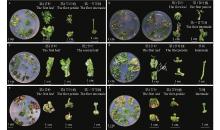
图1
6种野生溲疏属植物不同外植体的分化情况 a–f:粉红溲疏、钩齿溲疏、褐毛溲疏、长江溲疏、白溲疏、光萼溲疏。a–f: D.rubens, D. baroniana, D. pilosa,D. schneideriana, D. albida, and D. glabrata."
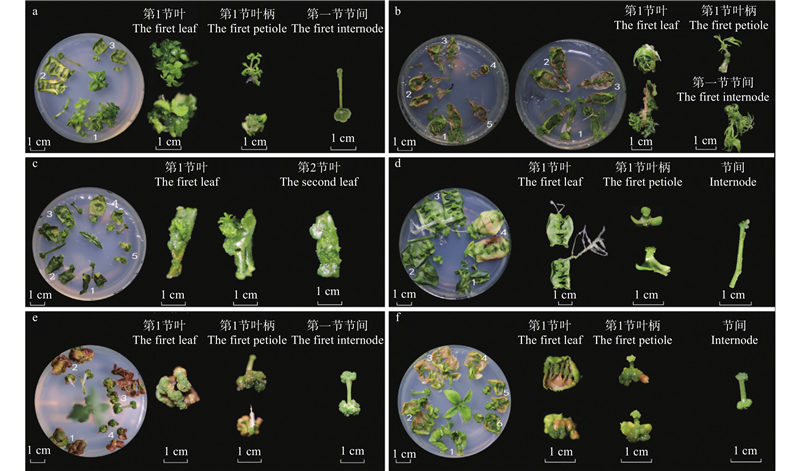
表2
基因型及外植体对溲疏属植物组培再生的影响①"
| 处理 Treatment | 基因型 Genotype | 外植体类型 Explant type | 外植体成熟度 Explant maturity/node | 分化率 Differentiation rate(%) | 出芽数 Number of sprouts |
| I | 粉红溲疏 D.rubens | 叶片Leaf | 1 | 100.00±0.00a | 9.63±1.30b |
| 2 | 35.00±0.49cd | 2.25±2.43f | |||
| 3~5 | 0.00±0.00f | 0.00±0.00f | |||
| 叶柄Petiole | 1 | 75.00±0.44b | 5.38±2.45d | ||
| 2 | 25.00±0.44de | 1.38±1.92fg | |||
| 3 | 10.00±0.31ef | 0.38±1.92gh | |||
| 4 | 10.00±0.31ef | 0.25±0.46gh | |||
| 5 | 0.00±0.00f | 0.00±0.00h | |||
| 节间Internode | 1~5 | 0.00±0.00f | 0.00±0.00h | ||
| II | 钩齿溲疏 D.baroniana | 叶片Leaf | 1 | 75.00±0.44b | 16.5±0.73a |
| 2 | 10.00±0.32ef | 4.15±0.88e | |||
| 3~5 | 0.00±0.00f | 0.00±0.00h | |||
| 叶柄Petiole | 1 | 5.23ef±0.23c | 6.05±0.94cd | ||
| 2 | 5.88ef±0.32b | 5.90±0.97cd | |||
| 3~5 | 0.00±0.00f | 0.00±0.00h | |||
| 节间Internode | 1 | 4.76ef±0.23c | 6.75±0.64c | ||
| 2~5 | 0.00±0.00f | 0.00±0.00h | |||
| III | 褐毛溲疏 D.pilosa | 叶片Leaf | 1 | 75.00±0.45b | 3.64±0.92e |
| 2 | 50.00±0.52c | 1.18±0.40fgf | |||
| 叶柄Petiole | 1~5 | 0.00±0.00f | 0.00±0.00h | ||
| 节间Internode | 1~5 | 0.00±0.00f | 0.00±0.00h | ||
| IV | 长江溲疏 D.schneideriana | 叶片Leaf 叶柄Petiole 节间Internode | 1~5 | 0.00±0.00f | 0.00±0.00h |
| V | 白溲疏 Deutzia albida | 叶片Leaf 叶柄Petiole 节间Internode | 1~5 | 0.00±0.00f | 0.00±0.00h |
| VI | 光萼溲疏 D.glabrata | 叶片Leaf 叶柄Petiole 节间Internode | 1~5 | 0.00±0.00f | 0.00±0.00h |
表3
IBA浓度对粉红溲疏生根培养的影响①"
| 处理 Treatment | 吲哚丁酸IBA/ (mg·L–1) | 生根率 Rootability (%) | 根长 Root length/cm | 株高 Plant height/cm |
| I | 0.25 | 100a | 4.23±0.50b | 5.75±0.86b |
| II | 0.5 | 100a | 5.38±0.79a | 7.09±0.93a |
| III | 1 | 100a | 5.19±0.92ab | 5.93±0.78b |
| IV | 2 | 100a | 3.27±0.76c | 4.50±0.85c |
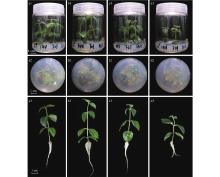
图2
IBA浓度对粉红溲疏生根培养的影响"

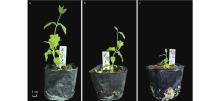
图3
土壤基质对粉红溲疏炼苗移栽的影响 a–c:珍珠岩∶营养土=3∶7;6∶4; 9∶1。a–c: Pearlite∶nutrient soil =3∶7; 6∶4; 9∶1."
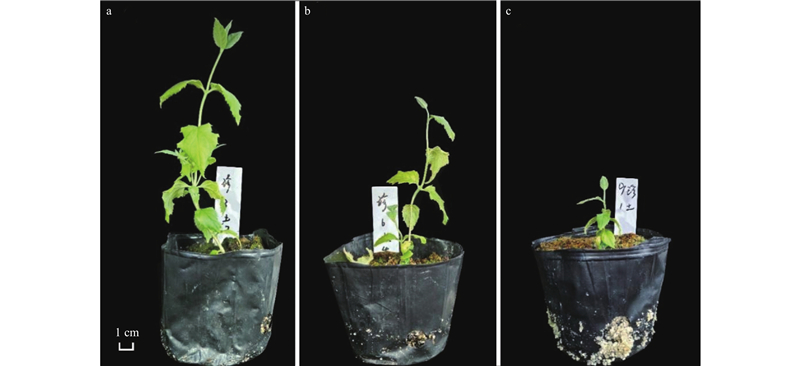
表4
土壤基质对粉红溲疏炼苗移栽的影响①"
| 处理 Treatment | 基质配比 Substrate ratio | 成活率 Survival rate (%) | 株高 Plant height/cm | 植株状态 Healthy states of plant |
| Ⅰ | 珍珠岩∶营养土=3∶7 Perlite∶nutrient soil =3∶7 | 100.00±0.00a | 15.68±0.96a | 叶片绿、长势好 Leaves remained green with robust growth |
| Ⅱ | 珍珠岩∶营养土=6∶4 Perlite∶nutrient soil = 6∶4 | 93.75±0.25a | 13.10±0.84b | 叶片黄、长势较好 Leaves turned yellow and grew fairly well |
| Ⅲ | 珍珠岩∶营养土=9∶1 Perlite∶nutrient soil = 9∶1 | 81.25±0.40a | 5.92±0.53c | 叶片黄、长势差 Leaves were yellow and growth was poor |
图4
不同特美汀质量浓度处理下外植体污染率及分化率 a–c:特美汀浓度为50、100、200 mg·L–1;a3–c3:再生植株转接后状态。a–c: The concentrations of Timentin are 50, 100 and 200 mg·L–1; a3–c3: Status of regenerated plants after transfer."
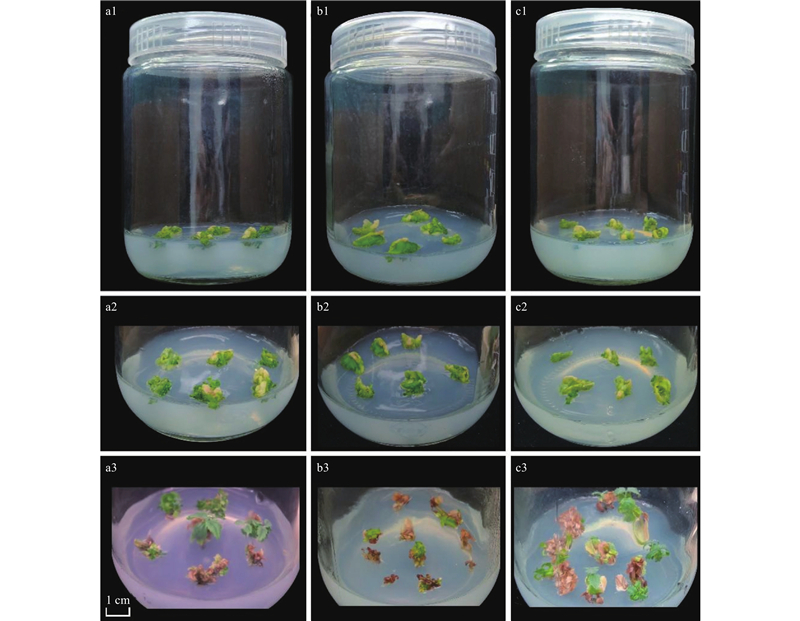
表5
不同特美汀质量浓度处理下外植体污染率及分化率①"
| 处理 Treatment | 特美汀 Timentin/ (mg·L–1) | 污染率 Contamination rate (%) | 分化率 Differentiation rate (%) |
| I | 50 | 0.00±0.00a | 83.33±0.38a |
| II | 100 | 0.00±0.00a | 72.22±0.46a |
| III | 200 | 0.00±0.00a | 68.75±0.47a |
图5
粉红溲疏阳性植株表型"
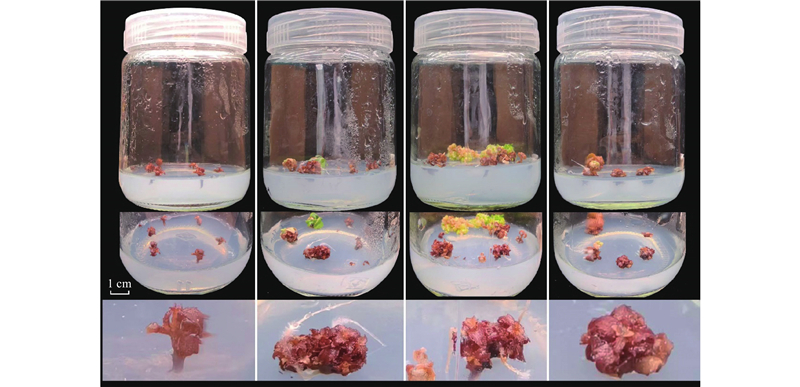
图6
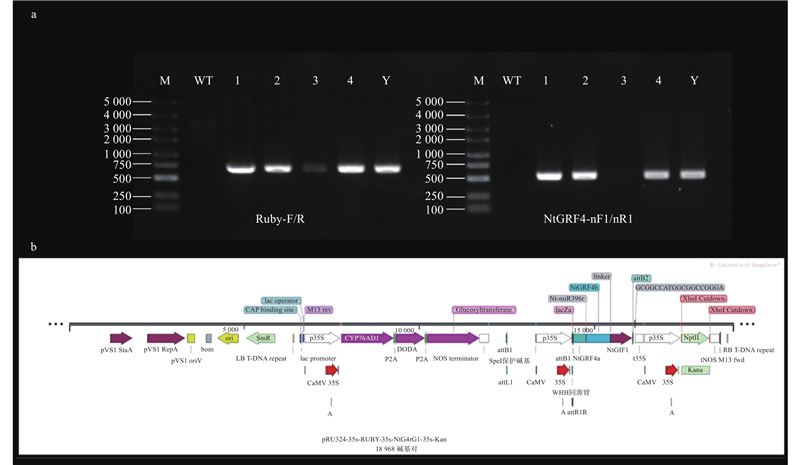
报告基因表达分析 a:Ruby及NtGRF4-NtGIF1的PCR扩增电泳鉴定;b:载体构建示意图;M:5 000 bp DNA Marker;WT:野生型粉红溲疏植株;1–4:转基因再生植株;Y:阳性菌液对照。a: PCR amplification and electrophoresis identification of Ruby and NtGRF4-NtGIF1; b: Schematic diagram of construction of vector; M: 5 000 bp DNA Marker; WT: Wild-type D. rubens; 1–4: Transgenic regenerated plants; Y: Positive bacterial liquid control."
|
柴慈江, 赵桐琳, 史燕山, 等. 矮溲疏组培快繁中的茎芽增殖与生根培养研究. 安徽农业科学, 2010, 38 (17): 8871- 8873.
doi: 10.3969/j.issn.0517-6611.2010.17.016 |
|
|
Chai C J, Zhao T L, Shi Y S, et al. Studies on micro-shoot multiplication and rooting during in vitro propagation of Deutzia hybrida ‘Boule’. Journal of Anhui Agricultural Sciences, 2010, 38 (17): 8871- 8873.
doi: 10.3969/j.issn.0517-6611.2010.17.016 |
|
| 陈美倩. 2023. 珠芽景天的叶片扦插与直接遗传转化. 贵阳: 贵州大学. | |
| Chen M Q. 2023. Leaf cuttage and directly genetic transformation of Sedum bulbiferum Makino (Crassulaceae). Guiyang: Guizhou University. [in Chinese] | |
| 陈 彤, 赵 洁, 张 艾, 等. 2025. 一种重组载体 PK7M34GW-NtRGRF4-GIF1-RUBY 及其构建方法和提高烟草转化再生效率的方法: CN120519501A. 2025−08−22. | |
| Chen T, Zhao J, Zhang A, et al. 2025. A recombinant vector PK7M34GW-NtRGRF4-GIF1-RUBY and its construction method, as well as the method for improving transformation and regeneration efficiency of tobacco: CN120519501A. 2025−08−22. [in Chinese] | |
| 管少花. 2014. ‘蜂蜜罐’枣不同外植体再生能力与转化Bt基因初探. 郑州: 河南农业大学. | |
| Guan S H. 2014. Regeneration capacity of different explants from ‘Fengmiguan’ (Zizyphus jujuba Mill. ) and transformation of Bt gene. Zhengzhou: Henan Agricultural University. [in Chinese] | |
|
胡欣荃, 古 今, 杨姝琦, 等. 木本植物再生和遗传转化的研究进展. 分子植物育种, 2023, 21 (16): 5322- 5329.
doi: 10.13271/j.mpb.021.005322 |
|
|
Hu X Q, Gu J, Yang S Q, et al. Research progress on regeneration and genetic transformation of woody plants. Molecular Plant Breeding, 2023, 21 (16): 5322- 5329.
doi: 10.13271/j.mpb.021.005322 |
|
|
简六梅, 肖英杰, 严建兵. 从头驯化: 作物品种设计与培育的新方向. 遗传, 2023, 45 (9): 741- 753.
doi: 10.16288/j.yczz.23-194 |
|
|
Jian L M, Xiao Y J, Yan J B. De novo domestication: a new way for crop design and breeding. Hereditas (Beijing), 2023, 45 (9): 741- 753.
doi: 10.16288/j.yczz.23-194 |
|
|
靳慧卿, 米福贵, 闫利军, 等. 不同外植体及植物生长调节剂对几种豆科牧草体细胞胚诱导的影响. 植物生理学报, 2015, 51 (12): 2169- 2174.
doi: 10.13592/j.cnki.ppj.2015.0379 |
|
|
Jin H Q, Mi F G, Yan L J, et al. Effects of different explants and plant growth regulator combinations on somatic embryo induction of leguminous forage plants. Plant Physiology Journal, 2015, 51 (12): 2169- 2174.
doi: 10.13592/j.cnki.ppj.2015.0379 |
|
| 李家艳. 2024. 德阳柿遗传转化体系建立及DdFT1早花因子功能研究. 杨陵: 西北农林科技大学. | |
| Li J Y. Establishment of a genetic transformation system for Diospyros deyangensis and study on the function of DdFT1 early flower factor. Yangling: Northwest A&F University. [in Chinese] | |
| 李雯霞. 2025. ‘富有’甜柿亲和砧木君迁子组培快繁及叶片再生体系的建立. 杨陵: 西北农林科技大学. | |
| Li W W. 2025. Establishment of a rapid tissue culture system and leaf regeneration system for the affinity rootstock Diospyros lotus of the 'Fuyu' persimmon. Yangling: Northwest A&F University. [in Chinese] | |
|
马彩霞, 穆国俊, 侯名语, 等. 一种快速、高效花生植株再生体系的建立. 植物生理学报, 2013, 49 (12): 1333- 1338.
doi: 10.13592/j.cnki.ppj.2013.12.006 |
|
|
Ma C X, Mu G J, Hou M Y, et al. A rapid and eff icient method for peanut regeneration. Plant Physiology Journal, 2013, 49 (12): 1333- 1338.
doi: 10.13592/j.cnki.ppj.2013.12.006 |
|
| 史 雪. 2013. 《中华本草》收载具有利水功效药物的药性规律研究. 济南: 山东中医药大学. | |
| Shi X. 2013. Research on Chinese herbs which have diuresis effect in Chinese materia medica. Jinan: Shandong University of Traditional Chinese Medicine. [in Chinese] | |
| 史宝胜, 刘冬云, 杨新兵, 等. 野生大花溲疏的组织培养和快速繁殖. 植物生理学通讯, 2006a, 42 (1): 68. | |
| Shi B S, Liu D Y, Yang X B, et al. Tissue culture and rapid propagation of the wild Deutzia grandiflora Bge. Plant Physiology Communications, 2006a, 42 (1): 68. | |
| 史宝胜, 刘冬云, 杨新兵, 等. 2006b. 野生小花溲疏繁殖方法研究. 中国园艺学会第七届青年学术讨论会论文集. 602–605. | |
| Shi B S, Liu D Y, Yang X B, et al. 2006. Study on the reproduction method of wild Deutzia parviflora. Proceedings of the 7th Youth Symposium of Chinese Horticultural Society. Chinese Society for Horticultural Science, 602–605. [in Chinese] | |
|
苏家乐, 刘晓青, 何丽斯, 等. 杜鹃品种‘江南春早’叶片离体再生体系的建立. 分子植物育种, 2019, 17 (4): 1283- 1289.
doi: 10.13271/j.mpb.017.001283 |
|
|
Su J L, Liu X Q, He L S, et al. Establishment of in vitro leaf regeneration system of a Rhododendron cultivar ‘Jiangnan Chunzao’. Molecular Plant Breeding, 2019, 17 (4): 1283- 1289.
doi: 10.13271/j.mpb.017.001283 |
|
| 孙晓波, 苏家乐, 陈双双, 等. 大花绣球‘无尽夏’组培苗叶片再生植株的研究. 中国农学通报, 2020, 36 (16): 67- 72. | |
| Sun X B, Su J L, Chen S S, et al. Plantlet regeneration from leaves of tissue culture seedlings of Hydrangea macrophylla ‘endless summer’. Chinese Agricultural Science Bulletin, 2020, 36 (16): 67- 72. | |
| 孙晓波, 苏家乐, 刘晓青, 等. 羊踯躅离体叶片再生体系的建立. 中国农学通报, 2018, 34 (10): 75- 81. | |
| Sun X B, Su J L, Liu X Q, et al. Establishment of in vitro leaf regeneration system of Rhododendron molle (Blume) G. Don. Chinese Agricultural Science Bulletin, 2018, 34 (10): 75- 81. | |
|
王亚鑫, 尚 鑫, 郝英男, 等. 2种溲疏叶片不定芽诱导的组织培养体系构建. 林业科学, 2024, 60 (10): 164- 174.
doi: 10.11707/j.1001-7488.LYKX20230500 |
|
|
Wang Y X, Shang X, Hao Y N, et al. Establishment of tissue culture systems for inducing adventitious buds from leaves of two Deutzia species. Scientia Silvae Sinicae, 2024, 60 (10): 164- 174.
doi: 10.11707/j.1001-7488.LYKX20230500 |
|
| 王亚鑫. 2024. 溲疏属植物代表种从头驯化的繁育技术体系. 杨陵: 西北农林科技大学. | |
| Wang Y X. 2024. The breeding techniques system for de novo domestication of Deutzia representative species. Yangling: Northwest A&F University. [in Chinese] | |
|
吴 洁, 谭文芳, 阎文昭, 等. 不同抗生素对甘薯遗传转化的影响. 西南农业学报, 2005, 18 (1): 77- 79.
doi: 10.3969/j.issn.1001-4829.2005.01.019 |
|
|
Wu J, Tan W F, Yan W Z, et al. Effects of different antibiotics on genetic transformation of sweet potato. Southwest China Journal of Agricultural Sciences, 2005, 18 (1): 77- 79.
doi: 10.3969/j.issn.1001-4829.2005.01.019 |
|
| 咸宏康. 2019. 金樱子器官再生体系的建立和遗传转化的初步探索. 南京: 南京农业大学. | |
| Xian H K. 2019. Establishment of plant regeneration system and preliminary studies on genetic transformation of Rosa laevigata Michx. Nanjing: Nanjing Agricultural University. [in Chinese] | |
| 徐成成, 刘 锦, 吴 恩, 等. 2026. 基于组织培养的木本植物器官发生型再生研究进展. 浙江农林大学学报, 43(3): 671–680. | |
| Xu Chengcheng, Liu Jin, Wu En, et al. 2025. Research progress on organogenesis regeneration of woody plants based on tissue culture. Journal of Zhejiang A&F University, 43(3): 671–680. [in Chinese] | |
| 徐长彬, 李 林, 方志蒙, 等. 2025. ‘脐红’猕猴桃组培再生和遗传转化体系建立与优化. 浙江林业科技, 45(2): 64–70. | |
| Xu C B, Li L, Fang Z M, et al. 2025. Optimization of regeneration process in the genetic transformation system of ‘qihong' Actinidia chinensis. Journal of Zhejiang Forestry Science and Technology, 45(2): 64–70. [in Chinese] | |
| 张荦麒. 2023. 微型月季快繁体系的建立及再生体系的初步研究. 北京: 北京林业大学. | |
| Zhang L Q. 2023. Establishment of rapid propagation and preliminary studies on regeneration system of miniature Roses. Beijing: Beijing Forestry University. [in Chinese] | |
|
朱晓宇, 赵 楚, 辛建攀, 等. 溲疏属种质资源研究进展及其园林应用前景分析. 中国野生植物资源, 2020, 39 (7): 69- 74.
doi: 10.3969/j.issn.1006-9690.2020.07.015 |
|
|
Zhu X Y, Zhao C, Xin J P, et al. Research progress of Deutzia germplasm resources and analysis of its landscape application prospect. Chinese Wild Plant Resources, 2020, 39 (7): 69- 74.
doi: 10.3969/j.issn.1006-9690.2020.07.015 |
|
|
Aregawi K, Shen J Q, Pierroz G, et al. Morphogene-assisted transformation of Sorghum bicolor allows more efficient genome editing. Plant Biotechnology Journal, 2022, 20 (4): 748- 760.
doi: 10.1111/pbi.13754 |
|
| Banerjee P, Maity S, Maiti S S. Influence of genotype on in vitro multiplication potential of Arachis hypogaea L. Acta Botanica Croatica, 2007, 66 (1): 15- 23. | |
|
Bie X M, Cao Y, Li M L, et al. Chromatin accessibility and TaSCR-TaLBD17 circuitry shape genotypic regeneration capacity in wheat. Cell Reports, 2026, 45 (1): 116743.
doi: 10.1016/j.celrep.2025.116743 |
|
|
Debernardi J M, Tricoli D M, Ercoli M F, et al. A GRF–GIF chimeric protein improves the regeneration efficiency of transgenic plants. Nature Biotechnology, 2020, 38 (11): 1274- 1279.
doi: 10.1038/s41587-020-0703-0 |
|
|
Gasparini K, Figueiredo Y G, Araújo W L, et al. De novo domestication in the Solanaceae: advances and challenges. Current Opinion in Biotechnology, 2024, 89, 103177.
doi: 10.1016/j.copbio.2024.103177 |
|
|
He Y B, Zhang T, Sun H, et al. A reporter for noninvasively monitoring gene expression and plant transformation. Horticulture Research, 2020, 7, 152.
doi: 10.1038/s41438-020-00390-1 |
|
|
Hembree W G, Ranney T G, Lynch N P, et al. Identification, genome sizes, and ploidy of Deutzia. Journal of the American Society for Horticultural Science, 2020, 145 (2): 88- 94.
doi: 10.21273/jashs04779-19 |
|
| Iwase A, Harashima H, Ikeuchi M, et al. WIND1 promotes shoot regeneration through transcriptional activation of enhancer of shoot regeneration in Arabidopsis. The Plant Cell, 2017, 29 (1): 54- 69. | |
|
Lee K, Kang M, Ji Q, et al. New T-DNA binary vectors with NptII selection and RUBY reporter for efficient maize transformation and targeted mutagenesis. Plant Physiology, 2023, 192 (4): 2598- 2603.
doi: 10.1093/plphys/kiad231 |
|
|
Liu Z Q, Chen O, Wall J B J, et al. Systematic comparison of 2A peptides for cloning multi-genes in a polycistronic vector. Scientific Reports, 2017, 7 (1): 2193.
doi: 10.1038/s41598-017-02460-2 |
|
|
Lo K H. Factors affecting shoot organogenesis in leaf disc culture of African violet. Scientia Horticulturae, 1997, 72 (1): 49- 57.
doi: 10.1016/S0304-4238(97)00116-7 |
|
|
Long Y, Yang Y, Pan G T, et al. New insights into tissue culture plant-regeneration mechanisms. Frontiers in Plant Science, 2022, 13, 926752.
doi: 10.3389/fpls.2022.926752 |
|
| Lowe K, Wu E, Wang N, et al. Morphogenic regulators Baby boom and Wuschel improve monocot transformation. The Plant Cell, 2016, 28 (9): 1998- 2015. | |
|
Morinaka H, Coleman D, Sugimoto K, et al. Molecular mechanisms of plant regeneration from differentiated cells: approaches from historical tissue culture systems. Plant & Cell Physiology, 2023, 64 (3): 297- 304.
doi: 10.1093/pcp/pcac172 |
|
|
Nap J P, Bijvoet J, Stiekema W J. Biosafety of kanamycin-resistant transgenic plants. Transgenic Research, 1992, 1 (6): 239- 249.
doi: 10.1007/BF02525165 |
|
|
Nauerby B, Billing K, Wyndaele R. Influence of the antibiotic timentin on plant regeneration compared to carbenicillin and cefotaxime in concentrations suitable for elimination of Agrobacterium tumefaciens. Plant Science, 1997, 123 (1/2): 169- 177.
doi: 10.1016/s0168-9452(96)04569-4 |
|
| Nicholson K L, Tarlyn N, Armour T, et al. 2012. Effect of phyllotactic position and cultural treatments toward successful direct shoot organogenesis in dwarf ‘Pixie’ grapevine (Vitis vinifera L. ). Plant Cell, Tissue and Organ Culture (PCTOC), 111(1): 123–129. | |
|
Omori M, Yamane H, Tao R. Comparative transcriptome and functional analyses provide insights into the key factors regulating shoot regeneration in highbush blueberry. Horticulture Research, 2024, 11 (6): uhae114.
doi: 10.1093/hr/uhae114 |
|
|
Pan J, Zhao F, Zhang G F, et al. Control of de novo root regeneration efficiency by developmental status of Arabidopsis leaf explants. Journal of Genetics and Genomics, 2019, 46 (3): 133- 140.
doi: 10.1016/j.jgg.2019.03.001 |
|
|
Potokina Е К, Sushchenko A S. Genetic mapping of loci affecting embryogenic callus formation and in vitro regeneration in cereals and leguminous crops. Vavilovskii Zhurnal Genetiki i Selektsii, 2025, 29 (4): 508- 516.
doi: 10.18699/vjgb-25-54 |
|
|
Rowan B A, Reeves M, Hays C, et al. Monitoring the stability of transgene expression in lettuce using the RUBY reporter. Plant Cell Reports, 2025, 44 (12): 281.
doi: 10.1007/s00299-025-03665-w |
|
|
Sharma P, Yan F, Doronina V A, et al. 2A peptides provide distinct solutions to driving stop-carry on translational recoding. Nucleic Acids Research, 2012, 40 (7): 3143- 3151.
doi: 10.1093/nar/gkr1176 |
|
|
Singh R K, Prasad M. Advances in Agrobacterium tumefaciens-mediated genetic transformation of graminaceous crops. Protoplasma, 2016, 253 (3): 691- 707.
doi: 10.1007/s00709-015-0905-3 |
|
|
Słomnicka R, Cieplak M, Antosiewicz M, et al. Identification of quantitative trait loci for in vitro plant regeneration from leaf microexplants in cucumber (Cucumis sativus L. ). Journal of Applied Genetics, 2025, 66 (3): 545- 555.
doi: 10.1007/s13353-024-00927-3 |
|
| Stamp J A, Colby S M, Meredith C P. 1990. Direct shoot organogenesis and plant regeneration from leaves of grape (Vitis spp. ). Plant Cell, Tissue and Organ Culture, 22(2): 127–133. | |
|
Tang L P, Zhai L M, Li J M, et al. Time-resolved reprogramming of single somatic cells into totipotent states during plant regeneration. Cell, 2025, 188 (24): 7009- 7015.
doi: 10.1016/j.cell.2025.10.035 |
|
|
The Angiosperm Phylogeny Group. An update of the Angiosperm Phylogeny Group classification for the orders and families of flowering plants: APG IV. Botanical Journal of the Linnean Society, 2016, 181 (1): 1- 20.
doi: 10.1111/j.1095-8339.2009.00996.x |
|
|
Wang K, Shi L, Liang X N, et al. The gene TaWOX5 overcomes genotype dependency in wheat genetic transformation. Nature Plants, 2022, 8 (2): 110- 117.
doi: 10.1038/s41477-021-01085-8 |
|
|
Yu H, Li J Y. Short- and long-term challenges in crop breeding. National Science Review, 2021, 8 (2): nwab002.
doi: 10.1093/nsr/nwab002 |
|
|
Yu J J, Deng S L, Huang H, et al. Exploring the potential applications of the noninvasive reporter gene RUBY in plant genetic transformation. Forests, 2023, 14 (3): 637.
doi: 10.3390/f14030637 |
|
|
Zhai N, Pan X, Zeng M H, et al. Developmental trajectory of pluripotent stem cell establishment in Arabidopsis callus guided by a quiescent center-related gene network. Development, 2023, 150 (5): dev200879.
doi: 10.1242/dev.200879 |
|
| Zhang P, Yu Z Y, Cheng Z M, et al. In vitro explants regeneration of the grape ‘Wink’ (Vitis vinifera L. ‘Wink’). Journal of Plant Breeding and Crop Science, 2011, 3 (11): 276- 282. | |
|
Zhang Q, Zhang Y, Lu M H, et al. A novel ternary vector system united with morphogenic genes enhances CRISPR/cas delivery in maize. Plant Physiology, 2019, 181 (4): 1441- 1448.
doi: 10.1104/pp.19.00767 |
|
|
Zhang X M, Wu Y F, Li Z, et al. Advancements in plant regeneration and genetic transformation of grapevine (Vitis spp. ). Journal of Integrative Agriculture, 2021, 20 (6): 1407- 1434.
doi: 10.1016/S2095-3119(20)63586-9 |
|
|
Zsögön A, Cermak T, Voytas D, et al. Genome editing as a tool to achieve the crop ideotype and de novo domestication of wild relatives: Case study in tomato. Plant Science, 2017, 256, 120- 130.
doi: 10.1016/j.plantsci.2016.12.012 |
| [1] | 张薇,张鑫,毕泉鑫,刘肖娟,姜国维,宁楚龙,赵海艳,王利兵. 发根农杆菌介导文冠果毛状根遗传转化体系的构建[J]. 林业科学, 2026, 62(8): 120-128. |
| [2] | 焦阳,乔静,曾智新,王深,杨雪鑫,张英睿,杨玉冰,赵禹森,舒文波. 84K杨组培苗高效毛状根遗传转化体系构建[J]. 林业科学, 2026, 62(1): 122-132. |
| [3] | 王亚鑫,尚鑫,郝英男,宁小艺,马跃,甘思楠,李进宇,张鑫. 2种溲疏叶片不定芽诱导的组织培养体系构建[J]. 林业科学, 2024, 60(10): 164-174. |
| [4] | 陈赢男,胡传景,诸葛强,胡建军,尹佟明. 杨树农杆菌遗传转化研究30年[J]. 林业科学, 2022, 58(12): 114-129. |
| [5] | 岑云昕,刘佳,陈发菊,杨敬元,刘强,王韬,梁宏伟. 农杆菌介导的楸树遗传转化体系[J]. 林业科学, 2021, 57(8): 195-204. |
| [6] | 杨晓红,陈晓阳. 木糖选择系统下xylA & BADH双价基因对二色胡枝子的遗传转化[J]. 林业科学, 2021, 57(6): 74-84. |
| [7] | 刘闵豪,徐郡儡,叶靖,李周岐,范睿深,李龙. 农杆菌介导的杜仲叶片愈伤组织遗传转化体系[J]. 林业科学, 2020, 56(2): 79-88. |
| [8] | 梁璧,张佳琦,任飞,胡恒康,徐川梅,胡渊渊,黄有军,娄和强,张启香. 山核桃贝壳杉烯氧化酶基因CcKO的克隆和表达分析[J]. 林业科学, 2020, 56(10): 70-82. |
| [9] | 谷战英, 杨若楠, 陈昊. 油桐叶肉细胞原生质体分离及瞬时转化体系的建立[J]. 林业科学, 2018, 54(1): 46-53. |
| [10] | 程珍霞, 胡海涛, 杨莉, 王长春, 郭卫东, 杨玲. 超表达牛奶子EutPDS提高番茄果实番茄红素含量[J]. 林业科学, 2017, 53(1): 62-69. |
| [11] | 罗在柒, 郭辉力, 杨亚东, 杨明峰, 马兰青, 王有年. 农杆菌介导虎杖芪合酶基因遗传转化壶瓶枣的研究[J]. 林业科学, 2015, 51(10): 101-109. |
| [12] | 张伟溪, 刘浡洋, 丁昌俊, 张冰玉, 黄秦军, 褚延广, 苏晓华. 欧美杨锌指蛋白转录因子基因(ZxZF)的遗传转化及抗旱性初步分析[J]. 林业科学, 2014, 50(3): 31-37. |
| [13] | 李思蒙;王永林;黄冬辉;田呈明. 杨树炭疽病菌原生质体遗传转化的建立及绿色荧光蛋白的表达[J]. , 2013, 49(5): 121-127. |
| [14] | 欧阳乐军;刘媛;黄真池;曾富华. 转TSRF 1基因尾叶桉的培育及其广谱抗病性[J]. 林业科学, 2013, 49(4): 46-53. |
| [15] | 黄艳;刘虹;袁丽;贾之春;罗克明. 过量表达LAR3和Bbchit1以提高毛白杨对叶枯病的抗性[J]. 林业科学, 2012, 48(7): 92-97. |
| 阅读次数 | ||||||
|
全文 |
|
|||||
|
摘要 |
|
|||||

