
Scientia Silvae Sinicae ›› 2026, Vol. 62 ›› Issue (2): 66-74.doi: 10.11707/j.1001-7488.LYKX20240451
• Frontiers and hot topics • Previous Articles
Hao Cheng1( ),Tingting Chen1,Jianren Ye1,*(),Anshun Ni1,2
Received:2024-07-16
Revised:2025-10-16
Online:2026-02-25
Published:2026-03-04
Contact:
Jianren Ye
E-mail:ch248375@njfu.edu.cn;jrye@njfu.edu.cn
CLC Number:
Hao Cheng,Tingting Chen,Jianren Ye,Anshun Ni. Relationship between External Symptoms of Pine Wilt Disease and the Effectiveness of Disease Treatment[J]. Scientia Silvae Sinicae, 2026, 62(2): 66-74.
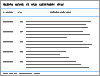
Table 1
Symptom progression in artificially inoculated 4-year-old Pinus massoniana"
| 感病阶段 Stage of infection | 外部症状 External symptoms | 距接种时天数 Days post inoculationd |
| 无症状阶段 No symptom stage | 全株针叶健康,未变色 The whole plant needles are healthy and not discolored | 5 |
| 早期阶段 Early stage | 仅接种枝针叶变色 Only inoculated branch needles discoloration | 10 |
| 中晚期阶段 Middle and late stage | 除接种枝外,松树上还有其他部位针叶变色 Except for the inoculated branches,the needles in other parts of the pine seedlings are discolored | 20 |
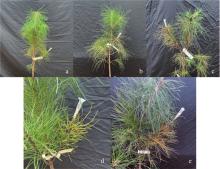
Fig.1
Symptom manifestations at different disease stages in 4-year-old Pinus massoniana"
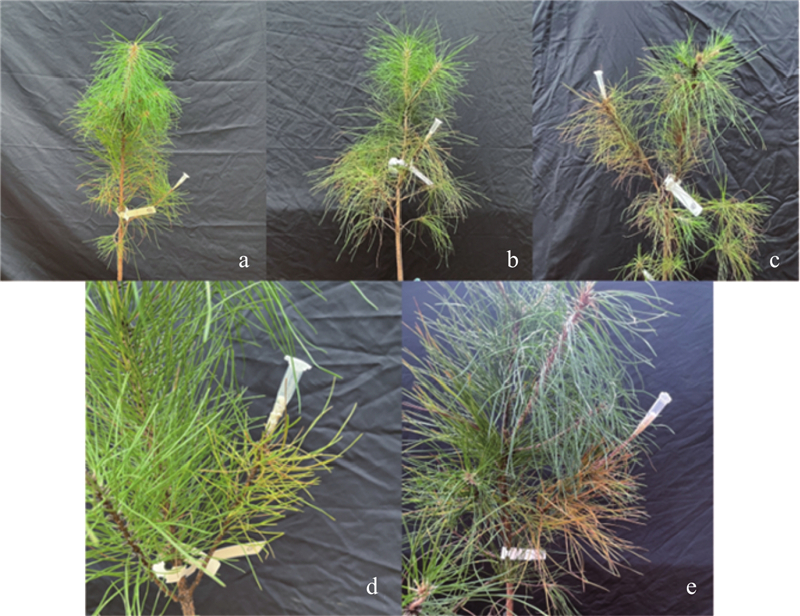
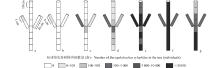
Fig.2
Temporal dynamics of Bursaphelenchus xylophilus population distribution and dispersal patterns in Pinus massoniana following inoculation "
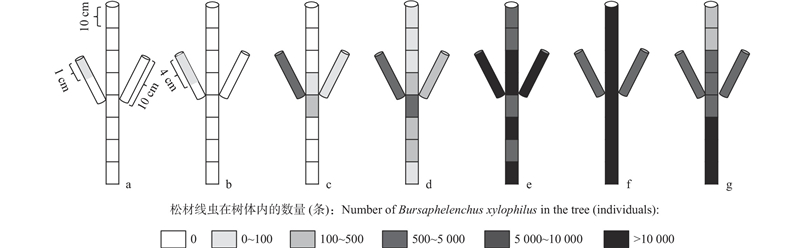
Table 2
Efficacy of trunk injection treatment at different disease stages for 4-year-old Pinus massoniana"
| 感病阶段 Stage of infection | 2%甲维盐 2% emamectin benzoate | ||
| 注药株数 Number of injections | 存活株数 Number of cured plants | 存活率 Survival rate (%) | |
| 无症状期(全株未变色) Asymptomatic stage (whole plant needles are not discolored) | 5 | 3 | 60 |
| 早期(仅接种枝针叶变色) Early stage (only needles of inoculated branches discolored) | 5 | 1 | 20 |
| 中、晚期(多个枝条针叶叶变色) Middle and late stage (needles of multiple branches discolored) | 5 | 0 | 0 |
Table 3
Relationship between the dispersal of Bursaphelenchus xylophilus and host symptom manifestation in 8-year-old Pinus thunbergii"
| 感病阶段 Stage of infection | 接种后天数及对应症状 Days after inoculation and corresponding symptoms | 松材线虫在黑松树体内扩散情况 Dispersal dynamics of Bursaphelenchus xylophilus within Pinus thunbergii | 松材线虫扩散速度 Dispersal speed of Bursaphelenchus xylophilus/(cm·d?1) |
| 发病前 Pre-onset | 外观全部正常绿色 The appearance of the tree is all normal green | 松材线虫基本聚集在接种点附近 Bursaphelenchus xylophilus primarily clusters around the inoculation site | 2.5 |
| 早期1 Early stage 1 | 25 天后仅接种枝针叶开始褪绿 After 25 days, only the needle leaves of the inoculated branches begin to fade | 松材线虫开始在接种枝内大量繁殖,移动速度慢 Bursaphelenchus xylophilus initiates rapid proliferation within inoculated branches, exhibiting a slow migration rate | 1.7 |
| 早期2 Early stage 2 | 35 天后接种枝针叶开始由绿变黄 After 35 days, the needles of inoculated branches begin to turn from green to yellow | 松材线虫在接种枝内快速移动,向主干扩散 Bursaphelenchus xylophilus rapidly migrates within inoculated branches and disperses toward the trunk | 4.0 |
| 中期 Middle stage | 45 天后接种枝针叶由黄变红褐色,其他附近小枝也有出现针叶褪绿 After 45 days of inoculation, the needles of inoculated branches change from yellow to reddish brown, and the needles of other nearby twigs also show chlorosis | 松材线虫在主干内上下扩散 Bursaphelenchus xylophilus spreads vertically within the trunk | 4.0 |
| 晚期 Late stage | 55 天后针叶大部分枯萎 After 55 days, most of the needles wither | 松材线虫扩散至全株 Bursaphelenchus xylophilus spreads systemically throughout the entire plant | 4.0 |

Fig.3
Symptom development following inoculation of Bursaphelenchus xylophilus in 8-year-old Pinus thunbergii"
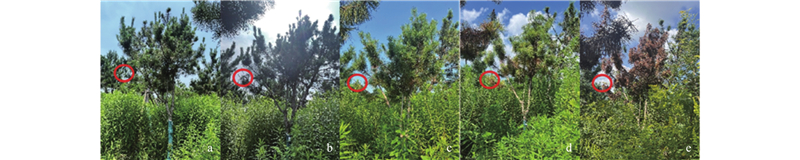
Table 4
Population density of Bursaphelenchus xylophilus in different tissues of 8-year-old Pinus thunbergii across disease progression stages"
| 感病阶段 Stage of infection | 感病部位The site of infection | |||
| 主干上 The upper part of the tree trunk/(ind.·g?1) | 主干中 The middle of the tree trunk/(ind.·g?1) | 主干下 The lower part of the tree trunk/(ind.·g?1) | 接种枝 Inoculated branches/ (ind.·g?1) | |
| 发病前 Pre-onset | 0±0Cb | 0±0Cb | 0±0Cb | 33.92±18.94Ca |
| 早期1 Early stage 1 | 0±0Cb | 0±0Cb | 0±0Cb | 223.62±69.64Ca |
| 早期2 Early stage 2 | 1.22±2.21Cb | 1.11±1.97Cb | 0.60±0.89Cb | 786.6±94.32Ba |
| 中期 Middle stage | 415.25±84.78Ab | 17.40±3.57Ac | 39.89±1.26 Ac | |
| 晚期 Late stage | 205.40±46.39Ba | 5.29±1.52Bc | 18.08±4.30Bc | 147.57±39.27Cb |
Table 5
Classification of susceptibility stages of Bursaphelenchus xylophilus on 20-year-old pine trees"
| 感病阶段 Stage of infection | 外部症状 External symptoms | 松脂情况 Condition of resin |
| 早期1 Early stage 1 | 有天牛咬食伤口,针叶未变色 There are wounds bited by mature beetles on twigs, but no needle discolouration | ++++ |
| 早期2 Early stage 2 | 有天牛咬食伤口,感染枝针叶轻微变色 There are wounds bited by mature beetles on twigs, slight discolouration of needles | +++ |
| 中期1 Middle stage 1 | 有天牛咬食伤口,单个感染枝出现枯萎 There are wounds bited by mature beetles on twigs, single infected twig wilts | + |
| 中期2 Middle stage 2 | 有天牛咬食伤口,整株针叶枯萎小于50%,树干上有产卵刻槽 There are wounds bited by mature beetles on twigs, needles of entire plant wilt less than 50%, a few oviposition scars | ? |
| 晚期 Late stage | 有天牛咬食伤口,整株针叶枯萎大于50%或变色,树干 有大量产卵刻槽等 There are wounds bited by mature beetles on twigs, needles of entire plant wilt greater than 50% or whole plant discolouration, many oviposition scars | ? |
Table 6
Treatment efficacy of injection therapy on 20-year-old pine trees at different infection stages over the past three years"
| 感病 阶段 Stage of infection | 2021 | 2022 | 2023 | 合计 Summarize | |||||||||||
| 确诊株数 Number of confirmed plants | 存活株数 Number of surviving plants | 存活率 Survival rate (%) | 确诊株数 Number of confirmed plants | 存活株数 Number of surviving plants | 存活率 Survival rate (%) | 确诊株数 Number of confirmed plants | 存活株数 Number of surviving plants | 存活率 Survival rate (%) | 确诊株数 Number of confirmed plants | 存活株数 Number of surviving plants | 存活率 Survival rate (%) | ||||
| 早期1 | 4 | 4 | 100 | 5 | 5 | 100 | 9 | 9 | 100 | 18 | 18 | 100 | |||
| Early stage 1 | |||||||||||||||
| 早期2 | 1 | 1 | 100 | 2 | 2 | 100 | 2 | 2 | 100 | 5 | 5 | 100 | |||
| Early stage 2 | |||||||||||||||
| 中期1 | 1 | 0 | 0 | 1 | 1 | 100 | 2 | 2 | 100 | 4 | 3 | 75 | |||
| Middle stage 1 | |||||||||||||||
| 中期2 | 4 | 0 | 0 | 3 | 0 | 0 | 3 | 2 | 66.7 | 10 | 2 | 20 | |||
| Middle stage 2 | |||||||||||||||
| 晚期 | 0 | 0 | 0 | 4 | 0 | 0 | 4 | 0 | 0 | 8 | 0 | 0 | |||
| Late stage | |||||||||||||||
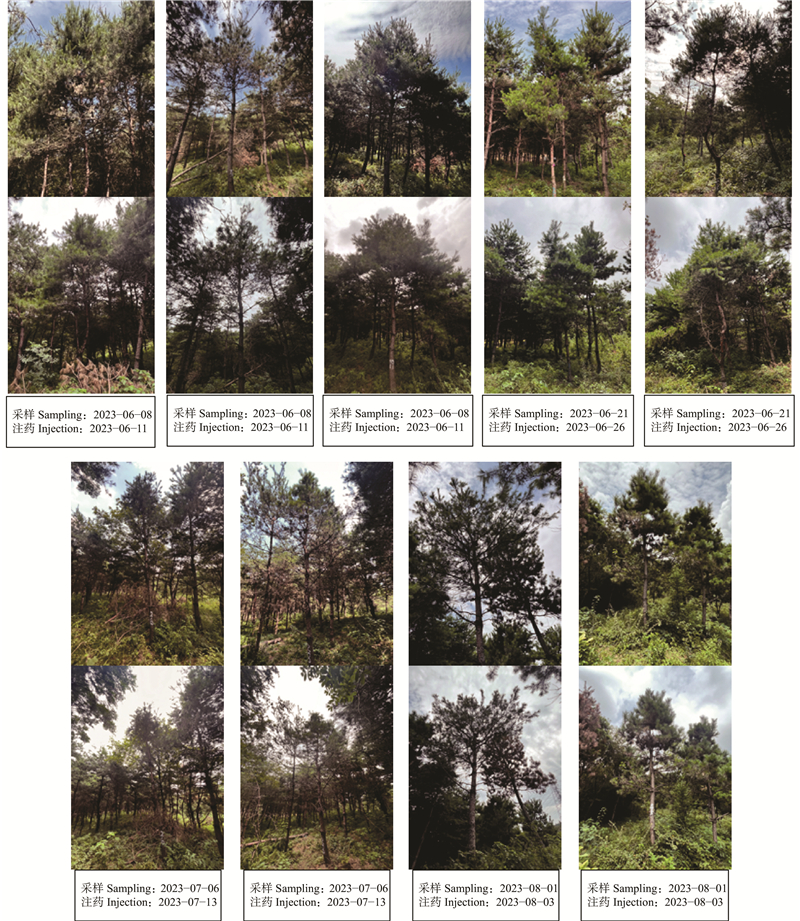
Fig.4
Pine trees survived in 2023 through therapeutic intervention implemented at early disease stage 1 of symptoms"
| 陈婷婷, 程 浩, 叶建仁, 等. 松材线虫移动状况与早期诊断及治疗效果. 林业科学, 2025, 61 (7): 241- 250. | |
| Chen T T, Cheng H, Ye J R, et al. Dynamics of Bursaphelenchus xylophilus movement with early diagnosis and treatment efficacy. Scientia Silvae Sinicae, 2025, 61 (7): 241- 250. | |
| 孙永春. 南京中山陵发现松材线虫. 江苏林业科技, 1982 (4): 47- 27. | |
| Sun Y C. Pine wood nematode found in Nanjing Zhongshan Mausoleum. Journal of Jiangsu Forestry Science & Technology, 1982 (4): 47- 27. | |
| 王玉嬿, 石运琳, 周新胜, 等. 南京地区黑松萎蔫线虫病发病规律的初步观察. 森林病虫通讯, 1985 (2): 15- 17. | |
| Wang Y L, Shi Y L, Zhou X S, et al. Preliminary observation on the occurrence regularity of wilt nematode disease of Pinus thunbergii in Nanjing area. Forest Pest Communication, 1985 (2): 15- 17. | |
| 徐华潮, 骆有庆, 张 琴. 松材线虫自然侵染对黑松、马尾松针叶含水量、色素及抗氧化酶活性的影响. 林业科学, 2012, 48 (11): 140- 143. | |
| Xu H C, Luo Y Q, Zhang Q. Changes in water content, pigments and antioxidant enzyme activities in pine needles of Pinus thunbergii and Pinus massoniana affected by pine wood nematode. Scientia Silvae Sinicae, 2012, 48 (11): 140- 143. | |
| 叶建仁. 松材线虫病在中国的流行现状、防治技术与对策分析. 林业科学, 2019, 55 (9): 1- 10. | |
| Ye J R. Epidemic status of pine wilt disease in China and its prevention and control techniques and counter measures. Scientia Silvae Sinicae, 2019, 55 (9): 1- 10. | |
| 叶为民, 冯志新. 松材线虫个体发育研究. 华南农业大学学报, 1993, 14 (2): 78- 83. | |
| Ye W M, Feng Z X. Embryology and life history studies on pine wood nematode. Bursaphelenchus Xylophilus. Journal of South China Agricultural University, 1993, 14 (2): 78- 83. | |
| Abelleira A, Picoaga A, Mansilla J P, et al. Detection of Bursaphelenchus xylophilus, causal agent of pine wilt disease on Pinus pinaster in northwestern Spain. Plant Disease, 2011, 95 (6): 776- 776. | |
| Allen E, Rott M, Humble L, et al. Application of a real-time PCR method for the detection of pine wood nematode, Bursaphelenchus xylophilus, in wood samples from lodgepole pine. Nematology, 2007, 9 (3): 351- 362. | |
|
Back M A, Bonifácio L, Inácio M L, et al. Pine wilt disease: a global threat to forestry. Plant Pathology, 2024, 73 (5): 1026- 1041.
doi: 10.1111/ppa.13875 |
|
|
Cha D, Kim D, Choi W, et al. Point-of-care diagnostic (POCD) method for detecting Bursaphelenchus xylophilus in pinewood using recombinase polymerase amplification (RPA) with the portable optical isothermal device (POID). PLoS ONE, 2020, 15 (1): e0227476.
doi: 10.1371/journal.pone.0227476 |
|
| Fukuda K. Physiological process of the symptom development and resistance mechanism in pine wilt disease. Journal of Forest Research, 1997, 2 (3): 171- 181. | |
| Fukuda K, Hogetsu T, Suzuki K. Cavitation and cytological changes in xylem of pine seedlings inoculated with virulent and avirulent isolates of Bursaphelenchus xylophilus and B. mucronatus. Journal of the Japanese Forestry Society, 1992, 74 (4): 289- 299. | |
| Ichihara Y, Fukuda K, Suzuki K. 2000. Early symptom development and histological changes associated with migration of Bursaphelenchus xylophilus in seedling tissues of Pinus thunbergii. Plant Disease, 84(6): 675−680. | |
| Ikeda T, Suzaki T. Influence of pine-wood nematodes on hydraulic conductivity and water status in Pinus thunbergii. Journal of the Japanese Forestry Society, 1984, 66 (10): 412- 420. | |
| Kuroda K. The mechanism of tracheid cavitation in trees infected with wilt diseases. Proceedings of the IUFRO Working Party, 2002, 7 (2): 17- 23. | |
|
Kusumoto D, Yonemichi T, Inoue H, et al. Comparison of histological responses and tissue damage expansion between resistant and susceptible Pinus thunbergii infected with pine wood nematode Bursaphelenchus xylophilus. Journal of Forest Research, 2014, 19 (2): 285- 294.
doi: 10.1007/s10310-013-0417-y |
|
|
Liu F, Su H J, Ding T T, et al. Refined assessment of economic loss from pine wilt disease at the subcompartment scale. Forests, 2023, 14 (1): 139.
doi: 10.3390/f14010139 |
|
|
Mamiya Y. Initial pathological changes and disease development in pine trees induced by the pine wood nematode, Bursaphelenchus xylophilus. Japanese Journal of Phytopathology, 1985, 51 (5): 546- 555.
doi: 10.3186/jjphytopath.51.546 |
|
|
Ni A S, Yang D, Cheng H, et al. Preliminary study on early diagnosis and rehabilitation treatment of pine wood nematode disease based on partial symptoms. Forests, 2023, 14 (4): 657.
doi: 10.3390/f14040657 |
|
|
Yamaguchi R, Matsunaga K, Watanabe A. Influence of temperature on pine wilt disease progression in Pinus thunbergii seedlings. European Journal of Plant Pathology, 2020, 156 (2): 581- 590.
doi: 10.1007/s10658-019-01908-7 |
|
|
Yamanobe T. Relationships between morphological traits and resistance to pine wood nematode in two Japanese pines. European Journal of Plant Pathology, 2009, 124 (4): 543- 552.
doi: 10.1007/s10658-009-9438-y |
|
|
Zas R, Moreira X, Ramos M, et al. Intraspecific variation of anatomical and chemical defensive traits in Maritime pine (Pinus pinaster) as factors in susceptibility to the pinewood nematode (Bursaphelenchus xylophilus). Trees, 2015, 29 (3): 663- 673.
doi: 10.1007/s00468-014-1143-6 |
| [1] | Hongwei Zhou,Yongzheng Li,Wenhui Guo,Yifan Chen,Haochang Hu,Siyan Zhang,Di Cui,Yumo Chen. Prediction of Subcompartment-Scale Spread of Pine Wilt Disease Based on Cellular Automata Model [J]. Scientia Silvae Sinicae, 2026, 62(1): 133-143. |
| [2] | Tingting Chen,Hao Cheng,Jianren Ye,Ying Li,Anshun Ni,Jiao Zhang. Dynamics of Bursaphelenchus xylophilus Movement with Early Diagnosis and Treatment Efficacy [J]. Scientia Silvae Sinicae, 2025, 61(7): 241-250. |
| [3] | Wanying Xie,Wenping Liu,Han Wang. UAV Images of Pine Forests for Early Detection of Pine Wood Nematode Infestation [J]. Scientia Silvae Sinicae, 2024, 60(9): 124-133. |
| [4] | Anshun Ni,yongchun Wang,Dan Yang,Xueshu Sun,Jianren Ye. Toxicity of a New Compound Medicament 2% Avermectin · 6% Fluopyram on Bursaphelenchus xylophilus [J]. Scientia Silvae Sinicae, 2022, 58(8): 18-25. |
| [5] | Minjia Wang,Jianren Ye,Yusheng Tu,Fangping Du. Screening of Wood Rot Fungi for Treating the Infected Wood by Bursaphelenchus xylophilus [J]. Scientia Silvae Sinicae, 2021, 57(6): 93-102. |
| [6] | Ye Jianren. Epidemic Status of Pine Wilt Disease in China and Its Prevention and Control Techniques and Counter Measures [J]. Scientia Silvae Sinicae, 2019, 55(9): 1-10. |
| [7] | Sun Tingyu, Wang Yanli, Shen Liyuan, Wu Xiaoqin, Zhu Lihua, Ye Jianren. Impact of Medium Components on Somatic Embryo Maturation in Pinus thunbergii [J]. Scientia Silvae Sinicae, 2019, 55(4): 178-186. |
| [8] | Lin Li, Zhou Lei, Pan Jun, Kang Lipeng, Ye Jianren, Zhu Lihua. Pathogenicity of Aseptic and Germ-Carrying Bursaphelenchus xylophilus on Pinus densiflora [J]. Scientia Silvae Sinicae, 2017, 53(5): 82-87. |
| [9] | Zhan Maokui, Yang Zhongqi, Wang Xiaoyi, Lai Yanxue, Zhang Yifeng. Capacity of Transmitting Bursaphelenchus xylophilus by the Vector Monochamus alternatus Adults [J]. Scientia Silvae Sinicae, 2014, 50(7): 74-81. |
| [10] | Xu Fuyuan;Zheng Huaying;Liu Yunpeng;Xie Chunxia;Xu Ming;Zhao Zhendong. Resistance Analysis of Pinus massoniana Provenances to Maturation Feedings by the Adult of Monochamus alternatus and Bursaphelenchus xylophilus [J]. Scientia Silvae Sinicae, 2011, 47(1): 101-106. |
| [11] | Xu Huachao;Xu Jinhua;Zhang Liqin;Lin Haiping;Yang Ping;Cheng Jianming. Virulence of Bacillus thuringiensis to Monochamus alternatus and Its biological Characteristics [J]. Scientia Silvae Sinicae, 2010, 46(4): 151-155. |
| [12] | Chen Yao.;Wang Laifa;Piao Chungen;Zhu Tianhui;Shin Sangchul;Chung Yeongjin. Effects of Wood Rotting Fungi on Stumps of Dead Wood Caused by PWN(Bursaphelenchus xylophilus) [J]. Scientia Silvae Sinicae, 2008, 44(8): 78-81. |
| [13] | Li Yan;Ye Jianren. Death Manner of Host Parenchymatous Cells in Infecting Early Stage of Pine Wilt Disease [J]. Scientia Silvae Sinicae, 2008, 44(4): 95-98. |
| [14] | Wang Laifa;Li Zhanpeng;Qing Xubing;Wang Chuanzhen;Wang Chengfa. Application of Oleoresin Exudation Method for Controlling Pine Wood Nematode Disease by Bursaphelenchus xylophilus in Changdao County of Shandong Province [J]. Scientia Silvae Sinicae, 2004, 40(3): 175-178. |
| [15] | Cao Yue;Han Zhengmin;Li Chuandao. STUDIES ON WILTING TOXIC SUBSTANCES PRODUCED IN PINES INFECTED BY PINE WOOD NEMATODES [J]. Scientia Silvae Sinicae, 2001, 37(4): 75-79. |
| Viewed | ||||||
|
Full text |
|
|||||
|
Abstract |
|
|||||
