
Scientia Silvae Sinicae ›› 2026, Vol. 62 ›› Issue (5): 69-79.doi: 10.11707/j.1001-7488.LYKX20250344
• Research papers • Previous Articles Next Articles
Dongyuan Tian,Zhaogang Liu,Lichun Jiang,Lingbo Dong*( )
)
Received:2025-05-29
Revised:2026-03-10
Online:2026-05-10
Published:2026-05-12
Contact:
Lingbo Dong
E-mail:farrell0503@126.com
CLC Number:
Dongyuan Tian,Zhaogang Liu,Lichun Jiang,Lingbo Dong. Identification of the Influencing Factors on the Regeneration Quantity of Natural Forests in the Central Part of Daxing’anling Mountains Based on Random Forest[J]. Scientia Silvae Sinicae, 2026, 62(5): 69-79.

Table 1
Basic characteristics of plots"
| 项 Item | 变量 Variables | 最小值 Min. | 平均值 Mean | 最大值 Max. | 标准差 SD | 变异系数 CV (%) |
| 林分特征 Stand characteristics | 平均胸径Mean DBH/cm | 9.50 | 13.37 | 21.10 | 2.63 | 19.67 |
| 平均树高Mean height/m | 8.80 | 11.75 | 18.20 | 2.13 | 18.13 | |
| 林木密度Tree density/( tree·hm?2) | 567.00 | 1 466.00 | 2 680.00 | 543.33 | 37.06 | |
| 单位蓄积量Volume/(m3·hm?2) | 53.47 | 127.58 | 223.11 | 39.40 | 30.88 | |
| 郁闭度Canopy density | 0.25 | 0.63 | 0.90 | 0.12 | 19.05 | |
| 灌木盖度Shrub coverage (%) | 0.00 | 15.48 | 84.00 | 20.07 | 129.65 | |
| 草本盖度Herb coverage (%) | 0.03 | 19.99 | 84.25 | 25.82 | 129.16 | |
| 立地条件 Site conditions | 海拔Elevation/m | 404.00 | 514.45 | 676.30 | 67.66 | 13.15 |
| 坡度Slope | 0.00 | 7.00 | 25.00 | 6.41 | 0.92 | |
| 坡向Aspect | 1.00 | 4.96 | 8.00 | 2.52 | 50.75 | |
| 坡位Site | 1.00 | 2.03 | 3.00 | 0.62 | 30.52 | |
| 土壤条件 Soil conditions | 酸碱度pH | 4.03 | 5.28 | 6.41 | 0.40 | 7.63 |
| OM/(g·kg?1) | 1.01 | 4.50 | 6.81 | 18.10 | 30.06 | |
| TN/(g·kg?1) | 0.67 | 3.21 | 9.11 | 1.68 | 52.36 | |
| TP/(g·kg?1) | 1.21 | 1.53 | 2.46 | 0.24 | 15.46 | |
| TK/(g·kg?1) | 6.14 | 8.28 | 10.85 | 1.28 | 15.41 | |
| 林木大小多样性 Tree size diversity | DSW | 1.54 | 2.11 | 2.89 | 0.27 | 13.03 |
| DS | 0.76 | 0.86 | 0.96 | 0.04 | 4.66 | |
| DP | 0.72 | 0.88 | 1.00 | 0.07 | 7.45 | |
| HSW | 1.23 | 1.76 | 2.12 | 0.18 | 10.52 | |
| HS | 0.67 | 0.80 | 0.87 | 0.04 | 5.07 | |
| HP | 0.72 | 0.87 | 0.99 | 0.06 | 6.45 | |
| 物种多样性 Species diversity | TSSW | 0.05 | 0.66 | 1.19 | 0.25 | 37.96 |
| TSS | 0.02 | 0.39 | 0.64 | 0.14 | 37.19 | |
| TSP | 0.07 | 0.63 | 1.00 | 0.20 | 32.18 | |
| 林分空间结构 Stand spatial structure | W | 0.41 | 0.50 | 0.75 | 0.05 | 9.12 |
| U | 0.39 | 0.50 | 0.70 | 0.04 | 8.21 | |
| M | 0.03 | 0.34 | 0.61 | 0.14 | 40.45 | |
| SDP | 0.00 | 0.63 | 1.00 | 0.39 | 61.93 | |
| 更新数量 Regeneration number | 兴安落叶松 Larix gmelinii /( tree·hm?2) | 90.00 | 899.00 | 4 550.00 | 999.39 | 111.17 |
| 白桦Betula platyphylla /( tree·hm?2) | 40.00 | 1 035.00 | 7 800.00 | 1 406.53 | 135.90 |
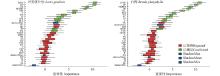
Fig.1
Selection of quantitative characteristic variables for larch and birch regeneration"
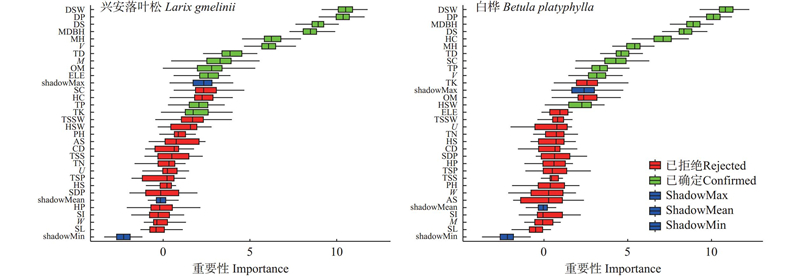
Table 2
Parameter estimation and significance of Poisson model and negative binomial model"
| 参数Parameter | 兴安落叶松Larix gmelinii | 白桦Betula platyphylla | |||||||||||
| Poisson | P | VIF | NB | P | VIF | Poisson | P | VIF | NB | P | VIF | ||
| 截距Intercept | 4.228 0 | *** | 7.114 1 | *** | 2.034 0 | *** | 2.534 4 | *** | |||||
| ELE | ?0.003 1 | *** | 2.082 2 | ?0.004 7 | *** | 1.499 2 | |||||||
| OM | 0.048 1 | *** | 1.548 0 | ||||||||||
| TP | ?1.755 0 | *** | 4.955 3 | ?0.887 5 | * | 1.532 0 | |||||||
| TK | 0.043 8 | *** | 4.108 5 | ||||||||||
| DSW | 1.567 5 | *** | 1.045 8 | 0.826 0 | *** | 8.115 0 | |||||||
| DS | 4.685 0 | *** | 3.719 1 | ||||||||||
| DP | 2.855 0 | *** | 4.215 4 | ||||||||||
| HSW | 0.169 8 | *** | 1.619 5 | 0.947 4 | * | 1.449 0 | |||||||
| MDBH | 0.230 6 | *** | 2.112 5 | ||||||||||
| MH | 0.132 1 | *** | 5.671 0 | 0.028 7 | *** | 5.523 9 | |||||||
| TD | ?0.000 1 | *** | 3.191 4 | ?0.000 5 | *** | 3.210 8 | |||||||
| V | 0.001 1 | *** | 3.570 9 | 0.001 3 | *** | 3.851 6 | ?0.006 0 | * | 1.657 2 | ||||
| M | 1.270 0 | *** | 1.054 7 | ||||||||||
| SC | 0.002 9 | *** | 1.822 5 | ||||||||||
| HC | 0.007 4 | *** | 2.486 3 | 0.006 4 | * | 1.368 8 | |||||||
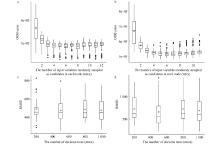
Fig.2
Change trend of the error of larch (a, c) and birch (b, d) with hyperparameter mtry and ntree"
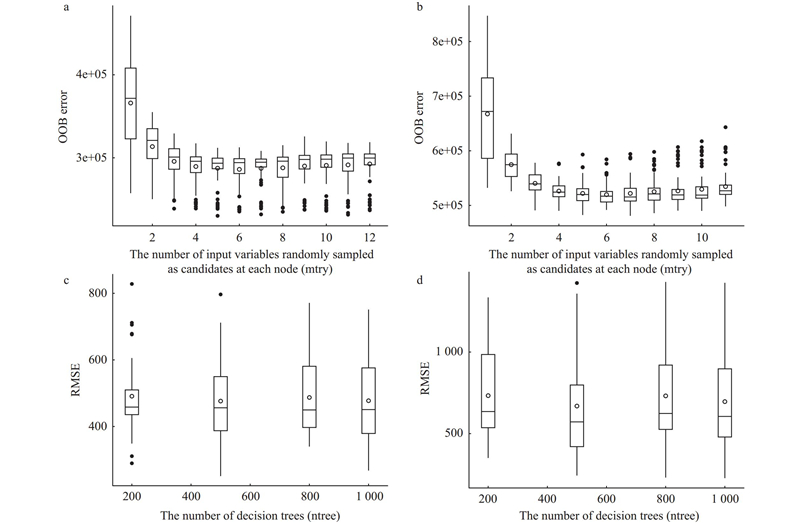
Table 3
Verification indicators for predictive model of larch and birch regeneration quantity"
| 树种 Tree species | 模型 Model | 检验指标Test indicators | |||
| RMSE/ (tree·hm?2) | rRMSE (%) | MAE/ (tree·hm?2) | MAPE (%) | ||
| 兴安落叶松 Larix gmelinii | Poisson | 1 312 | 142.63 | 899 | 98.38 |
| NB | 1 310 | 142.62 | 898 | 98.38 | |
| RF | 482 | 55.72 | 377 | 80.92 | |
| 白桦 Betula platyphylla | Poisson | 1 588 | 150.32 | 1 012 | 98.07 |
| NB | 1 586 | 150.31 | 1 011 | 98.05 | |
| RF | 682 | 68.00 | 460 | 84.85 | |
Fig.3
Scatter plot of measured and predicted values"
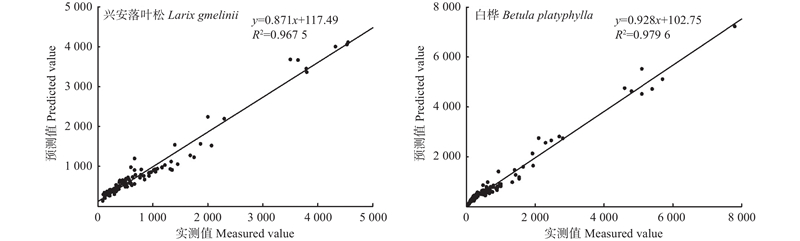
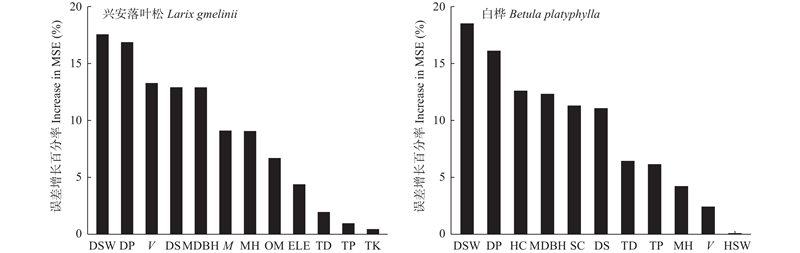
Fig.4
Relative importance of OOB-based permutation methods"
| 陈 莹, 董灵波, 刘兆刚. 帽儿山天然次生林主要林分类型最优树种组成. 北京林业大学学报, 2019, 41 (5): 118- 126. | |
| Chen Y, Dong L B, Liu Z G. Optimal species composition for the main forest types of secondary forest in Mao’ershan Mountain, northeastern China. Journal of Beijing Forestry University, 2019, 41 (5): 118- 126. | |
| 党宏忠, 陈 帅, 钟 鹏, 等. 樟子松人工林自然更新过程中断的机制及可能调控途径. 林业科学, 2024, 60 (12): 158- 167. | |
| Dang H Z, Chen S, Zhong P, et al. Mechanism and possible regulatory approaches of interruption in the natural regeneration process of Pinus sylvestris var. mongolica plantations in China. Scientia Silvae Sinicae, 2024, 60 (12): 158- 167. | |
|
丁家祺, 黄文丽, 刘迎春, 等. 基于机器学习和多源数据的湘西北森林地上生物量估测. 林业科学, 2021, 57 (10): 36- 48.
doi: 10.11707/j.1001-7488.20211004 |
|
|
Ding J Q, Huang W L, Liu Y C, et al. Estimation of forest aboveground biomass in northwest Hunan province based on machine learning and multi-source data. Scientia Silvae Sinicae, 2021, 57 (10): 36- 48.
doi: 10.11707/j.1001-7488.20211004 |
|
|
董灵波, 田栋元, 陈 莹, 等. 基于结构方程模型的兴安落叶松天然林更新影响因素. 应用生态学报, 2021, 32 (8): 2763- 2772.
doi: 10.13287/j.1001-9332.202108.010 |
|
|
Dong L B, Tian D Y, Chen Y, et al. Clarifying the factors affecting Larix gmelinii forest regeneration based on structural equation model. Chinese Journal of Applied Ecology, 2021, 32 (8): 2763- 2772.
doi: 10.13287/j.1001-9332.202108.010 |
|
| 冯晓燕, 刘 宁, 郭晋平, 等. 控制光照条件下华北山地4个混交树种幼苗幼树的形态响应和可塑性. 林业科学, 2013, 49 (11): 42- 50. | |
| Feng X Y, Liu N, Guo J P, et al. Morphological responses and morphological plasticity indices of seedlings and saplings of four woody species in montane forest of northern China to experimental light regimes. Scientia Silvae Sinicae, 2013, 49 (11): 42- 50. | |
| 韩广轩, 王光美, 毛培利, 等. 山东半岛北部黑松海防林幼龄植株更新动态及其影响因素. 林业科学, 2010, 46 (12): 158- 164. | |
| Han G X, Wang G M, Mao P L, et al. Regeneration dynamics of young pinus thunbergii and its influencing factors in the coastal protection forests in northern Shandong peninsula. Scientia Silvae Sinicae, 2010, 46 (12): 158- 164. | |
|
惠刚盈. 角尺度: 一个描述林木个体分布格局的结构参数. 林业科学, 1999, 35 (1): 39- 44.
doi: 10.3321/j.issn:1001-7488.1999.01.006 |
|
|
Hui G Y. The neighbourhood pattern: a new structure parameter for describing distribution of forest tree position. Scientia Silvae Sinicae, 1999, 35 (1): 39- 44.
doi: 10.3321/j.issn:1001-7488.1999.01.006 |
|
| 惠刚盈, 胡艳波, 赵中华. 结构化森林经营研究进展. 林业科学研究, 2018, 31 (1): 85- 93. | |
| Hui G Y, Hu Y B, Zhao Z H. Research progress of structure-based forest management. Forest Research, 2018, 31 (1): 85- 93. | |
|
惠刚盈, 胡艳波. 混交林树种空间隔离程度表达方式的研究. 林业科学研究, 2001, 14 (1): 23- 27.
doi: 10.3321/j.issn:1001-1498.2001.01.004 |
|
|
Hui G Y, Hu Y B. Measuring species spatial isolation in mixed forests. Forest Research, 2001, 14 (1): 23- 27.
doi: 10.3321/j.issn:1001-1498.2001.01.004 |
|
| 惠刚盈, Klaus von Gadow, Matthias Albert. 一个新的林分空间结构参数: 大小比数. 林业科学研究, 1999, 12 (1): 4- 9. | |
| Hui G Y, Gadow K V, Albert M. A new parameter for stand spatial structure neighbourhood comparison. Forest Research, 1999, 12 (1): 4- 9. | |
| 贾黎明, 翟明普, 尹伟伦. 油松、辽东栎混交林中生化他感作用的研究. 林业科学, 1995, 31 (6): 491- 498. | |
| Jia L M, Zhai M P, Yi W L. The study of allelopathy of Pinus tabulaeformis and Quercus liaotungensis. Scientia Silvae Sinicae, 1995, 31 (6): 491- 498. | |
| 焦强英, 韩宗甫, 王炜烨, 等. 基于多源数据和机器学习方法的大兴安岭地区雷击火驱动因子及火险预测模型. 林业科学, 2023, 59 (6): 74- 87. | |
| Jiao Q Y, Han Z F, Wang W H, et al. Driving factors and forecasting model of lightning-caused forest fires in Daxing’anling mountains based on multi-sources data and machine learning method. Scientia Silvae Sinicae, 2023, 59 (6): 74- 87. | |
| 雷相东. 机器学习算法在森林生长收获预估中的应用. 北京林业大学学报, 2019, 41 (12): 23- 36. | |
| Lei X D. Applications of machine learning algorithms in forest growth and yield prediction. Journal of Beijing Forestry University, 2019, 41 (12): 23- 36. | |
|
李春明, 付 卓. 基于广义混合效应模型的云冷杉林天然更新计数方法研究. 西南林业大学学报(自然科学), 2020, 40 (5): 108- 114.
doi: 10.11929/j.swfu.202002026 |
|
|
Li C M, Fu Z. The natural regeneration count model of spruce-fir mixed stand based on generalized mixed effect models. Journal of Southwest Forestry University (Natural Sciences), 2020, 40 (5): 108- 114.
doi: 10.11929/j.swfu.202002026 |
|
| 李欣海. 随机森林模型在分类与回归分析中的应用. 应用昆虫学报, 2013, 50 (4): 1190- 1197. | |
| Li X H. Using “random forest” for classification and regression. Chinese Journal of Applied Entomology, 2013, 50 (4): 1190- 1197. | |
|
李雪云, 潘 萍, 臧 颢, 等. 闽楠天然次生林自然更新的影响因子研究. 林业科学研究, 2017, 30 (5): 701- 708.
doi: 10.13275/j.cnki.lykxyj.2017.05.001 |
|
|
Li X Y, Pan P, Zang H, et al. Study on factors affecting natural regeneration of natural secondary Phoebe bournei forest. Forest Research, 2017, 30 (5): 701- 708.
doi: 10.13275/j.cnki.lykxyj.2017.05.001 |
|
|
刘 斌, 陈 维, 陈伏生, 等. 九连山次生阔叶林幼苗生长对氮磷添加的响应. 应用生态学报, 2020, 31 (8): 2533- 2540.
doi: 10.13287/j.1001-9332.202008.020 |
|
|
Liu B, Chen W, Chen F S, et al. Responses of seedling growth in subtropical secondary broad-leaved forest to nitrogen and phosphorus addition in Jiulian Mountain, China. Chinese Journal of Applied Ecology, 2020, 31 (8): 2533- 2540.
doi: 10.13287/j.1001-9332.202008.020 |
|
| 娄淑兰, 刘目兴, 易 军, 等. 三峡山地不同类型植被和坡位对土壤水文功能的影响. 生态学报, 2019, 39 (13): 4844- 4854. | |
| Lou S L, Liu M X, Yi J, et al. Influence of vegetation coverage and topographic position on soil hydrological function in the hillslope of the Three Gorges area. Acta Ecologica Sinica, 2019, 39 (13): 4844- 4854. | |
| 欧强新, 雷相东, 沈琛琛, 等. 基于随机森林算法的落叶松-云冷杉混交林单木胸径生长预测. 北京林业大学学报, 2019, 41 (9): 9- 19. | |
| Ou Q X, Lei X D, Shen C C, et al. Individual tree DBH growth prediction of larch-spruce-fir mixed forests based on random forest algorithm. Journal of Beijing Forestry University, 2019, 41 (9): 9- 19. | |
|
任学敏, 朱 雅, 陈兆进, 等. 太白山锐齿槲栎林乔木更新特征及其影响因子. 林业科学, 2019, 55 (1): 11- 21.
doi: 10.11707/j.1001-7488.20190102 |
|
|
Ren X M, Zhu Y, Chen Z J, et al. Regeneration of arbor trees and its contributing factors in an oak forest in Taibai Mountain, China. Scientia Silvae Sinicae, 2019, 55 (1): 11- 21.
doi: 10.11707/j.1001-7488.20190102 |
|
|
索奥丽, 陈 锋, 龚俊伟, 等. 华北落叶松林和油松林地表可燃物特征、土壤理化性质及林下植物多样性对林间草地放牧的响应. 林业科学, 2025, 61 (10): 60- 73.
doi: 10.11707/j.1001-7488.LYKX20250161 |
|
|
Suo A L, Chen F, Gong J W, et al. Response of surface fuel characteristics, soil physicochemical properties, and understory plant diversity to forest grassland grazing in Larix gmelinii var. principis-rupprechtii and Pinus tabuliformis forests. Scientia Silvae Sinicae, 2025, 61 (10): 60- 73.
doi: 10.11707/j.1001-7488.LYKX20250161 |
|
|
田惠玲, 朱建华, 何 潇, 等. 基于随机森林模型的东北三省乔木林生物质碳储量预测. 林业科学, 2022, 58 (4): 40- 50.
doi: 10.11707/j.1001-7488.20220405 |
|
|
Tian S L, Zhu J H, He X, et al. Projected biomass carbon stock of arbor forest of three provinces in northeastern China based on random forest model. Scientia Silvae Sinicae, 2022, 58 (4): 40- 50.
doi: 10.11707/j.1001-7488.20220405 |
|
| 王君杰, 姜立春. 利用分位数组合预测兴安落叶松枝下高. 北京林业大学学报, 2021, 43 (3): 9- 17. | |
| Wang J J, Jiang L C. Predicting height to crown base for Larix gmelinii using quantile groups. Journal of Beijing Forestry University, 2021, 43 (3): 9- 17. | |
| 肖 晨, 田栋元, 马 榕, 等. 兴安落叶松天然林更新数量相容性预测模型. 应用生态学报, 2023, 34 (9): 2345- 2354. | |
| Xiao C, Tian D Y, Ma R, et al. Compatibility predictive model for regeneration quantities of Larix gmelinii natural forest in Daxing’anling Mountains, China. Chinese Journal of Applied Ecology, 2023, 34 (9): 2345- 2354. | |
|
易 晨, 李德成, 张甘霖, 等. 土壤厚度的划分标准与案例研究. 土壤学报, 2015, 52 (1): 220- 227.
doi: 10.11766/trxb201402180069 |
|
|
Yi C, Li D C, Zhang G L, et al. Criteria for partition of soil thickness and case studies. Acta Pedologica Sinica, 2015, 52 (1): 220- 227.
doi: 10.11766/trxb201402180069 |
|
|
由珈齐, 李明泽, 范文义, 等. 基于高光谱和激光雷达数据的林分类型识别. 林业科学, 2021, 57 (5): 119- 129.
doi: 10.11707/j.1001-7488.20210511 |
|
|
You J Q, Li M Z, Fan W Y, et al. Stand type identification based on hyperspectral and LiDAR data. Scientia Silvae Sinicae, 2021, 57 (5): 119- 129.
doi: 10.11707/j.1001-7488.20210511 |
|
|
张凡兵, 龙 婷, 金文斌, 等. 红松林天然更新对连续小梯度海拔变化的响应. 东北林业大学学报, 2017, 45 (5): 1- 10.
doi: 10.3969/j.issn.1000-5382.2017.05.001 |
|
|
Zhang F B, Long T, Jin W B, et al. Natural regeneration of primitive Korean pine forests in response to the variation in continuous small elevation gradient. Journal of Northeast Forestry University, 2017, 45 (5): 1- 10.
doi: 10.3969/j.issn.1000-5382.2017.05.001 |
|
|
张 雷, 刘世荣, 孙鹏森, 等. 气候变化对马尾松潜在分布影响预估的多模型比较. 植物生态学报, 2011, 35 (11): 1091- 1105.
doi: 10.3724/SP.J.1258.2011.01091 |
|
|
Zhang L, Liu S R, Sun P S, et al. Comparative evaluation of multiple models of the effects of climate change on the potential distribution of Pinus massoniana. Chinese Journal of Plant Ecology, 2011, 35 (11): 1091- 1105.
doi: 10.3724/SP.J.1258.2011.01091 |
|
|
张 雷, 王琳琳, 张旭东, 等. 随机森林算法基本思想及其在生态学中的应用: 以云南松分布模拟为例. 生态学报, 2014, 34 (3): 650- 659.
doi: 10.5846/stxb201306031292 |
|
|
Zhang L, Wang L L, Zhang X D, et al. The basic principle of random forest and its applications in ecology: a case study of Pinus yunnanensis. Acta Ecologica Sinica, 2014, 34 (3): 650- 659.
doi: 10.5846/stxb201306031292 |
|
| 张凌宇, 刘兆刚. 2019. 基于地理加权回归模型的大兴安岭中部天然次生林更新分布. 林业科学, 55(11): 105−116. | |
| Zhang L Y, Liu Z G, 2019. Regeneration and distribution of natural secondary forests in the central part of Daxing’an mountains based on geographically weighted regression model. Scientia Silvae Sinicae, 55(11): 105−116. [in Chinese] | |
| 张雄清, 雷渊才, 雷相东, 等. 基于计数模型方法的林分枯损研究. 林业科学, 2012, 48 (8): 54- 61. | |
| Zhang X Q, Lei Y C, Lei X D, et al. Predicting stand-level mortality with count data models. Scientia Silvae Sinicae, 2012, 48 (8): 54- 61. | |
|
张宇娇, 赵恒谦, 付含聪, 等. 基于无人机遥感多特征的单木地上生物量反演模型. 林业科学, 2025, 61 (8): 129- 141.
doi: 10.11707/j.1001-7488.LYKX20240390 |
|
|
Zhang Y J, Zhao H Q, Fu H C, et al. Inversion model of aboveground biomass at individual tree scale based on the multiple features of UAV remote sensing. Scientia Silvae Sinicae, 2025, 61 (8): 129- 141.
doi: 10.11707/j.1001-7488.LYKX20240390 |
|
| 张兹鹏, 王君杰, 刘索名, 等. 形率对白桦单木材积和生物量预测精度的影响. 林业科学, 2022, 58 (5): 31- 39. | |
| Zhang Z P, Wang J J, Liu S M, et al. Effect of form quotient on prediction accuracy of individual tree volume and biomass of Betula platyphylla. Scientia Silvae Sinicae, 2022, 58 (5): 31- 39. | |
| 竹万宽, 王志超, 许宇星, 等. 基于机器学习算法的雷州半岛桉树复层混交林土壤呼吸模拟. 林业科学, 2026, 62 (1): 67- 82. | |
| Zhu W K, Wang Z C, Xu Y X, et al. Simulation of Soil respiration in a stratified mixed stand of Eucalyptus spp. and Manglietia glauca in Leizhou Peninsula based on machine learning algorithms. Scientia Silvae Sinicae, 2026, 62 (1): 67- 82. | |
| 祝子枭, 刘兆刚, 董灵波, 等. 环境因子对大兴安岭天然落叶松次生林主要树种更新的影响. 东北林业大学学报, 2020, 48 (6): 135- 141. | |
| Zhu Z X, Liu Z G, Dong L B, et al. Effects of environmental factors on regeneration of major species in larch secondary forest of Daxing’an Mountains. Journal of Northeast Forestry University, 2020, 48 (6): 135- 141. | |
| Boulesteix A L, Bender A, Lorenzo Bermejo J, et al. Random forest Gini importance favours SNPs with large minor allele frequency: impact, sources and recommendations. Briefings in Bioinformatics, 2012, 13 (3): 292- 304. | |
| Breiman L. Random forests. Machine Learning, 2001, 45 (1): 5- 32. | |
| Cutler D R, Edwards T C Jr, Beard K H, et al. Random forests for classification in ecology. Ecology, 2007, 88 (11): 2783- 2792. | |
| Diao J J, Feng T, Li M S, et al. Use of vegetation change tracker, spatial analysis, and random forest regression to assess the evolution of plantation stand age in southeast China. Annals of Forest Science, 2020, 77 (2): 27. | |
| Forbes C, Evans M, Hastings N, et al. 2010. Statistical Distributions. John Wiley & Sons, Inc. | |
| Degenhardt F, Seifert S, Szymczak S. Evaluation of variable selection methods for random forests and omics data sets. Briefings in Bioinformatics, 2019, 20 (2): 492- 503. | |
| Iverson L R, Prasad A M, Matthews S N, et al. Estimating potential habitat for 134 eastern US tree species under six climate scenarios. Forest Ecology and Management, 2008, 254 (3): 390- 406. | |
| Khaine I, Woo S Y, Kwak M, et al. Factors affecting natural regeneration of tropical forests across a precipitation gradient in Myanmar. Forests, 2018, 9 (3): 143. | |
| Nicodemus K K. Letter to the editor: on the stability and ranking of predictors from random forest variable importance measures. Briefings in Bioinformatics, 2011, 12 (4): 369- 373. |
| [1] | Kaile Mai,Rongzhen Li,Hong Liu,Kun Qin,Jianhua Lan,Changsan Zhu,Lixin Feng,Jienan Su,Quanlian Zhou. Factors Influencing the Callus Induction and Plant Regeneration of Cathaya argyrophylla [J]. Scientia Silvae Sinicae, 2024, 60(7): 56-64. |
| [2] | Hongzhong Dang,Shuai Chen,Peng Zhong,Hui Han,Risheng Zhang,Xueli Zhang,Changchun Shi. Mechanism and Possible Regulatory Approaches of Interruption in the Natural Regeneration Process of Pinus sylvestris var. mongolica Plantations in China [J]. Scientia Silvae Sinicae, 2024, 60(12): 158-167. |
| [3] | Juan Han,Yapeng Li,Yanting Tian,Qi Guo,Yun Li,Yuhan Sun,Yongping Deng,Dongsheng Niu,Lizhuo Su,Xiuyu Li,Zuodeng Peng. Optimization of Efficient Regeneration System of Robinia pseudoacacia Leavesin vitro [J]. Scientia Silvae Sinicae, 2023, 59(4): 68-78. |
| [4] | Yang Wang,Fuhao Zhang,Min Dou,Ting Xu,Hao Chen. Optimization of Plant Regeneration System of Litsea cubeba [J]. Scientia Silvae Sinicae, 2022, 58(8): 126-135. |
| [5] | Yingnan Chen,Chuanjing Hu,Qiang Zhuge,Jianjun Hu,Tongming Yin. Thirty Years of Agrobacterium-Mediated Genetic Transformation of Populus [J]. Scientia Silvae Sinicae, 2022, 58(12): 114-129. |
| [6] | Hong Xia,Chunyan Xia,Haiyan Song,Yu Du,Jianping Tao. Seed Rain, Soil Seed Bank, and Seedling Regeneration of Woody Plants in Three Karst Forest Communities on Jinfo Mountain, Chongqing [J]. Scientia Silvae Sinicae, 2022, 58(1): 1-11. |
| [7] | Jinchi Wang,Qinglin Huang,Minghai Yan,Ruchu Huang,Qunrui Zheng. Characteristics of 13-Year-Old Cyclobalanopsis glauca Natural Forest Converted from Eucalyptus grandis Plantation [J]. Scientia Silvae Sinicae, 2021, 57(9): 13-20. |
| [8] | Fang Tang,Shutang Zhao,Lijuan Wang,Xueqin Song,Mengzhu Lu. Gene Expression of Secondary Vascular System Regeneration in Populus tomentosa [J]. Scientia Silvae Sinicae, 2021, 57(9): 52-65. |
| [9] | Yanli Gao,Zhijie Yang,Li Zhang,Decheng Xiong. Effects of Different Regenerated Models on Soil Nitrogen Mineralization in Subtropical Evergreen Broad-Leaved Forest [J]. Scientia Silvae Sinicae, 2021, 57(4): 24-31. |
| [10] | Ping She,Bing Cao,Yanhui Wang,Zhijia Yu,Zheng Wang,Jie Ma,Baoguang Jia. Effect of Forest Floor Treatments on Density of the First-Year Seedlings in Larix principis-rupprechtii Plantation [J]. Scientia Silvae Sinicae, 2021, 57(3): 18-28. |
| [11] | Jinchi Wang,Qinglin Huang,Minghai Yan,Ruchu Huang,Qunrui Zheng. Characteristics of 7-Year-Old Castanopsis fargesii Natural Forest Converted from Eucalyptus dunnii Plantation [J]. Scientia Silvae Sinicae, 2021, 57(1): 12-19. |
| [12] | Wenjuan Wu,Chunyang Zou,Lijing Huang,Yongcan Jin. Dissolution and Regeneration of Bamboo in LiCl/DMSO Solvent System [J]. Scientia Silvae Sinicae, 2020, 56(9): 201-206. |
| [13] | Zong Zhao,Yong Liu,Zuwei Tian,Hongyan Jia,Ruirui Zhao,Ning An. Dynamics of Seed Rain, Soil Seed Bank and Seedling Regeneration of Castanopsis hystrix [J]. Scientia Silvae Sinicae, 2020, 56(5): 37-49. |
| [14] | Minhao Liu,Junlei Xu,Jing Ye,Zhouqi Li,Ruishen Fan,Long Li. Agrobacterium tumefaciens-Mediated Transformation of Leaf Callus in Eucommia ulmoides [J]. Scientia Silvae Sinicae, 2020, 56(2): 79-88. |
| [15] | Wang Feng, Lu Qi. A Spatial-Explicit Seedling Recruitment Model for Scattered Individual Trees of Pinus sylvestris var. mongolica [J]. Scientia Silvae Sinicae, 2019, 55(8): 1-8. |
| Viewed | ||||||
|
Full text |
|
|||||
|
Abstract |
|
|||||
