
Scientia Silvae Sinicae ›› 2026, Vol. 62 ›› Issue (4): 130-141.doi: 10.11707/j.1001-7488.LYKX20250614
• Research papers • Previous Articles Next Articles
Xinglu Zhou1,2,Lei Zhang1,2,Qinghe Li1,*( ),Jianjun Hu1,2,*()
Received:2025-10-13
Online:2026-04-15
Published:2026-04-11
Contact:
Qinghe Li,Jianjun Hu
E-mail:tsinghel@caf.ac.cn;hujj@caf.ac.cn
CLC Number:
Xinglu Zhou,Lei Zhang,Qinghe Li,Jianjun Hu. Genetic Variation in Growth and Wood Property Traits from Hybrid Progenies of Populus deltoides[J]. Scientia Silvae Sinicae, 2026, 62(4): 130-141.
Table 1
Genetic background information and growth performance of Populus deltoides clones"
| 无性系编号 Clone number | 性别 Sex | 遗传背景Genetic background | H/m | DBH/cm | |
| 母本Female parent | 父本Male parent | ||||
| 546 | ♂ | 50号杨P. deltoides ‘55/65’ | 帝国杨P. deltoides ‘Imperial’ | 15.67 | 24.65 |
| 540 | ♂ | 50号杨P. deltoides ‘55/65’ | 帝国杨P. deltoides ‘Imperial’ | 13.96 | 21.23 |
| 2025 | ♂ | I-69杨P. deltoides ‘Lux’ | 美洲黑杨P. deltoides | 14.83 | 23.86 |
| 1-116 | ♀ | 丹红杨P. deltoides ‘Danhong’ | 南杨P. deltoides ‘Nanyang’ | 14.50 | 21.85 |
| 17-2 | ♂ | 南抗杨 P. deltoides ‘Nankang’ | 帝国杨P. deltoides ‘Imperial’ | 14.26 | 23.91 |
| 3-54 | ♂ | 丹红杨P. deltoides ‘Danhong’ | 创新杨P. deltoides ‘Chuangxin’ | 15.85 | 24.26 |
| 3-59 | ♀ | 丹红杨P. deltoides ‘Danhong’ | 创新杨P. deltoides ‘Chuangxin’ | 15.32 | 23.28 |
| I37 | ♂ | 丹红杨P. deltoides ‘Danhong’ | 中成2号P. deltoides ‘Zhongcheng 2’ | 15.67 | 26.88 |
| J14 | ♂ | 丹红杨P. deltoides ‘Danhong’ | 中成2号P. deltoides ‘Zhongcheng 2’ | 14.48 | 26.72 |
| J16 | ♂ | 丹红杨P. deltoides ‘Danhong’ | 中成2号P. deltoides ‘Zhongcheng 2’ | 15.03 | 30.75 |
| J27 | ♂ | 丹红杨P. deltoides ‘Danhong’ | 中成2号P. deltoides ‘Zhongcheng 2’ | 14.90 | 26.95 |
| J30 | ♂ | 丹红杨P. deltoides ‘Danhong’ | 中成2号P. deltoides ‘Zhongcheng 2’ | 14.84 | 27.05 |
| A2 | ♀ | 丹红杨P. deltoides ‘Danhong’ | 北杨P. deltoides ‘Beiyang’ | 14.45 | 31.54 |
| A6 | ♀ | 丹红杨P. deltoides ‘Danhong’ | 北杨P. deltoides ‘Beiyang’ | 14.84 | 30.56 |
| D34 | ♀ | 丹红杨P. deltoides ‘Danhong’ | 北杨P. deltoides ‘Beiyang’ | 17.11 | 32.76 |
| F38 | ♂ | 丹红杨P. deltoides ‘Danhong’ | 北杨P. deltoides ‘Beiyang’ | 16.56 | 30.02 |
| J11 | ♂ | 丹红杨P. deltoides ‘Danhong’ | 北杨P. deltoides ‘Beiyang’ | 16.13 | 29.79 |
| K9 | ♂ | 丹红杨P. deltoides ‘Danhong’ | 创新杨P. deltoides ‘Chuangxin’ | 15.70 | 28.63 |
| K16 | ♀ | 丹红杨P. deltoides ‘Danhong’ | 创新杨P. deltoides ‘Chuangxin’ | 15.85 | 30.22 |
| K18 | ♂ | 丹红杨P. deltoides ‘Danhong’ | 创新杨P. deltoides ‘Chuangxin’ | 16.49 | 28.06 |
| K25 | ♂ | 丹红杨P. deltoides ‘Danhong’ | 创新杨P. deltoides ‘Chuangxin’ | 14.97 | 28.10 |
| K34 | ♀ | 丹红杨P. deltoides ‘Danhong’ | 创新杨P. deltoides ‘Chuangxin’ | 15.82 | 28.29 |
| A14 | ♀ | 丹红杨P. deltoides ‘Danhong’ | 中成4号 P. deltoides ‘Zhongcheng 4’ | 13.99 | 24.37 |
| A15 | ♀ | 丹红杨P. deltoides ‘Danhong’ | 中成4号 P. deltoides ‘Zhongcheng 4’ | 14.05 | 23.81 |
| A16 | ♀ | 丹红杨P. deltoides ‘Danhong’ | 中成4号 P. deltoides ‘Zhongcheng 4’ | 13.74 | 24.57 |
| A20 | ♀ | 丹红杨P. deltoides ‘Danhong’ | 中成4号 P. deltoides ‘Zhongcheng 4’ | 14.35 | 24.49 |
| A25 | ♀ | 丹红杨P. deltoides ‘Danhong’ | 中成4号 P. deltoides ‘Zhongcheng 4’ | 14.08 | 25.56 |
Table 2
Statistical results of growth traits in four full-sib families of Populus deltoides"
| 全同胞家系 Full-sib families | 树高Tree height/m | 胸径Diameter at breast height/cm | |||||
| 杂交组合 Hybrid combination | 优良子代 Superior progeny | 遗传增益 Genetic gain (%) | 杂交组合 Hybrid combination | 优良子代 Superior progeny | 遗传增益 Genetic gain (%) | ||
| 丹红杨×中成2号P. deltoides ‘Danhong’× P. deltoides ‘Zhongcheng 2’ | 14.38 ± 1.14a | 14.98 ± 0.43b | 4.19 | 23.20 ± 3.75a | 27.66 ± 1.41b | 19.26 | |
| 丹红杨×北杨P. deltoides ‘Danhong’× P. deltoides ‘Beiyang’ | 13.72 ± 1.30a | 15.82 ± 1.13a | 15.27 | 21.54 ± 3.86a | 30.93 ± 1.00a | 43.61 | |
| 丹红杨×创新杨P. deltoides‘Danhong’× P. deltoides‘Chuangxin’ | 14.19 ± 1.26a | 15.76 ± 0.54a | 11.11 | 23.15± 3.89a | 28.65 ± 0.74b | 23.79 | |
| 丹红杨×中成4号P. deltoides‘Danhong’× P. deltoides‘Zhongcheng 4’ | 13.29 ± 1.49a | 14.04 ± 0.22c | 5.65 | 22.12 ± 3.54a | 24.56 ± 0.52c | 11.04 | |
Table 3
Analysis of growth and wood property differences among superior progeny of full-sib families"
| 分组 Group | H/m | DBH/cm | RW/mm | BD/(g·cm?3) | MA/(°) | FL/μm | FW/μm | FLR |
| 丹红杨×北杨 P. deltoides‘Danhong’× P. deltoides‘Beiyang’ | 15.82±1.13a | 30.93±1.22a | 15.97±2.08a | 0.38±0.01a | 15.19±1.47ab | 24.23±0.74a | 44.93±4.41a | |
| 丹红杨×创新杨 P. deltoides‘Danhong’× P. deltoides‘Chuangxin’ | 15.76±0.54a | 28.66±0.90ab | 13.39±1.26ab | 0.39±0.01a | 15.60±1.98ab | 22.37±1.10a | 47.30±3.34a | |
| 丹红杨×中成2号 P. deltoides‘Danhong’× P. deltoides‘Zhongcheng 2’ | 14.98±0.43ab | 27.67±1.72b | 15.00±1.53ab | 0.39±0.03a | 14.33±0.84ab | 23.40±1.15a | 45.73±3.12a | |
| 丹红杨×中成4号 P. deltoides‘Danhong’× P. deltoides‘Zhongcheng 4’ | 14.04±0.22b | 24.56±0.63c | 12.39±0.89bc | 0.40±0.01a | 16.90±1.45a | 22.56±0.92a | 48.67±3.31a | |
| 新品种 New varieties | 14.91±0.72ab | 23.29±1.28c | 10.79±1.32c | 0.39±0.02a | 13.86±1.82b | 23.25±1.73a | 50.58±4.94a | |
| 群体平均值 Population mean | 15.09±0.90 | 26.75±3.10 | 13.31±2.36 | 0.39±0.02 | 15.08±1.82 | 23.17±1.31 | 47.67±4.27 |
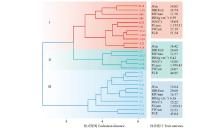
Fig.1
Cluster analysis of growth and wood properties of 27 Populus deltoides clones at year nine"
Table 4
Principal component analysis of wood property traits in Populus deltoides"
| 性状Trait | PC1 (0.361) | PC2 (0.230) | PC3 (0.190) |
| 年轮宽度 Ring width | ?0.367 | 0.148 | ?0.575 |
| 基本密度 Basic density | 0.091 | 0.342 | 0.736 |
| 微纤丝角 Microfibril angle | ?0.318 | ?0.436 | 0.102 |
| 纤维长度 Fiber length | 0.567 | 0.279 | ?0.276 |
| 纤维宽度 Fiber width | ?0.196 | 0.743 | ?0.108 |
| 纤维长宽比 Fiber length-to-width ratio | 0.630 | ?0.203 | ?0.174 |
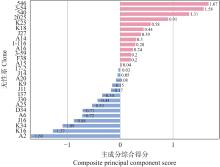
Fig.2
Comprehensive evaluation of wood property traits in 27 Populus deltoides hybrid clones"
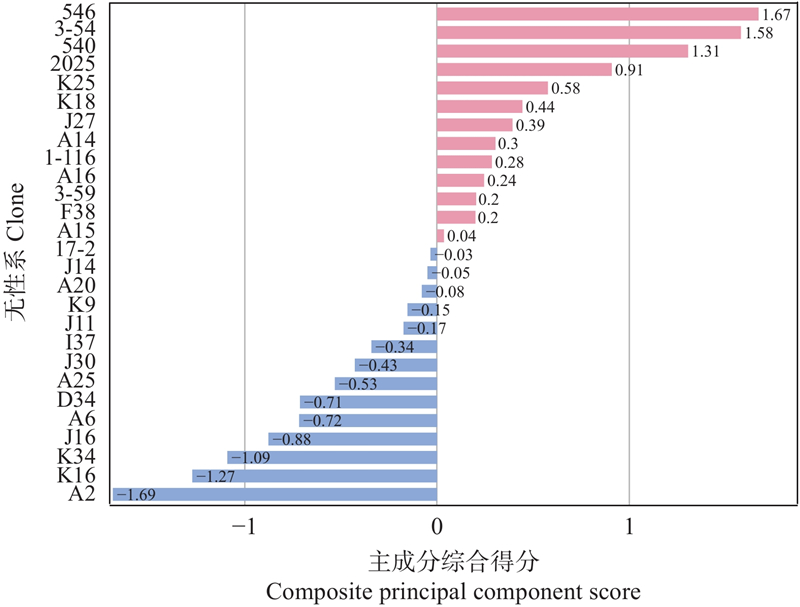
Fig.3
Variation coefficients of wood properties at different tree ages"
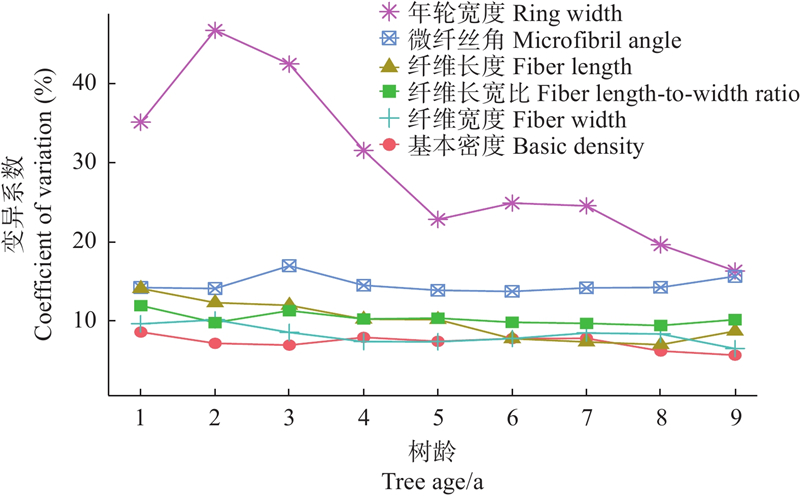
Fig.4
Radial variation patterns of wood properties"
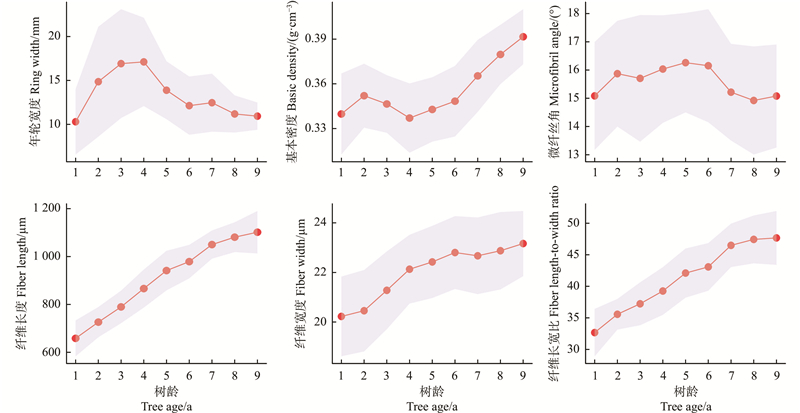
Table 5
Correlation analysis of growth and wood properties in the ninth year"
| 性状Trait | H | DBH | RW | BD | MA | FL | FW | FLR |
| H | 1 | |||||||
| DBH | 0.581** | 1 | ||||||
| RW | 0.542** | 0.846** | 1 | |||||
| BD | ?0.076 | ?0.321 | ?0.241 | 1 | ||||
| MA | ?0.178 | 0.173 | 0.131 | ?0.085 | 1 | |||
| FL | 0.175 | ?0.361 | ?0.189 | 0.063 | ?0.355 | 1 | ||
| FW | 0.125 | 0.16 | 0.243 | 0.142 | ?0.138 | 0.162 | 1 | |
| FLR | 0.058 | ?0.439* | ?0.333 | ?0.028 | ?0.224 | 0.802** | ?0.457* | 1 |
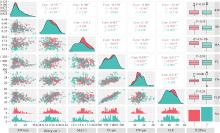
Fig.5
Correlations of wood properties and sex differences based on annual ring data The diagonal shows the data distribution of each trait, with colors indicating different sexes. The panels below the diagonal display pairwise scatter plots of the traits. The panels above the diagonal present the Pearson correlation coefficients between traits, including both the overall correlations and the correlations within each sex. * indicates significance at the 0.05 level, ** at the 0.01 level, and *** at the 0.001 level. The rightmost column shows boxplots of sex differences for each trait, and the bottom row displays sex-specific bar plots of frequency distributions."
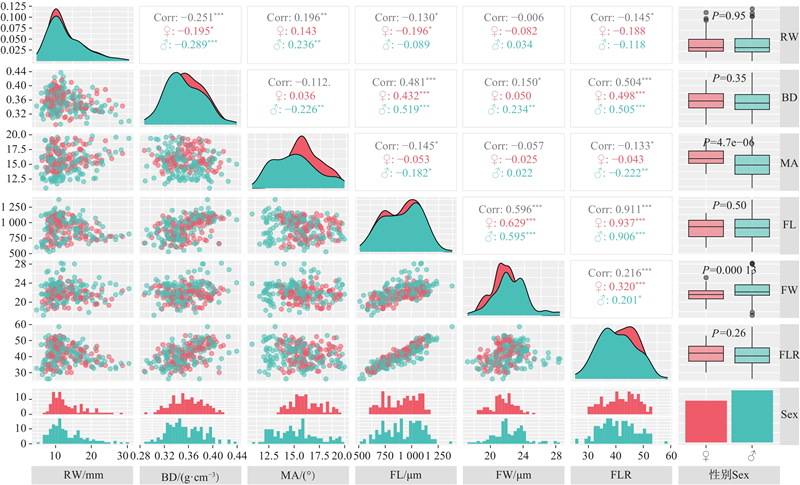
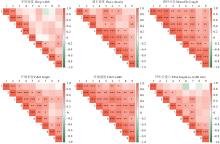
Fig.6
Annual correlation matrix of wood property traits across different growth rings"
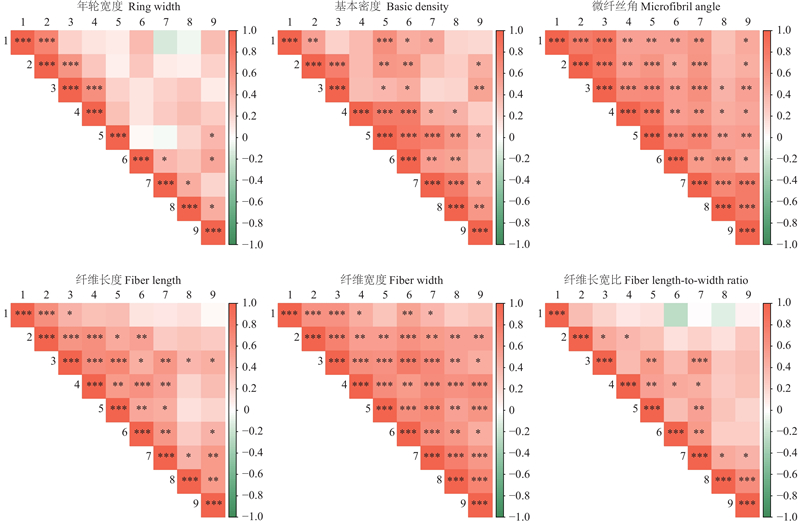
Fig.7
Linear regression analysis between ring width and wood properties"
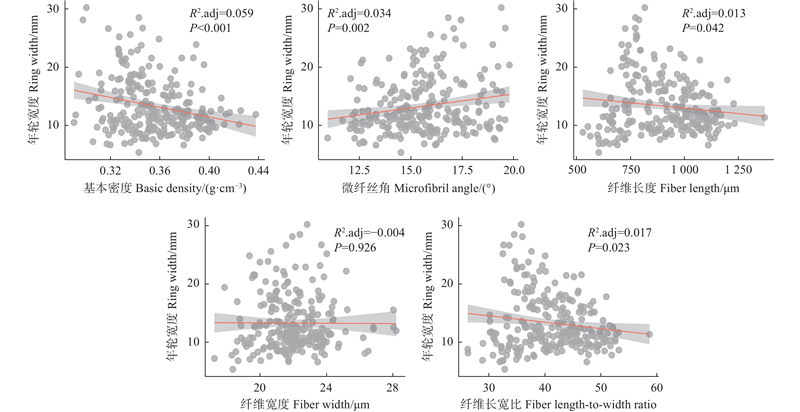
Table 6
Path coefficients of factors affecting ring width"
| 性状 Trait | 简单相关系数 Coefficient of simple correlation | 直接通径系数 Direct path coefficient | 间接通径系数 Indirect path coefficients | 决定系数 Coefficient of determination | ||
| BD → RW | MA → RW | FLR → RW | ||||
| BD | ?0.251*** | ?0.228 | 0 | ?0.043 | 0.002 | 0.055 |
| MA | 0.196** | 0.17 | ?0.045 | 0 | ?0.002 | 0.031 |
| FLR | ?0.145* | ?0.008 | 0.033 | ?0.025 | 0 | 0 |
|
鲍甫成, 江泽慧, 姜笑梅, 等. 中国主要人工林树种幼龄材与成熟材及人工林与天然林木材性质比较研究. 林业科学, 1998, 34 (2): 63- 76.
doi: 10.3321/j.issn:1001-7488.1998.02.010 |
|
|
Bao F C, Jiang Z H, Jiang X M, et al. Comparative studies on wood properties of juvenile mature wood and plantation natureal forest of main plantation tree species in China. Scientia Silvae Sinicae, 1998, 34 (2): 63- 76.
doi: 10.3321/j.issn:1001-7488.1998.02.010 |
|
| 康向阳. 林木遗传育种研究进展. 南京林业大学学报(自然科学版), 2020, 44 (3): 1- 10. | |
| Kang X Y. Research progress of forest genetics and tree breeding. Journal of Nanjing Forestry University (Natural Sciences Edition), 2020, 44 (3): 1- 10. | |
| 李开隆 杨传平, 刘桂丰. 黑龙江省杨树遗传育种研究进展. 东北林业大学学报, 2003, 31 (4): 45- 48. | |
| Li K L, Yang C P, Liu G F. Research progresses of genetics and breeding of Populus in Heilongjiang Province. Journal of Northeast Forestry University, 2003, 31 (4): 45- 48. | |
| 刘海峰. 2007. L&W纤维分析仪介绍. 中华纸业, 28(2): 27. | |
| Liu H F. 2007. Introduction to the L&W fiber analyzer. China Pulp & Paper Industry 28(2): 27. [in Chinese] | |
| 刘玉鑫, 颜开义, 何 伟, 等. 美洲黑杨无性系木材纤维性状遗传变异. 南京林业大学学报(自然科学版), 2020, 44 (2): 67- 74. | |
| Liu Y X, Yan K Y, He W, et al. Genetic variation of fiber traits in Populus deltoides clones. Journal of Nanjing Forestry University (Natural Sciences Edition), 2020, 44 (2): 67- 74. | |
| 吕士行, 徐锡增. 美洲黑杨及其引种展望. 南京林产工业学院学报, 1980, 4 (3): 13- 21. | |
| Lü S X, Xu X Z. Populus deltoides and their prospect of being introduced from abroad. Journal of Nanjing Institute of Forest Products Industry, 1980, 4 (3): 13- 21. | |
|
汤玉喜, 吴立勋, 吴 敏, 等. 杨树无性系生长与材性遗传变异及综合选择研究. 湖南林业科技, 2005, 32 (5): 5- 9.
doi: 10.3969/j.issn.1003-5710.2005.05.001 |
|
|
Tang Y X, Wu L X, Wu M, et al. Genetic analysis on growth and wood properties and comprehensive selection of Populus spp. clones. Hunan Forestry Science & Technology, 2005, 32 (5): 5- 9.
doi: 10.3969/j.issn.1003-5710.2005.05.001 |
|
|
汪贵斌, 曹福亮, 柳学军, 等. 落羽杉种源木材微纤丝角和纤维形态的变异. 林业科学, 2007, 43 (6): 117- 122.
doi: 10.3321/j.issn:1001-7488.2007.06.021 |
|
|
Wang G B, Cao F L, Liu X J, et al. Microfibril angles and fiber morphology characteristics of baldcypress wood. Scientia Silvae Sinicae, 2007, 43 (6): 117- 122.
doi: 10.3321/j.issn:1001-7488.2007.06.021 |
|
| 王克胜, 卞学瑜, 佟永昌, 等. 杨树无性系生长和材性的遗传变异及多性状选择. 林业科学, 1996, 32 (2): 111- 117. | |
| Wang K S, Bian X Y, Tong Y C, et al. Genetic variation in growth and wood properties and multiple-traits selection of poplar clones. Scientia Silvae Sinicae, 1996, 32 (2): 111- 117. | |
| 王明庥, 黄敏仁, 阮锡根, 等. 黑杨派新无性系木材性状的遗传改良. 南京林业大学学报, 1989, 13 (3): 9- 16. | |
| Wang M M, Huang M R, Ruan X G, et al. Genetic improvement of wood characters of new clones in the Aigeiros section. Journal of Nanjing Forestry University, 1989, 13 (3): 9- 16. | |
| 严涵薇, 程雅静, 余彤彤, 等. 10年生黑杨派无性系材性径向遗传变异分析与综合评价. 林业科学研究, 2021, 34 (6): 28- 37. | |
| Yan H W, Cheng Y J, Yu T T, et al. Radial genetic variation analysis and comprehensive evaluation of wood properties in ten-year-old section Aigeiros clones. Forest Research, 2021, 34 (6): 28- 37. | |
|
严艳兵, 潘惠新. 美洲黑杨无性系木材材性与生长性状遗传相关分析. 中南林业科技大学学报, 2021, 41 (5): 74- 81.
doi: 10.14067/j.cnki.1673-923x.2021.05.009 |
|
|
Yan Y B, Pan H X. Genetic correlation analysis of wood property and growth traits in Populus deltoides clones. Journal of Central South University of Forestry & Technology, 2021, 41 (5): 74- 81.
doi: 10.14067/j.cnki.1673-923x.2021.05.009 |
|
|
于海洋, 庞忠义, 殷春红, 等. 100个杨树无性系生长及材性变异研究. 西北林学院学报, 2023, 38 (4): 134- 142.
doi: 10.3969/j.issn.1001-7461.2023.04.17 |
|
|
Yu H Y, Pang Z Y, Yin H C, et al. Variation analysis on the growth and wood properties of 100 poplar clones. Journal of Northwest Forestry University, 2023, 38 (4): 134- 142.
doi: 10.3969/j.issn.1001-7461.2023.04.17 |
|
|
张春玲, 李淑梅, 赵自成, 等. 杨树新品种‘丹红杨’. 林业科学, 2008, 44 (1): 169.
doi: 10.3321/j.issn:1001-7488.2008.01.027 |
|
|
Zhang C L, Li S M, Zhao Z C, et al. A new poplar variety Populus deltoides CL. ‘Danhong. Scientia Silvae Sinicae, 2008, 44 (1): 169.
doi: 10.3321/j.issn:1001-7488.2008.01.027 |
|
|
张晓艳, 季新月, 王 雷, 等. 不同地点黑杨派无性系生长性状变异及其与叶片性状相关分析. 南京林业大学学报(自然科学版), 2020, 44 (3): 65- 73.
doi: 10.3969/j.issn.1000-2006.201907041 |
|
|
Zhang X Y, Ji X Y, Wang L, et al. Genetic variation in growth traits at different sites and correlationship among growth traits and leaf traits of section Aigeiros clones. Journal of Nanjing Forestry University (Natural Sciences Edition), 2020, 44 (3): 65- 73.
doi: 10.3969/j.issn.1000-2006.201907041 |
|
| 朱教君, 姜凤歧, 曾其蕴. 杨树林带木材纤维长度变化规律及其在经营中的应用. 林业科学, 1994, 30 (1): 50- 56. | |
| Zhu J J, Jiang F Q, Zeng Q Y. A study on regularity of the change of fiber length of wood in poplar shelterbelts and its application in shelterbelt management. Scientia Silvae Sinicae, 1994, 30 (1): 50- 56. | |
| Balatinecz J J, Kretschmann D E. 2001. Properties and utilization of poplar wood. NRC Research Press, National Research Council of Canada, Ottawa, ON KIA 0R6, Canada, 277−291. | |
|
Bao F C, Jiang Z H, Jiang X M, et al. Differences in wood properties between juvenile wood and mature wood in 10 species grown in China. Wood Science and Technology, 2001, 35 (4): 363- 375.
doi: 10.1007/s002260100099 |
|
| Burdon R, Kibblewhite R P, Riddell M. Wood density and kraft fibre and pulp properties of four Pinus radiata provenances. New Zealand Journal of Forestry Science, 1999, 29 (2): 214- 224. | |
| Debell D S, Singleton R, Harrington C A, et al. Wood density and fiber length in young Populus stems: relation to clone, age, growth rate, and pruning. Wood and Fiber Science, 2002, 34 (4): 529- 539. | |
|
Fang S Z, Yang W Z, Fu X X. Variation of microfibril angle and its correlation to wood properties in poplars. Journal of Forestry Research, 2004, 15, 261- 267.
doi: 10.1007/BF02844949 |
|
|
Fukatsu E, Hiraoka Y, Matsunaga K, et al. Genetic relationship between wood properties and growth traits in Larix kaempferi obtained from a diallel mating test. Journal of Wood Science, 2015, 61, 10- 18.
doi: 10.1007/s10086-014-1436-9 |
|
| Hannrup B, Cahalan C, Chantre G, et al. Genetic parameters of growth and wood quality traits in Picea abies. Scandinavian Journal of Forest Research, 2004, 19, 14- 29. | |
|
Liu Y M, Zhou L, Guan Y, et al. Radial variations to wood anatomical and chemical properties in eight poplar clones. Canadian Journal of Forest Research, 2021, 52 (1): 19- 26.
doi: 10.1139/cjfr-2020-0465 |
|
|
Ma T Y, Hou J. Trait assessment of 1122 Populus deltoides clones: unveiling correlations among growth, wood properties, and disease susceptibility. Forests, 2024, 15 (7): 1250.
doi: 10.3390/f15071250 |
|
|
Marzena N, Piotr P, Kamila P, et al. Productivity, growth patterns, and cellulosic pulp properties of hybrid aspen clones. Forests, 2019, 10 (5): 450.
doi: 10.3390/f10050450 |
|
|
Pliura A, Zhang S Y, MacKay J, et al. Genotypic variation in wood density and growth traits of poplar hybrids at four clonal trials. Forest Ecology and Management, 2007, 238 (1): 92- 106.
doi: 10.1016/j.foreco.2006.09.082 |
|
|
Raj T, Chandrasekhar K, Kumar N, et al. Lignocellulosic biomass as renewable feedstock for biodegradable and recyclable plastics production: a sustainable approach. Renewable and Sustainable Energy Reviews, 2022, 158, 112130.
doi: 10.1016/j.rser.2022.112130 |
|
|
Shen H, Xing X Y, Guan Y, et al. Radial variation studies on wood properties of Populus deltoides parents and their hybrids. BioResources, 2021, 16 (3): 4905- 4923.
doi: 10.15376/biores.16.3.4905-4923 |
|
|
Wu F, Zhang P D, Pei J C, et al. Genotypic parameters of wood density and fiber traits in triploid hybrid clones of Populus tomentosa at five clonal trials. Annals of Forest Science, 2013, 70 (7): 751- 759.
doi: 10.1007/s13595-013-0307-7 |
|
|
Wu J, Zhou Q, Sang Y R, et al. Genotype-environment interaction and stability of fiber properties and growth traits in triploid hybrid clones of Populus tomentosa. BMC Plant Biology, 2021, 21 (1): 405.
doi: 10.1186/s12870-021-03156-6 |
|
|
Xiao Y, Wang J H, Yun H L, et al. Genetic evaluation and combined selection for the simultaneous improvement of growth and wood properties in Catalpa bungei clones. Forests, 2021, 12 (7): 868.
doi: 10.3390/f12070868 |
|
|
Zhang J, Song X Q, Zhang L, et al. Agronomic performance of 27 Populus clones evaluated after two 3-year coppice rotations in Henan, China. GCB Bioenergy, 2020, 12 (2): 168- 181.
doi: 10.1111/gcbb.12662 |
|
|
Zhang Y H, Fang S Z, Tian Y, et al. Responses of radial growth, wood density and fiber traits to planting space in poplar plantations at a lowland site. Journal of Forestry Research, 2022, 33 (3): 963- 976.
doi: 10.1007/s11676-021-01382-0 |
|
|
Zhou X L, Zhang L, Zhang M, et al. Genomic selection for growth and wood properties in multi-generation hybrid populations of Populus deltoides. Horticulture Research, 2025, 12 (9): 165.
doi: 10.1093/hr/uhaf165 |
| [1] | Jing Zhang, Weixi Zhang, Changjun Ding, Yanguang Chu, Xiaohua Su, Jun Zhao, Xuehui Su, Zhengsai Yuan, Zhenghong Li, Jinjin Yu, Qinjun Huang. Differences in Leaf Sugar Metabolism of Populus deltoides Parents and their Hybrids with Different Growth Potentials and Different Forest Ages [J]. Scientia Silvae Sinicae, 2025, 61(5): 131-145. |
| [2] | Zhenghong Li,Changjun Ding,Weixi Zhang,Jing Zhang,Le Shen,Tengqian Zhang,Mi Ding,Xiaohua Su,Zhongqin Wu,Fazhi Fang. Growth and Physiological Response of Seedlings of Populus deltoides Clones to Different Photoperiods [J]. Scientia Silvae Sinicae, 2023, 59(3): 127-144. |
| [3] | Bai Ouyang,Zhu Li,Jiali Jiang. Hygroscopicity and Swelling Behavior of Catalpa bungei Earlywood and Latewood [J]. Scientia Silvae Sinicae, 2021, 57(5): 176-183. |
| [4] | Xiaogang Dai,Chen Chen,Liangjiao Xue,Huaitong Wu,Tongming Yin. Identification of Interspecific Hybrids between Populus deltoides and P. simonii by Using Species-Specific InDel Marker [J]. Scientia Silvae Sinicae, 2021, 57(11): 79-84. |
| [5] | Cun Chen,Changjun Ding,Jing Zhang,Bo Li,Yanguang Chu,Xiaohua Su,Qinjun Huang. Population Structure Analysis and Core Collection Construction of Populus deltoides [J]. Scientia Silvae Sinicae, 2020, 56(9): 67-76. |
| [6] | Wang Zhichao, Xu Yuxing, Zhu Wankuan, Du Apeng. Radial Growth Characteristics and Influencing Factors of Eucalyptus urophylla×E. grandis in Leizhou Peninsula in Dry Season [J]. Scientia Silvae Sinicae, 2019, 55(8): 45-53. |
| [7] | Anxin Li,Jianxiong Lü,Jiali Jiang. The Viscoelasticity of Chinese Fir Earlywood in Individual Growth Rings [J]. Scientia Silvae Sinicae, 2019, 55(12): 93-100. |
| [8] | Wang Zhigang, Su Zhi, Liu Minghu, Zhao Yingming, Zhang Ge, Cui Zhenrong, Dan Huili, Chen Xingming. Comparision of the Resistant Characteristics of Populus alba var. pyramidalis and Populus deltoides cl. Beikang to Damages against Anoplophora glabripennis (Coleoptera: Cerambycidae) [J]. Scientia Silvae Sinicae, 2018, 54(9): 89-96. |
| [9] | Zhang Jiangtao, Yang Shuhong, Zhu Di, Zhu Yanlin, Liu Youquan. Physiological Response of Annual Grafted Seedlings of Poplar 2025 and Its Two Bud Mutation Varieties to Drought Stress and Evaluation of Drought Resistance [J]. Scientia Silvae Sinicae, 2018, 54(6): 33-43. |
| [10] | Ding Changjun, Zhang Weixi, Gao Ming, Huang Qinjun, Chu Yanguang, Su Xiaohua. Analysis of Transcriptome Differences among Populus deltoides with Different Growth Potentials [J]. Scientia Silvae Sinicae, 2016, 52(3): 47-58. |
| [11] | Guo Minghui, Qin Lei. Radial Variation of the Wood Carbon Storage and Physical Characteristics of the Planted Pinus koraiensis [J]. Scientia Silvae Sinicae, 2015, 51(1): 97-102. |
| [12] | Ge Li;Chen Guangsheng. Timber Growth Ring Density Forecast Based on Process Neural Network with Time-Varied Input and Output Functions [J]. Scientia Silvae Sinicae, 2008, 44(1): 124-127. |
| [13] | Xia Ping;Liu Shengquan;Zhou Liang;Xu Bin. A Measurement Method of Wood Growth Ring Density Based on X-Ray Combined Image Processing [J]. Scientia Silvae Sinicae, 2007, 43(7): 61-66. |
| [14] | Fei Benhua;Jiang Zehui;Yu Huaqiang;Xu Youming;Liu Shengquan. Study on the Properties of Plantation Timber [J]. Scientia Silvae Sinicae, 2005, 41(1): 116-122. |
| [15] | Wang Zhaohui;Jiang Zehui;Ruan Xigen. Studies on Radial Variation in Density of Moso Bamboo Using X-ray Scanning [J]. Scientia Silvae Sinicae, 2004, 40(3): 111-116. |
| Viewed | ||||||
|
Full text |
|
|||||
|
Abstract |
|
|||||
