
Scientia Silvae Sinicae ›› 2025, Vol. 61 ›› Issue (12): 124-134.doi: 10.11707/j.1001-7488.LYKX20240807
• Research papers • Previous Articles
Fei Chen1,2,3,Jiejing Zhang2,3,Jishan Wang2,3,Weixiong Luo2,3,Yongjing Tang2,3,hui Fan1,*( )
)
Received:2024-12-31
Revised:2025-04-10
Online:2025-12-25
Published:2026-01-08
Contact:
hui Fan
E-mail:fanhui@ynu.edu.cn
CLC Number:
Fei Chen,Jiejing Zhang,Jishan Wang,Weixiong Luo,Yongjing Tang,hui Fan. Prediction of Potential Habitat of Global Wild Asian Elephants under Climate Change[J]. Scientia Silvae Sinicae, 2025, 61(12): 124-134.
Fig.1
Location of study area"
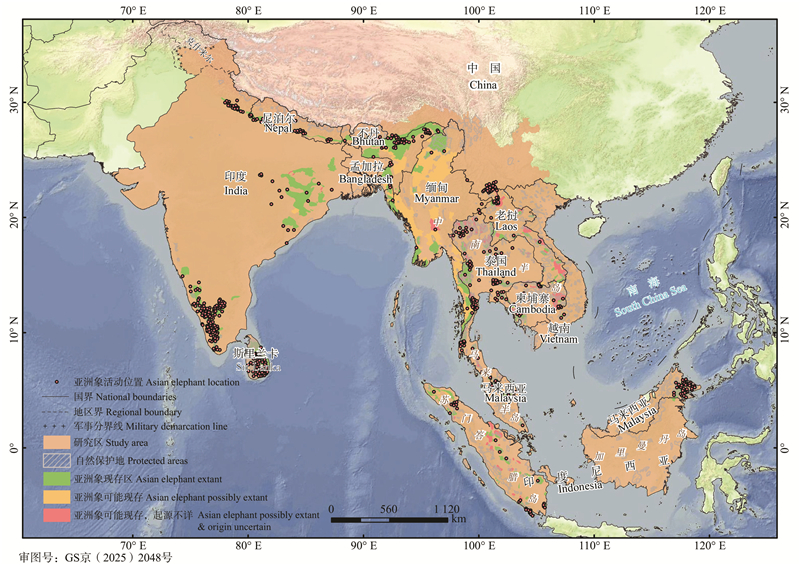
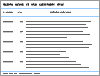
Table 1
Environmental factors for habitat suitability assessment of Elephas maximus"
| 类型 Type | 环境因子 Variable | 描述 Description | 单位 Unit |
| 生物气候因子 Bio climatic variables | Bio2 | 平均温度日较差 Mean diurnal temperature range | ℃ |
| Bio4 | 温度季节性变化 Temperature seasonality | — | |
| Bio12 | 年平均降水量 Annual precipitation | mm | |
| Bio14 | 最干月降水量 Precipitation of driest month | mm | |
| Bio15 | 降水量变异系数 Precipitation seasonality | — | |
| Bio18 | 最暖季度降水量 Precipitation of warmest quarter | mm | |
| Bio19 | 最冷季度降水量 Precipitation of coldest quarter | mm | |
| 地形因子 Terrain | 海拔 Elevation | 海拔 Elevation | m |
| 坡度 Slope | 坡度 Slope | ° | |
| 坡向 Aspect | 坡向 Aspect | — | |
| 地形位置指数 Topographic position index | 地形位置指数 Topographic position index | — | |
| 距河流距离 Distance from river | 距河流距离 Distance from river | m | |
| 土地利用/覆被Land use/cover | 土地利用/覆被 Land use/cover | 土地利用/覆被 Land use/cover | — |
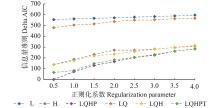
Fig.2
Delta AIC of Maxent model under different parameters"
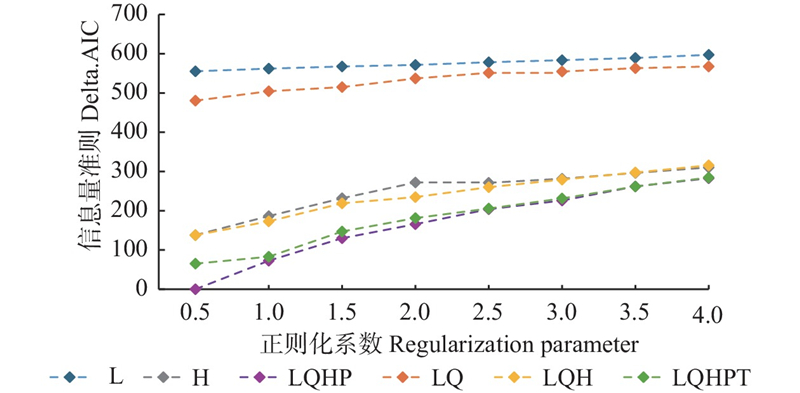
Fig.3
Global distribution of Elephas maximus habitats under current conditions"
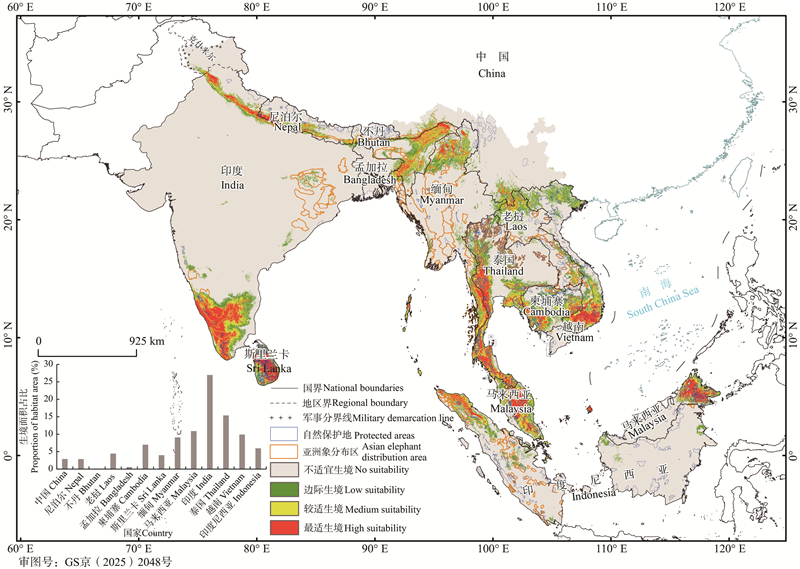
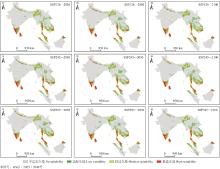
Fig.4
Distribution of Elephas maximus habitats under future climate scenarios"
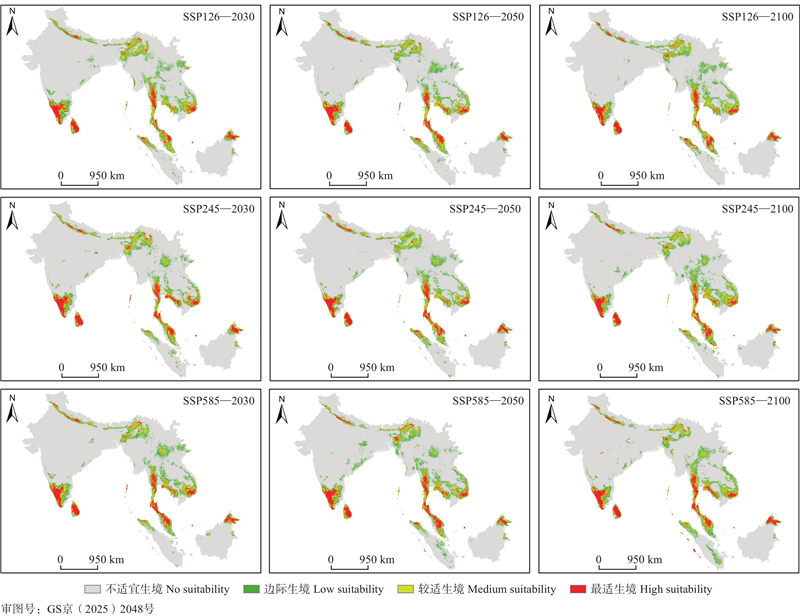
Fig.5
Area of Elephas maximus habitats under climate scenarios"
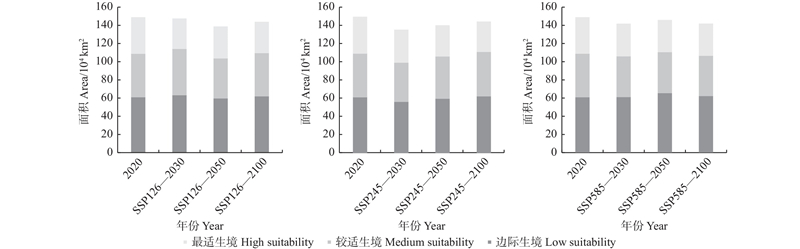
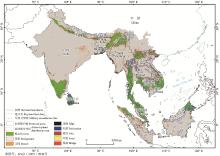
Fig.6
Spatial distribution of habitat landscape types of Elephas maximus worldwide in 2020"
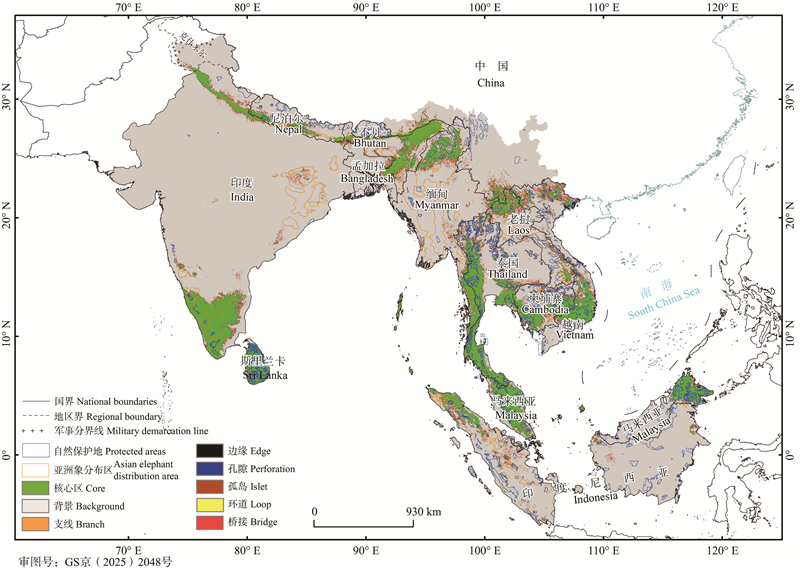
Fig.7
Landscape changes of Elephas maximus habitats worldwide under future climate scenarios"
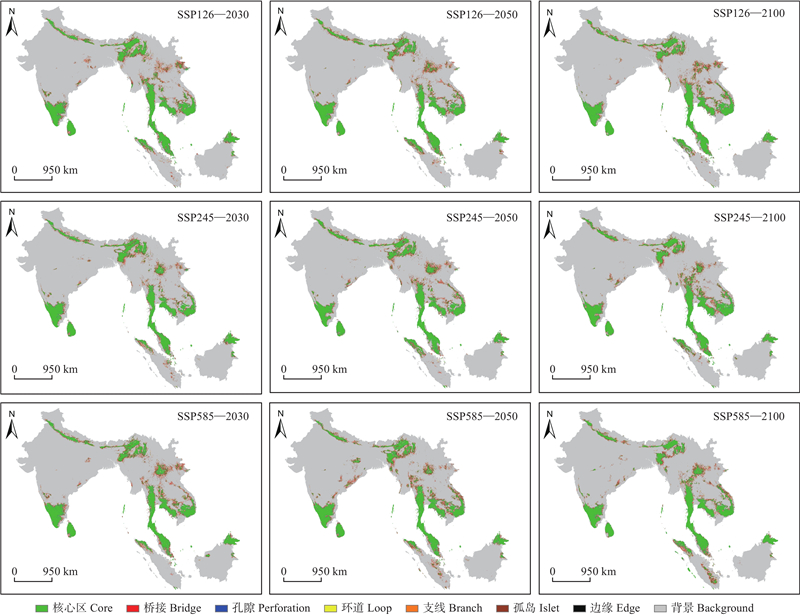
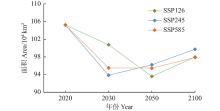
Fig.8
Core area of Elephas maximus habitats worldwide under future climate scenarios"
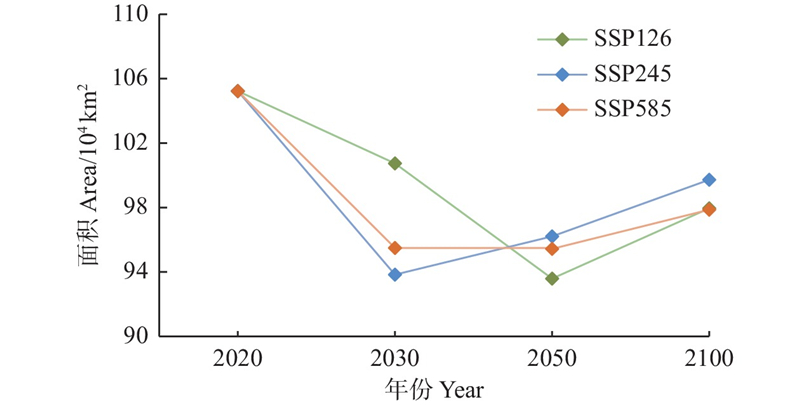
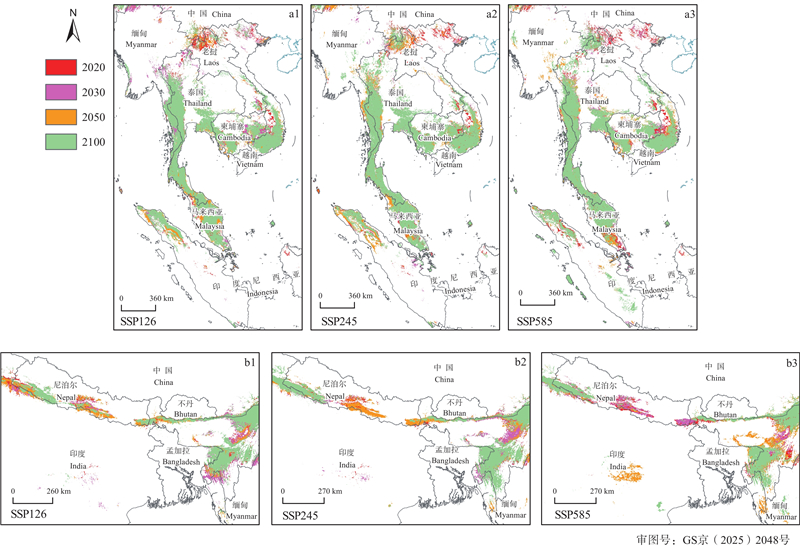
Fig.9
Changes in core area of Elephas maximus habitats in southeast Asia and southern Himalayan under future climate scenarios a1, a2, a3 represent the Southeast Asian region; b1, b2, b3 represent the southern foothills of the Himalaya."
| 陈 飞, 张杰京, 王利繁, 等. 中国和老挝跨境区域亚洲象生境时空变化及保护成效. 生态学报, 2024, 44 (22): 10222- 10233. | |
| Chen F, Zhang J J, Wang L F, et al. The spatio-temporal change pattern and protection effect of Asian elephant (Elephas maximus) habitat in China-Laos transboundary area. Acta Ecologica Sinica, 2024, 44 (22): 10222- 10233. | |
| 陈丽霞, 路 峰, 江红星, 等. 基于卫星跟踪的黄河三角洲东方白鹳适宜栖息地分布预测. 林业科学, 2024, 60 (8): 46- 56. | |
| Chen L X, Lu F, Jiang H X, et al. Predicting the distribution of suitable habitats for Oriental Storks based on satellite tracking in Yellow River Delta. Scientia Silvae Sinicae, 2024, 60 (8): 46- 56. | |
| 刘 磊, 赵丽娟, 刘佳奇, 等. 基于优化的MaxEnt模型预测气候变化下松褐天牛在我国的潜在适生区. 林业科学, 2024, 60 (11): 139- 148. | |
| Liu L, Zhao L J, Liu J Q, et al. Potentially suitable distribution areas of Monochamus alternatus in China under current and future climatic scenarios based on optimized MaxEnt model. Scientia Silvae Sinicae, 2024, 60 (11): 139- 148. | |
| 谭春萍, 杨建平, 米 睿. 1971—2007年青藏高原南部气候变化特征分析. 冰川冻土, 2010, 32 (6): 1111- 1120. | |
| Tan C P, Yang J P, Mi R. Analysis of the climatic change characteristics in the southern Tibetan Plateau from 1971 to 2007. Journal of Glaciology and Geocryology, 2010, 32 (6): 1111- 1120. | |
| 汤永晶, 杨 聪, 杨子诚, 等. 近五十年来野生亚洲象的种群动态. 兽类学报, 2023, 43 (5): 593- 607. | |
| Tang Y J, Yang C, Yang Z C, et al. Population dynamics of wild Asian elephants over the past fifty years. Acta Theriologica Sinica, 2023, 43 (5): 593- 607. | |
| 赵 宇, 金 崑. 亚洲象分布、数量、栖息地状况及种群管理. 世界林业研究, 2018, 31 (2): 25- 30. | |
| Zhao Y, Jin K. Distribution, population, habitat status and population management of Asian Elephant. World Forestry Research, 2018, 31 (2): 25- 30. | |
|
Al Muqtadir Abir K, Dey B, Redowan M, et al. Predicting suitable habitats for Asian elephant (Elephas maximus) in Tropical Asia under changing climatic scenarios. Geography and Sustainability, 2025, 6 (2): 100279.
doi: 10.1016/j.geosus.2025.100279 |
|
|
An Y, Liu S L, Sun Y X, et al. Construction and optimization of an ecological network based on morphological spatial pattern analysis and circuit theory. Landscape Ecology, 2021, 36 (7): 2059- 2076.
doi: 10.1007/s10980-020-01027-3 |
|
|
Bai D F, Wan X R, Zhang L, et al. The recent Asian elephant range expansion in Yunnan, China, is associated with climate change and enforced protection efforts in human-dominated landscapes. Frontiers in Ecology and Evolution, 2022, 10, 889077.
doi: 10.3389/fevo.2022.889077 |
|
|
Bellard C, Leclerc C, Leroy B, et al. Vulnerability of biodiversity hotspots to global change. Global Ecology and Biogeography, 2014, 23 (12): 1376- 1386.
doi: 10.1111/geb.12228 |
|
|
Birkett P J, Vanak A T, Muggeo V M R, et al. Animal perception of seasonal thresholds: changes in elephant movement in relation to rainfall patterns. PLoS One, 2012, 7 (6): e38363.
doi: 10.1371/journal.pone.0038363 |
|
|
Bohrer G, Beck P S, Ngene S M, et al. Elephant movement closely tracks precipitation-driven vegetation dynamics in a Kenyan forest-savanna landscape. Movement Ecology, 2014, 2 (1): 2.
doi: 10.1186/2051-3933-2-2 |
|
|
Chamaillé-Jammes S, Valeix M, Fritz H. Managing heterogeneity in elephant distribution: interactions between elephant population density and surface-water availability. Journal of Applied Ecology, 2007, 44 (3): 625- 633.
doi: 10.1111/j.1365-2664.2007.01300.x |
|
| Dai Y C. 2022 The overlap of suitable tea plant habitat with Asian elephant (Elephus maximus) distribution in southwestern China and its potential impact on species conservation and local economy. Environmental Science and Pollution Research, 29(4): 5960−5970. | |
|
Dang A N, Jackson B M, Benavidez R, et al. Review of ecosystem service assessments: pathways for policy integration in Southeast Asia. Ecosystem Services, 2021, 49, 101266.
doi: 10.1016/j.ecoser.2021.101266 |
|
|
De R, Sharma R, Davidar P, et al. Pan-India population genetics signifies the importance of habitat connectivity for wild Asian elephant conservation. Global Ecology and Conservation, 2021, 32, e01888.
doi: 10.1016/j.gecco.2021.e01888 |
|
|
Estoque R C, Ooba M, Avitabile V, et al. The future of Southeast Asia’s forests. Nature Communications, 2019, 10, 1829.
doi: 10.1038/s41467-019-09646-4 |
|
|
Feng Y, Ziegler A D, Elsen P R, et al. Upward expansion and acceleration of forest clearance in the mountains of Southeast Asia. Nature Sustainability, 2021, 4 (10): 892- 899.
doi: 10.1038/s41893-021-00738-y |
|
|
Gray T N E, Vidya T N C, Potdar S, et al. Population size estimation of an Asian elephant population in eastern Cambodia through non-invasive mark-recapture sampling. Conservation Genetics, 2014, 15 (4): 803- 810.
doi: 10.1007/s10592-014-0579-y |
|
|
Gütschow J, Jeffery M L, Günther A, et al. Country-resolved combined emission and socio-economic pathways based on the representative concentration pathway (RCP) and Shared Socio-Economic Pathway (SSP) scenarios. Earth System Science Data, 2021, 13 (3): 1005- 1040.
doi: 10.5194/essd-13-1005-2021 |
|
|
He K, Fan C J, Zhong M C, et al. Evaluation of habitat suitability for Asian elephants in sipsongpanna under climate change by coupling multi-source remote sensing products with MaxEnt model. Remote Sensing, 2023, 15 (4): 1047.
doi: 10.3390/rs15041047 |
|
| IPCC. 2001.Climate change 2001: impacts, adaptation, and vulnerability: Contribution of working group II to the third assessment report of the intergovernmental panel on climate change. Cambridge: Cambridge University Press. | |
|
Jayasankar C B, Surendran S, Rajendran K. Robust signals of future projections of Indian summer monsoon rainfall by IPCC AR5 climate models: role of seasonal cycle and interannual variability. Geophysical Research Letters, 2015, 42 (9): 3513- 3520.
doi: 10.1002/2015GL063659 |
|
|
Kanagaraj R, Araujo M B, Barman R, et al. Predicting range shifts of Asian elephants under global change. Diversity and Distributions, 2019, 25 (5): 822- 838.
doi: 10.1111/ddi.12898 |
|
|
Lawler J J, Shafer S L, White D, et al. Projected climate-induced faunal change in the western hemisphere. Ecology, 2009, 90 (3): 588- 597.
doi: 10.1890/08-0823.1 |
|
|
Li W W, Yu Y, Liu P, et al. Identifying climate refugia and its potential impact on small population of Asian elephant (Elephas maximus) in China. Global Ecology and Conservation, 2019, 19, e00664.
doi: 10.1016/j.gecco.2019.e00664 |
|
|
Lin X J, Yin D, Gao Q, et al. Extending the behavioral geography within the context of forest restoration: research on the geographical behaviors of northern-migrating Asian elephants (Elephas maximus) in southwest China. Forests, 2023, 14 (1): 122.
doi: 10.3390/f14010122 |
|
|
Menon V, Tiwari S K. Population status of Asian elephants Elephas maximus and key threats. International Zoo Yearbook, 2019, 53 (1): 17- 30.
doi: 10.1111/izy.12247 |
|
| Muluneh M G. Impact of climate change on biodiversity and food security: a global perspective: a review article. Agriculture & Food Security, 2021, 10 (1): 36. | |
| Nyhus P, Tilson R. 2004. Agroforestry, elephants, and tigers: balancing conservation theory and practice in human-dominated landscapes of southeast Asia. Agriculture, Ecosystems & Environment, 104(1): 87-97. | |
|
Olivier R. Distribution and status of the Asian Elephant. Oryx, 1978, 14 (4): 379- 424.
doi: 10.1017/S003060530001601X |
|
|
Pörtner H O, Scholes R J, Arneth A, et al. Overcoming the coupled climate and biodiversity crises and their societal impacts. Science, 2023, 380 (6642): eabl4881.
doi: 10.1126/science.abl4881 |
|
|
Rood E, Ganie A A, Nijman V. Using presence-only modelling to predict Asian elephant habitat use in a tropical forest landscape: implications for conservation. Diversity and Distributions, 2010, 16 (6): 975- 984.
doi: 10.1111/j.1472-4642.2010.00704.x |
|
| Rowell Z E. Locomotion in captive Asian elephants (Elephas maximus). Journal of Zoo and Aquarium Research, 2014, 2 (4): 130- 135. | |
|
Swets J A. Measuring the accuracy of diagnostic systems. Science, 1988, 240 (4857): 1285- 1293.
doi: 10.1126/science.3287615 |
|
|
Thornton D, Branch L, Murray D. Distribution and connectivity of protected areas in the Americas facilitates transboundary conservation. Ecological Applications, 2020, 30 (2): e02027.
doi: 10.1002/eap.2027 |
|
| Wiens J J, Zelinka J. 2024. How many species will Earth lose to climate change? Global Change Biology, 30: e17125. | |
|
Xu H X, Jiang L G, Liu Y. Mapping the potential distribution of Asian elephants: implications for conservation and human–elephant conflict mitigation in South and Southeast Asia. Ecological Informatics, 2024, 80, 102518.
doi: 10.1016/j.ecoinf.2024.102518 |
|
|
Yang W, Ma Y X, Jing L H, et al. Differential impacts of climatic and land use changes on habitat suitability and protected area adequacy across the Asian elephant’s range. Sustainability, 2022, 14 (9): 4933.
doi: 10.3390/su14094933 |
|
| Yao H Y, Wang P C, Davison G, et al. 2021. How do Snow Partridge (Lerwa lerwa) and Tibetan Snowcock (Tetraogallus tibetanus) coexist in sympatry under high-elevation conditions on the Qinghai–Tibetan Plateau? Ecology and Evolution, 11(24): 18331−18341. | |
|
Yu Q P, Hu Z C, Huang C, et al. Suitable habitats shifting toward human-dominated landscapes of Asian elephants in China. Biodiversity and Conservation, 2024, 33 (2): 685- 704.
doi: 10.1007/s10531-023-02766-w |
|
|
Zhang T Y, Cheng C X, Wu X D. Mapping the spatial heterogeneity of global land use and land cover from 2020 to 2100 at a 1 km resolution. Scientific Data, 2023, 10, 748.
doi: 10.1038/s41597-023-02637-7 |
| [1] | Zhong Zhao. Problems and Challenges Faced by the Health Management of Old Trees [J]. Scientia Silvae Sinicae, 2025, 61(7): 94-99. |
| [2] | Sisi Yu,Shangshu Cai,Shengrui Zhang,Jiacheng Huang,Kun Jin. Evolution and Multi-Scenario Prediction of Land Habitat Quality in the Potential Area of the Proposed Songnen Plain Crane Homeland National Park [J]. Scientia Silvae Sinicae, 2025, 61(7): 208-219. |
| [3] | Ke’er Xu,Luyao Tang,Bona Zhang,Linfeng Ye,Zhongyuan Wang,Jiangbo Xie. Variation in Functional Traits of Sophora japonica across a Precipitation Gradient [J]. Scientia Silvae Sinicae, 2025, 61(4): 81-91. |
| [4] | Wanting Gao,Xiaochuang Hu,Shoujia Sun,Jinsong Zhang,Ping Meng,Jinfeng Cai. Prediction of the Distribution of Robinia pseudoacacia in China under Future Climate Change Using an Optimized MaxEnt Model [J]. Scientia Silvae Sinicae, 2025, 61(4): 104-116. |
| [5] | Niuniu Cui,Jianzhuang Pang,Yifan Zhang,Hang Xu,Qin Zhang,Zhiqiang Zhang. Impacts of Climate Change and Vegetation Restoration on Hydrology in a Typical Watershed of Haihe Basin: A Case Study of Qingshuihe Watershed in Zhangjiakou [J]. Scientia Silvae Sinicae, 2025, 61(3): 38-49. |
| [6] | Yun Huang,Liliang Xu,Bofu Zheng,Xu Song,Fangqing Hu,Jinqi Zhu,Wei Wan. Responses of Productivity and Carbon Use Efficiency of Typical Subtropical Forests to Climate Change [J]. Scientia Silvae Sinicae, 2025, 61(3): 121-134. |
| [7] | Xiaoyu Wu,Xiuhai Zhao. Patterns of Species Diversity and Itʼs Scale Effects in the Broad-Leaved Korean Pine Forests of Changbai Mountain [J]. Scientia Silvae Sinicae, 2025, 61(2): 40-49. |
| [8] | Fengqing Li,Suzhen Liu,Guisheng Luo,Yuling Zou,Wei Huang,Mansheng Zeng. Analysis of Bacterial Community Structure and Diversity in Rhizosphere Soil of Monochasma savatieri in Different Habitats [J]. Scientia Silvae Sinicae, 2025, 61(1): 47-56. |
| [9] | Yutian Zhang,Junnan Shi,Huaiqing Zhang,Binglun Wu. Spatiotemporal Patterns and Driving Forces of Vegetation Restoration and Degradation in Dongting Lake Wetland [J]. Scientia Silvae Sinicae, 2024, 60(8): 1-13. |
| [10] | Lixia Chen,Feng Lu,Hongxing Jiang,Ge Sun,Xiupeng Yue,Yixuan Wang,Tong Gao,Xingbo Hu,Changqing Ding. Predicting the Distribution of Suitable Habitats for Oriental Storks Based on Satellite Tracking in Yellow River Delta [J]. Scientia Silvae Sinicae, 2024, 60(8): 46-56. |
| [11] | Jiaojun Zhu,G. Geoff Wang,Huaiqing Zhang,Tian Gao. On the Research of Climate-Smart Forestry [J]. Scientia Silvae Sinicae, 2024, 60(7): 1-7. |
| [12] | Zhao Zhuqi, Hu Zhenhong, He Xian, Huang Zhiqun. Research Progresses on the Dynamics of Microbial Community Establishment in Woody Debris [J]. Scientia Silvae Sinicae, 2024, 60(2): 106-117. |
| [13] | Hui Li,Qunyan Zhang,Guanhua Pu,Huakang Yin,Liqiang Fu,Zeen Mao,Jindong Zhang. Recovery Process of Giant Panda Habitat After Deforestation in the Mabian Dafengding Nature Reserve [J]. Scientia Silvae Sinicae, 2024, 60(12): 191-200. |
| [14] | Jiayan Shen,Zexin Fan,Hui Zhang,Xinhua Peng,Jinhua Li,Xiao Yu,Wenxiong Yang,Yunfang Li,Xinyu Li,Yuening Liu,Jianrong Su. Response Heterogeneity of Radial Growth of the Three Pine Species to Climate Factors in Yunnan Province [J]. Scientia Silvae Sinicae, 2024, 60(11): 48-62. |
| [15] | Wanting Ge,Ying Liu,Zhijia Zhao,Shen Zhang,Jie Li,Guijuan Yang,Guanzheng Qu,Junhui Wang,Wenjun Ma. Prediction of Potential Distribution for Huangxin (Catalpa) in China under Different Climate Scenarios [J]. Scientia Silvae Sinicae, 2024, 60(11): 63-74. |
| Viewed | ||||||
|
Full text |
|
|||||
|
Abstract |
|
|||||
