
Scientia Silvae Sinicae ›› 2026, Vol. 62 ›› Issue (1): 122-132.doi: 10.11707/j.1001-7488.LYKX20250266
• Research papers • Previous Articles Next Articles
Yang Jiao1,2,Jing Qiao1,2,Zhixin Zeng1,2,Shen Wang1,2,Xuexin Yang1,Yingrui Zhang1,Yubing Yang1,Yusen Zhao1,Wenbo Shu1,2,*( )
)
Received:2025-04-29
Revised:2025-08-13
Online:2026-01-25
Published:2026-01-14
Contact:
Wenbo Shu
E-mail:wenboshu@mail.hzau.edu.cn
CLC Number:
Yang Jiao,Jing Qiao,Zhixin Zeng,Shen Wang,Xuexin Yang,Yingrui Zhang,Yubing Yang,Yusen Zhao,Wenbo Shu. Construction of an Efficient Hairy Root Genetic Transformation System in 84K Poplar Tissue Culture Seedlings[J]. Scientia Silvae Sinicae, 2026, 62(1): 122-132.

Table 1
PCR amplification system"
| 组分Component | 用量Volume/μL |
| DNA | 1 |
| 正向引物 Forward primer | 1 |
| 反向引物 Reverse primer | 1 |
| 2×Magic Green Taq SuperMix | 10 |
| ddH2O | 7 |
Table 2
PCR amplification procedure"
| 步骤Step | 温度Temperature/℃ | 时间Time | |
| 预变性Pre-denaturation | 95 | 3 min | |
| 变性Denaturation | 95 | 35 cycles | 15 s |
| 退火Annealing | 59 | 15 s | |
| 延伸Extension | 72 | 30 s/kb | |
| 终延伸Final Extension | 72 | 5 min | |
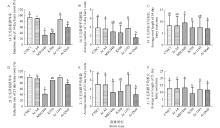
Fig.1
Comparative analysis of hairy root induction efficiency mediated by six Agrobacterium rhizogenes strains in 84K poplar Different lowercase letters indicate significant differences (P<0.05)."
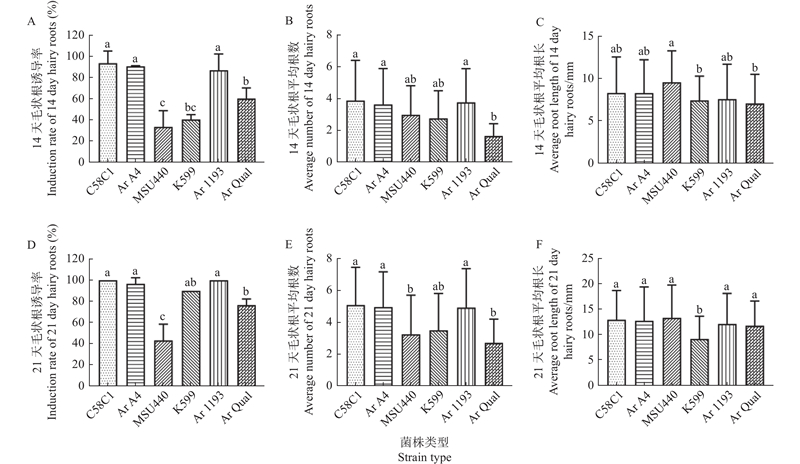
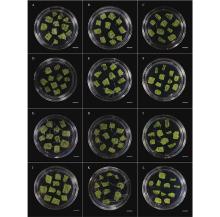
Fig.2
Phenotypic variance of hairy roots induced by six Agrobacterium rhizogenes strains in 84K poplar A–F: Effect diagrams of 84K poplar infected by different Agrobacterium rhizogenes strains for 14 days, corresponding to six strains of Agrobacterium rhizogenes: C58C1, Ar A4, MSU440, K599, Ar 1193 and Ar Qual. G–L: Effect diagrams of 84K poplar infected by different Agrobacterium rhizogenes strains for 21 days, corresponding to six strains of Agrobacterium rhizogenes: C58C1, Ar A4, MSU440, K599, Ar 1193 and Ar Qual. Scale bar: 1 cm."
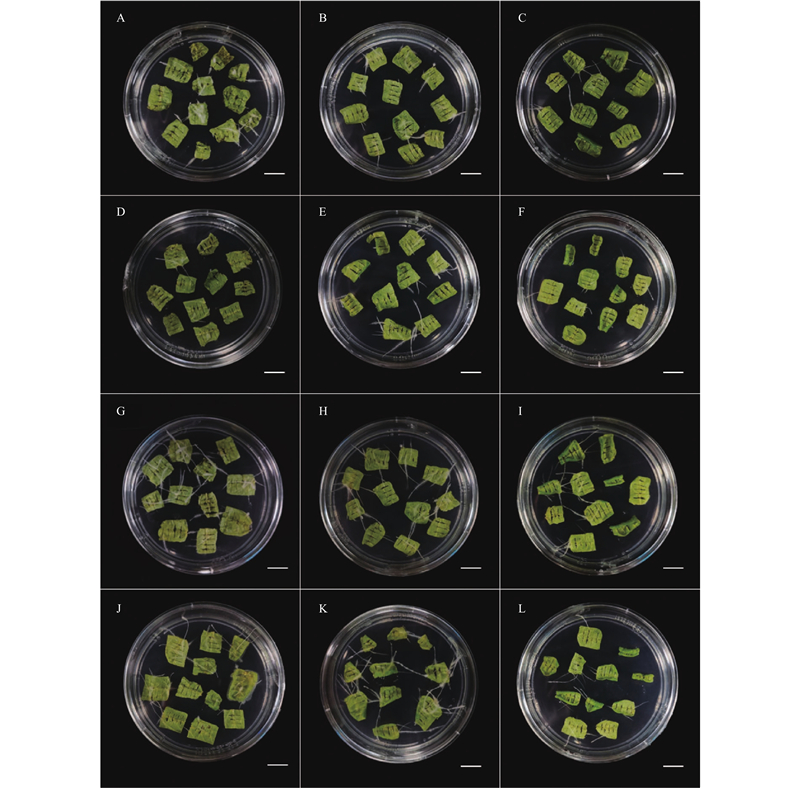
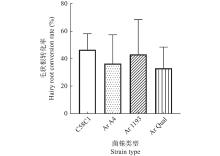
Fig.3
The transformation efficiency of four Agrobacterium rhizogenes strains"
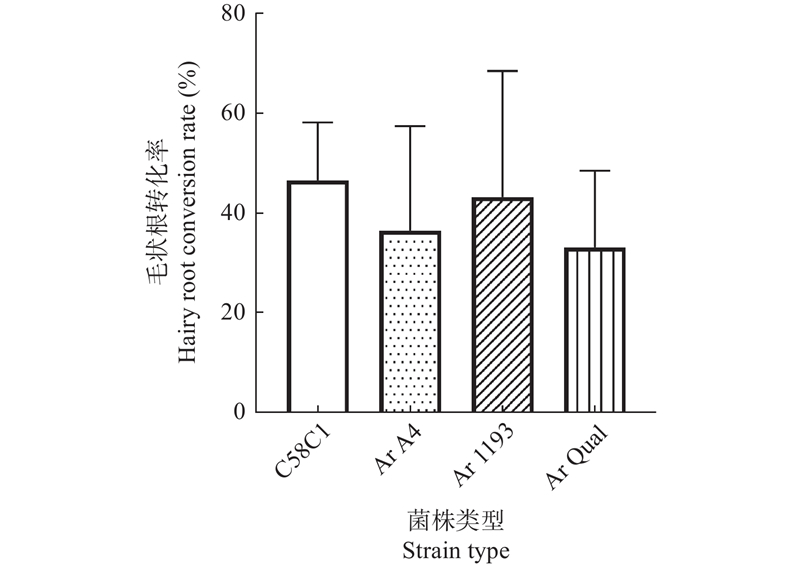
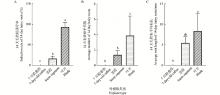
Fig.4
Data statistics of the influence of explant types on the induction of hairy roots of 84K poplar Different lowercase letters indicate significant differences (P<0.05)."
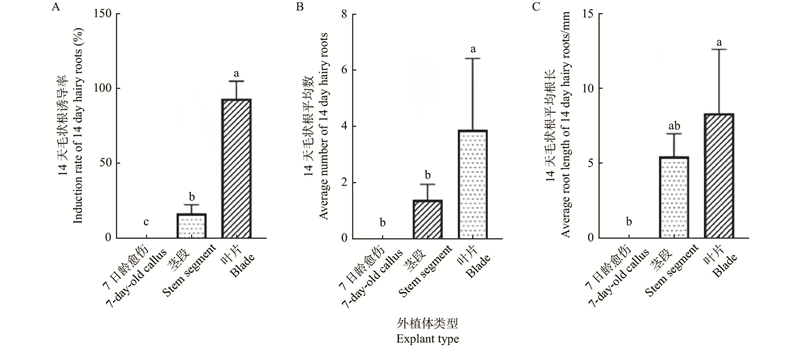
Fig.5
Data statistics of the influence of explant types on the induction of hairy roots of 84K poplar A: Pre-culture of callus at seven days old; B: Pre-culture of stem segments; C: Pre-culture of leaves; D: All the seven-day-old callus died in 14 days after infection; E: A few stem segments rooted at the base in 14 days after infection; F: Most of the leaves rooted at the wound sites in 14 days after infection. Scale bar: 1 cm."
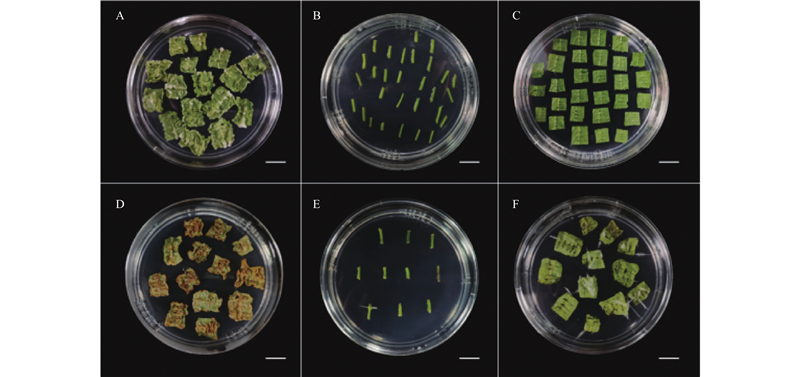
Fig.6
Statistical analysis of the effects of varying bacterial suspension concentrations (OD600) on hairy root induction in 84K poplar Different lowercase letters indicate significant differences (P<0.05)."
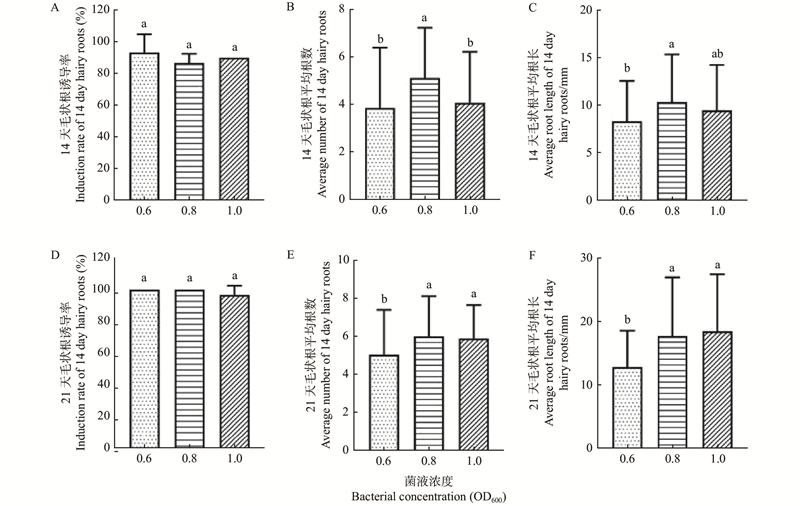
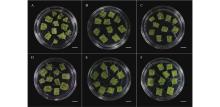
Fig.7
Effect diagrams of the hairy roots of 84K poplar induced by different bacterial liquid concentrations (OD600) A–C: Effect diagrams in 14 days after 84K poplar was infected by different bacterial liquid concentrations, corresponding to the three gradients of OD600 values at 0.6, 0.8 and 1.0, respectively. D–F: Effect diagrams in 21 days after 84K poplar was infected by different bacterial liquid concentrations, corresponding to the three gradients of OD600 values at 0.6, 0.8 and 1.0, respectively. Scale bar: 1 cm."

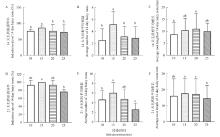
Fig.8
Data statistics on the influence of different infection durations on the induction of hairy roots of 84K poplar Different lowercase letters indicate significant differences (P<0.05)."
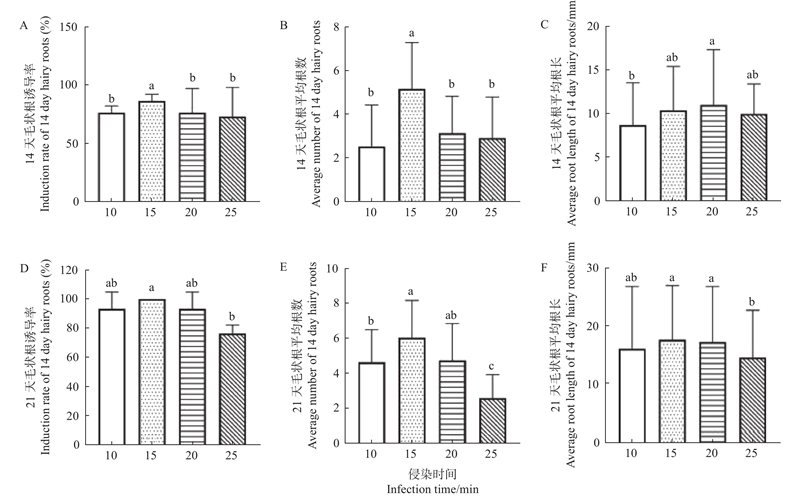
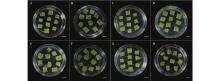
Fig.9
Effect diagrams of the hairy roots of 84K poplar induced by different infection durations A–D: Effect diagrams in 14 days after 84K poplar was infected at different infection durations, corresponding to the four gradients of 10 minutes, 15 minutes, 20 minutes and 25 minutes respectively. E–H: Effect diagrams in 21 days after 84K poplar was infected at different infection durations, corresponding to the four gradients of 10 minutes, 15 minutes, 20 minutes and 25 minutes respectively. Scale bar: 1 cm."
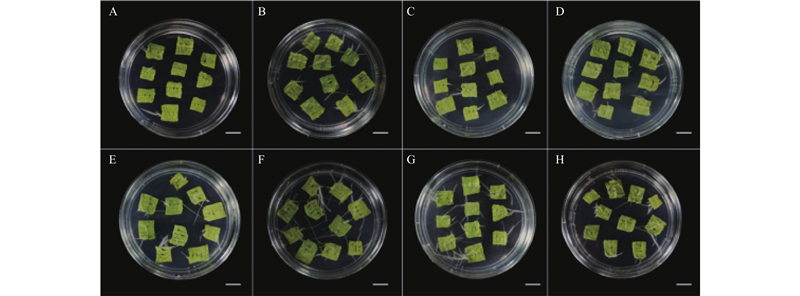

Fig.10
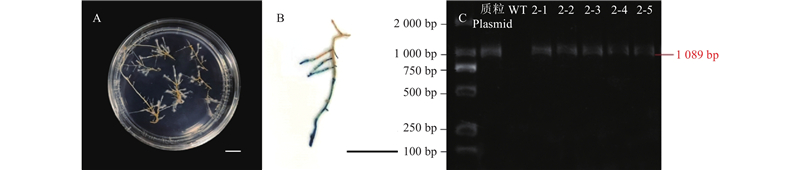
Positive identification of transgenic hairy roots of LOC2 A: Morphological identification, corresponding to LOC2; B: GUS staining identification, corresponding to LOC2; C: PCR identification, corresponding to plasmid, WT, LOC2 (2-1, 2-2, 2-3, 2-4, 2-5), respectively. Scale bar: 1 cm."
| 戴均贵, 朱蔚华. 发根培养技术在植物次生代谢物生产中的应用. 植物生理学通讯, 1999, 35 (1): 69- 76. | |
| Dai J G, Zhu W H. Application of hairy-root culture technology to production of plant secondary metabolites. Plant Physiology Communications, 1999, 35 (1): 69- 76. | |
| 杜 哲, 孙吉康, 闫钟荣, 等. 药用植物毛状根药用成分合成调控机制研究进展与应用前景. 中药材, 2023, 46 (1): 258- 264. | |
| Du Z, Sun J K, Yan Z R, et al. Research progress and application prospects of the regulatory mechanisms of medicinal component synthesis in hairy roots of medicinal plants. Journal of Chinese Medicinal Materials, 2023, 46 (1): 258- 264. | |
| 胡 菊. 2019. 蓝花丹毛状根遗传转化体系建立及白花丹素生物合成机制研究. 成都: 四川农业大学. | |
| Hu J. 2019. Establishment of genetic transformation system of hairy roots and study on biosynthesis mechanism of plumbagin in Plumbago auriculata Lam. Chengdu: Sichuan Agriculture University. [in Chinese] | |
| 胡 琼, 任国平. 资源植物毛状根培育及应用研究进展. 北方园艺, 2020 (6): 141- 148. | |
| Hu Q, Ren G P. Advances in the cultivation and application research of hairy roots of resource plants. Northern Horticulture, 2020 (6): 141- 148. | |
| 焦 阳, 张琦琦, 邱明萱, 等. 植物毛状根诱导及应用研究进展. 湖北林业科技, 2024, 53 (6): 66- 69,76. | |
| Jiao Y, Zhang Q Q, Qiu M X, et al. Research progress on induction and application of plant hairy roots. Hubei Forestry Science and Technology, 2024, 53 (6): 66- 69,76. | |
| 李 贵. 2020. 萜类合成酶基因sMpGPPS调节植物生长研究. 北京: 中国林业科学研究院. | |
| Li G. 2020. Study on the regulation of plant growth by terpene synthesis gene sMpGPPS. Beijing: Chinese Academy of Forestry. [in Chinese] | |
| 李文龙, 王媛媛, 张芳芳, 等. 药用植物毛状根技术的研究. 安徽农业科学, 2015, 43 (3): 44- 46. | |
| Li W L, Wang Y Y, Zhang F F, et al. Study on hairy roots of medicinal plant technology. Journal of Anhui Agricultural Sciences, 2015, 43 (3): 44- 46. | |
| 林 丽, 范海延, 潘 野, 等. 发根农杆菌Ri质粒及其在植物次生代谢物质生产中的应用. 北方园艺, 2007 (11): 94- 97. | |
| Lin L, Fan Y H, Pan Y, et al. Studies on Agrobacterium rhizogenes and its application to plant secondary metabolit. Northern Horticulture, 2007 (11): 94- 97. | |
| 刘锦红, 李思敏, 王紫莹, 等. 基因工程在药用植物研究中的应用及其发展前景. 热带农业科学, 2020, 40 (5): 52- 56. | |
| Liu J H, Li S M, Wang Z Y, et al. Research progress and application perspectives of genetic engineering on medical plants. Chinese Journal of Tropical Agriculture, 2020, 40 (5): 52- 56. | |
| 刘 彤, 杨淑慎, 方荣锋, 等. Ri质粒介导的毛状根体系建立及其在植物次生代谢产物合成中的研究进展. 植物科学学报, 2015, 33 (2): 264- 270. | |
| Liu T, Yang S S, Fang R F, et al. Establishment of hairy root system mediated by Ri plasmid and its advances in biosynthesis of plant secondary metabolites. Plant Science Journal, 2015, 33 (2): 264- 270. | |
| 马 曦, 张金睿, 庄红梅, 等. 发根农杆菌介导的芜菁高效遗传转化体系建立. 园艺学报, 2025, 52 (5): 1389- 1398. | |
| Ma X, Zhang J R, Zhuang H M, et al. Establishment of an efficient genetic transformation system mediated by Agrobacterium rhizogenes in Turnip. Acta Horticulturae Sinica, 2025, 52 (5): 1389- 1398. | |
| 孟凡娟, 王秋玉, 谢立波, 等. 利用发根农杆菌诱导毛状根的研究进展. 北方园艺, 2008 (12): 81- 83. | |
| Meng F J, Wang Q Y, Xie L B, et al. Progress on the induction of hairy root by Agrobacterium rhizogenes. Northern Horticulture, 2008 (12): 81- 83. | |
| 潘 野, 王晓峰, 林 丽, 等. 发根农杆菌诱导植物毛状根形成的研究进展. 辽宁农业科学, 2007 (5): 31- 33. | |
| Pan Y, Wang X F, Lin L, et al. Research progress on Agrobacterium rhizogenes-induced hairy root formation in plants. Liaoning Agricultural Sciences, 2007 (5): 31- 33. | |
| 邵宏波. 转基因植物药物的开发研究评述. 广西科学, 2002, 9 (1): 60- 63. | |
| Shao H B. An outlook on the developmental research of transgenic plant drug. Guangxi Sciences, 2002, 9 (1): 60- 63. | |
| 王承海. 2020. 影响植物组织培养生产次生代谢产物的因素. 农村经济与科技, 31(4): 34, 48. | |
| Wang C H. 2020. Factors influencing the production of secondary metabolites in plant tissue culture. Rural Economy and Science, 31(4): 34, 48. [in Chinese] | |
| 吴 萼, 张 瑞, 张 超, 等. 发根农杆菌Ri质粒介导的植物基因工程及应用. 杭州师范大学学报(自然科学版), 2018, 17 (5): 520- 525,554. | |
| Wu E, Zhang R, Zhang C, et al. Plant genetic engineering application with Ri plasmid of Agrobacterium rhizogenes. Journal of Hangzhou Normal University (Natural Science Edition), 2018, 17 (5): 520- 525,554. | |
| 谢 静. 生物技术与药用植物次生代谢产物. 西南军医, 2007 (3): 89- 90. | |
| Xie J. Biotechnology and secondary metabolites of medicinal plants. Journal of Military Surgeon in Southwest China, 2007 (3): 89- 90. | |
| 杨秀淦, 高 帅, 王洪峰. Ri质粒诱导药用植物毛状根技术及应用. 广东林业科技, 2012, 28 (5): 67- 73. | |
| Yang X G, Gao S, Wang H F. Research prospect on hairy root culture of medicinal herbs. Guangdong Forestry Science and Technology, 2012, 28 (5): 67- 73. | |
| 杨雪飞. 2007. 基因枪介导的LEA3基因对石斛的遗传转化研究. 合肥: 合肥工业大学. | |
| Yang X F. 2007. Study on genetic transformation of Dendrobium candidumn Wall. ex Lindl with LEA3 gene by particle bombardment. Hefei: Hefei University of Technology. [in Chinese] | |
| 张琦琦. 2024. ‘84K’杨内生菌脱菌体系及PagTMK家族部分形成层高表达基因功能研究. 武汉: 华中农业大学. | |
| Zhang Q Q. 2024. Endophytes debacterization system and functional studyofsomecambium high-expression genesin the PagTMK family of '84K'. Wuhan: Huazhong Agricultural University. [in Chinese] | |
| 张 兴, 刘晓娟, 吕巧玲, 等. 毛状根生产次生代谢产物的研究进展. 化工进展, 2007, 26 (9): 1228- 1232. | |
| Zhang X, Liu X J, Lü Q L, et al. Progress of production of secondary metabolites by hairy roots. Chemical Industry and Engineering Progress, 2007, 26 (9): 1228- 1232. | |
| 朱智慧, 晁二昆, 钱广涛, 等. 药用植物毛状根研究体系及应用方向. 中国现代中药, 2019, 21 (11): 1475- 1481,1496. | |
| Zhu Z H, Chao E K, Qian G T, et al. Hairy root system and its application in medicinal plants. Modern Chinese Medicine, 2019, 21 (11): 1475- 1481,1496. | |
|
Akutsu M, Ishizaki T, Sato H. Transformation of the monocotyledonous Alstroemeria by Agrobacterium tumefaciens. Plant Cell Reports, 2004, 22 (8): 561- 568.
doi: 10.1007/s00299-003-0729-z |
|
|
Chiyo N, Seki H, Kanamoto T, et al. Glycyrrhizin production in licorice hairy roots based on metabolic redirection of triterpenoid biosynthetic pathway by genome editing. Plant Cell Physiology, 2024, 65 (2): 185- 198.
doi: 10.1093/pcp/pcad161 |
|
| Christou P. Strategies for variety-independent genetic transformation of important cereals, legumes and woody species utilizing particle bombardment. Euphytica, 1995, 85 (1): 13- 27. | |
|
Gutierrez-Valdes N, Häkkinen S T, Lemasson C, et al. Hairy root cultures—a versatile tool with multiple applications. Frontiers in Plant Science, 2020, 11, 33.
doi: 10.3389/fpls.2020.00033 |
|
| Hou W N, Shakya P, Franklin G. A perspective on Hypericum perforatum genetic transformation. Frontiers in Plant Science, 2016, 7, 879. | |
|
Jiang Y, He G H, Li R Q, et al. Functional validation of the cytochrome P450 family PgCYP309 gene in Panax ginseng. Biomolecules, 2024, 14 (6): 715.
doi: 10.3390/biom14060715 |
|
|
Li J H, Mutanda I, Wang K B, et al. Chloroplastic metabolic engineering coupled with isoprenoid pool enhancement for committed taxanes biosynthesis in Nicotiana benthamiana. Nature Communications, 2019, 10 (1): 4850.
doi: 10.1038/s41467-019-12879-y |
|
|
Li Q H, Zhang X Y, Zhao P L, et al. Metal tolerance protein CsMTP4 has dual functions in maintaining zinc homeostasis in tea plant. Journal of Hazardous Materials, 2024a, 471, 134308.
doi: 10.1016/j.jhazmat.2024.134308 |
|
|
Li Y P, Yang Y K, Li L, et al. Advanced metabolic engineering strategies for increasing artemisinin yield in Artemisia annua L. Horticulture Research, 2024b, 11 (2): uhad292.
doi: 10.1093/hr/uhad292 |
|
|
Liu X Y, Li W X, Wang M H, et al. Establishment of hairy root system of transgenic IRT1 Brassica campestris L. and preliminary study of its effect on cadmium enrichment. International Journal of Phytoremediation, 2023, 25 (11): 1455- 1462.
doi: 10.1080/15226514.2022.2164247 |
|
|
Meng D, Yang Q, Dong B Y, et al. Development of an efficient root transgenic system for pigeon pea and its application to other important economically plants. Plant Biotechnology Journal, 2019, 17 (9): 1804- 1813.
doi: 10.1111/pbi.13101 |
|
|
Morey K J, Peebles C A M. Hairy roots: an untapped potential for production of plant products. Frontiers in Plant Science, 2022, 13, 937095.
doi: 10.3389/fpls.2022.937095 |
|
|
Sharma P, Padh H, Shrivastava N. Hairy root cultures: a suitable biological system for studying secondary metabolic pathways in plants. Engineering in Life Sciences, 2013, 13 (1): 62- 75.
doi: 10.1002/elsc.201200030 |
|
|
Shen X, Yang T, Du Y L, et al. Research on the function of CsMYB36 based on an effective hair root transformation system. Plant Signaling and Behavior, 2024, 19 (1): 2345983.
doi: 10.1080/15592324.2024.2345983 |
|
|
Shu W B, Shi M R, Zhang Q Q, et al. Transcriptomic and metabolomic analyses reveal differences in flavonoid pathway gene expression profiles between two Dendrobium varieties during vernalization. International Journal of Molecular Sciences, 2023, 24 (13): 11039.
doi: 10.3390/ijms241311039 |
|
|
Shu W B, Zhou H J, Jiang C, et al. The auxin receptor TIR1 homolog (PagFBL1) regulates adventitious rooting through interactions with Aux/IAA28 in Populus. Plant Biotechnology Journal, 2019, 17 (2): 338- 349.
doi: 10.1111/pbi.12980 |
|
|
Wu Z G, Singh S K, Lyu R Q, et al. Metabolic engineering to enhance the accumulation of bioactive flavonoids licochalcone A and echinatin in Glycyrrhiza inflata (Licorice) hairy roots. Frontiers in Plant Science, 2022, 13, 932594.
doi: 10.3389/fpls.2022.932594 |
|
|
Yu S W, Zhu M Z, Li P, et al. Dissection of the spatial dynamics of biosynthesis, transport, and turnover of major amino acids in tea plants (Camellia sinensis). Horticulture Research, 2024, 11 (5): uhae060.
doi: 10.1093/hr/uhae060 |
| [1] | Yingnan Chen,Chuanjing Hu,Qiang Zhuge,Jianjun Hu,Tongming Yin. Thirty Years of Agrobacterium-Mediated Genetic Transformation of Populus [J]. Scientia Silvae Sinicae, 2022, 58(12): 114-129. |
| [2] | Yunxin Cen,Jia Liu,Faju Chen,Jingyuan Yang,Qiang Liu,Tao Wang,Hongwei Liang. Agrobacterium-Mediated Genetic Transformation System of Catalpa bungei [J]. Scientia Silvae Sinicae, 2021, 57(8): 195-204. |
| [3] | Xiaohong Yang,Xiaoyang Chen. Transformation of Lespedeza bicolor with Bivalent Gene xylA & BADH under Xylose Selection System [J]. Scientia Silvae Sinicae, 2021, 57(6): 74-84. |
| [4] | Bi Liang,Jiaqi Zhang,Fei Ren,Hengkang Hu,Chuanmei Xu,Yuanyuan Hu,Youjun Huang,Heqiang Lou,Qixiang Zhang. Cloning and Expression Analysis of Ent-Kaurene Oxidase Gene CcKo in Carya cathayensis [J]. Scientia Silvae Sinicae, 2020, 56(10): 70-82. |
| [5] | Gu Zhanying, Yang Ruonan, Chen Hao. The Establishment of Isolation and Transient Transformation Methods of Protoplasts of Vernicia fordii Mesophyll Cells [J]. Scientia Silvae Sinicae, 2018, 54(1): 46-53. |
| [6] | Cheng Zhenxia, Hu Haitao, Yang Li, Wang Changchun, Guo Weidong, Yang Ling. Overexpression of EutPDS Gene from Elaeagnus umbellata Increases Lycopene Content in Tomato Fruit [J]. Scientia Silvae Sinicae, 2017, 53(1): 62-69. |
| [7] | Luo Zaiqi, Guo Huili, Yang Yadong, Yang Mingfeng, Ma Lanqin, Wang Younian. Agrobacterium-Mediated Transformation of Resveratrol Synthase Gene (PcPKS5) into Huping Jujube (Zizyphus jujuba) [J]. Scientia Silvae Sinicae, 2015, 51(10): 101-109. |
| [8] | Zhang Weixi, Liu Boyang, Ding Changjun, Zhang Bingyu, Huang Qinjun, Chu Yanguang, Su Xiaohua. Transformation of Zinc Finger Protein Transcription Factor Gene (ZxZF) and Preliminary Evaluation of Drought Tolerance in Populus × euramericana [J]. Scientia Silvae Sinicae, 2014, 50(3): 31-37. |
| [9] | Li Simeng;Wang Yonglin;Huang Donghui;Tian Chengming. Establishment of a PEG-Mediated Genetic Transformation System and Expression of Green Fluorescence Protein in Colletotrichum gloeosporioides [J]. , 2013, 49(5): 121-127. |
| [10] | Ouyang Lejun;Liu Yuan;Huang Zhenchi;Zeng Fuhua. Transformation of TSRF 1 into Eucalyptus urophylla and the Broad-Spectrum Disease Resistance of the Transgenic Plant to Diseases [J]. Scientia Silvae Sinicae, 2013, 49(4): 46-53. |
| [11] | Li Xiaorui;Hu Shanglian;Cao Ying;Lu Xueqin;Ren Peng;Wu Xiaoyu;Zhou Meijuan. Agrobacterium-Mediated Transformation of 4CL Gene from Neosinocalamus affinis into Dendrocalamus farinosus [J]. Scientia Silvae Sinicae, 2012, 48(3): 38-44. |
| [12] | Jia Xiaoming;Zhang Huanling;Fan Junfeng. System Optimization of Precociously Flowering of Poplar Induced by FT Gene Controlled by a Heat Shock Promoter [J]. Scientia Silvae Sinicae, 2011, 47(11): 37-43. |
| [13] | Zhang Xiaoying;Gan Jing;Yin Weilun;Zhu Zhen;Wang Huafang. Transformation of the Insecticidal Agglutinin Gene(gna) from Snowdrop (Galanthus nivalis) into Sophora japonica and Resistance of the Transgenic Plants to Aphids [J]. Scientia Silvae Sinicae, 2010, 46(2): 51-55. |
| [14] | Song Enhui;Cai Cheng;Wei Guo;Gao Hui;Xiang Yan. Cultivation of Low Lignin Poplar by RNA Interference [J]. Scientia Silvae Sinicae, 2010, 46(2): 39-44. |
| [15] | Zhang Xiaoying;Gan Jing;Yin Weilun;Zhu Zhen;Wang Huafang. An effective Transformation System of Sophora japonica [J]. Scientia Silvae Sinicae, 2009, 12(5): 20-26. |
| Viewed | ||||||
|
Full text |
|
|||||
|
Abstract |
|
|||||
