
Scientia Silvae Sinicae ›› 2026, Vol. 62 ›› Issue (4): 81-90.doi: 10.11707/j.1001-7488.LYKX20250191
• Research papers • Previous Articles Next Articles
Yihang Jiang1,2,Qingwei Zeng3,Zhenhua Liu4,Jianguo Zhang1,Xiongqing Zhang1,2,*( )
)
Received:2025-04-02
Online:2026-04-15
Published:2026-04-11
Contact:
Xiongqing Zhang
E-mail:xqzhang85@caf.ac.cn
CLC Number:
Yihang Jiang,Qingwei Zeng,Zhenhua Liu,Jianguo Zhang,Xiongqing Zhang. Impact mechanism of Large-Diameter Timber Yield of Chinese Fir under Close-to-Nature Transformation from Chinese Fir to Phoebe bournei Based on Bayesian Network Model[J]. Scientia Silvae Sinicae, 2026, 62(4): 81-90.

Table 1
Statistics of stand and tree variables"
| 项目Item | 杉木 Cunninghamia lanceolata | 闽楠 Phoebe bournei | 密度 Density/ (tree?hm?2) | |||
| 胸径 DBH/cm | 树高Tree height/m | 胸径 DBH/cm | 树高Tree height/m | |||
| 最大值Max. | 25.1 | 18.1 | 2.7 | 3.5 | 1 717 | |
| 最小值Min. | 17.6 | 10.0 | 0.9 | 1.8 | 1 050 | |
| 平均值Mean | 21.3 | 14.5 | 1.7 | 2.6 | 1 351 | |
Table 2
Discretization and prior probability of variables at each node in Bayesian network"
| 节点变量 Node variables | 离散值(低、高) Discretization value (low, high) | 先验概率 Prior probability |
| 胸径Average DBH/cm | [17.6, 21.55], (21.55, 25.1] | (0.50, 0.50) |
| 杉木保留密度Retained density/(tree?hm?2) | [367, 550], (550, | (0.50, 0.50) |
| 冠幅Crown width/m | [2.6, 4.25], (4.25, 5] | (0.50, 0.50) |
| 优势高 Dominant height/m | [11.6, 16.85], (16.85, 20.1] | (0.50, 0.50) |
| 灌木多样性 Shrub diversity | [0.552, 1.72], (1.72, 2.49] | (0.50, 0.50) |
| 草本多样性 Herb diversity | [0.323, 1.96], (1.96, 2.67] | (0.50, 0.50) |
| 全氮Total nitrogen (%) | [0.11, 0.137], (0.137, 0.258] | (0.50, 0.50) |
| 全磷Total phosphorus (%) | [0.017, | (0.50, 0.50) |
| 大径材出材量Large diameter yield/(m3?hm?2) | [0.38, 42.38], (42.38, 128.16] | (0.50, 0.50) |
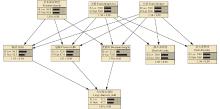
Fig.1
Bayesian network model for predicting the large-diameter yield of Chinese fir"
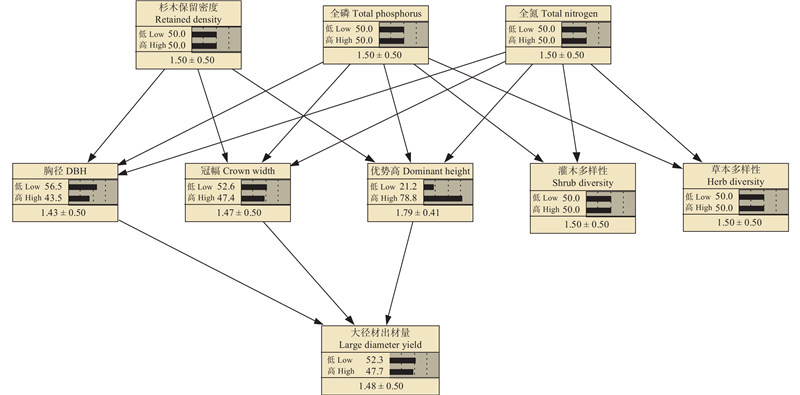
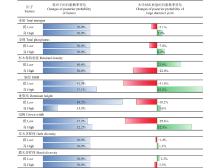
Fig.2
Causal reasoning: posterior probability change of the yield of large diameter timber of Chinese fir at different levels of each node"
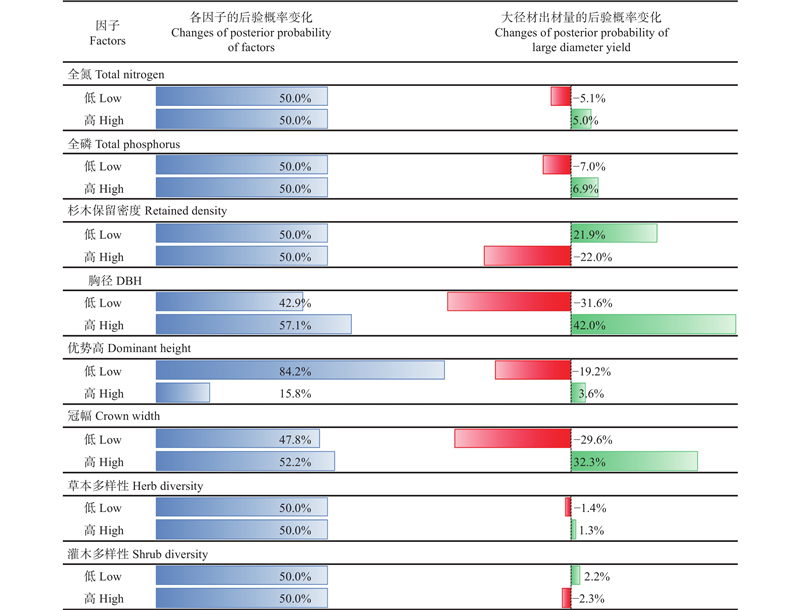
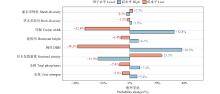
Fig.3
Diagnostic reasoning: posterior probability change of each node when the large diameter yield of Chinese fir is at high level (42?128 m3·hm?2)"
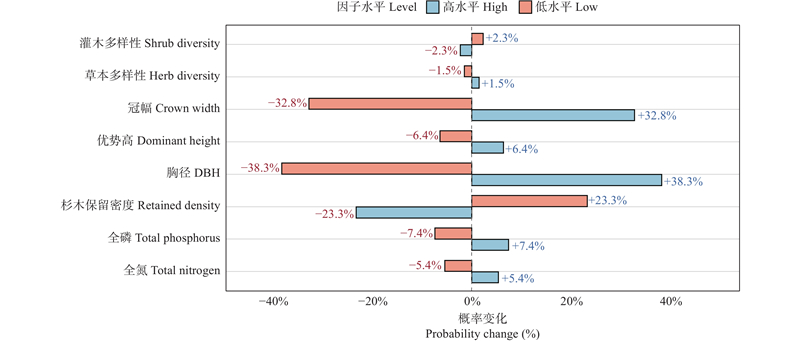
Table 3
Sensitivity analysis results of large-diameter yield of Chinese fir"
| 节点 Nodes | 方差减少 Variance reduction | 互信息值 Mutual information | 占比 Percent (%) |
| 大径材出材量Large diameter yield | 0.249 1 | 0.997 5 | 100.00 |
| 胸径DBH | 0.132 7 | 0.428 6 | 43.00 |
| 冠幅Crown width | 0.095 8 | 0.298 2 | 29.90 |
| 杉木保留密度Density | 0.048 1 | 0.144 2 | 14.50 |
| 优势高Dominant height | 0.006 9 | 0.020 7 | 2.07 |
| 全磷Total phosphorus | 0.004 8 | 0.013 9 | 1.40 |
| 全氮Total nitrogen | 0.002 6 | 0.007 4 | 0.74 |
| 灌木多样性Shrub diversity | 0.000 4 | 0.001 4 | 1.42E-01 |
| 草本多样性Herb diversity | 0.000 2 | 0.000 6 | 5.57E-02 |
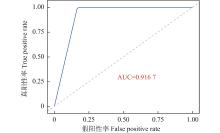
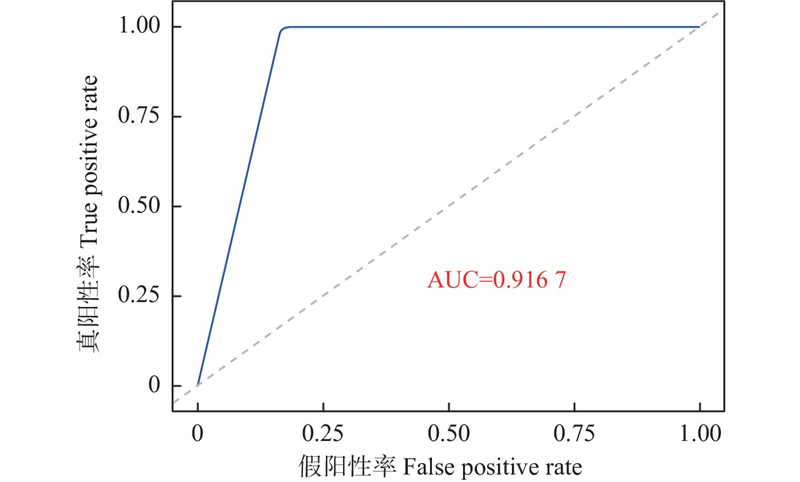
Fig.4
Receiver operating characteristic (ROC) curve for Bayesian network model"
|
江怡航, 胡宇欣, 刘振华, 等. 杉楠不同近自然改造模式对杉木林分生长及材种出材量的影响. 中南林业科技大学学报, 2024, 44 (12): 51- 58, 142.
doi: 10.14067/j.cnki.1673-923x.2024.12.005 |
|
|
Jiang Y H, Hu Y X, Liu Z H, et al. Effects of close-to-nature silviculture mixed with Phoebe bournei in Chinese fir plantations on stand growth and timber assortment output of Chinese fir. Journal of Central South University of Forestry & Technology, 2024, 44 (12): 51- 58, 142.
doi: 10.14067/j.cnki.1673-923x.2024.12.005 |
|
|
李晓燕, 段爱国, 张建国. 不同产区杉木人工林初植密度对优势高生长的影响. 林业科学, 2023, 59 (8): 22- 29.
doi: 10.11707/j.1001-7488.LYKX20210836 |
|
|
Li X Y, Duan A G, Zhang J G. Effects of initial planting density on dominant height growth of Chinese fir (Cunninghamia lanceolata) plantation in different distribution areas. Scientia Silvae Sinicae, 2023, 59 (8): 22- 29.
doi: 10.11707/j.1001-7488.LYKX20210836 |
|
| 路文燕, 董灵波, 田 园, 等. 基于树种组成的大兴安岭天然林主要树种树高−胸径曲线研究. 南京林业大学学报(自然科学版), 2023, 47 (4): 157- 165. | |
| Lu W Y, Dong L B, Tian Y, et al. Modelling height-diameter curves of main species for natural forests based on species composition in Greater Khingan Mountains, northeast China. Journal of Nanjing Forestry University (Natural Sciences Edition), 2023, 47 (4): 157- 165. | |
|
潘 昕, 李 骏, 孙帅超, 等. 杉木主伐林分材种结构及其出材率模型研建. 北京林业大学学报, 2023, 45 (8): 84- 93.
doi: 10.12171/j.1000-1522.20230031 |
|
|
Pan X, Li J, Sun S C, et al. Timber assortment structure and outturn model for final felling stands of Cunninghamia lanceolata plantations. Journal of Beijing Forestry University, 2023, 45 (8): 84- 93.
doi: 10.12171/j.1000-1522.20230031 |
|
| 钱 越, 李铁华, 游 美, 等. 杉木保留密度对杉阔异龄复层林生长量及土壤理化性质的影响. 湖南林业科技, 2024, 51 (3): 36- 43. | |
| Qian Y, Li T H, You M, et al. Effects of retention density on the growth and soil physicochemical properties of multi-layered Cunninghamia lanceolata forests of different ages. Hunan Forestry Science & Technology, 2024, 51 (3): 36- 43. | |
|
宋重升, 王有良, 张利荣, 等. 间伐强度对杉木人工林材种结构的影响. 福建农林大学学报(自然科学版), 2022, 51 (2): 195- 203.
doi: 10.13323/j.cnki.j.fafu(nat.sci.).2022.02.007 |
|
|
Song C S, Wang Y L, Zhang L R, et al. Effect of thinning intensity on timber structure of Chinese fir plantation. Journal of Fujian Agriculture and Forestry University (Natural Science Edition), 2022, 51 (2): 195- 203.
doi: 10.13323/j.cnki.j.fafu(nat.sci.).2022.02.007 |
|
| 童书振, 刘景芳. 2019. 杉木林经营数表与优化密度控制. 北京: 中国林业出版社. | |
| Tong S Z, Liu J F. 2019. Study on management number table and optimal density control of Cunninghamia lanceolata forest. Beijing: China Forestry Publishing House. [in Chinese] | |
|
王佳琪, 马东旭, 蓝伟立, 等. 间伐保留密度对基于大径材培育下杉木人工林生长和材种结构的影响. 中南林业科技大学学报, 2024, 44 (2): 20- 28.
doi: 10.14067/j.cnki.1673-923x.2024.02.003 |
|
|
Wang J Q, Ma D X, Lan W L, et al. Effects of thinning retention density on growth and wood species structure of Chinese fir plantation based on large-diameter timber cultivation. Journal of Central South University of Forestry & Technology, 2024, 44 (2): 20- 28.
doi: 10.14067/j.cnki.1673-923x.2024.02.003 |
|
|
王书韧, 郭利娜, 白彦锋, 等. 间伐套种对杉木人工林生长、干形形质和材种结构的影响. 林业科学研究, 2023, 36 (6): 48- 57.
doi: 10.12403/j.1001-1498.20230147 |
|
|
Wang S R, Guo L N, Bai Y F, et al. Effects of thinning and interplanting on the tree growth, stem-form quality and timber structure of Cunninghamia lanceolata. Forest Research, 2023, 36 (6): 48- 57.
doi: 10.12403/j.1001-1498.20230147 |
|
| 王晓红, 辛守英, 张 薇, 等. 基于主成分分析下贝叶斯优化卷积神经网络模型人工林树种识别的研究. 森林工程, 2025, 41 (2): 298- 311. | |
| Wang X H, Xin S Y, Zhang W, et al. Study on tree species identification of planted forests based on PCA-BO-CNN model. Forest Engineering, 2025, 41 (2): 298- 311. | |
| 魏书蒙, 陈详腾, 赵光宇, 等. 杉木人工林近自然改造对土壤化学性质及酶活性的影响. 生态学报, 2024, 44 (10): 4277- 4287. | |
| Wei S M, Chen X T, Zhao G Y, et al. Effects of close-to-nature transformation of Chinese fir plantation on soil chemical properties and enzyme activities. Acta Ecologica Sinica, 2024, 44 (10): 4277- 4287. | |
|
相聪伟, 张建国, 段爱国, 等. 杉木人工林材种结构的立地及密度效应研究. 林业科学研究, 2015, 28 (5): 654- 659.
doi: 10.3969/j.issn.1001-1498.2015.05.008 |
|
|
Xiang C W, Zhang J G, Duan A G, et al. Effects of site quality and planting density on wood assortment rate in Chinese fir plantation. Forest Research, 2015, 28 (5): 654- 659.
doi: 10.3969/j.issn.1001-1498.2015.05.008 |
|
|
杨 颖, 王国忠, 郑文华, 等. 杉木纯林转变为杉木和闽楠复层异龄混交林对土壤剖面氮磷组分的影响. 森林工程, 2025, 41 (6): 1230- 1241.
doi: 10.7525/j.issn.1006-8023.2025.06.013 |
|
|
Yang Y, Wang G Z, Zheng W H, et al. Effects of transforming pure Cunninghamia lanceolata plantations into multi-layered, uneven-aged mixed Cunninghamia lanceolata and Phoebe bournei plantations on soil profile nitrogen and phosphorus fractions. Forest Engineering, 2025, 41 (6): 1230- 1241.
doi: 10.7525/j.issn.1006-8023.2025.06.013 |
|
|
叶功富, 涂育合, 林瑞荣, 等. 杉木人工林不同密度管理定向培育大径材. 北华大学学报(自然科学版), 2005, 6 (6): 544- 549.
doi: 10.3969/j.issn.1009-4822.2005.06.020 |
|
|
Ye G F, Tu Y H, Lin R R, et al. On big-diameter-oriented cultivation techniques of Cunninghamia lanceolata of different density measures. Journal of Beihua University (Natural Science), 2005, 6 (6): 544- 549.
doi: 10.3969/j.issn.1009-4822.2005.06.020 |
|
|
张雄清, 张建国, 段爱国. 基于贝叶斯法估计杉木人工林树高生长模型. 林业科学, 2014, 50 (3): 69- 75.
doi: 10.11707/j.1001-7488.20140310 |
|
|
Zhang X Q, Zhang J G, Duan A G. Tree-height growth model for Chinese fir plantation based on Bayesian method. Scientia Silvae Sinicae, 2014, 50 (3): 69- 75.
doi: 10.11707/j.1001-7488.20140310 |
|
|
Aguilera P A, Fernández A, Fernández R, et al. Bayesian networks in environmental modelling. Environmental Modelling & Software, 2011, 26 (12): 1376- 1388.
doi: 10.1016/j.envsoft.2011.06.004 |
|
|
Bianchi S, Huuskonen S, Hynynen J, et al. Comparing wood production and carbon sequestration after extreme thinnings in boreal Scots pine stands. Forest Ecology and Management, 2024, 553, 121641.
doi: 10.1016/j.foreco.2023.121641 |
|
|
Bodewes T, Scutari M. Learning Bayesian networks from incomplete data with the node-average likelihood. International Journal of Approximate Reasoning, 2021, 138, 145- 160.
doi: 10.1016/j.ijar.2021.07.015 |
|
|
Charizanos G, Demirhan H. Bayesian prediction of wildfire event probability using normalized difference vegetation index data from an Australian forest. Ecological Informatics, 2023, 73, 101899.
doi: 10.1016/j.ecoinf.2022.101899 |
|
|
Chen F, Jia H C, Du E Y, et al. Modeling of the cascading impacts of drought and forest fire based on a Bayesian network. International Journal of Disaster Risk Reduction, 2024, 111, 104716.
doi: 10.1016/j.ijdrr.2024.104716 |
|
| Darwiche A. 2009. Modeling and reasoning with Bayesian networks. UK: Cambridge University Press, 560. | |
| Fenton N, Neil M. 2012. Risk assessment and decision analysis with Bayesian networks. Boca Raton, FL: CRC Press, 524. | |
|
Jian Z J, Ni Y Y, Lei L, et al. Phosphorus is the key soil indicator controlling productivity in planted Masson pine forests across subtropical China. Science of the Total Environment, 2022, 822, 153525.
doi: 10.1016/j.scitotenv.2022.153525 |
|
|
Jiang Y H, Wang Z, Chen H Y, et al. A Bayesian network model to disentangle the effects of stand and climate factors on tree mortality of Chinese fir plantations. Frontiers in Forests and Global Change, 2023, 6, 1298968.
doi: 10.3389/ffgc.2023.1298968 |
|
|
Jucker T, Bouriaud O, Coomes D A. Crown plasticity enables trees to optimize canopy packing in mixed-species forests. Functional Ecology, 2015, 29 (8): 1078- 1086.
doi: 10.1111/1365-2435.12428 |
|
|
Kaushal S, Baishya R. Stand structure and species diversity regulate biomass carbon stock under major central Himalayan forest types of India. Ecological Processes, 2021, 10 (1): 14.
doi: 10.1186/s13717-021-00283-8 |
|
|
Kweon D, Comeau P G. Relationships between tree survival, stand structure and age in trembling aspen dominated stands. Forest Ecology and Management, 2019, 438, 114- 122.
doi: 10.1016/j.foreco.2019.02.003 |
|
|
Li X Y, Duan A G, Zhang J G. Influence of stand density, site, age, and competition on the timber assortment structure of Chinese fir plantations. Scientific Reports, 2024, 14 (1): 29056.
doi: 10.1038/s41598-024-79411-1 |
|
|
Liu C L C, Kuchma O, Krutovsky K V. Mixed-species versus monocultures in plantation forestry: development, benefits, ecosystem services and perspectives for the future. Global Ecology and Conservation, 2018, 15, e00419.
doi: 10.1016/j.gecco.2018.e00419 |
|
|
Mustafaa Y T, Tolpekin V, Stein A. Application of the EM-algorithm for Bayesian network modelling to improve forest growth estimates. Procedia Environmental Sciences, 2011, 7, 74- 79.
doi: 10.1016/j.proenv.2011.07.014 |
|
|
Nappa A, Quartulli M, Azpiroz I, et al. Probabilistic Bayesian Neural Networks for olive phenology prediction in precision agriculture. Ecological Informatics, 2024, 82, 102723.
doi: 10.1016/j.ecoinf.2024.102723 |
|
|
Ouyang S, Xiang W H, Wang X P, et al. Effects of stand age, richness and density on productivity in subtropical forests in China. Journal of Ecology, 2019, 107 (5): 2266- 2277.
doi: 10.1111/1365-2745.13194 |
|
|
Selvaraj S, Duraisamy V, Huang Z J, et al. Influence of long-term successive rotations and stand age of Chinese fir (Cunninghamia lanceolata) plantations on soil properties. Geoderma, 2017, 306, 127- 134.
doi: 10.1016/j.geoderma.2017.07.014 |
|
|
Vogel K, Riggelsen C, Korup O, et al. Bayesian network learning for natural hazard analyses. Natural Hazards and Earth System Sciences, 2014, 14 (9): 2605- 2626.
doi: 10.5194/nhess-14-2605-2014 |
|
|
Wang Y R, Liu Z H, Tang T, et al. Analysis of the relative importance of stand structure and site conditions for the productivity, species diversity, and carbon sequestration of Cunninghamia lanceolata and Phoebe bournei mixed forest. Plants, 2023, 12 (8): 1633.
doi: 10.3390/plants12081633 |
|
|
Węgiel A, Bembenek M, Łacka A, et al. Relationship between stand density and value of timber assortments: a case study for Scots pine stands in north-western Poland. New Zealand Journal of Forestry Science, 2018, 48, 12.
doi: 10.1186/s40490-018-0117-7 |
|
|
Wei X H, Blanco J A, Jiang H, et al. Effects of nitrogen deposition on carbon sequestration in Chinese fir forest ecosystems. Science of the Total Environment, 2012, 416, 351- 361.
doi: 10.1016/j.scitotenv.2011.11.087 |
|
|
Zapata-Cuartas M, Sierra C A, Alleman L. Probability distribution of allometric coefficients and Bayesian estimation of aboveground tree biomass. Forest Ecology and Management, 2012, 277, 173- 179.
doi: 10.1016/j.foreco.2012.04.030 |
|
|
Zhang X Q, Cao Q V, Lu L L, et al. Use of modified Reineke’s stand density index in predicting growth and survival of Chinese fir plantations. Forest Science, 2019, 65 (6): 776- 783.
doi: 10.1093/forsci/fxz033 |
|
|
Zhang Y B, Duan B L, Xian J R, et al. Links between plant diversity, carbon stocks and environmental factors along a successional gradient in a subalpine coniferous forest in Southwest China. Forest Ecology and Management, 2011, 262 (3): 361- 369.
doi: 10.1016/j.foreco.2011.03.042 |
|
|
Zhou M L, Lei X D, Duan G S, et al. The effect of the calculation method, plot size, and stand density on the top height estimation in natural spruce-fir-broadleaf mixed forests. Forest Ecology and Management, 2019, 453, 117574.
doi: 10.1016/j.foreco.2019.117574 |
| [1] | Yuxin Hu,Yihang Jiang,Zhenhua Liu,Guangyu Zhu,Jianguo Zhang,Xiongqing Zhang. Effects of Understory Enrichment Planting Modes in Pure Chinese fir Forests on Soil Quality and Microbial Communities [J]. Scientia Silvae Sinicae, 2026, 62(3): 61-73. |
| [2] | Jiaqi Cai,Xueping Zhang,Ping Mao,Jing Yang,Senwen Yu,Kai Zhu,Kui Zhang,Xu Wang,Haijun Xu. Preparation of Smoke Flavorings of Cunninghamia lanceolata by Superheated Steam Distillation-Cracking and their Composition Analysis [J]. Scientia Silvae Sinicae, 2026, 62(3): 193-200. |
| [3] | Yamin Du,Zhu Li,Jiali Jiang,Fangyu Yin,Jianxiong Lü. Water Vapor Sorption Characteristics of Wood During Cyclic Adsorption-Desorption Processes [J]. Scientia Silvae Sinicae, 2024, 60(9): 150-158. |
| [4] | Lü Ziqing, Duan Aiguo. Biomass and Carbon Storage Model of Cunninghamia lanceolata in Different Production Areas [J]. Scientia Silvae Sinicae, 2024, 60(2): 1-11. |
| [5] | Mengjia Yang,Xianhua Zou,Zhijuan Guo,Zhao Peng,Yan He,Zhiyuan Peng,Bida Yao,Guomin Huang,Liqin Zhu,Rongzhen Huang. Dynamics of Photosynthetic Carbon Allocation in Seedlings of Two Chinese Fir Families Based on 13C Tracing [J]. Scientia Silvae Sinicae, 2024, 60(12): 35-46. |
| [6] | Xiaoyan Li,Aiguo Duan,Jianguo Zhang. Effects of Initial Planting Density on Dominant Height Growth of Chinese Fir (Cunninghamia lanceolata) Plantation in Different Distribution Areas [J]. Scientia Silvae Sinicae, 2023, 59(8): 22-29. |
| [7] | Yancheng Qu,Yihang Jiang,Yanyan Jiang,Jianguo Zhang,Anli Luo,Xiongqing Zhang. Tree Leaf Biomass Models of Chinese fir Plantations Based on Sapwood Area and Diameter at Breast Height and Diameter at Crown Base [J]. Scientia Silvae Sinicae, 2023, 59(7): 106-114. |
| [8] | Jiaqi Chen,Guangyu Zhao,Yanglong Li,Yuhong Dong,Lingyu Hou,Ruzhen Jiao. Age Changes of Soil Phosphorus Form and Content in Chinese Fir Plantations [J]. Scientia Silvae Sinicae, 2022, 58(5): 10-17. |
| [9] | Yuedong Shi,Hong Zheng,Daiquan Ye,Jisen Shi,Liming Bian. Spatial and Competition Effects for Growth Traits of Chinese Fir and Their Impacts on Estimations of Genetic Parameters [J]. Scientia Silvae Sinicae, 2022, 58(5): 75-84. |
| [10] | Shuzhen Wang,Jingjing Liang,Mingzhuo Bao,Fei Pan,Chuifan Zhou. Variation of Soil Phosphorus Fractions and the Phosphorus Solubilizing Microbial Communities in Chinese Fir Monoculture Plantations with Different Ages [J]. Scientia Silvae Sinicae, 2022, 58(2): 58-69. |
| [11] | Min Chen,Huayan Lai,Shanshan Zheng,Ming Li,Xiangqing Ma,Pengfei Wu. Effects of Exogenous Ethylene on Growth and Phosphorus Use Efficiency of Chinese Fir Seedlings under Phosphorus Stress [J]. Scientia Silvae Sinicae, 2021, 57(7): 43-50. |
| [12] | Ru Jia,Haiyan Sun,Yurong Wang,Rui Wang,Rongjun Zhao,Haiqing Ren. Relativity of Microstructures and Mechanical Properties of Juvenile Woods of 10-Year-Old New Chinese Fir Clones 'Yang 020' and 'Yang 061' [J]. Scientia Silvae Sinicae, 2021, 57(5): 165-175. |
| [13] | Hao Zang,Hongsheng Liu,Jincheng Huang,Zudong Zhang,Xunzhi Ouyang,Jinkui Ning. Effects of Competition, Climate Factors and Their Interactions on Diameter Growth for Chinese Fir Plantations [J]. Scientia Silvae Sinicae, 2021, 57(3): 39-50. |
| [14] | Hui Peng,Jiali Jiang,Jianxiong Lü,Rongjun Zhao,Jinzhen Cao. Time-Temperature Superposition in Chinese Fir Orthotropic Creep Response [J]. Scientia Silvae Sinicae, 2021, 57(1): 153-160. |
| [15] | Yihui Wei,Jiaqi Chen,Guangyu Zhao,Yuhong Dong,Lingyu Hou,Ruzhen Jiao. Screening of Phosphate Solubilizing Bacteria from Soil and Endogenous Environment of Chinese Fir Seedlings and Their Characterization of Phosphate Solubilization [J]. Scientia Silvae Sinicae, 2020, 56(12): 1-9. |
| Viewed | ||||||
|
Full text |
|
|||||
|
Abstract |
|
|||||
