
林业科学 ›› 2026, Vol. 62 ›› Issue (7): 126-139.doi: 10.11707/j.1001-7488.LYKX20250793
圣倩倩1,2,3,4,梁宇翔1,2,3,4,宋敏1,2,祝遵凌1,2,3,4,5,*( )
)
收稿日期:2025-12-31
出版日期:2026-07-10
发布日期:2026-07-14
通讯作者:
祝遵凌
E-mail:zhuzunling@njfu.edu.cn
基金资助:
Qianqian Sheng1,2,3,4,Yuxiang Liang1,2,3,4,Min Song1,2,Zunling Zhu1,2,3,4,5,*()
Received:2025-12-31
Online:2026-07-10
Published:2026-07-14
Contact:
Zunling Zhu
E-mail:zhuzunling@njfu.edu.cn
摘要:
目的: 在实验室模拟道路NO2暴露条件下,探究城市道路绿地植物三角梅在长期NO2作用下的叶片形态结构、生理生化和代谢组学响应特征,为揭示NO2对植物的影响机制和绿地植物精准选择及管养提供理论依据。方法: 以绿地植物三角梅常见品种‘水红’为研究对象,在全自动密闭熏气控制装置中设置对照(CK,洁净空气)、一类浓度(T1,0.02 μL·L?1)和二类浓度(T2,0.04 μL·L?1)3个处理,处理期间动态监测植株表型、光合参数和代谢调节相关指标,处理结束后对比分析叶片氮代谢、微观结构以及代谢组变化特征。结果: 1) 随着熏气时间延长,NO2显著抑制三角梅生长和光合速率,并改变代谢调节物的含量。二类浓度下,叶片完整指数、超氧化物歧化酶和过氧化氢酶活性分别下降50.14%、31.58%和46.81%,丙二醛、脯氨酸和可溶性蛋白含量分别上升43.50%、149.02%和22.72%。2) 与对照相比,T2处理显著降低叶片叶绿素含量、净光合速率和光化学效率,损伤叶片表皮角质层结构,破坏表皮细胞和叶绿体组织结构,显著提高氮代谢相关酶活性,并使高氧化氮含量增加158.43%。3) 对筛选后的22个指标进行关联分析和聚类分析后,根据基本变化趋势划分了两大类群:第一类为叶绿素荧光参数和抗氧化酶指标,第二类为氮形态及氮代谢相关酶指标。与对照相比,T1和T2处理下三角梅各指标总体变化趋势相似,但随时间推移未呈线性变化轨迹。4) NO2胁迫诱导代谢物发生系统性响应,包括L-亮氨酸、α-亚麻酸等在内的多种代谢物含量显著变化,主要涉及氨基酸、α-亚麻酸和甜菜色素代谢通路。KEGG富集分析显示甜菜色素生物合成和谷胱甘肽代谢等代谢通路的富集因子较高,相应通路中底物含量显著下降,并表现出剂量效应。结论: 关键代谢物合成受阻和细胞结构破坏可能是NO2胁迫后‘水红’三角梅抗性下降的重要原因,且胁迫会显著改变其代谢谱。总体上,高浓度、长时间NO2暴露对三角梅的负面影响大,而短时间、低浓度处理存在一定低剂量刺激效应,因此,在长时间NO2浓度较高的道路环境中应采用三角梅和其他植物混合配置模式。
中图分类号:
圣倩倩,梁宇翔,宋敏,祝遵凌. 模拟道路交通NO2对观赏植物三角梅形态、生理和代谢组学的影响[J]. 林业科学, 2026, 62(7): 126-139.
Qianqian Sheng,Yuxiang Liang,Min Song,Zunling Zhu. Effects of Simulated Road Traffic NO2 on Morphology, Physiology, and Metabolomics of the Ornamental Plant Bougainvillea × buttiana ‘Miss Manila’[J]. Scientia Silvae Sinicae, 2026, 62(7): 126-139.

图1
三角梅试验材料与模拟NO2熏气系统结构 a:‘水红’三角梅 2年生扦插苗B. × buttiana ‘Miss Manila’ 2-year-old cuttings;b:模拟NO2全自动密闭熏气控制装置结构NO2 fully automatic closed fumigation control device. 1:LED生长灯 LED growth light;2: 气体浓度显示屏 Gas concentration display screen;3: 电风扇 Electric fan;4: 试验熏气箱 Experimental fumigation chamber;5: 气体流量控制器 Mass flow controller;6: 气体压力减压阀 Gas pressure regulator;7: 气瓶 Gas cylinder;8: 温湿度监测传感器 Temperature and humidity sensor;9: 气体浓度传感器 Gas concentration sensor;10: 手机应用 Mobile application;11: 气体浓度监测系统 Gas concentration monitoring system;12: 数据收集系统 Data acquisition system."
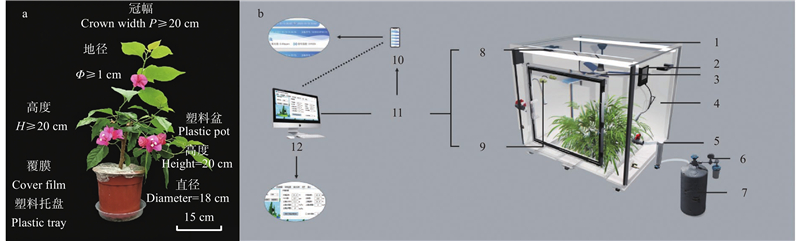
图2
不同浓度NO2处理下三角梅形态变化"
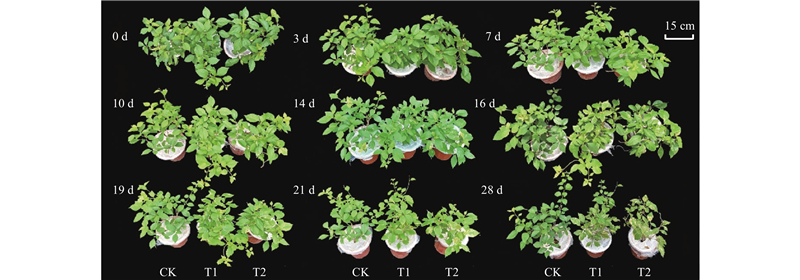
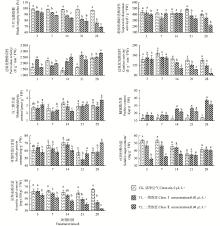
图3
不同浓度NO2处理下三角梅叶片损伤及代谢调节物质的变化"
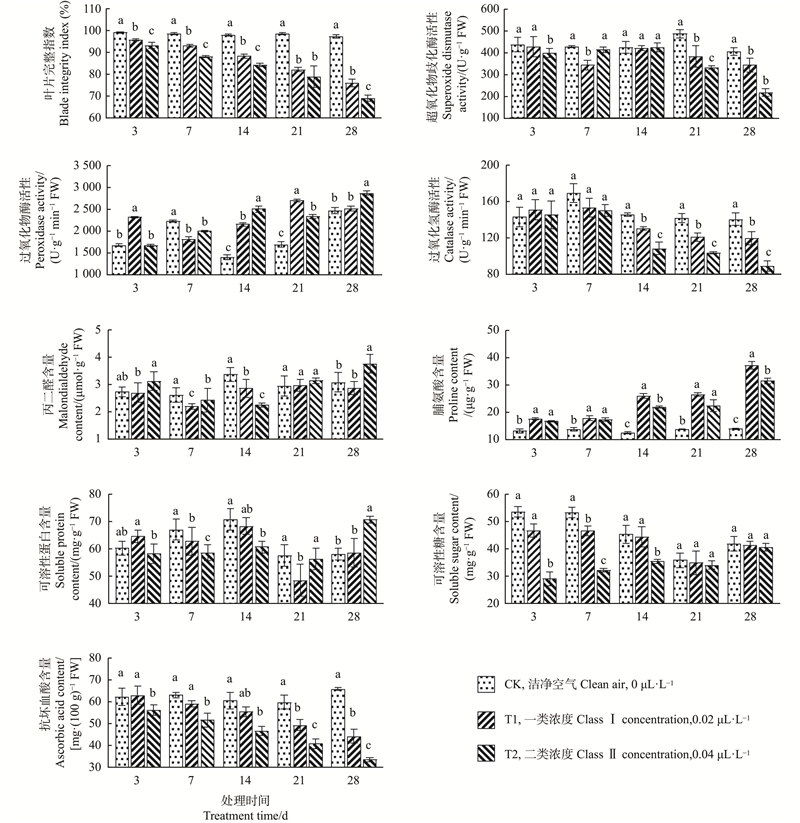

表1
不同浓度NO2处理下三角梅光合作用参数的变化①"
| 时间 Time/d | 处理 Treatment | 叶绿素a含量 Chl-a content/ (mg·g?1 FW) | 叶绿素b含量 Chl-b content/ (mg·g?1 FW) | 类胡萝卜素含量 Carotenoid content/ (mg·g?1 FW) | 净光合速率 Net photosynthetic rate/(μmol·m?2s?1) | 气孔导度 Stomatal conductance/ (mmol·m?2s?1) | 蒸腾速率 Transpiration rate/ (mmol·m?2s?1) | 胞间CO2浓度 Intercellular CO2 concentration/ (μmol·mol -1) |
| 3 | CK | 1.45±0.10a | 0.51±0.05a | 0.51±0.04a | 10.30±0.52a | 193.83±6.79a | 4.10±0.08a | 316.10±5.31a |
| T1 | 1.31±0.04a | 0.46±0.01a | 0.45±0.01b | 6.10±0.14b | 126.50±5.99b | 3.98±0.13a | 277.29±1.60b | |
| T2 | 1.38±0.08a | 0.49±0.04a | 0.48±0.03b | 7.71±0.17b | 127.91±5.12b | 3.06±0.08b | 299.42±4.72a | |
| 7 | CK | 1.44±0.05b | 0.51±0.02b | 0.52±0.02b | 9.80±0.15a | 148.83±5.12a | 3.29±0.06a | 257.64±6.14a |
| T1 | 1.57±0.03a | 0.57±0.01a | 0.56±0.01a | 6.19±0.18c | 154.91±5.04a | 2.53±0.17b | 249.07±4.13a | |
| T2 | 1.57±0.03a | 0.57±0.02a | 0.56±0.01a | 7.04±0.24b | 101.70±5.81b | 2.44±0.08b | 259.08±3.69a | |
| 14 | CK | 1.46±0.08b | 0.52±0.04b | 0.53±0.01a | 7.17±0.14a | 148.14±5.57a | 2.74±0.08b | 258.70±4.09c |
| T1 | 1.68±0.03a | 0.69±0.03a | 0.54±0.01a | 5.95±0.20b | 125.55±4.01ab | 2.89±0.10a | 290.54±4.91b | |
| T2 | 1.42±0.05b | 0.54±0.02b | 0.46±0.01b | 4.31±0.21b | 79.85±2.52b | 1.99±0.03c | 304.91±2.76a | |
| 21 | CK | 1.38±0.05a | 0.50±0.07a | 0.54±0.02a | 8.15±0.19a | 132.02±5.53a | 3.58±0.08a | 255.99±3.98b |
| T1 | 0.57±0.02b | 0.37±0.02b | 0.40±0.01b | 4.13±0.15b | 79.51±3.21b | 3.13±0.06b | 278.10±7.97a | |
| T2 | 0.36±0.02c | 0.28±0.04b | 0.38±0.01b | 2.93±0.16b | 57.94±2.50b | 2.31±0.02b | 277.33±5.59a | |
| 28 | CK | 1.38±0.05a | 0.52±0.07a | 0.53±0.02a | 8.44±0.19a | 205.19±4.14a | 3.81±0.07a | 308.61±6.70b |
| T1 | 0.26±0.02b | 0.26±0.02b | 0.39±0.02b | 4.77±0.18b | 96.51±6.59b | 2.32±0.03b | 306.34±4.52c | |
| T2 | 0.24±0.02c | 0.19±0.04c | 0.34±0.02c | 1.79±0.17c | 38.22±4.23c | 1.23±0.04b | 319.09±6.75a |
表2
不同浓度NO2处理下三角梅叶绿素荧光参数的变化①"
| 时间 Time/d | 处理 Treatment | 初始荧光 Initial fluorescence | 最大荧光 Maximum fluorescence | 最大光 化学效率 Maximum photochemical efficiency | 光化学淬灭系数 Photochemical quenching coefficient | 非光化学淬灭 Non-photochemical quenching | 非光化学淬灭系数 Non-photochemical quenching coefficient | 表观电子 传递速率 Apparent electron transport rate |
| 3 | CK | 641.39±7.67a | 3 137.40±43.11a | 0.80±0.03a | 0.25±0.02a | 2.98±0.18a | 0.17±0.01a | 0.60±0.03a |
| T1 | 611.91±2.88a | 3 055.84±21.84a | 0.80±0.01a | 0.24±0.02a | 2.98±0.02a | 0.17±0.01a | 0.55±0.02a | |
| T2 | 596.79±5.45b | 2 839.07±26.30b | 0.79±0.01a | 0.21±0.03b | 2.57±0.02b | 0.21±0.01a | 0.41±0.02b | |
| 7 | CK | 619.96±7.31b | 3 125.22±40.71a | 0.80±0.04a | 0.13±0.01b | 1.96±0.04a | 0.25±0.02a | 0.27±0.01b |
| T1 | 624.14±4.99b | 2 690.74±32.07b | 0.77±0.01a | 0.14±0.01b | 1.89±0.01a | 0.24±0.02a | 0.32±0.02a | |
| T2 | 691.46±7.64a | 2 690.39±15.07b | 0.74±0.02a | 0.14±0.01a | 1.89±0.02b | 0.22±0.02a | 0.29±0.02ab | |
| 14 | CK | 734.85±4.59b | 2 866.61±16.26a | 0.73±0.03a | 0.15±0.01c | 1.10±0.19b | 0.37±0.03a | 0.31±0.02b |
| T1 | 861.04±9.46a | 2 448.16±26.47b | 0.65±0.01b | 0.18±0.01a | 1.67±0.02a | 0.27±0.03b | 0.39±0.02a | |
| T2 | 721.88±2.97ab | 2 135.46±7.78c | 0.66±0.04b | 0.16±0.01b | 1.69±0.01a | 0.28±0.03b | 0.28±0.02c | |
| 21 | CK | 683.87±8.62b | 2 999.21±5.92a | 0.77±0.01a | 0.14±0.01a | 2.10±0.02a | 0.22±0.02b | 0.28±0.02a |
| T1 | 776.44±4.66ab | 2 111.47±24.95c | 0.62±0.01b | 0.12±0.01b | 1.71±0.02b | 0.26±0.03a | 0.24±0.02b | |
| T2 | 812.97±4.85a | 2 345.58±19.31b | 0.65±0.04b | 0.14±0.01a | 2.11±0.02a | 0.24±0.02a | 0.30±0.02a | |
| 28 | CK | 622.34±5.06b | 3 117.71±11.46a | 0.80±0.02a | 0.13±0.01a | 1.57±0.03a | 0.28±0.02b | 0.25±0.01a |
| T1 | 756.98±6.94a | 2 486.63±22.59b | 0.67±0.02c | 0.12±0.01b | 1.54±0.02a | 0.26±0.02b | 0.16±0.02b | |
| T2 | 601.22±9.10b | 2 225.59±12.68b | 0.72±0.02b | 0.12±0.01b | 0.98±0.01b | 0.44±0.04a | 0.15±0.01b |
表3
不同浓度NO2处理下三角梅不同形态氮含量和代谢酶的变化①"
| 时间 Time/d | 组别 Group | 硝酸还原酶活性 Nitrate reductase activity/ (U·g?1 FW) | 亚硝酸还原 酶活性 Nitrite reductase/ (U·g?1 FW) | 谷氨酰胺合成 酶活性 Glutamine synthetase activity/ (U·g?1 FW) | 谷氨酸合成 酶活性 Glutamate synthase activity / (U·g?1 FW) | 谷氨酸脱 氢酶活性 Glutamate dehydrogenase activity / (U·g?1 FW) | 总氮含量 Total nitrogen content / (mg·100g?1 DW) | 硝态氮含量 Nitrate nitrogen content / (μg·g?1 DW) | 铵态氮含量 Ammonium nitrogen content / (μg·g?1 DW) |
| 3 | CK | 0.53±0.01b | 1.09±0.01b | 0.34±0.01c | 0.22±0.01c | 0.08±0.01b | 988.06±11.51a | 581.91±12.24b | 46.89±0.47c |
| T1 | 0.54±0.01a | 1.18±0.03a | 0.48±0.01b | 0.26±0.01b | 0.07±0.01c | 789.23±13.55a | 64.68±0.47b | ||
| T2 | 0.58±0.02a | 0.98±0.01c | 0.55±0.03a | 0.32±0.02a | 0.08±0.01a | 997.45±10.19a | 821.07±14.21a | 70.29±1.11a | |
| 7 | CK | 0.46±0.02b | 1.09±0.01a | 0.35±0.01c | 0.29±0.01a | 0.05±0.01c | 635.80±31.32b | 52.83±1.13b | |
| T1 | 0.41±0.01c | 0.86±0.02c | 0.41±0.01b | 0.26±0.02a | 0.07±0.01b | 812.32±31.69a | 68.88±0.45a | ||
| T2 | 0.60±0.03a | 0.94±0.02b | 0.50±0.03a | 0.27±0.01a | 0.08±0.01a | 821.65±44.78a | 67.00±1.44a | ||
| 14 | CK | 0.42±0.02c | 1.08±0.02c | 0.43±0.02b | 0.21±0.01c | 0.06±0.01c | 592.70±21.22c | 48.62±1.06c | |
| T1 | 0.58±0.01b | 1.38±0.02a | 0.66±0.03a | 0.32±0.01b | 0.08±0.01b | 69.67±1.05b | |||
| T2 | 0.66±0.02a | 1.13±0.02b | 0.61±0.03a | 0.41±0.03a | 0.10±0.01a | 83.10±0.56a | |||
| 21 | CK | 0.45±0.02b | 0.97±0.04c | 0.45±0.02b | 0.22±0.01b | 0.06±0.01c | 653.28±12.81b | 51.08±1.32c | |
| T1 | 0.74±0.01a | 1.44±0.04a | 0.48±0.02b | 0.33±0.01a | 0.10±0.01b | 85.32±1.42b | |||
| T2 | 0.76±0.01a | 1.26±0.01b | 0.73±0.04a | 0.33±0.01a | 0.11±0.01a | 970.69±58.97b | 93.38±1.76a | ||
| 28 | CK | 0.52±0.01c | 1.13±0.02b | 0.37±0.02c | 0.26±0.01c | 0.07±0.01b | 937.48±22.41c | 654.85±20.19c | 53.79±0.47b |
| T1 | 0.61±0.03b | 1.53±0.04a | 0.61±0.03b | 0.44±0.01b | 0.11±0.01a | 104.29±1.2a | |||
| T2 | 0.68±0.01a | 1.48±0.01a | 0.74±0.02a | 0.47±0.01a | 0.10±0.01a | 988.31±23.93b | 102.00±1.3a |
图4
不同浓度NO2处理28天对三角梅叶片显微结构的影响 a:叶片上表面 Upper leaf surface;b:叶片横切结构 Leaf cross-section;c:叶片下表面 Lower leaf surface;d:叶片绒毛 Leaf trichomes;e:叶片气孔 Leaf stomata;EC:表皮细胞 Epidermal cells;CU:角质层 Cuticle;PT:栅栏组织 Palisade tissue;VB:维管束 Vascular bundle;SPT:海绵组织 Spongy tissue;ST:气孔 Stomata;TR:表皮毛 Trichomes."
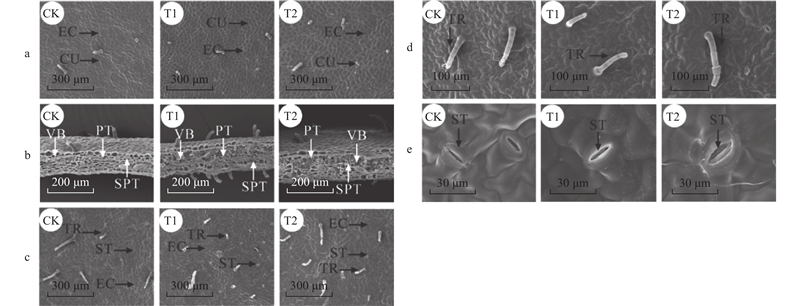
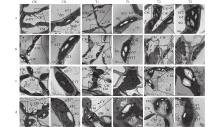
图5
不同浓度NO2处理对三角梅叶片细胞和叶绿体显微结构的影响 a:处理后3日 3 days after treatment;b:处理后7日 7 days after treatment;c:处理后14日 14 days after treatment;d:处理后28日 28 days after treatment;CW:细胞壁 Cell wall;CM:细胞膜 Cell membrane;CY:细胞质 Cytoplasm;Chl:叶绿体 Chloroplast;SG:淀粉粒 Starch granules;OG:嗜锇颗粒 Osmiophilic granules;PG:蛋白质体 Proteinoplast granules;STT:基质类囊体 Stroma thylakoid;GT:基粒类囊体 Granular thylakoid."
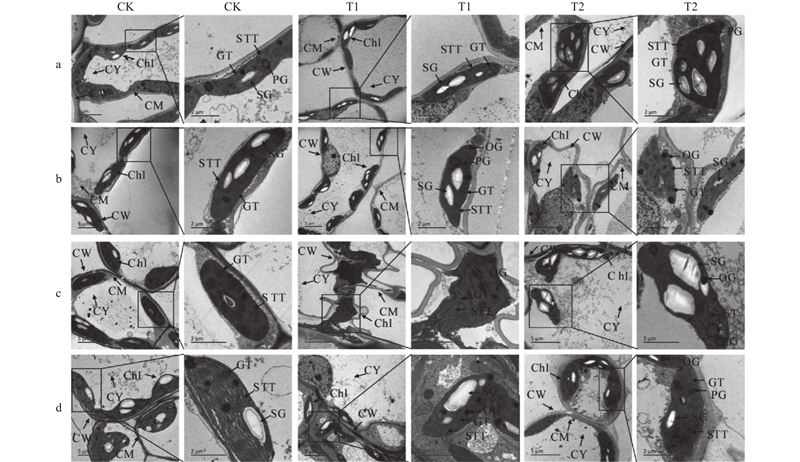
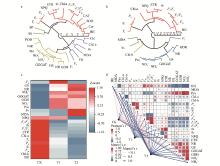
图6
不同NO2处理下生理生化指标的聚类与相关性分析 a:32个原始指标的相关性聚类分析 Correlation clustering analysis of 32 original indicators;b:剔除相似指标后的22个指标相关性聚类分析 Correlation clustering analysis of 22 indicators after removing similar indicators;c:22个指标与处理间的相关性分析 Correlation analysis between 22 indicators and treatments;d:处理措施与指标的相关性及显著性分析 Correlation and significance analysis between processing measures and indicators. BII:叶片完整指数 Blade integrity index;Chl:总叶绿素含量 Total chlorophyll content;Chl-a:叶绿素a含量 Chlorophyll a content;Chl-b:叶绿素b含量 Chlorophyll b content;Car:类胡萝卜素含量 Carotenoid content;Pn:净光合速率 Net photosynthetic rate;gs:气孔导度 Stomatal conductance;Tr:蒸腾速率 Transpiration rate;Ci:胞间CO2浓度 Intercellular CO2 concentration;Fo:初始荧光 Initial fluorescence;Fm:最大荧光 Maximum fluorescence;Fv/Fm:PSⅡ最大光化学效率 Maximum quantum yield of PSⅡ;Fv/Fo:PSⅡ潜在活性 Potential activity of PSⅡ;ETR:表观电子传递速率 Apparent electron transport rate;qP:光化学淬灭系数 Photochemical quenching coefficient;NPQ:非光化学淬灭 Non-photochemical quenching;qN:非光化学淬灭系数 Non-photochemical quenching coefficient;MDA:丙二醛含量 Malondialdehyde content;Pro:脯氨酸含量 Proline content;SP:可溶性蛋白含量 Soluble protein content;SS:可溶性糖含量 Soluble sugar content;POD:过氧化物酶活性 Peroxidase activity;SOD:超氧化物歧化酶活性 Superoxide dismutase activity;CAT:过氧化氢酶活性 Catalase activity;NR:硝酸还原酶活性 Nitrate reductase activity;NiR:亚硝酸还原酶活性 Nitrite reductase activity;GS:谷氨酰胺合成酶活性 Glutamine synthetase activity;GOGAT:谷氨酸合酶活性 Glutamate synthase activity;GDH:谷氨酸脱氢酶活性 Glutamate dehydrogenase activity;TN:总氮含量 Total nitrogen content;NO3−-N:硝态氮含量 Nitrate nitrogen content;NH4+-N:铵态氮含量 Ammonium nitrogen content."
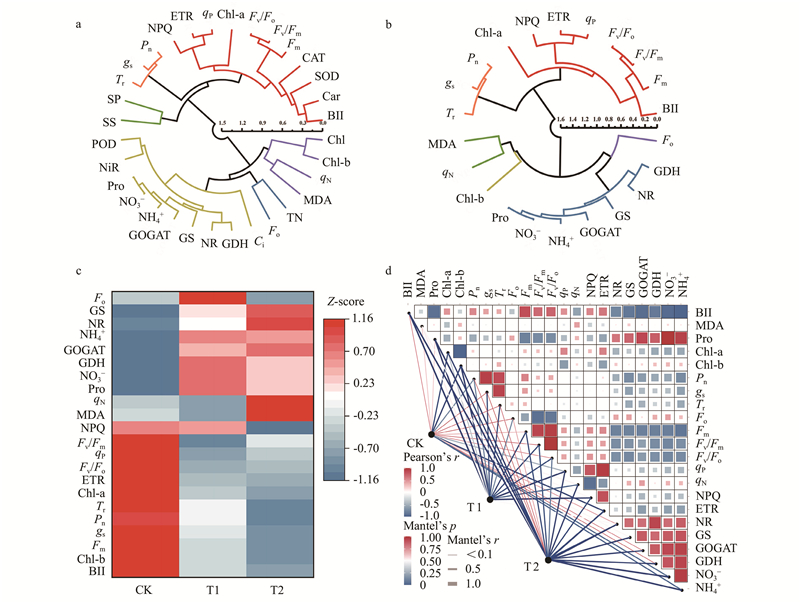
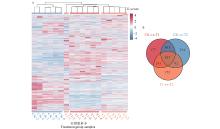
图7
不同NO2处理下差异代谢物的层次聚类与韦恩分析 a: 不同处理组差异代谢物聚类热图 DMs clustering heatmap of different treatment groups; b: 差异代谢物韦恩图 DMs Venn diagram. Z-score 表示某个代谢物在某个样本中的相对丰度偏离该代谢物平均水平的程度 Z-score represents the extent to which the relative abundance of a metabolite in a given sample deviates from its mean abundance across samples."
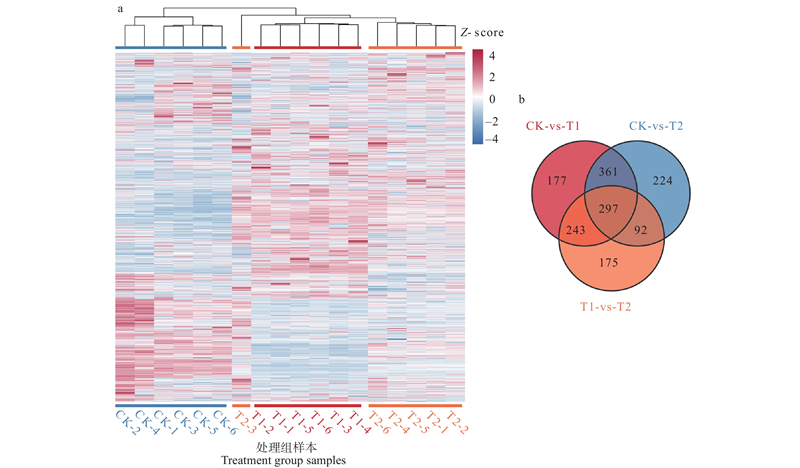
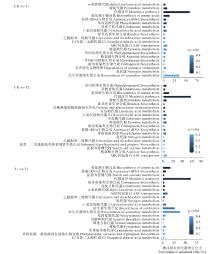
图8
不同处理组间差异代谢物的KEGG通路富集分析 横坐标表示注释至各 KEGG 通路的差异代谢物个数占该比较组全部已注释差异代谢物总数的百分比,柱形越长表示该通路涉及的差异代谢物比例越高;柱形颜色表示q-value,q-value越小,富集结果可靠性越高。The x-axis represents the percentage of DMs assigned to each KEGG pathway relative to the total number of annotated DMs in the corresponding comparison; longer bars indicate a higher proportion of DMs, and bar color represents the q-value. Lower q-values indicate higher reliability of enrichment;纵坐标表示不同处理组间q值最小的前20个KEGG 富集通路 The y-axis represents the top 20 KEGG-enriched pathways with the lowest q-values among different treatment comparisons;DMs表示差异积累代谢物 DMs, differential accumulation metabolites."
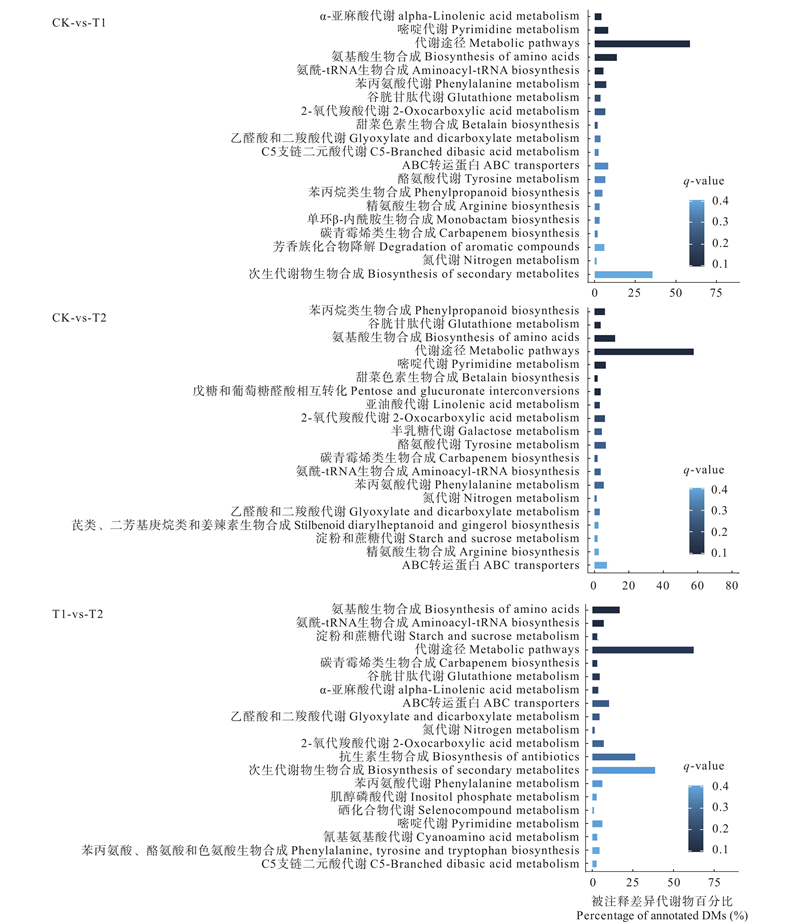
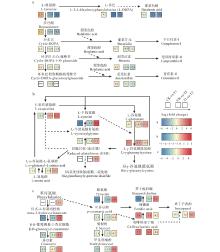
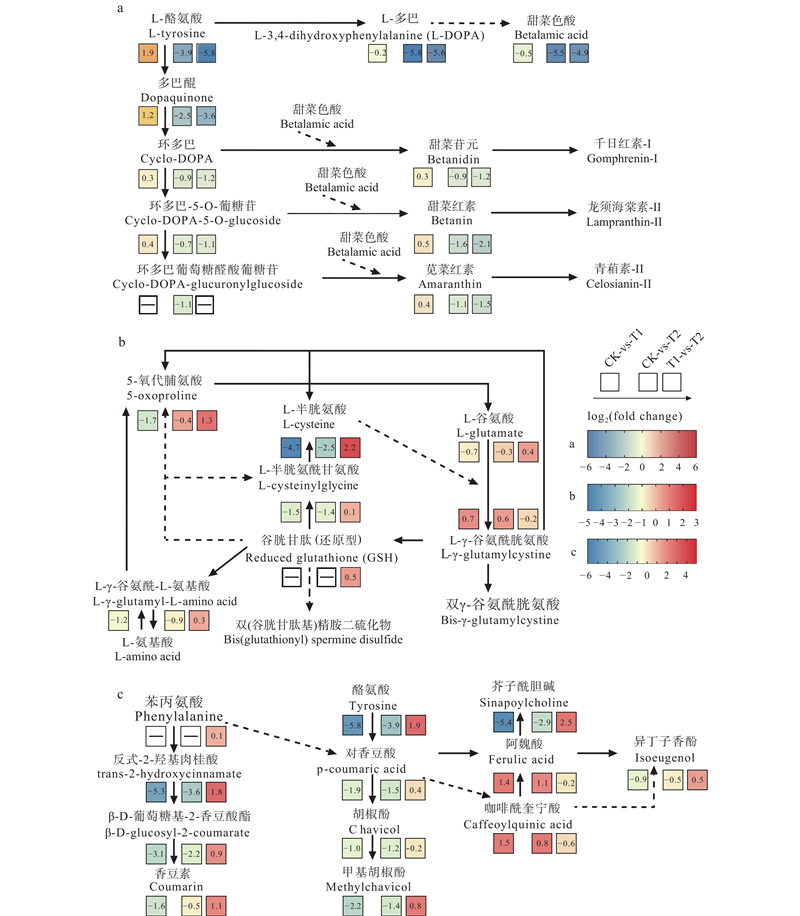
图9
不同处理下差异代谢物在关键代谢通路中的变化 a: 甜菜色素生物合成相关通路 Betalain biosynthesis-related pathway;b: 谷胱甘肽代谢相关通路 Glutathione metabolism-related pathway;c: 苯丙烷类生物合成相关通路 Phenylpropanoid biosynthesis-related pathway. 代谢物下方色块依次表示CK-vs-T1、CK-vs-T2和T1-vs-T2的 log2 (fold change)值,分别对应log2 (T1/CK)、log2 (T2/CK)和log2 (T2/T1);空白框内“—”表示该比较中未达到差异筛选标准或未获得有效变化值 Colored squares below each metabolite indicate the log2 (fold change) values for CK-vs-T1, CK-vs-T2, and T1-vs-T2, corresponding to log2 (T1/CK), log2 (T2/CK), and log2 (T2/T1), respectively. A dash (“—”) in a blank square indicates that the metabolite does not meet the differential screening criteria or that no valid change value is obtained in the corresponding comparison. 实线和虚线箭头表示根据 KEGG 通路简化后的代谢转化关系,其中虚线表示间接生成关系,实线表示直接生成关系 Solid and dashed arrows represent simplified metabolic conversion relationships based on KEGG pathways; dashed arrows indicate indirect formation relationships, whereas solid arrows indicate direct formation relationships. 各分图色标范围独立设置 The color scales were set independently for each panel."
|
白 涵, 郝珉辉, 何怀江, 等. 东北主要树种幼树叶片功能性状对模拟氮沉降的响应. 林业科学, 2025, 61 (5): 23- 32.
doi: 10.11707/j.1001-7488.LYKX20240511 |
|
|
Bai H, Hao M H, He H J, et al. Response of seedling leaf functional traits to simulated nitrogen deposition for the major tree species of Northeast China. Scientia Silvae Sinicae, 2025, 61 (5): 23- 32.
doi: 10.11707/j.1001-7488.LYKX20240511 |
|
| 高俊凤. 2006. 植物生理学实验指导. 北京: 教育出版社. | |
| Gao J F. 2006. Experimental guide to plant physiology. Beijing: Higher Education Press. [in Chinese] | |
|
鲁绍伟, 房佳兴, 赵 娜, 等. 植物对大气中二氧化氮的吸收净化研究: 方法、抗性特征及机理探索. 世界林业研究, 2023, 36 (6): 1- 7.
doi: 10.13348/j.cnki.sjlyyj.2023.0091.y |
|
|
Lu S W, Fang J X, Zhao N, et al. A study of uptake and purification of atmospheric nitrogen dioxide by plants: methodology, resistance characterization and mechanistic exploration. World Forestry Research, 2023, 36 (6): 1- 7.
doi: 10.13348/j.cnki.sjlyyj.2023.0091.y |
|
|
罗建平, 王 宁, 宋菲菲, 等. 大庆市6种绿化树种对SO2、NO2的消减及滞尘效应. 生态学报, 2023, 43 (11): 4561- 4569.
doi: 10.5846/stxb202102060388 |
|
|
Luo J P, Wang N, Song F F, et al. Dust-retention and reduce to SO2 and NO2 by 6 landscape trees in Daqing. Acta Ecologica Sinica, 2023, 43 (11): 4561- 4569.
doi: 10.5846/stxb202102060388 |
|
|
圣倩倩, 季亚欧, 宋 敏, 等. 15NO2胁迫下三角梅不同器官的氮素吸收分配动态及代谢规律. 生态学报, 2023, 43 (19): 7998- 8010.
doi: 10.20103/j.stxb.202205311536 |
|
|
Sheng Q Q, Ji Y O, Song M, et al. Dynamics and metabolism of nitrogen absorption and distribution in different organs of Bougainvillea spectabilis under 15 NO2 stress. Acta Ecologica Sinica, 2023, 43 (19): 7998- 8010.
doi: 10.20103/j.stxb.202205311536 |
|
| 施海涛. 2016. 植物逆境生理学实验指导. 北京: 科学出版社. | |
| Shi H T. 2016. Experimental guide to plant stress physiology. Beijing: Science Press. [in Chinese] | |
| 孙英杰, 张德楠, 沈育伊, 等. 模拟氮沉降对中亚热带桉树人工林土壤微生物群落结构及酶活性的影响. 林业科学, 2025, 61 (5): 46- 60. | |
| Sun Y J, Zhang D N, Shen Y Y, et al. Effects of simulated nitrogen deposition on soil microbial community structure and enzyme activities in Eucalyptus plantations in mid-subtropical region. Scientia Silvae Sinicae, 2025, 61 (5): 46- 60. | |
|
Arbid Y, Richard C, Sleiman M. Towards an experimental approach for measuring the removal of urban air pollutants by green roofs. Building and Environment, 2021, 205, 108286.
doi: 10.1016/j.buildenv.2021.108286 |
|
|
Beirle S, Borger C, Dörner S, et al. Pinpointing nitrogen oxide emissions from space. Science Advances, 2019, 5 (11): eaax9800.
doi: 10.1126/sciadv.aax9800 |
|
|
Campbell S A, Vallano D M. Plant defences mediate interactions between herbivory and the direct foliar uptake of atmospheric reactive nitrogen. Nature Communications, 2018, 9, 4743.
doi: 10.1038/s41467-018-07134-9 |
|
|
Cassaniti C, Leonardi C, Flowers T J. The effects of sodium chloride on ornamental shrubs. Scientia Horticulturae, 2009, 122 (4): 586- 593.
doi: 10.1016/j.scienta.2009.06.032 |
|
|
Chaparro-Suarez I G, Meixner F X, Kesselmeier J. Nitrogen dioxide (NO2) uptake by vegetation controlled by atmospheric concentrations and plant stomatal aperture. Atmospheric Environment, 2011, 45 (32): 5742- 5750.
doi: 10.1016/j.atmosenv.2011.07.021 |
|
|
Gao J Q, Liu L N, Ma N, et al. Effect of ammonia stress on carbon metabolism in tolerant aquatic plant: Myriophyllum aquaticum. Environmental Pollution, 2020, 263, 114412.
doi: 10.1016/j.envpol.2020.114412 |
|
|
Gaponova I S, Davydov E Y, Lomakin S M, et al. Features of stable radical generation in lignin on exposure to nitrogen dioxide. Polymer Degradation and Stability, 2010, 95 (7): 1177- 1182.
doi: 10.1016/j.polymdegradstab.2010.04.009 |
|
|
Hu Y B, Bellaloui N, Sun G Y, et al. Exogenous sodium sulfide improves morphological and physiological responses of a hybrid Populus species to nitrogen dioxide. Journal of Plant Physiology, 2014, 171 (10): 868- 875.
doi: 10.1016/j.jplph.2013.10.018 |
|
| Hucklesby D P, Dalling M J, Hageman R H. Some properties of two forms of nitrite reductase from corn leaves. Planta, 1972, 104, 220- 233. | |
|
Leppälä J, Gaupels F, Xu E J, et al. Ozone and nitrogen dioxide regulate similar gene expression responses in Arabidopsis but natural variation in the extent of cell death is likely controlled by different genetic loci. Frontiers in Plant Science, 2022, 13, 994779.
doi: 10.3389/fpls.2022.994779 |
|
|
Liang Y X, Li D L, Sheng Q, et al. Exogenous salicylic acid alleviates NO2 damage by maintaining cell stability and physiological metabolism in Bougainvillea × buttiana ‘Miss Manila’ seedlings. Plants, 2023, 12 (18): 3283.
doi: 10.3390/plants12183283 |
|
|
Liu C, Li L L, Li G Z, et al. Ethylene insensitive mutation improves Arabidopsis plant tolerance to NO2 exposure. Ecotoxicology and Environmental Safety, 2020, 189, 110043.
doi: 10.1016/j.ecoenv.2019.110043 |
|
|
Liu Z H, Rieder H E, Schmidt C, et al. Optimal reactive nitrogen control pathways identified for cost-effective PM2.5 mitigation in Europe. Nature Communications, 2023, 14, 4246.
doi: 10.1038/s41467-023-39900-9 |
|
|
Lobell D B, Di Tommaso S, Burney J A. Globally ubiquitous negative effects of nitrogen dioxide on crop growth. Science Advances, 2022, 8 (22): eabm9909.
doi: 10.1126/sciadv.abm9909 |
|
|
Lu S W, Wang M X, Fang J X, et al. Absorption and partitioning mechanism of nitrogen oxides by typical greening species of tree in Beijing. Environmental and Experimental Botany, 2024, 228, 106028.
doi: 10.1016/j.envexpbot.2024.106028 |
|
|
Mishra S, Gogna N, Dorai K. NMR-based investigation of the altered metabolic response of Bougainvillea spectabilis leaves exposed to air pollution stress during the circadian cycle. Environmental and Experimental Botany, 2019, 164, 58- 70.
doi: 10.1016/j.envexpbot.2019.04.019 |
|
| Morikawa H, Higaki A, Nohno M, et al. 1998. More than a 600-fold variation in nitrogen dioxide assimilation among 217 plant taxa. Plant, Cell & Environment, 21(2): 180−190. | |
|
Pandey J, Agrawal M. Growth responses of tomato plants to low concentrations of sulphur dioxide and nitrogen dioxide. Scientia Horticulturae, 1994, 58 (1/2): 67- 76.
doi: 10.1016/0304-4238(94)90128-7 |
|
|
Pettit T, Torpy F R, Surawski N C, et al. Effective reduction of roadside air pollution with botanical biofiltration. Journal of Hazardous Materials, 2021, 414, 125566.
doi: 10.1016/j.jhazmat.2021.125566 |
|
|
Qu Y, Wang Y Y, Yin Q S, et al. Multiple biological processes involved in the regulation of salicylic acid in Arabidopsis response to NO2 exposure. Environmental and Experimental Botany, 2018, 149, 9- 16.
doi: 10.1016/j.envexpbot.2018.02.003 |
|
|
Ryalls J M W, Bishop J, Mofikoya A O, et al. Air pollution disproportionately impairs beneficial invertebrates: a meta-analysis. Nature Communications, 2024, 15, 5447.
doi: 10.1038/s41467-024-49729-5 |
|
|
Sandhu R, Gupta G. Effects of nitrogen dioxide on growth and yield of black turtle bean (Phaseolus vulgaris L. ) cv. ‘Domino’. Environmental Pollution, 1989, 59 (4): 337- 344.
doi: 10.1016/0269-7491(89)90160-7 |
|
|
Sangthong S, Suksabye P, Thiravetyan P. Air-borne xylene degradation by Bougainvillea buttiana and the role of epiphytic bacteria in the degradation. Ecotoxicology and Environmental Safety, 2016, 126, 273- 280.
doi: 10.1016/j.ecoenv.2015.12.017 |
|
|
Selmi W, Weber C, Rivière E, et al. Air pollution removal by trees in public green spaces in Strasbourg city, France. Urban Forestry & Urban Greening, 2016, 17, 192- 201.
doi: 10.1016/j.ufug.2016.04.010 |
|
|
Shattuck V I, Wang W. Nitrogen dioxide fumigation alters the glucosinolate and nitrate levels in pak choy (Brassica campestris ssp. chinensis). Scientia Horticulturae, 1993, 56 (2): 87- 100.
doi: 10.1016/0304-4238(93)90010-N |
|
|
Sheng Q Q, Zhou C Y, Liang Y L, et al. Elevated NO2 induces leaf defensive mechanisms in Bougainvillea spectabilis seedlings. Ecotoxicology and Environmental Safety, 2022, 248, 114292.
doi: 10.1016/j.ecoenv.2022.114292 |
|
|
Song M J, Sun B, Li R, et al. Dynamic succession patterns and interactions of phyllospheric microorganisms during NOx exposure. Journal of Hazardous Materials, 2022, 430, 128371.
doi: 10.1016/j.jhazmat.2022.128371 |
|
| Suzuki A, Oaks A, Jacquot J P, et al. Corn leaf glutamate synthase: purification and properties of the enzyme. Plant and Cell Physiology, 1979, 20 (7): 1329- 1340. | |
|
Takahashi M, Furuhashi T, Ishikawa N, et al. Nitrogen dioxide regulates organ growth by controlling cell proliferation and enlargement in Arabidopsis. New Phytologist, 2014, 201 (4): 1304- 1315.
doi: 10.1111/nph.12609 |
|
|
Voordeckers D, Lauriks T, Baetens D, et al. Numerical study on the impact of traffic lane adjustments and low boundary walls on pedestrian exposure to NO2 in street canyons. Landscape and Urban Planning, 2024, 243, 104974.
doi: 10.1016/j.landurbplan.2023.104974 |
|
|
Wang Y, Guo D D, Wang J C, et al. Exogenous melatonin alleviates NO2 damage in tobacco leaves by promoting antioxidant defense, modulating redox homeostasis, and signal transduction. Journal of Hazardous Materials, 2022, 424, 127265.
doi: 10.1016/j.jhazmat.2021.127265 |
|
| Wang Y, Wang J C, Li Z B, Song J Q, et al. Atmospheric NO2 enhances tolerance to low temperature by promoting nitrogen and carbon metabolism in tobacco. Environmental and Experimental Botany, 2024, 225, 105860. | |
|
Yang S R, Li M M, Guo C, et al. Associations of long-term exposure to nitrogen oxides with all-cause and cause-specific mortality. Nature Communications, 2025, 16, 1730.
doi: 10.1038/s41467-025-56963-y |
|
|
Zhang X, Su J X, Ji Y H, et al. Nitrogen deposition affects the productivity of planted and natural forests by modulating forest climate and community functional traits. Forest Ecology and Management, 2024, 563, 121970.
doi: 10.1016/j.foreco.2024.121970 |
|
| Zhao F, Elkelish A, Durner J, et al. 2016. Common ragweed (Ambrosia artemisiifolia L. ): allergenicity and molecular characterization of pollen after plant exposure to elevated NO2. Plant, Cell & Environment, 39(1): 147−164. |
| [1] | 赵子宇,杨霄霞,郭慧,葛浙东,周玉成. 基于卷积神经网络模型的木材宏、微观辨识方法[J]. 林业科学, 2021, 57(6): 134-143. |
| [2] | 陈新,王敏,傅茂润,王贵芳,相昆,刘庆忠,焦文晓,张美勇,许海峰. 核桃炭疽病发生相关的酚类物质代谢分析[J]. 林业科学, 2021, 57(10): 71-80. |
| [3] | 刘果, 陈鸿鹏, 吴志华, 彭彦, 谢耀坚. 南美油藤种子发育过程的代谢组学和转录组学联合分析[J]. 林业科学, 2019, 55(5): 169-179. |
| [4] | 候亚会, 严善春, 李志强. 对苯二酚对台湾乳白蚁诱食效果及其诱导代谢的响应[J]. 林业科学, 2018, 54(9): 97-103. |
| [5] | 秦媛, 潘雪玉, 靳微, 陈连庆, 袁志林. 杨树人工林土壤微生物群落4种提取方法比较[J]. 林业科学, 2018, 54(9): 169-176. |
| [6] | 秦理哲, 林兰英, 傅峰. 木材胶合界面微观结构样品制备新方法——激光烧蚀技术[J]. 林业科学, 2018, 54(4): 93-99. |
| [7] | 赖寒健, 葛照硕, 李小兵, 陶冉, 张鹏翔, 董致远, 李燕. 微观结构和蜡质对植物叶表面疏水性能的影响[J]. 林业科学, 2017, 53(4): 74-82. |
| [8] | 吕少一, 傅峰, 郭丽敏, 陈志林, 常焕君. 柔性薄木/纳米碳材料复合电极的微观结构与电导性能[J]. 林业科学, 2017, 53(11): 150-156. |
| [9] | 黄秦军, 黄国伟, 苏晓华, 张新叶. 蒙古栎生长及生理特征的种源间差异[J]. 林业科学, 2013, 49(9): 72-78. |
| [10] | 张晓敏;孙正军;王喜明;尚莉莉. 杨木径向压缩的黏弹性行为[J]. 林业科学, 2011, 47(9): 135-139. |
| [11] | 陈秋夏;廖亮;郑坚;王金旺;李效文;夏海涛;马履一. 光照强度对青冈栎容器苗生长和生理特征的影响[J]. 林业科学, 2011, 47(12): 53-59. |
| [12] | 赵钟声;崔永志;于海鹏;刘一星;沈隽. 木材薄板横纹压缩强化的微观结构变化[J]. 林业科学, 2010, 46(11): 124-130. |
| [13] | 张淑勇 周泽福 张光灿 夏江宝. 半干旱黄土丘陵区 4 种天然次生灌木光合生理和水分利用特征[J]. 林业科学, 2008, 44(12): 140-146. |
| [14] | 江泽慧 姜笑梅 周玉成 安源 赵亮 井元伟. 杉木微观结构与其品质特性关系模型的一类神经网络建模方法[J]. 林业科学, 2005, 41(4): 133-139. |
| [15] | 田晓瑞 舒立福 张小罗 戴兴安. 树种枝叶微观结构对树种燃烧性的影响研究[J]. 林业科学, 2003, 39(4): 84-88. |
| 阅读次数 | ||||||
|
全文 |
|
|||||
|
摘要 |
|
|||||

