
林业科学 ›› 2026, Vol. 62 ›› Issue (2): 214-229.doi: 10.11707/j.1001-7488.LYKX20250310
• 研究论文 • 上一篇
林丽梅1,陈炜诺2,陈钦萍3,黄安胜4,*( )
)
收稿日期:2025-05-14
修回日期:2025-08-18
出版日期:2026-02-25
发布日期:2026-03-04
通讯作者:
黄安胜
E-mail:haszgfj@163.com
基金资助:
Limei Lin1,Weinuo Chen2,Qinping Chen3,Ansheng Huang4,*()
Received:2025-05-14
Revised:2025-08-18
Online:2026-02-25
Published:2026-03-04
Contact:
Ansheng Huang
E-mail:haszgfj@163.com
摘要:
目的: 量化分析森林可持续管理对“四库”安全的作用机制和影响路径,为完善森林资源管理体系建设提供决策参考。方法: 基于2011—2022年我国31个省级行政区面板数据,综合使用熵值法、两阶段最小二乘法和中介效应模型,构建森林“四库”安全评价指标体系,分析森林可持续管理对“四库”安全的作用机制。结果: 1) 森林可持续管理对“四库”安全具有显著正向影响,其中森林资源利用持续性的影响最大,森林资源保护投入和森林系统恢复干预的影响相对较小;2) 森林可持续管理通过林业绿色发展韧性提升和森林生态系统服务价值增强2条路径促进“四库”安全,其中森林资源利用持续性主要通过森林生态系统服务价值增强路径发挥作用,森林资源保护投入和森林系统恢复干预在2条路径上均有显著作用;3) 森林可持续管理对“四库”安全的影响在不同功能区和经济发展水平区域存在显著差异,重点生态功能区森林资源利用持续性作用最为突出,不同经济发展水平地区呈现从资源依赖向效率提升再到生态服务导向的演化特征。结论: 深化森林可持续管理与“四库”安全的协同发展,应强化森林资源可持续利用的政策导向,构建差异化的区域森林资源管理体系,建立森林韧性与生态服务的协同提升机制,健全森林“四库”安全保障的制度体系,提升森林资源对“四库”安全的综合支撑能力。
中图分类号:
林丽梅,陈炜诺,陈钦萍,黄安胜. 森林可持续管理对“四库”安全的作用机制与实证分析[J]. 林业科学, 2026, 62(2): 214-229.
Limei Lin,Weinuo Chen,Qinping Chen,Ansheng Huang. Mechanism and Empirical Analysis of the Impact of Forest Sustainable Management on “Four-Repository” Security[J]. Scientia Silvae Sinicae, 2026, 62(2): 214-229.

表1
森林“四库”安全评价指标体系"
| 一级指标Primary indicators | 二级指标 Secondary indicators | 三级指标 Tertiary indicators | 测量方式 Measurement method | 指标属性Attribute | 权重Weight(%) |
| 水库安全Water repository security | 水资源保障Water resource security | 人均水资源量 Per capita water resources | 水资源总量/人口数量 Total water resources/population/ (m3·person?1) | + | 4.155 |
| 供水保障率 Water supply security rate | 供水总量/区域总人口 Total water supply/regional population/(m3·person?1) | + | 12.481 | ||
| 水文调节Hydrological regulation | 水资源利用率 Water resource utilization rate | (供水总量/水资源总量)×100% (Total water supply/total water resources)×100% | + | 7.468 | |
| 水土流失治理率 Soil erosion control rate | (水土流失治理面积/区域国土面积)×100% (Soil erosion control area/regional land area)×100% | + | 2.809 | ||
| 碳库安全Carbon repository security | 碳汇功能 Carbon sink function | 区域碳平衡率 Regional carbon balance rate | (森林碳储量/碳排放量)×100% (Forest carbon storage/carbon emissions)×100% | + | 10.204 |
| 碳汇稳定性 Carbon sink stability | 近5年森林碳储量的变异系数 Coefficient of variation of forest carbon storage (5-year) | - | 3.319 | ||
| 气候稳定性Climate stability | 气候极端风险指数Extreme climate risk index | 极端低温、高温、降雨、干旱气候日数平均值 Average days with extreme temperature, rainfall,and drought | - | 1.767 | |
| 空气质量优良天数比例Good air quality days ratio | 空气质量二级以上天数占比 Proportion of days with air quality level 2+ | + | 8.861 | ||
| 粮库安全 Grain repository security | 森林食品供给量Forest food supply capacity | 森林食品产量密度Forest food production density | 森林食品总产量/森林总面积 Total forest food production/total forest area/[(t·(104 hm2)?1] | + | 11.357 |
| 油茶产业发展水平Oil-tea industry development level | (油茶种植面积/森林总面积)×100% (Oil-tea planting area/total forest area)×100% | + | 6.199 | ||
| 森林食品供给稳定性Forest food supply stability | 森林食品产量稳定系数Forest food production stability coefficient | 1/森林食品总产量变异系数(近5年) 1/coefficient of variation of total forest food production (recent 5 years) | + | 4.308 | |
| 森林食品相对增长率Forest food relative growth rate | 森林食品产量增长率/粮食作物产量增长率Forest food production growth rate/grain crop production growth rate | + | 3.507 | ||
| 钱库安全Financial repository security | 林业经济贡献Forestry economic contribution | 林业产值占比 Forestry output percentage | (林业产值/区域GDP)×100% (Forestry output value/regional GDP)×100% | + | 9.621 |
| 林业就业贡献率Forestry employment contribution | (林业从业人员数/就业总人口)×100% (Forestry workers/total employed population)×100% | + | 5.152 | ||
| 林业产业发展质量Quality of forestry industry development | 林业产值增长稳定性Stability of forestry output value growth | 林业产值增长率的5年滚动标准差 5-year rolling standard deviation of forestry output value growth rate | - | 2.351 | |
| 林业产业结构优化度Optimization of forestry industry structure | 林业第二、三产业占比 Secondary and tertiary forestry industries ratio | + | 4.441 |
表2
森林可持续管理测量指标"
| 维度 Dimension | 具体指标 Specific indicators | 测量方式 Measurement method | 权重 Weight(%) |
| 森林资源保护投入 Forest protection investment | 林业保护投入强度 Intensity of forestry protection investment | (林业生态保护投资/地区GDP)×100% (Forestry ecological protection investment/regional GDP)×100% | 7.046 |
| 自然保护区占比 Proportion of nature reserves | (自然保护区面积/森林总面积)×100% (Nature reserve area/total forest area)×100% | 13.407 | |
| 公益林保护强度Public welfare forest protection intensity | 公益林面积增长率的5年滚动标准差(负向指标)5-year rolling standard deviation of public welfare forest area growth rate (negative indicator) | 3.258 | |
| 天然林停伐政策执行强度Natural forest logging ban policy implementation intensity | ln(1-当期原木产量/上一年原木产量)×天然林面积占比 ln(1 - current timber production/previous year timber production)× proportion of natural forest area | 5.256 | |
| 森林系统恢复干预 Forest system restoration intervention | 森林有害生物防治效率Forest pest control efficiency | (森林有害生物防治投资/发生面积)×100% (Forest pest control investment/affected area)×100% | 14.314 |
| 人工造林密度 Artificial afforestation density | (人工造林面积/林业面积)×100% (Artificial afforestation area/forestry area)×100% | 4.358 | |
| 低产林改造水平Low-productivity forest transformation level | 低产林改造面积增长率 Growth rate of low-productivity forest transformation area | 22.292 | |
| 森林资源利用持续性Sustainability of forest resource utilization | 林业资源集约利用Intensive utilization of forest resources | (林业产值/林地面积)×100% (Forestry output value/forest land area)×100% | 16.241 |
| 森林采伐压力系数Forest harvesting pressure coefficient | 当年原木材产量/连续5年蓄积量差值均值 Ratio of current year timber production to mean annual forest increment | 13.828 |
表3
主要变量定义与描述性统计"
| 变量类别 Variable category | 变量名 Variable | 变量定义 Variable definitions | 均值 Mean | 标准差 Standard deviation | 最小值 Min. | 最大值 Max. |
| 被解释变量 Dependent variable | 森林“四库”安全 Forest “Four-Repository” security | 基于指标体系利用熵值法测算所得 Calculated results based on the indicator system using the entropy method | 0.114 0 | 0.053 6 | 0.018 6 | 0.296 2 |
| 解释变量Independent variable | 森林资源保护投入 Forest protection investment | 相应指标熵值法测算所得 Calculated results using the entropy method for corresponding indicators | 0.140 7 | 0.149 1 | 0.022 3 | 0.746 3 |
| 森林系统恢复干预 Forest system restoration intervention | 相应指标熵值法测算所得 Calculated results using the entropy method for corresponding indicators | 0.055 1 | 0.056 1 | 0.000 3 | 0.525 5 | |
| 森林资源利用持续性Sustainability of forest resource utilization | 相应指标熵值法测算所得 Calculated results using the entropy method for corresponding indicators | 0.092 2 | 0.124 5 | 0.000 5 | 0.618 8 | |
| 森林可持续管理 Forest sustainable management | 相应3个维度指标熵值法测算所得 Calculated results using the entropy method for corresponding indicators | 0.084 2 | 0.061 5 | 0.024 3 | 0.398 5 | |
| 机制变量Mechanism variable | 林业绿色发展韧性 Green development resilience of forestry | 相应指标的熵值法加权值 Calculated results using the entropy method for corresponding indicators | 0.082 5 | 0.062 7 | 0.015 3 | 0.470 1 |
| 森林生态系统服务价值 Forest ecosystem service value | 森林面积× Σ(各项服务功能价值系数)/GDP Forest area × Σ(value coefficients of various service functions)/GDP | 0.035 0 | 0.035 7 | 0.000 0 | 0.330 0 | |
| 控制变量Control variable | 城镇化率 Urbanization rate | 城镇人口/总人口数量 Urban population/total population (%) | 0.591 7 | 0.129 9 | 0.228 1 | 0.896 0 |
| 产业结构优化 Industrial structure optimization | 第三产业占比 Tertiary industry proportion (%) | 0.499 4 | 0.088 9 | 0.326 6 | 0.837 6 | |
| 环境治理投资水平 Environmental governance investment | (环境治理投资额/地区GDP)×100% (Environmental governance investment/ regional GDP)×100% | 0.012 1 | 0.008 7 | 0.001 6 | 0.046 3 | |
| 人口密度 Population density | 人口数量/土地面积 Population/land area | 0.045 6 | 0.069 8 | 0.000 3 | 0.392 6 | |
| 财政自由度 Fiscal autonomy index | (地方财政收入/地方财政支出)×100% (Local fiscal revenue/local fiscal expenditure)×100% | 0.004 0 | 0.009 5 | 0.000 0 | 0.070 7 | |
| 土地利用集约度 Land use intensity coefficient | GDP/土地总面积 GDP/land area | 0.738 5 | 0.125 8 | 0.194 6 | 0.972 0 | |
| 农业科技创新水平 Agriculture science and technology innovation | 农业发明专利授权数的自然对数 Natural logarithm of authorized agricultural patents | 0.404 0 | 0.212 1 | 0.173 3 | 1.486 8 | |
| 国家公共安全投入 National public security investment | 公共安全支出/地方财政支出 Public security expenditure/local fiscal expenditure | 0.016 1 | 0.012 9 | 0.006 8 | 0.099 0 | |
| 对外依存度 External dependence | (进出口总额/地区GDP)×100% (Import and export volume/regional GDP)×100% | 0.265 7 | 0.278 7 | 0.007 6 | 1.463 8 |
图1
森林“四库”安全变化趋势"
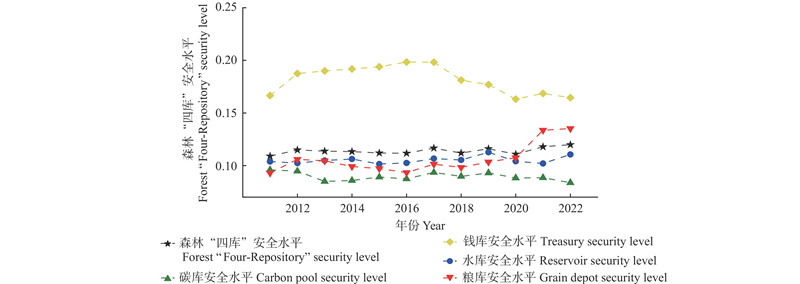
图2
全国七大区域森林“四库”安全时空演变对比"
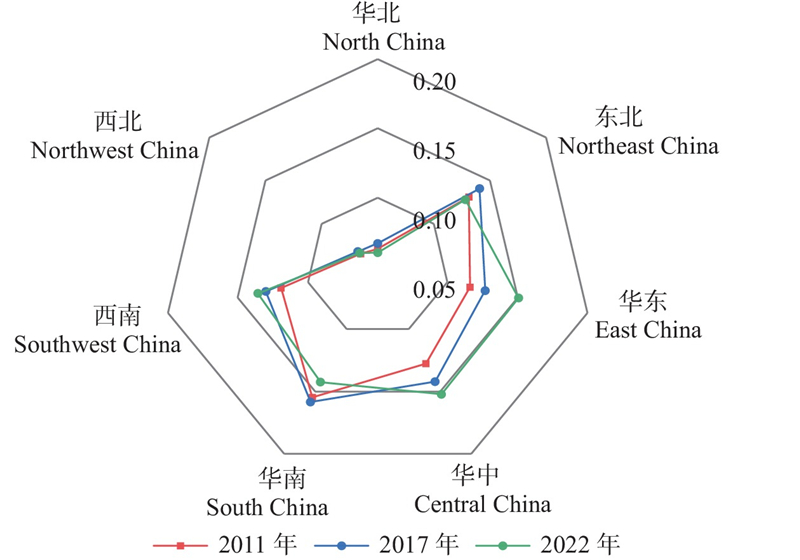
表4
森林可持续管理对森林“四库”安全的基准回归结果①"
| 变量Variables | 被解释变量:森林“四库”安全Dependent variables: forest “Four-Repository” security | |||||||
| 森林可持续管理 Forest sustainable management | 0.087 3*** (0.031 1) | 0.085 1*** (0.024 2) | ||||||
| 森林资源保护投入 Forest resource protection investment | 0.095 3** (0.036 5) | 0.073 1** (0.027 3) | ||||||
| 森林系统恢复干预 Forest ecosystem restoration intervention | 0.018 1** (0.008 7) | 0.019 3* (0.010 2) | ||||||
| 森林资源利用持续性 Sustainability of forest resource utilization | 0.117 7** (0.043 7) | 0.144 5*** (0.045 7) | ||||||
| 城镇化率 Urbanization rate | 0.297 5** (0.145 2) | 0.272 6* (0.138 4) | 0.302 8* (0.154 1) | 0.307 4** (0.131 4) | ||||
| 产业结构优化 Industrial structure optimization | 0.038 9 (0.046 2) | 0.038 7 (0.046 7) | 0.048 5 (0.047 8) | 0.033 9 (0.044 2) | ||||
| 环境治理投资水平 Investments in environmental governance | 0.492 1*** (0.175 6) | 0.464 3** (0.187 6) | 0.502 6*** (0.176 4) | 0.455 3*** (0.160 8) | ||||
| 人口密度 Population density | ?0.663 8 (0.842 5) | ?0.505 7 (0.870 8) | ?0.398 8 (0.816 3) | ?1.107 8 (0.794 2) | ||||
| 财政自由度 Fiscal autonomy index | ?0.063 8* (0.035 2) | ?0.065 7* (0.037 9) | ?0.062 4* (0.033 9) | ?0.053 4 (0.032 8) | ||||
| 土地利用集约度 Land use intensity coefficient | 1.283 3** (0.549 7) | 0.869 5* (0.512 1) | 0.948 5 (0.580 9) | 2.157 6*** (0.621 9) | ||||
| 农业科技创新水平 Agriculture science and technology innovation | ?0.065 6* (0.036 8) | ?0.065 9* (0.037 6) | ?0.072 1* (0.037 6) | ?0.050 7 (0.035 5) | ||||
| 国家公共安全投入 National public security investment | 0.198 2 (0.291 2) | 0.121 5 (0.242 4) | 0.153 2 (0.300 8) | 0.162 9 (0.247 4) | ||||
| 对外依存度 External dependence | ?0.002 3 (0.026 0) | ?0.002 2 (0.026 3) | ?0.004 0 (0.026 6) | 0.000 8 (0.025 6) | ||||
| 常数项 Constant | 0.106 6*** (0.004 6) | 0.002 2 (0.085 5) | 0.100 6*** (0.004 6) | 0.010 9 (0.088 8) | 0.113 0*** (0.000 5) | ?0.005 1 (0.091 5) | 0.103 1*** (0.004 0) | ?0.005 7 (0.080 6) |
| 省份固定效应 Province fixed effects | 是 Yes | 是 Yes | 是 Yes | 是 Yes | 是 Yes | 是 Yes | 是 Yes | 是 Yes |
| 时间固定效应 Time fixed effects | 是 Yes | 是 Yes | 是 Yes | 是 Yes | 是 Yes | 是 Yes | 是 Yes | 是 Yes |
| 观测值 Observations | 372 | 372 | 372 | 372 | 372 | 372 | 372 | 372 |
| R2 | 0.939 1 | 0.947 4 | 0.940 0 | 0.947 3 | 0.937 3 | 0.946 0 | 0.941 2 | 0.949 9 |
表5
森林可持续管理影响“四库”安全的稳健性检验结果①"
| 变量Variables | 替换被解释变量 Replacing the dependent variable | 替换回归模型 Replacing the regression model | 调整研究样本 Adjusting the research sample | 剔除异常值 Removing outliers |
| 森林可持续管理 Forest sustainable management | 2.482 3** (1.350 6) | 0.085 1*** (0.023 5) | 0.079 0*** (0.023 5) | 0.091 8*** (0.026 0) |
| 观测值Observations | 372 | 372 | 336 | 372 |
| R2 | 0.941 7 | — | 0.903 0 | 0.948 0 |
| 森林资源保护投入 Forest resource protection investment | 1.775 7* (0.923 1) | 0.073 1*** (0.026 5) | 0.065 8** (0.028 2) | 0.069 8** (0.028 2) |
| 观测值Observations | 372 | 372 | 336 | 372 |
| R2 | 0.940 7 | — | 0.900 5 | 0.947 6 |
| 森林系统恢复干预 Forest ecosystem restoration intervention | 0.490 9* (0.259 1) | 0.019 3* (0.009 9) | 0.018 3* (0.009 4) | 0.070 1* (0.036 6) |
| 观测值Observations | 372 | 372 | 336 | 372 |
| R2 | 0.939 5 | — | 0.898 2 | 0.945 4 |
| 森林资源利用持续性 Sustainability of forest resource utilization | 3.004 3** (1.294 8) | 0.144 5*** (0.044 4) | 0.135 2*** (0.043 6) | 0.142 6*** (0.040 7) |
| 观测值Observations | 372 | 372 | 336 | 372 |
| R2 | 0.943 2 | — | 0.903 7 | 0.950 3 |
表6
森林可持续管理对“四库”安全影响的工具变量回归结果①"
| 变量 Variable | 第一阶段 First stage | 第二阶段Second stage | 系统GMM |
| 1980年降水量×林长制政策 1980 rainfall × forest chief system | 1.718 5*** (0.450 3) | ||
| 森林可持续管理 Forest sustainable management | 0.693 7** (0.295 3) | 0.065 5 (0.128 7) | |
| 森林“四库”安全(t-1) Forest “Four-Repository” security (t-1) | 0.559 1*** (0.179 6) | ||
| Kleibergen-Paap rk LM | 4.966 (P=0.025 9) | ||
| Kleibergen-Paap rk Wald F | 14.608 [8.96] | ||
| AR(1) | ?2.29 (P =0.022) | ||
| AR(2) | ?0.78 (P =0.438) | ||
| 控制变量Control variables | 是Yes | 是Yes | |
| 省份固定效应Province fixed effects | 是Yes | 是Yes | |
| 时间固定效应Time fixed effects | 是Yes | 是Yes |
表7
森林可持续管理对森林“四库”安全影响的机制检验估计结果①"
| 变量 Variable | 绿色发展韧性指数 Forest resource endowment | 森林生态系统服务价值 Forest resource utilization | ||||||
| 森林可持续管理 Forest sustainable management | 0.188 9** (0.086 1) | 0.434 5** (0.181 2) | ||||||
| 森林资源保护投入 Forest resource protection investment | 0.190 3* (0.093 6) | 0.398 1*** (0.117 4) | ||||||
| 森林系统恢复干预 Forest ecosystem restoration intervention | 0.109 8** (0.048 7) | 0.212 7* (0.119 1) | ||||||
| 森林资源利用持续性 Sustainability of forest resource utilization | ?0.049 7 (0.110 3) | 0.129 7*** (0.024 3) | ||||||
| 控制变量 Control variables | 是 Yes | 是 Yes | 是 Yes | 是 Yes | 是 Yes | 是 Yes | 是 Yes | 是 Yes |
| 常数项 Constant | 0.210 0 (0.359 8) | 0.243 7 (0.344 3) | 0.201 3 (0.359 7) | 0.192 1 (0.358 6) | 0.001 4 (0.049 9) | 0.051 9 (0.074 2) | ?0.022 7 (0.061 6) | ?0.045 6 (0.067 7) |
| 省份固定效应 Province fixed effects | 是 Yes | 是 Yes | 是 Yes | 是 Yes | 是 Yes | 是 Yes | 是 Yes | 是 Yes |
| 时间固定效应 Time fixed effects | 是 Yes | 是 Yes | 是 Yes | 是 Yes | 是 Yes | 是 Yes | 是 Yes | 是 Yes |
| 观测值 Observations | 372 | 372 | 372 | 372 | 372 | 372 | 372 | 372 |
| R2 | 0.530 5 | 0.536 6 | 0.528 9 | 0.525 5 | 0.911 1 | 0.919 5 | 0.879 8 | 0.823 7 |
表8
森林可持续管理对“四库”安全影响的异质性分析结果①"
| 变量 Variables | 被解释变量:森林“四库”安全 Dependent variables: forest “Four-Repository” security | |||||
| 功能区分组 Function zone groups | 经济发展水平分组 Economic development level groups | |||||
| 重点生态功能区 Key ecological function areas | 农产品主产区 Major agricultural production areas | 城市功能集聚区 Urban function agglomeration areas | 高经济发展 水平地区 High economic development regions | 中经济发展 水平地区 Medium economic development regions | 低经济发展 水平地区 Low economic development regions | |
| 森林可持续管理 Forest sustainable management | ?0.010 9 (0.037 0) | 0.066 9* (0.033 7) | 0.073 5 (0.060 9) | 0.060 7 (0.043 0) | 0.099 3*** (0.027 1) | 0.030 0 (0.036 1) |
| 森林资源保护投入 Forest resource protection investment | ?0.001 5 (0.045 2) | 0.078 9*** (0.020 0) | 0.197 8* (0.098 1) | 0.191 9 (0.124 1) | 0.065 8*** (0.013 6) | 0.057 0 (0.053 1) |
| 森林系统恢复干预 Forest ecosystem restoration intervention | ?0.017 0 (0.022 4) | 0.014 4 (0.020 6) | ?0.003 5 (0.027 7) | 0.012 5 (0.018 1) | 0.054 9*** (0.011 8) | ?0.001 2 (0.019 7) |
| 森林资源利用持续性 Sustainability of forest resource utilization | 0.424 7*** (0.108 1) | 0.155 4 (0.103 2) | 0.057 6 (0.032 4) | 0.028 7 (0.021 7) | 0.387 2 (0.295 5) | 0.253 8*** (0.051 4) |
| 控制变量 Control variables | 是 Yes | 是 Yes | 是 Yes | 是 Yes | 是 Yes | 是 Yes |
| 常数项 Constant | ?0.059 3 (0.084 7) | 0.154 4 (0.341 2) | 0.033 2 (0.126 3) | 0.155 3 (0.155 1) | ?0.075 0 (0.084 4) | 0.127 3 (0.109 3) |
| 省份固定效应 Province fixed effects | 是 Yes | 是 Yes | 是 Yes | 是 Yes | 是 Yes | 是 Yes |
| 时间固定效应 Time fixed effects | 是 Yes | 是 Yes | 是 Yes | 是 Yes | 是 Yes | 是 Yes |
| 观测值 Observations | 132 | 144 | 96 | 120 | 120 | 132 |
| R2 | 0.976 6 | 0.908 9 | 0.945 5 | 0.925 0 | 0.965 0 | 0.972 0 |
| 曹 恒, 王 弟, 赵 鹏. 山西省森林碳汇经济价值评估及交易评价体系构建研究. 经济问题, 2023 (7): 120- 128. | |
| Cao H, Wang D, Zhao P. Evaluation of economic value of forest carbon sequestration and construction of carbon sequestration trade evaluation system in Shanxi Province. On Economic Problems, 2023 (7): 120- 128. | |
| 曹建华, 王红英, 严 成. 森林资源经济利用的政策模拟模型应用研究. 中国人口·资源与环境, 2008, 18 (6): 198- 202. | |
| Cao J H, Wang H Y, Yan C. Application of the policy simulation model of forest resource economic utilization. China Population Resources and Environment, 2008, 18 (6): 198- 202. | |
| 陈心仪. 我国森林康养产业发展现状与展望. 山西财经大学学报, 2021, 43 (S1): 50- 52. | |
| Chen X Y. Present situation and prospect of forest health care industry in China. Journal of Shanxi University of Finance and Economics, 2021, 43 (S1): 50- 52. | |
| 陈幸良, 窦亚权. 林下经济高质量发展: 战略要义、技术突破与关键举措. 林业科学, 2025, 61 (7): 59- 71. | |
| Chen X L, Dou Y Q. High-quality development of non-timber forest-based economics: strategic essence, technological breakthroughs and key measures. Scientia Silvae Sinicae, 2025, 61 (7): 59- 71. | |
| 邓健睿. 2022. 吉林省辽河上游区森林水源涵养功能特征研究. 长春: 中国科学院大学(中国科学院东北地理与农业生态研究所). | |
| Deng J R. 2022. A preliminary study on water conservation function of Liaohe River forest in Jilin Province. Changchun: Northeast Institute of Geography and Agroecology, Chinese Academy of Sciences.[in Chinese] | |
| 洪燕真, 叶 遄, 杨萌萌, 等. 森林“四库”促进共同富裕的逻辑和路径. 林业经济问题, 2023, 43 (3): 240- 249. | |
| Hong Y Z, Ye C, Yang M M, et al. The logic and paths of forests as “Four Repositories” to promote common prosperity. Issues of Forestry Economics, 2023, 43 (3): 240- 249. | |
| 黄显乔, 李敬烨, 吴家欣, 等. 提高森林生态产品价值实现效率的林业高质量发展评估: 以东北、内蒙古重点国有林区为例. 林业科学, 2025, 61 (6): 209- 223. | |
| Huang X Q, Li J Y, Wu J X, et al. Evaluation of high-quality development in forestry for enhancing the value realization efficiency of forest ecological products: based on the key state-owned forest regions in northeast China. Scientia Silvae Sinicae, 2025, 61 (6): 209- 223. | |
| 孔凡斌, 程文杰, 徐彩瑶, 等. 国家试点区森林生态资本经济转换效率及其影响因素. 林业科学, 2023, 59 (1): 1- 11. | |
| Kong F B, Cheng W J, Xu C Y, et al. Economic conversion efficiency of forest ecological capital in national pilot area of China and its influencing factors. Scientia Silvae Sinicae, 2023, 59 (1): 1- 11. | |
| 李 凯, 王根绪, 孙向阳, 等. 西南地区森林生态系统水源涵养评价. 地理科学, 2023, 43 (12): 2217- 2227. | |
| Li K, Wang G X, Sun X Y, et al. Evaluation of water conservation function of forest ecosystem in southwest China. Scientia Geographica Sinica, 2023, 43 (12): 2217- 2227. | |
| 李秋娟, 陈绍志, 赵 荣. 基于PSR概念模型的我国木材安全评价. 中国农业大学学报, 2018, 23 (3): 140- 148. | |
| Li Q J, Chen S Z, Zhao R. Evaluation of China’s wood security based on PSR conceptual model. Journal of China Agricultural University, 2018, 23 (3): 140- 148. | |
| 李 坦, 张 颖. 江西省森林生态系统服务价值评估与调整. 统计与决策, 2013, 29 (3): 92- 95. | |
| Li T, Zhang Y. Evaluation and adjustment of forest ecosystem service value in Jiangxi Province. Statistics & Decision, 2013, 29 (3): 92- 95. | |
| 刘广超. “林草兴”之于“生态兴”的基础性作用. 福建师范大学学报(哲学社会科学版), 2023 (1): 39- 47. | |
| Liu G C. The fundamental role of flourishing forests and grasslands in thriving environment. Journal of Fujian Normal University (Philosophy and Social Sciences Edition), 2023 (1): 39- 47. | |
| 刘淑兰, 王宇卓, 李 泽. 绿色共富视域下推进森林“四库”建设的路径. 林业经济问题, 2024, 44 (1): 25- 31. | |
| Liu S L, Wang Y Z, Li Z. The paths to promote the construction of forest “Four Repositories” from the perspective of green common prosperity. Issues of Forestry Economics, 2024, 44 (1): 25- 31. | |
| 罗贤宇, 黄登良, 王艺筱. 森林“四库”论: 理论脉络、科学内涵与践行路径. 东南学术, 2023 (4): 81- 91. | |
| Luo X Y, Huang D L, Wang Y X. On forests as reservoirs, money banks, grain depot and carbon pool: theoretical context, scientific connotation and practical path. Southeast Academic Research, 2023 (4): 81- 91. | |
| 罗贤宇, 李清泽. 森林“四库”视域下乡村生态产品价值实现的现实困境与破解路径. 价格月刊, 2024 (10): 1- 8. | |
| Luo X Y, Li Q Z. The practical difficulties and solution path of realizing the value of rural ecological products from the perspective of the “Four Treasures” of forests. Prices Monthly, 2024 (10): 1- 8. | |
| 罗贤宇, 吴兴强, 黄登良. 新质生产力赋能森林“四库”建设的理论逻辑、现实困境与破解路径. 林业经济问题, 2025, 45 (4): 350- 359. | |
| Luo X Y, Wu X Q, Huang D L. The theoretical logic, practical dilemma and implementation paths of new quality productive forces empowering the construction of the forest “Four Repositories”. Issues of Forestry Economics, 2025, 45 (4): 350- 359. | |
| 王金芳, 胡明形. 中国森林碳汇效率与生态福利绩效耦合协调评价. 统计与决策, 2025, 41 (2): 84- 88. | |
| Wang J F, Hu M X. Coupling coordination evaluation of forest carbon sequestration efficiency and ecological welfare performance in China. Statistics & Decision, 2025, 41 (2): 84- 88. | |
| 吴伟光, 许 恒, 王凤婷, 等. “两山”理念的有效载体与实践: 林下经济的经济效应、环境效应及其协同逻辑. 中国农村经济, 2023 (10): 158- 174. | |
| Wu W G, Xu H, Wang F T, et al. The effective carrier and practice of “Two Mountains” concept: the economic and environmental effects of under-forest economy and their synergistic logic. Chinese Rural Economy, 2023 (10): 158- 174. | |
| 肖文发, 朱建华, 曾立雄, 等. 森林碳汇助力碳中和的几点认识. 林业科学, 2023, 59 (3): 1- 11. | |
| Xiao W F, Zhu J H, Zeng L X, et al. Several perspectives on forest carbon sink for promoting carbon neutrality. Scientia Silvae Sinicae, 2023, 59 (3): 1- 11. | |
| 谢高地, 张彩霞, 张雷明, 等. 基于单位面积价值当量因子的生态系统服务价值化方法改进. 自然资源学报, 2015, 30 (8): 1243- 1254. | |
| Xie G D, Zhang C X, Zhang L M, et al. Improvement of the evaluation method for ecosystem service value based on per unit area. Journal of Natural Resources, 2015, 30 (8): 1243- 1254. | |
| 徐晋涛, 陶 然, 危结根. 信息不对称、分成契约与超限额采伐: 中国国有森林资源变化的理论分析和实证考察. 经济研究, 2004 (3): 37- 46. | |
| Xu J T, Tao R, Wei J G. Information asymmetry, profit-sharing contract and over-the-quota harvesting: theory and empirical analysis of China’s state-owned forests. Economic Research Journal, 2004 (3): 37- 46. | |
| 徐晋涛, 关宝珠. 气候变化背景下的大食物观: 基于森林食物视角的分析. 农业经济问题, 2024 (10): 57- 67. | |
| Xu J T, Guan B Z. Big food approach in the context of climate change: an analysis from the perspective of forest food. Issues in Agricultural Economy, 2024 (10): 57- 67. | |
| 张 锋. 林业碳汇交易的问题检视与体系建构. 华东政法大学学报, 2024, 27 (6): 109- 123. | |
| Zhang F. Compliance governance system construction of forestry carbon sequestration trading. ECUPL Journal, 2024, 27 (6): 109- 123. | |
| 张 华, 丰 超, 刘贯春. 中国式环境联邦主义: 环境分权对碳排放的影响研究. 财经研究, 2017, 43 (9): 33- 49. | |
| Zhang H, Feng C, Liu G C. Chinese-style environmental federalism: a study on the effect of environmental decentralization on carbon emissions. Journal of Finance and Economics, 2017, 43 (9): 33- 49. | |
| 张候祥, 尹占文. 森林“四库”生态理念的生成逻辑、基本内涵与理论特质. 鄱阳湖学刊, 2025 (3): 17- 28,155-156. | |
| Zhang H X, Yin Z W. The generative logic, basic connotation, and theoretical characteristics of the “Four Forest Repositories” ecological concept. Journal of Poyang Lake, 2025 (3): 17- 28,155-156. | |
| 张 颖. 基于森林资源清查的中国森林生物多样性变化状态的评价分析. 环境保护, 2021, 49 (21): 22- 25. | |
| Zhang Y. Assessment and analysis of the change status of forest biodiversity in China based on forest inventory. Environmental Protection, 2021, 49 (21): 22- 25. | |
|
张英男, 龙花楼. 农业生产转型及其环境效应的研究进展与展望. 自然资源学报, 2022, 37 (7): 1691- 1706.
doi: 10.31497/zrzyxb.20220703 |
|
|
Zhang Y N, Long H L. Research progress and prospects on agricultural production transformation and its environmental effects. Journal of Natural Resources, 2022, 37 (7): 1691- 1706.
doi: 10.31497/zrzyxb.20220703 |
|
| Carll C G, Youngquist J A, Dickerhoof H E. United-states wood-based panel industry-energy, environmental-protection, and occupational-safety and health. Forest Products Journal, 1982, 32 (9): 14- 22. | |
|
Costanza R, d’Arge R, de Groot R, et al. The value of the world’s ecosystem services and natural capital. Nature, 1997, 387 (6630): 253- 260.
doi: 10.1038/387253a0 |
|
| Kant S, Lee S S. A social choice approach to sustainable forest management: an analysis of multiple forest values in northwestern Ontario. Forest Policy and Economics, 2004, 6 (3/4): 215- 227. | |
| Leontief W. 1986. Input-output economics. UK: Oxford University Press. | |
|
Mendoza G, Prabhu R. Development of a methodology for selecting criteria and indicators of sustainable forest management: a case study on participatory assessment. Environmental Management, 2000, 26 (6): 659- 673.
doi: 10.1007/s002670010123 |
|
|
Walker B, Holling C S, Carpenter S R, et al. Resilience, adaptability and transformability in social-ecological systems. Ecology and Society, 2004, 9 (2): 5.
doi: 10.5751/ES-00650-090205 |
| [1] | 王兵;任晓旭;胡文. 中国森林生态系统服务功能及其价值评估[J]. 林业科学, 2011, 47(2): 145-153. |
| 阅读次数 | ||||||
|
全文 |
|
|||||
|
摘要 |
|
|||||

