
林业科学 ›› 2026, Vol. 62 ›› Issue (7): 61-73.doi: 10.11707/j.1001-7488.LYKX20250213
董灵波,梅雪松,刘兆刚*( )
)
收稿日期:2025-04-09
出版日期:2026-07-10
发布日期:2026-07-16
通讯作者:
刘兆刚
E-mail:lzg19700602@163.com
基金资助:
Lingbo Dong,Xuesong Mei,Zhaogang Liu*()
Received:2025-04-09
Online:2026-07-10
Published:2026-07-16
Contact:
Zhaogang Liu
E-mail:lzg19700602@163.com
摘要:
目的: 针对以往研究中忽略立地条件和当前林分特征等因素对森林碳汇量估算不确定性影响的问题,借鉴森林资源资产价值评估理论,提出一种简单且有效的经营单位尺度森林碳汇量预估新方法,为多功能经营视角下经营单位内各种抚育间伐措施的合理配置提供科学依据与决策支撑。方法: 基于帽儿山实验林场2022年二类调查数据,采用连乘方式构造以小班尺度立地指数、平均胸径和株数密度为基础的林分状态综合调整系数(K),并结合不同林分类型生长过程表以及不同组分生物量扩展因子和含碳率等数据,对经营单位尺度的森林碳汇潜力进行预估。结果: 1) 研究区内林分平均胸径调整系数(
中图分类号:
董灵波,梅雪松,刘兆刚. 基于二类调查数据的经营单位尺度森林碳汇量预估方法[J]. 林业科学, 2026, 62(7): 61-73.
Lingbo Dong,Xuesong Mei,Zhaogang Liu. Estimaton Method on Forest Carbon Sequestration Based on Forest Resources Survey Data at Management Unit Scale[J]. Scientia Silvae Sinicae, 2026, 62(7): 61-73.

表1
各林分类型面积、蓄积及基本林分特征统计 ①"
| 年份 Year | 林分类型 Forest types | 数量 Number | 面积 Area/ hm2 | 年龄 Age/ a | 平均胸径 Mean DBH/ cm | 平均树高 Mean HT/ m | 株数密度 Stand density/ (tree·hm?2) | 单位蓄积 Stand volume/ (m3·hm?2) | 总蓄积 Total volume/ m3 |
| 2016 | 人工红松林 PPK | 33 | 129.71 | 30 | 16.1 | 16.1 | 1 300 | 131.61 | 17 315 |
| 人工落叶松林 PLO | 396 | 1 740.65 | 27 | 14.6 | 14.7 | 1 337 | 119.40 | 227 298 | |
| 人工杨树林 PPD | 29 | 92.55 | 18 | 12.3 | 13.9 | 1 314 | 97.61 | 8 730 | |
| 人工樟子松林 PPS | 116 | 407.09 | 30 | 14.7 | 14.7 | 1 357 | 115.55 | 47 577 | |
| 天然软阔林 NSW | 1 064 | 10 302.25 | 38 | 17.7 | 16.5 | 1 413 | 118.74 | 1 250 878 | |
| 天然硬阔林 NHW | 24 | 168.24 | 25 | 14.3 | 15.4 | 1 501 | 94.54 | 14 697 | |
| 天然软硬阔林 NSH | 838 | 7 412.23 | 35 | 17.1 | 16.3 | 1 439 | 115.93 | 888 813 | |
| 天然杨桦林 NPB | 132 | 652.61 | 31 | 15.6 | 15.3 | 1 497 | 111.56 | 76 720 | |
| 天然蒙古栎林 NQF | 125 | 717.75 | 26 | 15.1 | 15.8 | 1 460 | 119.88 | 90 040 | |
| 天然针阔混交林 NCB | 62 | 353.19 | 32 | 16.3 | 16.1 | 1 212 | 113.47 | 40 792 | |
| 天然针叶混交林 NCF | 30 | 155.56 | 38 | 16.8 | 12.5 | 1 562 | 133.11 | 22 448 | |
| 2022 | 人工红松林 PPK | 58 | 81.40 | 44 | 17.3 | 14.1 | 1 411 | 127.30 | 10 959 |
| 人工落叶松林 PLO | 202 | 694.19 | 28 | 15.0 | 15.2 | 1 432 | 168.66 | 125 306 | |
| 人工杨树林 PPD | 32 | 41.62 | 15 | 12.2 | 13.1 | 1 212 | 52.47 | 2 218 | |
| 人工樟子松林 PPS | 60 | 141.54 | 40 | 17.1 | 14.8 | 1 242 | 115.56 | 18 283 | |
| 天然软阔林 NSW | 561 | 8 089.70 | 48 | 17.0 | 15.6 | 933 | 110.54 | 977 031 | |
| 天然硬阔林 NHW | 80 | 864.47 | 47 | 15.5 | 14.6 | 1 204 | 110.34 | 113 545 | |
| 天然软硬阔林 NSH | 541 | 9 461.31 | 60 | 18.7 | 16.5 | 818 | 126.29 | 1 199 260 | |
| 天然杨桦林 NPB | 151 | 815.15 | 26 | 12.0 | 12.5 | 1 379 | 77.21 | 89 108 | |
| 天然蒙古栎林 NQF | 40 | 389.29 | 61 | 18.5 | 15.4 | 1 055 | 161.98 | 63 436 | |
| 天然针阔混交林 NCB | 123 | 885.21 | 34 | 15.4 | 15.0 | 1 347 | 137.96 | 134 543 | |
| 天然针叶混交林 NCF | 85 | 206.01 | 33 | 13.8 | 12.3 | 1 421 | 128.77 | 37 044 |
表2
各林分类型平均胸径、株数密度和蓄积量模型拟合结果①"
| 林分类型 Forest types | 平均胸径 Mean DBH (Eq.1) | 株数密度 Stand density (Eq.2) | 林分蓄积 Stand volume (Eq. 3) | ||||||||
| R2 | R2 | R2 | |||||||||
| 人工红松林 PPK | 15.63 | 0.057 96 | 0.978 | 4 760 | ?0.185 1 | 0.977 | 234.0 | ?18.06 | 0.973 | ||
| 人工落叶松林 PLO | 21.28 | 0.035 47 | 0.999 | 5 582 | ?0.275 8 | 0.977 | 640.5 | ?31.35 | 0.999 | ||
| 人工杨树林 PPD | 17.00 | 0.073 85 | 0.994 | 3 642 | ?0.257 9 | 0.976 | 258.2 | ?11.50 | 0.997 | ||
| 人工樟子松林 PPS | 24.01 | 0.029 76 | 0.999 | 8 002 | ?0.397 8 | 0.977 | 291.8 | ?24.41 | 0.999 | ||
| 天然软阔林 NSW | 20.30 | 0.030 17 | 0.986 | 3 515 | ?0.330 8 | 0.956 | 184.7 | ?25.88 | 0.994 | ||
| 天然硬阔林 NHW | 21.83 | 0.024 21 | 0.989 | 4 659 | ?0.381 6 | 0.964 | 207.0 | ?30.48 | 0.993 | ||
| 天然软硬阔林 NSH | 21.06 | 0.027 19 | 0.988 | 4 087 | ?0.356 2 | 0.960 | 195.8 | ?28.18 | 0.993 | ||
| 天然杨桦林 NPB | 20.80 | 0.025 78 | 0.995 | 2 637 | ?0.299 3 | 0.963 | 214.1 | ?40.99 | 0.997 | ||
| 天然蒙古栎林 NQF | 28.06 | 0.016 60 | 0.998 | 21 290 | ?0.743 1 | 0.999 | 292.8 | ?37.55 | 0.988 | ||
| 天然针阔混交林 NCB | 25.62 | 0.020 93 | 0.992 | 5 131 | ?0.418 6 | 0.976 | 297.7 | ?33.61 | 0.997 | ||
| 天然针叶混交林 NCF | 25.22 | 0.020 42 | 0.986 | 2 941 | ?0.297 7 | 0.997 | 441.1 | ?60.62 | 0.991 | ||
表3
各林分类型立地指数、生物量扩展因子和含碳率参数①"
| 林分类型 Forest types | 立地指数 Site index | 生物量扩展因子 Biomass expansion factor | 含碳率 Carbon concentration | |||||||||||
| k | c | 树干 Stem | 树枝 Branch | 树叶 Leaf | 树根 Root | 树干 Stem | 树枝 Branch | 树叶 Leaf | 树根 Root | |||||
| 人工红松林 PPK | 21.47 | — | 30 | 10 | 0.570 3 | 0.125 5 | 0.075 4 | 0.223 5 | 0.470 4 | 0.483 7 | 0.487 9 | 0.481 5 | ||
| 人工落叶松林 PLO | 0.023 1 | 0.836 5 | 30 | 14 | 0.551 3 | 0.077 8 | 0.034 9 | 0.162 1 | 0.461 0 | 0.473 6 | 0.473 4 | 0.461 7 | ||
| 人工杨树林 PPD | 0.137 8 | 1.501 3 | 20 | 12 | 0.313 9 | 0.072 0 | 0.021 6 | 0.120 9 | 0.443 0 | 0.445 4 | 0.458 7 | 0.433 0 | ||
| 人工樟子松林 PPS | 17.45 | — | 30 | 10 | 0.655 7 | 0.100 8 | 0.060 1 | 0.182 5 | 0.477 5 | 0.483 3 | 0.496 7 | 0.469 6 | ||
| 天然软阔林 NSW | 0.011 3 | 0.541 1 | 40 | 12 | 0.606 5 | 0.142 0 | 0.028 5 | 0.205 3 | 0.446 6 | 0.443 2 | 0.455 9 | 0.437 7 | ||
| 天然硬阔林 NHW | 0.007 7 | 0.537 8 | 50 | 12 | 0.612 6 | 0.143 4 | 0.028 8 | 0.207 4 | 0.445 4 | 0.440 7 | 0.454 3 | 0.428 7 | ||
| 天然软硬阔林 NSH | 0.028 6 | 0.837 7 | 50 | 12 | 0.606 5 | 0.142 0 | 0.028 5 | 0.205 3 | 0.446 0 | 0.441 9 | 0.455 1 | 0.433 2 | ||
| 天然杨桦林 NPB | 0.020 6 | 0.734 3 | 35 | 14 | 0.596 0 | 0.099 6 | 0.023 7 | 0.185 0 | 0.453 2 | 0.453 7 | 0.472 2 | 0.442 3 | ||
| 天然蒙古栎林 NQF | 0.011 8 | 0.579 2 | 50 | 12 | 0.704 4 | 0.198 8 | 0.033 7 | 0.252 3 | 0.455 8 | 0.449 1 | 0.467 2 | 0.440 7 | ||
| 天然针阔混交林 NCB | 0.007 5 | 0.579 3 | 50 | 14 | 0.533 1 | 0.101 9 | 0.030 0 | 0.190 4 | 0.455 1 | 0.457 6 | 0.465 1 | 0.449 5 | ||
| 天然针叶混交林 NCF | 0.003 7 | 0.624 6 | 90 | 18 | 0.477 0 | 0.082 6 | 0.033 3 | 0.173 2 | 0.473 6 | 0.488 2 | 0.494 0 | 0.476 3 | ||
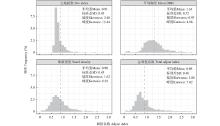
图1
林分平均胸径、株数密度、立地指数和总调整系数的频率分布 虚线代表平均值。Dash line represents the mean value."
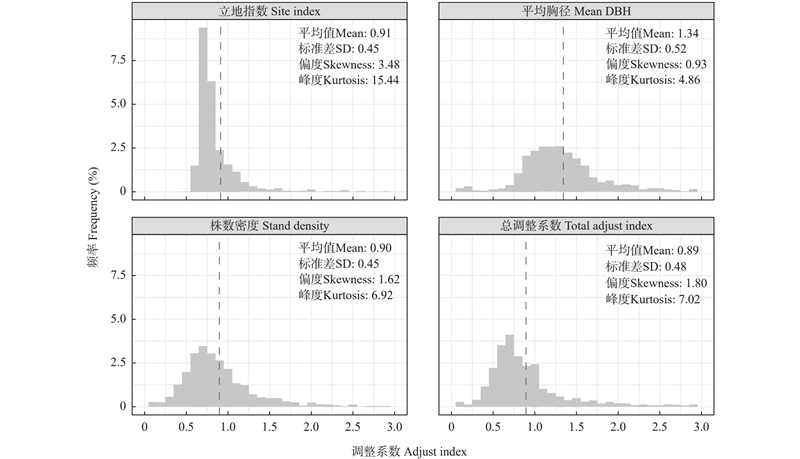
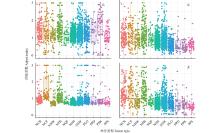
图2
各林分类型的平均胸径(k1)、株数密度(k2)、立地指数调整系数(k3)和总调整系数(K) PPK: 人工红松林 Planted P. koraiensis forest;PLO: 人工落叶松林 Planted L. olgensis forest;PPS: 人工樟子松林 Planted P. sylvestris var. mongolica forest; PPD: 人工杨树林 Planted P. davidiana forest;NSW: 天然软阔林 Natural softwood forest;NHW: 天然硬阔林 Natural hardwood forest;NSH: 天然软硬阔林 Natural soft- and hard-wood forest;NPB: 天然杨桦林 Natural P. davidiana and B. platyphylla forest;NQF: 天然蒙古栎林 Natural Q. mongolica forest;NCB: 天然针阔林Natural coniferous and broadleaf forest;NCF: 天然针叶林 Natural coniferous forest."
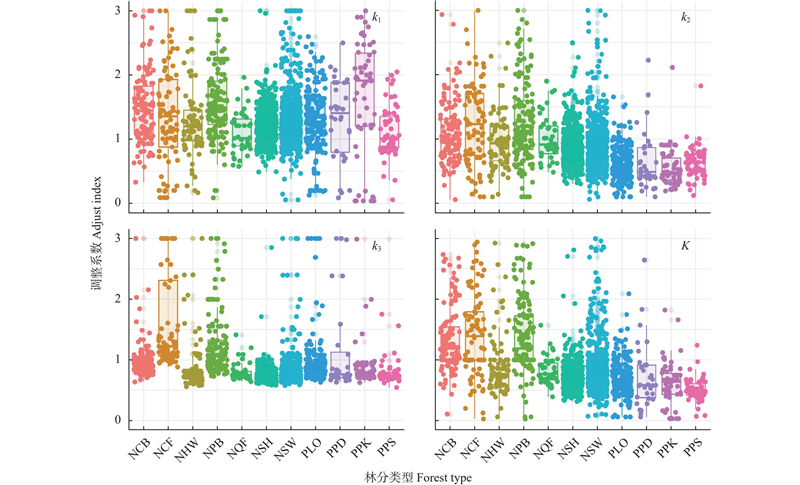
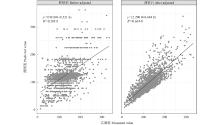
图3
小班单位面积蓄积量实测值与直接预测(左)和调整预测(右)结果的关系"
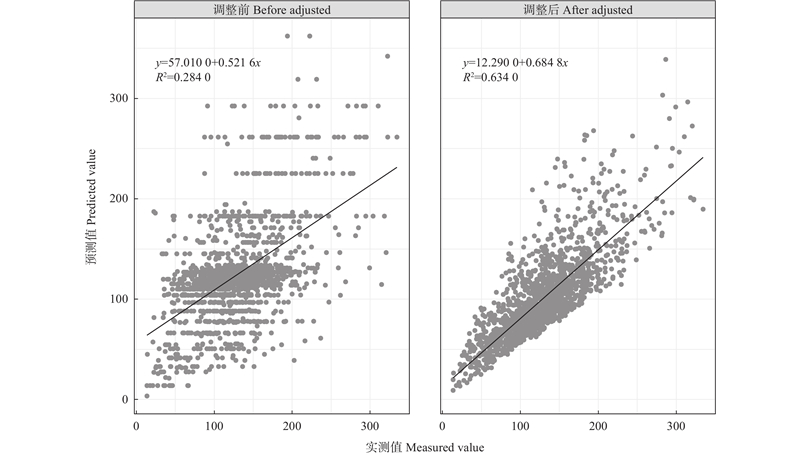
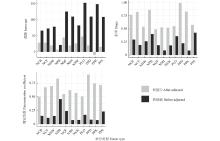
图4
各林分类型单位面积蓄积实测值与直接预值和调整预测值间线性关系的截距、斜率和确定系数 PPK:人工红松林 Planted P. koraiensis forest;PLO:人工落叶松林 Planted L. olgensis forest;PPS:人工樟子松林 Planted P. sylvestris var. mongolica forest;PPD:人工杨树林 Planted P. davidiana forest;NSW:天然软阔林 Natural softwood forest;NHW:天然硬阔林 Natural hardwood forest;NSH:天然软硬阔林 Natural soft- and hard-wood forest;NPB:天然杨桦林 Natural P. davidiana and B. platyphylla forest;NQF:天然蒙古栎林 Natural Q. mongolica forest;NCB:天然针阔林Natural coniferous and broadleaf forest;NCF:天然针叶林 Natural coniferous forest."
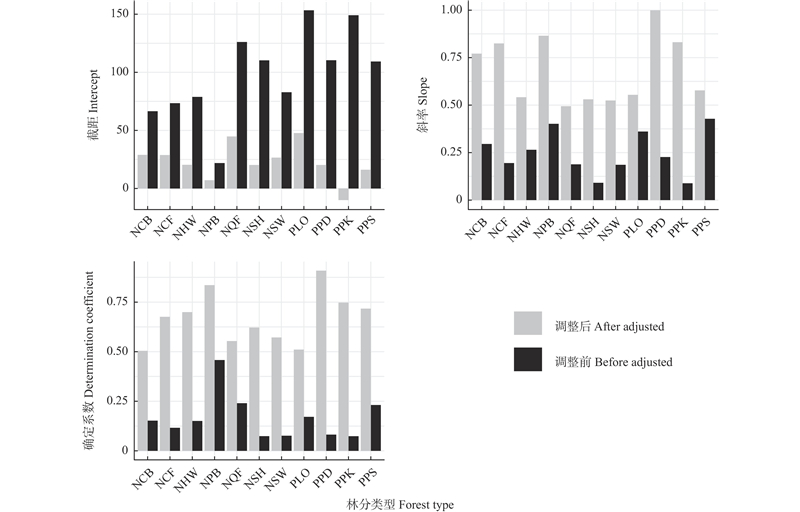
表4
各林分类型不同时期碳储量、碳汇量和固碳速率①"
| 林分类型 Forest types | 碳储量 Carbon stocks/ 104 t | 碳汇量CS/ 104 t | 固碳速率 Carbon rate/ (t·hm?2 a?1) | ||||||||
| 2016 | 2022a | 2022b | 2025 | 2030 | 2035 | 2040 | 2045 | 2050 | |||
| 人工红松林 PPK | 0.60 | 0.70 | 0.39 | 0.39 | 0.40 | 0.41 | 0.42 | 0.43 | 0.44 | 0.05 | 0.25 |
| 人工落叶松林 PLO | 9.40 | 11.39 | 3.75 | 4.09 | 4.60 | 5.04 | 5.41 | 5.74 | 6.03 | 2.28 | 1.20 |
| 人工杨树林 PPD | 0.22 | 0.28 | 0.07 | 0.08 | 0.09 | 0.10 | 0.10 | 0.11 | 0.11 | 0.04 | 0.38 |
| 人工樟子松林 PPS | 1.40 | 1.79 | 0.50 | 0.52 | 0.55 | 0.58 | 0.60 | 0.62 | 0.63 | 0.14 | 0.35 |
| 天然软阔林 NSW | 37.47 | 41.27 | 30.97 | 32.12 | 33.82 | 35.27 | 36.54 | 37.65 | 38.63 | 7.65 | 0.34 |
| 天然硬阔林 NHW | 0.56 | 0.64 | 3.29 | 3.39 | 3.55 | 3.70 | 3.82 | 3.93 | 4.03 | 0.75 | 0.31 |
| 天然软硬阔林 NSH | 22.79 | 25.70 | 35.75 | 36.57 | 37.80 | 38.90 | 39.88 | 40.76 | 41.55 | 5.80 | 0.22 |
| 天然杨桦林 NPB | 2.41 | 2.93 | 2.92 | 3.22 | 3.68 | 4.10 | 4.47 | 4.80 | 5.10 | 2.18 | 0.96 |
| 天然蒙古栎林 NQF | 1.52 | 1.96 | 2.69 | 2.77 | 2.89 | 3.00 | 3.10 | 3.19 | 3.27 | 0.58 | 0.53 |
| 天然针阔混交林 NCB | 1.14 | 1.36 | 4.88 | 5.28 | 5.87 | 6.39 | 6.84 | 7.24 | 7.59 | 2.71 | 1.09 |
| 天然针叶混交林 NCF | 1.20 | 1.38 | 1.26 | 1.38 | 1.58 | 1.76 | 1.93 | 2.08 | 2.23 | 0.96 | 1.74 |
| 合计 Total | 78.71 | 89.38 | 86.47 | 89.82 | 94.84 | 99.24 | 103.12 | 106.55 | 109.61 | 23.14 | 0.38 |
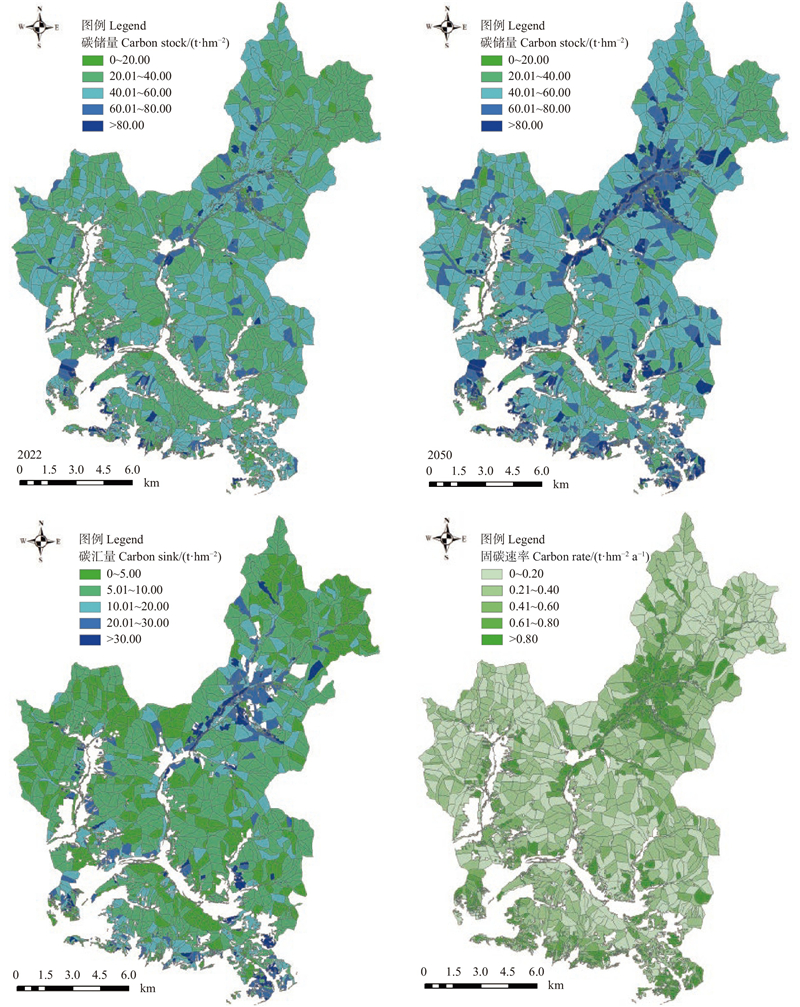
图5
帽儿山实验林2022—2050年单位面积碳储量、碳汇量和固碳速率空间分布"
| 董利虎. 2015,. 东北林区主要树种及林分类型生物量模型. 哈尔滨: 东北林业大学. | |
| Dong L H. 2015,. Developing individual and stand-level biomass equations in northeast China forest area. Harbin: Northeast Forestry University. [in Chinese] | |
|
董灵波, 陈冠谋, 蔺雪莹, 等. 基于CO2FIX模型的长白落叶松人工林碳汇和木材生产模拟. 应用生态学报, 2022, 33 (10): 2653- 2662.
doi: 10.13287/j.1001-9332.202210.009 |
|
|
Dong L B, Chen G M, Lin X Y, et al. Simulation of carbon sequestration and timber production in Larix olgensis plantation based on CO2FIX model. Chinese Journal of Applied Ecology, 2022, 33 (10): 2653- 2662.
doi: 10.13287/j.1001-9332.202210.009 |
|
|
董灵波, 刘兆刚, 李凤日. 大兴安岭盘古林场森林景观的空间分布格局及其关联性. 林业科学, 2015, 51 (7): 28- 36.
doi: 10.11707/j.1001-7488.20150704 |
|
|
Dong L B, Liu Z G, Li F R. Spatial point patterns and associations of forest landscapes in Pangu Forest Farm in Daxing’an Mountains. Scientia Silvae Sinicae, 2015, 51 (7): 28- 36.
doi: 10.11707/j.1001-7488.20150704 |
|
| 谷云鹏, 董灵波, 刘兆刚, 等. 近40年帽儿山林场森林景观格局的动态变化及影响因素. 中南林业科技大学学报, 2023, 43 (5): 73- 85. | |
| Gu Y P, Dong L B, Liu Z G, et al. Dynamic changes and driving factors of the forest landscape pattern in Mao’er Mountain Forest Farm in the recent 40 years. Journal of Central South University of Forestry & Technology, 2023, 43 (5): 73- 85. | |
|
洪玲霞, 雷相东, 李永慈. 蒙古栎林全林整体生长模型及其应用. 林业科学研究, 2012, 25 (2): 201- 206.
doi: 10.3969/j.issn.1001-1498.2012.02.015 |
|
|
Hong L X, Lei X D, Li Y C. Integrated stand growth model of Mongolian oak and it’s application. Forest Research, 2012, 25 (2): 201- 206.
doi: 10.3969/j.issn.1001-1498.2012.02.015 |
|
|
皇宝林, 毕艳玲, 温庆忠, 等. 基于CBM-CFS3模型的迪庆州云杉林地上生物量碳动态研究. 林业调查规划, 2017, 42 (5): 1- 8.
doi: 10.3969/j.issn.1671-3168.2017.05.001 |
|
|
Huang B L, Bi Y L, Wen Q Z, et al. Carbon dynamic of above-ground biomass of spruce forest in Diqing Tibetan Autonomous Prefecture based on CBM-CFS3 model. Forest Inventory and Planning, 2017, 42 (5): 1- 8.
doi: 10.3969/j.issn.1671-3168.2017.05.001 |
|
|
黄烺增. 柳杉人工林林分生长模型的研究. 福建林学院学报, 2007, 27 (1): 74- 79.
doi: 10.3969/j.issn.1001-389X.2007.01.017 |
|
|
Huang L Z. Growth model of the Cryptomeria fortunei plantation stand. Journal of Fujian College of Forestry, 2007, 27 (1): 74- 79.
doi: 10.3969/j.issn.1001-389X.2007.01.017 |
|
|
惠刚盈, 盛炜彤, Gadow K V, 等. 杉木人工林收获模型系统的研究. 林业科学研究, 1994, 7 (4): 353- 358.
doi: 10.13275/j.cnki.lykxyj.1994.04.001 |
|
|
Hui G Y, Sheng W T, Gadow K V, et al. Study on the yield modelling system of Chinese fir plantation. Forest Research, 1994, 7 (4): 353- 358.
doi: 10.13275/j.cnki.lykxyj.1994.04.001 |
|
|
季文旭, 冯仲科, 张瀚月, 等. 基于立木胸径生长率模型的乔木林碳汇潜力评估. 中国农业科技导报, 2024, 26 (1): 99- 109.
doi: 10.13304/j.nykjdb.2022.0815 |
|
|
Ji W X, Feng Z K, Zhang H Y, et al. Assessment of carbon sink potential of arbor forests based on DBH growth rate model for standing trees. Journal of Agricultural Science and Technology, 2024, 26 (1): 99- 109.
doi: 10.13304/j.nykjdb.2022.0815 |
|
| 贾炜玮, 李凤日. 2014,. 东北林区各林分类型森林生物量和碳储量. 哈尔滨: 黑龙江科学技术出版社. | |
| Jia W W, Li F R. 2014,. Forest biomass and carbon stocks of forest stand types in northeast forest region. Harbin: Heilongjiang Science and Technology Press. [in Chinese] | |
|
解雅麟, 雷相东, 曾伟生. 基于3-PGmix过程模型的落叶松人工林生长过程表编制. 林业科学, 2023, 59 (12): 87- 104.
doi: 10.11707/j.1001-7488.LYKX20220837 |
|
|
Xie Y L, Lei X D, Zeng W S. Compilation of growth and yield table for larch plantations based on 3-PGmix model. Scientia Silvae Sinicae, 2023, 59 (12): 87- 104.
doi: 10.11707/j.1001-7488.LYKX20220837 |
|
| 郎奎建. 东北林区森林资源可持续特征模型研究. 林业科学, 2002, 38 (3): 67- 72. | |
| Lang K J. Study on northeast forest resource sustainable model. Scientia Silvae Sinicae, 2002, 38 (3): 67- 72. | |
|
李海奎. 碳中和愿景下森林碳汇评估方法和固碳潜力预估研究进展. 中国地质调查, 2021, 8 (4): 79- 86.
doi: 10.19388/j.zgdzdc.2021.04.08 |
|
|
Li H K. Research advance of forest carbon sink assessment methods and carbon sequestration potential estimation under carbon neutral vision. Geological Survey of China, 2021, 8 (4): 79- 86.
doi: 10.19388/j.zgdzdc.2021.04.08 |
|
|
刘世荣, 王 晖, 李海奎, 等. 碳中和目标下中国森林碳储量、碳汇变化预估与潜力提升途径. 林业科学, 2024, 60 (4): 157- 172.
doi: 10.11707/j.1001-7488.LYKX20230206 |
|
|
Liu S R, Wang H, Li H K, et al. Projections of China’s forest carbon storage and sequestration and ways of their potential capacity enhancement. Scientia Silvae Sinicae, 2024, 60 (4): 157- 172.
doi: 10.11707/j.1001-7488.LYKX20230206 |
|
| 卢 军, 张会儒, 李凤日. 2011,. 大兴安岭天然林林分生长模型研究. 林业资源管理 (3): 33−36. | |
| Lu J, Zhang H R, Li F R. 2011,. Natural forest stand growth models for Daxing’anling Mountains. Forest Resources Management, (3): 33−36. [in Chinese] | |
|
吕沅杭, 伊利启, 王儒林, 等. 基于空间结构参数的大兴安岭天然落叶松单木直径生长模型. 林业科学研究, 2021, 34 (2): 81- 91.
doi: 10.13275/j.cnki.lykxyj.2021.02.009 |
|
|
Lyu Y H, Yi L Q, Wang R L, et al. Diameter growth model using spatial structure parameters of natural Larix gmelinii stand in Daxing’anling Mountains, northeast China. Forest Research, 2021, 34 (2): 81- 91.
doi: 10.13275/j.cnki.lykxyj.2021.02.009 |
|
|
潘建勇, 邹奕巧, 葛宏立, 等. 用林分生长模型更新小班主要调查因子的方法研究. 西南林业大学学报, 2012, 32 (3): 55- 59.
doi: 10.3969/j.issn.2095-1914.2012.03.012 |
|
|
Pan J Y, Zou Y Q, Ge H L, et al. Updating the main subcompartment variables based on stand growth model. Journal of Southwest Forestry University, 2012, 32 (3): 55- 59.
doi: 10.3969/j.issn.2095-1914.2012.03.012 |
|
|
朴世龙, 何 悦, 王旭辉, 等. 中国陆地生态系统碳汇估算: 方法、进展、展望. 中国科学: 地球科学, 2022, 52 (6): 1010- 1020.
doi: 10.1360/SSTe-2021-0197 |
|
|
Piao S L, He Y, Wang X H, et al. Estimation of China’s terrestrial ecosystem carbon sink: methods, progress and prospects. Scientia Sinica (Terrae), 2022, 52 (6): 1010- 1020.
doi: 10.1360/SSTe-2021-0197 |
|
| 苏思琪, 邹冠华, 余云军, 等. 广东省红树林碳储量与碳汇潜力估算. 南方能源建设, 2024, 11 (5): 63- 74. | |
| Su S Q, Zhou G H, Yu Y J, et al. Carbon reserve and carbon sink potential estimation of mangrove in Guangdong Province. Southern Energy Construction, 2024, 11 (5): 63- 74. | |
|
孙云霞, 刘兆刚, 董灵波. 帽儿山地区1983—2016年森林景观空间点格局及其关联动态性. 应用生态学报, 2018, 29 (8): 2601- 2614.
doi: 10.13287/j.1001-9332.201808.012 |
|
|
Sun Y X, Liu Z G, Dong L B. Spatial point patterns and their association dynamics of forest landscapes in Mao’ershan region, northeast China between 1983 and 2016. Chinese Journal of Applied Ecology, 2018, 29 (8): 2601- 2614.
doi: 10.13287/j.1001-9332.201808.012 |
|
|
唐守正, 李希菲, 孟昭和. 林分生长模型研究的进展. 林业科学研究, 1993, 6 (6): 672- 679.
doi: 10.3321/j.issn:1001-1498.2004.04.020 |
|
|
Tang S Z, Li X F, Meng Z H. The development of studies on stand growth models. Forest Research, 1993, 6 (6): 672- 679.
doi: 10.3321/j.issn:1001-1498.2004.04.020 |
|
| 王鹤智. 2012,. 东北林区林分生长动态模拟系统研究. 哈尔滨: 东北林业大学. | |
| Wang H Z. 2012,. Dynamic simulating system for stand growth of forests in northeast China. Harbin: Northeast Forestry University. [in Chinese] | |
|
王晓慧, 陈永富, 刘 华, 等. 基于森林资源二类调查数据的森林碳储量和固碳潜力评估: 以西藏自治区扎囊县为例. 西北林学院学报, 2020, 35 (4): 125- 131.
doi: 10.3969/j.issn.1001-7461.2020.04.21 |
|
|
Wang X H, Chen Y F, Liu H, et al. Estimation of carbon storage and potential carbon sequestration based on the second type inventory of forest resources: a case study of Zhanang County of Tibet Autonomous Region. Journal of Northwest Forestry University, 2020, 35 (4): 125- 131.
doi: 10.3969/j.issn.1001-7461.2020.04.21 |
|
| 王兴昌, 刘 帆, 孙 雪, 等. 温带次生林涡动协方差与清单法碳通量交互对比. 林业科学, 2023, 59 (3): 31- 43. | |
| Wang X C, Liu F, Sun X, et al. Intercomparison of carbon fluxes measured with eddy covariance and inventory methods in temperate secondary forest. Scientia Silvae Sinicae, 2023, 59 (3): 31- 43. | |
| 魏占才. 2004,. 长白落叶松人工林林分生长与收获模型应用的研究. 哈尔滨: 东北林业大学. | |
| Wei Z C. 2004,. A study on application of growth and yield models for Larix olgensis plantations. Harbin: Northeast Forestry University. [in Chinese] | |
| 吴 恒, 朱丽艳, 刘智军, 等. 2019. 基于生长模型的林地“一张图”林分因子更新研究. 林业资源管理, (2): 73−79, 108. | |
| Wu H, Zhu L Y, Liu Z J, et al. 2019. Study of data updating for forestry land resources on single map based on growth model. Forest Resources Management, (2): 73−79, 108. [in Chinese] | |
|
胥 辉. 思茅松天然次生林林分生长模型的研究. 云南林业科技, 2001, 30 (2): 13- 16.
doi: 10.3969/j.issn.1672-8246.2001.02.003 |
|
|
Xu H. Study on growth model of Pinus kesiya var. langbianensis natural secondary forest. Yunnan Forestry Science and Technology, 2001, 30 (2): 13- 16.
doi: 10.3969/j.issn.1672-8246.2001.02.003 |
|
|
徐思若, 成志影, 那雪迎, 等. 黑龙江省森林碳汇及其经济价值的变化分析与潜力预测. 生态学杂志, 2024, 43 (1): 197- 205.
doi: 10.13292/j.1000-4890.202401.008 |
|
|
Xu S R, Cheng Z Y, Na X Y, et al. Change and potentiality prediction of forest carbon sink and its economic value in Heilongjiang Province. Chinese Journal of Ecology, 2024, 43 (1): 197- 205.
doi: 10.13292/j.1000-4890.202401.008 |
|
|
于贵瑞, 朱剑兴, 徐 丽, 等. 中国生态系统碳汇功能提升的技术途径: 基于自然解决方案. 中国科学院院刊, 2022, 37 (4): 490- 501.
doi: 10.16418/j.issn.1000-3045.20220121002 |
|
|
Yu G R, Zhu J X, Xu L, et al. Technological approaches to enhance ecosystem carbon sink in China: nature-based solutions. Bulletin of Chinese Academy of Sciences, 2022, 37 (4): 490- 501.
doi: 10.16418/j.issn.1000-3045.20220121002 |
|
| 张 璐, 王 静, 施润和. 2015,.2000—2010年东北三省碳源汇时空动态遥感研究. 华东师范大学学报(自然科学版) (4): 164−173. | |
| Zhang L, Wang J, Shi R H. 2015,. Temporal-spatial variations of carbon sink/source in northeast China from 2000 to 2010,. Journal of East China Normal University (Natural Science), (4): 164−173. [in Chinese] | |
|
张晓红, 张会儒. 蒙古栎次生林垂直结构特征对目标树经营的响应. 北京林业大学学报, 2019, 41 (5): 56- 65.
doi: 10.13332/j.1000-1522.20190046 |
|
|
Zhang X H, Zhang H R. Response of vertical structure characteristics of natural secondary Quercus mongolica forest to crop tree release. Journal of Beijing Forestry University, 2019, 41 (5): 56- 65.
doi: 10.13332/j.1000-1522.20190046 |
|
|
张 颖, 李晓格, 温亚利. 碳达峰碳中和背景下中国森林碳汇潜力分析研究. 北京林业大学学报, 2022, 44 (1): 38- 47.
doi: 10.12171/j.1000?1522.20210143 |
|
|
Zhang Y, Li X G, Wen Y L. Forest carbon sequestration potential in China under the background of carbon emission peak and carbon neutralization. Journal of Beijing Forestry University, 2022, 44 (1): 38- 47.
doi: 10.12171/j.1000?1522.20210143 |
|
| 郑小贤. 信州落叶松人工林生长模型及其系统收获表的研究. 林业科学, 1997, 33 (1): 42- 50. | |
| Zheng X X. Growth model and constructing a system yield table for Larix kaempferi plantation. Scientia Silvae Sinicae, 1997, 33 (1): 42- 50. | |
|
Bradshaw C J A, Warkentin I G. Global estimates of boreal forest carbon stocks and flux. Global and Planetary Change, 2015, 128, 24- 30.
doi: 10.1016/j.gloplacha.2015.02.004 |
|
| Bukoski J J, Atkinson S R, Miller M A S, et al. 2023. Leveraging surf breaks to expand conservation of carbon-dense coastal ecosystems. EcoEvoRxiv, https://doi.org/10.32942/X2GC8S | |
|
Dong L B, Bettinger P, Liu Z G. Estimating the optimal internal carbon prices for balancing forest wood production and carbon sequestration: the case of northeast China. Journal of Cleaner Production, 2021, 281, 125342.
doi: 10.1016/j.jclepro.2020.125342 |
|
| IPCC. 2021,. Summary for policymakers. Climate change 2021: the physical science basis. Contribution of Working Group I to the Sixth Assessment Report of the Intergovernmental Panel on Climate Change: 3−32. | |
|
Lal R. Forest soils and carbon sequestration. Forest Ecology and Management, 2005, 220 (1/3): 242- 258.
doi: 10.1016/j.foreco.2005.08.015 |
|
|
Lei X D, Lu Y C, Peng C H, et al. Growth and structure development of semi-natural larch-spruce-fir (Larix olgensis–Picea jezoensis–Abies nephrolepis) forests in northeast China: 12-year results after thinning. Forest Ecology and Management, 2007, 240 (1/2/3): 165- 177.
doi: 10.1016/j.foreco.2006.12.019 |
|
|
Lei X D, Yu L, Hong L X. Climate-sensitive integrated stand growth model (CS-ISGM) of Changbai larch (Larix olgensis) plantations. Forest Ecology and Management, 2016, 376, 265- 275.
doi: 10.1016/j.foreco.2016.06.024 |
|
|
Liu Y C, Yu G R, Wang Q F, et al. Carbon carry capacity and carbon sequestration potential in China based on an integrated analysis of mature forest biomass. Science China Life Sciences, 2014, 57 (12): 1218- 1229.
doi: 10.1007/s11427-014-4776-1 |
|
|
Moreau G, Auty D, Pothier D, et al. Long-term tree and stand growth dynamics after thinning of various intensities in a temperate mixed forest. Forest Ecology and Management, 2020, 473, 118311.
doi: 10.1016/j.foreco.2020.118311 |
|
| Piao S L, Wang X H, Park T, et al. Characteristics, drivers and feedbacks of global greening. Nature Reviews Earth & Environment, 2020, 1 (1): 14- 27. | |
|
Qiu Z X, Feng Z K, Song Y N, et al. Carbon sequestration potential of forest vegetation in China from 2003 to 2050: predicting forest vegetation growth based on climate and the environment. Journal of Cleaner Production, 2020, 252, 119715.
doi: 10.1016/j.jclepro.2019.119715 |
|
|
Sohngen B, Brown S. The influence of conversion of forest types on carbon sequestration and other ecosystem services in the south central United States. Ecological Economics, 2006, 57 (4): 698- 708.
doi: 10.1016/j.ecolecon.2005.06.001 |
|
| Wang B, Li M, Fan W, et al. Quantitative simulation of C budgets in a forest in Heilongjiang Province, China. IForest - Biogeosciences and Forestry, 2017, 10 (1): 128- 135. | |
| Wang S Q, Zhou L, Chen J M, et al. Relationships between netprimary productivity and stand age for several forest types and theirinfluence on China’s carbon balance. Journal of Environmental Management, 2011, 92 (6): 1651- 1662. | |
|
Wang T, Dong L B, Liu Z G. Factors driving carbon accumulation in forest biomass and soil organic carbon across natural forests and planted forests in China. Frontiers in Forests and Global Change, 2024, 6, 1333868.
doi: 10.3389/ffgc.2023.1333868 |
|
| West P W. 2009,. Tree and forest measurement. Berlin, Heidelberg: Springer. | |
| Zhang C, Ju W, Chen J, et al. Sustained biomass carbon sequestration by China’s forests from 2010 to 2050. Forests, 2018, 9 (11): 689. | |
| Zhang F M, Chen J M, Pan Y D, et al. 2012. Attributing carbon changes in conterminous U. S. forests to disturbance and non-disturbance factors from 1901 to 2010. Journal of Geophysical Research: Biogeosciences, 117(G2): 2011JG001930. |
| [1] | 何潇,罗光成,高文强,李海奎,曾伟生,段福军,雷相东. 山西中条山林局油松纯林碳汇潜力[J]. 林业科学, 2025, 61(5): 74-84. |
| [2] | 周律,欧光龙,王俊峰,胥辉. 基于空间回归模型的思茅松林生物量遥感估测及光饱和点确定[J]. 林业科学, 2020, 56(3): 38-47. |
| [3] | 赵春燕, 李际平, 马文俊, 袁晓红, 郑柳. 顾及耦合作用的森林景观多尺度分类[J]. 林业科学, 2013, 49(11): 183-188. |
| [4] | 陈先刚;; 张一平 詹 卉. 云南退耕还林工程林木生物质碳汇潜力*[J]. 林业科学, 2008, 44(5): 24-30. |
| [5] | 许等平 唐小明 毕于慧. 基于嵌入式GIS的森林资源二类调查数据采集系统[J]. , 2006, 42(zk): 151-154. |
| [6] | 陆元昌 洪玲霞 雷相东. 基于森林资源二类调查数据的森林景观分类研究[J]. 林业科学, 2005, 41(2): 21-29. |
| [7] | 潘国兴. 国营林场森林经营方案编制与实施问题的研究[J]. , 1993, 29(6): 563-568. |
| 阅读次数 | ||||||
|
全文 |
|
|||||
|
摘要 |
|
|||||

