
Scientia Silvae Sinicae ›› 2026, Vol. 62 ›› Issue (9): 1-12.doi: 10.11707/j.1001-7488.LYKX20260484
• Frontiers and hot topics • Next Articles
Ruizhou Huang1,Mingchun Feng1,Chang Dong2,Yanyan Zheng3,Jiahui Liu1,Guangshu Gan1,Suqin Fang2,Han Xu1,*( )
Received:2026-07-29
Revised:2026-08-11
Online:2026-09-10
Published:2026-09-16
Contact:
Han Xu
E-mail:ywfj@163.com
CLC Number:
Ruizhou Huang,Mingchun Feng,Chang Dong,Yanyan Zheng,Jiahui Liu,Guangshu Gan,Suqin Fang,Han Xu. Multidimensional Analysis of Alien Plants: Species Traits, Spatial Occupancy, and Ecological Impacts[J]. Scientia Silvae Sinicae, 2026, 62(9): 1-12.
Table 1
Spatial distribution of study sites and sampling plots"
| 区域 Region | 样地数 Number of sites | 样方数 Number of sample plots | 经度范围 Longitude range (E)/(°) | 纬度范围 Latitude range (N)/(°) |
| 粤东 Eastern Guangdong | 6 | 86 | ||
| 粤西 Western Guangdong | 5 | 127 | ||
| 珠三角 Pearl River Delta | 20 | 278 | ||
| 粤北 Northern Guangdong | 22 | 333 | ||
| 合计 Total | 53 | 824 |

Fig.1
Taxonomic composition of alien plants at the family and genus levels in 824 plots The values preceding the names of each family and genus in the figure represent their species richness proportion and species richness, respectively."
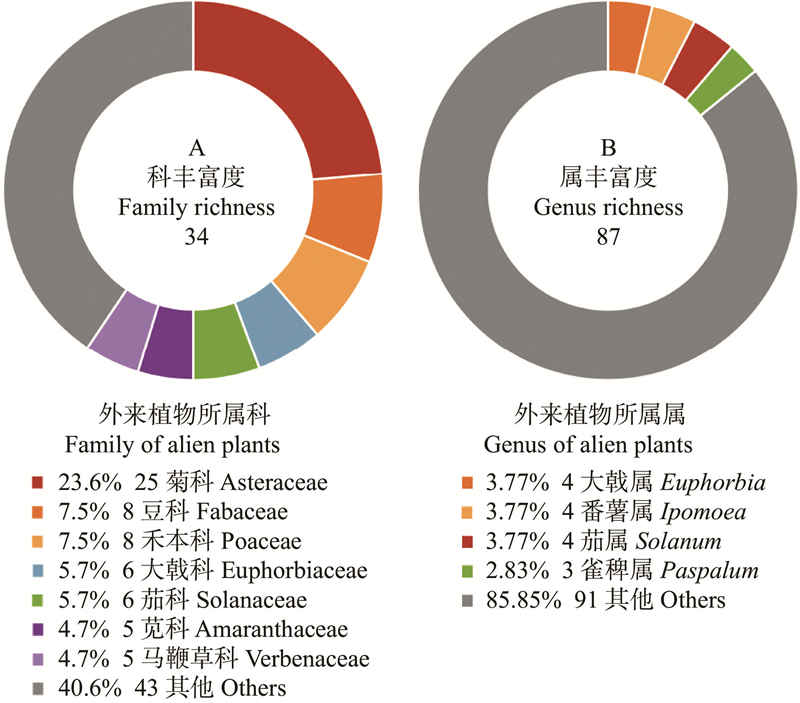
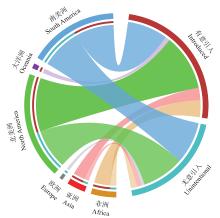
Fig.2
Geographic origins of alien plants in 824 plots"

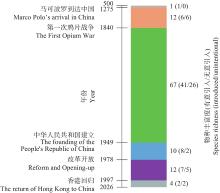
Fig.3
Introduction time of alien plants in 824 plots"
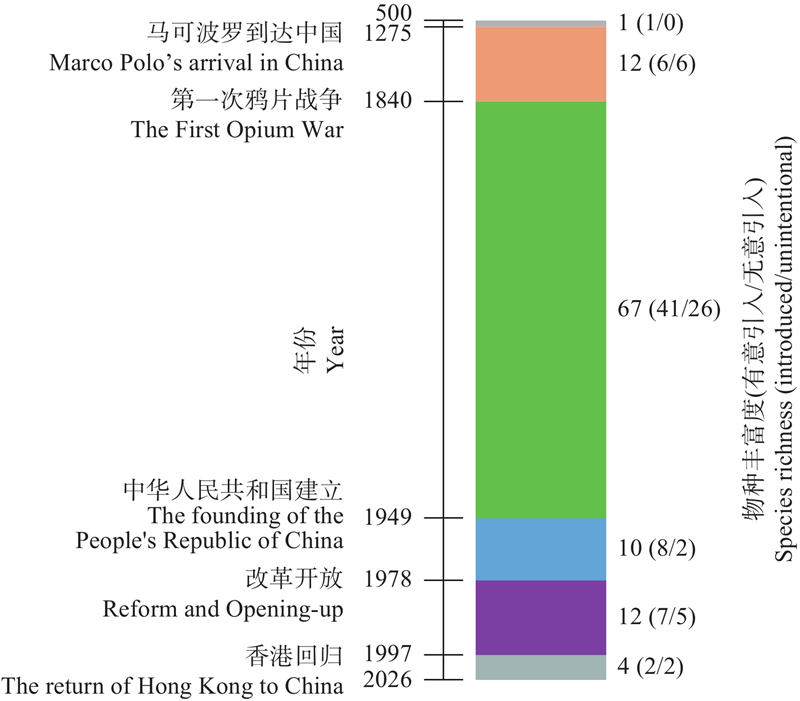
Fig.4
Introduction pathways of alien plants in 824 plots"
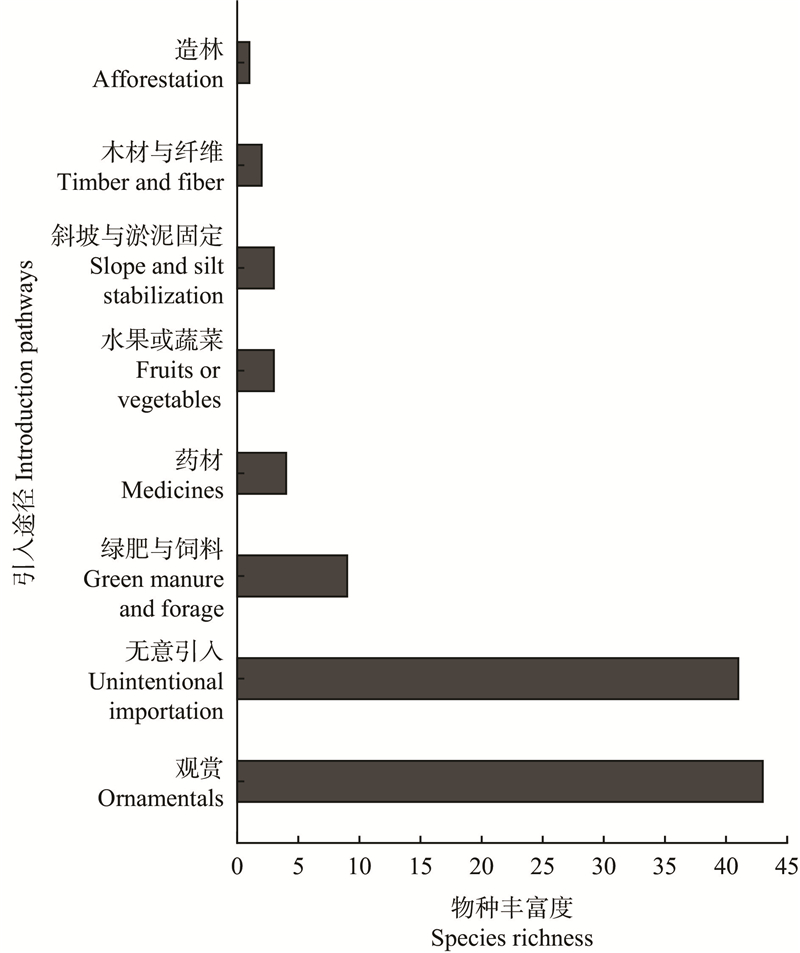
Fig.5
Growth forms and life span of alien plants in 824 plots"
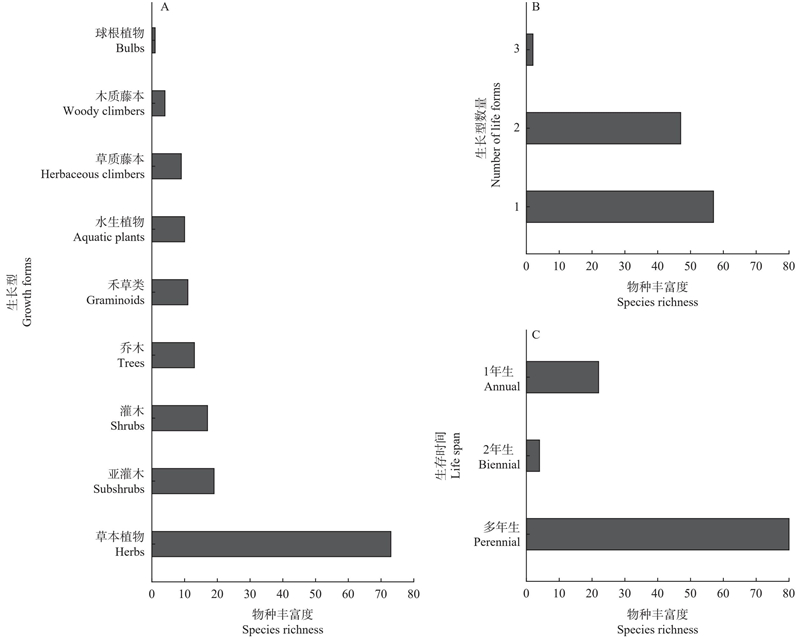

Fig.6
Comparison of ecological space occupation capacity between alien and native plants Points and error bars represent posterior predicted means and 95% credible intervals derived from the Bayesian phylogenetic generalized linear mixed effect model,respectively."
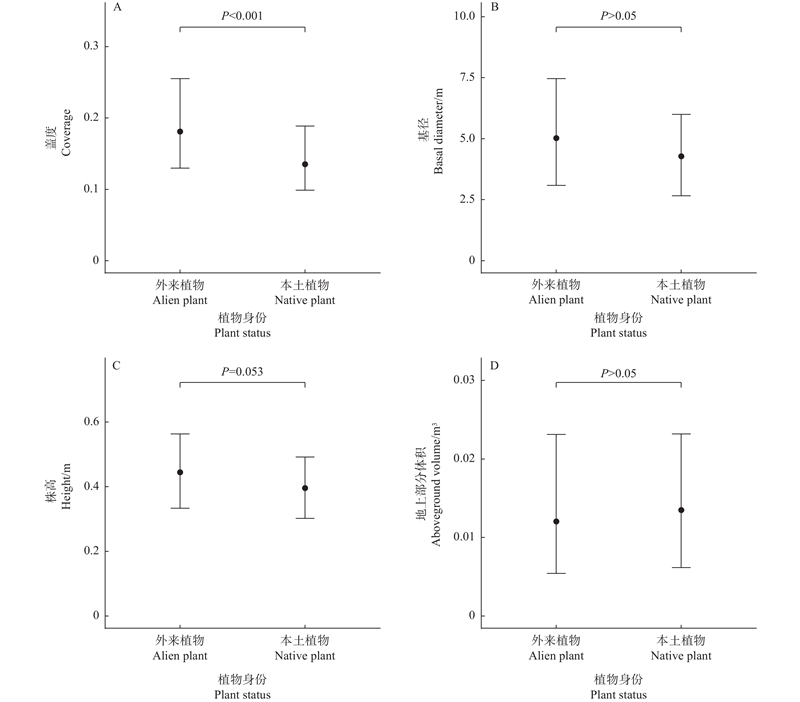
Fig.7
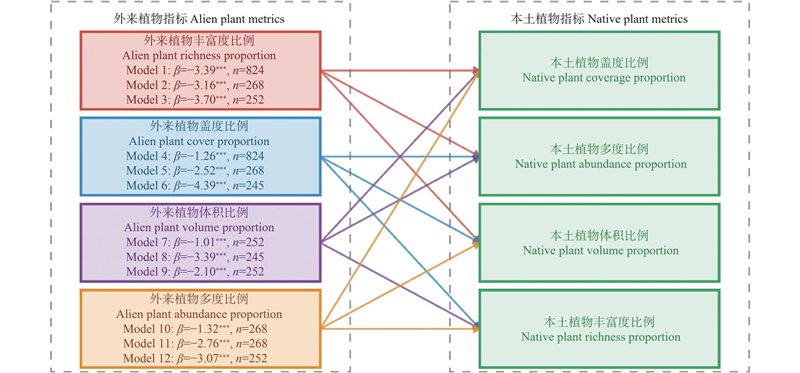
Impacts of alien plants on native plants The diagram illustrates the 12 generalized linear mixed effect models (Models 1–12). Predictor variables (alien plant community metrics) are enclosed within the left dashed box. Response variables (native plant community metrics) are in the right dashed box. Arrows originating from the predictor variables on the left correspond sequentially to Models 1–12, ordered from top to bottom. The volume proportion of plants refers to the proportion of their aboveground volume. β: The fixed-effect coefficient on the logit link scale from the generalized linear mixed effect model. n: Total number of plots used in the model."
|
段婷婷, 何文亮, 杨嘉琦, 等. 湛江市外来植物入侵状况. 生物安全学报, 2022, 31 (3): 245- 251.
doi: 10.3969/j.issn.2095-1787.2022.03.008 |
|
|
Duan T T, He W L, Yang J Q, et al. Analysis of the alien invasive plants in Zhanjiang City, Guangdong Province, China. Journal of Biosafety, 2022, 31 (3): 245- 251.
doi: 10.3969/j.issn.2095-1787.2022.03.008 |
|
|
耿守保, 孙中宇, 张 敏, 等. 广东省陆地生物多样性热点区域及其胁迫因素. 热带地理, 2023, 43 (3): 359- 371.
doi: 10.13284/j.cnki.rddl.003636 |
|
|
Geng S B, Sun Z Y, Zhang M, et al. Terrestrial biodiversity hotspots and their threats in Guangdong Province. Tropical Geography, 2023, 43 (3): 359- 371.
doi: 10.13284/j.cnki.rddl.003636 |
|
|
郭亚男, 王瑞江. 华南地区外来入侵和归化植物分析. 热带亚热带植物学报, 2023, 31 (5): 715- 726.
doi: 10.11926/jtsb.4644 |
|
|
Guo Y N, Wang R J. Analysis on the alien invasive and naturalized plants in south China. Journal of Tropical and Subtropical Botany, 2023, 31 (5): 715- 726.
doi: 10.11926/jtsb.4644 |
|
| 何家庆. 2012. 中国外来植物. 上海: 上海科学技术出版社. | |
| He J Q. 2012. Exotic plants in China. Shanghai: Shanghai Scientific & Technical Publishers. [in Chinese] | |
| 金效华, 林秦文, 赵 宏. 2020. 中国外来入侵植物志.4卷. 上海: 上海交通大学出版社. | |
| Jin X H, Lin Q W, Zhao H. 2020. Alien invisive flora of China. Volume 4. Shanghai: Shanghai Jiaotong University Press. [in Chinese] | |
| 林秦文, 肖 翠, 马金双. 2022. 中国外来植物数据集. 生物多样性, 30(5): 22127. | |
| Lin Q W, Xiao C, Ma J S. 2022. A dataset on catalogue of alien plants in China. Biodiversity Science, 30(5): 22127. [in Chinese] | |
| 刘全儒, 张 勇, 齐淑艳. 2020. 中国外来入侵植物志. 3卷. 上海: 上海交通大学出版社. | |
| Liu Q R, Zhang Y, Qi S Y. 2020. Alien invisive flora of China. Volume 3. Shanghai: Shanghai Jiaotong University Press. [in Chinese] | |
| 刘晓娟, 马克平. 植物功能性状研究进展. 中国科学(生命科学), 2015, 45 (4): 325- 339. | |
| Liu X J, Ma K P. Analysis of the alien invasive plants in Zhanjiang City, Guangdong Province, China. Scientia Sinica Vitae, 2015, 45 (4): 325- 339. | |
|
刘艳杰, 黄 伟, 杨 强, 等. 近十年植物入侵生态学重要研究进展. 生物多样性, 2022, 30 (10): 22438.
doi: 10.17520/biods.2022438 |
|
|
Liu Y J, Huang W, Yang Q, et al. Research advances of plant invasion ecology over the past 10 years. Biodiversity Science, 2022, 30 (10): 22438.
doi: 10.17520/biods.2022438 |
|
| 马金双, 李惠茹. 2018. 中国外来入侵植物名录. 北京: 高等教育出版社. | |
| Ma J S, Li H R. 2018. The checklist of the alien invasive plants in China. Beijing: Higher Education Press. [in Chinese] | |
| 王瑞江, 王发国, 曾宪锋. 2020. 中国外来入侵植物志 2卷. 上海: 上海交通大学出版社. | |
| Wang R J, Wang F G, Zeng X F. 2020. Alien invisive flora of China. Volume 2. Shanghai: Shanghai Jiaotong University Press. [in Chinese] | |
|
王世雄, 何跃军, 王文颖. 基于功能性状多维性理解外来物种入侵的达尔文归化难题. 生物安全学报, 2023, 32 (3): 193- 201.
doi: 10.3969/j.issn.2095-1787.2023.03.001 |
|
|
Wang S X, He Y J, Wang W Y. Understanding Darwin’s naturalization conundrum of alien species invasion based on the multidimensional nature of functional traits. Journal of Biosafety, 2023, 32 (3): 193- 201.
doi: 10.3969/j.issn.2095-1787.2023.03.001 |
|
|
王 忠, 董仕勇, 罗燕燕, 等. 广州外来入侵植物. 热带亚热带植物学报, 2008, 16 (1): 29- 38.
doi: 10.11926/jtsb.3681 |
|
|
Wang Z, Dong S Y, Luo Y Y, et al. Invasive plants in Guangzhou, China. Journal of Tropical and Subtropical Botany, 2008, 16 (1): 29- 38.
doi: 10.11926/jtsb.3681 |
|
| 严 靖, 唐赛春, 李惠茹, 等. 2020. 中国外来入侵植物志. 5卷. 上海: 上海交通大学出版社. | |
| Yan J, Tang S C, Li H R, et al. 2020. Alien invisive flora of China. Volume 5. Shanghai: Shanghai Jiaotong University Press. [in Chinese] | |
|
严 靖, 闫小玲, 李惠茹, 等. 华东地区归化植物的组成特征、引入时间及时空分布. 生物多样性, 2021, 29 (4): 428- 438.
doi: 10.17520/biods.2020335 |
|
|
Yan J, Yan X L, Li H R, Du C, et al. Composition, time of introduction and spatial-temporal distribution of naturalized plants in East China. Biodiversity Science, 2021, 29 (4): 428- 438.
doi: 10.17520/biods.2020335 |
|
| 严 靖, 闫小玲, 马金双. 2016. 中国外来入侵植物彩色图鉴. 上海: 上海科学技术出版社. | |
| Yan J, Yan X L, Ma J S. 2016. Illustrations of alien invasive plants in China. Shanghai: Shanghai Scientific & Technical Publishers. [in Chinese] | |
|
闫小玲, 刘全儒, 寿海洋, 等. 中国外来入侵植物的等级划分与地理分布格局分析. 生物多样性, 2014, 22 (5): 667- 676.
doi: 10.3724/SP.J.1003.2014.14069 |
|
|
Yan X L, Liu Q R, Shou H Y, et al. The categorization and analysis on the geographic distribution patterns of Chinese alien invasive plants. Biodiversity Science, 2014, 22 (5): 667- 676.
doi: 10.3724/SP.J.1003.2014.14069 |
|
| 闫小玲, 王樟华, 李惠茹, 等. 2020. 中国外来入侵植物志. 1卷. 上海: 上海交通大学出版社. | |
| Yan X L, Wang Z H, Li H R, et al. 2020. Alien invisive flora of China. Volume 1. Shanghai: Shanghai Jiaotong University Press. [in Chinese] | |
|
Baker H G. The evolution of weeds. Annual Review of Ecology and Systematics, 1974, 5 (1): 1- 24.
doi: 10.1146/annurev.es.05.110174.000245 |
|
|
Brooks M E, Kristensen K, van Benthem K J, et al. glmmTMB balances speed and flexibility among packages for zero-inflated generalized linear mixed modeling. The R Journal, 2017, 9 (2): 378.
doi: 10.32614/rj-2017-066 |
|
|
Cao Z Y, Wu Z F, Kuang Y Q, et al. Coupling an intercalibration of radiance-calibrated nighttime light images and land use/cover data for modeling and analyzing the distribution of GDP in Guangdong, China. Sustainability, 2016, 8 (2): 108.
doi: 10.3390/su8020108 |
|
|
Dawson W. Release from belowground enemies and shifts in root traits as interrelated drivers of alien plant invasion success: a hypothesis. Ecology and Evolution, 2015, 5 (20): 4505- 4516.
doi: 10.1002/ece3.1725 |
|
|
Diagne C, Leroy B, Vaissière A C, et al. High and rising economic costs of biological invasions worldwide. Nature, 2021, 592 (7855): 571- 576.
doi: 10.1038/s41586-021-03405-6 |
|
|
Divíšek J, Pyšek P, Richardson D M, et al. Naturalized and invasive species integrate differently in the trait space of local plant communities. Ecology Letters, 2025, 28 (11): e70235.
doi: 10.1111/ele.70235 |
|
|
Fan S Y, Fristoe T S, Li S P, et al. Ecological similarities and dissimilarities between donor and recipient regions shape global plant naturalizations. Nature Communications, 2025, 16, 10485.
doi: 10.1038/s41467-025-65455-y |
|
|
Fan S Y, Yang Q, Li S P, et al. A latitudinal gradient in Darwin’s naturalization conundrum at the global scale for flowering plants. Nature Communications, 2023, 14, 6244.
doi: 10.1038/s41467-023-41607-w |
|
|
Feng J M, Zhang Z, Nan R Y. The roles of climatic factors in spatial patterns of alien invasive plants from America into China. Biodiversity and Conservation, 2011, 20 (14): 3385- 3391.
doi: 10.1007/s10531-011-0122-0 |
|
|
Fridley J D. Plant invasions across the northern hemisphere: a deep-time perspective. Annals of the New York Academy of Sciences, 2013, 1293 (1): 8- 17.
doi: 10.1111/nyas.12107 |
|
|
Fristoe T S, Bleilevens J, Kinlock N L, et al. Evolutionary imbalance, climate and human history jointly shape the global biogeography of alien plants. Nature Ecology & Evolution, 2023, 7 (10): 1633- 1644.
doi: 10.1038/s41559-023-02172-z |
|
|
Frost C M, Allen W J, Courchamp F, et al. Using network theory to understand and predict biological invasions. Trends in Ecology & Evolution, 2019, 34 (9): 831- 843.
doi: 10.1016/j.tree.2019.04.012 |
|
| Garbowski M, Laughlin D C, Blumenthal D M, et al. 2024. Naturalized species drive functional trait shifts in plant communities. Proceedings of the National Academy of Sciences of the United States of America, 121(40): e2403120121. | |
|
Gioria M, Osborne B A. Resource competition in plant invasions: emerging patterns and research needs. Frontiers in Plant Science, 2014, 5, 501.
doi: 10.3389/fpls.2014.00501 |
|
|
Gregory D, White M, Catford J A. Similar drivers but distinct patterns of woody and herbaceous alien plant invasion. NeoBiota, 2025, 103, 31- 52.
doi: 10.3897/neobiota.103.164914 |
|
|
Hao Q, Ma J S. Invasive alien plants in China: an update. Plant Diversity, 2023, 45 (1): 117- 121.
doi: 10.1016/j.pld.2022.11.004 |
|
|
Heger T, Pahl A T, Botta-Dukát Z, et al. Conceptual frameworks and methods for advancing invasion ecology. AMBIO, 2013, 42 (5): 527- 540.
doi: 10.1007/s13280-012-0379-x |
|
|
Holden E M, Cahill J F Jr. Plant trait dissimilarity increases competitive interactions among co-occurring plants. Functional Ecology, 2024, 38 (7): 1464- 1474.
doi: 10.1111/1365-2435.14561 |
|
|
Huang Z Y, Lin M, Chen G Q. Common agricultural weeds among alien invasive plants in China: species lists and their practical managing strategies. Heliyon, 2025, 11 (2): e41772.
doi: 10.1016/j.heliyon.2025.e41772 |
|
|
Hulme P E, Brundu G, Carboni M, et al. Integrating invasive species policies across ornamental horticulture supply chains to prevent plant invasions. Journal of Applied Ecology, 2018, 55 (1): 92- 98.
doi: 10.1111/1365-2664.12953 |
|
|
Jin Y, Qian H. V. PhyloMaker2: An updated and enlarged R package that can generate very large phylogenies for vascular plants. Plant Diversity, 2022, 44 (4): 335- 339.
doi: 10.1016/j.pld.2022.05.005 |
|
| Keser L H, Visser E J W, Dawson W, et al. 2015. Herbaceous plant species invading natural areas tend to have stronger adaptive root foraging than other naturalized species. Frontiers in Plant Science, 6. | |
|
Kong J, Hu C, Qie Y D, et al. Shifts in composition, origin, and distribution of invasive alien plants in Guangxi, China, over 50 years. Diversity, 2026, 18 (1): 44.
doi: 10.3390/d18010044 |
|
|
Lau J A, Funk J L. How ecological and evolutionary theory expanded the ‘ideal weed’ concept. Oecologia, 2023, 203, 251- 266.
doi: 10.1007/s00442-023-05397-8 |
|
|
Lavorel S, Garnier E. Predicting changes in community composition and ecosystem functioning from plant traits: revisiting the holy grail. Functional Ecology, 2002, 16 (5): 545- 556.
doi: 10.1046/j.1365-2435.2002.00664.x |
|
|
Lenzner B, Latombe G, Schertler A, et al. Naturalized alien floras still carry the legacy of european colonialism. Nature Ecology & Evolution, 2022, 6 (11): 1723- 1732.
doi: 10.1038/s41559-022-01865-1 |
|
| Liu Y P, Scheiner S M, Hogan J A, et al. 2025. Nonnative tree invaders lead to declines in native tree species richness. Proceedings of the National Academy of Sciences of the United States of America, 122(17): e2424908122. | |
|
Ni M, Deane D C, Li S, et al. Invasion success and impacts depend on different characteristics in non-native plants. Diversity and Distributions, 2021, 27 (7): 1194- 1207.
doi: 10.1111/ddi.13267 |
|
|
Park D S, Feng X, Maitner B S, et al. Darwin’s naturalization conundrum can be explained by spatial scale. Proceedings of the National Academy of Sciences of the United States of America, 2020, 117 (20): 10904- 10910.
doi: 10.1073/pnas.1918100117 |
|
|
Pei J, Niu Z, Wang L, et al. Spatial-temporal dynamics of carbon emissions and carbon sinks in economically developed areas of China: a case study of Guangdong Province. Scientific Reports, 2018, 8, 13383.
doi: 10.1038/s41598-018-31733-7 |
|
|
Pérez G, Vilà M, Gallardo B. Potential impact of four invasive alien plants on the provision of ecosystem services in Europe under present and future climatic scenarios. Ecosystem Services, 2022, 56, 101459.
doi: 10.1016/j.ecoser.2022.101459 |
|
|
Poppenwimer T, Mayrose I, DeMalach N. Revising the global biogeography of annual and perennial plants. Nature, 2023, 624 (7990): 109- 114.
doi: 10.1038/s41586-023-06644-x |
|
|
Pyšek P, Hulme P E, Meyerson L A, et al. Hitting the right target: taxonomic challenges for, and of, plant invasions. AoB Plants, 2013, 5, plt042.
doi: 10.1093/aobpla/plt042 |
|
|
Pyšek P, Hulme P E, Simberloff D, et al. Scientists’ warning on invasive alien species. Biological Reviews, 2020, 95 (6): 1511- 1534.
doi: 10.1111/brv.12627 |
|
| Pyšek P, Pergl J, Essl F, et al. Naturalized alien flora of the world: species diversity, taxonomic and phylogenetic patterns, geographic distribution and global hotspots of plant invasion. Preslia, 2017, 89 (3): 203- 274. | |
|
Ren W J, Peng J, Shrestha N, et al. Potential distribution and future shifts of invasive alien plants in China under climate change. Global Ecology and Conservation, 2025, 60, e03601.
doi: 10.1016/j.gecco.2025.e03601 |
|
|
Richards C L, Bossdorf O, Muth N Z, et al. Jack of all trades, master of some? On the role of phenotypic plasticity in plant invasions. Ecology Letters, 2006, 9 (8): 981- 993.
doi: 10.1111/j.1461-0248.2006.00950.x |
|
|
Sáradi N, Reis B P, Csákvári E, et al. Restorative seeding controls annual invasive species, but perennials can thrive in the long term despite treatments in sand grassland restoration. Biological Invasions, 2025, 27 (6): 154.
doi: 10.1007/s10530-025-03613-5 |
|
|
Schaffner U, Steinbach S, Sun Y, et al. Biological weed control to relieve millions from Ambrosia allergies in Europe. Nature Communications, 2020, 11 (1): 1745.
doi: 10.1038/s41467-020-15586-1 |
|
|
Seebens H, Bacher S, Blackburn T M, et al. Projecting the continental accumulation of alien species through to 2050. Global Change Biology, 2021, 27 (5): 970- 982.
doi: 10.1111/gcb.15333 |
|
|
Seebens H, Meyerson L A, Richardson D M, et al. Biological invasions: a global assessment of geographic distributions, long-term trends, and data gaps. Biological Reviews, 2025, 100 (6): 2542- 2583.
doi: 10.1111/brv.70058 |
|
|
Stanisci A, Acosta A T R, Di Iorio A, et al. Leaf and root trait variability of alien and native species along Adriatic coastal dunes (Italy). Plant Biosystems, 2010, 144 (1): 47- 52.
doi: 10.1080/11263500903454252 |
|
|
Thorne M S, Skinner Q D, Smith M A, et al. Evaluation of a technique for measuring canopy volume of shrubs. Journal of Range Management, 2002, 55 (3): 235- 241.
doi: 10.2458/azu_jrm_v55i3_thorne |
|
|
van Kleunen M, Dawson W, Essl F, et al. Global exchange and accumulation of non-native plants. Nature, 2015, 525 (7567): 100- 103.
doi: 10.1038/nature14910 |
|
|
van Kleunen M, Essl F, Pergl J, et al. The changing role of ornamental horticulture in alien plant invasions. Biological Reviews, 2018, 93 (3): 1421- 1437.
doi: 10.1111/brv.12402 |
|
| van Kleunen M, Pyšek P, Dawson W, et al. The global naturalized alien flora (GloNAF) database. Ecology, 2019, 100 (1): e02542. | |
|
van Kleunen M, Weber E, Fischer M. A meta-analysis of trait differences between invasive and non-invasive plant species. Ecology Letters, 2010, 13 (2): 235- 245.
doi: 10.1111/j.1461-0248.2009.01418.x |
|
| Violle C, Navas M-L, Vile D, et al. 2007. Let the concept of trait be functional! Oikos, 116(5): 882−892. | |
|
Wang H Y, Yang M, Ma X H, et al. The ecological risks and invasive potential of introduced ornamental plants in China. Plants, 2025, 14 (9): 1361.
doi: 10.3390/plants14091361 |
|
|
Weber E, Sun S G, Li B. Invasive alien plants in China: diversity and ecological insights. Biological Invasions, 2008, 10 (8): 1411- 1429.
doi: 10.1007/s10530-008-9216-3 |
|
| Wu Z Y, Raven P H, Hong D Y. 1994—2013. Flora of China, Vols. 1–25. Beijing: Science Press. | |
| Yan X, Li Z Y, Gregg W P, et al. 2001. Invasive species in China: an overview. Biodiversity and Conservation, 10(8): 1317−1341. | |
|
Yang Y B, Liu X, Wu J H, et al. A comprehensive county-level distribution database of alien and invasive plants in China. Ecology, 2025, 106 (5): e70084.
doi: 10.1002/ecy.70084 |
| [1] | Ruijing Xu,Yi Wang,Chuanteng Huang,Chunju Cai,Shaohui Fan,Guanglu Liu. Effects of Drought Durations on the Functional Traits of Daemonorops jenkinsiana Seedlings [J]. Scientia Silvae Sinicae, 2026, 62(9): 165-176. |
| [2] | Xueying Ren,Zhirong Xu,Xuan Wang,Zhongyi Li,Xiuhai Zhao,Huaijiang He,Chunyu Zhang,Xinna Zhang. Synergistic and Trade-off Relationships among Multi-Organ Functional Traits of Quercus mongolica and Their Responses to Soil Carbon and Nitrogen Contents [J]. Scientia Silvae Sinicae, 2026, 62(8): 43-54. |
| [3] | Shaokun Wang,Jing Li,Lijuan Cui. Research Progress on Mechanisms of Halophyte Plant Root Traits Influencing Microbial Nitrogen Removal in Coastal Wetlands [J]. Scientia Silvae Sinicae, 2026, 62(4): 1-11. |
| [4] | Xinglu Zhou,Lei Zhang,Qinghe Li,Jianjun Hu. Genetic Variation in Growth and Wood Property Traits from Hybrid Progenies of Populus deltoides [J]. Scientia Silvae Sinicae, 2026, 62(4): 130-141. |
| [5] | Wenqiang Gao,Xiangdong Lei,Xiao He,Yutang Li. Variability in Tree Species Diversity-Aboveground Biomass Relationship in Temperate Forest Types and Developmental Stages in Northeast China [J]. Scientia Silvae Sinicae, 2026, 62(4): 55-67. |
| [6] | Min Deng,Huaijiang He,Xiangju Wu,Xinna Zhang,Chunyu Zhang,Xiuhai Zhao. Effects of Biomass Allocation Trade-Offs and Traits of Temperate Forests in Northeast China on Seedling Growth [J]. Scientia Silvae Sinicae, 2026, 62(3): 48-60. |
| [7] | Xiahui Hua,Xianyin Ding,Shaoze Wu,Qinyun Huang,Shu Diao,Yadi Wu,Qifu Luan. Aboveground Biomass Models for Young Pinus elliottii Plantations Based on Various Growth Factors [J]. Scientia Silvae Sinicae, 2026, 62(3): 211-222. |
| [8] | Shirong Liu,Yuanqi Chen,Xiuqing Nie,Angang Ming,Hui Wang. Effects of Tree Species Diversity on Multifunctionality and Resilience of Forest Ecosystems [J]. Scientia Silvae Sinicae, 2026, 62(1): 1-18. |
| [9] | Chenchen Guo,Qi Li,Siyuan Li,Zemin Wang,Yingnan Chen,Suyun Wei,Jianjun Hu. Genomic Selection for Dynamic Growth Traits during the Seedling Stage of Poplar Hybrid Population [J]. Scientia Silvae Sinicae, 2026, 62(1): 32-41. |
| [10] | Yafei Wang,Yu Zou,Xucun Zhu,Shusen Zhang,Shaoran Li,Ye Wang,Liming Jia. Plastic Response of Leaf-Fine Root Phenotype and Growth Rhythm of Populus tomentosa Plantation to Thinning Intensity [J]. Scientia Silvae Sinicae, 2026, 62(1): 95-108. |
| [11] | Zhihui Yang,Liuduan Wei,Miao Yu,Tianxin Dong,Xingyu Zhang,Xinna Zhang,Bingqian Ma,Chengyang Xu. Drought Effect on the Seedling Growth of Four Species Depends on the Lower Order Root Traits [J]. Scientia Silvae Sinicae, 2025, 61(9): 81-89. |
| [12] | Rui Gu,Shaohui Fan,Songpo Wei,Guanglu Liu. Construction of a Core Germplasm of Moso Bamboo Based on Phenotypic Traits [J]. Scientia Silvae Sinicae, 2025, 61(9): 101-112. |
| [13] | Guangzhen Shi,Zhengnan Zhao,Hui Feng,Juan Yang,Gongfa Shi,Kuwantai Aerdake,Lei Wang,Weilun Sun,Ling Wang. Analysis of Chromosome Ploidy and Phenotypic Diversity of Modern Rose Cultivars with Floral Blotches [J]. Scientia Silvae Sinicae, 2025, 61(9): 123-137. |
| [14] | Yupei Xu,Xuan Guo,Zuoyou Hu,Bingqian Ma,Jiaxin Guo,Yang Li,Qian Xiao,Tianxin Dong,Chengyang Xu. Effects of Stand Structure on Visually Morphological Quality of Beijing Urban Forests [J]. Scientia Silvae Sinicae, 2025, 61(7): 220-230. |
| [15] | Kang Xiangyang. Rethinking the Issues That Need to Be Taken Seriously in Forest Tree Breeding, Seed Production of Improved Variety and Their Application in China [J]. Scientia Silvae Sinicae, 2025, 61(6): 224-231. |
| Viewed | ||||||
|
Full text |
|
|||||
|
Abstract |
|
|||||
