
Scientia Silvae Sinicae ›› 2026, Vol. 62 ›› Issue (8): 43-54.doi: 10.11707/j.1001-7488.LYKX20260049
• Research papers • Previous Articles Next Articles
Xueying Ren1,Zhirong Xu1,Xuan Wang1,Zhongyi Li1,Xiuhai Zhao1,Huaijiang He2,Chunyu Zhang1,Xinna Zhang1,*( )
)
Received:2026-01-23
Revised:2026-05-14
Online:2026-08-10
Published:2026-08-20
Contact:
Xinna Zhang
E-mail:zhangxinna@bjfu.edu.cn
CLC Number:
Xueying Ren,Zhirong Xu,Xuan Wang,Zhongyi Li,Xiuhai Zhao,Huaijiang He,Chunyu Zhang,Xinna Zhang. Synergistic and Trade-off Relationships among Multi-Organ Functional Traits of Quercus mongolica and Their Responses to Soil Carbon and Nitrogen Contents[J]. Scientia Silvae Sinicae, 2026, 62(8): 43-54.

Table 1
Basic information of the plots"
| 样地 Plots | 海拔 Altitude/m | 纬度 Latitude (N) | 经度 Longitude (E) | 坡向 Aspect |
| 1 | 649.1 | 40°54′57″ | 124°53′47″ | 阳坡Sunny slope |
| 2 | 713.2 | 40°54′05″ | 124°54′09″ | 阳坡Sunny slope |
| 3 | 694.1 | 40°55′00″ | 124°53′49″ | 阳坡Sunny slope |
Fig.1
Schematic diagram of plot setup"
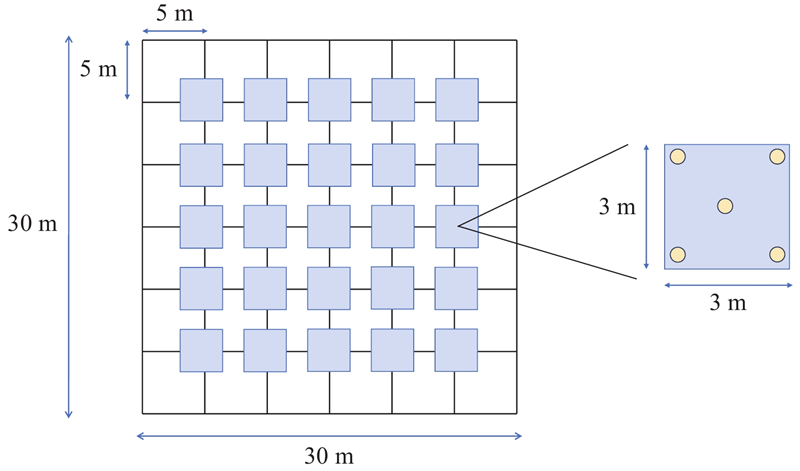
Table 2
Basic information of plant functional traits"
| 植物功能性状指标 Plant functional traits | 简称 Abbreviation | 单位 Units | 计算公式 Calculation formula | 生态学意义 Ecological significance |
| 叶干物质含量 Leaf dry matter content | LDMC | g·g–1 | 叶片干质量/叶片鲜质量 Leaf dry mass/leaf fresh mass | 反映叶片在组织结构紧密程度与水分含量 之间的权衡 Reflecting the trade-off between the tightness of the tissue structure and the moisture content of the leaves |
| 叶面积 Leaf area | LA | cm2 | 使用扫描仪扫描叶面积,再使用 ImageJ分析扫描图 Use a scanner to scan the leaf area, and then use ImageJ to analyze the scanned image to obtain | 反映叶片的光合作用潜力与水分蒸腾效率 Reflecting the photosynthetic potential of the leaves and the efficiency of water evaporation |
| 比叶面积 Specific leaf area | SLA | cm2·g–1 | 叶面积/叶片干质量 Leaf area/leaf dry mass | 反映叶片在干物质投入效率与光合利用 效率之间的权衡 Reflecting the trade-off between the efficiency of dry matter input and the efficiency of photosynthetic utilization of the leaves |
| 叶碳含量 Leaf carbon content | LC | mg·g–1 | 叶片中的碳质量/叶片干质量 Carbon content in the leaf/leaf dry mass | 反映叶片碳积累与分配的能力 Reflecting the ability of leaf carbon accumulation and distribution |
| 叶氮含量 Leaf nitrogen content | LN | mg·g–1 | 叶片中的氮质量/叶片干质量 Nitrogen in the leaf/leaf dry mass | 反映叶片光合能力与氮素利用效率 Reflecting the photosynthetic capacity of leaves and nitrogen utilization efficiency |
| 叶碳氮比 Leaf carbon to nitrogen ratio | LC∶N | - | 叶碳含量/叶氮含量 Leaf carbon content/leaf nitrogen content | 反映叶片碳氮养分分配与利用效率的能力 Reflecting the ability of the distribution and utilization efficiency of carbon and nitrogen nutrients in leaves |
| 枝碳含量 Branch carbon content | BC | mg·g–1 | 枝中的碳质量/枝干质量 Carbon content in the branch/branch dry mass | 反映枝条碳积累与分配的能力 Reflecting the ability of the accumulation and distribution of carbon in branches |
| 枝氮含量 Branch nitrogen content | BN | mg·g–1 | 枝中的氮质量/枝干质量 Nitrogen in the branch/branch dry mass | 反映枝条生长发育、光合产物分配调控与 养分利用的能力 Reflecting the ability of branches to grow and develop, regulate the distribution of photosynthetic products, and utilize nutrients |
| 枝碳氮比 Branch carbon to nitrogen ratio | BC∶N | - | 枝碳含量/枝氮含量Branch carbon content/branch nitrogen content | 反映枝条碳氮养分分配与利用效率的能力 Reflecting the ability of branches to allocate and utilize carbon and nitrogen nutrients efficiently |
| 比根长 Specific root length | SRL | cm·g–1 | 总细根长/细根干质量 Total fine root length/fine root dry mass | 反映根系在养分吸收效率与抗逆能力之间的权衡 Reflecting the trade-off between nutrient absorption efficiency and stress resistance of the root system |
| 根平均直径 Root average diameter | RD | mm | WINRHIZO根系分析系统扫描分析 The WINRHIZO root system analysis system has achieved scanning and analysis results | 反映根系在木质化程度与资源利用效率之间的权衡 Reflecting the trade-off between lignification degree and resource utilization efficiency of the root system |
| 根组织密度 Root tissue density | RTD | g·cm–3 | 细根干质量/细根体积 Fine root dry mass/fine root volume | 反映根系在木质化程度与资源利用效率之间的权衡 Reflecting the trade-off between lignification degree and resource utilization efficiency of the root system |
| 根碳含量 Root carbon content | RC | mg·g–1 | 细根中的碳质量/细根干质量 Carbon content in the fine root/fine root dry mass | 反映根系碳积累与分配的能力 Reflecting the ability of carbon accumulation and distribution of the root system |
| 根氮含量 Root nitrogen content | RN | mg·g–1 | 细根中的氮质量/细根干质量 Nitrogen in the fine root/fine root dry mass | 反映根系生长发育和养分利用的能力 Reflecting the ability of growth, development, and nutrient utilization of the root system |
| 根碳氮比 Root carbon to nitrogen ratio | RC∶N | - | 根碳含量/根氮含量 Root carbon content/root nitrogen content | 反映根系碳氮养分分配与利用效率的能力 Reflecting the ability of distribution and utilization efficiency of carbon and nitrogen nutrients in the root system |
Fig.2
Carbon, nitrogen, and carbon to nitrogen ratio in different organs of Quercus mongolica"
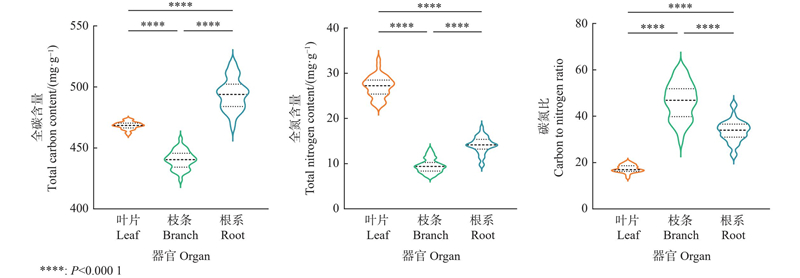
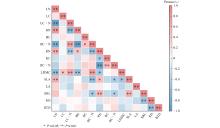
Fig.3
Correlations among functional traits of different organs of Quercus mongolica"
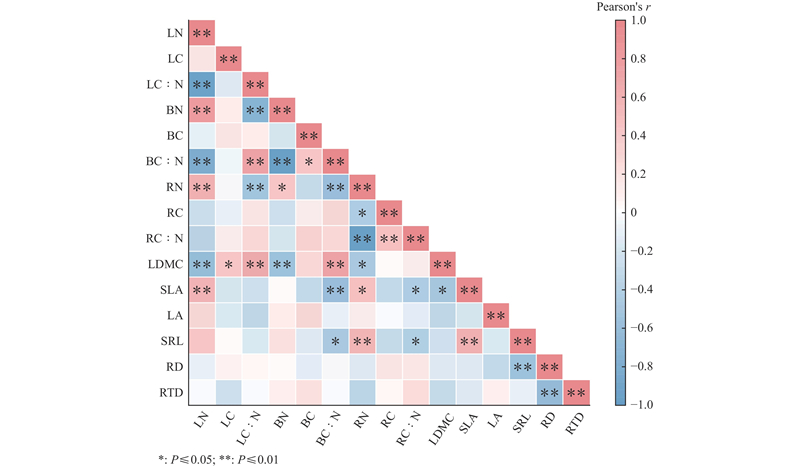
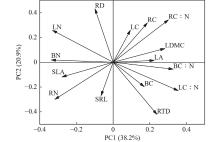
Fig.4
Principal component analysis of functional traits across different organs of Quercus mongolica"
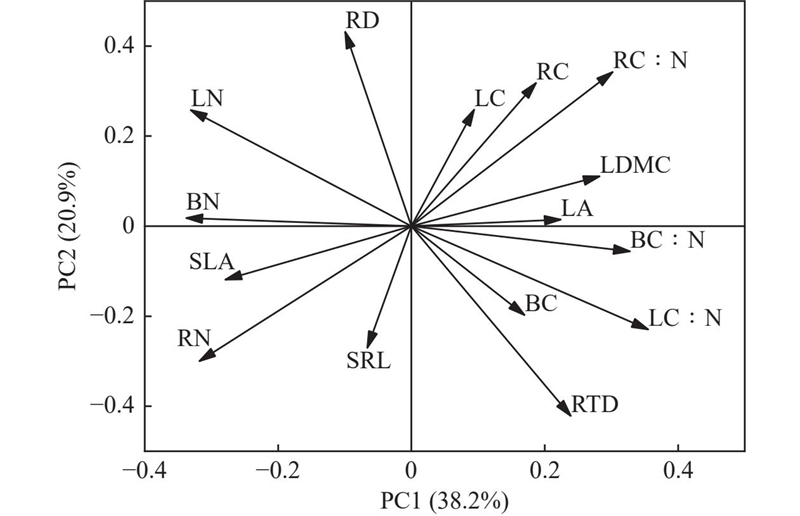
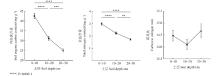
Fig.5
Carbon, nitrogen and carbon to nitrogen ratio across soil layers"
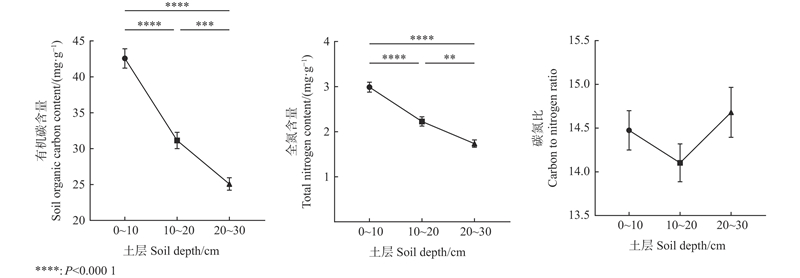
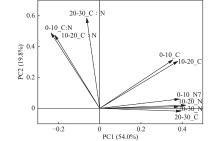
Fig.6
Principal component analysis of soil carbon, nitrogen, and carbon to nitrogen ratio across soil layers"
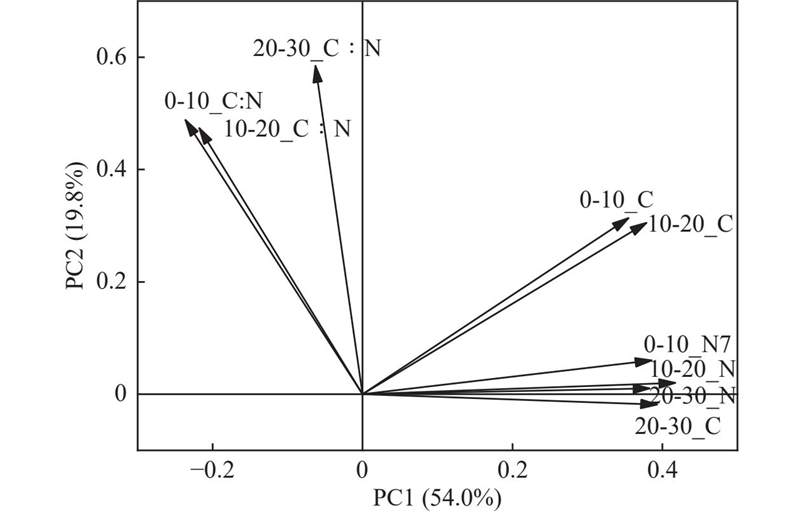
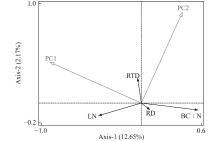
Fig.7
Redundancy analysis ordination biplot of plant functional traits and soil environmental factors"
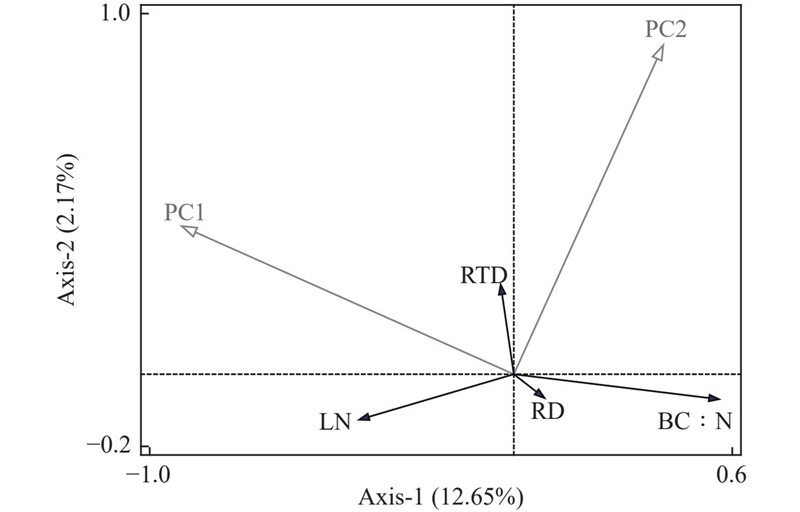
Table 3
Forward selection results of the redundancy analysis"
| 变量 Variable | 独立解释率 Independent explanation rate (%) | 贡献率 Contribution rate (%) | 伪F值 Pseudo F-value | P |
| PC1 | 10.9 | 73.4 | 3.5 | 0.026 |
| PC2 | 3.9 | 26.6 | 1.3 | 0.278 |
| 白 涵, 郝珉辉, 何怀江, 等. 东北主要树种幼树叶片功能性状对模拟氮沉降的响应. 林业科学, 2025, 61 (5): 23- 32. | |
| Bai H, Hao M H, He H J, et al. Response of seedling leaf functional traits to simulated nitrogen deposition for the major tree species of northeast China. Scientia Silvae Sinicae, 2025, 61 (5): 23- 32. | |
| 冯秋红, 史作民, 董莉莉. 植物功能性状对环境的响应及其应用. 林业科学, 2008, 44 (4): 125- 131. | |
| Feng Q H, Shi Z M, Dong L L. Response of plant functional traits to environment and its application. Scientia Silvae Sinicae, 2008, 44 (4): 125- 131. | |
|
冯 宇, 王雨晴, 李沅楷, 等. 胡杨叶功能性状与土壤因子的关系. 生态学报, 2024, 44 (4): 1717- 1726.
doi: 10.20103/j.stxb.202212043499 |
|
|
Feng Y, Wang Y Q, Li Y K, et al. Relationship between leaf functional traits of Populus euphratica and soil factors. Acta Ecologica Sinica, 2024, 44 (4): 1717- 1726.
doi: 10.20103/j.stxb.202212043499 |
|
|
顾 泽, 刘晓东, 陈 锋. 不同火烈度条件下油松枝功能性状的响应. 林业科学, 2022, 58 (8): 99- 108.
doi: 10.11707/j.1001-7488.20220810 |
|
|
Gu Z, Liu X D, Chen F. Response of twig functional traits of Pinus tabuliformis to different fire severities. Scientia Silvae Sinicae, 2022, 58 (8): 99- 108.
doi: 10.11707/j.1001-7488.20220810 |
|
|
郭 璞, 邢鹏杰, 宋 佳, 等. 蒙古栎根系与根区土壤真菌群落组成及与环境因子的关系. 菌物研究, 2022, 20 (3): 173- 182.
doi: 10.13341/j.jfr.2022.1489 |
|
|
Guo P, Xing P J, Song J, et al. Fungal community in roots and the root zone of Quercus mongolica and the correlations with the environmental factors. Journal of Fungal Research, 2022, 20 (3): 173- 182.
doi: 10.13341/j.jfr.2022.1489 |
|
|
郭文俊, 李鑫豪, 田 赟, 等. 北京东北部山区不同生活型木本植物叶功能性状特征及其权衡关系. 林业科学, 2025, 61 (9): 70- 80.
doi: 10.11707/j.1001-7488.LYKX20240342 |
|
|
Guo W J, Li X H, Tian Z, et al. Characteristics and trade-offs of leaf functional traits of woody plants with different life forms in mountainous areas of northeastern Beijing. Scientia Silvae Sinicae, 2025, 61 (9): 70- 80.
doi: 10.11707/j.1001-7488.LYKX20240342 |
|
| 侯馨博, 赵秀海, 何怀江, 等. 蒙古栎纯林根际与非根际微生物群落结构对土壤碳氮的响应. 生物多样性, 2025, 33 (7): 67- 81. | |
| Hou X B, Zhao X H, He H J, et al. Responses of rhizosphere and non-rhizosphere microbial communities to the soil carbon and nitrogen in Quercus mongolica pure forest. Biodiversity Science, 2025, 33 (7): 67- 81. | |
| 侯瑄珠, 李 楠. 原始阔叶红松林中不同生活型阔叶植物枝叶性状的变异及权衡. 南京林业大学学报(自然科学版), 2025, 49 (3): 163- 171. | |
| Hou X Z, Li N. Variation and trade-offs of twig and leaf traits among different broadleaved life form plants in the primitive broadleaved-Korean pine forest. Journal of Nanjing Forestry University ( Natural Sciences Edition), 2025, 49 (3): 163- 171. | |
|
李蕊希, 吴 雪, 贡 璐. 塔里木河上游典型荒漠植物叶片性状及其与土壤因子的关系. 生态学报, 2022, 42 (13): 5360- 5370.
doi: 10.5846/stxb202107272029 |
|
|
Li R X, Wu X, Gong L. Leaf characteristics of typical desert plants in the upper reaches of Tarim River and their relationship with soil factors. Acta Ecologica Sinica, 2022, 42 (13): 5360- 5370.
doi: 10.5846/stxb202107272029 |
|
| 李永宁, 宗 鹏. 2024. 植物功能性状对环境的响应及在森林经营中的应用. 中南林业科技大学学报, 44(6): 1–10. | |
| Li Y N, Zong P. 2024 The response of plant functional traits to the environment and their application in forest management. Journal of Central South University of Forestry & Technology, 44(6): 1–10. [in Chinese] | |
|
刘聪聪, 何念鹏, 李 颖, 等. 宏观生态学中的植物功能性状研究: 历史与发展趋势. 植物生态学报, 2024, 48 (1): 21- 40.
doi: 10.17521/cjpe.2023.0111 |
|
|
Liu C C, He N P, Li Y, et al. Current and future trends of plant functional traits in macro-ecology. Chinese Journal of Plant Ecology, 2024, 48 (1): 21- 40.
doi: 10.17521/cjpe.2023.0111 |
|
| 刘 婷, 王 超, 任毅华. 植物功能性状研究进展. 农业与技术, 2025, 45 (18): 45- 50. | |
| Liu T, Wang C, Ren Y H. Research progress of plant functional traits. Agriculture and Technology, 2025, 45 (18): 45- 50. | |
|
罗来开, 章 伟, 原 萌, 等. 长江下游滩涂湿地优势植物功能性状及其与土壤理化性质的关系. 生态学报, 2025, 45 (1): 13- 24.
doi: 10.20103/j.stxb.202404150825 |
|
|
Luo L K, Zhang W, Yuan M, et al. Functional traits of dominant plants in mudflat wetlands and their relationship with soil physicochemical properties in the lower reaches of the Yangtze River. Acta Ecologica Sinica, 2025, 45 (1): 13- 24.
doi: 10.20103/j.stxb.202404150825 |
|
| 闵秀云, 武 君, 高春亮, 等. 基于元素分析仪测定土壤有机碳的不同前处理方法对比研究. 盐湖研究, 2020, 28 (4): 64- 70. | |
| Min X Y, Wu J, Gao C L, et al. The comparative study on different pretreatment methods of soil organic carbon determined by elemental analyzer. Journal of Salt Lake Research, 2020, 28 (4): 64- 70. | |
| 秦 娟, 孔海燕, 刘 华. 马尾松不同林型土壤C、N、P、K的化学计量特征. 西北农林科技大学学报(自然科学版), 2016, 44 (2): 68- 76, 82. | |
| Qin J, Kong H Y, Liu H. Stoichiometric characteristics of soil C, N, P and K in different Pinus massoniana forests. Journal of Northwest A&F University (Natural Science Edition), 2016, 44 (2): 68- 76, 82. | |
| 施 宇, 温仲明, 龚时慧. 黄土丘陵区植物叶片与细根功能性状关系及其变化. 生态学报, 2011, 31 (22): 6805- 6814. | |
| Shi Y, Wen Z M, Gong S H. Comparisons of relationships between leaf and fine root traits in hilly area of the Loess Plateau, Yanhe River basin, Shaanxi Province, China. Acta Ecologica Sinica, 2011, 31 (22): 6805- 6814. | |
|
宋玉波. 宽甸地区生态公益林建设现状及建议. 辽宁林业科技, 2020 (4): 54- 55.
doi: 10.3969/j.issn.1001-1714.2020.04.018 |
|
|
Song Y B. Status quo and suggestions of non-commercial forest construction in Kuandian. Liaoning Forestry Science and Technology, 2020 (4): 54- 55.
doi: 10.3969/j.issn.1001-1714.2020.04.018 |
|
| 孙佳慧, 史海兰, 陈科宇, 等. 植物细根功能性状的权衡关系研究进展. 植物生态学报, 2023, 47 (8): 1055- 1070. | |
| Sun J H, Shi H L, Chen K Y, et al. Research advances on trade-off relationships of plant fine root functional traits. Chinese Journal of Plant Ecology, 2023, 47 (8): 1055- 1070. | |
| 王梦雪, 胡明艳, 储诚进, 等. 2026. 亚热带森林不同菌根真菌树种叶片和细根的C、N、P化学计量特征. 植物生态学报, https://link.cnki.net/urlid/11.3397.Q.20250910.1245.002. | |
| Wang M X, Hu M Y, Chu C J, et al. 2026. C, N, P stoichiometric characteristics of leaves and fine roots in different mycorrhizal tree species in subtropical forests. Chinese Journal of Plant Ecology, https://link.cnki.net/urlid/11.3397.Q.20250910.1245.002. [in Chinese] | |
|
王思琦, 金光泽. 五角槭不同生活史阶段叶枝根性状的变异与权衡. 植物生态学报, 2024, 48 (11): 1510- 1523.
doi: 10.17521/cjpe.2024.0081 |
|
|
Wang S Q, Jin G Z. Variation and trade-offs in leaf, branch, and root traits at different life history stages of Acer pictum subsp. mono. Chinese Journal of Plant Ecology, 2024, 48 (11): 1510- 1523.
doi: 10.17521/cjpe.2024.0081 |
|
| 王维奇, 曾从盛, 钟春棋, 等. 人类干扰对闽江河口湿地土壤碳、氮、磷生态化学计量学特征的影响. 环境科学, 2010, 31 (10): 2411- 2416. | |
| Wang W Q, Zeng C S, Zhong C Q, et al. Effect of human disturbance on ecological stoichiometry characteristics of soil carbon, nitrogen and phosphorus in Minjiang River estuarine wetland. Environmental Science, 2010, 31 (10): 2411- 2416. | |
|
王亚飞, 王 凯, 刘 洋, 等. 间伐强度对毛白杨S86人工林器官养分含量、化学计量特征和养分重吸收的影响. 林业科学, 2025, 61 (12): 49- 60.
doi: 10.11707/j.1001-7488.LYKX20240402 |
|
|
Wang Y F, Wang K, Liu Y, et al. Effects of thinning intensity on nutrient content, stoichiometric characteristics and nutrient reabsorption of various organs of Populus tomentosa plantations. Scientia Silvae Sinicae, 2025, 61 (12): 49- 60.
doi: 10.11707/j.1001-7488.LYKX20240402 |
|
| 王钊颖, 陈晓萍, 程 英, 等. 武夷山49种木本植物叶片与细根经济谱. 植物生态学报, 2021, 45 (3): 242- 252. | |
| Wang Z Y, Chen X P, Cheng Y, et al. Leaf and fine root economics spectrum across 49 woody plant species in Wuyi Mountains. Chinese Journal of Plant Ecology, 2021, 45 (3): 242- 252. | |
|
吴立文, 李国雷, 杨钦淞, 等. 栎树研究进展与展望. 林业科学, 2025, 61 (10): 1- 14.
doi: 10.11707/j.1001-7488.LYKX20250425 |
|
|
Wu L W, Li G L, Yang Q S, et al. Research progress and prospect on oak trees. Scientia Silvae Sinicae, 2025, 61 (10): 1- 14.
doi: 10.11707/j.1001-7488.LYKX20250425 |
|
|
徐大猛. 宽甸地区生态游憩自然资源及其发展现状. 农业与技术, 2020, 40 (4): 84- 85.
doi: 10.19754/j.nyyjs.20200229026 |
|
|
Xu D M. Natural resources of ecological recreation in Kuandian area and its development status. Agriculture and Technology, 2020, 40 (4): 84- 85.
doi: 10.19754/j.nyyjs.20200229026 |
|
| 徐 睿, 刘 静, 王利艳, 等. 不同地理种源杉木根叶功能性状与碳氮磷化学计量分析. 生态学报, 2022, 42 (15): 6298- 6310. | |
| Xu R, Liu J, Wang L Y, et al. Analysis of root and leaf functional traits and C, N, P stoichiometry of Cunninghamia lanceolata from different provenances. Acta Ecologica Sinica, 2022, 42 (15): 6298- 6310. | |
| 张城伟, 王 兴, 安 可, 等. 黄土丘陵区退耕植被叶片-土壤生态化学计量特征与植物内稳态差异. 林业科学, 2025, 61 (6): 61- 74. | |
| Zhang C W, Wang X, An K, et al. Leaf-soil ecological stoichiometric characteristics and plant homeostasis differences of reclaimed vegetation in the Loess Hilly Region. Scientia Silvae Sinicae, 2025, 61 (6): 61- 74. | |
|
张雨鉴, 王克勤, 宋娅丽, 等. 滇中亚高山5种林型土壤碳氮磷生态化学计量特征. 生态环境学报, 2019, 28 (1): 73- 82.
doi: 10.16258/j.cnki.1674-5906.2019.01.009 |
|
|
Zhang Y J, Wang K Q, Song Y L, et al. Ecological stoichiometry of soil carbon, nitrogen and phosphorus in five forest types in subalpine of middle Yunnan Province. Ecology and Environmental Sciences, 2019, 28 (1): 73- 82.
doi: 10.16258/j.cnki.1674-5906.2019.01.009 |
|
|
郑晓霞, 葛 楠, 刘艳萍, 等. 腾格里沙漠东北缘花棒群落土壤C, N, P的化学计量特征. 水土保持通报, 2025, 45 (1): 74- 81.
doi: 10.13961/j.cnki.stbctb.2025.01.009 |
|
|
Zheng X X, Ge N, Liu Y P, et al. C, N, and P stoichiometry characterizationin soil of Hedysarum scoparium community at northeastern edge of Tengger Desert. Bulletin of Soil and Water Conservation, 2025, 45 (1): 74- 81.
doi: 10.13961/j.cnki.stbctb.2025.01.009 |
|
|
周正虎, 王传宽, 张全智. 土地利用变化对东北温带幼龄林土壤碳氮磷含量及其化学计量特征的影响. 生态学报, 2015, 35 (20): 6694- 6702.
doi: 10.5846/stxb201403290589 |
|
|
Zhou Z H, Wang C K, Zhang Q Z. The effect of land use change on soil carbon, nitrogen, and phosphorus contents and their stoichiometry in temperate sapling stands in northeastern China. Acta Ecologica Sinica, 2015, 35 (20): 6694- 6702.
doi: 10.5846/stxb201403290589 |
|
|
Bergmann J, Weigelt A, van der Plas F, et al. The fungal collaboration gradient dominates the root economics space in plants. Science Advances, 2020, 6 (27): eaba3756.
doi: 10.1126/sciadv.aba3756 |
|
|
Brundrett M C. Coevolution of roots and mycorrhizas of land plants. New Phytologist, 2002, 154 (2): 275- 304.
doi: 10.1046/j.1469-8137.2002.00397.x |
|
|
Chave J, Coomes D, Jansen S, et al. Towards a worldwide wood economics spectrum. Ecology Letters, 2009, 12 (4): 351- 366.
doi: 10.1111/j.1461-0248.2009.01285.x |
|
|
Comas L H, Eissenstat D M. Linking fine root traits to maximum potential growth rate among 11 mature temperate tree species. Functional Ecology, 2004, 18 (3): 388- 397.
doi: 10.1111/j.0269-8463.2004.00835.x |
|
| Cornelissen J H C, Lavorel S, Garnier E, et al. A handbook of protocols for standardised and easy measurement of plant functional traits worldwide. Australian Journal of Botany, 2003, 51 (4): 335- 380. | |
|
Cotrufo M F, Wallenstein M D, Boot C M, et al. The Microbial Efficiency-Matrix Stabilization (MEMS) framework integrates plant litter decomposition with soil organic matter stabilization: do labile plant inputs form stable soil organic matter?. Global Change Biology, 2013, 19 (4): 988- 995.
doi: 10.1111/gcb.12113 |
|
|
Díaz S, Kattge J, Cornelissen J H C, et al. The global spectrum of plant form and function. Nature, 2016, 529 (7585): 167- 171.
doi: 10.1038/nature16489 |
|
| Freschet G T, Cornelissen J H C, van Logtestijn R S P, et al. Evidence of the ‘Plant economics Spectrum’ in a subarctic flora. Journal of Ecology, 2010, 98 (2): 362- 373. | |
| Guo Y P, Jiang M W, Liu Q, et al. Climate and vegetation together control the vertical distribution of soil carbon, nitrogen and phosphorus in shrublands in China. Plant and Soil, 2020, 456 (1): 15- 26. | |
|
Jobbágy E G, Jackson R B. The vertical distribution of soil organic carbon and its relation to climate and vegetation. Ecological Applications, 2000, 10 (2): 423- 436.
doi: 10.1890/1051-0761(2000)010[0423:TVDOSO]2.0.CO;2 |
|
|
Jobbágy E G, Jackson R B. The distribution of soil nutrients with depth: Global patterns and the imprint of plants. Biogeochemistry, 2001, 53 (1): 51- 77.
doi: 10.1023/A:1010760720215 |
|
|
Kong D L, Wang J J, Wu H F, et al. Nonlinearity of root trait relationships and the root economics spectrum. Nature Communications, 2019, 10, 2203.
doi: 10.1038/s41467-019-10245-6 |
|
|
Laliberté E. Below-ground frontiers in trait-based plant ecology. New Phytologist, 2017, 213 (4): 1597- 1603.
doi: 10.1111/nph.14247 |
|
|
Li F L, Bao W K. New insights into leaf and fine-root trait relationships: implications of resource acquisition among 23 xerophytic woody species. Ecology and Evolution, 2015, 5 (22): 5344- 5351.
doi: 10.1002/ece3.1794 |
|
|
Liu B T, Li H B, Zhu B, et al. Complementarity in nutrient foraging strategies of absorptive fine roots and arbuscular mycorrhizal fungi across 14 coexisting subtropical tree species. New Phytologist, 2015, 208 (1): 125- 136.
doi: 10.1111/nph.13434 |
|
|
McCormack M L, Dickie I A, Eissenstat D M, et al. Redefining fine roots improves understanding of below-ground contributions to terrestrial biosphere processes. New Phytologist, 2015, 207 (3): 505- 518.
doi: 10.1111/nph.13363 |
|
|
Olson M E, Aguirre-Hernández R, Rosell J A. Universal foliage-stem scaling across environments and species in dicot trees: plasticity, biomechanics and Corner’s Rules. Ecology Letters, 2009, 12 (3): 210- 219.
doi: 10.1111/j.1461-0248.2008.01275.x |
|
|
Ordoñez J C, Van Bodegom P M, Witte J M, et al. A global study of relationships between leaf traits, climate and soil measures of nutrient fertility. Global Ecology and Biogeography, 2009, 18 (2): 137- 149.
doi: 10.1111/j.1466-8238.2008.00441.x |
|
|
Poorter H, Evans J R. Photosynthetic nitrogen-use efficiency of species that differ inherently in specific leaf area. Oecologia, 1998, 116 (1): 26- 37.
doi: 10.1007/s004420050560 |
|
|
Post W M, Emanuel W R, Zinke P J, et al. Soil carbon pools and world life zones. Nature, 1982, 298 (5870): 156- 159.
doi: 10.1038/298156a0 |
|
|
Reich P B. The world-wide ‘fast–slow’ plant economics spectrum: a traits manifesto. Journal of Ecology, 2014, 102 (2): 275- 301.
doi: 10.1111/1365-2745.12211 |
|
|
Reich P B, Walters M B, Kloeppel B D, et al. Different photosynthesis-nitrogen relations in deciduous hardwood and evergreen coniferous tree species. Oecologia, 1995, 104 (1): 24- 30.
doi: 10.1007/BF00365558 |
|
|
Reich P B, Wright I J, Cavender-Bares J, et al. The evolution of plant functional variation: traits, spectra, and strategies. International Journal of Plant Sciences, 2003, 164 (S3): S143- S164.
doi: 10.1086/374368 |
|
|
Roumet C, Birouste M, Picon-Cochard C, et al. Root structure-function relationships in 74 species: evidence of a root economics spectrum related to carbon economy. New Phytologist, 2016, 210 (3): 815- 826.
doi: 10.1111/nph.13828 |
|
|
Roumet C, Urcelay C, Díaz S. Suites of root traits differ between annual and perennial species growing in the field. New Phytologist, 2006, 170 (2): 357- 368.
doi: 10.1111/j.1469-8137.2006.01667.x |
|
| Rumpel C, Kögel-Knabner I. Deep soil organic matter: a key but poorly understood component of terrestrial C cycle. Plant and Soil, 2011, 338 (1): 143- 158. | |
|
Schmidt M W I, Torn M S, Abiven S, et al. Persistence of soil organic matter as an ecosystem property. Nature, 2011, 478 (7367): 49- 56.
doi: 10.1038/nature10386 |
|
|
Tian H Q, Chen G S, Zhang C, et al. Pattern and variation of C∶N∶P ratios in China’s soils: a synthesis of observational data. Biogeochemistry, 2010, 98 (1/3): 139- 151.
doi: 10.1007/s10533-009-9382-0 |
|
|
Violle C, Navas M L, Vile D, et al. Let the concept of trait be functional!. Oikos, 2007, 116 (5): 882- 892.
doi: 10.1111/j.0030-1299.2007.15559.x |
|
|
Weemstra M, Mommer L, Visser E J W, et al. Towards a multidimensional root trait framework: a tree root review. New Phytologist, 2016, 211 (4): 1159- 1169.
doi: 10.1111/nph.14003 |
|
|
Wright I J, Reich P B, Westoby M, et al. The worldwide leaf economics spectrum. Nature, 2004, 428 (6985): 821- 827.
doi: 10.1038/nature02403 |
|
|
You C M, Li J H, Yang K J, et al. Variations and patterns of C and N stoichiometry in the first five root branch orders across 218 woody plant species. New Phytologist, 2023, 238 (5): 1838- 1848.
doi: 10.1111/nph.18870 |
|
|
Zhao H, He N P, Xu L, et al. Variation in the nitrogen concentration of the leaf, branch, trunk, and root in vegetation in China. Ecological Indicators, 2019, 96, 496- 504.
doi: 10.1016/j.ecolind.2018.09.031 |
| Viewed | ||||||
|
Full text |
|
|||||
|
Abstract |
|
|||||
