
林业科学 ›› 2026, Vol. 62 ›› Issue (11): 49-60.doi: 10.11707/j.1001-7488.LYKX20260166
秦舒悦,尚姿杞,李光耀,李冲,严冬强,刘震*( )
收稿日期:2026-03-23
修回日期:2026-09-27
出版日期:2026-11-10
发布日期:2026-11-20
通讯作者:
刘震
E-mail:liuzhen@henau.edu.cn
基金资助:
Shuyue Qin,Ziqi Shang,Guangyao Li,Chong Li,Dongqiang Yan,Zhen Liu*()
Received:2026-03-23
Revised:2026-09-27
Online:2026-11-10
Published:2026-11-20
Contact:
Zhen Liu
E-mail:liuzhen@henau.edu.cn
摘要:
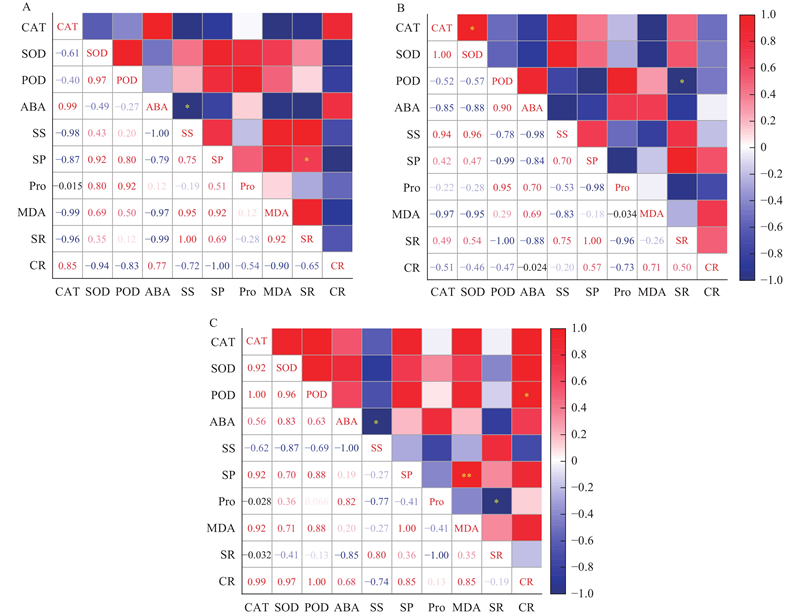
目的: 探究不同种源山桐子顶芽休眠深度与耐寒性的关系,为山桐子良种选育、优化树冠结构以及适地适树适气候提供理论依据。方法: 以河南郑州气候条件下济源、广元和广州种源山桐子(3~4年生)顶芽为研究对象,选择深休眠期带顶芽的直立枝条进行水培,5 ℃低温处理0、20、40、60天后转入25 ℃全光照条件,观测其萌发时间、萌发率、展叶数等指标,判断休眠深度;选取休眠解除期的顶芽进行不同低温冷冻处理,测定相对电导率,计算半致死温度;采集深休眠期、休眠解除期和内生长期的顶芽在25 ℃全光照条件下进行水培,测定其生理生化物质和内源激素含量。结果: 1) 3个种源顶芽休眠深度排序为济源 >广元 >广州;5 ℃低温处理20天能够解除济源和广元种源休眠;5 ℃ 低温处理40天一定程度上抑制广州和广元种源顶芽萌发,而5 ℃低温处理60天萌发率增加,表明低纬度种源在应对低温累积胁迫时可能表现出更强的可塑性。2) 顶芽死亡率呈气候梯度变化趋势,随纬度降低,顶芽死亡率升高;根据半致死温度测定 3个种源的抗寒性为济源(–13.47 ℃)>广元 (–9.27 ℃)>广州(–7.376 ℃)。3) 在顶芽深休眠期,济源种源丙二醛含量最低为5.4 nmol·g?1,膜损伤程度最小,顶芽抗寒性最强。抗氧化酶系统呈显著种源分化,广州种源超氧化物歧化酶活性先升后降,于内生长期达到最低值163.73 nmol·g?1,而济源和广元种源超氧化物歧化酶活性在该时期达到最高值,分别为 272.33和440.52 U·g?1;深休眠期济源种源过氧化氢酶活性最高,为广元种源的2.2倍,表明高纬度种源具有更稳定的抗氧化调控能力。4) 不同种源激素含量变化存在明显差异,济源种源脱落酸、赤霉素含量最高,济源和广元种源吲哚乙酸含量在休眠解除期达到最大值,而广州种源吲哚乙酸含量在深休眠期达到最大值后逐渐降低;济源和广州种源玉米素核苷含量在深休眠期达到最大值后逐渐降低,而广元种源玉米素核苷含量在休眠解除期达到最大值后缓慢降低。5) 3个种源山桐子顶芽休眠深度与抗寒性指标相关性分析表明,济源种源深度休眠阶段顶芽通过提高脱落酸水平和调节活性氧代谢增强低温适应能力,而低纬度种源通过调控抗氧化酶系统增强耐寒性。结论: 不同纬度种源山桐子冬芽在休眠深度与抗寒机制上存在明显差异,低纬度种源休眠较浅可塑性更强,主要通过提高脯氨酸含量及超氧化物歧化酶、过氧化氢酶活性应对低温,但整体抗寒性较弱,顶芽更易受害;高纬度种源休眠较深,脱落酸、玉米素核苷含量及过氧化氢酶活性较高,抗寒性更强。
中图分类号:
秦舒悦,尚姿杞,李光耀,李冲,严冬强,刘震. 不同种源山桐子顶芽休眠深度与耐寒性的关系[J]. 林业科学, 2026, 62(11): 49-60.
Shuyue Qin,Ziqi Shang,Guangyao Li,Chong Li,Dongqiang Yan,Zhen Liu. Relationship between Dormancy Depth and Cold Resistance of Terminal Buds in Idesia polycarpa from Different Provenances[J]. Scientia Silvae Sinicae, 2026, 62(11): 49-60.
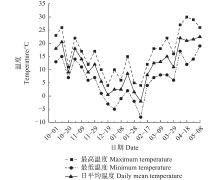
图1
郑州市日气温变化"
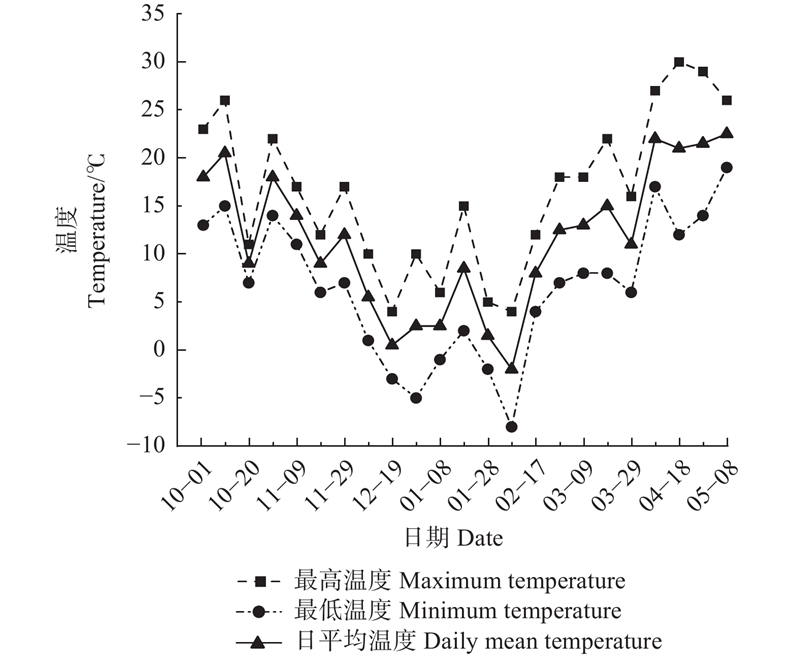
表1
不同种源山桐子顶芽死亡情况①"
| 种源 Provenance | 株数 No. of plants | 顶芽死亡率a Terminal bud mortality (%) | 顶芽死亡率b Terminal bud mortality (%) | 东经 Longitude (E) | 北纬 Latitude (N) | 年均温 Mean annual temperature/℃ | 年降水量 Annual precipitation/ mm | 年日照时数 Annual sunshine duration/h |
| 济源 Jiyuan | 234 | 3.0 | 2.9 | 112°01′—112°45′ | 34°53′—35°16′ | 14.5 | 567.9 | 1 899.4 |
| 广元 Guangyuan | 311 | 20.6 | 19 | 104°36′—106°45′ | 31°31′—32°56′ | 16.1 | 800~1 000 | 1 300~1 400 |
| 洛阳 Luoyang | 39 | 7.7 | 7.6 | 111°11'—112°01' | 33°39'—34°11' | 13.4 | 1 253.7 | 1 775.3 |
| 信阳 Xinyang | 26 | 30.8 | 27 | 113°45′—115°55′ | 30°23′—32°27′ | 15.3~15.8 | 993~1 294 | 1 900~2 100 |
| 成都 Chengdu | 45 | 22.2 | 24.4 | 102°54′—104°53′ | 30°05′—31°26′ | 15.7~18.0 | 734.8~1 142.3 | 843.9~1 406.2 |
| 漯河 Luohe | 27 | 22.2 | 14.8 | 113°43′—114°09′ | 33°43′—33°59′ | 14.5 | 720 | 2 187~2 359 |
| 广州 Guangzhou | 30 | 33.3 | 30 | 112°57′—114°3′ | 22°26′—23°56′ | 21.5~22.2 | 1 800 | 1 830.5 |
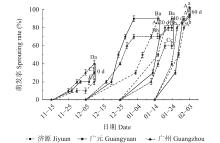
图2
山桐子顶芽5 ℃低温处理不同时间后在25 ℃条件下的萌发率 小写字母表示相同低温处理时间下不同种源芽的萌发率差异(P<0.01);大写字母表示相同种源不同低温处理时间之间芽的萌发率差异(P<0.01);n≥3。"
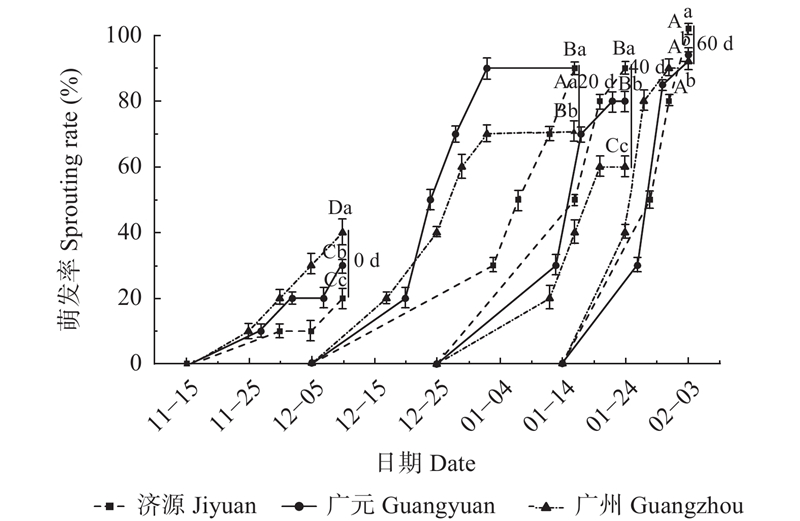
图3
山桐子顶芽5 ℃低温处理不同时间后在25 ℃条件下的萌发平均展叶数"
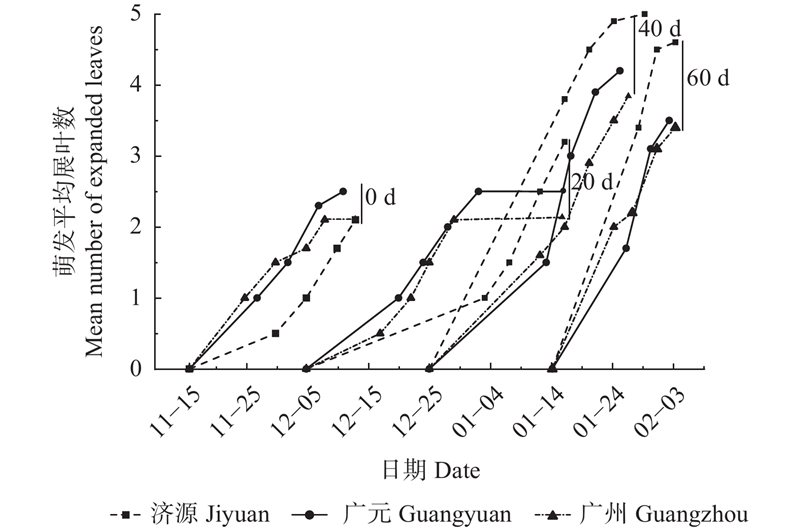
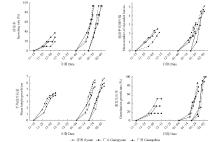
图4
不同时期山桐子顶芽在25 ℃条件下的萌发生长变化"
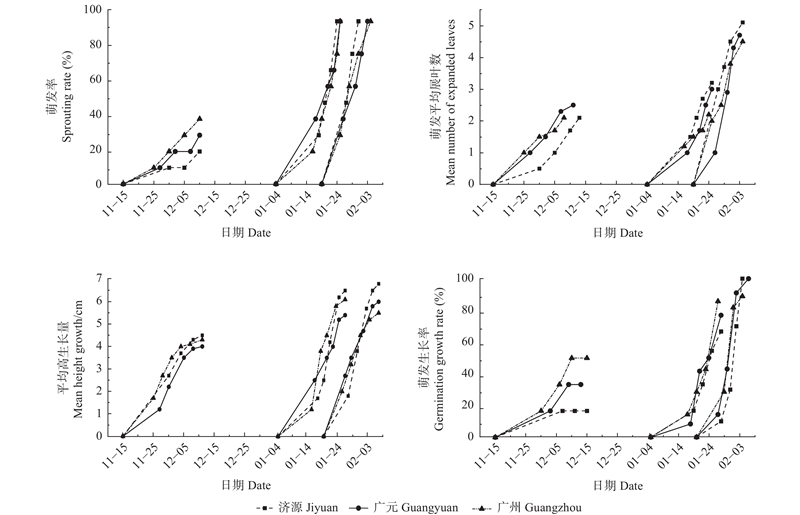
表2
不同低温处理下顶芽相对电导率及Logistic 拟合方程①"
| 种源 Provenance | 相对电导率Relative electric conductivity (%) | 回归方程 Regression equation | 拟合度 R2 | 半致死温度 LT50/℃ | |||||
| 0 ℃ | –5 ℃ | –8 ℃ | –10 ℃ | –12 ℃ | –15 ℃ | ||||
| 济源 Jiyuan | 54.01+4.17a | 58.06+3.41a | 58.18+2.96c | 60.95+3.07b | 62.59+1.15c | 68.31+3.20b | y=100/(1+2.428e | –13.47 | |
| 广元 Guangyuan | 50.01+3.46b | 58.40+3.95a | 62.00+5.10b | 61.52+2.45b | 67.31+3.85b | 73.69+2.02a | y=100/(1+2.739e | –9.27 | |
| 广州 Guangzhou | 41.34+3.32c | 58.51+6.55a | 64.26+2.08a | 68.55+2.86a | 70.69+5.35a | 78.69+4.76a | y=100/(1+3.044e0.1509x) | –7.376 | |
表3
不同种源山桐子顶芽在不同休眠时期的营养物质与抗氧化能力变化①"
| 休眠时期 Dormancy period | 可溶性糖 SS/(mg·g?1) | 脯氨酸 Pro/(μg·g?1) | 可溶性蛋白 SP/(mg·g?1) | 丙二醛 MDA/(nmol·g?1) | 超氧化物歧化 酶SOD/(U·g?1) | 过氧化物酶 POD/(ΔOD470·min?1g?1) | 过氧化氢酶 CAT/(μmol·min?1g?1) | |
| 济源 Jiyuan | Ⅰ | 25.21±0.72g | 88.18±1.66d | 4.25±0.228c | 5.40±0.30f | 221.90±4.28e | 10 229.49±222.76d | 21.74±1.52a |
| Ⅱ | 64.73±0.34b | 72.53±2.99e | 4.47±0.11bc | 7.00±0.04bc | 210.75±6.86e | 7 021.41±503.31f | 18.62±1.34bc | |
| Ⅲ | 69.07±2.41b | 93.37±1.87cd | 5.17±0.23a | 7.04±0.66c | 272.33±6.46d | 15 061.28±807.42a | 17.28±0.66c | |
| 广元 Guangyuan | Ⅰ | 31.34±0.89f | 110.23±1.94b | 3.13±0.22d | 7.58±0.28ab | 340.03±18.39c | 12 080.19±584.39c | 9.75±0.03e |
| Ⅱ | 49.34±0.81d | 93.83±5.12cd | 4.62±0.2bc | 7.97±0.05a | 345.56±1.33c | 11 893.025±210.27c | 9.68±0.49e | |
| Ⅲ | 86.40±3.56a | 98.69±6.67c | 4.49±0.18bc | 6.52±0.12cd | 440.52±5.11a | 11 884.68±414.76c | 14.15±0.27d | |
| 广州 Guangzhou | Ⅰ | 36.81±2.87e | 124.27±3.23a | 4.75±0.11b | 6.01±0.06ef | 356.67±25.73bc | 11 458.74±562.80c | 15.43±0.12d |
| Ⅱ | 45.75±0.98d | 92.93±5.54cd | 4.84±0.16ab | 7.37±0.79abc | 380.01±9.223b | 13 545.19±672.18b | 19.82±0.99b | |
| Ⅲ | 59.04±2.97c | 95.02±4.06cd | 4.74±0.12b | 5.72±0.39ef | 163.73±1.26f | 8 204.21±23.17e | 10.54±0.63e | |
图5
不同种源山桐子顶芽休眠过程中内源激素含量变化 J:济源种源;Y:广元种源; Z:广州种源;n≥3;小写字母表示不同种源同一时期之间的差异显著(P<0.01);大写字母表示同一种源不同时期之间的差异显著(P<0.01)。 J: Jiyuan provenance; Y: Guangyuan provenance; Z: Guangzhou provenance; n≥3; Different lowercase letters indicate significant differences among provenances at the same sampling stage (P<0.01); whereas different uppercase letters indicate significant differences among sampling stages within the same provenance (P<0.01)."
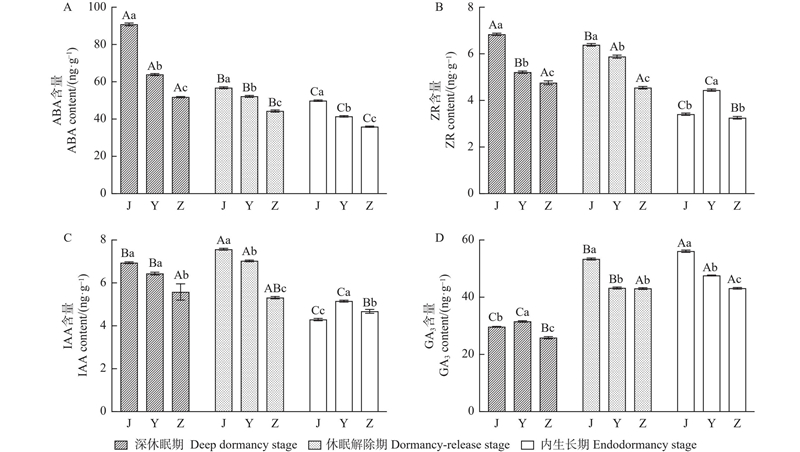
图6
不同种源山桐子顶芽休眠过程中内源激素比值的动态变化 J:济源种源;Y:广元种源;Z:广州种源;n ≥ 3;小写字母表示不同种源不同时期之间的差异显著(P<0.01);大写字母表示同一种源不同时期之间的差异显著(P<0.01)。"
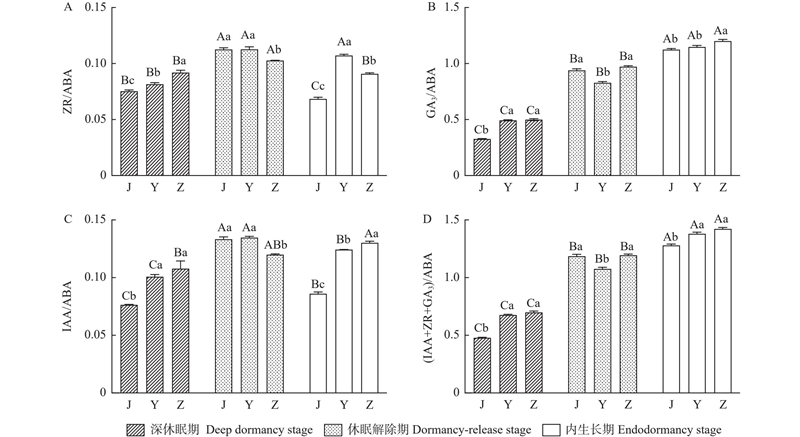
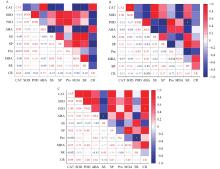
图7
济源(A)、广元(B)和广州(C)种源的山桐子顶芽休眠深度与抗寒性指标(Spearman)相关性分析 SR: 萌发率Sprouting rate;CR: 需冷量Chilling requirement;ABA: 脱落酸Abscisic acid;MDA: 丙二醛Malondialdehyde;POD: 过氧化物酶Peroxidase;SOD: 超氧化物歧化酶Superoxide dismutase;CAT: 过氧化氢酶Catalase;Pro: 脯氨酸Proline; SP: 可溶性蛋白Soluble protein;SS: 可溶性糖Soluble sugar. * 表示显著性相关(P<0.05);** 表示极显著性相关(P<0.01);*** 表示极显著性相关(P<0.001)。"
| 陈珺肄. 2019. 山桐子顶侧芽生长发育的生物季节学研究. 郑州: 河南农业大学. | |
| Chen J Y. 2019. Biological seasonal study on the growth and development on apical and lateral buds of Idesia polycarpa. Zhengzhou: Henan Agricultural University. [in Chinese] | |
|
范军强, 武军艳, 刘丽君, 等. 甘蓝型冬油菜气孔特性与抗寒性的关系. 中国农业科学, 2023, 56 (4): 599- 618.
doi: 10.3864/j.issn.0578-1752.2023.04.002 |
|
|
Fan J Q, Wu J Y, Liu L J, et al. Correlation between stomatal characteristics and cold resistance of Brassica napus L. Scientia Agricultura Sinica, 2023, 56 (4): 599- 618.
doi: 10.3864/j.issn.0578-1752.2023.04.002 |
|
| 高俊凤. 2000. 植物生理学实验技术. 西安: 世界图书出版公司. | |
| Gao J F. 2000. Experimental techniques in plant physiology. Xi’an: World Book Press. [in Chinese] | |
|
孔德真, 桑 伟, 聂迎彬, 等. 小麦AL型细胞质雄性不育系与同型保持系穗花发育时期代谢物变化比较研究. 作物学报, 2025, 51 (9): 2454- 2466.
doi: 10.3724/SP.J.1006.2025.51016 |
|
|
Kong D Z, Sang W, Nie Y B, et al. Comparative analysis of metabolite changes during young panicle development in wheat AL type cytoplasmic male serile line and homologous maintainers. Acta Agronomica Sinica, 2025, 51 (9): 2454- 2466.
doi: 10.3724/SP.J.1006.2025.51016 |
|
| 李海炎, 阳爱民, 梁瑞郑, 等. 不同需冷量桃休眠相关DAM基因表达特性及激素调控的响应分析. 北方园艺, 2022 (3): 27- 34. | |
| Li H Y, Yang A M, Liang R Z, et al. Analysis of dormant-related DAM gene expression characteristics and hormonal regulation responses in different chilling peaches. Northern Horticulture, 2022 (3): 27- 34. | |
|
李顺福, 王慧敏, 房丽莎, 等. 短日照诱导白花泡桐顶芽死亡过程相关基因的表达. 林业科学, 2022, 58 (2): 148- 158.
doi: 10.11707/j.1001-7488.20220215 |
|
|
Li S F, Wang H M, Fang L S, et al. Gene expression related to terminal bud death induced by short-day in Paulownia fortunei. Scientia Silvae Sinicae, 2022, 58 (2): 148- 158.
doi: 10.11707/j.1001-7488.20220215 |
|
| 刘 震, 何松林, 王艳梅, 等. 泡桐顶侧芽休眠发育的温度特性研究. 林业科学, 2004, 40 (3): 46- 50. | |
| Liu Z, He S L, Wang Y M, et al. Study on the temperature characteristics of dormancy development of terminal and lateral buds in Paulownia. Scientia Silvae Sinicae, 2004, 40 (3): 46- 50. | |
| 刘 震, 王国霞, 蒋建平. 二球悬铃木冬芽休眠的温度特性. 生态学报, 2006, 26 (9): 2870- 2876. | |
| Liu Z, Wang G X, Jiang J P. Temperature characteristics of winter Buds' dormancy in Platanus acerifolia. Acta Ecologica Sinica, 2006, 26 (9): 2870- 2876. | |
| 刘 震, 王 玲. 不同种源山桐子冬芽休眠的温度特性. 河南农业大学学报, 2000, 34 (3): 252- 254,297. | |
| Liu Z, Wang L. Temperature characteristics of winter buds dormancy in Idesia polycarpa of different origins. Journal of Henan Agricultural University, 2000, 34 (3): 252- 254,297. | |
| 劉 震. 2000. 亜熱帯域に分布するイイギリの休眠に関する研究. 三重大学生物资源学部演习林报告, 24: 107–161. | |
| Liu Z. 2000. Studies on the dormancy in Idesia polycarpa distributed in subtropical zone. Bulletin of the Mie University Forests, 24: 107–161. [ in Japanese] | |
| 劉 震, 永岛敦司, 櫛田逹矢, 等. 1998. 冬季の温度環境がイイギリ頂芽の開芽に及ぼす影響. 環境システム研究, 26: 239–244. | |
| Liu Z, Nakashima A, Kushida T, et al. 1998. Effect of temperature condition in winter on the terminal buds sprouting in Idesia polycarpa. Environmental Systems Research, 26: 239–244. [in Japanese] | |
| 王海波, 王孝娣, 程存刚, 等. 桃芽休眠的自然诱导因子及钙在休眠诱导中的作用. 应用生态学报, 2008, 19 (11): 2333- 2338. | |
| Wang H B, Wang X D, Cheng C G, et al. Natural inducing factors of peach bud dormancy and roles of Ca2+ in the dormancy inducetion. Chinese Journal of Applied Ecology, 2008, 19 (11): 2333- 2338. | |
| 王 好, 王 玲, 王应敏, 等. 桑树种质资源超低温保存效果与芽休眠状态关系探讨. 植物遗传资源学报, 2025, 26 (8): 1654- 1662. | |
| Wang H, Wang L, Wang Y M, et al. Study on the relationship between survival behaviors after cryopreservation and bud dormancy states of mulberry germplasm resources. Journal of Plant Genetic Resources, 2025, 26 (8): 1654- 1662. | |
|
王孝安, 赵相健. 太白红杉顶芽与分枝格局的适应性分析. 生态学报, 2004, 24 (11): 2616- 2620.
doi: 10.3321/j.issn:1000-0933.2004.11.039 |
|
|
Wang X A, Zhao X J. Adaptive analysis of apical buds and branching pattern in a woody plant Larix chinensis. Acta Ecologica Sinica, 2004, 24 (11): 2616- 2620.
doi: 10.3321/j.issn:1000-0933.2004.11.039 |
|
| 王艳梅, 郭云天, 陈珺肄, 等. 山桐子冬芽休眠过程及其生理生化特征. 西南林业大学学报(自然科学), 2021, 41 (6): 13- 21. | |
| Wang Y M, Guo Y T, Chen J Y, et al. Dormancy period of winter bud of Idesia polycarpa and its physiological and biochemical characteristics. Journal of Southwest Forestry University (Natural Sciences), 2021, 41 (6): 13- 21. | |
|
王艳梅, 王东洪, 刘 震, 等. 6个种源山桐子种子含油率和脂肪酸GC/MS分析. 河南农业大学学报, 2011, 45 (5): 530- 533, 547.
doi: 10.16445/j.cnki.1000-2340.2011.05.020 |
|
|
Wang Y M, Wang D H, Liu Z, et al. Analysis of oil content and fatty acid GC/MS in Idesia polycarpa seeds from different provenances. Journal of Henan Agricultural University, 2011, 45 (5): 530- 533, 547.
doi: 10.16445/j.cnki.1000-2340.2011.05.020 |
|
|
王艳梅, 姚顺阳, 刘宇新, 等. 3种源山桐子冬芽休眠及萌发的温度特性分析. 河南科学, 2013, 31 (12): 2160- 2165.
doi: 10.3969/j.issn.1004-3918.2013.12.015 |
|
|
Wang Y M, Yao S Y, Liu Y X, et al. The temperature characteristics of Idesia polycarpa winter buds dormancy and sprouting from three provenances. Henan Science, 2013, 31 (12): 2160- 2165.
doi: 10.3969/j.issn.1004-3918.2013.12.015 |
|
|
吴玲利, 邓雯方, 卢晓宇, 等. 山桐子开发利用研究进展. 经济林研究, 2023, 41 (2): 242- 252.
doi: 10.14067/j.cnki.1003-8981.2023.02.025 |
|
|
Wu L L, Deng W F, Lu X Y, et al. Research progress in the development and utilization of Idesia polycarpa. Non-wood Forest Research, 2023, 41 (2): 242- 252.
doi: 10.14067/j.cnki.1003-8981.2023.02.025 |
|
|
熊星月, 刘 震. 山桐子树干解析及物理力学性质分析. 河南科学, 2021, 39 (11): 1828- 1833.
doi: 10.3969/j.issn.1004-3918.2021.11.017 |
|
|
Xiong X Y, Liu Z. Stem analysis and physical and mechanical property determination of Idesia polycarpa. Henan Science, 2021, 39 (11): 1828- 1833.
doi: 10.3969/j.issn.1004-3918.2021.11.017 |
|
| 永田洋, 中島淳司, 万木豊. 1994. 樹木の芽の休眠. 三重大学演習林報告, 18: 17–42. | |
| Nagata H, Nakashima A, Yurugi Y. 1994. Dormancy of buds in trees. Bulletin of the Mie University Forests, 18: 17–42. [in Japanese] | |
| 永田洋, 佐佐木惠彦. 2002. 树木环境生理学. 东京: 文永堂出版社. | |
| Nagata H, Sasaki Y. 2002. Tree environmental physiology. Tokyo: Buneido Publishing. [in Japanese] | |
| 赵相健, 王孝安. 太白红杉顶芽动态及其对分枝格局的影响. 应用生态学报, 2005, 16 (1): 25- 28. | |
| Zhao X J, Wang X A. Fate of Larix chinensis apex buds and its influence on branching pattern. Chinese Journal of Applied Ecology, 2005, 16 (1): 25- 28. | |
|
Band L R. Auxin fluxes through plasmodesmata. New Phytologist, 2021, 231 (5): 1686- 1692.
doi: 10.1111/nph.17517 |
|
|
Barba-Espín G, Hernández J A, Díaz-Vivancos P. Antioxidant system: The hub of bud dormancy regulation in Prunus sp. Scientia Horticulturae, 2022, 305, 111396.
doi: 10.1016/j.scienta.2022.111396 |
|
|
Beauvieux R, Wenden B, Dirlewanger E. Bud dormancy in perennial fruit tree species: a pivotal role for oxidative cues. Frontiers in Plant Science, 2018, 9, 657.
doi: 10.3389/fpls.2018.00657 |
|
|
Ben Mohamed H, Vadel A M, Geuns J M C, et al. Biochemical changes in dormant grapevine shoot tissues in response to chilling: possible role in dormancy release. Scientia Horticulturae, 2010, 124 (4): 440- 447.
doi: 10.1016/j.scienta.2010.01.029 |
|
|
Cao Y W, Hwarari D, Radani Y, et al. Molecular mechanism underlying plant response to cold stress. Phyton, 2023, 92 (9): 2665- 2683.
doi: 10.32604/phyton.2023.024929 |
|
|
Chen Z Y, Chen Y D, Shi L X, et al. Interaction of phytohormones and external environmental factors in the regulation of the bud dormancy in woody plants. International Journal of Molecular Sciences, 2023, 24 (24): 17200.
doi: 10.3390/ijms242417200 |
|
| Cooke J E K, Eriksson M E, Junttila O. 2012. The dynamic nature of bud dormancy in trees: environmental control and molecular mechanisms. Plant, Cell & Environment, 35(10): 1707–1728. | |
|
Fadón E, Fernandez E, Behn H, et al. A conceptual framework for winter dormancy in deciduous trees. Agronomy, 2020, 10 (2): 241.
doi: 10.3390/agronomy10020241 |
|
|
Ghasemi-Soloklui A A, Gharaghani A. Determination of freezing tolerance in twenty Iranian pomegranate cultivars and its relationship to geographic and climatic distribution and some tree characteristics. Erwerbs-Obstbau, 2023, 65 (4): 819- 827.
doi: 10.1007/s10341-022-00677-8 |
|
|
Hamilton J A, El Kayal W, Hart A T, et al. The joint influence of photoperiod and temperature during growth cessation and development of dormancy in white spruce (Picea glauca). Tree Physiology, 2016, 36 (11): 1432- 1448.
doi: 10.1093/treephys/tpw061 |
|
|
Hernández J A, Díaz-Vivancos P, Acosta-Motos J R, et al. Interplay among antioxidant system, hormone profile and carbohydrate metabolism during bud dormancy breaking in a high-chill peach variety. Antioxidants, 2021, 10 (4): 560.
doi: 10.3390/antiox10040560 |
|
|
Hu Z, Lin S Z, Wang H J, et al. Seasonal variations of cold hardiness and dormancy depth in five temperate woody plants in China. Frontiers in Forests and Global Change, 2022, 5, 1061191.
doi: 10.3389/ffgc.2022.1061191 |
|
|
Hussain M A, Li S Q, Gao H T, et al. Comparative analysis of physiological variations and genetic architecture for cold stress response in soybean germplasm. Frontiers in Plant Science, 2023, 13, 1095335.
doi: 10.3389/fpls.2022.1095335 |
|
|
Junttila O, Nilsen J, Igeland B. Effect of temperature on the induction of bud dormancy in ecotypes of Betula pubescens and Betula pendula. Scandinavian Journal of Forest Research, 2003, 18 (3): 208- 217.
doi: 10.1080/02827581.2003.9728291 |
|
|
Li C Y, Junttila O, Ernstsen A, et al. Photoperiodic control of growth, cold acclimation and dormancy development in silver birch (Betula pendula) ecotypes. Physiologia Plantarum, 2003a, 117 (2): 206- 212.
doi: 10.1034/j.1399-3054.2003.00002.x |
|
|
Li C Y, Junttila O, Heino P, et al. Low temperature sensing in silver birch (Betula pendula Roth) ecotypes. Plant Science, 2004, 167 (1): 165- 171.
doi: 10.1016/j.plantsci.2004.03.015 |
|
|
Li C Y, Viherä-Aarnio A, Puhakainen T, et al. Ecotype-dependent control of growth, dormancy and freezing tolerance under seasonal changes in Betula pendula Roth. Trees, 2003b, 17 (2): 127- 132.
doi: 10.1007/s00468-002-0214-2 |
|
|
Li P C, Rana S, Zhang M X, et al. An investigation of the growth status of 19-year-old Idesia polycarpa ‘Yuji’ plantation forest in the mountainous region of Henan, China. Heliyon, 2023c, 9 (9): e19716.
doi: 10.1016/j.heliyon.2023.e19716 |
|
| Liao J H, Li J M, Li Y F, et al. 2014. Analysis for measuring peroxidase activity in wheat seeds. Research on Crops, 15(2): 352–357. | |
|
Liu X J, Wang L, Manzoor M A, et al. Unveiling the power of PavGID1s: the critical player in sweet cherry flower bud dormancy release. Plant Molecular Biology, 2025, 115 (3): 60.
doi: 10.1007/s11103-025-01589-3 |
|
|
Mura C, Charrier G, Buttò V, et al. Local conditions have greater influence than provenance on sugar maple (Acer saccharum Marsh.) frost hardiness at its northern range limit. Tree Physiology, 2025, 45 (1): tpae167.
doi: 10.1093/treephys/tpae167 |
|
|
Niu R X, Cheng Y J, Wang F L, et al. Transcriptome analysis provides insights into the safe overwintering of local peach flower buds. Current Issues in Molecular Biology, 2024, 46 (12): 13903- 13921.
doi: 10.3390/cimb46120831 |
|
|
North M G, Kovaleski A P. Time to budbreak is not enough: cold hardiness evaluation is necessary in dormancy and spring phenology studies. Annals of Botany, 2024, 133 (2): 217- 224.
doi: 10.1093/aob/mcad182 |
|
|
Pan W Q, Liang J H, Sui J J, et al. ABA and bud dormancy in perennials: current knowledge and future perspective. Genes, 2021, 12 (10): 1635.
doi: 10.3390/genes12101635 |
|
|
Pandey S K, Maurya J P, Aryal B, et al. A regulatory module mediating temperature control of cell-cell communication facilitates tree bud dormancy release. The EMBO Journal, 2024, 43 (23): 4.
doi: 10.1038/s44318-024-00256-5 |
|
|
Pandey S K, Moraes T S, Nair A, et al. Variable temperature processing by plasmodesmata regulates robust bud dormancy release. Nature Communications, 2026, 17, 348.
doi: 10.1038/s41467-025-67260-z |
|
| Peskin A V, Winterbourn C C. 2017. Assay of superoxide dismutase activity in a plate assay using WST-1. Free Radical Biology and Medicine, 103: 188−191. | |
|
Sakai A. Freezing resistance in willows from different climates. Ecology, 1970, 51 (3): 485- 491.
doi: 10.2307/1935383 |
|
| Sharma S, Sharma U, Sharma S. 2025. Seed and bud dormancy: advances in growth regulation of fruit crops. Boca Raton: CRC Press, 128–141. | |
|
Singh R K, Maurya J P, Azeez A, et al. A genetic network mediating the control of bud break in hybrid aspen. Nature Communications, 2018, 9, 4173.
doi: 10.1038/s41467-018-06696-y |
|
| Singh R K, Miskolczi P, Maurya J P, et al. 2019. A tree ortholog of short vegetative phase floral repressor mediates photoperiodic control of bud dormancy. Current Biology, 29(1): 128−133. | |
|
Vitasse Y, Lenz A, Körner C. The interaction between freezing tolerance and phenology in temperate deciduous trees. Frontiers in Plant Science, 2014, 5, 541.
doi: 10.3389/fpls.2014.00541 |
|
|
Vitra A, Lenz A, Vitasse Y. Frost hardening and dehardening potential in temperate trees from winter to budburst. New Phytologist, 2017, 216 (1): 113- 123.
doi: 10.1111/nph.14698 |
|
|
Welling A, Palva E T. Molecular control of cold acclimation in trees. Physiologia Plantarum, 2006, 127 (2): 167- 181.
doi: 10.1111/j.1399-3054.2006.00672.x |
|
|
Wen L H, Zhong W J, Huo X M, et al. Expression analysis of ABA- and GA-related genes during four stages of bud dormancy in Japanese apricot (Prunus mume Sieb. et Zucc). The Journal of Horticultural Science and Biotechnology, 2016, 91 (4): 362- 369.
doi: 10.1080/14620316.2016.1160546 |
|
|
Xiang X W, Song K K, Li Y Y, et al. Screening and expression analysis of POD gene in POD-H2O2 pathway on bud dormancy of pear (Pyrus pyrifolia). Forests, 2024, 15 (3): 434.
doi: 10.3390/f15030434 |
|
|
Zhou Q, Gao B, Li W F, et al. Effects of exogenous growth regulators and bud picking on grafting of grapevine hard branches. Scientia Horticulturae, 2020, 264, 109186.
doi: 10.1016/j.scienta.2020.109186 |
|
|
Zhuang W B, Gao Z H, Wang L J, et al. Comparative proteomic and transcriptomic approaches to address the active role of GA4 in Japanese apricot flower bud dormancy release. Journal of Experimental Botany, 2013, 64 (16): 4953- 4966.
doi: 10.1093/jxb/ert284 |
| [1] | 李伟,易华清,刘莉,张中一,王宏超,王毅花,陈丽霞,刘冬平. 北戴河朱鹮野化种群对滨海食物的适应性[J]. 林业科学, 2026, 62(5): 131-138. |
| [2] | 张建国,李云晓,段爱国,王兆山,张雄清,刘娟娟,何彩云. 杉木群体遗传结构的均一性显示:2 000年的栽培导致中国杉木已完全转化为人工林[J]. 林业科学, 2025, 61(12): 1-23. |
| [3] | 马子威,赵瑞,蒋翔宇,普甜,潘悦,王娟,童美琪. 蒜头果半同胞家系苗期生长特性评价及配合选择[J]. 林业科学, 2025, 61(10): 96-110. |
| [4] | 田凯欣,许郡元,代莉,李志,耿晓东,刘震,王艳梅. 山桐子幼苗对极端高温和高温干旱复合胁迫的生理响应[J]. 林业科学, 2024, 60(11): 84-92. |
| [5] | 李志,薛晓焱,刘震,蔡齐飞,耿晓东,冯建,周慧娜,张涛,李明婉,王艳梅. 山桐子健康和感病植株不同器官区细菌群落结构、多样性与功能预测分析[J]. 林业科学, 2022, 58(8): 136-148. |
| [6] | 李顺福,王慧敏,房丽莎,刘震. 短日照诱导白花泡桐顶芽死亡过程相关基因的表达[J]. 林业科学, 2022, 58(2): 148-158. |
| [7] | 魏永成,张勇,孟景祥,仲崇禄. 不同种源短枝木麻黄对青枯病的生理生化响应及早期选择[J]. 林业科学, 2021, 57(11): 134-141. |
| [8] | 房丽莎,徐自恒,刘震,李志,耿晓东,蔡齐飞,翟雯婧,周海清,王艳梅. 山桐子果实发育过程中内含物、内源激素及光合特性的变化[J]. 林业科学, 2020, 56(11): 41-52. |
| [9] | 伍汉斌,段爱国,张建国. 杉木地理种源不同林龄生长变异及选择[J]. 林业科学, 2019, 55(10): 181-192. |
| [10] | 王艳梅, 姚兵, 刘伟伟, 王丽君, 颜慧萍, 李非, 刘震. 休眠解除后山桐子种子萌发过程中内源激素的动态变化[J]. 林业科学, 2018, 54(6): 44-52. |
| [11] | 余华, 钟全林, 程栋梁, 张中瑞, 徐朝斌, 郑文婷, 裴盼. 不同种源刨花楠林下幼苗叶片碳氮磷化学计量特征[J]. 林业科学, 2018, 54(12): 22-32. |
| [12] | 李楠, 郑勇奇, 丁红梅, 柳新红, 盛炜彤, 江波, 李海波. 低温胁迫下短枝木麻黄耐寒相关基因的差异表达分析[J]. 林业科学, 2017, 53(7): 62-71. |
| [13] | 刘宇, 徐焕文, 尚福强, 焦宏, 张利民, 罗建新, 滕文华, 刘桂丰. 16年生白桦种源变异及区划[J]. 林业科学, 2016, 52(9): 48-56. |
| [14] | 王艳梅, 张龙冲, 马天晓, 刘震, 任雪敏, 耿晓东, 宋良红. 人工调控对泡桐顶芽生长发育的影响[J]. 林业科学, 2016, 52(8): 53-59. |
| [15] | 高尚坤, 张彦龙, 唐艳龙, 杨忠岐, 王小艺, 路纪芳, 王健, 司徒春南, 付甫永. 花绒寄甲松褐天牛生物型的越冬特性及耐寒性[J]. 林业科学, 2016, 52(3): 68-74. |
| 阅读次数 | ||||||
|
全文 |
|
|||||
|
摘要 |
|
|||||

