
林业科学 ›› 2026, Vol. 62 ›› Issue (11): 34-48.doi: 10.11707/j.1001-7488.LYKX20260123
苗铮,赵雪晗,蒋宇萌,董利虎*( )
收稿日期:2026-03-02
修回日期:2026-04-20
出版日期:2026-11-10
发布日期:2026-11-20
通讯作者:
董利虎
E-mail:donglihu2006@163.com
基金资助:
Zheng Miao,Xuehan Zhao,Yumeng Jiang,Lihu Dong*()
Received:2026-03-02
Revised:2026-04-20
Online:2026-11-10
Published:2026-11-20
Contact:
Lihu Dong
E-mail:donglihu2006@163.com
摘要:
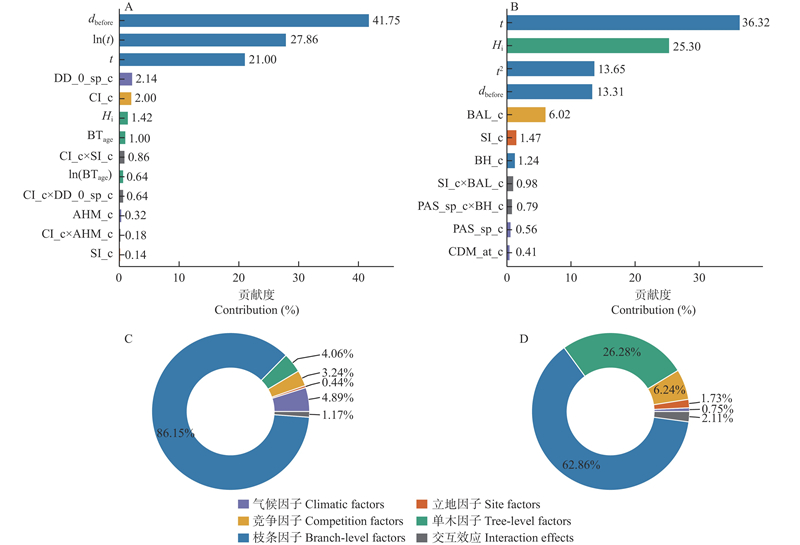
目的: 量化气候与竞争及其交互作用对长白落叶松枝条基径和枝长生长的影响规律,构建兼顾生物学解释与预测能力的枝条生长模型,为基于树冠动态的抚育间伐和整枝决策提供科学依据。方法: 2023年,在吉林省辽源市林业局长白落叶松人工纯林中设置10块标准地并选伐30株解析木,获取枝条基径和枝长生长数据;对对象木周围竞争木钻取生长锥,重建竞争指数序列,并逐年匹配气候因子。基于对数线性模型,考虑样地和样木水平随机效应,构建枝条基径和枝长年生长量模型。采用刀切法检验模型预测能力,评估不同校正样本量对预测精度的影响,并利用层次分割法量化各类因子的相对贡献。结果: 1) 枝条基径和枝长生长均表现出显著的非线性年龄效应。枝条基径生长随树木年龄和枝条年龄增加均呈先增后减趋势,峰值分别出现在约32年树木年龄和4年枝条年龄;枝长生长总体随枝条年龄增加而下降,表明枝条在早期生长空间相对充足时枝长生长较快。前期基径和树高年生长量对枝条生长具有显著促进作用,而竞争增强和不利气候条件则表现为抑制效应。2) 气候与竞争存在显著交互作用,在较强气候胁迫条件下,竞争对枝条生长的抑制效应增强,高竞争水平亦会放大气候胁迫造成的生长差异,表现出明显的“双重胁迫”叠加效应;立地条件对竞争效应具有调节作用,且在枝条基径和枝长生长的调节方向上存在差异。3) 引入随机效应后,模型拟合与预测精度明显提高,其中,样木单水平混合效应模型在保持较高精度的同时结构更简洁,可作为枝条生长预测最优模型。校正抽样结果表明,随校正枝条数量增加,枝条基径和枝长预测误差总体下降且不确定性收敛,抽取4~5个枝条即可显著提高预测稳定性,低龄和高龄枝条对校正样本量更敏感。4) 层次分割结果显示,枝条基径生长主要由枝条自身因子主导,贡献率约86%,其中前期基径和枝条年龄贡献最大,说明基径增长主要受自身大小和发育阶段影响;枝长生长的驱动因子贡献更为均衡,枝条因子、单木因子和竞争因子贡献率分别约为63%、26%和6%,表明枝长生长更易受单木生长势和空间竞争的调控。结论: 气候与竞争及其交互作用是影响长白落叶松枝条生长的重要驱动因素,样木单水平混合效应模型能够较好地模拟和预测枝条生长过程。枝条基径生长模型可为判断树干不同高度潜在节子大小和确定整枝方案提供依据,枝长生长模型可用于估算树冠半径变化和树冠重叠程度,为林分密度调控、间伐时间和强度优化提供参考。
中图分类号:
苗铮,赵雪晗,蒋宇萌,董利虎. 气候与竞争对长白落叶松枝条生长的影响及预测模型[J]. 林业科学, 2026, 62(11): 34-48.
Zheng Miao,Xuehan Zhao,Yumeng Jiang,Lihu Dong. Predictive Modeling of Branch Growth of Larix olgensis under Climate and Competition Effects[J]. Scientia Silvae Sinicae, 2026, 62(11): 34-48.

表1
样地、样木、竞争和枝条因子基本统计量"
| 数据类型 Data type | 变量 Variable | 缩写 Abbreviation | 最大值 Max. | 最小值 Min. | 平均值 Mean | 标准差 SD |
| 样地因子 Plot factors | 林分年龄Stand age/a | 57 | 15 | 31 | 13.49 | |
| 株数密度 Stems per hectare/(tree·hm?2) | 2 300 | 556 | 1 216 | 661.27 | ||
| 立地指数 Site index/m | 24.5 | 13.7 | 19.8 | 3.03 | ||
| 林分平均胸径Quadratic mean diameter/cm | 20.4 | 10.0 | 15.7 | 3.73 | ||
| 样木因子 Tree factors | 胸径 Diameter at breast height/cm | 27.1 | 6.7 | 15.9 | 5.41 | |
| 树高 Tree height/m | 22.8 | 7.7 | 15.0 | 3.99 | ||
| 冠长 Crown length/m | 9.9 | 1.9 | 6.8 | 1.85 | ||
| 冠幅Crown width/m | 5.7 | 1.5 | 3.4 | 1.08 | ||
| 竞争因子 Competition factors | Hegyi竞争指数 Hegyi competition index | 8.25 | 0.14 | 2.79 | 2.11 | |
| 胸径大于对象木的竞争木断面积之和 Total basal area of competitor trees with a larger DBH than the subject tree/(m2·hm?2) | 12.45 | 0 | 2.27 | 2.37 | ||
| 枝条数据 Branch factors | 枝条基径 Branch base diameter/mm | 79.01 | 1.37 | 16.09 | 11.41 | |
| 枝长 Branch length/cm | 579 | 6 | 168 | 100.60 | ||
| 枝条年龄 Branch age/a | 28 | 1 | 8 | 5.43 | ||
| 枝条基径年生长量 Branch base diameter annual increment/mm | di | 7.33 | 0.18 | 1.91 | 0.98 | |
| 枝条枝长年生长量 Branch length annual increment/cm | li | 79 | 2 | 20 | 11.62 | |
| 着枝角度 Branch insertion angle/(°) | 105 | 10 | 49 | 15.64 | ||
| 方位角度 Horizontal azimuth angle/(°) | 354 | 0 | 165 | 113.30 |
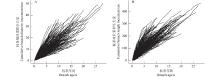
图1
枝条基径(A)和枝长(B)累积生长量随实测枝条年龄的变化"
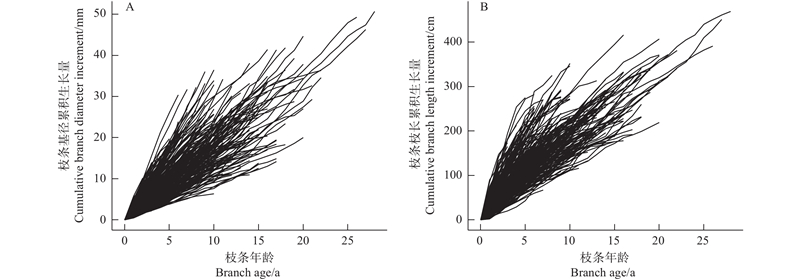
表2
枝条基径生长模型的参数估计结果(基础模型、样木水平混合模型和样地–样木两水平混合模型)①"
| 类别 Component | 参数 Parameter | Mbasic | Mtree | Mplot-tree | |||
| Est. | P | Est. | P | Est. | P | ||
| 固定效应参数 Fixed-effect parameters | 0.639 2 | 0.010 8 | ?1.355 4 | <0.001 | ?1.701 2 | <0.001 | |
| ?0.028 4 | <0.001 | ?0.049 0 | <0.001 | ?0.047 8 | <0.001 | ||
| 0.557 3 | <0.001 | 1.484 0 | <0.001 | 1.520 0 | <0.001 | ||
| ?0.229 0 | <0.001 | ?0.292 7 | <0.001 | ?0.292 6 | <0.001 | ||
| 0.979 6 | <0.001 | 1.295 5 | <0.001 | 1.298 1 | <0.001 | ||
| 0.129 5 | <0.001 | 0.115 0 | <0.001 | 0.114 7 | <0.001 | ||
| 0.448 3 | <0.001 | 0.176 8 | 0.001 1 | 0.175 9 | 0.001 2 | ||
| ?0.071 4 | <0.001 | ?0.025 5 | 0.490 4 | ?0.080 2 | 0.009 5 | ||
| 0.008 8 | 0.150 5 | 0.101 4 | 0.195 5 | 0.079 2 | 0.238 4 | ||
| ?0.009 7 | 0.001 1 | ?0.002 5 | 0.393 0 | ?0.002 2 | 0.469 9 | ||
| ?0.003 1 | <0.001 | ?0.001 3 | 0.004 0 | ?0.001 2 | 0.010 5 | ||
| 0.016 4 | <0.001 | 0.073 6 | 0.004 7 | 0.091 3 | <0.001 | ||
| ?0.009 1 | <0.001 | ?0.004 4 | 0.027 1 | ?0.004 9 | 0.013 6 | ||
| ?0.002 2 | <0.001 | ?0.001 1 | <0.001 | ?0.001 2 | <0.001 | ||
| 残差方差 Residual variance | 0.862 3 | 0.825 9 | 0.840 1 | ||||
| 权函数参数 Variance-function parameter | ?0.140 0 | ?0.174 9 | ?0.173 1 | ||||
| 随机效应方差–协方差矩阵 Random-effects variance-covariance matrix | 样地水平 Plot-level | — | — | ||||
| 样木水平 Tree-level | — | ||||||
表3
枝长生长模型的参数估计结果(基础模型、样木水平混合模型和样地–样木两水平混合模型)①"
| 类别 Component | 参数 Parameter | Mbasic | Mtree | Mplot-tree | |||||
| Est. | P | Est. | P | Est. | P | ||||
| 固定效应参数 Fixed-effects parameters | <0.001 | <0.001 | <0.001 | ||||||
| ? | <0.001 | ? | <0.001 | ? | <0.001 | ||||
| <0.001 | ? | ? | |||||||
| <0.001 | <0.001 | <0.001 | |||||||
| <0.001 | <0.001 | <0.001 | |||||||
| ? | ? | ? | <0.001 | ||||||
| ? | <0.001 | ? | <0.001 | ? | <0.001 | ||||
| ? | ? | <0.001 | ? | <0.001 | |||||
| ? | ? | ? | |||||||
| ? | ? | <0.001 | ? | <0.001 | |||||
| 残差方差Residual variance | |||||||||
| 权函数参数Variance- function parameter | ? | ? | ? | ||||||
| 随机效应方差– 协方差矩阵 Random-effects variance-covariance matrix | 样地水平 Plot-level | — | — | ||||||
| 样木水平 Tree-level | — | ||||||||
表4
枝条基径与长度生长对数线性模型的拟合评价与刀切法检验结果①"
| 评价尺度 Evaluation scale | 指标 Indices | 基径生长模型 Branch diameter growth model | 枝长生长模型 Branch length growth model | |||||
| Mbasic | Mtree | Mplot-tree | Mbasic | Mtree | Mplot-tree | |||
| 对数尺度 Log scale [ | 0.606 6 | 0.535 1 | 0.536 9 | 0.517 9 | 0.470 7 | 0.470 9 | ||
| 0.726 0 | 0.781 6 | 0.780 2 | 0.271 7 | 0.395 1 | 0.394 8 | |||
| 5 532 | 4 974 | 4 966 | 4 667 | 4 272 | 4 271 | |||
| 原尺度 Original scale (y) | 27.430 7 | 22.995 0 | 23.008 2 | 9.723 1 | 8.710 4 | 8.715 8 | ||
| 0.629 3 | 0.739 5 | 0.739 2 | 0.296 2 | 0.435 2 | 0.434 5 | |||
| 原尺度校正后 Original scale after bias-corrected ( | 27.524 9 | 24.112 0 | 24.066 0 | 9.448 2 | 8.510 9 | 8.515 8 | ||
| 0.626 8 | 0.713 6 | 0.714 7 | 0.335 4 | 0.460 8 | 0.460 1 | |||
| 刀切法检验 Jackknife validation | 5.029 6 | 3.543 0 | 3.543 2 | 2.044 3 | 1.885 1 | 1.986 1 | ||
| 17.288 0 | 13.956 9 | 13.927 7 | 7.444 7 | 6.572 3 | 6.759 1 | |||
| ?23.780 3 | ?18.410 1 | ?17.825 5 | ?19.223 4 | ?14.310 6 | ?15.031 8 | |||
| 60.409 1 | 50.011 6 | 49.444 1 | 50.610 1 | 43.438 9 | 44.447 6 | |||
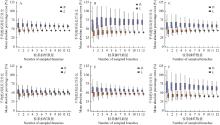
图2
不同枝条抽样数量下混合效应模型对枝条基径(BD)和枝长(BL)年生长量的预测精度评估 A–F 分别表示不同枝条年龄组,A:总体,B:1~5 年,C: 6~10 年,D: 11~15 年,E:16~20 年,F: >20 年。Panels A–F correspond to branch-age groups, A: overall, B: 1–5 a, C: 6–10 a, D: 11–15 a, E: 16–20 a, F: >20 a. gi:枝条基径年增量Branch annual increment in squared diameter;li:枝条枝长年生长量Branch length annual increment."
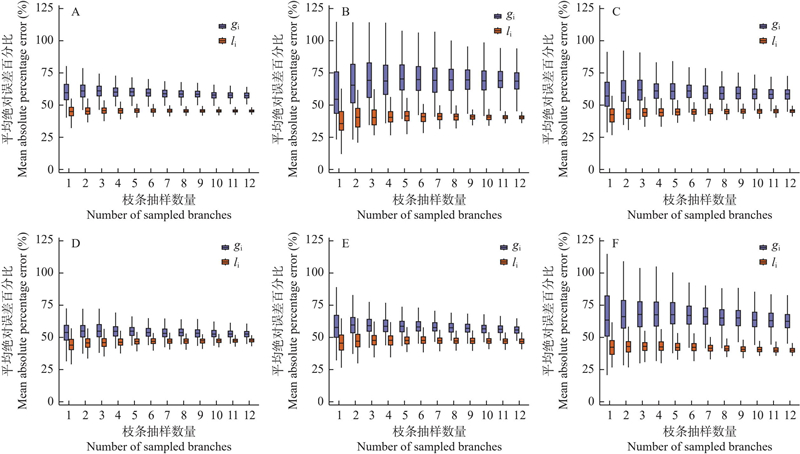
图3
不同关键因子水平下枝条基径生长量随枝条年龄的变化曲线 BTage:枝条形成时树木年龄 Tree age at branch formation;dbefore:前期枝条基径 Prior branch diameter;Hi:树高年生长量 Annual height increment;CI_c:中心化后的Hegyi竞争指数Centered Hegyi competition index; DD_0_sp_c:中心化后的春季负积温(0 ℃以下积温) Centered spring degree-days below 0 ℃."
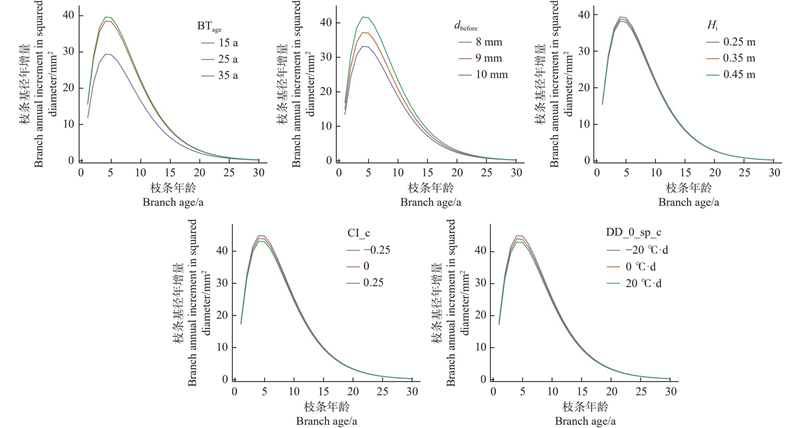
图4
不同关键因子水平下枝条枝长生长量随枝条年龄的变化曲线 dbefore:前期枝条基径 Prior branch base diameter;Hi:树高年生长量 Annual height increment;BAL_c:中心化后的胸径大于对象木的竞争木断面积之和 Centered basal area of larger competitors;SI_c:中心化后的立地指数 Centered site index;CMD_at_c:中心化后的秋季气候水分亏缺 Centered autumn climatic moisture deficit;PAS_sp_c:中心化后的春季雪相降水量 Centered spring precipitation as snow."
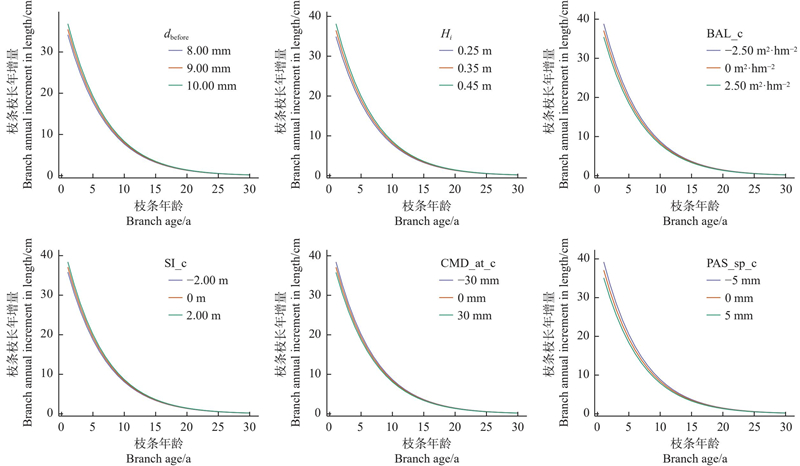
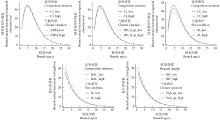
图5
气候、立地情景与竞争情景的交互作用对枝条基径和枝长生长的影响 CI_low/CI_high:低/高Hegyi竞争指数 Low/high Hegyi index (CI_c = ?0.25/0.25);AHM_low/AHM_high:低/高湿热指数 Low/high annual heat-moisture index (AHM_c = ?5/5 mm);DD_0_sp_low/DD_0_sp_high:低/高春季雪相降水量 Low/high centered spring degree-days below 0 ℃ (DD_0_sp _c = ?20/20 ℃·d);SI_low/SI_high:低/高立地指数 Low/high site index (SI_c = ?2/2 m);BAL_low/BAL_high:低/高胸径大于对象木的竞争木断面积之和Low/high centered basal area of larger competitors (BAL_c = ?2.5/2.5 m2·hm−2);BH_low/BH_high:低/高枝条高度 Low/high branch height (BH_c = ?5/5 m);PAS_sp_low/ PAS_sp_high:低/高春季雪相降水量 Low/high spring precipitation as snow (PAS_sp_c = ?5/5 mm)."
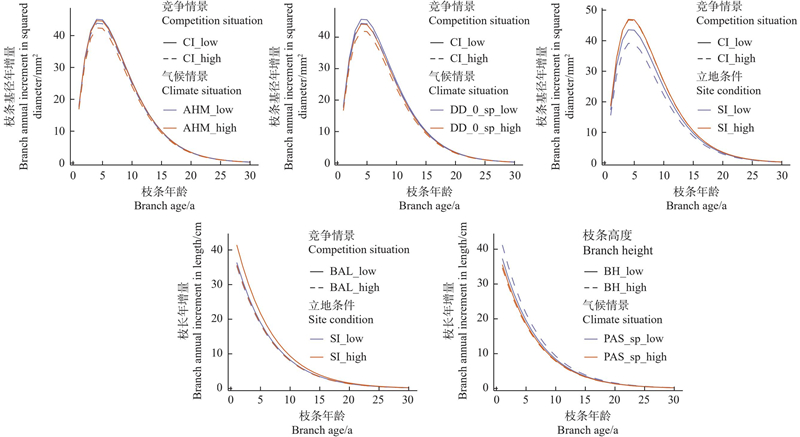
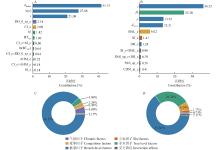
图6
各变量与变量组对枝条基径(A、C)和枝长(B、D)生长的相对贡献(HP 分析)"
| 金大庆, 董利虎, 郝元朔. 基于Copula函数的胸径−树高二元联合分布模拟. 森林工程, 2025, 41 (5): 896- 903. | |
| Jin D Q, Dong L H, Hao Y S. Simulation of bivariate joint distribution of diameter at breast height-tree height based on Copula function. Forest Engineering, 2025, 41 (5): 896- 903. | |
|
李宇婷, 马爱云, 苗 铮, 等. 邻域竞争对长白落叶松生物量及其分配的影响. 北京林业大学学报, 2025, 47 (4): 92- 102.
doi: 10.12171/j.1000-1522.20230322 |
|
|
Li Y T, Ma A Y, Miao Z, et al. Effects of neighborhood competition on biomass and its allocation of Larix olgensis. Journal of Beijing Forestry University, 2025, 47 (4): 92- 102.
doi: 10.12171/j.1000-1522.20230322 |
|
| 宋 磊, 金星姬, Pukkala Timo, 等. 长白落叶松人工林多目标经营模式研究. 南京林业大学学报(自然科学版), 2023, 47 (2): 150- 158. | |
| Song L, Jin X J, Timo P, et al. Research on multi-objective management schedules of Larix olgensis plantations. Journal of Nanjing Forestry University (Natural Sciences Edition), 2023, 47 (2): 150- 158. | |
|
赵子琪, 李丹丹, 赵 鼎, 等. 基于深度学习的树冠分割及生物量估算. 森林工程, 2024, 40 (5): 145- 155.
doi: 10.7525/j.issn.1006-8023.2024.05.015 |
|
|
Zhao Z Q, Li D D, Zhao D, et al. Canopy segmentation and biomass estimation based on deep learning. Forest Engineering, 2024, 40 (5): 145- 155.
doi: 10.7525/j.issn.1006-8023.2024.05.015 |
|
|
Brix H. Effects of thinning and nitrogen fertilization on branch and foliage production in douglas-fir. Canadian Journal of Forest Research, 1981, 11 (3): 502- 511.
doi: 10.1139/x81-069 |
|
|
Calama R, Montero G. Multilevel linear mixed model for tree diameter increment in stone pine (Pinus pinea): a calibrating approach. Silva Fennica, 2005, 39 (1): 37- 54.
doi: 10.14214/sf.394 |
|
|
Cao Q V, Wang J. Evaluation of methods for calibrating a tree taper equation. Forest Science, 2015, 61 (2): 213- 219.
doi: 10.5849/forsci.14-008 |
|
|
Carnwath G C, Peterson D W, Nelson C R. Effect of crown class and habitat type on climate-growth relationships of ponderosa pine and douglas-fir. Forest Ecology and Management, 2012, 285, 44- 52.
doi: 10.1016/j.foreco.2012.07.037 |
|
|
Cawley G C, Talbot N L C. Efficient leave-one-out cross-validation of kernel fisher discriminant classifiers. Pattern Recognition, 2003, 36 (11): 2585- 2592.
doi: 10.1016/S0031-3203(03)00136-5 |
|
|
Chen L, Sumida A. Effects of light on branch growth and death vary at different organization levels of branching units in sakhalin spruce. Trees, 2018, 32 (4): 1123- 1134.
doi: 10.1007/s00468-018-1700-5 |
|
|
Constable J V H, Friend A L. Suitability of process-based tree growth models for addressing tree response to climate change. Environmental Pollution, 2000, 110 (1): 47- 59.
doi: 10.1016/S0269-7491(99)00289-4 |
|
|
Dănescu A, Ehring A, Bauhus J, et al. Modelling discoloration and duration of branch occlusion following green pruning in Acer pseudoplatanus and Fraxinus excelsior. Forest Ecology and Management, 2015, 335, 87- 98.
doi: 10.1016/j.foreco.2014.09.027 |
|
|
Dong L B, Liu Z G, Li F R, et al. Modelling primary branch growth based on a multilevel nonlinear mixed-effects model: a Pinus koraiensis plantation case study in north-east China. Southern Forests: a Journal of Forest Science, 2015, 77 (3): 179- 190.
doi: 10.2989/20702620.2014.1001676 |
|
|
Dong L H, Zhang L J, Li F R. A compatible system of biomass equations for three conifer species in northeast, China. Forest Ecology and Management, 2014, 329, 306- 317.
doi: 10.1016/j.foreco.2014.05.050 |
|
|
Feller U. Drought stress and carbon assimilation in a warming climate: reversible and irreversible impacts. Journal of Plant Physiology, 2016, 203, 84- 94.
doi: 10.1016/j.jplph.2016.04.002 |
|
|
Ford K R, Breckheimer I K, Franklin J F, et al. Competition alters tree growth responses to climate at individual and stand scales. Canadian Journal of Forest Research, 2017, 47 (1): 53- 62.
doi: 10.1139/cjfr-2016-0188 |
|
| Foster J R, Finley A O, D’Amato A W, et al. 2016. Predicting tree biomass growth in the temperate-boreal ecotone: is tree size, age, competition, or climate response most important? Global Change Biology, 22(6): 2138−2151. | |
|
Fu L Y, Zhang H R, Sharma R P, et al. A generalized nonlinear mixed-effects height to crown base model for mongolian oak in northeast China. Forest Ecology and Management, 2017, 384, 34- 43.
doi: 10.1016/j.foreco.2016.09.012 |
|
|
Groot A, Schneider R. Predicting maximum branch diameter from crown dimensions, stand characteristics and tree species. Forestry Chronicle, 2011, 87 (4): 542- 551.
doi: 10.5558/tfc2011-053 |
|
|
Guo H T, Jia W W, Li D D, et al. Modelling branch growth of korean pine plantations based on stand conditions and climatic factors. Forest Ecology and Management, 2023, 546, 121318.
doi: 10.1016/j.foreco.2023.121318 |
|
| Hegyi F. 1974. A simulation model for managing jack-pine stands simulation//Fries J. Growth models for tree and stand simulation. Stockholm: Royal College of Forestry, 74−90. | |
|
Hein S, Mäkinen H, Yue C F, et al. Modelling branch characteristics of norway spruce from wide spacings in Germany. Forest Ecology and Management, 2007, 242 (2/3): 155- 164.
doi: 10.1016/j.foreco.2007.01.014 |
|
|
Hein S. Knot attributes and occlusion of naturally pruned branches of Fagus sylvatica. Forest Ecology and Management, 2008, 256 (12): 2046- 2057.
doi: 10.1016/j.foreco.2008.07.033 |
|
|
Hildebrand M, Perles-Garcia M D, Kunz M, et al. Tree-tree interactions and crown complementarity: the role of functional diversity and branch traits for canopy packing. Basic and Applied Ecology, 2021, 50, 217- 227.
doi: 10.1016/j.baae.2020.12.003 |
|
|
Jiang Z, van Zanten M, Sasidharan R. Mechanisms of plant acclimation to multiple abiotic stresses. Communications Biology, 2025, 8, 655.
doi: 10.1038/s42003-025-08077-w |
|
|
Kolo H, Ankerst D, Knoke T. Predicting natural forest regeneration: a statistical model based on inventory data. European Journal of Forest Research, 2017, 136 (5): 923- 938.
doi: 10.1007/s10342-017-1080-1 |
|
|
Küppers M. Ecological significance of above-ground architectural patterns in woody plants: a question of cost-benefit relationships. Trends in Ecology & Evolution, 1989, 4 (12): 375- 379.
doi: 10.1016/0169-5347(89)90103-1 |
|
|
Lai J S, Zou Y, Zhang J L, et al. Generalizing hierarchical and variation partitioning in multiple regression and canonical analyses using the rdacca. hp R package. Methods in Ecology and Evolution, 2022, 13 (4): 782- 788.
doi: 10.1111/2041-210X.13800 |
|
|
Li Q C, Liu Z L, Jin G Z. Impacts of stand density on tree crown structure and biomass: a global meta-analysis. Agricultural and Forest Meteorology, 2022, 326, 109181.
doi: 10.1016/j.agrformet.2022.109181 |
|
|
Liang H X, Huang J G, Ma Q Q, et al. Contributions of competition and climate on radial growth of Pinus massoniana in subtropics of China. Agricultural and Forest Meteorology, 2019, 274, 7- 17.
doi: 10.1016/j.agrformet.2019.04.014 |
|
|
Mäkinen H. Effect of stand density on radial growth of branches of scots pine in southern and central Finland. Canadian Journal of Forest Research, 1999, 29 (8): 1216- 1224.
doi: 10.1139/x99-060 |
|
| Mao S W, Li Y H, Agrawal P, et al. 2010. Toward efficient wireless medium access control//Handbook on sensor networks. Singapore: World Scientific Publishing, 69−96. | |
|
Miao Z, Widagdo F R A, Dong L H, et al. Prediction of branch growth using quantile regression and mixed-effects models: an example with planted Larix olgensis Henry trees in northeast China. Forest Ecology and Management, 2021a, 496, 119407.
doi: 10.1016/j.foreco.2021.119407 |
|
|
Miao Z, Zhang L J, Widagdo F R A, et al. Modeling the number of the first- and second-order branches within the live tree crown of korean larch plantations in northeast China. Canadian Journal of Forest Research, 2021b, 51 (5): 704- 719.
doi: 10.1139/cjfr-2020-0375 |
|
|
Peng W, Pukkala T, Jin X J, et al. Optimal management of larch (Larix olgensis A. Henry) plantations in northeast China when timber production and carbon stock are considered. Annals of Forest Science, 2018, 75 (2): 63.
doi: 10.1007/s13595-018-0739-1 |
|
| Pinheiro J C, Bates D M. 2000. Mixed-effects models in S and S-PLUS. New York, NY: Springer New York. | |
|
Qiu H Q, Liu S, Zhang Y T, et al. Variation in height-diameter allometry of ponderosa pine along competition, climate, and species diversity gradients in the western United States. Forest Ecology and Management, 2021, 497, 119477.
doi: 10.1016/j.foreco.2021.119477 |
|
|
Pretzsch H. Canopy space filling and tree crown morphology in mixed-species stands compared with monocultures. Forest Ecology and Management, 2014, 327, 251- 264.
doi: 10.1016/j.foreco.2014.04.027 |
|
|
Remphrey W R, Powell G R. Crown architecture of Larix laricina saplings: sylleptic branching on the main stem. Canadian Journal of Botany, 1985, 63 (7): 1296- 1302.
doi: 10.1139/b85-180 |
|
|
Schielzeth H. Simple means to improve the interpretability of regression coefficients. Methods in Ecology and Evolution, 2010, 1 (2): 103- 113.
doi: 10.1111/j.2041-210X.2010.00012.x |
|
|
Trincado G, Burkhart H E. A framework for modeling the dynamics of first-order branches and spatial distribution of knots in loblolly pine trees. Canadian Journal of Forest Research, 2009, 39 (3): 566- 579.
doi: 10.1139/X08-189 |
|
|
Tullus A, Rusalepp L, Lutter R, et al. Climate and competitive status modulate the variation in secondary metabolites more in leaves than in fine roots of Betula pendula. Frontiers in Plant Science, 2021, 25 (12): 746165.
doi: 10.3389/fpls.2021.746165 |
|
|
Wang B H, Bu Y K, Tao G H, et al. Quantifying the effect of crown vertical position on individual tree competition: total overlap index and its application in sustainable forest management. Sustainability, 2020, 12 (18): 7498.
doi: 10.3390/su12187498 |
|
|
Wang T L, Wang G Y, Innes J L, et al. ClimateAP: an application for dynamic local downscaling of historical and future climate data in Asia Pacific. Frontiers of Agricultural Science and Engineering, 2017, 4 (4): 448.
doi: 10.15302/J-FASE-2017172 |
|
|
Wang Y C. Characteristics of physical ecology and regulation measurement for establishment of fast growing and high yield larch forest of Larix gmelinii/Larix principes-rupprechtii in northeast of China. Journal of Northeast Forestry University, 1992, 3 (2): 23- 26.
doi: 10.1007/bf02843033 |
|
|
Weiskittel A R, Maguire D A, Monserud R A. Response of branch growth and mortality to silvicultural treatments in coastal douglas-fir plantations: implications for predicting tree growth. Forest Ecology and Management, 2007, 251 (3): 182- 194.
doi: 10.1016/j.foreco.2007.06.007 |
|
|
Zhao X H, Miao Z, Li F R, et al. Unraveling the individual and interactive effects of climate and competition on branch growth dynamics in Pinus koraiensis in northeast China. Frontiers in Plant Science, 2025, 16, 1545892.
doi: 10.3389/fpls.2025.1545892 |
| [1] | 刘鑫,郝元朔,董利虎,赵颖慧,李凤日. 基于UAV-LiDAR的长白落叶松人工林单木断面积生长量估测模型研建[J]. 林业科学, 2026, 62(8): 11-20. |
| [2] | 张少鹏,任阳阳,姜巧悦,贯君,朱洪革. 气候政策不确定性对林业高质量发展的影响[J]. 林业科学, 2026, 62(5): 189-199. |
| [3] | 孔欣茹,金星姬,Pukkala Timo,李凤日. 基于随机多准则可接受性分析的长白落叶松人工林多目标经营决策[J]. 林业科学, 2026, 62(4): 34-44. |
| [4] | 刘世荣,陈远其,聂秀青,明安刚,王晖. 树种多样性对森林生态系统多功能性和韧性的影响[J]. 林业科学, 2026, 62(1): 1-18. |
| [5] | 何潇,曾伟生,陈新云,黄宏超,雷相东. 我国4种落叶松人工林的林分优势高和平均高转换模型[J]. 林业科学, 2026, 62(1): 223-230. |
| [6] | 赵忠. 古树健康管理面临的问题和挑战[J]. 林业科学, 2025, 61(7): 94-99. |
| [7] | 冉馨,孙晓梅,吴春燕,陈东升,王宏星,张守攻. 降水减少和间伐对日本落叶松人工林根系分布与生理特性的影响[J]. 林业科学, 2025, 61(7): 157-169. |
| [8] | 许可儿,汤璐瑶,张博纳,叶琳峰,王忠媛,谢江波. 国槐功能性状沿降水梯度带的变异规律[J]. 林业科学, 2025, 61(4): 81-91. |
| [9] | 高婉婷,胡晓创,孙守家,张劲松,孟平,蔡金峰. 基于优化的MaxEnt模型预测未来气候变化下刺槐在中国的空间分布[J]. 林业科学, 2025, 61(4): 104-116. |
| [10] | 崔妞妞,庞建壮,张祎帆,许行,张勤,张志强. 海河典型流域气候变化和植被恢复对水文的影响——以张家口清水河流域为例[J]. 林业科学, 2025, 61(3): 38-49. |
| [11] | 黄云,徐黎亮,郑博福,宋旭,胡方清,朱锦奇,万炜. 亚热带典型森林生产力及碳利用率的气候变化响应[J]. 林业科学, 2025, 61(3): 121-134. |
| [12] | 陈飞,张杰京,王继山,罗伟雄,汤永晶,樊辉. 气候变化背景下全球野生亚洲象潜在生境预测[J]. 林业科学, 2025, 61(12): 124-134. |
| [13] | 何江,覃林. 气候敏感的杉木天然林林分进界模型[J]. 林业科学, 2025, 61(1): 70-80. |
| [14] | 张雨田,石军南,张怀清,吴炳伦. 洞庭湖湿地植被时空动态及其驱动力分析[J]. 林业科学, 2024, 60(8): 1-13. |
| [15] | 黄栋才,郭鑫,王得祥,王韵淑,张欣,霍雪莹. 不同经营方法对秦岭华北落叶松林分生长和林下植被的影响[J]. 林业科学, 2024, 60(8): 57-66. |
| 阅读次数 | ||||||
|
全文 |
|
|||||
|
摘要 |
|
|||||

