
林业科学 ›› 2026, Vol. 62 ›› Issue (11): 213-230.doi: 10.11707/j.1001-7488.LYKX20250705
• 研究论文 • 上一篇
徐彩瑶1,2,梁笑嫣2,孔凡斌3,*( )
收稿日期:2025-11-25
修回日期:2026-01-07
出版日期:2026-11-10
发布日期:2026-11-20
通讯作者:
孔凡斌
E-mail:kongfanbin@aliyun.com
基金资助:
Caiyao Xu1,2,Xiaoyan Liang2,Fanbin Kong3,*()
Received:2025-11-25
Revised:2026-01-07
Online:2026-11-10
Published:2026-11-20
Contact:
Fanbin Kong
E-mail:kongfanbin@aliyun.com
摘要:
目的: 研究乡村数字化对森林资源水平的影响机制及“负能”向“赋能”转化的路径,为山区统筹数字乡村建设与森林资源保护、实现经济发展与生态环境保护协同推进提供科学依据。方法: 基于2001—2023年浙江省山区26县的面板数据,运用熵权法、基准回归模型、调节效应模型和门槛效应模型,从森林资源数量和质量双维度,系统探究乡村数字化对森林资源的影响及其作用机制。结果: 1) 乡村数字化对森林资源整体呈现显著“负能”效应,乡村数字化水平每提升1单位,森林资源水平显著下降1.153单位,且该结论经稳健性检验与内生性处理后依然成立;其负向影响在森林资源质量维度更为突出,对数量维度的冲击未通过显著性检验。2) 异质性分析结果表明,生态发展县的乡村数字化呈现正向保护效应,跨越发展县的负向效应不显著;乡村数字宏观环境、基础设施、应用环境对森林资源呈显著负向影响,数字信息环境则表现为正向赋能。3) 产业结构水平与土地利用强度发挥差异化调节作用。产业结构水平在乡村数字化对森林资源整体、数量和质量的影响中均呈正向调节效应,能有效削弱数字化“负能”效应;土地利用强度呈负向调节,会强化乡村数字化对森林资源的破坏,其中对数量维度的负向调节效应最显著。4) 门槛效应分析结果表明,产业结构水平存在单一门槛值0.127,跨越后乡村数字化对森林资源水平和数量的“负能”效应大幅缓解,对质量维度无门槛效应;土地利用强度对森林资源水平、数量、质量分别存在单一门槛值0.457、0.485、0.037,跨越后乡村数字化的“负能”效应显著加剧。结论: 2001—2023年浙江省山区26县乡村数字化以“负能”为主导抑制森林资源水平,区域发展定位、数字化子维度特征、产业结构水平与土地利用强度显著影响其效应方向与强度;产业结构升级是推动数字化从“负能”向“赋能”转化的核心驱动力,土地利用强度粗放扩张则会锁定“负能”路径。因此,需通过靶向优化数字化应用场景、推动产业结构绿色升级、严控土地利用开发强度,实现数字乡村建设与森林资源保护协同发展,推动森林资源数量稳定与质量提升。
中图分类号:
徐彩瑶,梁笑嫣,孔凡斌. 山区乡村数字化对森林资源的影响:数字“赋能”还是“负能”[J]. 林业科学, 2026, 62(11): 213-230.
Caiyao Xu,Xiaoyan Liang,Fanbin Kong. Impact of Rural Digitalization in Mountainous Areas on Forest Resources: Digital “Empowerment” or “Disempowerment”[J]. Scientia Silvae Sinicae, 2026, 62(11): 213-230.

图1
乡村数字化与森林资源关系的理论分析框架"


图2
浙江省山区26县概览"
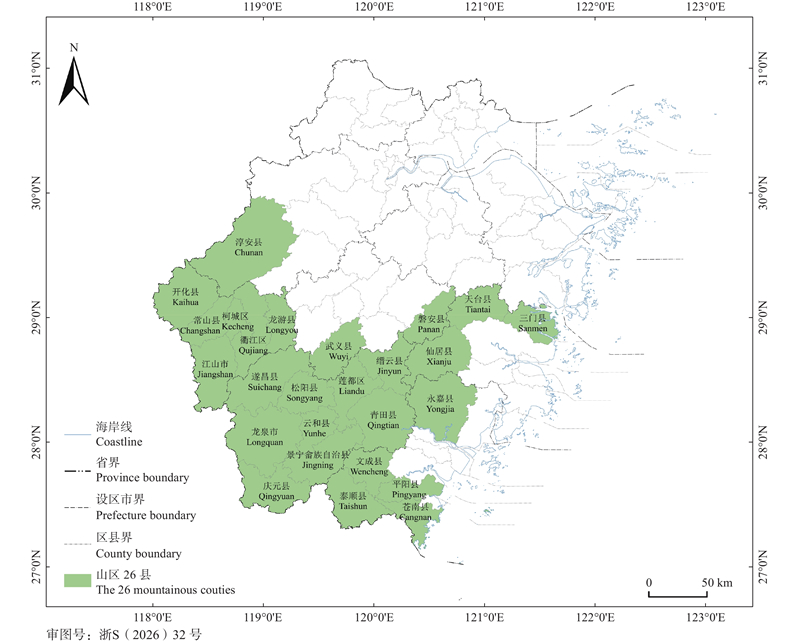
表1
乡村数字化水平评价指标体系①"
| 指标层 Indicator layer | 一级指标 Primary index | 二级指标 Secondary index | 指标说明 Index description | 属性 Attribute | 权重 Weights |
| 乡村数字化水平 Rural digitalization level | 乡村数字宏观环境 Rural digital macro environment | 乡村人均生产总值 Rural per capita GDP | 乡村人均生产总值 Rural per capita GDP | + | 0.115 |
| 乡村居民人均可支配收入 Rural per capita disposable income of rural residents | 乡村居民人均可支配收入 Rural per capita disposable income of rural residents | + | 0.086 | ||
| 乡村数字基础设施 Rural digital infrastructure | 乡村宽带用户规模 Scale of rural broadband users | 乡村宽带接入用户数 Rural number of rural broadband access users | + | 0.131 | |
| 乡村移动电话用户规模 Scale of rural mobile phone users | 乡村移动电话用户数 Rural number of rural mobile phone users | + | 0.135 | ||
| 乡村数字信息环境 Rural digital information environment | 乡村第三产业对GDP贡献率 Rural contribution rate of the tertiary industry to GDP | 乡村第三产业产值/乡村GDP Rural output value of the tertiary industry/rural GDP | + | 0.074 | |
| 乡村邮电业务量 Rural postal and telecommunications business volume | 乡村邮电业务量 Rural postal and telecommunications business volume | + | 0.197 | ||
| 乡村数字政务环境 Rural digital government environment | 乡村财政科学技术支出占比 Rural proportion of local fiscal expenditure on science and technology | 乡村财政教育事业费支出/乡村财政总支出Rural financial education expenditure/total rural financial expenditure | + | 0.022 | |
| 乡村财政交通运输支出 Rural financial transportation expenditure | 乡村每平方千米公路里程 Rural road mileage per square kilometer | + | 0.047 | ||
| 乡村数字应用环境 Rural digital application environment | 乡村电信业务收入 Rural rural telecommunication business income | (乡村居民可支配收入/乡村居民和城镇居民总收入)×电信业务收入(Disposable income of rural residents/total income of rural and urban residents) x telecommunications business income | + | 0.126 | |
| 乡村投递路线 Rural delivery route | 乡村投递路线 Rural delivery route | + | 0.067 |
表2
变量的描述性统计特征"
| 变量类型 Variables types | 变量名称 Variables name | 样本量 Sample size | 均值 Mean | 标准差 Standard deviation | 最小值 Min. | 最大值 Max. |
| 被解释变量 Explanatory variable | 森林资源水平 Forest resource level | 598 | 1.259 | 0.450 | 0.146 | 2.763 |
| 森林资源质量 Forest resource quality | 598 | 0.277 | 0.184 | 0.000 | 1.000 | |
| 森林资源数量 Forest resource quantity | 598 | 0.982 | 0.292 | 0.095 | 1.850 | |
| 核心解释变量 Core explanatory variables | 乡村数字化水平 Rural digitalization level | 598 | 0.167 | 0.102 | 0.026 | 0.555 |
| 控制变量 Control variables | 交通基础设施 Transportation infrastructure | 598 | 0.025 | 0.047 | 0.000 | 1.000 |
| 对外开放程度 Degree of openness to the outside world | 598 | 0.091 | 0.288 | 0.002 | 4.686 | |
| 政府财政支出规模 Scale of government fiscal expenditure | 598 | 0.211 | 0.120 | 0.016 | 0.713 | |
| 经济发展水平 Economic development level | 598 | 0.994 | 0.940 | 0.095 | 10.964 | |
| 机制变量 Mechanism variable | 产业结构水平 Industrial structure level | 598 | 0.181 | 0.144 | 0.000 | 1.000 |
| 土地利用强度 Land use intensity | 598 | 0.188 | 0.184 | 0.000 | 1.000 |

图3
2001—2023年浙江省山区26县乡村数字化水平"


图4
2001—2023年浙江省山区26县乡村数字化水平的空间特征"


图5
2001—2023年浙江省山区26县森林资源水平"


图6
2001—2023年浙江省山区26县森林资源水平的空间特征"


图7
乡村数字化水平与森林资源水平的拟合关系"

表3
基准模型回归结果①"
| 变量 Variables | 森林资源水平 Forest resource level | |
| (1) | (2) | |
| 乡村数字化水平 Rural digitalization level | ?1.358*** (0.240) | ?1.153*** (0.255) |
| 交通基础设施 Transportation infrastructure | — | ?0.131 (0.130) |
| 对外开放程度 Degree of openness to the outside world | — | 0.033 (0.023) |
| 政府财政支出规模 The scale of government fiscal expenditure | — | 0.328*** (0.121) |
| 经济发展水平 Economic development level | — | ?0.016** (0.007) |
| 常数项 Constant | 2.258*** (0.039) | 2.231*** (0.042) |
| 地区效应 Regional effect | 是Yes | 是Yes |
| 时间效应 Time effect | 是Yes | 是Yes |
| 观测值 Observations | 598 | 598 |
| R2 | 0.911 | 0.921 |
表4
区域异质性分析结果①"
| 变量 Variables | 森林资源水平 Forest resource level | |
| 跨越发展县 Leapfrog development county (1) | 生态发展县 Eco-development county (2) | |
| 乡村数字化水平 Rural digitalization level | ?0.164 (0.105) | 0.650*** (0.118) |
| 控制变量 Control variable | 是Yes | 是Yes |
| 常数项 Constant | 1.754*** (0.053) | 2.153*** (0.036) |
| 地区效应 Regional effect | 是Yes | 是Yes |
| 时间效应 Time effect | 是Yes | 是Yes |
| 观测值 Observations | 345 | 253 |
| R2 | 0.852 | 0.879 |
表5
基于乡村数字化水平不同维度的分析结果①"
| 变量 Variables | 森林资源水平 Forest resource level | ||||
| (1) | (2) | (3) | (4) | (5) | |
| 乡村数字宏观环境 Rural digital macro environment | ?0.693** (0.318) | — | — | — | — |
| 乡村数字基础设施 Rural digital infrastructure | — | ?0.859** (0.342) | — | — | — |
| 乡村数字信息环境 Rural digital information environment | — | — | 4.577*** (1.480) | — | — |
| 乡村数字治理环境 Rural digital governanc e environment | — | — | — | 0.849 (1.709) | — |
| 乡村数字应用环境 Rural digital application environment | — | — | — | — | ?0.496** (0.206) |
| 控制变量 Control variable | 是Yes | 是Yes | 是Yes | 是Yes | 是Yes |
| 常数项 Constant | 2.206*** (0.035) | 2.205*** (0.035) | 0.996*** (0.091) | 2.155*** (0.043) | 0.818*** (0.041) |
| 地区效应 Regional effect | 是Yes | 是Yes | 是Yes | 是Yes | 是Yes |
| 时间效应 Time effect | 是Yes | 是Yes | 是Yes | 是Yes | 是Yes |
| 观测值 Observations | 598 | 598 | 598 | 598 | 598 |
| R2 | 0.886 | 0.886 | 0.155 | 0.910 | 0.816 |
表6
基于不同森林资源数量和质量的异质性分析结果①"
| 变量 Variables | 森林资源质量 Forest resource quality (1) | 森林资源数量 Forest resource quantity (2) |
| 乡村数字化水平 Rural digitalization level | ?0.064*** (0.029) | ?0.104 (0.085) |
| 控制变量 Control variable | 是Yes | Yes |
| 常数项 Constant | 0.777*** (0.010) | 1.470*** (0.060) |
| 地区效应 Regional effect | 是Yes | 是Yes |
| 时间效应 Time effect | 是Yes | 是Yes |
| 观测值 Observations | 598 | 598 |
| R2 | 0.943 | 0.543 |
表7
稳健性检验结果①"
| 变量 Variables | 缩尾 Winsorization (1) | 替换被解释变量 Replace the explained variable (2) | 调整样本量 Adjust sample size (3) |
| 乡村数字化水平 Rural digitalization level | ?0.972*** (0.248) | ?4.656* (2.528) | ?0.871*** (0.283) |
| 控制变量 Control variable | 是Yes | 是Yes | 是Yes |
| 常数项 Constant | 2.193*** (0.041) | 5.929*** (0.419) | 2.189*** (0.039) |
| 地区效应 Regional effect | 是Yes | 是Yes | 是Yes |
| 时间效应 Time effect | 是Yes | 是Yes | 是Yes |
| 观测值 Observations | 598 | 598 | 598 |
| R2 | 0.923 | 0.342 | 0.929 |
表8
内生性讨论结果①"
| 变量 Variables | 森林资源水平 Forest resource level |
| 乡村数字化水平滞后一期 Lag the rural digitalization level for one phase | ?1.591** (0.466) |
| 控制变量 Control variable | 是Yes |
| 常数项 Constant | 2.339*** (0.055) |
| 地区效应 Regional effect | 是Yes |
| 时间效应 Time effect | 是Yes |
| 观测值 Observations | 572 |
| R2 | 0.922 |
表9
调节效应检验结果①"
| 变量 Variables | 森林资源水平 Forest resource level | 森林资源数量 Forest resource quantity | 森林资源质量 Forest resource quality | |||||
| (1) | (2) | (3) | (4) | (5) | (6) | |||
| 乡村数字化水平 Rural digitalization level | 0.183*** (0.067) | ?0.095** (0.044) | ?0.411* (0.249) | 0.439*** (0.087) | ?0.522*** (0.099) | 0.184*** (0.065) | ||
| 产业结构水平 Industrial structure level | 0.292*** (00.079) | — | 0.135* (0.072) | — | 0.280** (0.116) | — | ||
| 乡村数字化水平×产业结构水平 Rural digitalization level×Industrial structure level | 4.674*** (0.515) | — | 4.124*** (0.485) | — | 2.340*** (0.756) | — | ||
| 土地利用强度 Land use intensity | — | ?1.423*** (0.200) | — | ?0.331** (0.154) | — | ?0.701*** (0.037) | ||
| 乡村数字化水平×土地利用强度 Rural digitalization level×Land use intensity | — | ?1.106*** (0.319) | — | ?2.784*** (0.284) | — | 0.699*** (0.268) | ||
| 控制变量 Control variable | YES | YES | YES | YES | YES | YES | ||
| 常数项 Constant | 2.148*** (0.045) | 1.867*** (0.142) | 1.431*** (0.047) | 1.444*** (0.029) | ?0.284*** (0.066) | 0.372*** (0.012) | ||
| 地区效应 Regional effect | 是Yes | 是Yes | 是Yes | 是Yes | 是Yes | 是Yes | ||
| 时间效应 Time effect | 是Yes | 是Yes | 是Yes | 是Yes | 是Yes | 是Yes | ||
| 观测值 Observations | 598 | 598 | 598 | 598 | 598 | 598 | ||
| R2 | 0.898 | 0.938 | 0.817 | 0.802 | 0.938 | 0.403 | ||
表10
门槛效应检验结果"
| 变量 Variables | 门槛变量 Threshold variables | 检验类型 Test type | 门槛值 Threshold value | F值 F-value | P | 临界值 Threshold value | ||
| 10% | 5% | 1% | ||||||
| 产业结构水平 Industrial structure level | 森林资源水平 Forest resource level | 单一门槛 Single threshold | 0.127 | 53.212 | 0.023 | 33.262 | 44.274 | 58.656 |
| 森林资源数量 Forest resource quantity | 单一门槛 Single threshold | 0.127 | 52.254 | 0.017 | 31.803 | 35.782 | 56.273 | |
| 森林资源质量 Forest resource quality | 单一门槛 Single threshold | 0.049 | 10.816 | 0.150 | 12.201 | 13.038 | 15.979 | |
| 土地利用强度 Land use intensity | 森林资源水平 Forest resource level | 单一门槛 Single threshold | 0.457 | 56.121 | 0.040 | 45.043 | 53.149 | 67.429 |
| 森林资源数量 Forest resource quantity | 单一门槛 Single threshold | 0.485 | 68.983 | 0.017 | 42.231 | 49.909 | 76.447 | |
| 森林资源质量 Forest resource quality | 单一门槛 Single threshold | 0.037 | 14.165 | 0.007 | 7.401 | 8.648 | 12.114 | |
表11
门槛效应回归结果①"
| 变量 Variables | 森林资源水平 Forest resource level | 森林资源数量 Forest resource quantity | 森林资源质量 Forest resource quality | ||||
| (1) | (2) | (3) | (4) | (5) | |||
| 乡村数字化水平(产业结构水平<0.127) Rural digitalization level(industrial structure level <0.127) | ?0.503** (0.177) | — | — | — | — | ||
| 乡村数字化水平(产业结构水平≥0.127) Rural digitalization level(industrial structure level≥0.127) | 0.092 (0.265) | — | — | — | — | ||
| 乡村数字化水平(产业结构水平<0.127) Rural digitalization level(industrial structure level <0.127) | — | — | ?0.412* (0.189) | — | — | ||
| 乡村数字化水平(产业结构水平≥0.127) Rural digitalization level(industrial structure level≥0.127) | — | — | 0.145 (0.279) | — | — | ||
| 乡村数字化水平(土地利用强度<0.457) Rural digitalization level(land use intensity <0.457) | — | ?0.070 (0.247) | — | — | — | ||
| 乡村数字化水平(土地利用强度≥0.457) Rural digitalization level(land use intensity≥0.457) | — | ?0.945*** (0.220) | — | — | — | ||
| 乡村数字化水平(土地利用强度<0.485) Rural digitalization level(land use intensity <0.485) | — | — | — | 0.011 (0.242) | — | ||
| 乡村数字化水平(土地利用强度≥0.485) Rural digitalization level(land use intensity≥0.485) | — | — | — | ?0.945*** (0.213) | — | ||
| 乡村数字化水平(土地利用强度<0.037) Rural digitalization level(land use intensity <0.037) | — | — | — | — | ?0.303*** (0.065) | ||
| 乡村数字化水平(土地利用强度≥0.037) Rural digitalization level(land use intensity≥0.037) | — | — | — | — | ?0.096** (0.028) | ||
| 控制变量 Control variable | 是Yes | 是Yes | 是Yes | 是Yes | 是Yes | ||
| 常数项 Constant | 1.218*** (0.038) | 1.212*** (0.033) | 0.928*** (0.037) | 0.922*** (0.032) | 0.292*** (0.003) | ||
| 观测值 Observations | 598 | 598 | 598 | 598 | 598 | ||
|
杜 群. 中国法律中的森林定义: 兼论法律保护森林资源生态价值的迫切性. 资源科学, 2018, 40 (9): 1878- 1889.
doi: 10.18402/resci.2018.09.17 |
|
|
Du Q. The definition of forest in Chinese legislation—the rationale of legal protection of the ecological values of forest resources. Resources Science, 2018, 40 (9): 1878- 1889.
doi: 10.18402/resci.2018.09.17 |
|
| 高帅印, 侯方淼, 成诗怡, 等.2023,. 数字化赋能林下经济发展的机理.林业经济问题,43(6): 615−625. | |
| Gao S Y, Hou F M, Cheng S Y, et al.2023,.The mechanism of digitization enabling the development of the undergrowth economy.Issues of Forsety Economics, 43(6): 615−625.[in Chinese] | |
| 何文剑,徐静文,张红霄.2016,.森林采伐限额管理制度能否起到保护森林资源的作用.中国人口·资源与环境, 26(7): 128−136. | |
| He J W, Xu J W, Zhang H X.2016,.Can the forest logging quota management system protect forest resources? China Population,Resources and Environment, 26(7): 128−136.[in Chinese] | |
| 侯孟阳, 邓元杰, 姚顺波, 等. 考虑空间溢出效应的森林质量与经济增长关系EKC检验. 林业科学, 2020, 56 (12): 145- 156. | |
| Hou M Y, Deng Y J, Yao S B, et al. EKC test of the relationship between forest quality and economic growth considering spatial spillover effects. Scientia Silvae Sinicae, 2020, 56 (12): 145- 156. | |
| 黄显乔, 李敬烨, 吴家欣, 等. 提高森林生态产品价值实现效率的林业高质量发展评估: 以东北、内蒙古重点国有林区为例. 林业科学, 2025, 61 (6): 209- 223. | |
| Huang X Q, Li J Y, Wu J X, et al. Evaluation of high-quality development in forest for enhancing the value realization efficiency of forest ecological products:based on the key state-owned forest regions in northeast China. Scientia Silvae Sinicae, 2025, 61 (6): 209- 223. | |
| 孔凡斌. 集体林权制度改革绩效评价理论与实证研究: 基于江西省2484户林农收入增长的视角. 林业科学, 2008 (10): 132- 141. | |
| Kong F B. Theoretical and empirical research of performance evaluation for the policy of collective forest property rights system reform. Scientia Silvae Sinicae, 2008 (10): 132- 141. | |
|
孔凡斌, 程文杰, 徐彩瑶. 数字经济发展能否提高森林生态产品价值转化效率: 基于浙江省丽水市的实证分析. 中国农村经济, 2023a (5): 163- 184.
doi: 10.20077/j.cnki.11-1262/f.2023.05.009 |
|
|
Kong F B, Cheng W J, Xu C Y. Does the development of digital economy improve the value transformation efficiency of forest ecological products: an empirical analysis in Lishui, Zhejiang Province. Chinese Rural Economy, 2023a (5): 163- 184.
doi: 10.20077/j.cnki.11-1262/f.2023.05.009 |
|
| 孔凡斌, 陆 雨, 徐彩瑶. 数字经济发展、森林生态产品价值实现与城乡收入差距. 林业科学, 2024, 60 (5): 1- 21. | |
| Kong F B, Lu Y, Xu C Y. Digital economy development, value realization of forest ecological products, and urban-rural income gap. Scientia Silvae Sinicae, 2024, 60 (5): 1- 21. | |
| 孔凡斌, 王 宁, 徐彩瑶, 等. 2023b. 浙江省山区26县森林生态产品价值实现对城乡收入差距的影响. 林业科学, 59(1): 44−58. | |
| Kong F B, Wang N, Xu C Y, et al. 2023b. Impact of value realization of forest ecological products on urban-rural income gap in 26 mountainous counties of Zhejiang Province. Scientia Silvae Sinicae, 59(1): 44−58. [in Chinese] | |
| 李 波, 陈 豪. 数字乡村建设缩小收入差距的机制与实现路径. 中南民族大学学报(人文社会科学版), 2023, 43 (5): 137- 145, 187. | |
| Li B, Chen H. Mechanism and implementation path of digital rural construction. Journal of South-Central University for Nationalities (Humanities and Social Sciences), 2023, 43 (5): 137- 145, 187. | |
|
李朝洪, 韦 唯, 刘舒欣. 国有林区天然林资源保护工程绩效评价: 以黑龙江省重点国有林区为例. 林业科学, 2021, 57 (4): 153- 162.
doi: 10.11707/j.1001-7488.20210416 |
|
|
Li C H, Wei W, Liu S X. Performance evaluation of natural forest protection project in state-owned forest region—a case study of key state-owned forest region in heilongjiang province. Scientia Silvae Sinicae, 2021, 57 (4): 153- 162.
doi: 10.11707/j.1001-7488.20210416 |
|
| 李全峰, 胡守庚, 瞿诗进. 2017.1990—2015年长江中游地区耕地利用转型时空特征. 地理研究, 2017, 36 (8): 1489−1502. | |
| Li Q F, Hu S G, Qu S J. 2017. Spatiotemporal characteristics of cultivated land use transition in the middle Yangtze River from 1990 to 2015. Geographical Research, 2017, 36 (8): 1489−1502. [in Chinese] | |
| 联合国粮农组织. 2020. 《2020年全球森林资源评估》. 罗马: 粮农组织, 17−18. | |
| Food and Agriculture Organization of the United Nations. 2020. "Global Forest Resources Assessment 2020". Rome: FAO, 17−18. [in Chinese] | |
|
林洁雯, 陈 建. 基于多源数据与丰度信息融合的森林生物量估算研究. 农业机械学报, 2025, 56 (1): 65- 73.
doi: 10.6041/j.issn.1000-1298.2025.01.007 |
|
|
Lin J W, Chen J. Forest biomass estimation based on multi-source data and abundance information fusion. Transactions of the Chinese Society for Agricultural Machinery, 2025, 56 (1): 65- 73.
doi: 10.6041/j.issn.1000-1298.2025.01.007 |
|
|
穆亚丽, 王 浩, 杨红强, 等. 农村数字化发展能否提升林业经济韧性: 基于30个省域面板数据的实证检验. 林业科学, 2024, 60 (5): 51- 66.
doi: 10.11707/j.1001-7488.LYKX20230484 |
|
|
Mu Y L, Wang H, Yang H Q, et al. Can the rural digital development improve forestry economy resilience: an empirical evidence based on panel data of 30 provinces. Scientia Silvae Sinicae, 2024, 60 (5): 51- 66.
doi: 10.11707/j.1001-7488.LYKX20230484 |
|
|
潘 丹, 罗璐薏, 余 异, 等. 森林资源培育工程对革命老区县域城乡收入差距的影响. 林业科学, 2023, 59 (1): 74- 89.
doi: 10.11707/j.1001-7488.LYKX20220730 |
|
|
Pan D, Luo L Y, Yu Y, et al. Influence of forest resource development project on the urban-rural income gap in old revolutionary regions. Scientia Silvae Sinicae, 2023, 59 (1): 74- 89.
doi: 10.11707/j.1001-7488.LYKX20220730 |
|
| 庞瑞芝, 王宏鸣. 2024. 数字经济与城市绿色发展: 赋能还是负能? 科学学研究, 42(7): 1397−1408. | |
| Pang R Z, Wang H M. 2024. Digital economy and urban green development: empowerment or negative energy? Studies in Science of Science, 42(7): 1397−1408. [in Chinese] | |
|
齐元浩, 侯正阳, 刘太训, 等. 模型假设对基于模型的森林蓄积量估算的影响. 林业科学, 2024, 60 (9): 111- 123.
doi: 10.11707/j.1001-7488.LYKX20230041 |
|
|
Qi Y H, Hou Z Y, Liu T X. Effects of modeling assumptions on the estimation of stem volume with model-based inference. Scientia Silvae Sinicae, 2024, 60 (9): 111- 123.
doi: 10.11707/j.1001-7488.LYKX20230041 |
|
| 任 彬, 荆文君, 胡壮程. 2025. 交通基础设施与区域经济差距: 基于高铁开通的市场差异化配置视角. 经济问题, (9): 110−119. | |
| Ren B, Jing W J, Hu Z C. 2025. Transport infrastructure and regional economic disparities—form the perspective of heterogeneous market allocation based on high-speed railway operation. On Economic Problems, (9): 110−119. [in Chinese] | |
|
任玲玲, 曹 霞. 对外开放对资源衰退型城市经济转型的影响研究. 经济问题, 2025 (3): 117- 127.
doi: 10.16011/j.cnki.jjwt.2025.03.006 |
|
|
Ren L L, Cao X. Research on the impact of opening up on economic transformation of resource-declining cities. On Economic Problems, 2025 (3): 117- 127.
doi: 10.16011/j.cnki.jjwt.2025.03.006 |
|
|
邵 帅, 范美婷, 杨莉莉. 经济结构调整、绿色技术进步与中国低碳转型发展: 基于总体技术前沿和空间溢出效应视角的经验考察. 管理世界, 2022, 38 (2): 46- 69, 4−10.
doi: 10.3969/j.issn.1002-5502.2022.02.005 |
|
|
Shao S, Fan M T, Yang L L. Economic restructuring, green technical progress, and low-carbon transition development in China: an empirical investigation based on the overall technology frontier and spatial spillover effect. Management World, 2022, 38 (2): 46- 69, 4−10.
doi: 10.3969/j.issn.1002-5502.2022.02.005 |
|
|
史常亮, 揭昌亮, 石 峰, 等. 中国林业技术效率与全要素生产率增长分解: 基于SFA-Malmquist方法的估计. 林业科学, 2017, 53 (12): 126- 135.
doi: 10.11707/j.1001-7488.20171214 |
|
|
Shi C L, Jie C L, Shi F, et al. Estimation of the technical efficiency and the decomposition of TFP of Chinese forestry: based on SFA-Malmquist method. Scientia Silvae Sinicae, 2017, 53 (12): 126- 135.
doi: 10.11707/j.1001-7488.20171214 |
|
|
史 丹. 数字经济条件下产业发展趋势的演变. 中国工业经济, 2022 (11): 26- 42.
doi: 10.3969/j.issn.1006-480X.2022.11.006 |
|
|
Shi D. Evolution of industrial development trend under digital economy. China Industrial Economics, 2022 (11): 26- 42.
doi: 10.3969/j.issn.1006-480X.2022.11.006 |
|
| 施晓辉, 梁坤宇. 基于生态供需与土地变化的生态安全格局构建: 以江苏省江阴市为例. 水土保持研究, 2025, 32 (5): 423- 434. | |
| Shi X H, Liang K Y. Construction of ecological security pattern based on supply and demand of ecosystem services and land use changes:—a case study of Jiangyin City, Jiangsu Province. Research of Soil and Water Conservation, 2025, 32 (5): 423- 434. | |
| 滕 颖, 郑宇航. 制造企业数字化对企业碳排放量的影响研究: 基于微观视角的“杰文斯悖论”再检验. 工业技术经济, 2023, 42 (11): 48- 56. | |
| Teng Y, Zheng Y H. Research on the impact of digitalization of manufacturing enterprises on corporate carbon emissions— a reexamination of the ‘Jevons Paradox’ from a micro perspective. Journal of Industrial Technology and Economy, 2023, 42 (11): 48- 56. | |
| 王雨露, 谢 煜. 中国省际森林资源诅咒效应的时空分异及传导机制分析. 南京林业大学学报(人文社会科学版), 2020, 20 (3): 103- 113. | |
| Wang Y L, Xie Y. Spatiotemporal differentiation and transmission mechanism of interprovincial forest resource curse in China. Journal of Nanjing Forestry University(Humanities and Social Sciences Edition), 2020, 20 (3): 103- 113. | |
| 谢 晨, 李 周, 张晓辉. 森林资源禀赋、改革路径选择与我国农村林业发展. 林业经济, 2007 (1): 45- 52. | |
| Xie C, Li Z, Zhang X H. Forest resources,forest reform and rural forestry development in China. Forestry Economics, 2007 (1): 45- 52. | |
| 徐彩瑶, 孔凡斌. 2024a. 数字乡村建设赋能森林生态产品价值实现: 理论逻辑与实践路径. 中国人口·资源与环境, 34(11): 163−177. | |
| Xu C Y, Kong F B. 2024a. Theoretical logic and practical path of digital rural construction enpowering the value realization of forest ecological products. China Population, Resources and Environment, 34(11): 163−177. [in Chinese] | |
| 徐彩瑶, 孔凡斌. 2025b. 乡村数字化、森林生态产品价值实现与共同富裕的协同增效机制. 北京: 中国农业出版社. | |
| Xu C Y, Kong F B. 2025b. The synergistic mechanism of rural digitalization, forest ecological product value realization, and common prosperity. Beijing: China Agriculture Press. [in Chinese] | |
| 徐彩瑶, 钱 晨, 孔凡斌. 数字乡村建设能否缩小城乡收入差距: 基于农业科技进步中介和门槛效应的实证检验. 农业技术经济, 2024d (12): 4- 24. | |
| Xu C Y, Qian C, Kong F B. Can digital village construction narrow urban-rural income gap: an empirical test based on the mediating and threshold effect of agricultural scientific and technological progress. Journal of Agrotechnical Economics, 2024d (12): 4- 24. | |
| 徐彩瑶, 钱一莹, 孔凡斌, 等. 乡村数字化影响林业新质生产力发展的理论逻辑与作用机制. 林业科学, 2025c, 61 (6): 159- 182. | |
| Xu C Y, Qian Y Y, Kong F B, et al. Theoretical logic and mechanism of rural digitalization affecting the development of foresty new quality productive forces. Scientia Silvae Sinicae, 2025c, 61 (6): 159- 182. | |
| 徐彩瑶, 任 燕, 孔凡斌, 等. 林业产业升级对森林生态产品价值实现效率的影响: 考察乡村数字化和环境规制的作用. 林业经济问题, 2024b, 44 (6): 561- 573. | |
| Xu C Y, Ren Y, Kong F B, et al. The impact of forestry industry upgrading on the value realization efficiency of forest ecological products—examining the roles of rural digitalization and environmental regulations. Issues of Forestry Economics, 2024b, 44 (6): 561- 573. | |
| 徐彩瑶, 任 燕, 孔凡斌. 2025a. 人力资本对森林生态产品价值实现效率的影响研究. 农林经济管理学报, 24 (3): 418−429. | |
| Xu C Y, Ren Y, Kong F B. 2025a. Impact of human capital on efficiency of forest ecological products value realization. Journal of Agro-Forestry Economics and Management, 24(3): 418−429. [in Chinese] | |
| 徐彩瑶, 任 燕, 翟 郡, 等. 数字乡村建设对浙江省山区26县林业产业发展升级的影响. 林业科学, 2024c, 60 (5): 67- 88. | |
| Xu C Y, Ren Y, Zhai J, et al. Impact of digital rural construction on development and upgrading of forestry industry of 26 counties in mountainous regions of Zhejiang Province. Scientia Silvae Sinicae, 2024c, 60 (5): 67- 88. | |
| 徐彩瑶, 王 宁, 孔凡斌, 等. 森林生态产品价值实现对县域发展差距的影响: 以浙江省山区26县为例. 林业科学, 2023, 59 (1): 12- 30. | |
| Xu C Y, Wang N, Kong F B, et al. Impact of value realization of forest ecological products on county level development gaps:a case study of 26 counties in mountainous regions of Zhejiang Province. Scientia Silvae Sinicae, 2023, 59 (1): 12- 30. | |
| 殷浩栋, 霍 鹏, 汪三贵. 农业农村数字化转型: 现实表征、影响机理与推进策略. 改革, 2020 (12): 48- 56. | |
| Yin H D, Huo P, Wang S G. Agricultural and rural digital transformation: realistic representation, impact mechanism and promotion strategy. Reform, 2020 (12): 48- 56. | |
| 勇 强, 李 群. 2023. 《中国特色生态文明建设与林业发展报告(2022—2023)》. 北京: 社会科学文献出版社. | |
| Yong Q, Li Q. 2023. “Report on the development of ecological civilization with Chinese and forestry (2022—2023)”. Beijing: Social Sciences Literature Publishing House. [in Chinese] | |
| 张怀清, 邱汉清, 雷可欣, 等. 2025. 数字孪生驱动森林精准经营决策: 理论模型、关键技术与应用示范. 北京林业大学学报, 47 (11): 1−16. | |
| Zhang H Q, Qiu H Q, Lei K X, et al. Digital- twin-driven precise forest management and decision-making: theoretical models, key technologies and application demonstrations. Journal of Beijing Forestry University, 47 (11): 1−16. [in Chinese] | |
| 张少鹏, 付 瑶, 朱洪革, 等. 天然林资源保护政策对重点国有林区林业新质生产力的影响: 基于林业绿色全要素生产率视角. 林业科学, 2025, 61 (6): 183- 195. | |
| Zhang S P, Fu Y, Zhu H G, et al. Impact of natural forest protection policies in keystate-owned forest areas on the new quality productivity of forestry: based on the perspective of forestry greentotal factor productivity. Scientia Silvae Sinicae, 2025, 61 (6): 183- 195. | |
| 赵晓迪, 李凌超, 杨文涛, 等. 2019. 福建省县域森林转型社会经济影响因素分析. 林业科学, 55 (8): 147−156. | |
| Zhao X D, Li L C, Yang W T, et al. 2019. Analysis of socio-economic influencing factors of forest transition in counties of Fujian Province. Scientia Silvae Sinicae, 55 (8): 147−156. [in Chinese] | |
| 朱洪革, 赵梦涵, 张少鹏. 国有林管理体制转型对林业新质生产力发展的影响机制. 林业科学, 2025, 61 (5): 207- 221. | |
| Zhu H G, Zhao M H, Zhang S P. Impact and mechanism of the transformation of state-owned forest management system on the development of new forestry productivity. Scientia Silvae Sinicae, 2025, 61 (5): 207- 221. | |
| 朱红根, 陈 晖. 中国数字乡村发展的水平测度、时空演变及推进路径. 农业经济问题, 2023 (3): 21- 33. | |
| Zhu H G, Chen H. Measurement, spatial-temporal evolution and promotion path of digital village development in China. Issues in Agricultural Economy, 2023 (3): 21- 33. | |
| 朱教君, 王高峰, 张怀清, 等. 关于“气候智慧林业”研究的思考. 林业科学, 2024, 60 (7): 1- 7. | |
| Zhu J J, Wang G F, Zhang H Q, et al. On the research of climate-smart forestry. Scientia Silvae Sinicae, 2024, 60 (7): 1- 7. | |
| Alcott B. Jevons’ paradox. Ecological Economics, 2005, 54 (1): 9- 21. | |
| Grossman G M, Krueger A B. Economic growth and the environment. The Quarterly Journal of Economics, 1995, 110 (2): 353- 377. | |
| Lange S, Pohl J, Santarius S. Digitalization and energy consumption does ICT reduce energy demand?. Ecological Economics, 2020, 176, 106760. | |
| Lidong M, M C Z, B P R, et al. Integrated global assessment of the natural forest carbon potential. Nature, 2023, 624 (7990): 92- 101. | |
| Ricardo D. 2015. On the principles of political economy and taxation.Cambridge: Cambridge University Press. | |
| Saunders H D. The Khazzoom-Brookes Postulate and neoclassical growth. The Energy Journal, 1992, 13 (4): 131- 148. |
| [1] | 徐彩瑶,任燕,翟郡,孔凡斌. 数字乡村建设对浙江省山区26县林业产业发展升级的影响[J]. 林业科学, 2024, 60(5): 67-88. |
| [2] | 石春娜 王立群. 我国森林资源质量变化及现状分析[J]. 林业科学, 2009, 12(11): 90-97. |
| 阅读次数 | ||||||
|
全文 |
|
|||||
|
摘要 |
|
|||||

