
林业科学 ›› 2026, Vol. 62 ›› Issue (11): 127-139.doi: 10.11707/j.1001-7488.LYKX20260217
• 研究论文 • 上一篇
林汝晴1,李雪茹1,王雷2,石杰3,王延平1,*( )
收稿日期:2026-04-15
修回日期:2026-09-07
出版日期:2026-11-10
发布日期:2026-11-20
通讯作者:
王延平
E-mail:wangyp@sdau.edu.cn
基金资助:
Ruqing Lin1,Xueru Li1,Lei Wang2,Jie Shi3,Yanping Wang1,*()
Received:2026-04-15
Revised:2026-09-07
Online:2026-11-10
Published:2026-11-20
Contact:
Yanping Wang
E-mail:wangyp@sdau.edu.cn
摘要:
目的: 构建多维度核心菌群筛选框架,精准识别黑杨派杨树根际中跨遗传背景和地理区域稳定定殖的核心细菌类群,为合成菌群的理性设计提供候选靶标。方法: 基于2个不同遗传背景和地理区域的黑杨派杨树根际细菌高通量测序数据集(数据集A和B,共包含10个杨树基因型),通过存在率与共有性分析、共现网络拓扑分析以及特异性–占有率分析,独立筛选各数据集的核心细菌扩增子序列变异体(ASV);对2个数据集核心ASV进行属水平物种注释比对,提取共有类群,定义为跨数据集核心细菌类群。结合内聚力分析与PICRUSt2功能预测,解析核心细菌类群的生态角色。结果: 1) 数据集A与B分别鉴定出8个和7个核心ASV,这些ASV均表现出高存在率(>80%)、强网络互作潜力(均为非外围节点)及稳定的生态适应性(特异性与占有率均≥0.7)。2) 跨数据集共有的核心类群仅有Gp6,归属于酸杆菌门,分别包含ASV_440(数据集A)和ASV_711(数据集B),表明该类群可在不同遗传背景和地理区域的黑杨派杨树根际中稳定定殖。3) 相对丰度与网络特征分析表明,ASV_440和ASV_711在群落中的相对丰度较低,但节点连接度较高,ASV_440连接559个ASV,ASV_711连接385个ASV,提示其在细菌网络中承担关键连接角色。内聚力分析表明,与ASV_440呈负相关的ASV总丰度同群落正向内聚力(C+)呈极显著正相关(r = 0.6,P < 0.01),ASV_711自身相对丰度及与其呈正相关的ASV总丰度与C+呈显著负相关(r = –0.47,P = 0.01;r = –0.45,P = 0.015),而与其呈负相关的ASV总丰度与C+呈极显著正相关(r = 0.66,P < 0.001),说明Gp6类群可能通过负向调控关系增强群落内聚力。4) PICRUSt2功能预测显示,2个数据集中Gp6核心ASV均富集于脂肪酸代谢、氨基酸降解、糖类代谢等通路,表明其可能参与根际土壤有机质转化与外源物代谢。结论: 研究构建的“多方法交集筛选+跨数据集属级验证”框架可有效识别跨基因型与地理背景的黑杨派杨树根际核心细菌类群,筛选获得的Gp6类群是维持根际细菌群落内聚力的关键节点,其保守的化能异养功能特征与高网络中心性,共同支持其作为合成菌群理性设计的候选靶标。
中图分类号:
林汝晴,李雪茹,王雷,石杰,王延平. 基于差异数据集的黑杨派杨树根际细菌核心菌群识别[J]. 林业科学, 2026, 62(11): 127-139.
Ruqing Lin,Xueru Li,Lei Wang,Jie Shi,Yanping Wang. Identification of the Core Bacterial Microbiota in Rhizosphere of Populus Sect. Aigeiros Based on Differential Microbial Datasets[J]. Scientia Silvae Sinicae, 2026, 62(11): 127-139.

图1
数据集A核心菌群的识别 A:3种黑杨派杨树基因型间共有扩增子序列变体的Venn图 Venn diagram of shared amplicon sequence variants (ASVs) among the three Populus Sect. Aigeiros genotypes;H1:‘中荷1号’(P. deltoides‘Zhonghe 1’)בL323’(P. deltoides‘L323’);H2:‘T66’(P. deltoides‘T66’)בI-72’(P.× canadensis‘San Martino’);H3:‘T66’(P. deltoides‘T66’)בL323’(P. deltoides‘L323’);B:基于所有ASV构建的共现网络,节点颜色表示不同分类Co-occurrence network of all ASVs, with nodes colored by taxonomy;C:节点拓扑角色分布(Zi-Pi图;Zi为模块内连接度,Pi为模块间连接度)Zi-Pi plot of node topological roles, where Zi and Pi represent within-module connectivity and among-module connectivity, respectively;D:ASV的特异性–占有率分析。每个圆点代表一个ASV,圆点大小表示平均相对丰度,颜色表示分类门。Specificity-occupancy analysis of ASVs. Each dot represents one ASV, dot size indicates average relative abundance and dot color indicates taxonomic phylum."

表1
数据集A核心ASV"
| 扩增子序列变异体 Amplicon sequence variant (ASV) | 门Phylum | 科Family | 属Genus |
| ASV_199 | 变形菌门Proteobacteria | 假单胞菌科Pseudomonadaceae | 假单胞菌属Pseudomonas |
| ASV_235 | 厚壁菌门Firmicutes | 芽孢杆菌科Bacillaceae_1 | 周芽孢杆菌属Peribacillus |
| ASV_300 | 厚壁菌门Firmicutes | 芽孢杆菌科Bacillaceae_1 | 假芽孢杆菌属Fictibacillus |
| ASV_188 | 厚壁菌门Firmicutes | 芽孢杆菌科Bacillaceae_1 | 芽孢杆菌属Bacillus |
| ASV_619 | 酸杆菌门Acidobacteria | — | Gp16 |
| ASV_230 | 绿弯菌门Chloroflexi | 聚集线菌科Aggregatilineaceae | 聚集线菌属Aggregatilinea |
| ASV_435 | 厚壁菌门Firmicutes | — | — |
| ASV_440 | 酸杆菌门Acidobacteria | — | Gp6 |

图2
数据集B核心菌群的识别 A:7种黑杨派杨树基因型根际扩增子序列变体总数的极坐标柱状图。AM、AF、AP1、AP2为A家系,AM为雄性亲本‘中荷1号’(P. deltoides‘Zhonghe 1’),AF为雌性亲本(P. deltoides‘55/65’×P. deltoides‘2KEN8’),AP1、AP2为二者杂交后代;BM、BF、BP为B家系,BM为雄性亲本P. deltoides‘T26’,BF为雌性亲本P. deltoides‘55/65’,BP为二者杂交后代。Polar bar chart showing total counts of amplicon sequence variants (ASVs) in the rhizosphere across seven Populus Sect. Aigeiros genotypes. Family A comprises AM (male, P. deltoides‘Zhonghe 1’), AF (female, P. deltoides‘55/65’×P. deltoides‘2KEN8’) and their hybrids AP1 and AP2; Family B comprises BM (male, P. deltoides‘T26’), BF (female, P. deltoides‘55/65’) and their hybrid BP. B:基于所有ASV构建的共现网络,节点颜色表示不同分类。Co-occurrence network of all ASVs, with nodes colored by taxonomy. C:节点拓扑角色分布(Zi-Pi图,Zi为模块内连接度,Pi为模块间连接度)。Zi-Pi plot of node topological roles, where Zi and Pi represent within-module connectivity and among-module connectivity, respectively. D:ASV的特异性–占有率分析,每个圆点代表一个ASV,圆点大小表示平均相对丰度,颜色表示分类门。Specificity-occupancy analysis of ASVs. Each dot represents one ASV, dot size indicates average relative abundance and dot color indicates taxonomic phylum."
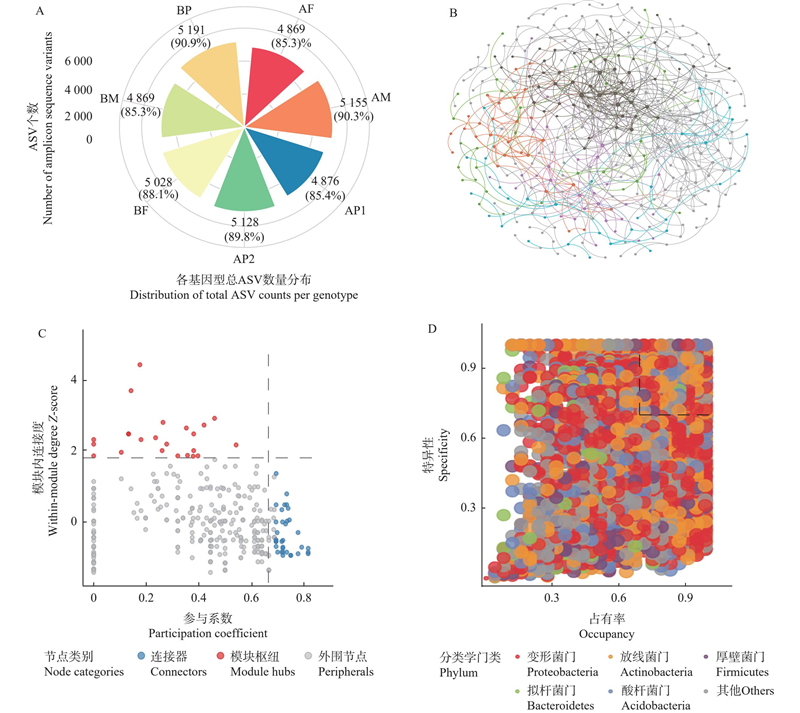
表2
数据集B核心ASV"
| 扩增子序列 变异体Amplicon sequence variant (ASV) | 门 Phylum | 科 Family | 属 Genus |
| ASV_1204 | 放线菌门Actinobacteria | 盖耶拉菌科Gaiellaceae | 盖耶拉菌属 Gaiella |
| ASV_367 | 芽单胞菌门Gemmatimonadetes | 芽单胞菌科Gemmatimonadaceae | — |
| ASV_711 | 酸杆菌门Acidobacteria | — | Gp6 |
| ASV_913 | 变形菌门Proteobacteria | 黄单胞菌科Xanthomonadaceae | 溶杆菌属 Lysobacter |
| ASV_1741 | 放线菌门Actinobacteria | 盖耶拉菌科Gaiellaceae | 盖耶拉菌属 Gaiella |
| ASV_744 | 酸杆菌门Acidobacteria | 芽链菌科Blastocatellaceae | 土微菌属 Tellurimicrobium |
| ASV_567 | 变形菌门Proteobacteria | 科夫勒菌科Kofleriaceae | 科夫勒菌属 Kofleria |

图3
跨数据集核心菌群识别 A和C:数据集A和B中核心扩增子序列变体在宿主基因型中的平均相对丰度 Average relative abundance of the core amplicon sequence variants (ASVs) across host genotypes in dataset A (A) and dataset B (C);B和D:数据集A和B中核心ASV在共现网络中的节点位置 Node positions of the core ASVs in the co-occurrence network of dataset A (B) and dataset B (D);E和F:数据集A和B中由3种方法(高频共有、非外围节点、特化)筛选的候选核心ASV的UpSet图 UpSet plots of candidate core ASVs screened by three methods (high-frequency shared, non-peripheral nodes, and specialists) in datasetA (E) and dataset B (F)."


图4
核心类群ASV_440和ASV_711丰度特征、共现网络及其与群落内聚力的关联"


图5
核心菌群的功能预测 A和C:数据集A和B中差异最显著的前20个KEGG通路的气泡图。Bubble plot of the top 20 most significantly differential KEGG pathways in Dataset A (A) and Dataset B (C). B和D:ASV_440和ASV_711功能丰度前10的KEGG通路条形图。Bar plot of the top 10 KEGG pathways with the highest functional abundance in ASV_440 (B) and ASV_711 (D)."

|
康向阳. 关于我国林木育种向智能分子设计育种发展的思考. 北京林业大学学报, 2024, 46 (3): 1- 7.
doi: 10.12171/j.1000-1522.20230338 |
|
|
Kang X Y. Thoughts on the development of forest tree breeding towards intelligent molecular design breeding in China. Journal of Beijing Forestry University, 2024, 46 (3): 1- 7.
doi: 10.12171/j.1000-1522.20230338 |
|
|
李金花. 基于BLUP和GGE双标图的黑杨派无性系生长性状基因型与环境互作效应. 林业科学, 2021, 57 (6): 64- 73.
doi: 10.11707/j.1001-7488.20210607 |
|
|
Li J H. Genotype by environment interaction for growth traits of clones of Populus section Aigeiros based on BLUP and GGE biplot. Scientia Silvae Sinicae, 2021, 57 (6): 64- 73.
doi: 10.11707/j.1001-7488.20210607 |
|
|
栗卢瑞, 文俊明, 林 波, 等. 宏基因组学检测技术在土壤微生物群落物种及功能多样性研究中的应用. 植物医学, 2024, 3 (5): 1- 7.
doi: 10.13718/j.cnki.zwyx.2024.05.001 |
|
|
Li L R, Wen J M, Lin B, et al. Application of metagenomic technique in the study of species and functional diversity of soil microbial communities. Plant Health and Medicine, 2024, 3 (5): 1- 7.
doi: 10.13718/j.cnki.zwyx.2024.05.001 |
|
| 李 振. 2024. 基因组学在林木遗传育种领域的应用与展望. 河南农业, (22): 39–41. | |
| Li Z. 2024. Application and prospect of genomics in forest genetic breeding field. Agriculture of Henan, (22): 39–41. [in Chinese] | |
|
廖小龙, 古丽娜尔·吐尔孙, 李 斌, 等. 黑杨派和青杨派杨树杂交种质全基因组的遗传变异规律. 东北林业大学学报, 2026, 54 (1): 9- 16, 60.
doi: 10.3969/j.issn.1000-5382.2026.01.003 |
|
|
Liao X L, Gulnar Tursun, Li B, et al. Genetic variation patterns in the whole genome of hybrid germplasm between Populus sect. Aigeiros and Populus sect. Tacamahaca. Journal of Northeast Forestry University, 2026, 54 (1): 9- 16, 60.
doi: 10.3969/j.issn.1000-5382.2026.01.003 |
|
|
刘少芳, 王若愚. 植物根际促生细菌提高植物耐盐性研究进展. 中国沙漠, 2019, 39 (2): 1- 12.
doi: 10.7522/j.issn.1000-694X.2018.00029 |
|
|
Liu S F, Wang R Y. Advance in research on plant salt tolerance improved by plant-growth-promoting rhizobacteria. Journal of Desert Research, 2019, 39 (2): 1- 12.
doi: 10.7522/j.issn.1000-694X.2018.00029 |
|
|
王光华, 刘俊杰, 于镇华, 等. 土壤酸杆菌门细菌生态学研究进展. 生物技术通报, 2016, 32 (2): 14- 20.
doi: 10.13560/j.cnki.biotech.bull.1985.2016.02.002 |
|
|
Wang G H, Liu J J, Yu Z H, et al. Research progress of Acidobacteria ecology in soils. Biotechnology Bulletin, 2016, 32 (2): 14- 20.
doi: 10.13560/j.cnki.biotech.bull.1985.2016.02.002 |
|
| 王 宇, 王毅敏, 高 晗, 等. 不同树龄珙桐根际和根内微生物的群落特征及构建机制. 生物技术通报, 2026, 42 (5): 158- 173. | |
| Wang Y, Wang Y M, Gao H, et al. Characteristics and assembly mechanisms of rhizosphere and root endosphere microbial communities in Davidia involucrata of different ages. Biotechnology Bulletin, 2026, 42 (5): 158- 173. | |
|
杨海莲, 孙晓璐, 宋 未. 植物根际促生细菌和内生细菌的诱导抗病性的研究进展. 植物病理学报, 2000, 30 (2): 106- 110.
doi: 10.3321/j.issn:0412-0914.2000.02.002 |
|
|
Yang H L, Sun X L, Song W. Research progress on induced disease resistance of plant rhizosphere growth-promoting bacteria and endophytic bacteria. Acta Phytopathologica Sinica, 2000, 30 (2): 106- 110.
doi: 10.3321/j.issn:0412-0914.2000.02.002 |
|
| 郑 雷, 郑棋腾, 张天骄, 等. 构建根际合成微生物菌群促进作物养分高效吸收利用. 合成生物学, 2025, 6 (5): 1058- 1071. | |
| Zheng L, Zheng Q T, Zhang T J, et al. Engineering rhizosphere synthetic microbial communities to enhance crop nutrient use efficiency. Synthetic Biology Journal, 2025, 6 (5): 1058- 1071. | |
|
周洁尘, 肖亚琴, 段 翔, 等. 不同林分类型下花榈木根系细菌群落多样性分析及其功能预测. 中南林业科技大学学报, 2025, 45 (2): 112- 121.
doi: 10.14067/j.cnki.1673-923x.2025.02.011 |
|
|
Zhou J C, Xiao Y Q, Duan X, et al. Diversity analysis and function prediction of bacterial community in root system of Ormosia henryi under different stand types. Journal of Central South University of Forestry & Technology, 2025, 45 (2): 112- 121.
doi: 10.14067/j.cnki.1673-923x.2025.02.011 |
|
|
周星鲁, 张 磊, 李清河, 等. 美洲黑杨杂交子代生长及材性性状遗传变异分析. 林业科学, 2026, 62 (4): 130- 141.
doi: 10.11707/j.1001-7488.LYKX20250614 |
|
|
Zhou X L, Zhang L, Li Q H, et al. Genetic variation in growth and wood property traits from hybrid progenies of Populus deltoides. Scientia Silvae Sinicae, 2026, 62 (4): 130- 141.
doi: 10.11707/j.1001-7488.LYKX20250614 |
|
| Banerjee S, Schlaeppi K, van der Heijden M G A. Keystone taxa as drivers of microbiome structure and functioning. Nature Reviews Microbiology, 2018, 16 (9): 567- 576. | |
| Bastian M, Heymann S, Jacomy M. Gephi: an open source software for exploring and manipulating networks. Proceedings of the International AAAI Conference on Web and Social Media, 2009, 3 (1): 361- 362. | |
| Berry D, Widder S. Deciphering microbial interactions and detecting keystone species with co-occurrence networks. Frontiers in Microbiology, 2014, 5, 219. | |
|
Blondel V D, Guillaume J L, Lambiotte R, et al. Fast unfolding of communities in large networks. Journal of Statistical Mechanics: Theory and Experiment, 2008, 2008 (10): P10008.
doi: 10.1088/1742-5468/2008/10/P10008 |
|
|
Busby P E, Soman C, Wagner M R, et al. Research priorities for harnessing plant microbiomes in sustainable agriculture. PLoS Biology, 2017, 15 (3): e2001793.
doi: 10.1371/journal.pbio.2001793 |
|
|
Clauset A, Newman M E J, Moore C. Finding community structure in very large networks. Physical Review E, 2004, 70 (6): 066111.
doi: 10.1103/PhysRevE.70.066111 |
|
|
Cole J R, Wang Q, Fish J A, et al. Ribosomal database project: data and tools for high throughput rRNA analysis. Nucleic Acids Research, 2014, 42 (D1): D633- D642.
doi: 10.1093/nar/gkt1244 |
|
|
Conway J R, Lex A, Gehlenborg N. UpSetR: an R package for the visualization of intersecting sets and their properties. Bioinformatics, 2017, 33 (18): 2938- 2940.
doi: 10.1093/bioinformatics/btx364 |
|
|
Du Y, Yang Y, Wu S N, et al. Core microbes regulate plant-soil resilience by maintaining network resilience during long-term restoration of alpine grasslands. Nature Communications, 2025, 16, 3116.
doi: 10.1038/s41467-025-58080-2 |
|
| Dufrêne M, Legendre P. Species assemblages and indicator species: the need for a flexible asymmetrical approach. Ecological Monographs, 1997, 67 (3): 345- 366. | |
| Edgar R C. 2016. UNOISE2: improved error-correction for Illumina 16S and ITS amplicon sequencing. BioRxiv, 081257. | |
|
Finkel O M, Salas-González I, Castrillo G, et al. A single bacterial genus maintains root growth in a complex microbiome. Nature, 2020, 587 (7832): 103- 108.
doi: 10.1038/s41586-020-2778-7 |
|
|
Gao Z Y, Hu Y Y, Han M K, et al. Effects of continuous cropping of sweet potatoes on the bacterial community structure in rhizospheric soil. BMC Microbiology, 2021, 21 (1): 102.
doi: 10.1186/s12866-021-02120-6 |
|
|
Gloor G B, Macklaim J M, Pawlowsky-Glahn V, et al. Microbiome datasets are compositional: and this is not optional. Frontiers in Microbiology, 2017, 8, 2224.
doi: 10.3389/fmicb.2017.02224 |
|
|
Gweon H S, Bowes M J, Moorhouse H L, et al. Contrasting community assembly processes structure lotic bacteria metacommunities along the river continuum. Environmental Microbiology, 2021, 23 (1): 484- 498.
doi: 10.1111/1462-2920.15337 |
|
|
Hamonts K, Trivedi P, Garg A, et al. Field study reveals core plant microbiota and relative importance of their drivers. Environmental Microbiology, 2018, 20 (1): 124- 140.
doi: 10.1111/1462-2920.14031 |
|
|
Herren C M, McMahon K D. Cohesion: a method for quantifying the connectivity of microbial communities. The ISME Journal, 2017, 11 (11): 2426- 2438.
doi: 10.1038/ismej.2017.91 |
|
|
Holm J B, Paragkamian S, Humphreys M, et al. First island-wide, single-day soil collection study on Crete reveals environmental drivers of microbial diversity. Environmental Microbiome, 2025, 20 (1): 94.
doi: 10.1186/s40793-025-00752-z |
|
|
Hu J, Chen J W, Ma L B, et al. Characterizing core microbiota and regulatory functions of the pig gut microbiome. The ISME Journal, 2024, 18 (1): wrad037.
doi: 10.1093/ismejo/wrad037 |
|
|
Jiang Y J, Li S Z, Li R P, et al. Plant cultivars imprint the rhizosphere bacterial community composition and association networks. Soil Biology and Biochemistry, 2017, 109, 145- 155.
doi: 10.1016/j.soilbio.2017.02.010 |
|
|
Jousset A, Bienhold C, Chatzinotas A, et al. Where less may be more: how the rare biosphere pulls ecosystems strings. The ISME Journal, 2017, 11 (4): 853- 862.
doi: 10.1038/ismej.2016.174 |
|
|
Kalam S, Basu A, Ahmad I, et al. Recent understanding of soil acidobacteria and their ecological significance: a critical review. Frontiers in Microbiology, 2020, 11, 580024.
doi: 10.3389/fmicb.2020.580024 |
|
|
Laine M B, Taipale S J, Tiirola M. Comparison of methods for assessing fungi-to-bacteria ratio of soil. Biology and Fertility of Soils, 2025, 61 (5): 941- 954.
doi: 10.1007/s00374-025-01911-7 |
|
|
Ling N, Wang T T, Kuzyakov Y. Rhizosphere bacteriome structure and functions. Nature Communications, 2022, 13, 836.
doi: 10.1038/s41467-022-28448-9 |
|
|
Lu D C, Wang F Q, Amann R I, et al. Epiphytic common core bacteria in the microbiomes of co-located green (Ulva), brown (Saccharina) and red (Grateloupia, Gelidium) macroalgae. Microbiome, 2023, 11 (1): 126.
doi: 10.1186/s40168-023-01559-1 |
|
|
Maillard F, Klinghammer F, Beatty B H, et al. Keystone protist suppression triggers mesopredator release and biotic homogenization in complex soil microbial communities. The ISME Journal, 2025, 19 (1): wraf253.
doi: 10.1093/ismejo/wraf253 |
|
|
Matias M G, Combe M, Barbera C, et al. Ecological strategies shape the insurance potential of biodiversity. Frontiers in Microbiology, 2012, 3, 432.
doi: 10.3389/fmicb.2012.00432 |
|
|
Matthews A, Pierce S, Hipperson H, et al. Rhizobacterial community assembly patterns vary between crop species. Frontiers in Microbiology, 2019, 10, 581.
doi: 10.3389/fmicb.2019.00581 |
|
|
Oña L, Giri S, Avermann N, et al. Obligate cross-feeding expands the metabolic niche of bacteria. Nature Ecology & Evolution, 2021, 5 (9): 1224- 1232.
doi: 10.1038/s41559-021-01505-0 |
|
|
Park J, Davis K, Lajoie G, et al. Alternative approaches to identify core bacteria in Fucus distichus microbiome and assess their distribution and host-specificity. Environmental Microbiome, 2022, 17 (1): 55.
doi: 10.1186/s40793-022-00451-z |
|
|
Prodan A, Tremaroli V, Brolin H, et al. Comparing bioinformatic pipelines for microbial 16S rRNA amplicon sequencing. PLoS One, 2020, 15 (1): e0227434.
doi: 10.1371/journal.pone.0227434 |
|
|
Puente-Sánchez F, Pascual-García A, Bastolla U, et al. Cross-biome microbial networks reveal functional redundancy and suggest genome reduction through functional complementarity. Communications Biology, 2024, 7, 1046.
doi: 10.1038/s42003-024-06616-5 |
|
|
Qiao Y Z, Wang Z D, Sun H, et al. Synthetic community derived from grafted watermelon rhizosphere provides protection for ungrafted watermelon against Fusarium oxysporum via microbial synergistic effects. Microbiome, 2024a, 12 (1): 101.
doi: 10.1186/s40168-024-01814-z |
|
| Qiao Y Z, Wang T T, Huang Q W, et al. 2024b. Core species impact plant health by enhancing soil microbial cooperation and network complexity during community coalescence. Soil Biology and Biochemistry, 188. | |
| Ramirez K S, Knight C G, de Hollander M, et al. Detecting macroecological patterns in bacterial communities across independent studies of global soils. Nature Microbiology, 2018, 3 (2): 189- 196. | |
|
Rawstern A H, Hernandez D J, Afkhami M E. Central taxa are keystone microbes during early succession. Ecology Letters, 2025, 28 (1): e70031.
doi: 10.1111/ele.70031 |
|
|
Rognes T, Flouri T, Nichols B, et al. VSEARCH: a versatile open source tool for metagenomics. PeerJ, 2016, 4, e2584.
doi: 10.7717/peerj.2584 |
|
|
Ruan Z P, Chen K, Cao W M, et al. Engineering natural microbiomes toward enhanced bioremediation by microbiome modeling. Nature Communications, 2024, 15, 4694.
doi: 10.1038/s41467-024-49098-z |
|
|
Shade A, Stopnisek N. Abundance-occupancy distributions to prioritize plant core microbiome membership. Current Opinion in Microbiology, 2019, 49, 50- 58.
doi: 10.1016/j.mib.2019.09.008 |
|
|
Sun S, Jones R B, Fodor A A. Inference-based accuracy of metagenome prediction tools varies across sample types and functional categories. Microbiome, 2020, 8 (1): 46.
doi: 10.1186/s40168-020-00815-y |
|
|
Trivedi P, Leach J E, Tringe S G, et al. Plant–microbiome interactions: from community assembly to plant health. Nature Reviews Microbiology, 2020, 18 (11): 607- 621.
doi: 10.1038/s41579-020-0412-1 |
|
|
Wang L X, Han M Z, Li X, et al. Mechanisms of niche-neutrality balancing can drive the assembling of microbial community. Molecular Ecology, 2021, 30 (6): 1492- 1504.
doi: 10.1111/mec.15825 |
|
| Wang X W, Sun Z, Jia H J, et al. Identifying keystone species in microbial communities using deep learning. Nature Ecology & Evolution, 2024, 8 (1): 22- 31. | |
| Weiss S, Van Treuren W, Lozupone C, et al. Correlation detection strategies in microbial data sets vary widely in sensitivity and precision. The ISME Journal, 2016, 10 (7): 1669- 1681. | |
| Wickham H. 2016. Data analysis. ggplot2: Elegant graphics for data analysis. Cham: Springer. | |
| Wu G J, Xu T, Zhao N S, et al. 2024. A core microbiome signature as an indicator of health. Cell, 187(23): 6550–6565. | |
|
Yan K, Lu D S, Ding C J, et al. Rare and abundant bacterial communities in poplar rhizosphere soils respond differently to genetic effects. Science of the Total Environment, 2024, 908, 168216.
doi: 10.1016/j.scitotenv.2023.168216 |
|
|
Yang C, Mai J H, Cao X, et al. ggpicrust2: an R package for PICRUSt2 predicted functional profile analysis and visualization. Bioinformatics, 2023, 39 (8): btad470.
doi: 10.1093/bioinformatics/btad470 |
|
|
Yang Y Z, Li Y, Hao K, et al. Microbial community composition and co-occurrence network analysis of the rhizosphere soil of the main constructive tree species in Helan Mountain of Northwest China. Scientific Reports, 2024, 14, 24557.
doi: 10.1038/s41598-024-76195-2 |
|
|
Yuan B, Wang S L. Microbiome data integration via shared dictionary learning. Nature Communications, 2025, 16, 8147.
doi: 10.1038/s41467-025-63425-y |
|
|
Yue H, Yue W J, Jiao S, et al. Plant domestication shapes rhizosphere microbiome assembly and metabolic functions. Microbiome, 2023, 11 (1): 70.
doi: 10.1186/s40168-023-01513-1 |
|
|
Zhou H J, He K J, Chen J, et al. LinDA: linear models for differential abundance analysis of microbiome compositional data. Genome Biology, 2022, 23 (1): 95.
doi: 10.1186/s13059-022-02655-5 |
|
|
Zhu Q L, Yan K, Wang N Z, et al. The structure and assembly of rhizobacterial communities are influenced by poplar genotype. Frontiers in Microbiology, 2022, 13, 1052567.
doi: 10.3389/fmicb.2022.1052567 |
| [1] | 秦媛, 潘雪玉, 靳微, 陈连庆, 袁志林. 杨树人工林土壤微生物群落4种提取方法比较[J]. 林业科学, 2018, 54(9): 169-176. |
| 阅读次数 | ||||||
|
全文 |
|
|||||
|
摘要 |
|
|||||

