
林业科学 ›› 2026, Vol. 62 ›› Issue (10): 82-92.doi: 10.11707/j.1001-7488.LYKX20260068
毛阳骏1,2,马立帮1,2,郭昊天2,3,李同欣1,2,王懿祥1,2,*( )
)
收稿日期:2026-01-29
修回日期:2026-06-30
出版日期:2026-10-10
发布日期:2026-10-17
通讯作者:
王懿祥
E-mail:wangyixiang@zafu.edu.cn
基金资助:
Yangjun Mao1,2,Libang Ma1,2,Haotian Guo2,3,Tongxin Li1,2,Yixiang Wang1,2,*()
Received:2026-01-29
Revised:2026-06-30
Online:2026-10-10
Published:2026-10-17
Contact:
Yixiang Wang
E-mail:wangyixiang@zafu.edu.cn
摘要:
目的: 构建浙江省马尾松天然林枯损与进界模型,分析影响林分动态的关键因素,为该地区马尾松林的可持续经营提供理论依据。方法: 基于浙江省第五次(1994 年)、第六次(1999 年)、第七次(2004 年)和第八次(2009 年)森林资源连续清查固定样地数据,筛选出马尾松天然林样地389 块,其中311 块作为模拟样本、78 块作为检验样本。采用Kendall’s tau-b相关系数筛选林分与立地因子,分别构建泊松模型(Poisson)、负二项模型(NB)、零膨胀泊松模型(ZIP)、零膨胀负二项模型(ZINB)、Hurdle-泊松模型(HP)和Hurdle-负二项模型(HNB)共6类广义线性模型,对林分枯损与进界过程进行拟合与比较。利用赤池信息准则(AIC)、贝叶斯信息准则(BIC)、–2倍对数似然函数值(–2logL)和Vuong检验比较各模型间的拟合效果,选取平均绝对误差(MAE)和均方根误差(RMSE)评价其预测效果。结果: 1) ZINB模型在枯损与进界模拟中表现最优;2) 负二项系列模型(NB、ZINB、HNB)在拟合效果上显著优于相应的泊松系列模型(Poisson、ZIP、HP),ZIP与HP模型拟合效果相当,ZINB模型拟合效果略优于HNB模型;3) 林分枯损主要受林分密度、林分胸高断面积、阔叶树胸高断面积和海拔的影响;4) 林分进界主要受林分密度、林分胸高断面积和阔叶树胸高断面积的影响,立地因子对进界无显著影响。结论: 林分密度是调控枯损与进界过程的核心变量,但其作用方向相反;阔叶树组成增加有助于降低马尾松林枯损风险并促进更新。建议在马尾松林实际经营中合理控制林分密度并适当补植阔叶树种,从而维持马尾松林的长期健康与生产力。
中图分类号:
毛阳骏,马立帮,郭昊天,李同欣,王懿祥. 浙江省马尾松天然林枯损与进界模型构建及影响因素分析[J]. 林业科学, 2026, 62(10): 82-92.
Yangjun Mao,Libang Ma,Haotian Guo,Tongxin Li,Yixiang Wang. Model Construction and Influencing Factors Analysis of Mortality and Ingrowth for Natural Pinus massoniana Forests in Zhejiang Province[J]. Scientia Silvae Sinicae, 2026, 62(10): 82-92.

表1
马尾松固定样地枯损与进界情况汇总"
| 调查期次 Inventory round | 样地数 Number of plots | 枯损发生样地数 Plots with mortality | 进界发生样地数 Plots with ingrowth | 总样木数 Number of trees | 总枯损株数 Mortality stem count | 总进界株数 Ingrowth stem count | 年均枯损率 Annual mortality rate (%) | 年均进界率 Annual ingrowth rate (%) |
| 第六次6th (1999) | 93 | 6 | 32 | 7 670 | 111 | 333 | 0.29 | 0.87 |
| 第七次7th (2004) | 104 | 44 | 59 | 8 880 | 421 | 618 | 0.95 | 1.39 |
| 第八次8th (2009) | 192 | 113 | 130 | 18 740 | 1 135 | 1 597 | 1.21 | 1.70 |
| 总计/平均 Total/mean | 389 | 163 | 221 | 35 290 | 1 667 | 2 548 | 0.94 | 1.44 |
表2
林分变量因子统计"
| 变量 Variable | 变量符号 Variable symbol | 平均值 Mean | 标准差 Std. | 最小值 Min. | 最大值 Max. |
| 林分平均年龄Stand mean age/a | A | 22.39 | 6.42 | 6 | 42 |
| 林分密度Stand density/(trees·hm–2) | N | 666 | 250 | 4 650 | |
| 林分平均高Stand mean height/m | Hd | 7.56 | 2.38 | 3.5 | 15.8 |
| 林分平方平均胸径Stand quadratic mean diameter at breast height/cm | Dg | 10.49 | 2.79 | 6.19 | 23.1 |
| 林分算术平均胸径Stand arithmetic mean diameter at breast height/cm | Dm | 9.92 | 2.54 | 6.13 | 21.47 |
| 林分胸高断面积Stand basal area/(m2·hm–2) | G | 10.04 | 6.79 | 0.86 | 47.65 |
| 阔叶树胸高断面积 Broadleaved basal area/(m2·hm–2) | Gb | 0.81 | 1.44 | 0 | 10.5 |
| 阔叶树胸高断面积占比Proportion of broadleaved basal area (%) | Pb | 7.17 | 8.83 | 0 | 41.1 |
| 海拔Elevation/ m | EL | 318.55 | 190.54 | 40 | 830 |
| 坡度Slope/(°) | SL | 28.76 | 9.57 | 0 | 75 |
| 土层厚度Soil depth/cm | SD | 41.43 | 13.45 | 2 | 100 |
| 林分枯损株数Stand mortality stem count/(trees·hm–2) | MC | 53.57 | 105.70 | 0 | 613 |
| 林分进界株数Stand ingrowth stem count/(trees·hm–2) | IC | 81.88 | 133.94 | 0 | 738 |
表3
林分枯损及进界株数与各变量的Kendall’s tau-b相关性"
| 变量 Variable | 变量符号 Variable symbol | 相关系数(林分枯损株数) Correlation with stand mortality stem count | 相关系数(林分进界株数) Correlation with stand ingrowth stem count |
| 林分平均年龄Stand mean age/a | A | 0.10 | –0.04 |
| 林分密度Stand density/(trees·hm–2) | N | 0.27 | –0.17 |
| 林分平均高Stand mean height/m | Hd | 0.07 | –0.07 |
| 林分平方平均胸径Stand quadratic mean diameter at breast height/cm | Dg | 0.10 | –0.09 |
| 林分算术平均胸径Stand arithmetic mean diameter at breast height/cm | Dm | 0.09 | –0.10 |
| 林分胸高断面积Stand basal area/(m2·hm–2) | G | 0.28 | –0.12 |
| 阔叶树胸高断面积 Broadleaved basal area/(m2·hm–2) | Gb | 0.13 | –0.12 |
| 阔叶树胸高断面积占比Proportion of broadleaved basal area (%) | Pb | 0.05 | –0.06 |
| 海拔Elevation/ m | EL | –0.07 | –0.02 |
| 坡度Slope/(°) | SL | –0.05 | 0.01 |
| 土层厚度Soil depth/cm | SD | 0.06 | 0.03 |
表4
Poisson模型和NB模型参数估计及评价统计量①"
| 类别 Class | 参数 Parameter | Poisson模型 Poisson model | NB模型 NB model |
| 林分枯损 模型 Stand mortality model | 截距 Intercept | 2.100 5 (0.018 4)*** | –0.387 6 (0.338 8) |
| N | 0.001 0 (0.000 1)*** | 0.002 0 (0.000 3)*** | |
| G | 0.080 5 (0.000 9)*** | 0.157 5 (0.031 9)*** | |
| Gb | –0.186 9 (0.004 0)*** | –0.224 8 (0.113 4)* | |
| EL | –0.001 3 (0.000 1)*** | –0.001 2 (0.000 6)* | |
| θ | — | 6.900 2 (0.650 8)*** | |
| AIC | 29 126.97 | 2 467.22 | |
| BIC | 29 145.67 | 2 489.66 | |
| –2logL | 29 116.97 | 2 455.22 | |
| 林分进界 模型 Stand ingrowth model | 截距 Intercept | 6.210 9 ( | 7.399 0 (0.284 9)*** |
| N | –0.001 3 (0.000 1)*** | –0.002 0 (0.000 2)*** | |
| G | –0.124 3 (0.002 1)*** | –0.253 2 (0.026 1)*** | |
| Gb | 0.272 5 (0.006 9)*** | 0.922 8 (0.120 8)*** | |
| θ | — | 3.731 9 (0.314 0)*** | |
| AIC | 35 023.81 | 3 128.70 | |
| BIC | 35 038.77 | 3 147.40 | |
| –2logL | 35 015.81 | 3 118.70 |
表5
零膨胀模型和Hurdle模型参数估计及评价统计量①"
| 类别Class | 参数Parameter | ZIP模型ZIP model | ZINB模型ZINB model | HP模型HP model | HNB模型HNB model |
| 林分枯损模型 Stand mortality model | 计数部分Count component | ||||
| 截距Intercept | 3.637 3 (0.022 3)*** | 3.525 4 (0.224 6)*** | 3.637 3 (0.022 3)*** | 3.532 8 (0.222 8)*** | |
| N | 0.000 5 (0.000 1)*** | 0.000 6 (0.000 1)*** | 0.000 5 (0.000 1)*** | 0.000 6 (0.000 1)*** | |
| G | 0.043 7 (0.001 0)*** | 0.044 6 (0.011 9)*** | 0.043 7 (0.001 0)*** | 0.044 4 (0.011 8)*** | |
| Gb | ?0.112 6 (0.004 2)*** | ?0.092 1 (0.038 7)* | ?0.112 6 (0.004 2)*** | ?0.091 8 (0.038 3)* | |
| EL | ?0.000 8 (0.000 1)*** | ?0.000 8 (0.000 3)* | ?0.000 8 (0.000 1)*** | ?0.000 8 (0.000 3)* | |
| θ | — | 0.738 1 (0.078 1)*** | — | 0.738 1 (0.078 1)*** | |
| 零部分Zero component | |||||
| 截距Intercept | 6.663 8 (0.676 1)*** | 6.654 7 (0.677 3)*** | ?6.663 7 (0.676 1)*** | ?6.663 7 (0.676 1)*** | |
| N | ?0.003 1 (0.000 4)*** | ?0.003 1 (0.000 4)*** | 0.003 1 (0.000 4)*** | 0.003 1 (0.000 4)*** | |
| G | ?0.326 0 (0.048 4)*** | ?0.326 1 (0.048 6)*** | 0.326 0 (0.048 4)*** | 0.326 0 (0.048 4)*** | |
| Gb | 0.645 8 (0.156 5)*** | 0.645 3 (0.157 4)*** | ?0.645 8 (0.156 5)*** | ?0.645 8 (0.156 5)*** | |
| AIC | 14 745.58 | 2 118.74 | 14 745.58 | 2 118.77 | |
| BIC | 14 779.24 | 2 156.14 | 14 779.24 | 2 156.17 | |
| –2logL | 14 727.58 | 2 098.74 | 14 727.58 | 2 098.77 | |
| 林分进界模型 Stand ingrowth model | 计数部分Count component | ||||
| 截距Intercept | 5.748 6 (0.013 0)*** | 5.703 0 (0.121 6)*** | 5.748 6 ( | 5.702 0 (0.120 7)*** | |
| N | –0.001 1 (0.000 1)*** | –0.001 1 (0.000 2)*** | –0.001 1 (0.000 1)*** | –0.001 1 (0.000 2)*** | |
| Gb | 0.048 7 (0.006 6)*** | 0.109 9 (0.045 8)* | 0.048 7 (0.006 6)*** | 0.108 5 (0.045 2)* | |
| θ | — | 0.780 7 (0.070 7)*** | — | 0.780 7 (0.070 7)*** | |
| 零部分Zero component | |||||
| 截距Intercept | –6.249 9 (0.652 8)*** | –6.262 2 (0.657 6)*** | 6.249 8 (0.652 8)*** | 6.249 8 (0.652 8)*** | |
| N | 0.002 0 (0.000 4)*** | 0.002 0 (0.000 4)*** | –0.002 0 (0.000 4)*** | –0.002 0 (0.000 4)*** | |
| G | 0.485 3 (0.059 7)*** | 0.485 9 (0.059 9)*** | –0.485 3 (0.059 7)*** | –0.485 3 (0.059 7)*** | |
| Gb | –1.303 4 (0.180 3)*** | –1.304 3 (0.181 3)*** | 1.303 4 (0.180 3)*** | 1.303 4 (0.180 3)*** | |
| AIC | 23 719.56 | 2 817.24 | 23 719.56 | 2 817.29 | |
| BIC | 23 745.74 | 2 847.16 | 23 745.74 | 2 847.21 | |
| –2logL | 23 705.56 | 2 801.24 | 23 705.56 | 2 801.29 | |
表6
Vuong检验结果"
| 类别 Class | 模型A Model A | 模型B Model B | Vuong检验值 Vuong test statistic | P | 较优模型 Preferred model |
| 林分枯损模型 Stand mortality model | Poisson | NB | –7.87 | <0.01 | NB |
| ZIP | ZINB | –5.86 | <0.01 | ZINB | |
| HP | HNB | –5.86 | <0.01 | HNB | |
| HNB | ZINB | –0.07 | >0.05 | ZINB | |
| 林分进界模型 Stand ingrowth model | Poisson | NB | –12.24 | <0.01 | NB |
| ZIP | ZINB | –9.72 | <0.01 | ZINB | |
| HP | HNB | –9.72 | <0.01 | HNB | |
| HNB | ZINB | –0.09 | >0.05 | ZINB |
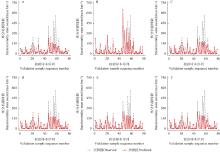
图1
林分枯损模型检验样本预测值与实测值对比 A:泊松模型Poisson model;B:负二项模型Negative binomial model;C:零膨胀泊松模型Zero-inflated Poisson model;D:零膨胀负二项模型Zero-inflated negative binomial model;E:Hurdle-泊松模型Hurdle-Poisson model;F:Hurdle-负二项模型Hurdle-negative binomial model."
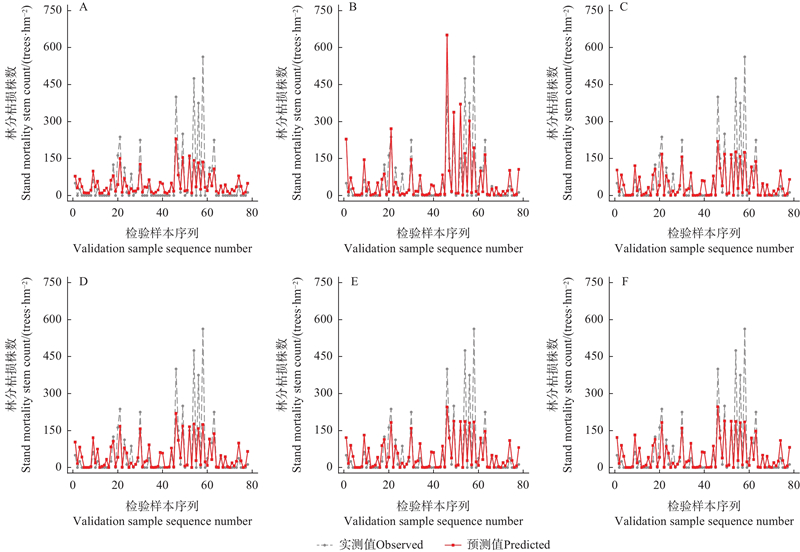
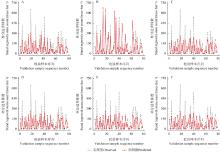
图2
林分进界模型检验样本预测值与实测值对比 A:泊松模型Poisson model;B:负二项模型Negative binomial model;C:零膨胀泊松模型Zero-inflated Poisson model;D:零膨胀负二项模型Zero-inflated negative binomial model;E:Hurdle-泊松模型Hurdle-Poisson model;F:Hurdle-负二项模型Hurdle-negative binomial model."
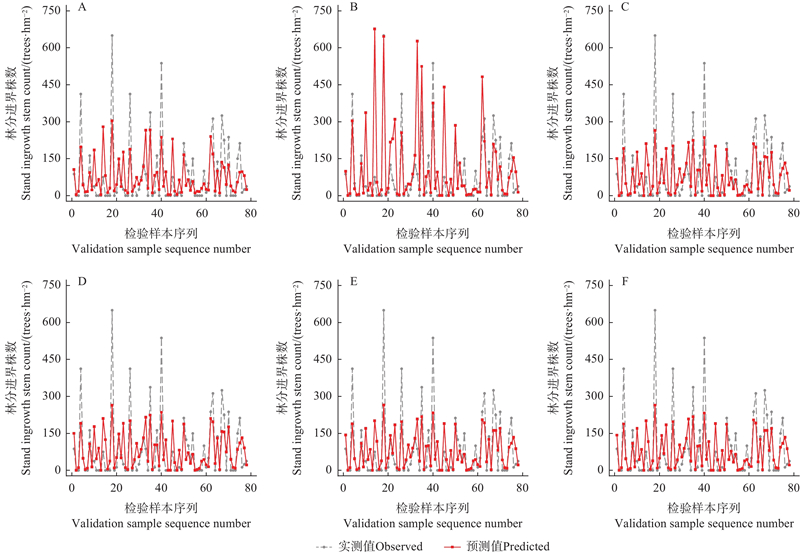
表7
模型检验结果"
| 类别 Class | 模型 Model | 指标Index | |
| 均方根误差 RMSE/(trees·hm–2) | 平均绝对误差 MAE/(trees·hm–2) | ||
| 林分枯损模型 Stand mortality model | Poisson | 79.111 2 | 42.385 9 |
| NB | 78.319 9 | 39.829 5 | |
| ZIP | 73.133 3 | 37.051 3 | |
| ZINB | 70.703 9 | 36.996 2 | |
| HP | 73.133 3 | 37.051 3 | |
| HNB | 70.784 4 | 37.006 4 | |
| 林分进界模型 Stand ingrowth model | Poisson | 91.501 9 | 59.324 4 |
| NB | 129.937 8 | 70.585 9 | |
| ZIP | 90.840 2 | 57.537 2 | |
| ZINB | 89.934 2 | 56.620 5 | |
| HP | 90.840 2 | 57.537 2 | |
| HNB | 89.936 0 | 56.659 0 | |
|
冯益明, 张海军, 吕 全, 等. 松材线虫病在我国适生性分布的定量估计. 林业科学, 2009, 45 (2): 65- 71.
doi: 10.3321/j.issn:1001-7488.2009.02.012 |
|
|
Feng Y M, Zhang H J, Lü Q, et al. Quantification of suitability distribution region of Bursaphelenchus xylophilus in China. Scientia Silvae Sinicae, 2009, 45 (2): 65- 71.
doi: 10.3321/j.issn:1001-7488.2009.02.012 |
|
|
何 江, 覃 林. 气候敏感的杉木天然林林分进界模型. 林业科学, 2025, 61 (1): 70- 80.
doi: 10.11707/j.1001-7488.LYKX20230538 |
|
|
He J, Qin L. Climate-sensitive tree recruitment model for natural Cunninghamia lanceolata forests. Scientia Silvae Sinicae, 2025, 61 (1): 70- 80.
doi: 10.11707/j.1001-7488.LYKX20230538 |
|
| 李春明, 李利学. 基于零膨胀模型及混合效应模型相结合的蒙古栎林林木进界模拟研究. 北京林业大学学报, 2020, 42 (6): 59- 67. | |
| Li C M, Li L X. Simulating study on tree recruitment of Quercus mongolica based on zero-inflated model and mixed effect model methods. Journal of Beijing Forestry University, 2020, 42 (6): 59- 67. | |
|
刘佳琦, 董利虎, 苗 铮. 帽儿山天然林进界模型及影响因素分析. 森林工程, 2025, 41 (5): 871- 882.
doi: 10.7525/j.issn.1006-8023.2025.05.001 |
|
|
Liu J Q, Dong L H, Miao Z. Analysis of the ingrowth model and influencing factors for the natural forests of Mao’er Mountain. Forest Engineering, 2025, 41 (5): 871- 882.
doi: 10.7525/j.issn.1006-8023.2025.05.001 |
|
|
刘 军, 潘 萍, 欧阳勋志, 等. 基于零膨胀模型和栅栏模型的赣南杉木林林分枯损模型. 江西农业大学学报, 2022, 44 (6): 1428- 1437.
doi: 10.13836/j.jjau.2022140 |
|
|
Liu J, Pan P, Ouyang X Z, et al. Stand-level mortality model of Cunninghamia lanceolata forest in southern Jiangxi based on zero-inflated model and hurdle model. Acta Agriculturae Universitatis Jiangxiensis, 2022, 44 (6): 1428- 1437.
doi: 10.13836/j.jjau.2022140 |
|
|
刘 强, 吴志伟, 林世滔, 等. 松材线虫病发生点格局及影响因素. 应用生态学报, 2022, 33 (9): 2530- 2538.
doi: 10.13287/j.1001-9332.202209.030 |
|
|
Liu Q, Wu Z W, Lin S T, et al. Spatial point pattern analysis of pine wilt disease occurrence and its influence factors. Chinese Journal of Applied Ecology, 2022, 33 (9): 2530- 2538.
doi: 10.13287/j.1001-9332.202209.030 |
|
|
马 武, 雷相东, 徐 光, 等. 蒙古栎天然林生长模型的研究: Ⅳ. 进界生长模型. 西北农林科技大学学报(自然科学版), 2015, 43 (5): 58- 64.
doi: 10.13207/j.cnki.jnwafu.2015.05.025 |
|
|
Ma W, Lei X D, Xu G, et al. Growth models for natural Mongolian oak forests: Ⅳ. Recruitment model. Journal of Northwest A& F University (Natural Science Edition), 2015, 43 (5): 58- 64.
doi: 10.13207/j.cnki.jnwafu.2015.05.025 |
|
|
王国明, 赵 颖, 陈 斌, 等. 松材线虫病除治迹地自然恢复过程中物种多样性的动态变化. 浙江林学院学报, 2010, 27 (2): 170- 177.
doi: 10.3969/j.issn.2095-0756.2010.02.002 |
|
|
Wang G M, Zhao Y, Chen B, et al. Species diversity with natural restoration in slash after control of pine wilt disease. Journal of Zhejiang Forestry College, 2010, 27 (2): 170- 177.
doi: 10.3969/j.issn.2095-0756.2010.02.002 |
|
|
吴敏娟, 尤誉杰, 张晓红, 等. 不同干扰模式对受害马尾松人工纯林林分结构的影响. 应用生态学报, 2019, 30 (1): 58- 66.
doi: 10.13287/j.1001-9332.201901.007 |
|
|
Wu M J, You Y J, Zhang X H, et al. Effects of different disturbance patterns on stand structure of infected pure Pinus massoniana plantation. Chinese Journal of Applied Ecology, 2019, 30 (1): 58- 66.
doi: 10.13287/j.1001-9332.201901.007 |
|
|
杨学云, 陈新云. 我国林木枯损量分析及森林经营措施建议. 林业资源管理, 2014 (suppl.1): 48- 50, 55.
doi: 10.13466/j.cnki.lyzygl.2014.S0.012 |
|
|
Yang X Y, Chen X Y. Analysis on mortality volume and measures for forest management. Forest Resources Management, 2014 (suppl.1): 48- 50, 55.
doi: 10.13466/j.cnki.lyzygl.2014.S0.012 |
|
|
叶建仁. 松材线虫病在中国的流行现状、防治技术与对策分析. 林业科学, 2019, 55 (9): 1- 10.
doi: 10.11707/j.1001-7488.20190901 |
|
|
Ye J R. Epidemic status of pine wilt disease in China and its prevention and control techniques and counter measures. Scientia Silvae Sinicae, 2019, 55 (9): 1- 10.
doi: 10.11707/j.1001-7488.20190901 |
|
|
张华锋, 陈思宇, 刘 刚, 等. 松材线虫病疫木卫生伐对马尾松纯林林分结构的影响. 浙江农林大学学报, 2020, 37 (4): 745- 751.
doi: 10.11833/j.issn.2095-0756.20190487 |
|
|
Zhang H F, Chen S Y, Liu G, et al. Effects of sanitation cutting pine wilt diseased trees on the stand structure of pure Pinus massoniana plantation. Journal of Zhejiang A& F University, 2020, 37 (4): 745- 751.
doi: 10.11833/j.issn.2095-0756.20190487 |
|
| 张雄清. 2012. 北京地区油松林分生长、枯损和进界模型的研究. 北京: 中国林业科学研究院. | |
| Zhang X Q. 2012. Modeling forest growth, mortality and recruitment for Chinese Pine in Beijing. Beijing: Chinese Academy of Forestry. [in Chinese] | |
|
赵同谦, 欧阳志云, 郑 华, 等. 中国森林生态系统服务功能及其价值评价. 自然资源学报, 2004, 19 (4): 480- 491.
doi: 10.3321/j.issn:1000-3037.2004.04.010 |
|
|
Zhao T Q, Ouyang Z Y, Zheng H, et al. Forest ecosystem services and their valuation in China. Journal of Natural Resources, 2004, 19 (4): 480- 491.
doi: 10.3321/j.issn:1000-3037.2004.04.010 |
|
|
周泽宇, 冯林艳, 闫星蓉, 等. 华北落叶松人工林林分枯损株数随机效应预测模型. 林业科学, 2022, 58 (10): 67- 78.
doi: 10.11707/j.1001-7488.20221007 |
|
|
Zhou Z Y, Feng L Y, Yan X R, et al. Prediction model of stand mortality of Larix principis-rupprechtii plantation in the core area of winter Olympic games. Scientia Silvae Sinicae, 2022, 58 (10): 67- 78.
doi: 10.11707/j.1001-7488.20221007 |
|
|
Affleck D L. Poisson mixture models for regression analysis of stand-level mortality. Canadian Journal of Forest Research, 2006, 36 (11): 2994- 3006.
doi: 10.1139/x06-189 |
|
|
Al-huqail A A, Islam Z, Al-Harbi H F. Mangroves trend and their impact on surface temperature in Al-Wajh Lagoon: a study aligned with Saudi Arabia’s vision 2030. Frontiers in Environmental Science, 2024, 12, 1439425.
doi: 10.3389/fenvs.2024.1439425 |
|
|
Buijs J, Ragas A M J, Hendriks A J, et al. Correlation between Coleoptera abundance in cattle excrements and pesticide contamination of nature conservation areas grazed by cattle. Science of the Total Environment, 2024, 949, 175030.
doi: 10.1016/j.scitotenv.2024.175030 |
|
|
Buongiorno J, Michie B R. A matrix model of uneven-aged forest management. Forest Science, 1980, 26 (4): 609- 625.
doi: 10.1093/forestscience/26.4.609 |
|
| Cohen J, Cohen P, West S G. et al. 2013. Applied multiple regression/correlation analysis for the behavioral sciences. Routledge. | |
|
Cunningham R B, Lindenmayer D B. Modeling count data of rare species: some statistical issues. Ecology, 2005, 86 (5): 1135- 1142.
doi: 10.1890/04-0589 |
|
|
Eskelson B N I, Temesgen H, Barrett T M. Estimating cavity tree and snag abundance using negative binomial regression models and nearest neighbor imputation methods. Canadian Journal of Forest Research, 2009, 39 (9): 1749- 1765.
doi: 10.1139/X09-086 |
|
| Evans M, Hastings N, Peacock B. 2000. Statistical distributions. New York: John Wiley & Sons. | |
|
Heilbron D C. Zero-altered and other regression models for count data with added Zeros. Biometrical Journal, 1994, 36 (5): 531- 547.
doi: 10.1002/bimj.4710360505 |
|
| Kangas E, Maltamo M. 2006 Forest inventory. Dordrecht: Springer. | |
|
Kendall M G. A new measure of rank correlation. Biometrika, 1938, 30 (1/2): 81- 93.
doi: 10.2307/2332226 |
|
|
Kneeshaw D D, Bergeron Y. Canopy gap characteristics and tree replacement in the southeastern boreal forest. Ecology, 1998, 79 (3): 783- 794.
doi: 10.1890/0012-9658(1998)079[0783:CGCATR]2.0.CO;2 |
|
|
Lambert D. Zero-inflated Poisson regression, with an application to defects in manufacturing. Technometrics, 1992, 34 (1): 1- 14.
doi: 10.2307/1269547 |
|
|
Lexerød N L. Recruitment models for different tree species in Norway. Forest Ecology and Management, 2005, 206 (1/2/3): 91- 108.
doi: 10.1016/j.foreco.2004.11.001 |
|
|
Li R X, Weiskittel A R, Kershaw J A Jr. Modeling annualized occurrence, frequency, and composition of ingrowth using mixed-effects zero-inflated models and permanent plots in the Acadian forest region of north America. Canadian Journal of Forest Research, 2011, 41 (10): 2077- 2089.
doi: 10.1139/x11-117 |
|
|
Li Y, Kang X G, Zhang Q, et al. Modelling tree mortality across diameter classes using mixed-effects zero-inflated models. Journal of Forestry Research, 2020, 31 (1): 131- 140.
doi: 10.1007/s11676-018-0854-8 |
|
|
Mullahy J. Specification and testing of some modified count data models. Journal of Econometrics, 1986, 33 (3): 341- 365.
doi: 10.1016/0304-4076(86)90002-3 |
|
|
Peet R K, Christensen N L. Competition and tree death. Bioscience, 1987, 37 (8): 586- 595.
doi: 10.2307/1310669 |
|
|
Radcliffe D C, Hix D M, Matthews S N. Predisposing factors’ effects on mortality of oak (Quercus) and hickory (Carya) species in mature forests undergoing mesophication in Appalachian Ohio. Forest Ecosystems, 2021, 8 (1): 7.
doi: 10.1186/s40663-021-00286-z |
|
|
Shifley S R, Ek A R, Burk T E. A generalized methodology for estimating forest ingrowth at multiple threshold diameters. Forest Science, 1993, 39 (4): 776- 798.
doi: 10.1093/forestscience/39.4.776 |
|
|
Thapa R, Burkhart H E. Modeling stand-level mortality of loblolly pine (Pinus taeda L.) using stand, climate, and soil variables. Forest Science, 2015, 61 (5): 834- 846.
doi: 10.5849/forsci.14-125 |
|
|
Turner M G, Romme W H, Gardner R H, et al. Effects of fire size and pattern on early succession in Yellowstone National Park. Ecological Monographs, 1997, 67 (4): 411- 433.
doi: 10.1890/0012-9615(1997)067[0411:EOFSAP]2.0.CO;2 |
|
|
Vanclay J K. Modelling regeneration and recruitment in a tropical rain forest. Canadian Journal of Forest Research, 1992, 22 (9): 1235- 1248.
doi: 10.1139/x92-165 |
|
|
Vanclay J K. Synthesis: growth models for tropical forests: a synthesis of models and methods. Forest Science, 1995, 41 (1): 7- 42.
doi: 10.1093/forestscience/41.1.7 |
|
|
Vuong Q H. Likelihood ratio tests for model selection and non-nested hypotheses. Econometrica, 1989, 57 (2): 307- 333.
doi: 10.2307/1912557 |
|
| Weiskittel A R, Hann D W, Kershaw J A, et al. 2011. Forest growth and yield modeling. New Jersey: John Wiley & Sons, Inc. | |
|
Woollons R C. Even-aged stand mortality estimation through a two-step regression process. Forest Ecology and Management, 1998, 105 (1/2/3): 189- 195.
doi: 10.1016/s0378-1127(97)00279-x |
|
|
Xiang W, Lei X D, Zhang X Q. Modelling tree recruitment in relation to climate and competition in semi-natural Larix-Picea-Abies forests in northeast China. Forest Ecology and Management, 2016, 382, 100- 109.
doi: 10.1016/j.foreco.2016.09.050 |
|
|
Yang Y Q, Huang S. Two-stage ingrowth models for four major tree species in Alberta. European Journal of Forest Research, 2015, 134 (6): 991- 1004.
doi: 10.1007/s10342-015-0904-0 |
|
|
Zell J, Rohner B, Thürig E, et al. Modeling ingrowth for empirical forest prediction systems. Forest Ecology and Management, 2019, 433, 771- 779.
doi: 10.1016/j.foreco.2018.11.052 |
|
|
Zhang X Q, Lei Y C, Cai D X, et al. Predicting tree recruitment with negative binomial mixture models. Forest Ecology and Management, 2012, 270, 209- 215.
doi: 10.1016/j.foreco.2012.01.028 |
|
|
Zhao D H, Borders B, Wang M L, et al. Modeling mortality of second-rotation loblolly pine plantations in the Piedmont/Upper Coastal Plain and Lower Coastal Plain of the southern United States. Forest Ecology and Management, 2007, 252 (1/2/3): 132- 143.
doi: 10.1016/j.foreco.2007.06.030 |
|
|
Zhao D H, Borders B, Wilson M. Individual-tree diameter growth and mortality models for bottomland mixed-species hardwood stands in the lower Mississippi alluvial valley. Forest Ecology and Management, 2004, 199 (2/3): 307- 322.
doi: 10.1016/j.foreco.2004.05.043 |
| [1] | 文炳南,党龙,杨琪铉,邓柏林,王永健,张伟东,姜春前,白彦锋. 马尾松次生林土壤理化性质和胞外酶活性的林窗响应及其土层分异规律[J]. 林业科学, 2026, 62(8): 71-85. |
| [2] | 都亚敏,李珠,蒋佳荔,殷方宇,黄鹤. 马尾松早/晚材管胞和纺锤形木射线的湿胀−干缩行为[J]. 林业科学, 2026, 62(7): 165-175. |
| [3] | 刘军,欧阳勋志,潘萍,郑怡,郑李平,刘畅. 树种多样性对天然马尾松林种内和种间竞争关系的影响[J]. 林业科学, 2026, 62(6): 71-81. |
| [4] | 尹海锋,刘思泽,曾杰,苏宇,余安卫,李贤伟. 林窗改造下马尾松根系分解与土壤线虫功能群的互馈作用[J]. 林业科学, 2026, 62(2): 85-96. |
| [5] | 胡建文,勾蒙蒙,刘常富,曾立雄,雷蕾,张佳佳,肖文发. 鄂中丘陵区不同龄组马尾松人工林矿物结合有机碳固存潜力[J]. 林业科学, 2026, 62(10): 30-41. |
| [6] | 胡建文,刘常富,勾蒙蒙,雷蕾,陈会玲,张佳佳,朱粟锋,斛如媛,肖文发. 马尾松人工林土壤有机碳及其组分对林龄的响应及驱动因素[J]. 林业科学, 2025, 61(6): 75-84. |
| [7] | 王胤,姚瑞玲,肖玉菲. PBZ/DPC处理对马尾松扦插生根及GAs代谢的影响[J]. 林业科学, 2025, 61(3): 147-157. |
| [8] | 朱粟锋,勾蒙蒙,赵海平,刘常富,简尊吉,朱建华,肖文发. 基于CBM-CFS3模型的不同采伐情景下马尾松人工林生态系统碳动态[J]. 林业科学, 2025, 61(12): 24-33. |
| [9] | 舒韦维,明安刚,杨坤,李华,闵惠琳,陶怡,李忠国,韦菊玲,刘世荣. 近自然化改造对马尾松和杉木人工林土壤有机碳化学稳定性的影响[J]. 林业科学, 2025, 61(11): 1-13. |
| [10] | 何江,覃林. 气候敏感的杉木天然林林分进界模型[J]. 林业科学, 2025, 61(1): 70-80. |
| [11] | 张时馨,耿阳阳,周汀,王纪辉,胡伯凯,刘亚娜. 橙黄乳菇对马尾松和华山松幼苗生长及根系代谢物的调控[J]. 林业科学, 2024, 60(9): 50-58. |
| [12] | 都亚敏,李珠,蒋佳荔,殷方宇,吕建雄. 吸湿解吸循环过程中木材水分吸附特性[J]. 林业科学, 2024, 60(9): 150-158. |
| [13] | 沈熙为,曾彬,葛梦婷,王敬贤. 基于GC-MS-O技术的景观设计用马尾松木材气味化合物分析[J]. 林业科学, 2024, 60(9): 159-169. |
| [14] | 李媛,李珠,都亚敏,蒋佳荔. 水热环境中马尾松早材和晚材的轴向拉伸力学行为[J]. 林业科学, 2024, 60(8): 184-192. |
| [15] | 刘澳,王嘉铮,卢思航,雷菲娅,宁宏涛,腾渝,李守中. 长汀生态恢复区不同混交比例针阔混交林内马尾松种群动态及其驱动机制[J]. 林业科学, 2024, 60(5): 89-97. |
| 阅读次数 | ||||||
|
全文 |
|
|||||
|
摘要 |
|
|||||

