
林业科学 ›› 2026, Vol. 62 ›› Issue (10): 71-81.doi: 10.11707/j.1001-7488.LYKX20260024
高原1,2,杨海军3,孟京辉1,2,*( )
)
收稿日期:2026-01-12
修回日期:2026-07-09
出版日期:2026-10-10
发布日期:2026-10-17
通讯作者:
孟京辉
E-mail:jmeng@bjfu.edu.cn
基金资助:
Yuan Gao1,2,Haijun Yang3,Jinghui Meng1,2,*()
Received:2026-01-12
Revised:2026-07-09
Online:2026-10-10
Published:2026-10-17
Contact:
Jinghui Meng
E-mail:jmeng@bjfu.edu.cn
摘要:
目的: 构建适配浙江省天然林生态特征的碳汇导向经营技术体系,精准量化最优碳汇能力对应的森林经营关键参数和实操措施,为浙江省天然林经营和碳汇能力提升提供科学依据。方法: 以浙江省全域天然林为研究对象,根据第九次全国森林资源清查浙江省固定样地数据(2019年)和2023年样地复测数据,筛选1 307块未受采伐、火烧和病虫害干扰的天然林固定样地,建立林木生长、枯死、进界模型,引入胸径、树种多样性、径阶多样性、林分胸高断面积等多维协变量,构建浙江省天然林转移矩阵生长模型,实现林分动态的精准模拟;基于林分径阶分布的均衡曲线,耦合采伐后林分总胸高断面积(B=30、35、40 m2·hm–2)、保留木最大胸径(D=35、40、45 cm)、相邻直径比(q=1.3、1.5、1.7)三大关键参数,构建27条潜在均衡曲线作为经营目标参照系;利用转移矩阵生长模型开展50年生长经营动态模拟,设定10年为经营期,采伐冗余林木,结合均衡指数(var)、碳储量(C)、碳储量连年生长量(ic)等核心指标,筛选碳汇最优情景下的均衡曲线。结果: 1) 基于30%独立检验集的转移矩阵生长模型验证效果良好(RMSE=0.64 m2·hm–2,MAE=0.62 m2·hm–2),胸径、树种多样性等因子对林木生长、枯死、进界具有显著影响;2) 27条潜在均衡曲线中20条达到均衡状态,筛选出最优均衡曲线为B=40 m2·hm–2、D=45 cm、q=1.3;3) 最优曲线指导下,模拟林分生长,50年后林分形成以栎类为主导的稳定径阶结构,碳储量达237.85 t·hm–2(以C计),碳汇功能显著增强。结论: 本研究构建融合转移矩阵生长模型与均衡曲线的天然林碳汇经营技术框架,确定最优经营参数组合,可兼顾林分结构稳定与碳汇效能提升,为浙江省天然林由“被动保护”向“主动增汇”转型提供技术支撑。
中图分类号:
高原,杨海军,孟京辉. 浙江省天然林最优碳汇能力下的经营技术[J]. 林业科学, 2026, 62(10): 71-81.
Yuan Gao,Haijun Yang,Jinghui Meng. Management Techniques of Natural Forests for Optimal Carbon Sink Capacity in Zhejiang Province[J]. Scientia Silvae Sinicae, 2026, 62(10): 71-81.

表1
天然林固定样地主要林分调查因子统计(2019年)①"
| 取值范围Range | DBH/cm | B/(m2·hm–2) | N/(trees·hm–2) | S1 | D2 |
| 最大值Max. | 84.60 | 69.96 | 7 590 | 1.60 | 2.29 |
| 最小值Min. | 5.00 | 1.92 | 465 | 0.00 | 0.00 |
| 平均值Mean | 9.84 | 26.74 | 3 073 | 0.91 | 1.28 |
| 标准差SD | 4.85 | 12.57 | 1 267.22 | 0.32 | 0.37 |
表2
天然林各优势树种(组)胸径生长模型参数估计值及拟合统计量①"
| 模型项 Model term | 栎类 Quercus spp. | 马尾松 Pinus massoniana | 木荷 Schima superba | 杉木 Cunninghamia lanceolata | 其他树种 Others |
| 截距项Intercept | 5.34×10⁻¹*** | 6.45×10⁻¹*** | 5.50×10⁻¹*** | 1.05×100*** | 6.26×10⁻¹*** |
| 胸径Diameter at breast height/cm | 2.76×10⁻²*** | 2.72×10⁻²*** | 3.37×10⁻²*** | 3.30×10⁻²*** | 3.36×10⁻²*** |
| 立地地形因子Slope-cosAspect interaction | 2.25×10⁻⁴*** | –2.01×10⁻⁴ | –4.57×10⁻⁴*** | –3.66×10⁻⁴*** | 6.99×10⁻⁵ |
| 树种多样性Tree species diversity | 7.63×10⁻²*** | 8.83×10⁻³ | 8.64×10⁻²*** | –1.73×10⁻¹*** | 4.72×10⁻²*** |
| 径阶多样性Diameter class diversity | –3.90×10⁻²*** | –6.59×10⁻²*** | 3.30×10⁻²*** | –1.75×10⁻¹*** | –1.07×10⁻¹*** |
| 胸高断面积Basal area at breast height/m2 | –4.90×10⁻³*** | –6.83×10⁻³*** | –8.55×10⁻³*** | –1.15×10⁻²*** | –3.61×10⁻³*** |
| 每公顷株数Stand density/(trees·hm–2) | –1.46×10⁻⁵*** | 1.91×10⁻⁶ | 1.28×10⁻⁶ | –2.97×10⁻⁶ | –4.42×10⁻⁵*** |
| R2 | 0.23 | 0.15 | 0.20 | 0.27 | 0.21 |
| AIC | 23 943.43 | 6 232.73 | 11 515.32 | 17 818.72 | 27 118.68 |
| BIC | 24 011.55 | 6 287.80 | 11 577.58 | 17 882.93 | 27 187.12 |
| logLik | –11 963.71 | –3 108.37 | –5 749.66 | –8 901.36 | –13 551.34 |
表3
天然林各优势树种(组)枯死模型参数估计值及拟合统计量①"
| 模型项 Model term | 栎类 Quercus spp. | 马尾松 Pinus massoniana | 木荷 Schima superba | 杉木 Cunninghamia lanceolata | 其他树种 Others |
| 截距项Intercept | –1.91×100*** | –1.91×100*** | –1.52×10–0*** | –1.74×100*** | –1.44×100*** |
| 胸径Diameter at breast height/cm | –2.12×10⁻²*** | –8.89×10⁻³** | –5.25×10⁻²*** | –7.64×10⁻²*** | –3.90×10⁻²*** |
| 立地地形因子Slope-cosAspect interaction | –1.59×10⁻³*** | –2.20×10⁻³** | –9.46×10⁻⁵ | 2.18×10⁻³** | –3.89×10⁻⁴ |
| 树种多样性Tree species diversity | –7.00×10⁻² | 2.18×10⁻¹*** | –3.62×10⁻¹*** | 2.09×10⁻¹*** | –4.29×10⁻² |
| 径阶多样性Diameter–class diversity | 9.78×10⁻² | 1.50×10⁻¹ | –5.06×10⁻² | 8.50×10⁻² | 3.94×10⁻² |
| 胸高断面积Basal area at breast height/m2 | 5.23×10⁻⁴*** | 1.96×10⁻²*** | 9.96×10⁻³** | 1.05×10⁻²*** | 1.60×10⁻³ |
| 每公顷株数Stand density/(trees·hm–2) | 3.75×10⁻⁵*** | –1.64×10⁻⁴*** | 1.04×10⁻⁵ | –9.47×10⁻⁵*** | –3.15×10⁻⁵* |
| R2 | 0.25 | 0.13 | 0.14 | 0.16 | 0.12 |
| AIC | 10 341.94 | 3 567.11 | 3 201.64 | 3 563.39 | 12 190.86 |
| BIC | 10 402.04 | 3 615.92 | 3 256.38 | 3 620.14 | 12 251.23 |
| logLik | –5 163.97 | –1 776.55 | –1 593.82 | –1 774.70 | –6 088.43 |
表4
天然林各优势树种(组)进界模型参数估计值及拟合统计量①"
| 模型项 Model term | 栎类 Quercus spp. | 马尾松 Pinus massoniana | 木荷 Schima superba | 杉木 Cunninghamia lanceolata | 其他树种 Others |
| 截距项Intercept | –4.61×100 | 7.30×100 | –3.77×101** | 4.99×101 | 2.64×101** |
| 每公顷株数Stand density/(trees·hm–2) | –1.06×10⁻²** | –1.63×10⁻³ | 3.02×10⁻³*** | –2.69×10⁻²*** | –2.79×10⁻³ |
| 立地地形因子Slope-cosAspect interaction | 1.04×10⁻¹ | 7.13×10⁻² | 2.01×10⁻¹* | –1.31×10⁻¹ | 1.16×10⁻¹ |
| 树种多样性Tree species diversity | 5.15×101*** | –3.36×100 | 3.52×101*** | 4.26×101* | 2.59×101*** |
| 径阶多样性Diameter–class diversity | –6.06×101*** | –3.04×101** | –1.13×101 | –8.13×101*** | –1.27×101 |
| 胸高断面积Basal area at breast height/m2 | –2.49×10⁻¹ | –1.86×100** | –8.31×10⁻¹* | –3.08×100*** | –1.36×100*** |
| 树种每公顷株数Species group stand density/(trees·hm–2) | 5.43×10⁻²*** | 6.01×10⁻²*** | 3.27×10⁻²*** | 7.70×10⁻²*** | 3.51×10⁻²*** |
| logSigma | 4.42×100*** | 3.83×100*** | 4.06×100*** | 4.73×100*** | 4.26×100*** |
| R2 | 0.22 | 0.26 | 0.14 | 0.22 | 0.11 |
| AIC | 6 428.83 | 1 158.32 | 3 184.99 | 2 794.65 | 10 841.67 |
| BIC | 6 469.64 | 1 193.77 | 3 221.73 | 2 831.88 | 10 882.85 |
| logLik | –3 206.41 | –571.16 | –1 584.49 | –1 389.32 | –5 412.84 |
表5
不同均衡曲线情景下林分结构均衡与碳储量模拟结果①"
| 编号 No. | 采伐后胸高断面积 Post-harvest basal area at breast height/ (m2·hm–2) | 保留木最大胸径 Maximum DBH of retained trees/ cm | 相邻直径比 Adjacent diameter ratio | var | ic/ (t·hm–2a–1) | QU (%) | FI (%) | MP (%) | SS (%) | OT (%) | C/ (t·hm–2) |
| 1 | 30 | 35 | 1.3 | 0.42 | 8.24 | 98.07 | 0.00 | 0.00 | 0.20 | 1.73 | 171.98 |
| 2 | 30 | 35 | 1.5 | 0.99 | 6.97 | 95.79 | 0.08 | 0.07 | 1.85 | 2.21 | 161.27 |
| 3 | 30 | 35 | 1.7 | 1.89 | 8.10 | 94.15 | 0.08 | 0.07 | 4.35 | 1.35 | 163.56 |
| 4 | 30 | 40 | 1.3 | 0.22 | 7.02 | 98.09 | 0.00 | 0.00 | 0.00 | 1.91 | 155.76 |
| 5 | 30 | 40 | 1.5 | 0.49 | 8.29 | 97.46 | 0.08 | 0.07 | 0.99 | 1.40 | 170.26 |
| 6 | 30 | 40 | 1.7 | 0.67 | 6.99 | 93.66 | 0.38 | 0.07 | 4.50 | 1.39 | 158.32 |
| 7 | 30 | 45 | 1.3 | 0.06 | 8.50 | 98.34 | 0.00 | 0.00 | 0.00 | 1.66 | 179.69 |
| 8 | 30 | 45 | 1.5 | 0.12 | 6.27 | 98.05 | 0.09 | 0.00 | 0.73 | 1.13 | 150.07 |
| 9 | 30 | 45 | 1.7 | 0.20 | 8.29 | 94.82 | 0.34 | 0.06 | 3.14 | 1.64 | 176.77 |
| 10 | 35 | 35 | 1.3 | 0.42 | 7.92 | 96.30 | 0.00 | 0.00 | 0.92 | 2.78 | 182.70 |
| 11 | 35 | 35 | 1.5 | 1.54 | 9.04 | 95.32 | 0.56 | 0.06 | 2.24 | 1.83 | 190.68 |
| 12 | 35 | 35 | 1.7 | 1.79 | 6.91 | 95.33 | 0.35 | 0.07 | 2.53 | 1.72 | 168.44 |
| 13 | 35 | 40 | 1.3 | 0.03 | 10.05 | 97.48 | 0.00 | 0.00 | 0.08 | 2.44 | 208.06 |
| 14 | 35 | 40 | 1.5 | 0.08 | 8.62 | 94.85 | 0.07 | 0.06 | 2.21 | 2.81 | 192.60 |
| 15 | 35 | 40 | 1.7 | 0.19 | 8.45 | 95.68 | 0.33 | 0.06 | 2.34 | 1.59 | 182.24 |
| 16 | 35 | 45 | 1.3 | 0.05 | 8.47 | 98.42 | 0.00 | 0.00 | 0.00 | 1.58 | 188.88 |
| 17 | 35 | 45 | 1.5 | 0.15 | 9.10 | 97.57 | 0.07 | 0.06 | 0.87 | 1.44 | 195.01 |
| 18 | 35 | 45 | 1.7 | 0.23 | 9.40 | 95.55 | 0.57 | 0.06 | 2.28 | 1.55 | 187.21 |
| 19 | 40 | 35 | 1.3 | 0.40 | 10.29 | 96.10 | 0.06 | 0.00 | 1.42 | 2.42 | 209.67 |
| 20 | 40 | 35 | 1.5 | 1.10 | 9.30 | 90.35 | 0.52 | 0.05 | 6.28 | 2.80 | 205.86 |
| 21 | 40 | 35 | 1.7 | 2.02 | 6.31 | 95.66 | 0.31 | 0.06 | 2.23 | 1.74 | 190.89 |
| 22 | 40 | 40 | 1.3 | 0.06 | 9.64 | 97.38 | 0.00 | 0.00 | 0.52 | 2.11 | 213.20 |
| 23 | 40 | 40 | 1.5 | 0.09 | 9.54 | 95.77 | 0.51 | 0.05 | 2.06 | 1.60 | 206.93 |
| 24 | 40 | 40 | 1.7 | 0.20 | 8.71 | 95.47 | 0.55 | 0.06 | 2.21 | 1.72 | 193.24 |
| 25 | 40 | 45 | 1.3 | 0.08 | 10.54 | 99.00 | 0.00 | 0.00 | 0.07 | 0.93 | 237.85 |
| 26 | 40 | 45 | 1.5 | 0.12 | 9.12 | 95.04 | 0.28 | 0.05 | 2.03 | 2.59 | 209.46 |
| 27 | 40 | 45 | 1.7 | 0.21 | 8.95 | 96.27 | 0.29 | 0.05 | 2.06 | 1.32 | 206.51 |
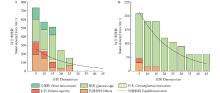
图1
模拟初期(A)和模拟末期(B)直径分布情况"
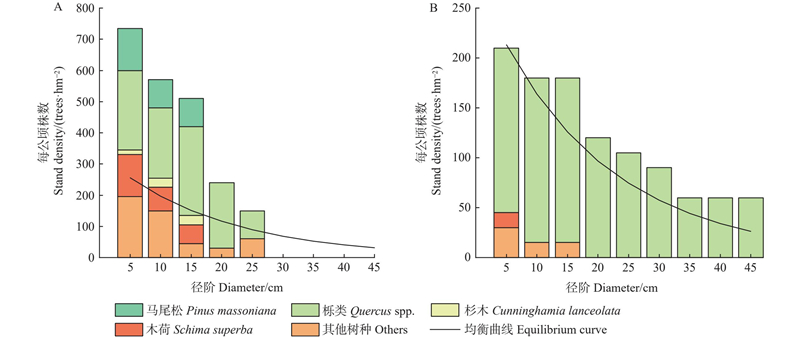
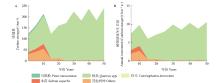
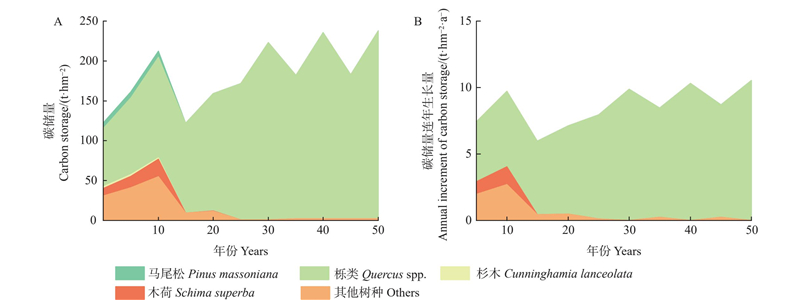
图2
模拟期内林分碳储量及连年生长量的变化"
| 陈 欣, 韩有志. 华北落叶松林林分密度对林下更新影响研究. 山西农业大学学报(自然科学版), 2024, 44 (2): 110- 118. | |
| Chen X, Han Y Z. Study on the effect of stand density on understory regeneration in Larix principis-rupprechtii forest in north China. Journal of Shanxi Agricultural University (Natural Science Edition), 2024, 44 (2): 110- 118. | |
|
彭祚登, 乔 丹. 沈国舫先生关于天然林保育思想的研究. 北京林业大学学报(社会科学版), 2017, 16 (4): 1- 7.
doi: 10.13931/j.cnki.bjfuss.2017071 |
|
|
Peng Z D, Qiao D. Studies on Shen Guo-Fang’s thoughts of natural forest conservation. Journal of Beijing Forestry University (Social Sciences), 2017, 16 (4): 1- 7.
doi: 10.13931/j.cnki.bjfuss.2017071 |
|
| 施 义, 施 贤. 双碳背景下森林资源保护与碳汇利用规划研究. 林业科技情报, 2025, 57 (2): 63- 65. | |
| Shi Y, Shi X. Research on forest resource protection and carbon sink utilization planning under the background of carbon peaking and carbon neutrality. Forestry Science and Technology Information, 2025, 57 (2): 63- 65. | |
|
王田雨, 岳文泽, 黄 波, 等. 未来气候变化情景下浙江省陆地生态系统碳汇估算与保护区识别. 地理学报, 2025, 80 (1): 183- 199.
doi: 10.11821/dlxb202501012 |
|
|
Wang T Y, Yue W Z, Huang B, et al. Estimation of terrestrial ecosystem carbon sinks and identification of carbon sink conservation areas under future climate change scenarios: a case study of Zhejiang Province. Acta Geographica Sinica, 2025, 80 (1): 183- 199.
doi: 10.11821/dlxb202501012 |
|
|
王湘龙. 实施全面停止天然林商业性采伐政策的建议. 热带林业, 2019, 47 (3): 76- 79.
doi: 10.3969/j.issn.1672-0938.2019.03.018 |
|
|
Wang X L. Suggestions on implementing the policy of stopping commercial cutting of natural forests. Tropical Forestry, 2019, 47 (3): 76- 79.
doi: 10.3969/j.issn.1672-0938.2019.03.018 |
|
|
赵卫高, 高 原, 杨 鑫, 等. 重庆市天然栎类转移矩阵和均衡曲线的构建及应用. 中南林业科技大学学报, 2026, 46 (1): 50- 59.
doi: 10.14067/j.cnki.1673-923x.2026.01.005 |
|
|
Zhao W G, Gao Y, Yang X, et al. Construction and application of transition matrix and equilibrium curve for oak natural secondary forests in Chongqing. Journal of Central South University of Forestry and Technology, 2026, 46 (1): 50- 59.
doi: 10.14067/j.cnki.1673-923x.2026.01.005 |
|
| 郑云峰. 关于强化浙江省天然林保护修复的调研报告. 国家林业和草原局管理干部学院学报, 2023, 22 (suppl.1): 1- 6. | |
| Zheng Y F. Research report on strengthening protection and restoration of natural forests in Zhejiang Province. National Academy of Forestry and Grassland Administration Journal, 2023, 22 (suppl.1): 1- 6. | |
|
Abrams M D, Scott M L. Disturbance-mediated accelerated succession in two Michigan forest types. Forest Science, 1989, 35 (1): 42- 49.
doi: 10.1093/forestscience/35.1.42 |
|
|
Amyntas A, Berti E, Gauzens B, et al. Niche complementarity among plants and animals can alter the biodiversity–ecosystem functioning relationship. Functional Ecology, 2023, 37 (10): 2652- 2665.
doi: 10.1111/1365-2435.14419 |
|
|
Bonan G B. Forests and climate change: forcings, feedbacks, and the climate benefits of forests. Science, 2008, 320 (5882): 1444- 1449.
doi: 10.1126/science.1155121 |
|
|
Bryan B A, Gao L, Ye Y Q, et al. China’s response to a national land-system sustainability emergency. Nature, 2018, 559 (7713): 193- 204.
doi: 10.1038/s41586-018-0280-2 |
|
| Burkhart H E, Tomé M. 2012. Whole-stand models for even-aged stands//Modeling forest trees and stands. Dordrecht: Springer Netherlands, 245–260. | |
|
Carrijo J V N, de Freitas Ferreira A B, Ferreira M C, et al. The growth and production modeling of individual trees of Eucalyptus urophylla plantations. Journal of Forestry Research, 2020, 31 (5): 1663- 1672.
doi: 10.1007/s11676-019-00920-1 |
|
|
Clark J S, Fastie C, Hurtt G, et al. Reid’s paradox of rapid plant migration. BioScience, 1998, 48 (1): 13- 24.
doi: 10.2307/1313224 |
|
|
Connell J H, Slatyer R O. Mechanisms of succession in natural communities and their role in community stability and organization. The American Naturalist, 1977, 111 (982): 1119- 1144.
doi: 10.1086/283241 |
|
|
Coomes D A, Allen R B. Mortality and tree-size distributions in natural mixed-age forests. Journal of Ecology, 2007, 95 (1): 27- 40.
doi: 10.1111/j.1365-2745.2006.01179.x |
|
|
D’Amato A W, Catanzaro P F, Fletcher L S. Early regeneration and structural responses to patch selection and structural retention in second-growth northern hardwoods. Forest Science, 2015, 61 (1): 183- 189.
doi: 10.5849/forsci.13-180 |
|
|
Dean T J, Baldwin V C. The relationship between Reineke’s stand-density index and physical stem mechanics. Forest Ecology and Management, 1996, 81 (1/2/3): 25- 34.
doi: 10.1016/0378-1127(95)03666-0 |
|
|
Dillaway D N, Stringer J W, Rieske L K. Light availability influences root carbohydrates, and potentially vigor, in white oak advance regeneration. Forest Ecology and Management, 2007, 250 (3): 227- 233.
doi: 10.1016/j.foreco.2007.05.019 |
|
|
Du X, Chen X Y, Zeng W S, et al. A climate-sensitive transition matrix growth model for uneven-aged mixed-species oak forests in north China. Forestry, 2021, 94 (2): 258- 277.
doi: 10.1093/forestry/cpaa035 |
|
|
Feng X M, Fu B J, Piao S L, et al. Revegetation in China’s Loess Plateau is approaching sustainable water resource limits. Nature Climate Change, 2016, 6 (11): 1019- 1022.
doi: 10.1038/nclimate3092 |
|
|
Frelich L E, Reich P B. Spatial patterns and succession in a Minnesota southern-boreal forest. Ecological Monographs, 1995, 65 (3): 325- 346.
doi: 10.2307/2937063 |
|
|
Hantsch L, Bien S, Radatz S, et al. Tree diversity and the role of non-host neighbour tree species in reducing fungal pathogen infestation. Journal of Ecology, 2014, 102 (6): 1673- 1687.
doi: 10.1111/1365-2745.12317 |
|
|
Harmer R, Morgan G. Development of Quercus robur advance regeneration following canopy reduction in an oak woodland. Forestry, 2007, 80 (2): 137- 149.
doi: 10.1093/forestry/cpm006 |
|
|
Hu Z H, Yu M J. Study on successions sequence of evergreen broad-leaved forest in Gutian Mountain of Zhejiang, eastern China: species diversity. Frontiers of Biology in China, 2008, 3 (1): 45- 49.
doi: 10.1007/s11515-008-0011-4 |
|
|
Hui G Y, Zhang G G, Zhao Z H, et al. Methods of forest structure research: a review. Current Forestry Reports, 2019, 5 (3): 142- 154.
doi: 10.1007/s40725-019-00090-7 |
|
|
Liang J J, Buongiorno J, Monserud R A, et al. Effects of diversity of tree species and size on forest basal area growth, recruitment, and mortality. Forest Ecology and Management, 2007, 243 (1): 116- 127.
doi: 10.1016/j.foreco.2007.02.028 |
|
|
Liang J, Crowther T W, Picard N, et al. Positive biodiversity-productivity relationship predominant in global forests. Science, 2016, 354 (6309): aaf8957.
doi: 10.1126/science.aaf8957 |
|
|
Liang J J, Picard N. Matrix model of forest dynamics: an overview and outlook. Forest Science, 2013, 59 (3): 359- 378.
doi: 10.5849/forsci.11-123 |
|
|
Liu B, Liu Q Q, Daryanto S, et al. Responses of Chinese fir and Schima superba seedlings to light gradients: implications for the restoration of mixed broadleaf-conifer forests from Chinese fir monocultures. Forest Ecology and Management, 2018, 419, 51- 57.
doi: 10.1016/j.foreco.2018.03.033 |
|
|
López I, Ortuño S F, Martín Á J, et al. Estimating the sustainable harvesting and the stable diameter distribution of European beech with projection matrix models. Annals of Forest Science, 2007, 64 (6): 593- 599.
doi: 10.1051/forest:2007037 |
|
|
Luo Y, Chen H Y H. Competition, species interaction and ageing control tree mortality in boreal forests. Journal of Ecology, 2011, 99 (6): 1470- 1480.
doi: 10.1111/j.1365-2745.2011.01882.x |
|
|
Meyer H A. Structure, growth, and drain in balanced uneven-aged forests. Journal of Forestry, 1952, 50 (2): 85- 92.
doi: 10.1093/jof/50.2.85 |
|
|
Pan Y D, Birdsey R A, Fang J Y, et al. A large and persistent carbon sink in the world’s forests. Science, 2011, 333 (6045): 988- 993.
doi: 10.1126/science.1201609 |
|
|
Porté A, Bartelink H H. Modelling mixed forest growth: a review of models for forest management. Ecological Modelling, 2002, 150 (1/2): 141- 188.
doi: 10.1016/s0304-3800(01)00476-8 |
|
|
Pretzsch H, Biber P. A re-evaluation of reineke’s rule and stand density index. Forest Science, 2005, 51 (4): 304- 320.
doi: 10.1093/forestscience/51.4.304 |
|
|
Pretzsch H, Biber P. Tree species mixing can increase maximum stand density. Canadian Journal of Forest Research, 2016, 46 (10): 1179- 1193.
doi: 10.1139/cjfr-2015-0413 |
|
|
Seidl R, Thom D, Kautz M, et al. Forest disturbances under climate change. Nature Climate Change, 2017, 7 (6): 395- 402.
doi: 10.1038/nclimate3303 |
|
|
Sohn J A, Gebhardt T, Ammer C, et al. Mitigation of drought by thinning: Short-term and long-term effects on growth and physiological performance of Norway spruce (Picea abies). Forest Ecology and Management, 2013, 308, 188- 197.
doi: 10.1016/j.foreco.2013.07.048 |
|
|
Song Y F, Yan G, Zhang G F. Light competition contributes to the death of Masson pines of coniferous-broadleaf mixed forests in subtropical China. Forests, 2022, 13 (1): 85.
doi: 10.3390/f13010085 |
|
|
Stage A R. An expression for the effect of aspect, slope, and habitat type on tree growth. Forest Science, 1976, 22 (4): 457- 460.
doi: 10.1093/forestscience/22.4.457 |
|
|
Stephenson N L, Das A J, Condit R, et al. Rate of tree carbon accumulation increases continuously with tree size. Nature, 2014, 507 (7490): 90- 93.
doi: 10.1038/nature12914 |
|
|
Sterba H. Equilibrium curves and growth models to deal with forests in transition to uneven-aged structure-application in two sample stands. Silva Fennica, 2004, 38 (4): 413- 423.
doi: 10.14214/sf.409 |
|
|
Tobin J. Estimation of relationships for limited dependent variables. Econometrica, 1958, 26 (1): 24.
doi: 10.2307/1907382 |
|
|
Turnbull L A, Crawley M J, Rees M. Are plant populations seed-limited? A review of seed sowing experiments. Oikos, 2000, 88 (2): 225- 238.
doi: 10.1034/j.1600-0706.2000.880201.x |
|
| Weiskittel A R, Hann D W, Kershaw J A, et al. , 2011. Forest Growth and Yield Modeling. Chichester: John Wiley & Sons. | |
|
Young B, Liang J J, Stuart Chapin F. Effects of species and tree size diversity on recruitment in the Alaskan boreal forest: a geospatial approach. Forest Ecology and Management, 2011, 262 (8): 1608- 1617.
doi: 10.1016/j.foreco.2011.07.011 |
|
| Zenner E K. 2004. Does old-growth condition imply high live-tree structural complexity? Forest Ecology and Management, 195(1/2): 243–258. | |
|
Zhai L, Will R E, Zhang B. Structural diversity is better associated with forest productivity than species or functional diversity. Ecology, 2024, 105 (4): e4269.
doi: 10.1002/ecy.4269 |
| [1] | 全迎,邵国凡,李明泽. 从经验模型到智能估算:东北森林碳储量遥感监测技术革新路径[J]. 林业科学, 2026, 62(6): 236-248. |
| [2] | 范光鹏,许亮亮,蔡会德,徐占勇,孟想,邵亚奎,卢峰. 基于地基激光雷达点云的桉树单木参数提取与地上碳储量测定[J]. 林业科学, 2026, 62(3): 88-99. |
| [3] | 田惠玲,朱建华,何潇,陈新云,王冉,肖文发,雷相东. 中亚热带典型森林类型林分乔木碳储量生长模型[J]. 林业科学, 2026, 62(2): 15-24. |
| [4] | 劳万里,吕斌,李晓玲,段新芳,王军锋. 新型室内铺地材料石木塑复合地板生产过程的环境影响评价[J]. 林业科学, 2026, 62(2): 204-213. |
| [5] | 张少鹏,付瑶,朱洪革,赵梦涵. 天然林资源保护政策对重点国有林区林业新质生产力的影响——基于林业绿色全要素生产率视角[J]. 林业科学, 2025, 61(6): 183-195. |
| [6] | 陈碧雁,徐金梅,陈秀芳,张波. 基于IPCC生产法的我国木质林产品碳储量动态评估及驱动因素分析[J]. 林业科学, 2025, 61(12): 153-163. |
| [7] | 张聪,刘琪,李海奎,刘鹏举,詹思颖. 我国尺度兼容和树种分类的材积源森林碳储量模型[J]. 林业科学, 2025, 61(1): 57-69. |
| [8] | 杨润露,王娟,张春雨. 东北天然次生针阔混交林乔木层碳储量变化的采伐干扰响应[J]. 林业科学, 2024, 60(7): 17-27. |
| [9] | 刘世荣,王晖,李海奎,余振,栾军伟. 碳中和目标下中国森林碳储量、碳汇变化预估与潜力提升途径[J]. 林业科学, 2024, 60(4): 157-172. |
| [10] | 龚金玉,马致远,胡琛,李田,雷静品. 原始森林的概念、生态功能及研究进展[J]. 林业科学, 2024, 60(4): 173-182. |
| [11] | 沈琛琛,肖文发,朱建华,曾立雄,陈吉臻,黄志霖. 基于机器学习算法的华中天然林土壤有机碳特征与关键影响因子[J]. 林业科学, 2024, 60(3): 65-77. |
| [12] | 吕梓晴, 段爱国. 不同产区杉木生物量与碳储量模型[J]. 林业科学, 2024, 60(2): 1-11. |
| [13] | 劳万里,李晓玲,段新芳. 木竹产品碳足迹评价研究进展[J]. 林业科学, 2024, 60(1): 142-150. |
| [14] | 龙时胜, 曾思齐, 杨盛扬. 基于改进林分密度指数的栎类天然林最大密度线[J]. 林业科学, 2023, 59(9): 13-22. |
| [15] | 曾伟生,蒲莹,杨学云,易善军. 我国5种主要人工林乔木层碳储量生长模型及其气候驱动分析[J]. 林业科学, 2023, 59(3): 21-30. |
| 阅读次数 | ||||||
|
全文 |
|
|||||
|
摘要 |
|
|||||

