
林业科学 ›› 2026, Vol. 62 ›› Issue (10): 150-160.doi: 10.11707/j.1001-7488.LYKX20260021
• 研究论文 • 上一篇
周宏威1,王成哲1,胡浩昌1,刘人维2,陈怡帆3,潘佳亮3,马玲4,*( )
)
收稿日期:2026-01-09
出版日期:2026-10-10
发布日期:2026-10-16
通讯作者:
马玲
E-mail:maling63@163.com
基金资助:
Hongwei Zhou1,Chengzhe Wang1,Haochang Hu1,Renwei Liu2,Yifan Chen3,Jialiang Pan3,Ling Ma4,*()
Received:2026-01-09
Online:2026-10-10
Published:2026-10-16
Contact:
Ling Ma
E-mail:maling63@163.com
摘要:
目的: 整合1982—2023年全国县级疫情数据,运用时空扫描统计与回归模型,系统重建中国松材线虫病42年的传播路径,识别关键演化阶段,并量化近期热点暴发驱动因素的异质性效应,揭示不同区域热点的驱动模式差异,为制定差异化精准防控策略提供科学依据。方法: 采用 SaTScan 进行基于离散Poisson模型的时空扫描统计。以年为时间单位,最大空间扫描窗口和最大时间扫描窗口均设为30%。通过999次蒙特卡洛模拟检验时空聚集区的统计学显著性,识别显著热点(P<0.05)。针对2015—2023年识别出的3个时间范围重叠的时空聚集区(分别位于中国中南部、山东半岛和辽宁东部),分别构建二元Logistic回归模型。模型以县级单元是否发生松材线虫病疫情为因变量,以空间近邻疫情县数(NEIGHBOR)、6—9月平均气温和降水量(TEMP_MEAN, PREC_MEAN)、归一化植被指数(NDVI)、树木覆盖(TC)及地区生产总值(GDP)为自变量,采用Hosmer-Lemeshow检验评估模型拟合优度。结果: 1) 时空演化路径:共探测到9个显著热点,呈现四阶段跃迁特征。1982—1988年仅识别出1个显著热点,位于苏皖交界(RR=3.39),反映疫情早期局部聚集特征;1989—1999年形成长三角(RR=12.22)和珠三角(RR=8.66)2个聚集中心;2000—2014年疫情向中西部内陆扩展,新增武陵山区显著热点;2015—2023年呈现“北扩西进”态势,在湘鄂赣交界区识别出显著热点(RR=14.15),并首次在山东半岛和辽宁东部确立北方疫区,呈现多点暴发格局。2) 共性驱动模式:空间近邻效应在3个热点区域均显著(P<0.05),但强度分异明显,中南部、山东半岛、辽宁东部的NEIGHBOR优势比依次为2.606、2.359和1.627,表明周边疫情每增加1个县,本地疫情发生风险为原来的1.627~2.606倍,提示局域扩散是3个热点区的共性驱动因素。3) 区域异质性主导因子:中南部热点降水呈显著负向效应,推测高湿环境可能通过抑制媒介昆虫活性降低松材线虫病传播风险;山东半岛热点NDVI为最强正向因子,标准化后风险增幅仍达9.33倍,表明寄主植被密度可能是该区域内定殖暴发的关键生境筛选因子;辽宁东部热点6—9月均温为主导性限制因子,表明温度适宜性是高纬度前沿定殖的基础性前提。结论: 本研究首次构建全国尺度的长时序分析框架,揭示松材线虫病“沿海输入?区域蔓延?内陆跳转?北扩暴发”的四阶段入侵扩散路径,并解析“空间近邻效应为共性基础驱动、区域生境因子异质性主导暴发强度”的驱动模式。本研究结果为制定精准防控策略提供了关键科学依据,尤其强调北方新兴疫区需强化气候预警与源头阻截,成熟疫区应依据主导因子优化监测布局。
中图分类号:
周宏威,王成哲,胡浩昌,刘人维,陈怡帆,潘佳亮,马玲. 中国松材线虫病的传播时空演化与阶段驱动因素分析[J]. 林业科学, 2026, 62(10): 150-160.
Hongwei Zhou,Chengzhe Wang,Haochang Hu,Renwei Liu,Yifan Chen,Jialiang Pan,Ling Ma. Analysis of the Spatiotemporal Evolution and Stage Driving Factors of Pine Wilt Disease Transmission in China[J]. Scientia Silvae Sinicae, 2026, 62(10): 150-160.
表1
松材线虫病历史发生分布"
| 历史发生省份 Historical occurrence province | 历史发生县数量 Number of counties with historical occurrences |
| 天津市Tianjin | 1 |
| 辽宁省Liaoning Province | 22 |
| 吉林省Jilin Province | 4 |
| 上海市Shanghai | 1 |
| 江苏省Jiangsu Province | 30 |
| 浙江省Zhejiang Province | 79 |
| 安徽省Anhui Province | 64 |
| 福建省Fujian Province | 72 |
| 江西省Jiangxi Province | 88 |
| 山东省Shandong Province | 29 |
| 河南省Henan Province | 10 |
| 湖北省Hubei Province | 79 |
| 湖南省Hunan Province | 83 |
| 广东省Guangdong Province | 84 |
| 广西壮族自治区Guangxi Zhuang Autonomous Region | 55 |
| 重庆市Chongqing | 36 |
| 四川省Sichuan Province | 47 |
| 贵州省Guizhou Province | 22 |
| 云南省Yunnan Province | 5 |
| 陕西省Shaanxi Province | 25 |
| 甘肃省Gansu Province | 1 |
表2
影响因子及其数据来源"
| 数据项Data item | 缩写Abbreviation | 单位Unit | 数据来源Data source |
| 近邻疫情县数量Number of neighboring epidemic counties | NEIGHBOR | unit | |
| 归一化植被指数Normalized vegetation index | NDVI | / | |
| 树木覆盖面积Tree coverage area | TC | m2 | |
| 地区生产总值Regional gross domestic product | GDP | billion yuan | |
| 6—9月平均温度Average temperature from June to September | TEMP_MEAN | °C | |
| 6—9月平均降水量Average precipitation from June to September | PREC_MEAN | mm |
表3
敏感性分析结果"
| 最大空间 聚类大小 Maximum spatial clustering size (%) | 最大时间集群大小 Maximum time cluster size (%) | 空间热点 个数 Number of spatial hotspots | 未通过显著性 检验的聚类个数 Number of clusters that do not pass the significance test |
| 10 | 10 | 18 | 1 |
| 10 | 20 | 17 | 2 |
| 10 | 30 | 15 | 1 |
| 10 | 40 | 14 | 1 |
| 10 | 50 | 14 | 1 |
| 20 | 10 | 16 | 1 |
| 20 | 20 | 12 | 2 |
| 20 | 30 | 11 | 1 |
| 20 | 40 | 10 | 2 |
| 20 | 50 | 8 | 1 |
| 30 | 10 | 14 | 1 |
| 30 | 20 | 11 | 1 |
| 30 | 30 | 9 | 0 |
| 30 | 40 | 15 | 2 |
| 30 | 50 | 14 | 2 |
| 40 | 10 | 12 | 1 |
| 40 | 20 | 11 | 1 |
| 40 | 30 | 11 | 1 |
| 40 | 40 | 9 | 2 |
| 40 | 50 | 7 | 1 |
| 50 | 10 | 10 | 1 |
| 50 | 20 | 9 | 1 |
| 50 | 30 | 11 | 1 |
| 50 | 40 | 8 | 1 |
| 50 | 50 | 5 | 1 |
表4
松材线虫病时空热点统计特征"
| 热点编号 Hotspot number | 起始时间 Start time | 结束时间 End time | 中心坐标 Center coordinates | 半径 Radius/km | 相对风险 Relative risk | 对数似然比 Log-likelihood ratio |
| 1 | 1982 | 1988 | 32.10°N,119.44°E | 82.90 | 3.39 | 22.07 |
| 2 | 1988 | 1999 | 22.69°N,114.03°E | 31.85 | 12.22 | 138.98 |
| 3 | 1990 | 2001 | 31.33°N,118.96°E | 121.36 | 8.66 | 340.79 |
| 4 | 2001 | 2012 | 23.35°N,114.28°E | 98.00 | 11.81 | 305.14 |
| 5 | 2006 | 2012 | 28.57°N,110.59°E | 395.50 | 1.62 | 15.62 |
| 6 | 2003 | 2014 | 30.81°N,120.08°E | 301.72 | 6.80 | 859.99 |
| 7 | 2015 | 2023 | 37.37°N,122.11°E | 199.97 | 11.49 | 212.73 |
| 8 | 2016 | 2023 | 28.21°N,114.32°E | 671.10 | 14.15 | |
| 9 | 2017 | 2023 | 40.76°N,124.92°E | 156.69 | 6.58 | 80.44 |
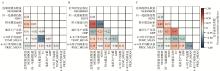
图1
3个代表性热点的Pearson相关性分析结果矩阵 A. 中南部热点 Hotspots in central and southern China;B. 山东半岛热点 Shandong Peninsula hotspot;C. 辽宁东部热点 Hotspots in eastern Liaoning. NEIGHBOR: 近邻疫情县数量Number of neighboring epidemic counties; NDVI: 归一化植被指数Normalized difference vegetation index; TC: 树木覆盖面积Tree coverage area; GDP: 地区生产总值Regional gross domestic product; TEMP_MEAN: 6—9月平均温度Average temperature from June to September; PREC_MEAN: 6—9月平均降水量Average precipitation from June to September."
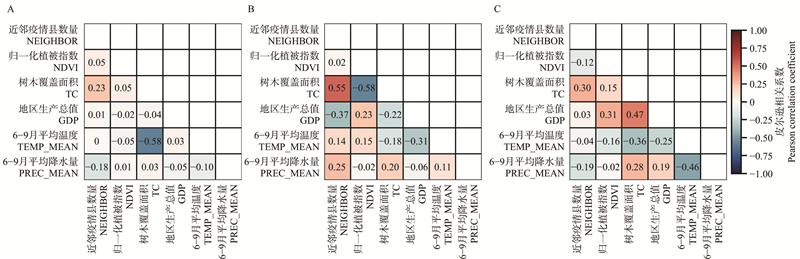
表5
方差扩大因子结果①"
| 变量 Variables | 中南部热点 Hotspots in central and southern China | 山东半岛热点 Shandong Peninsula hotspot | 辽宁东部热点 Hotspots in eastern Liaoning |
| NEIGHBOR | 1.12 | 2.39 | 1.28 |
| NDVI | 1.01 | 2.22 | 1.18 |
| TC | 1.64 | 3.17 | 1.63 |
| GDP | 1.00 | 1.43 | 1.40 |
| TEMP_MEAN | 1.56 | 1.27 | 1.42 |
| PREC_MEAN | 1.04 | 1.09 | 1.47 |
表6
3个近期热点Logistic回归模型性能与关键变量①"
| 变量/指标 Variables/Indicators | 中南部热点 Hotspots in central and southern China | 山东半岛热点 Shandong Peninsula hotspot | 辽宁东部热点 Hotspots in eastern Liaoning |
| 霍斯默-莱梅肖检验 Hosmer-Lemeshow test | 0.071 | 0.314 | 0.937 |
| 模型准确率 Accuracy | 0.834 | 0.822 | 0.782 |
| NEIGHBOR | P<0.001 Exp(B)=2.606 | P=0.044 Exp(B)=2.359 | P=0.009 Exp(B)=1.627 |
| NDVI_Standard_Score | P=0.528 Exp(B)=0.811 | P=0.005 Exp(B)=9.33 | P=0.561 Exp(B)=2.324 |
| TC | P=0.005 Exp(B)=1.000 | P=0.739 Exp(B)=1.000 | P=0.733 Exp(B)=1.000 |
| GDP | P=0.195 Exp(B)=1.000 | P=0.711 Exp(B)=1.000 | P=0.052 Exp(B)=1.000 |
| TEMP_MEAN | P=0.182 Exp(B)=1.055 | P=0.639 Exp(B)=1.318 | P<0.001 Exp(B)=2.668 |
| PREC_MEAN | P<0.001 Exp(B)=0.994 | P=0.224 Exp(B)=1.012 | P=0.555 Exp(B)=0.994 |
| 截距B | ?1.872 | ?10.952 | ?21.069 |
| 崔东阳, 张智洋, 程邦洲, 等. 基于地理加权逻辑回归模型的松材线虫病发生风险预测. 森林工程, 2026, 42 (3): 439- 451. | |
| Cui D Y, Zhang Z Y, Cheng B Z, et al. Risk prediction of pine wilt disease based on geographically weighted logistic regression model. Forest Engineering, 2026, 42 (3): 439- 451. | |
|
崔 嵘, 潘 龙, 张吉利, 等. 加格达奇地区发生松材线虫病的风险性预测. 东北林业大学学报, 2022, 50 (9): 128- 134.
doi: 10.13759/j.cnki.dlxb.2022.09.018 |
|
|
Cui R, Pan L, Zhang J L, et al. Risk analysis of pine wilt disease in Jiagedaqi area of cold temperate zone. Journal of Northeast Forestry University, 2022, 50 (9): 128- 134.
doi: 10.13759/j.cnki.dlxb.2022.09.018 |
|
|
丁晓磊, 汪青桐, 林司曦, 等. 广东省与江苏省松材线虫种群遗传结构差异分析. 林业科学, 2022, 58 (8): 1- 9.
doi: 10.11707/j.1001-7488.20220801 |
|
|
Ding X L, Wang Q T, Lin S X, et al. Analysis of genetic variations of Bursaphelenchus xylophilus populations between Guangdong and Jiangsu Provinces with SNP Marker. Scientia Silvae Sinicae, 2022, 58 (8): 1- 9.
doi: 10.11707/j.1001-7488.20220801 |
|
| 付彦蓉, 曾 煜, 吴 宇, 等. 三峡水库库首区域景观格局对松材线虫病危害的影响. 应用生态学报, 2026, 37 (2): 583- 590. | |
| Fu Y R, Zeng Y, Wu Y, et al. Effects of landscape pattern in the head region of the Three Gorges Reservoir on the damage of pine wilt disease. Chinese Journal of Applied Ecology, 2026, 37 (2): 583- 590. | |
|
李好男, 俞琳锋, 詹钟易, 等. 林分和景观水平因子对松材线虫病发生的影响: 以山东威海地区松林为例. 环境昆虫学报, 2024, 46 (3): 616- 624.
doi: 10.3969/j.issn.1674-0858.2024.03.8 |
|
|
Li H N, Yu L F, Zhan Z Y, et al. Effects of stand and landscape level factors on the occurrence of pine wilt disease-a case study of pine forest in Weihai, Shandong Province. Journal of Environmental Entomology, 2024, 46 (3): 616- 624.
doi: 10.3969/j.issn.1674-0858.2024.03.8 |
|
|
理永霞, 陈友吾, 王 璇, 等. 松材线虫病的潜伏侵染. 北京林业大学学报, 2021, 43 (9): 14- 18.
doi: 10.12171/j.1000-1522.20210218 |
|
|
Li Y X, Chen Y W, Wang X, et al. Latent infection of pine wilt disease. Journal of Beijing Forestry University, 2021, 43 (9): 14- 18.
doi: 10.12171/j.1000-1522.20210218 |
|
| 理永霞, 方国飞, 李东振, 等. 松材线虫病区域性绿色可持续防控模式. 树木医学, 2026, 3 (1): 81- 86. | |
| Li Y X, Fang G F, Li D Z, et al. A new regional green and sustainable prevention and control technology model for pine wilt disease. Tree Health, 2026, 3 (1): 81- 86. | |
|
理永霞, 温晓健, 王 璇, 等. 松材线虫病防控技术研究进展及防控对策建议. 中国森林病虫, 2025, 44 (6): 1- 7.
doi: 10.19688/j.cnki.issn1671-0886.20250050 |
|
|
Li Y X, Wen X J, Wang X, et al. Research progress on the control technologies and suggestions for control of pine wilt disease. Forest Pest and Disease, 2025, 44 (6): 1- 7.
doi: 10.19688/j.cnki.issn1671-0886.20250050 |
|
|
刘 强, 吴志伟, 林世滔, 等. 松材线虫病发生点格局及影响因素. 应用生态学报, 2022, 33 (9): 2530- 2538.
doi: 10.13287/j.1001-9332.202209.030 |
|
|
Liu Q, Wu Z W, Lin S T, et al. Spatial point pattern analysis of pine wilt disease occurrence and its influence factors. Chinese Journal of Applied Ecology, 2022, 33 (9): 2530- 2538.
doi: 10.13287/j.1001-9332.202209.030 |
|
|
刘婷婷, 杨晋帆, 周汝良, 等. 基于地理栅格变量与机器学习的松材线虫病扩散风险分析. 浙江农林大学学报, 2023, 40 (3): 617- 626.
doi: 10.11833/j.issn.2095-0756.20220470 |
|
|
Liu T T, Yang J F, Zhou R L, et al. Prediction of spread risk of pine wilt disease based on geographic raster variables and machine learning models. Journal of Zhejiang A&F University, 2023, 40 (3): 617- 626.
doi: 10.11833/j.issn.2095-0756.20220470 |
|
|
南俊科, 杨越翔, 张玲华, 等. 松墨天牛在秦巴林区不同寄主上的危害规律. 环境昆虫学报, 2021, 43 (6): 1376- 1388.
doi: 10.3969/j.issn.1674-0858.2021.06.05 |
|
|
Nan J K, Yang Y X, Zhang L H, et al. The damage of Monochamus alternatus on different host pine species in Qinling-Daba Mountains. Journal of Environmental Entomology, 2021, 43 (6): 1376- 1388.
doi: 10.3969/j.issn.1674-0858.2021.06.05 |
|
|
宁 眺, 方宇凌, 汤 坚, 等. 松材线虫及其关键传媒墨天牛的研究进展. 昆虫知识, 2004, 41 (2): 97- 104.
doi: 10.3969/j.issn.0452-8255.2004.02.001 |
|
|
Ning T, Fang Y L, Tang J, et al. Advances in research on Bursaphelenchus xylophilus and its key vector Monochamus spp. Entomological Knowledge, 2004, 41 (2): 97- 104.
doi: 10.3969/j.issn.0452-8255.2004.02.001 |
|
|
王曦茁, 曹业凡, 朴春根, 等. 韩国松材线虫病防控成效及启示. 世界林业研究, 2022, 35 (6): 94- 100.
doi: 10.13348/j.cnki.sjlyyj.2022.0084.y |
|
|
Wang X Z, Cao Y F, Piao C G, et al. Effectiveness of pine wilt disease prevention and control in republic of Korea and its inspirations. World Forestry Research, 2022, 35 (6): 94- 100.
doi: 10.13348/j.cnki.sjlyyj.2022.0084.y |
|
|
许格希, 余荣兵, 杨昌旭, 等. 基于GIS空间技术和MaxEnt模型预测川西松材线虫病入侵风险. 北京林业大学学报, 2023, 45 (9): 104- 115.
doi: 10.12171/j.1000-1522.20220527 |
|
|
Xu G X, Yu R B, Yang C X, et al. Prediction of invasion risk of pine wilt disease based on GIS spatial technology and MaxEnt model in western Sichuan Province of southwestern China. Journal of Beijing Forestry University, 2023, 45 (9): 104- 115.
doi: 10.12171/j.1000-1522.20220527 |
|
|
叶建仁. 松材线虫病在中国的流行现状、防治技术与对策分析. 林业科学, 2019, 55 (9): 1- 10.
doi: 10.11707/j.1001-7488.20190901 |
|
|
Ye J R. Epidemic status of pine wilt disease in China and its prevention and control techniques and counter measures. Scientia Silvae Sinicae, 2019, 55 (9): 1- 10.
doi: 10.11707/j.1001-7488.20190901 |
|
| 叶建仁, 吴小芹. 松材线虫病研究进展. 中国森林病虫, 2022, 41 (3): 1- 10. | |
| Ye J R, Wu X Q. Research progress of pine wilt disease. Forest Pest and Disease, 2022, 41 (3): 1- 10. | |
| 张晨书, 孙 红, 陈怡帆, 等. 2025年全国主要林业有害生物发生情况及2026年趋势预测. 中国森林病虫, 2026, 45 (2): 69- 74. | |
| Zhang C S, Sun H, Chen Y F, et al. Occurrence of major forestry pests in China in 2025 and trend forecast in 2026. Forest Pest and Disease, 2026, 45 (2): 69- 74. | |
| 赵 飞, 朱 蓉, 张利娟, 等. 2011. SaTScan在湖沼型血吸虫病聚集区域探测中的应用. 中国血吸虫病防治杂志, , 23(1): 28−31. | |
| Zhao F, Zhu R, Zhang L J, et al. 2011. Application of SaTScan in detection of schistosomiasis clusters in marshland and lake areas. Chinese Journal of Schistosomiasis Control, 23(1): 28−31. [in Chinese] | |
|
郑雅楠, 刘佩旋, 时 勇, 等. 辽宁松材线虫病与中国其他疫区的差异性分析. 北京林业大学学报, 2021, 43 (5): 155- 160.
doi: 10.12171/j.1000-1522.20200108 |
|
|
Zheng Y N, Liu P X, Shi Y, et al. Difference analysis on pine wilt disease between Liaoning Province of northeastern China and other epidemic areas in China. Journal of Beijing Forestry University, 2021, 43 (5): 155- 160.
doi: 10.12171/j.1000-1522.20200108 |
|
|
赵金文, 古 剑, 肖正利, 等. 湖北宜昌市2018—2021年松材线虫病疫情扩散时空演变分析. 中国森林病虫, 2023, 42 (3): 36- 43.
doi: 10.19688/j.cnki.issn1671-0886.20220066 |
|
|
Zhao J W, Gu J, Xiao Z L, et al. Spatial-temporal evolution of pine wilt disease in Yichang city, Hubei Province from 2018 to 2021. Forest Pest and Disease, 2023, 42 (3): 36- 43.
doi: 10.19688/j.cnki.issn1671-0886.20220066 |
|
| 周宏威, 李永正, 郭文辉, 等. 2025. 基于元胞自动机模型的松材线虫病小班尺度预测. 林业科学, , 62(1): 133−143. | |
| Zhou H W, Li Y Z, Guo W H, et al. 2025. Prediction of subcompartment-scale spread of pine wilt disease based on cellular automata model. Scientia Silvae Sinicae, , 62(1): 133−143. [in Chinese] | |
|
Aierken N, Wang G, Chen M Y, et al. Assessing global pine wilt disease risk based on ensemble species distribution models. Ecological Indicators, 2024, 167, 112691.
doi: 10.1016/j.ecolind.2024.112691 |
|
|
Back M A, Bonifácio L, Inácio M L, et al. Pine wilt disease: a global threat to forestry. Plant Pathology, 2024, 73 (5): 1026- 1041.
doi: 10.1111/ppa.13875 |
|
|
Bu F F, Hayes D, Burton A, et al. Equal, equitable or exacerbating inequalities: patterns and predictors of social prescribing referrals in 160 128 UK patients. The British Journal of Psychiatry, 2025, 226 (2): 91- 99.
doi: 10.1192/bjp.2024.141 |
|
|
Calvão T, Duarte C M, Pimentel C S. Climate and landscape patterns of pine forest decline after invasion by the pinewood nematode. Forest Ecology and Management, 2019, 433, 43- 51.
doi: 10.1016/j.foreco.2018.10.039 |
|
|
Gao R H, Wang Z, Wang H X, et al. Relationship between pine wilt disease outbreaks and climatic variables in the three gorges reservoir region. Forests, 2019, 10 (9): 816.
doi: 10.3390/f10090816 |
|
|
Hao Z Q, Fang G F, Huang W J, et al. Risk prediction and variable analysis of pine wilt disease by a maximum entropy model. Forests, 2022a, 13 (2): 342.
doi: 10.3390/f13020342 |
|
|
Hao Z Q, Huang J X, Li X D, et al. A multi-point aggregation trend of the outbreak of pine wilt disease in China over the past 20 years. Forest Ecology and Management, 2022b, 505 (2022): 119890.
doi: 10.1016/j.foreco.2021.119890 |
|
|
Hao Z Q, Huang J X, Zhou Y T, et al. Spatiotemporal pattern of pine wilt disease in the Yangtze River basin. Forests, 2021, 12 (6): 731.
doi: 10.3390/f12060731 |
|
|
Hao Z Q, Huang W J, Zhang B Y, et al. Improved pest and disease spread model for simulating the spread of invasive species: a case study of pine wilt disease. Computers and Electronics in Agriculture, 2025, 237, 110561.
doi: 10.1016/j.compag.2025.110561 |
|
|
Huang J X, Zhao X T, Mo X M, et al. Host vegetation connectivity is decisive for the natural spread of pine wilt disease. Pest Management Science, 2024, 80 (10): 5141- 5156.
doi: 10.1002/ps.8240 |
|
|
Liu F, Su H J, Ding T T, et al. Refined assessment of economic loss from pine wilt disease at the subcompartment scale. Forests, 2023a, 14 (1): 139.
doi: 10.3390/f14010139 |
|
|
Liu Y Q, Huang J X, Yang T. Natural factors play a dominant role in the short-distance transmission of pine wilt disease. Forests, 2023b, 14 (5): 1059.
doi: 10.3390/f14051059 |
|
|
Lu X, Huang J X, Li X D, et al. The interaction of environmental factors increases the risk of spatiotemporal transmission of pine wilt disease. Ecological Indicators, 2021, 133, 108394.
doi: 10.1016/j.ecolind.2021.108394 |
|
|
Lun X C, Wang Y G, Zhao C C, et al. Epidemiological characteristics and temporal-spatial analysis of overseas imported dengue fever cases in outbreak provinces of China, 2005—2019. Infectious Diseases of Poverty, 2022, 11 (1): 12.
doi: 10.1186/s40249-022-00937-5 |
|
| Mo X M, Zhao X T, Zhao J H, et al. Risk prediction of pine wilt disease based on graphical convolutional network in China. Pest Management Science, 2025, 81 (10): 6550- 6559. | |
|
Tang X G, Yuan Y D, Li X M, et al. Maximum entropy modeling to predict the impact of climate change on pine wilt disease in China. Frontiers in Plant Science, 2021, 12, 652500.
doi: 10.3389/fpls.2021.652500 |
|
|
Wang F, Zhu W C, Liu X H, et al. Wilt of Pinus thunbergii induced by a succession of extreme meteorological events. Ecological Informatics, 2017, 42, 24- 31.
doi: 10.1016/j.ecoinf.2017.09.003 |
|
|
Wang W, Peng W T, Liu X Y, et al. Spatiotemporal dynamics and factors driving the distributions of pine wilt disease-damaged forests in China. Forests, 2022, 13 (2): 261.
doi: 10.3390/f13020261 |
|
|
Xu Q W, Zhang X J, Li J X, et al. Pine wilt disease in northeast and northwest China: a comprehensive risk review. Forests, 2023, 14 (2): 174.
doi: 10.3390/f14020174 |
|
|
Xue M J, Zhong J L, Gao M, et al. Analysis of spatial–temporal dynamic distribution and related factors of tuberculosis in China from 2008 to 2018. Scientific Reports, 2023, 13 (1): 4974.
doi: 10.1038/s41598-023-31430-0 |
|
|
Yoon S, Jung J M, Hwang J, et al. Ensemble evaluation of the spatial distribution of pine wilt disease mediated by insect vectors in south Korea. Forest Ecology and Management, 2023, 529, 120677.
doi: 10.1016/j.foreco.2022.120677 |
|
|
Yoon S, Jung J M, Kim D, et al. Risk monitoring of pine wilt disease based on semi-dynamic spatial prediction in south Korea. Agricultural Systems, 2025, 224, 104253.
doi: 10.1016/j.agsy.2024.104253 |
|
|
Yu L F, Zhan Z Y, Ren L L, et al. Impact of stand- and landscape-level variables on pine wilt disease-caused tree mortality in pine forests. Pest Management Science, 2023, 79 (5): 1791- 1799.
doi: 10.1002/ps.7357 |
|
|
Zhang R C, Huang J X, Zhao X T, et al. The threshold and lag effects of temperature on pine wilt disease show significant spatial heterogeneity. Insects, 2025, 16 (8): 834.
doi: 10.3390/insects16080834 |
|
|
Zhao J H, Wang J H, Huang J X, et al. Spring temperature accumulation is a primary driver of forest disease and pest occurrence in China in the context of climate change. Forests, 2023, 14 (9): 1730.
doi: 10.3390/f14091730 |
|
|
Zhao H X, Xian X Q, Yang N W, et al. Continuum of global to local dispersal frameworks highlights the increasing threat of pine wilt disease in China. Global Ecology and Conservation, 2024, 54, e03059.
doi: 10.1016/j.gecco.2024.e03059 |
|
|
Zhou H W, Xie M, Koski T M, et al. Epidemiological model including spatial connection features improves prediction of the spread of pine wilt disease. Ecological Indicators, 2024, 163, 112103.
doi: 10.1016/j.ecolind.2024.112103 |
|
|
Zhou H W, Xie M, Zhao P, et al. Explainable ensemble learning for predicting pine wilt disease spread. Journal of Environmental Management, 2025a, 393, 126910.
doi: 10.1016/j.jenvman.2025.126910 |
|
|
Zhou H W, Zhang S Y, Chen Y F, et al. Research on pine wilt disease spread prediction based on an improved light gradient boosting machine model. Phytopathology, 2025b, 115 (4): 410- 421.
doi: 10.1094/PHYTO-07-24-0202-R |
|
| Zou Y, Ge X Z, Zong S X, et al. Climate change may make pine wilt disease more prevalent. Journal of Applied Ecology, 2024, 61 (12): 3028- 3039. |
| [1] | 高博洋,徐健楠,李伟克,王明玉,宁吉彬,杨光. 大兴安岭雷击火时空聚集性及其驱动因素[J]. 林业科学, 2026, 62(6): 56-70. |
| [2] | 程浩,陈婷婷,叶建仁,倪安顺. 松材线虫病外部症状表现与病害治疗效果的关系[J]. 林业科学, 2026, 62(2): 66-74. |
| [3] | 周宏威,李永正,郭文辉,陈怡帆,胡浩昌,张思岩,崔迪,陈雨茉. 基于元胞自动机模型的松材线虫病小班尺度预测[J]. 林业科学, 2026, 62(1): 133-143. |
| [4] | 王凯波,金光泽,刘志理. 温带阔叶树种不同生活史阶段的资源获取能力和防御能力关系的变化[J]. 林业科学, 2025, 61(8): 219-230. |
| [5] | 陈婷婷,程浩,叶建仁,李映,倪安顺,张娇. 松材线虫移动状况与早期诊断及治疗效果[J]. 林业科学, 2025, 61(7): 241-250. |
| [6] | 李俊楠,付煜,陈润恺,徐云,蔡梦玲,罗圣洁,张继峰,吴松青,张飞萍. 松天牛小首螨的研究Ⅳ:环境及培养条件对寄生率的影响[J]. 林业科学, 2025, 61(5): 161-170. |
| [7] | 李志红,张威,赵新康,舒金平,王浩杰. 浙江省不同发生区松材线虫表型变异[J]. 林业科学, 2025, 61(1): 137-149. |
| [8] | 谢婉滢,刘文萍,王晗. 无人机松林图像早期松材线虫病害检测[J]. 林业科学, 2024, 60(9): 124-133. |
| [9] | 周庆,张恒,赵鹏武,周勇,章林,弥宏卓,王嘉夫,赵梦玉,杨泽华. 内蒙古大兴安岭林火发生概率及驱动因素在1987年森林大火重大历史事件前后的差异[J]. 林业科学, 2024, 60(7): 81-94. |
| [10] | 李俊楠,陈润恺,付煜,蔡梦玲,黄炳荣,徐云,吴松青,张飞萍. 松天牛小首螨的研究Ⅲ.携播特性[J]. 林业科学, 2022, 58(9): 128-137. |
| [11] | 倪安顺,王永春,杨丹,孙学书,叶建仁. 一种新型复配药剂2%阿维菌素·6%氟吡菌酰胺对松材线虫毒力药效[J]. 林业科学, 2022, 58(8): 18-25. |
| [12] | 李俊楠,陈润恺,付煜,蔡梦玲,黄炳荣,徐云,吴松青,张飞萍. 松天牛小首螨的研究Ⅱ.雌成螨的移动和趋性[J]. 林业科学, 2022, 58(8): 149-156. |
| [13] | 李俊楠,朱禹臻,陈润恺,付煜,蔡梦玲,黄炳荣,徐云,吴松青,张飞萍. 松天牛小首螨的研究Ⅰ.生物学特性[J]. 林业科学, 2022, 58(6): 79-87. |
| [14] | 王旻嘉,叶建仁,涂煜昇,杜方平. 处理松材线虫病疫木的木腐真菌筛选[J]. 林业科学, 2021, 57(6): 93-102. |
| [15] | 叶建仁. 松材线虫病在中国的流行现状、防治技术与对策分析[J]. 林业科学, 2019, 55(9): 1-10. |
| 阅读次数 | ||||||
|
全文 |
|
|||||
|
摘要 |
|
|||||

