
林业科学 ›› 2026, Vol. 62 ›› Issue (10): 42-57.doi: 10.11707/j.1001-7488.LYKX20260402
陈思梦1,王爽1,刘倩愿1,*( ),寇亮2,杨风亭2,王辉民2
收稿日期:2026-06-26
出版日期:2026-10-10
发布日期:2026-10-16
通讯作者:
刘倩愿
E-mail:liuqianyuan333@126.com
基金资助:
Simeng Chen1,Shuang Wang1,Qianyuan Liu1,*(),Liang Kou2,Fengting Yang2,Huimin Wang2
Received:2026-06-26
Online:2026-10-10
Published:2026-10-16
Contact:
Qianyuan Liu
E-mail:liuqianyuan333@126.com
摘要:
目的: 探究亚热带常绿阔叶林不同菌根类型的林下木本植物根叶功能性状差异,揭示菌根类型是否影响根叶性状关联以及哪些土壤因子影响丛枝菌根和外生菌根植物根叶性状变异,为理解菌根类型如何驱动植物地上?地下功能性状协同变异以及植物的环境适应策略提供理论依据。方法: 以亚热带常绿阔叶林中共存的5个丛枝菌根(AM)和5个外生菌根(ECM)树种为对象,通过测定植物叶片和根系功能性状以及土壤理化性质,分析不同菌根类型植物根叶功能性状差异,并阐明性状变异与土壤因子的关系。结果: 丛枝菌根树种具有更高的叶片含水量、比叶面积、比根长和比根面积,比叶质量、叶碳含量、根组织密度、根分枝比、分枝强度和根碳含量则显著低于外生菌根树种。丛枝菌根树种倾向于采取“低投入–快速回报”的资源获取型策略,即通过高比叶面积和低比叶质量快速获取资源,外生菌根树种则倾向于采取“高投入?缓慢回报”的资源保守型策略,具有低比叶面积和高比叶质量,资源获取速率较慢但防御能力较强。根性状变异还存在独立的自身根系构建(高比根长与比根面积)与菌根共生投资(高分枝强度与依赖菌根共生获取资源)的“自己动手–菌根投资”协作轴:丛枝菌根树种依赖高比根长和比根表面积增强自身根系对土壤养分和水分的获取能力,外生菌根树种则通过增加根系分枝促进与真菌共生增强资源获取。根叶性状相关性在2类菌根类型间差异明显:丛枝菌根树种比叶面积与根分枝强度呈显著正相关,反映其地上–地下资源获取策略的协同一致性;而外生菌根树种上述关系不显著,呈现解耦格局。土壤因子对2类菌根树种的根叶性状配置具有差异化调控作用。在低pH、低无机氮含量条件下,丛枝菌根树种表现出比叶面积和比根长增大;在高pH和低硝态氮含量条件下,外生菌根树种增大根组织密度和根分枝强度。土壤可溶性有机碳含量与丛枝菌根植物的比根长和比表面积呈显著正相关(P<0.05),与外生菌根植物的比叶面积呈显著正相关(P<0.05),而与外生菌根植物的叶碳含量呈极显著负相关(P<0.001)。结论: 菌根类型驱动根叶性状沿资源“获取型?保守型”和“自己动手–菌根投资”双轴分化,土壤pH和氮有效性是根叶性状变异的关键环境过滤器。
中图分类号:
陈思梦,王爽,刘倩愿,寇亮,杨风亭,王辉民. 亚热带常绿阔叶林不同菌根类型的林下木本植物根叶功能性状差异及影响因素[J]. 林业科学, 2026, 62(10): 42-57.
Simeng Chen,Shuang Wang,Qianyuan Liu,Liang Kou,Fengting Yang,Huimin Wang. Variations in Root and Leaf Functional Traits and Their Driving Factors in Understory Woody Plants with Different Mycorrhizal Types in Subtropical Evergreen Broad-Leaved Forests[J]. Scientia Silvae Sinicae, 2026, 62(10): 42-57.
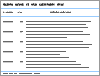
表1
亚热带10种林下优势木本植物基本信息"
| 物种 Species | 菌根类型Mycorrhizal type | 树高 Tree height/m | 地径 Ground diameter/mm |
| 黄瑞木Adinandra millettii | 丛枝菌根Arbuscular mycorrhiza | 2.58 | 39.60 |
| 荚蒾Viburnum dilatatum | 丛枝菌根Arbuscular mycorrhiza | 2.08 | 22.40 |
| 栀子树Gardenia jasminoides | 丛枝菌根Arbuscular mycorrhiza | 1.58 | 13.08 |
| 枫香Liquidambar formosana | 丛枝菌根Arbuscular mycorrhiza | 2.60 | 28.43 |
| 盐肤木Rhus chinensis | 丛枝菌根Arbuscular mycorrhiza | 6.90 | 72.00 |
| 檵木Loropetalum chinense | 外生菌根Ectomycorrhiza | 3.55 | 42.60 |
| 青冈栎Quercus glauca | 外生菌根Ectomycorrhiza | 3.95 | 71.10 |
| 麻栎Quercus acutissima | 外生菌根Ectomycorrhiza | 4.15 | 92.98 |
| 湿地松Pinus elliottii | 外生菌根Ectomycorrhiza | 5.93 | 127.75 |
| 红锥Castanopsis hystrix | 外生菌根Ectomycorrhiza | 5.05 | 49.20 |
表2
植物叶片和根系性状的统计描述"
| 项目Items | 简写 Abbreviation | 单位 Units | 样本数量 Sample numbers | 最小值 Min. | 最大值 Max. | 均值 Mean | 标准误差 Standard error | 变异系数 Coefficient of variation |
| 叶片含水量Leaf water content | LWC | % | 40 | 31.02 | 69.94 | 53.61 | 1.36 | 0.16 |
| 比叶面积Specific leaf area | SLA | cm2·g–1 | 40 | 21.17 | 196.62 | 118.39 | 6.79 | 0.36 |
| 比叶质量Leaf mass per area | LMA | mg·cm–2 | 40 | 5.09 | 47.24 | 10.82 | 1.34 | 0.79 |
| 叶碳含量Leaf carbon content | LCC | g·g–1 | 40 | 0.45 | 0.54 | 0.50 | 0.00 | 0.04 |
| 叶氮含量Leaf nitrogen content | LNC | mg·g–1 | 40 | 11.84 | 25.03 | 17.56 | 0.52 | 0.19 |
| 叶碳氮比Leaf carbon-to-nitrogen ratio | LC∶N | — | 40 | 20.72 | 42.91 | 29.16 | 0.84 | 0.18 |
| 根直径Root diameter | RD | mm | 40 | 0.11 | 0.27 | 0.17 | 0.01 | 0.27 |
| 根组织密度Root tissue density | RTD | g·cm–3 | 40 | 0.29 | 1.11 | 0.71 | 0.04 | 0.32 |
| 比根长Specific root length | SRL | m·g–1 | 40 | 32.70 | 193.35 | 77.50 | 6.90 | 0.56 |
| 比根表面积Specific root surface area | SRA | cm2·g–1 | 40 | 201.59 | 749.41 | 369.87 | 22.36 | 0.38 |
| 根分枝比Root branching ratio | BR | — | 40 | 1.43 | 8.48 | 4.00 | 0.31 | 0.48 |
| 根分枝强度Root branching density | BI | cm–1 | 40 | 1.34 | 19.49 | 6.16 | 0.72 | 0.74 |
| 根碳含量Root carbon content | RCC | g·g–1 | 40 | 0.36 | 0.47 | 0.43 | 0.00 | 0.06 |
| 根氮含量Root nitrogen content | RNC | mg·g–1 | 40 | 7.38 | 14.91 | 10.88 | 0.30 | 0.18 |
| 根碳氮比Root carbon-to-nitrogen ratio | RC∶N | — | 40 | 25.69 | 57.87 | 40.88 | 1.29 | 0.20 |
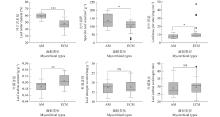
图1
植物叶性状 *:P<0.05;**:P<0.01;***:P<0.001;NS:不显著Non-significant;AM:丛枝菌根Arbuscular mycorrhiza;ECM:外生菌根Ectomycorrhiza."


图2
植物根性状 **:P<0.01;***:P<0.001;NS:不显著Non-significant;AM:丛枝菌根Arbuscular mycorrhiza;ECM:外生菌根Ectomycorrhiza."

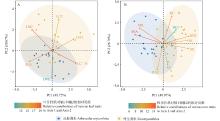
图3
叶性状(A)和根性状(B)的主成分分析 LWC:叶片含水量Leaf water content;SLA:比叶面积Specific leaf area;LNC:叶氮含量Leaf nitrogen content;LCC:叶碳含量Leaf carbon content;LMA:比叶质量Leaf mass per area;LC∶N:叶碳氮比Leaf carbon-to-nitrogen ratio;RNC:根氮含量Root nitrogen content;SRA:比根表面积Specific root surface area;SRL:比根长Specific root length;RC∶N:根碳氮比Root carbon-to-nitrogen ratio;RCC:根碳含量Root carbon content;RTD:根组织密度Root tissue density;BI:根分枝强度Root branching density;BR:根分枝比Root branching ratio;RD:根直径Root diameter."

表3
叶性状在主成分(PC1和PC2)上的载荷矩阵①"
| 叶片性状Leaf traits | PC1 | PC2 |
| 叶片含水量Leaf water content (LWC) | ?0.019 | ?0.727 |
| 比叶面积Specific leaf area (SLA) | ?0.877 | ?0.285 |
| 比叶质量Leaf mass per area (LMA) | 0.823 | 0.314 |
| 叶碳含量Leaf carbon content (LCC) | 0.248 | 0.842 |
| 叶氮含量Leaf nitrogen content (LNC) | ?0.779 | 0.560 |
| 叶碳氮比Leaf carbon-to-nitrogen ratio (LC∶N) | 0.899 | ?0.328 |
| 特征值Eigenvalues | 2.923 | 1.840 |
| 方差解释率Ratio of variance explained (%) | 48.72 | 30.67 |
| 累积解释率Cumulative resolution rate (%) | 48.72 | 79.39 |
表4
根性状在主成分(PC1和PC2)上的载荷矩阵①"
| 根性状Root traits | PC1 | PC2 |
| 根直径Root diameter (RD) | 0.145 | ?0.656 |
| 根组织密度Root tissue density (RTD) | 0.816 | 0.231 |
| 比根长Specific root length (SRL) | ?0.753 | 0.483 |
| 比根表面积Specific root surface area (SRA) | ?0.901 | 0.281 |
| 根分枝比Root branching ratio (BR) | 0.803 | ?0.153 |
| 根分枝强度Root branching density (BI) | 0.786 | 0.104 |
| 根碳含量Root carbon content (RCC) | 0.410 | 0.432 |
| 根氮含量Root nitrogen content (RNC) | ?0.189 | ?0.810 |
| 根碳氮比Root carbon-to-nitrogen ratio (RC∶N) | 0.274 | 0.858 |
| 特征值Eigenvalues | 3.607 | 2.408 |
| 方差解释率Ratio of variance explained (%) | 40.07 | 26.76 |
| 累积解释率Cumulative resolution rate (%) | 40.07 | 66.83 |
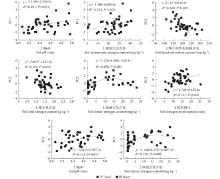
图4
土壤理化性质与根叶主成分2个轴坐标的回归分析"

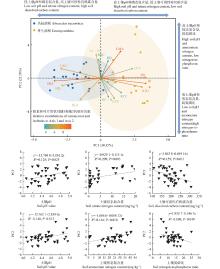
图5
叶根性状联合主成分分析以及土壤理化性质与主成分坐标轴得分的线性回归 SLA:比叶面积Specific leaf area;SRL:比根长 Specific root length;SRA:比根表面积 Specific root surface area;LWC:叶片含水量 Leaf water content;LC∶N:叶碳氮比 Leaf carbon-to-nitrogen ratio;RNC:根氮含量 Root nitrogen content;RD:根直径 Root diameter;LMA:比叶质量 Leaf mass per area;LCC:叶碳含量 Leaf carbon content;BR:根分枝比 Root branching ratio;BI:根分枝强度 Root branching density;RTD:根组织密度 Root tissue density;RCC:根碳含量 Root carbon content;LNC:叶氮含量 Leaf nitrogen content;RC∶N:根碳氮比 Root carbon-to-nitrogen ratio."

表5
根叶性状联合在主成分上的载荷矩阵①"
| 性状Traits | PC1 | PC2 |
| 叶片含水量Leaf water content (LWC) | ?0.726 | 0.281 |
| 比叶面积Specific leaf area (SLA) | ?0.378 | ?0.643 |
| 比叶质量Leaf mass per area (LMA) | 0.367 | 0.802 |
| 叶碳含量Leaf carbon content (LCC) | 0.580 | 0.283 |
| 叶氮含量Leaf nitrogen content (LNC) | 0.250 | ?0.610 |
| 叶碳氮比Leaf carbon-to-nitrogen ratio (LC∶N) | ?0.085 | 0.709 |
| 根直径Root diameter (RD) | 0.137 | 0.521 |
| 根组织密度Root tissue density (RTD) | 0.756 | ?0.265 |
| 比根长Specific root length (SRL) | ?0.708 | ?0.222 |
| 比根表面积Specific root surface area (SRA) | ?0.852 | ?0.083 |
| 根分枝比Root branching ratio (BR) | 0.821 | 0.018 |
| 根分枝强度Root branching density (BI) | 0.826 | ?0.157 |
| 根碳含量Root carbon content (RCC) | 0.377 | ?0.438 |
| 根氮含量Root nitrogen content (RNC) | ?0.040 | 0.558 |
| 根碳氮比Root carbon-to-nitrogen ratio (RC∶N) | 0.143 | ?0.569 |
| 特征值Eigenvalues | 4.552 | 3.342 |
| 方差解释率Ratio of variance explained (%) | 30.35 | 22.28 |
| 累积解释率Cumulative resolution rate (%) | 30.35 | 52.63 |
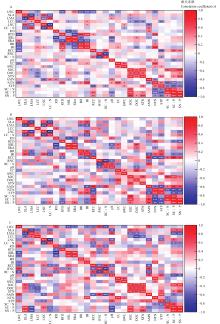
图6
所有物种(A)、丛枝菌根(B)和外生菌根(C)物种的根叶性状和土壤因子的相关性 LWC:叶片含水量Leaf water content;SLA:比叶面积Specific leaf area;LMA:比叶质量Leaf mass per area;LCC:叶碳含量Leaf carbon content;LNC:叶氮含量Leaf nitrogen content;LC∶N:叶碳氮比Leaf carbon-to-nitrogen ratio;RD:根直径Root diameter;RTD:根组织密度Root tissue density;SRL:比根长Specific root length;SRA:比根表面积Specific root surface area;BR:根分枝比Root branching ratio;BI:根分枝强度Root branching density;RCC:根碳含量Root carbon content;RNC:根氮含量Root nitrogen content;RC∶N:根碳氮比Root carbon-to-nitrogen ratio;EC:土壤电导率Soil electrical conductivity;SWC:土壤含水量Soil water content;SOC:土壤有机碳含量Soil organic carbon content;DOC:土壤可溶性有机碳含量Soil dissolved carbon content;STN:土壤全氮含量Soil total nitrogen content;AMN:土壤铵态氮含量Soil ammonium nitrogen content;NTN:土壤硝态氮含量Soil nitrate nitrogen content;STP:土壤全磷含量Soil total phosphorus content;SC∶N:土壤碳氮比Soil carbon-to-nitrogen ratio;SC∶P:土壤碳磷比Soil carbon-to-phosphorus ratio;SN∶P:土壤氮磷比Soil nitrogen-to-phosphorus ratio. *: P<0.05; **: P<0.01; ***: P<0.001."

表6
冗余分析前的土壤因素共线性检验"
| 土壤因子Soil factors | 方差膨胀 因子VIF |
| pH | 2.698 |
| 土壤电导率Soil electrical conductivity (EC) | 2.416 |
| 土壤含水量Soil water content (SWC) | 1.290 |
| 土壤有机碳含量Soil organic carbon content (SOC) | 6.037 |
| 土壤可溶性有机碳含量Soil dissolved carbon content (DOC) | 1.544 |
| 土壤全氮含量Soil total nitrogen content (STN) | 5.894 |
| 土壤铵态氮含量Soil ammonium nitrogen content (AMN) | 2.861 |
| 土壤硝态氮含量Soil nitrate nitrogen content (NTN) | 4.444 |
| 土壤全磷含量Soil total phosphorus content (STP) | 1.603 |
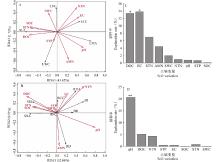
图7
土壤理化性质对叶性状(A)和根性状(B)的影响的冗余分析以及相对应的土壤变量解释率(C、D) 红色箭头代表土壤理化性质,蓝色箭头分别代表叶片性状(A)和根系性状(B)。The red arrows represent soil physicochemical properties, the blue arrows represent leaf traits(A) and root traits (B), respectively. LWC:叶片含水量Leaf water content;STP:土壤全磷含量Soil total phosphorus content;DOC:土壤可溶性有机碳含量Soil dissolved carbon content;SLA:比叶面积Specific leaf area;STN:土壤全氮含量Soil total nitrogen content;SOC:土壤有机碳含量Soil organic carbon content;SWC:土壤含水量Soil water content;LNC:叶氮含量Leaf nitrogen content;NTN:土壤硝态氮含量Soil nitrate nitrogen content;EC:土壤电导率Soil electrical conductivity;LCC:叶碳含量Leaf carbon content;LMA:比叶质量Leaf mass per area;AMN:土壤铵态氮含量Soil ammonium nitrogen content;SRA:比根表面积Specific root surface area;SRL:比根长Specific root length;RNC:根氮含量Root nitrogen content;RCC:根碳含量Root carbon content;RTD:根组织密度Root tissue density;BI:根分枝强度Root branching density;BR:根分枝比Root branching ratio;RD:根直径Root diameter. *: P<0.05; **: P<0.01; ***: P<0.001."

|
陈雅轩, 韩雨音, 陈艳梅, 等. 华北不同林龄人工林植物功能性状与碳氮化学计量. 植物生态学报, 2026, 50 (2): 318- 333.
doi: 10.17521/cjpe.2025.0183 |
|
|
Chen Y X, Han Y Y, Chen Y M, et al. Plant functional traits and carbon-nitrogen stoichiometry of plantations at different forest ages in north China. Chinese Journal of Plant Ecology, 2026, 50 (2): 318- 333.
doi: 10.17521/cjpe.2025.0183 |
|
| 韩 飞, 张家铱, 夏 蕾, 等. 菌根类型对亚热带森林主要树种根叶功能性状关联的影响. 生态学杂志, 2023, 42 (4): 838- 845. | |
| Han F, Zhang J Y, Xia L, et al. Effects of mycorrhizal type on the correlation of root and leaf functional traits of main tree species in sub-tropical forests. Chinese Journal of Ecology, 2023, 42 (4): 838- 845. | |
|
黄汐月, 陈 卓, 黄梦月, 等. 藏东木本植物群落功能性状分布与环境的关系. 生态学报, 2022, 42 (22): 8964- 8976.
doi: 10.5846/stxb202205071265 |
|
|
Huang X Y, Chen Z, Huang M Y, et al. Functional traits of woody plants along the environmental gradients in eastern Tibet. Acta Ecologica Sinica, 2022, 42 (22): 8964- 8976.
doi: 10.5846/stxb202205071265 |
|
| 李艳红, 姜 勇, 王文杰, 等. 有机碳和无机碳对3种真菌胞外酸性磷酸酶和蛋白酶活性的影响. 植物研究, 2013, 33 (4): 404- 409. | |
| Li Y H, Jiang Y, Wang W J, et al. Effect of organic and inorganic carbon on extracellular enzyme activity of acid phosphatase and proteases in three kinds of fungal hyphae. Bulletin of Botanical Research, 2013, 33 (4): 404- 409. | |
|
刘聪聪, 何念鹏, 李 颖, 等. 宏观生态学中的植物功能性状研究: 历史与发展趋势. 植物生态学报, 2024, 48 (1): 21- 40.
doi: 10.17521/cjpe.2023.0111 |
|
|
Liu C C, He N P, Li Y, et al. Current and future trends of plant functional traits in macro-ecology. Chinese Journal of Plant Ecology, 2024, 48 (1): 21- 40.
doi: 10.17521/cjpe.2023.0111 |
|
| 苗 原, 吴会芳, 马承恩, 等. 菌根真菌与吸收根功能性状的关系: 研究进展与评述. 植物生态学报, 2013, 37 (11): 1035- 1042. | |
| Miao Y, Wu H F, Ma C E, et al. Relationship between mycorrhizal fungi and functional traits in absorption roots: research progress and synthesis. Chinese Journal of Plant Ecology, 2013, 37 (11): 1035- 1042. | |
|
欧阳园丽, 张参参, 林小凡, 等. 中国亚热带不同菌根树种的根叶形态学性状特征与生长差异: 以江西新岗山为例. 生物多样性, 2021, 29 (6): 746- 758.
doi: 10.17520/biods.2020368 |
|
|
Ouyang Y L, Zhang C C, Lin X F, et al. Growth differences and characteristics of root and leaf morphological traits for different mycorrhizal tree species in the subtropical China: a case study of Xingangshan, Jiangxi Province. Biodiversity Science, 2021, 29 (6): 746- 758.
doi: 10.17520/biods.2020368 |
|
| 齐 威, 郭淑青, 崔现亮, 等. 青藏高原东部4科植物种子大小和比叶面积随海拔和生境的变异. 草业学报, 2012, 21 (6): 42- 50. | |
| Qi W, Guo S Q, Cui X L, et al. Variation of seed mass and SLA of 63 plant species in different habitats at various altitudes on the eastern Qinghai-Tibet Plateau. Acta Prataculturae Sinica, 2012, 21 (6): 42- 50. | |
| 宋 光, 温仲明, 郑 颖, 等. 陕北黄土高原刺槐植物功能性状与气象因子的关系. 水土保持研究, 2013, 20 (3): 125- 130. | |
| Song G, Wen Z M, Zheng Y, et al. Relationships between plant functional traits of Robinia pseudoacacia and meteorological factors in Loess Plateau, north Shaanxi, China. Research of Soil and Water Conservation, 2013, 20 (3): 125- 130. | |
|
王佳乐, 刘倩愿, 陈艳梅. 树木对无机氮吸收偏好研究进展. 河北师范大学学报(自然科学版), 2025, 49 (3): 304- 313.
doi: 10.13763/j.cnki.jhebnu.nse.202405024 |
|
|
Wang J L, Liu Q Y, Chen Y M. Research progress on inorganic nitrogen uptake preference of trees. Journal of Hebei Normal University (Natural Science Edition), 2025, 49 (3): 304- 313.
doi: 10.13763/j.cnki.jhebnu.nse.202405024 |
|
| 赵 敏, 练琚愉, 刘小容, 等. 南亚热带森林2种菌根类型树木水分传导和养分利用策略的对比研究. 热带亚热带植物学报, 2021, 29 (6): 589- 596. | |
| Zhao M, Lian J Y, Liu X R, et al. Comparison studies on water transport and nutrient acquisition of trees with different mycorrhiza types in subtropical forest. Journal of Tropical and Subtropical Botany, 2021, 29 (6): 589- 596. | |
| Averill C, Bhatnagar J M, Dietze M C, et al. Global imprint of mycorrhizal fungi on whole-plant nutrient economics. Proceedings of the National Academy of Sciences, 2019, 116 (46): 23163- 23168. | |
|
Bergmann J, Weigelt A, van der Plas F, et al. The fungal collaboration gradient dominates the root economics space in plants. Science Advances, 2020, 6 (27): eaba3756.
doi: 10.1126/sciadv.aba3756 |
|
|
Brzostek E R, Fisher J B, Phillips R P. Modeling the carbon cost of plant nitrogen acquisition: mycorrhizal trade-offs and multipath resistance uptake improve predictions of retranslocation: carbon cost of mycorrhizae. Journal of Geophysical Research: Biogeosciences, 2014, 119 (8): 1684- 1697.
doi: 10.1002/2014JG002660 |
|
|
Castro Sánchez-Bermejo P, Monjau T, Goldmann K, et al. Tree and mycorrhizal fungal diversity drive intraspecific and intraindividual trait variation in temperate forests: evidence from a tree diversity experiment. Functional Ecology, 2024, 38 (5): 1089- 1103.
doi: 10.1111/1365-2435.14549 |
|
|
Chave J, Coomes D, Jansen S, et al. Towards a worldwide wood economics spectrum. Ecology Letters, 2009, 12 (4): 351- 366.
doi: 10.1111/j.1461-0248.2009.01285.x |
|
|
Cornejo P, Borie F, Rubio R, et al. Influence of nitrogen source on the viability, functionality and persistence of Glomus etunicatum fungal propagules in an Andisol. Applied Soil Ecology, 2007, 35 (2): 423- 431.
doi: 10.1016/j.apsoil.2006.06.006 |
|
| de la Riva E G, Marañón T, Pérez-Ramos I M, et al. 2018. Root traits across environmental gradients in Mediterranean woody communities: are they aligned along the root economics spectrum? Plant and Soil, 424(1): 35−48. | |
|
Ding J X, Kong D L, Zhang Z L, et al. Climate and soil nutrients differentially drive multidimensional fine root traits in ectomycorrhizal-dominated alpine coniferous forests. Journal of Ecology, 2020, 108 (6): 2544- 2556.
doi: 10.1111/1365-2745.13407 |
|
| Ding J, Yin H, Kong D, et al. Precipitation, rather than temperature drives coordination of multidimensional root traits with ectomycorrhizal fungi in alpine coniferous forests. Journal of Ecology, 2023, 111 (9): 1935- 1949. | |
|
Erel R, T Le T, Eshel A, et al. Root development of bell pepper (Capsicum annuum L.) as affected by water salinity and sink strength. Plants, 2019, 9 (1): 35.
doi: 10.3390/plants9010035 |
|
|
Fort F, Volaire F, Guilioni L, et al. Root traits are related to plant water-use among rangeland Mediterranean species. Functional Ecology, 2017, 31 (9): 1700- 1709.
doi: 10.1111/1365-2435.12888 |
|
|
Geng Y, Wang L, Jin D M, et al. Alpine climate alters the relationships between leaf and root morphological traits but not chemical traits. Oecologia, 2014, 175 (2): 445- 455.
doi: 10.1007/s00442-014-2919-5 |
|
|
Guo L, Deng M, Li X, et al. Evolutionary and ecological forces shape nutrient strategies of mycorrhizal woody plants. Ecology Letters, 2024, 27 (1): e14330.
doi: 10.1111/ele.14330 |
|
| Hong J T, Ma X X, Yan Y, et al. 2018. Which root traits determine nitrogen uptake by alpine plant species on the Tibetan Plateau? Plant and Soil, 424(1): 63−72. | |
|
Kiers E T, Duhamel M, Beesetty Y, et al. Reciprocal rewards stabilize cooperation in the mycorrhizal symbiosis. Science, 2011, 333 (6044): 880- 882.
doi: 10.1126/science.1208473 |
|
|
Kong D L, Ma C G, Zhang Q, et al. Leading dimensions in absorptive root trait variation across 96 subtropical forest species. New Phytologist, 2014, 203 (3): 863- 872.
doi: 10.1111/nph.12842 |
|
|
Kong D L, Wang J J, Wu H F, et al. Nonlinearity of root trait relationships and the root economics spectrum. Nature Communications, 2019, 10, 2203.
doi: 10.1038/s41467-019-10245-6 |
|
|
Kou L, Zuo W Y, Freschet G T, et al. Toward refining and contextualizing the root economics space. Trends in Ecology & Evolution, 2026, 41 (5): 416- 426.
doi: 10.1016/j.tree.2026.02.003 |
|
|
Li H B, Liu B T, McCormack M L, et al. Diverse belowground resource strategies underlie plant species coexistence and spatial distribution in three grasslands along a precipitation gradient. The New Phytologist, 2017, 216 (4): 1140- 1150.
doi: 10.1111/nph.14710 |
|
|
Liu G F, Freschet G T, Pan X, et al. Coordinated variation in leaf and root traits across multiple spatial scales in Chinese semi-arid and arid ecosystems. The New Phytologist, 2010, 188 (2): 543- 553.
doi: 10.1111/j.1469-8137.2010.03388.x |
|
|
Liu Q Y, Chen Y X, Chen Y M. Nitrogen acquisition strategy shifts with tree age depending on root functional traits and soil properties in Larix principis-rupprechtii plantations. Frontiers in Plant Science, 2024, 15, 1358367.
doi: 10.3389/fpls.2024.1358367 |
|
|
Suzuki K C, Kajino H, Hirokawa S, et al. The coordination between root and leaf functional traits across 33 woody plant species shifts between mycorrhizal types. Tree Physiology, 2026, 46 (1): tpaf151.
doi: 10.1093/treephys/tpaf151 |
|
|
Valverde-Barrantes O J, Freschet G T, Roumet C, et al. A worldview of root traits: the influence of ancestry, growth form, climate and mycorrhizal association on the functional trait variation of fine-root tissues in seed plants. New Phytologist, 2017, 215 (4): 1562- 1573.
doi: 10.1111/nph.14571 |
|
|
Valverde-Barrantes O J, Smemo K A, Blackwood C B. Fine root morphology is phylogenetically structured, but nitrogen is related to the plant economics spectrum in temperate trees. Functional Ecology, 2015, 29 (6): 796- 807.
doi: 10.1111/1365-2435.12384 |
|
|
Vendramini F, Díaz S, Gurvich D E, et al. Leaf traits as indicators of resource-use strategy in floras with succulent species. New Phytologist, 2002, 154 (1): 147- 157.
doi: 10.1046/j.1469-8137.2002.00357.x |
|
|
Veresoglou S D, Chen B D, Fischer M M, et al. Latitudinal constraints in responsiveness of plants to arbuscular mycorrhiza: the ‘Sun-worshipper’ hypothesis. The New Phytologist, 2019, 224 (2): 552- 556.
doi: 10.1111/nph.15918 |
|
|
Wang J N, Han S J, Wang C G, et al. Long-term nitrogen-addition-induced shifts in the ectomycorrhizal fungal community are associated with changes in fine root traits and soil properties in a mixed Pinus koraiensis forest. European Journal of Soil Biology, 2022, 112, 103431.
doi: 10.1016/j.ejsobi.2022.103431 |
|
|
Weigelt A, Mommer L, Andraczek K, et al. An integrated framework of plant form and function: the belowground perspective. New Phytologist, 2021, 232 (1): 42- 59.
doi: 10.1111/nph.17590 |
|
|
Withington J M, Reich P B, Oleksyn J, et al. Comparisons of structure and life span in roots and leaves among temperate trees. Ecological Monographs, 2006, 76 (3): 381- 397.
doi: 10.1890/0012-9615(2006)076[0381:COSALS]2.0.CO;2 |
|
|
Wright I J, Reich P B, Westoby M, et al. The worldwide leaf economics spectrum. Nature, 2004, 428 (6985): 821- 827.
doi: 10.1038/nature02403 |
|
|
Wright I J, Westoby M, Reich P B. Convergence towards higher leaf mass per area in dry and nutrient-poor habitats has different consequences for leaf life span. Journal of Ecology, 2002, 90 (3): 534- 543.
doi: 10.1046/j.1365-2745.2002.00689.x |
|
|
Yang Y, Zhang X Y, Hartley I P, et al. Contrasting rhizosphere soil nutrient economy of plants associated with arbuscular mycorrhizal and ectomycorrhizal fungi in karst forests. Plant and Soil, 2022, 470 (1): 81- 93.
doi: 10.1007/s11104-021-05032-6 |
|
|
Yi R J, Liu Q Y, Yang F T, et al. Complementary belowground strategies underlie species coexistence in an early successional forest. The New Phytologist, 2023, 238 (2): 612- 623.
doi: 10.1111/nph.18736 |
|
|
Zhao H J, Liao H X, Biere A, et al. Plant economics traits predict plant carbon allocation and responsiveness to arbuscular mycorrhizal fungi under varying precipitation. Functional Ecology, 2026, 40 (6): 1921- 1932.
doi: 10.1111/1365-2435.70340 |
|
|
Zhu X M, Lambers H, Guo W J, et al. Extraradical hyphae exhibit more plastic nutrient-acquisition strategies than roots under nitrogen enrichment in ectomycorrhiza-dominated forests. Global Change Biology, 2023, 29 (16): 4605- 4619.
doi: 10.1111/gcb.16768 |
|
| Zou Y T, Zhang Y X, Testerink C. Root dynamic growth strategies in response to salinity. Plant, Cell & Environment, 2022, 45 (3): 695- 704. |
| [1] | 徐瑞晶,王艺,黄川腾,蔡春菊,范少辉,刘广路. 持续干旱时间对黄藤幼苗功能性状的影响[J]. 林业科学, 2026, 62(9): 165-176. |
| [2] | 任雪莹,许智荣,王璇,李重仪,赵秀海,何怀江,张春雨,张新娜. 蒙古栎多器官功能性状的协同与权衡关系及其对土壤碳氮含量的响应[J]. 林业科学, 2026, 62(8): 43-54. |
| [3] | 邓敏,何怀江,吴相菊,张新娜,张春雨,赵秀海. 东北温带森林幼苗生长受生物量分配权衡和性状影响[J]. 林业科学, 2026, 62(3): 48-60. |
| [4] | 刘世荣,陈远其,聂秀青,明安刚,王晖. 树种多样性对森林生态系统多功能性和韧性的影响[J]. 林业科学, 2026, 62(1): 1-18. |
| [5] | 郭文俊,李鑫豪,田赟,孙艳丽,房新民,代远萌,陈文婧,李廷山,刘鹏,贾昕,查天山. 北京东北部山区不同生活型木本植物叶功能性状特征及其权衡关系[J]. 林业科学, 2025, 61(9): 70-80. |
| [6] | 杨智慧,韦柳端,于淼,董天心,张星宇,张新娜,马冰倩,徐程扬. 4种树苗生长的干旱胁迫响应取决于低序级根性状[J]. 林业科学, 2025, 61(9): 81-89. |
| [7] | 冉馨,孙晓梅,吴春燕,陈东升,王宏星,张守攻. 降水减少和间伐对日本落叶松人工林根系分布与生理特性的影响[J]. 林业科学, 2025, 61(7): 157-169. |
| [8] | 白涵,郝珉辉,何怀江,张新娜,张春雨,赵秀海. 东北主要树种幼树叶片功能性状对模拟氮沉降的响应[J]. 林业科学, 2025, 61(5): 23-32. |
| [9] | 许可儿,汤璐瑶,张博纳,叶琳峰,王忠媛,谢江波. 国槐功能性状沿降水梯度带的变异规律[J]. 林业科学, 2025, 61(4): 81-91. |
| [10] | 杨乐梅,张宝刚,陈有超,蔡延江. 毛竹林林下植物叶片功能性状的模拟氮沉降响应[J]. 林业科学, 2025, 61(12): 61-71. |
| [11] | 笪明慧,冉松松,傅彦榕,邹秉章,王思荣,万晓华,余再鹏,黄志群. 邻体树种多样性对杉木叶片氮与钾、钙、镁计量比的影响[J]. 林业科学, 2024, 60(6): 37-43. |
| [12] | 杭宇杰,陈志成,王林,牛保亮,刘松松,于博,王晓,刘世荣. 宝天曼8种阔叶树木材密度的解剖学决定因素及其与叶性状的协同与权衡[J]. 林业科学, 2024, 60(4): 62-70. |
| [13] | 赵洪贤,苏同,王瑞福,孙艳丽,高永龙,隗骥超,李鑫豪,田赟,贾昕,查天山. 北京密云油松林下灌木小叶鼠李叶片资源利用效率季节变异及环境调控[J]. 林业科学, 2023, 59(7): 1-11. |
| [14] | 顾泽,刘晓东,陈锋. 不同火烈度条件下油松枝功能性状的响应[J]. 林业科学, 2022, 58(8): 99-108. |
| [15] | 徐瑞晶,胡璇,刘广路,郭雯,梁昌强,孔祥河. 海南岛热带低地雨林2种攀缘竹的叶片功能性状差异[J]. 林业科学, 2021, 57(12): 155-166. |
| 阅读次数 | ||||||
|
全文 |
|
|||||
|
摘要 |
|
|||||

