
林业科学 ›› 2026, Vol. 62 ›› Issue (10): 125-140.doi: 10.11707/j.1001-7488.LYKX20260225
• 研究论文 • 上一篇
冷佳怡1,2,杨晓伟2,3,杨桂娟2,王军辉2,麻文俊2,安三平4,高本旺5,王丽芳4,张苗苗2,*( )
)
收稿日期:2026-04-17
出版日期:2026-10-10
发布日期:2026-10-16
通讯作者:
张苗苗
E-mail:mmzhang@caf.ac.cn
基金资助:
Jiayi Leng1,2,Xiaowei Yang2,3,Guijuan Yang2,Junhui Wang2,Wenjun Ma2,Sanping An4,Benwang Gao5,Lifang Wang4,Miaomiao Zhang2,*()
Received:2026-04-17
Online:2026-10-10
Published:2026-10-16
Contact:
Miaomiao Zhang
E-mail:mmzhang@caf.ac.cn
摘要:
目的: 对甘肃小陇山欧洲云杉无性系群体的生长、材性和抗逆性状进行综合评价,并结合全基因组 SNP 标记解析群体遗传结构、遗传多样性和性状遗传参数,为优良无性系筛选和核心育种群体构建提供依据。方法: 以136个欧洲云杉无性系为材料,测定15项生长、材性和抗逆性状;同时基于质控后的
中图分类号:
冷佳怡,杨晓伟,杨桂娟,王军辉,麻文俊,安三平,高本旺,王丽芳,张苗苗. 基于生长、材性、抗性及遗传结构分析的欧洲云杉无性系综合选择[J]. 林业科学, 2026, 62(10): 125-140.
Jiayi Leng,Xiaowei Yang,Guijuan Yang,Junhui Wang,Wenjun Ma,Sanping An,Benwang Gao,Lifang Wang,Miaomiao Zhang. Comprehensive Selection of Picea abies Clones based on the Analysis of Growth, Wood Properties, Resistance, and Genetic Structure[J]. Scientia Silvae Sinicae, 2026, 62(10): 125-140.
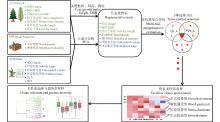
图1
主要内容结构框架 U:隶属函数法;PCA:主成分分析法;Qi:多性状综合指数法。"


图2
欧洲云杉无性系群体遗传结构与聚类分析 A:群体遗传结构图(K=2);B:主成分分析散点图;C:群体遗传分层分析;D:系统发育聚类图。A: Population genetic structure (K = 2); B: Principal component analysis scatter plot; C: Population genetic stratification analysis; D: Phylogenetic clustering tree. ▲:多方法交集的生长材性优良无性系;◆:多方法交集的抗逆优良无性系;★:综合选优无性系。▲: Clones with superior growth and wood properties identified by the consensus of multiple methods; ◆: Clones with superior stress resistance identified by the consensus of multiple methods; ★: Clones selected by the integrative strategy."

表1
欧洲云杉群体遗传参数分析"
| 指标Indicator | 均值Mean | 标准差SD |
| 有效等位基因数 Effective allele number | 1.40 | 0.29 |
| 观测杂合度 Observed heterozygosity | 0.21 | 0.15 |
| 期望杂合度 Expected heterozygosity | 0.26 | 0.14 |
| Shannon-Wiener 多样性指数 Shannon-Wiener diversity index | 0.41 | 0.18 |
| 多态性信息含量 Polymorphic information content | 0.21 | 0.10 |
表2
欧洲云杉无性系各性状的描述统计"
| 性状 Traits | 最大值 Max | 最小值 Min | 均值 Mean | 标准差 SD | 变异系数 CV (%) | 偏度系数 Skewness | 峰度系数 Kurtosis | 遗传力 h2 | 遗传方差 Vu | 残差方差 Ve |
| 树高 Tree height/m | 8.950 | 3.170 | 6.605 | 1.099 | 16.643 | –0.400 | –0.196 | 0.141 | 0.172 | 1.047 |
| 胸径 DBH/cm | 12.800 | 3.100 | 8.390 | 1.781 | 21.222 | 0.051 | –0.416 | 0.485 | 1.886 | 2.001 |
| 冠幅 Crown width/cm | 432.940 | 144.830 | 288.169 | 56.482 | 19.600 | –0.108 | –0.357 | 0.001 | 0.000 | 0.001 |
| 树干通直度 Trunk straightness | 4.700 | 2.850 | 3.951 | 0.358 | 9.068 | –0.414 | 0.196 | 0.000 | 0.000 | 0.001 |
| 枝条基径 Branch base diameter/mm | 20.000 | 10.230 | 15.545 | 2.141 | 13.776 | –0.339 | –0.644 | 0.368 | 2.160 | 3.712 |
| 木材密度 Pilodyn/mm | 45.300 | 29.150 | 37.400 | 3.106 | 8.306 | –0.087 | –0.145 | 0.658 | 9.359 | 4.869 |
| 弹性模量 MOE/GPa | 4.950 | 2.850 | 3.908 | 0.343 | 8.783 | –0.277 | 0.996 | 0.608 | 0.103 | 0.066 |
| 针叶长 Needle length/cm | 2.220 | 0.940 | 1.436 | 0.244 | 17.006 | 0.446 | 0.394 | 0.001 | 0.000 | 0.000 |
| 叶片干质量 Leaf dry weight/g | 3.400 | 1.100 | 1.817 | 0.387 | 21.313 | 1.083 | 1.691 | 0.508 | 0.097 | 0.094 |
| 淀粉含量 Starch/(g·kg–1) | 11.920 | 1.640 | 8.947 | 1.428 | 15.957 | –2.464 | 11.692 | 0.873 | 3.394 | 0.496 |
| 可溶性糖含量 Soluble sugar content/(g·kg–1) | 13.300 | 1.240 | 8.164 | 2.012 | 24.650 | –0.225 | 2.225 | 0.000 | 0.001 | 0.000 |
| 叶绿素含量 Chlorophyll content/(mg·g–1) | 7.850 | 1.170 | 3.261 | 1.195 | 36.648 | 0.819 | 1.217 | 0.100 | 0.160 | 1.444 |
| 叶芽萌发等级 Budburst stage | 9.000 | 2.000 | 6.886 | 1.962 | 28.497 | –0.551 | –0.767 | 0.686 | 3.371 | 1.545 |
| 氮含量Nitrogen content/(g·kg–1) | 13.600 | 5.660 | 9.612 | 1.671 | 17.384 | –0.012 | –0.899 | 0.036 | 0.105 | 2.808 |
| 磷含量Phosphorus content/(g·kg–1) | 2.250 | 0.900 | 1.389 | 0.313 | 22.548 | 0.358 | –0.737 | 0.785 | 0.127 | 0.035 |

图3
欧洲云杉各性状相关性分析 *: P < 0.05; **: P < 0.01; ***, P < 0.001. H:树高Height;DBH:胸径Diameter at breast height;CW:冠幅Crown width;TS:树干通直度Trunk straightness;BBD:枝条基径Branch base diameter;NL:针叶长Needle length;LDW:叶片干质量Leaf dry weight;Pilodyn:木材密度Wood density;MOE:弹性模量Modulus of elasticity;Starch:淀粉Starch;SS:可溶性糖Soluble sugar;CC:叶绿素含量Chlorophyll content;BS:叶芽萌发等级Budburst stage;N:氮Nitrogen content、P:磷Phosphorus content."


图4
生长、材性和抗逆方面3种评价方法的排序结果比较 A:隶属函数法无性系排序;B:主成分分析法无性系排序;C:多性状综合指数法无性系排序;D:生长、材性与抗逆性状主成分分析;E:生长、材性与抗逆无性系选择韦恩图。A: Clonal ranking based on membership function (U); B: Clonal ranking based on principal component analysis (PCA); C: Clonal ranking based on multi-trait comprehensive index (Qi); D: PCA of growth, wood properties, and stress resistance; E: Venn diagram of growth, wood properties and stress resistance in clonal selection. H:树高Height;DBH:胸径Diameter at breast height;CW:冠幅Crown width;TS:树干通直度Trunk straightness;BBD:枝条基径Branch base diameter;NL:针叶长Needle length;LDW:叶片干质量Leaf dry weight;Pilodyn:木材密度Wood density;MOE:弹性模量Modulus of elasticity;Starch:淀粉Starch;SS:可溶性糖Soluble sugar;CC:叶绿素含量Chlorophyll content;BS:叶芽萌发等级Budburst stage;N:氮Nitrogen content;P:磷Phosphorus content."


图5
基于代表性指标综合选优 A:13个性状的主成分分析;B:基于7个关键性状的隶属函数、主成分和布雷金多性状综合评价法方法优良无性系交集;C:13个优良无性系性状分布热图;D:7个关键性状蜜蜂图;E:13个优良无性系雷达分布图。A: Principal component analysis (PCA) of 13 traits of Picea abies clones; B: Intersection of superior clones identified by membership function (U), PCA, and multi-trait comprehensive index (Qi) methods based on seven key traits; C: Heatmap of the 13 superior clones; D: Beeswarm plots of the seven key traits; E: Radar chart of the 13 selected superior clones. H:树高Height;DBH:胸径Diameter at breast height;CW:冠幅Crown width;TS:树干通直度Trunk straightness;BBD:枝条基径Branch base diameter;NL:针叶长Needle length;LDW:叶片干质量Leaf dry weight;Pilodyn:木材密度Wood density;MOE:弹性模量Modulus of elasticity;Starch:淀粉Starch;SS:可溶性糖Soluble sugar;CC:叶绿素含量Chlorophyll content;BS:叶芽萌发等级Budburst stage;N:氮Nitrogen content、P:磷Phosphorus content;All clones: 全部无性系;Elite clones: 优良无性系。"

表3
13个欧洲云杉入选无性系关键性状表现①"
| 系号 No. | 生长Growth (H, DBH, LDW) | 材性Wood (Pilodyn, MOE) | 抗逆Resist (CC, BS) | 综合贡献值 Comprehensive classification |
| 2025 | 1.95 | 0.20 | 0.29 | G-D |
| 2012 | 1.78 | 0.71 | 0.05 | G-D |
| 1946 | 2.41 | 0.32 | 1.95 | G-D |
| 1760 | 1.01 | 0.51 | 0.65 | G-D |
| 2382 | 0.89 | –0.10 | 1.14 | G-D |
| 1719 | 0.77 | 1.71 | 0.99 | W-P |
| 1455 | 1.05 | 1.59 | 0.83 | W-P |
| 2215 | 0.85 | –0.07 | 0.89 | G-D |
| 2114 | 1.39 | 0.82 | 0.45 | G-D |
| 1941 | 0.71 | 1.30 | 0.64 | W-P |
| 1943 | 0.78 | 0.63 | 0.98 | G-D |
| 2065 | 0.52 | 0.54 | 0.92 | S-D |
| 1878 | 1.60 | –0.29 | 0.49 | G-D |
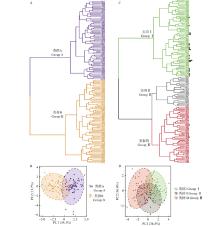
图6
欧洲云杉群体聚类分析与主成分分析 A:基于全部性状的群体聚类分析;B:基于全部性状的群体主成分分析;C:基于7个关键性状的群体聚类分析;D:基于7个关键性状的群体主成分分析。A: Cluster analysis of 136 clones based on all traits; B: PCA of 136 clones based on all traits; C: Cluster analysis of 136 clones based on seven key traits; D: PCA of 136 clones based on seven key traits. ▲:多方法交集的生长材性优良无性系;◆:多方法交集的抗逆优良无性系;★:综合选优无性系。▲: Clones with superior growth and wood properties identified by the consensus of multiple methods; ◆: Clones with superior stress resistance identified by the consensus of multiple methods; ★: Clones selected by the integrative strategy."


图7
3个类群在关键性状上的表现 H:树高Height;DBH:胸径Diameter at breast height;LDW:叶片干质量Leaf dry weight;Pilodyn:木材密度Wood density;MOE:弹性模量Modulus of elasticity;CC:叶绿素含量Chlorophyll content;BS:叶芽萌发等级Budburst stage. *: P<0.05; **: P<0.01; ***: P<0.001."

|
安三平, 欧阳芳群, 马建伟, 等. 欧洲云杉无性系遗传变异及早期选择. 西北林学院学报, 2018, 33 (6): 61- 65.
doi: 10.3969/j.issn.1001-7461.2018.06.10 |
|
|
An S P, Ouyang F Q, Ma J W, et al. Genetic variation and early evaluation of Picea abies clones. Journal of Northwest Forestry University, 2018, 33 (6): 61- 65.
doi: 10.3969/j.issn.1001-7461.2018.06.10 |
|
|
安三平, 王丽芳, 王美琴, 等. 欧洲云杉无性系苗期选育. 东北林业大学学报, 2011, 39 (12): 16- 19, 23.
doi: 10.3969/j.issn.1000-5382.2011.12.005 |
|
|
An S P, Wang L F, Wang M Q, et al. Selection and breeding of cutting clones of Picea abies during seedling stage. Journal of Northeast Forestry University, 2011, 39 (12): 16- 19, 23.
doi: 10.3969/j.issn.1000-5382.2011.12.005 |
|
|
高本旺, 欧阳芳群, 高 晗, 等. 鄂西地区欧洲云杉幼龄无性系生长差异及早期评价与选择. 林业科学研究, 2021, 34 (5): 88- 94.
doi: 10.13275/j.cnki.lykxyj.2021.005.010 |
|
|
Gao B W, Ouyang F Q, Gao H, et al. Growth difference and early evaluation and selection of young Picea abies clones in western Hubei. Forest Research, 2021, 34 (5): 88- 94.
doi: 10.13275/j.cnki.lykxyj.2021.005.010 |
|
| 潘春林. 2012. 欧洲云杉嫁接无性系遗传变异与选择. 北京: 中国林业科学研究院. | |
| Pan C L. 2012. Genetic variation and selection of grafted clones of Picea abies. Beijing: Chinese Academy of Forestry. [in Chinese] | |
|
夏 燕, 张建伟, 田开春, 等. 云杉5个种18个种源的早期评价. 东北林业大学学报, 2014, 42 (12): 1- 6.
doi: 10.3969/j.issn.1000-5382.2014.12.001 |
|
|
Xia Y, Zhang J W, Tian K C, et al. Early valuation of eighteen provenances from five species of spruce. Journal of Northeast Forestry University, 2014, 42 (12): 1- 6.
doi: 10.3969/j.issn.1000-5382.2014.12.001 |
|
|
Alexander D H, Novembre J, Lange K. Fast model-based estimation of ancestry in unrelated individuals. Genome Research, 2009, 19 (9): 1655- 1664.
doi: 10.1101/gr.094052.109 |
|
|
Alexandru A M, Mihai G, Stoica E, et al. Multi-trait selection and stability in Norway spruce (Picea abies) provenance trials in Romania. Forests, 2023, 14 (3): 456.
doi: 10.3390/f14030456 |
|
|
Aro T, Tan B Y, Chen Z Q, et al. Multivariate models improve accuracy of genomic prediction for spring frost tolerance in Norway spruce. The Plant Genome, 2025, 18 (4): e70151.
doi: 10.1002/tpg2.70151 |
|
|
Baison J, Vidalis A, Zhou L H, et al. Genome-wide association study identified novel candidate loci affecting wood formation in Norway spruce. The Plant Journal, 2019, 100 (1): 83- 100.
doi: 10.1111/tpj.14429 |
|
|
Berlin M, Jansson G, Högberg K A. Genotype by environment interaction in the southern Swedish breeding population of Picea abiesusing new climatic indices. Scandinavian Journal of Forest Research, 2015, 30 (2): 112- 121.
doi: 10.1080/02827581.2014.978889 |
|
|
Bínová Z, Korecký J, Dvořák J, et al. Genetic structure of Norway spruce ecotypes studied by SSR markers. Forests, 2020, 11 (1): 110.
doi: 10.3390/f11010110 |
|
| Browning B L, Browning S R. 2016. Genotype imputation with millions of reference samples. American Journal of Human Genetics 98(1): 116–126. | |
|
Chen Z Q, Baison J, Pan J, et al. Accuracy of genomic selection for growth and wood quality traits in two control-pollinated progeny trials using exome capture as the genotyping platform in Norway spruce. BMC Genomics, 2018, 19 (1): 946.
doi: 10.1186/s12864-018-5256-y |
|
|
Chen Z Q, Helmersson A, Westin J, et al. Efficiency of using spatial analysis for Norway spruce progeny tests in Sweden. Annals of Forest Science, 2017, 75 (1): 2.
doi: 10.1007/s13595-017-0680-8 |
|
|
Chen Z Q, Hai H N T, Helmersson A, et al. Advantage of clonal deployment in Norway spruce (Picea abies (L.) H. Karst). Annals of Forest Science, 2020, 77 (1): 14.
doi: 10.1007/s13595-020-0920-1 |
|
|
Chen Z Q, Zan Y J, Milesi P, et al. Leveraging breeding programs and genomic data in Norway spruce (Picea abies L. Karst) for GWAS analysis. Genome Biology, 2021, 22 (1): 210.
doi: 10.1186/s13059-021-02421-z |
|
|
Chen Z Q, Zan Y J, Zhou L H, et al. Genetic architecture behind developmental and seasonal control of tree growth and wood properties in Norway spruce. Frontiers in Plant Science, 2022, 13, 927673.
doi: 10.3389/fpls.2022.927673 |
|
|
Dai J H, Fan Y R, Diao S, et al. Construction of core collection and phenotypic evaluation of Toona sinensis. Forests, 2023, 14 (6): 1269.
doi: 10.3390/f14061269 |
|
|
Ding X Y, Zhang Y N, Sun J M, et al. Genetic selection for growth, wood quality and resin traits of potential Slash pine for multiple industrial uses. Forestry Research, 2024, 4, e023.
doi: 10.48130/forres-0024-0020 |
|
|
Fang S Z, Liu Y, Yue J, et al. Assessments of growth performance, crown structure, stem form and wood property of introduced poplar clones: results from a long-term field experiment at a lowland site. Forest Ecology and Management, 2021, 479, 118586.
doi: 10.1016/j.foreco.2020.118586 |
|
|
Gross N, Le Bagousse-Pinguet Y, Liancourt P, et al. Functional trait diversity maximizes ecosystem multifunctionality. Nature Ecology & Evolution, 2017, 1 (5): 132.
doi: 10.1038/s41559-017-0132 |
|
|
Han C, Chen J N, Liu Z M, et al. Morphological and physiological responses of Melia azedarach seedlings of different provenances to drought stress. Agronomy, 2022, 12 (6): 1461.
doi: 10.3390/agronomy12061461 |
|
|
Hannrup B, Cahalan C, Chantre G, et al. Genetic parameters of growth and wood quality traits in Picea abies. Scandinavian Journal of Forest Research, 2004, 19 (1): 14- 29.
doi: 10.1080/02827580310019536 |
|
|
Hayatgheibi H, Hallingbäck H R, Gezan S A, et al. Cross-generational genomic prediction of Norway spruce (Picea abies) wood properties: an evaluation using independent validation. BMC Genomics, 2025, 26 (1): 680.
doi: 10.1186/s12864-025-11861-x |
|
| Jansson G, Danusevičius D, Grotehusman H, et al. 2013. Norway spruce (Picea abies (L.) H. Karst.)//Pâques L E. ed. Forest Tree Breeding in Europe. Dordrecht: Springer Netherlands, 123–176. | |
|
Karacic A, Adler A, Weih M, et al. An analysis of poplar growth and quality traits to facilitate identification of climate-adapted plant material for Sweden. BioEnergy Research, 2021, 14 (2): 409- 425.
doi: 10.1007/s12155-020-10210-y |
|
|
Korecký J, Čepl J, Korolyova N, et al. Resistance to bark beetle outbreak in Norway spruce: population structure analysis and comparative genomic assessment of surviving (LTS) and randomly selected reference trees. Forests, 2023, 14 (10): 2074.
doi: 10.3390/f14102074 |
|
|
Korecký J, Čepl J, Stejskal J, et al. Genetic diversity of Norway spruce ecotypes assessed by GBS-derived SNPs. Scientific Reports, 2021, 11, 23119.
doi: 10.1038/s41598-021-02545-z |
|
|
Krenn T, Berthold D, Ritter N, et al. Effects of growth and treatment conditions on the quality of Norway spruce (Picea abies L.) sawn timber. Forests, 2024, 15 (9): 1588.
doi: 10.3390/f15091588 |
|
|
Kumar S, Stecher G, Tamura K. MEGA7: molecular evolutionary genetics analysis version 7.0 for bigger datasets. Molecular Biology and Evolution, 2016, 33 (7): 1870- 1874.
doi: 10.1093/molbev/msw054 |
|
|
Lenz P, Cloutier A, MacKay J, et al. Genetic control of wood properties in Picea glauca: an analysis of trends with cambial age. Canadian Journal of Forest Research, 2010, 40 (4): 703- 715.
doi: 10.1139/X10-014 |
|
|
Lenz P R N, Nadeau S, Mottet M J, et al. Multi-trait genomic selection for weevil resistance, growth, and wood quality in Norway spruce. Evolutionary Applications, 2020, 13 (1): 76- 94.
doi: 10.1111/eva.12823 |
|
|
Mickelbart M V, Hasegawa P M, Bailey-Serres J. Genetic mechanisms of abiotic stress tolerance that translate to crop yield stability. Nature Reviews Genetics, 2015, 16 (4): 237- 251.
doi: 10.1038/nrg3901 |
|
| Mura C. 2025. Surviving the winter: tree phenology and frost hardiness at the boundary between temperate and boreal forest in eastern Canada. Québec: Université du Québec. | |
|
Pan Y Y, Jiang L P, Xu G Y, et al. Evaluation and selection analyses of 60 Larix kaempferi clones in four provenances based on growth traits andwood properties. Tree Genetics & Genomes, 2020, 16 (2): 27.
doi: 10.1007/s11295-020-1420-z |
|
| Park Y S, Weng Y H, Mansfield S D. Genetic effects on wood quality traits of plantation-grown white spruce (Picea glauca) and their relationships with growth. Tree Genetics and Genomes, 2012, 8 (2): 303- 311. | |
| Pérez-Harguindeguy N, Díaz S, Garnier E, et al. New handbook for standardised measurement of plant functional traits worldwide. Australian Journal of Botany, 2013, 61 (3): 167- 234. | |
|
Pliura A, Zhang S Y, MacKay J, et al. Genotypic variation in wood density and growth traits of poplar hybrids at four clonal trials. Forest Ecology and Management, 2007, 238 (1/2/3): 92- 106.
doi: 10.1016/j.foreco.2006.09.082 |
|
|
Poorter H, Niklas K J, Reich P B, et al. Biomass allocation to leaves, stems and roots: meta-analyses of interspecific variation and environmental control. New Phytologist, 2012, 193 (1): 30- 50.
doi: 10.1111/j.1469-8137.2011.03952.x |
|
|
Pretzsch H. Canopy space filling and tree crown morphology in mixed-species stands compared with monocultures. Forest Ecology and Management, 2014, 327, 251- 264.
doi: 10.1016/j.foreco.2014.04.027 |
|
|
Purcell S, Neale B, Todd-Brown K, et al. PLINK: a tool set for whole-genome association and population-based linkage analyses. American Journal of Human Genetics, 2007, 81 (3): 559- 575.
doi: 10.1086/519795 |
|
| Ray D, Berlin M, Alia R, et al. 2022. Transformative changes in tree breeding for resilient forest restoration. Frontiers in Forests and Global Change 5: 1005761. | |
|
Reich P B. The world-wide ‘fast–slow’ plant economics spectrum: a traits manifesto. Journal of Ecology, 2014, 102 (2): 275- 301.
doi: 10.1111/1365-2745.12211 |
|
|
Rennenberg H, Loreto F, Polle A, et al. Physiological responses of forest trees to heat and drought. Plant Biology, 2006, 8 (5): 556- 571.
doi: 10.1055/s-2006-924084 |
|
|
Rieksts-Riekstiņš R, Zeltiņš P, Baliuckas V, et al. Pinus sylvestris breeding for resistance against natural infection of the fungus Heterobasidion annosum. Forests, 2020, 11 (1): 23.
doi: 10.3390/f11010023 |
|
|
Ritchie R J. Consistent sets of spectrophotometric chlorophyll equations for acetone, methanol and ethanol solvents. Photosynthesis Research, 2006, 89 (1): 27- 41.
doi: 10.1007/s11120-006-9065-9 |
|
|
Salmela M J. Patterns of genetic diversity vary among shoot and root functional traits in Norway spruce (Picea abies) along a latitudinal gradient. Oikos, 2021, 130 (7): 1143- 1157.
doi: 10.1111/oik.08203 |
|
|
Schuldt B, Buras A, Arend M, et al. A first assessment of the impact of the extreme 2018 summer drought on Central European forests. Basic and Applied Ecology, 2020, 45, 86- 103.
doi: 10.1016/j.baae.2020.04.003 |
|
|
Senf C, Seidl R. Mapping the forest disturbance regimes of Europe. Nature Sustainability, 2021, 4 (1): 63- 70.
doi: 10.1101/2020.03.30.015875 |
|
|
Song Y J, Sterck F, Zhou X Q, et al. Drought resilience of conifer species is driven by leaf lifespan but not by hydraulic traits. New Phytologist, 2022, 235 (3): 978- 992.
doi: 10.1111/nph.18177 |
|
|
Torres-Sánchez E, Acosta J J, Hodge G R, et al. Multi-trait selection in a Pinus pinaster Aiton breeding program: developing a selection index dealing with genotype by environment interaction in volume. Forestry, 2026, 99 (2): cpaf054.
doi: 10.1093/forestry/cpaf054 |
|
|
VanRaden P M. Efficient methods to compute genomic predictions. Journal of Dairy Science, 2008, 91 (11): 4414- 4423.
doi: 10.3168/jds.2007-0980 |
|
| Waraich E A, Ahmad R, Saifullah, et al. Role of mineral nutrition in alleviation of drought stress in plants. Australian Journal of Crop Science, 2011, 5 (6): 764- 777. | |
|
Weih M, Asplund L, Bergkvist G. Assessment of nutrient use in annual and perennial crops: a functional concept for analyzing nitrogen use efficiency. Plant and Soil, 2011, 339 (1): 513- 520.
doi: 10.1007/s11104-010-0599-4 |
|
|
Yemm E W, Willis A J. The estimation of carbohydrates in plant extracts by anthrone. The Biochemical Journal, 1954, 57 (3): 508- 514.
doi: 10.1042/bj0570508 |
|
|
Zhang P P, Ding J X, Wang Q T, et al. Contrasting coordination of non-structural carbohydrates with leaf and root economic strategies of Alpine coniferous forests. New Phytologist, 2024, 243 (2): 580- 590.
doi: 10.1111/nph.19678 |
|
|
Zhou X L, Zhang L, Zhang M, et al. Genomic selection for growth and wood properties in multi-generation hybrid populations of Populus deltoides. Horticulture Research, 2025, 12 (9): uhaf165.
doi: 10.1093/hr/uhaf165 |
| [1] | 周艳萍,李涵宇,黄政强,王楠,李青粉. 欧洲云杉胚性愈伤组织长期继代培养的内源激素含量及基因表达变化[J]. 林业科学, 2026, 62(7): 113-125. |
| [2] | 杨慧,赵海艳,娄蓝,张凌峰,张梓苗,贾小明,毕泉鑫,王利兵. 文冠果自由授粉子代父本鉴定及遗传多样性分析[J]. 林业科学, 2026, 62(4): 142-153. |
| [3] | 张建国,李云晓,段爱国,王兆山,张雄清,刘娟娟,何彩云. 杉木群体遗传结构的均一性显示:2 000年的栽培导致中国杉木已完全转化为人工林[J]. 林业科学, 2025, 61(12): 1-23. |
| [4] | 梁燕,王因花,燕丽萍,孔雨光,李庆华,仲伟国,田泽新,董元夫,张元帅. 刺槐群体遗传多样性分析及其核心种质初步筛选[J]. 林业科学, 2025, 61(11): 242-254. |
| [5] | 张俊红,王洋,周生财,吴小林,吴仁超,杨琪,张毓婷,童再康. 闽楠群体遗传结构分析与核心种质库构建[J]. 林业科学, 2024, 60(1): 68-79. |
| [6] | 丁晓磊,汪青桐,林司曦,赵瑞文,张悦,叶建仁. 广东省与江苏省松材线虫种群遗传结构差异分析[J]. 林业科学, 2022, 58(8): 1-9. |
| [7] | 潘文婷,孙建军,原勤勤,张利利,邓康桥,厉月桥. RAD-seq技术研究鹅掌楸属种源遗传多样性和遗传结构[J]. 林业科学, 2022, 58(4): 74-81. |
| [8] | 杜超群,孙晓梅,谢允慧,侯义梅. 北亚热带日本落叶松不同改良水平群体的遗传多样性[J]. 林业科学, 2021, 57(5): 68-76. |
| [9] | 贾子瑞,王亚,马建伟,安三平,胡继文,王军辉. 欧洲云杉PSⅡ的热稳定性对温度升高的响应[J]. 林业科学, 2020, 56(7): 22-32. |
| [10] | 李霞,王利宝,文亚峰,林军,武星彤,袁美灵,张原,王敏求,李鑫玉. 杉木不同世代育种群体的遗传多样性[J]. 林业科学, 2020, 56(11): 53-61. |
| [11] | 马松梅, 王春成, 孙芳芳, 魏博, 聂迎彬. 濒危植物新疆野扁桃的遗传多样性[J]. 林业科学, 2019, 55(9): 71-80. |
| [12] | 金玲, 刘明国, 董胜君, 吴月亮, 张欣. 97个山杏无性系的遗传多样性及SSR指纹图谱[J]. 林业科学, 2018, 54(7): 51-61. |
| [13] | 包文泉, 乌云塔娜, 杜红岩, 李铁柱, 刘慧敏, 王淋, 白玉娥. 基于SSR标记的西藏光核桃群体遗传多样性和遗传结构分析[J]. 林业科学, 2018, 54(2): 30-41. |
| [14] | 杨汉波, 张蕊, 王帮顺, 徐肇友, 陈焕伟, 周志春. 木荷优树无性系种质SSR标记的遗传多样性分析[J]. 林业科学, 2017, 53(5): 43-53. |
| [15] | 毛秀红, 郑勇奇, 孙百友, 张元帅, 韩丛聪, 位晓, 荀守华. 基于SSR的刺槐无性系遗传多样性分析和指纹图谱构建[J]. 林业科学, 2017, 53(10): 80-89. |
| 阅读次数 | ||||||
|
全文 |
|
|||||
|
摘要 |
|
|||||

