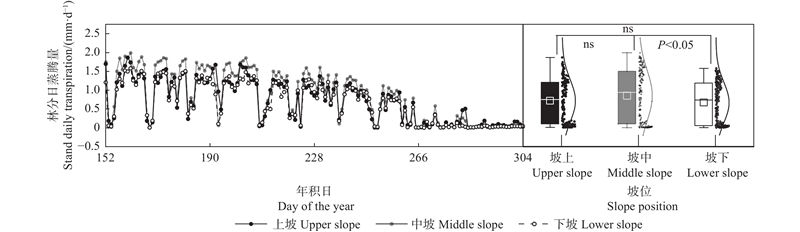
|
丁文斌, 王 飞. 植被建设对黄土高原土壤水分的影响. 生态学报, 2022, 42 (13): 5531- 5542.
|
|
Ding W B, Wang F. Effects of vegetation construction on soil moisture in the Loess Plateau. Acta Ecologica Sinica, 2022, 42 (13): 5531- 5542.
|
|
刘 璇, 郭建斌, 付高冉, 等. 宁夏六盘山半湿润区华北落叶松人工林蒸腾特征及其影响因子. 西北林学院学报, 2025, 40 (2): 9- 19.
doi: 10.3969/j.issn.1001-7461.2025.02.02
|
|
Liu X, Guo J B, Fu G R, et al. Transpiration characteristics and influencing factors of Larix principis-rupprechtii plantations in the semi-humid area of the Liupan Mountain, Ningxia. Journal of Northwest Forestry University, 2025, 40 (2): 9- 19.
doi: 10.3969/j.issn.1001-7461.2025.02.02
|
|
刘泽彬. 2018. 六盘山坡面华北落叶松林水文影响的时空变化及尺度转换. 北京: 中国林业科学研究院.
|
|
Liu Z B. 2018. Spatio-temporal variations and scale transition of hydrological impact of Larix principis-ruprechtii plantation on a slope of Liupan Mountains, China. Beijing: Chinese Academy of Forestry. [in Chinese]
|
|
马 菁, 郭建斌, 刘泽彬, 等. 六盘山华北落叶松林分蒸腾日内变化及其对环境因子的响应. 北京林业大学学报, 2020, 42 (5): 1- 11.
|
|
Ma J, Guo J B, Liu Z B, et al. Diurnal variations of stand transpiration of Larix principis-rupprechtii forest and its response to environmental factors in Liupan Mountains of northwestern China. Journal of Beijing Forestry University, 2020, 42 (5): 1- 11.
|
|
秦颢萍, 刘泽彬, 郭建斌, 等. 环境和冠层结构对华北落叶松林树干液流的影响. 应用生态学报, 2021, 32 (5): 1681- 1689.
doi: 10.13287/j.1001-9332.202105.007
|
|
Qin H P, Liu Z B, Guo J B, et al. Effects of environment and canopy structure on stem sap flow in a Larix principis-rupprechtii plantation. Chinese Journal of Applied Ecology, 2021, 32 (5): 1681- 1689.
doi: 10.13287/j.1001-9332.202105.007
|
|
王艳兵, 王彦辉, 熊 伟, 等. 六盘山半干旱区华北落叶松树干液流速率及主要影响因子的坡位差异. 林业科学, 2017, 53 (6): 10- 20.
doi: 10.11707/j.1001-7488.20170602
|
|
Wang Y B, Wang Y H, Xiong W, et al. Variation in the sap flow velocity of Larix principis-rupprechtii and its impact factors in different slope positions in a semi-arid region of Liupan Mountains. Scientia Silvae Sinicae, 2017, 53 (6): 10- 20.
doi: 10.11707/j.1001-7488.20170602
|
|
王云霓, 曹恭祥, 王彦辉, 等. 六盘山南侧华北落叶松人工林冠层蒸腾及其影响因子的坡位差异. 应用生态学报, 2018, 29 (5): 1503- 1514.
doi: 10.13287/j.1001-9332.201805.006
|
|
Wang Y N, Cao G X, Wang Y H, et al. Canopy transpiration of Larix principis-rupprechtii plantation and its impact factors in different slope locations at the south side of Liupan Mountains, China. Chinese Journal of Applied Ecology, 2018, 29 (5): 1503- 1514.
doi: 10.13287/j.1001-9332.201805.006
|
|
杨 洁, 金继明, 邵 进, 等. 黄土高原中部典型流域植被恢复对径流的影响. 农业机械学报, 2021, 52 (5): 257- 266.
doi: 10.6041/j.issn.1000-1298.2021.05.028
|
|
Yang J, Jin J M, Shao J, et al. Vegetation restoration and its impact on runoff in typical areas of Middle Loess Plateau. Transactions of the Chinese Society for Agricultural Machinery, 2021, 52 (5): 257- 266.
doi: 10.6041/j.issn.1000-1298.2021.05.028
|
|
杨世纪, 万艳芳, 白雨诗, 等. 六盘山不同坡向华北落叶松林分蒸腾对环境因子的响应. 林业科学, 2025, 61 (3): 108- 120.
doi: 10.11707/j.1001-7488.LYKX20240174
|
|
Yang S J, Wan Y F, Bai Y S, et al. Transpiration of Larix gmelinii var. principis-rupprechtii plantations on different slope aspects in Liupan Mountains in response of environmental factors. Scientia Silvae Sinicae, 2025, 61 (3): 108- 120.
doi: 10.11707/j.1001-7488.LYKX20240174
|
|
张晶莹, 陈滇豫, 马永胜, 等. 基于贝叶斯分析的干热河谷区橙子林冠层蒸腾耗水模拟. 农业机械学报, 2024, 55 (1): 305- 315.
doi: 10.6041/j.issn.1000-1298.2024.01.029
|
|
Zhang J Y, Chen D Y, Ma Y S, et al. Canopy transpiration water consumption simulation of orange forest in dry and hot valley area based on bayesian analysis. Transactions of the Chinese Society for Agricultural Machinery, 2024, 55 (1): 305- 315.
doi: 10.6041/j.issn.1000-1298.2024.01.029
|
|
赵 姹, 李 志, 刘文兆, 等. 泾河流域潜在蒸散量的时空变异. 生态学报, 2014, 34 (19): 5600- 5608.
doi: 10.5846/stxb201306101623
|
|
Zhao C, Li Z, Liu W Z, et al. Spatiotemporal characteristics of potential evapotranspiration during current and future period in the Jinghe watershed. Acta Ecologica Sinica, 2014, 34 (19): 5600- 5608.
doi: 10.5846/stxb201306101623
|
|
Abdalla M, Ali Ahmed M, Cai G C, et al. Stomatal closure during water deficit is controlled by below-ground hydraulics. Annals of Botany, 2022, 129 (2): 161- 170.
doi: 10.1093/aob/mcab141
|
|
Allen R G, Pereira L S, Raes D, et al. Crop evapotranspiration-Guidelines for computing crop water requirements. FAO Irrigation and drainage paper, 1998, 56, 1- 15.
|
|
Andrews C M, D’Amato A W, Fraver S, et al. Low stand density moderates growth declines during hot droughts in semi-arid forests. Journal of Applied Ecology, 2020, 57 (6): 1089- 1102.
doi: 10.1111/1365-2664.13615
|
|
Bai R H, Wang X Z, Li J W, et al. The impact of vegetation reconstruction on soil erosion in the Loess plateau. Journal of Environmental Management, 2024, 363, 121382.
doi: 10.1016/j.jenvman.2024.121382
|
|
Bai Y S, Yu P T, Wang Y F, et al. Promotion of tree transpiration by soil moisture replenishment along a larch hillslope in the Liupan Mountains, northwest China. Journal of Hydrology, 2025, 662, 134041.
doi: 10.1016/j.jhydrol.2025.134041
|
|
Bodo A V, Arain M A. Effects of variable retention harvesting on canopy transpiration in a red pine plantation forest. Ecological Processes, 2022, 11 (1): 28.
doi: 10.1186/s13717-022-00366-0
|
|
Clausnitzer F, Köstner B, Schwärzel K, et al. Relationships between canopy transpiration, atmospheric conditions and soil water availability: analyses of long-term sap-flow measurements in an old Norway spruce forest at the Ore Mountains/Germany. Agricultural and Forest Meteorology, 2011, 151 (8): 1023- 1034.
doi: 10.1016/j.agrformet.2011.04.007
|
|
Feng X M, Fu B J, Piao S L, et al. Revegetation in China’s Loess Plateau is approaching sustainable water resource limits. Nature Climate Change, 2016, 6 (11): 1019- 1022.
doi: 10.1038/nclimate3092
|
|
Fernandes T J, Campo A, García-Bartual R, et al. Coupling daily transpiration modelling with forest management in a semiarid pine plantation. IForest-Biogeosciences and Forestry, 2015, 9 (1): 38- 48.
doi: 10.3832/ifor1290-008
|
|
Joshi R K, Garkoti S C. 2023. Seasonal patterns of leaf physiological traits, nutrient and adaptive strategies of co-occurring Alnus nepalensis and Quercus leucotrichophora tree species in the central Himalaya. Perspectives in Plant Ecology, Evolution and Systematics, 61: 125761.
|
|
Kumagai T, Tateishi M, Shimizu T, et al. Transpiration and canopy conductance at two slope positions in a Japanese cedar forest watershed. Agricultural and Forest Meteorology, 2008, 148 (10): 1444- 1455.
doi: 10.1016/j.agrformet.2008.04.010
|
|
Kume T, Tsuruta K, Komatsu H, et al. Differences in sap flux-based stand transpiration between upper and lower slope positions in a Japanese cypress plantation watershed. Ecohydrology, 2016, 9 (6): 1105- 1116.
doi: 10.1002/eco.1709
|
|
Liu B B, Yu P T, Zhang X, et al. Soil moisture shapes the responses of Quercus wutaishansea forest stand transpiration to potential evapotranspiration. Journal of Hydrology, 2025, 652, 132679.
doi: 10.1016/j.jhydrol.2025.132679
|
|
Liu W N, Nie Y P, Luo Z D, et al. Transpiration rates decline under limited moisture supply along hillslopes in a humid karst terrain. Science of the Total Environment, 2023, 894, 164977.
doi: 10.1016/j.scitotenv.2023.164977
|
|
Liu Z B, Wang Y H, Tian A, et al. Modeling the response of daily evapotranspiration and its components of a larch plantation to the variation of weather, soil moisture, and canopy leaf area index. Journal of Geophysical Research: Atmospheres, 2018, 123 (14): 7354- 7374.
doi: 10.1029/2018JD028384
|
|
Liu Z B, Wang Y H, Yu P T, et al. Environmental and canopy conditions regulate the forest floor evapotranspiration of larch plantations. Forest Ecosystems, 2022, 9, 100058.
doi: 10.1016/j.fecs.2022.100058
|
|
Matsumoto K, Ohta T, Tanaka T. Dependence of stomatal conductance on leaf chlorophyll concentration and meteorological variables. Agricultural and Forest Meteorology, 2005, 132 (1/2): 44- 57.
doi: 10.1016/j.agrformet.2005.07.001
|
|
Renner M, Hassler S K, Blume T, et al. Dominant controls of transpiration along a hillslope transect inferred from ecohydrological measurements and thermodynamic limits. Hydrology and Earth System Sciences, 2016, 20 (5): 2063- 2083.
doi: 10.5194/hess-20-2063-2016
|
|
Scheff J, Frierson D M W. Scaling potential evapotranspiration with greenhouse warming. Journal of Climate, 2014, 27 (4): 1539- 1558.
doi: 10.1175/JCLI-D-13-00233.1
|
|
Schlesinger W H, Jasechko S. Transpiration in the global water cycle. Agricultural and Forest Meteorology, 2014, 189, 115- 117.
|
|
Schmidt U, Thöni H, Kaupenjohann M. Using a boundary line approach to analyze N2O flux data from agricultural soils. Nutrient Cycling in Agroecosystems, 2000, 57 (2): 119- 129.
doi: 10.1023/A:1009854220769
|
|
Song L N, Zhu J J, Li X, et al. Transpiration of Pinus sylvestris var. mongolica trees at different positions of sand dunes in a semiarid sandy region of Northeast China. Trees, 2022, 36 (2): 749- 762.
doi: 10.1007/s00468-021-02247-z
|
|
Tian A, Wang Y H, Webb A A, et al. Partitioning the causes of spatiotemporal variation in the sunny day sap flux density of a larch plantation on a hillslope in northwest China. Journal of Hydrology, 2019, 571, 503- 515.
doi: 10.1016/j.jhydrol.2019.02.004
|
|
Tromp-van Meerveld H J, McDonnell J J. On the interrelations between topography, soil depth, soil moisture, transpiration rates and species distribution at the hillslope scale. Advances in Water Resources, 2006, 29 (2): 293- 310.
doi: 10.1016/j.advwatres.2005.02.016
|
|
Vosnjak M, Kastelec D, Vodnik D, et al. The physiological response of the sweet cherry leaf to non-freezing low temperatures. Horticulture, Environment, and Biotechnology, 2021, 62 (2): 199- 211.
|
|
Wang L, Liu Z B, Guo J B, et al. Estimate canopy transpiration in larch plantations via the interactions among reference evapotranspiration, leaf area index, and soil moisture. Forest Ecology and Management, 2021, 481, 118749.
doi: 10.1016/j.foreco.2020.118749
|
|
Wen X, Deng X Z, Zhang F. 2019. Scale effects of vegetation restoration on soil and water conservation in a semi-arid region in China: resources conservation and sustainable management. Resources, Conservation and Recycling, 151: 104474.
|
|
Whitley R, Zeppel M, Armstrong N, et al. A modified Jarvis-Stewart model for predicting stand-scale transpiration of an Australian native forest. Plant and Soil, 2008, 305 (1): 35- 47.
doi: 10.1007/s11104-007-9399-x
|
|
Xi B Y, Di N, Wang Y, et al. Modeling stand water use response to soil water availability and groundwater level for a mature Populus tomentosa plantation located on the North Plain. Forest Ecology and Management, 2017, 391, 63- 74.
doi: 10.1016/j.foreco.2017.02.016
|
|
Xiong W, Oren R, Wang Y H, et al. Heterogeneity of competition at decameter scale: patches of high canopy leaf area in a shade-intolerant larch stand transpire less yet are more sensitive to drought. Tree physiology, 2015, 35 (5): 470- 484.
doi: 10.1093/treephys/tpv022
|
|
Xu Z P, Man X L, Cai T J, et al. How potential evapotranspiration regulates the response of canopy transpiration to soil moisture and leaf area index of the boreal larch forest in China. Forests, 2022, 13 (4): 571.
doi: 10.3390/f13040571
|
|
Yin Y, Wu S, Zheng D, et al. Radiation calibration of FAO56 Penman-Monteith model to estimate reference crop evapotranspiration in China. Agricultural Water Management, 2008, 95 (1): 77- 84.
doi: 10.1016/j.agwat.2007.09.002
|
|
Yu S P, Liu Z B, Guo J B, et al. Distribution of evapotranspiration components along vertical layers and their controls in dry days of larch plantation in the Liupan Mountains of northwest China. Agricultural and Forest Meteorology, 2024, 358, 110265.
doi: 10.1016/j.agrformet.2024.110265
|
|
Zhang R F, Xu X L, Liu M X, et al. Hysteresis in sap flow and its controlling mechanisms for a deciduous broad-leaved tree species in a humid karst region. Science China Earth Sciences, 2019, 62 (11): 1744- 1755.
doi: 10.1007/s11430-018-9294-5
|
|
Zhang S L, Yang D W, Yang Y T, et al. Excessive afforestation and soil drying on China’s Loess Plateau. Journal of Geophysical Research: Biogeosciences, 2018, 123 (3): 923- 935.
doi: 10.1002/2017JG004038
|

 ),刘泽彬2,4,*(