
林业科学 ›› 2026, Vol. 62 ›› Issue (10): 107-124.doi: 10.11707/j.1001-7488.LYKX20260137
• 研究论文 • 上一篇
吴霜1,贺君星1,宋晓波1,李广柱1,李宝鑫1,马庆国1,2,*( ),裴东1
),裴东1
收稿日期:2026-03-08
出版日期:2026-10-10
发布日期:2026-10-16
通讯作者:
马庆国
E-mail:mqg@caf.ac.cn
基金资助:
Shuang Wu1,Junxing He1,Xiaobo Song1,Guangzhu Li1,Baoxin Li1,Qingguo Ma1,2,*(),Dong Pei1
Received:2026-03-08
Online:2026-10-10
Published:2026-10-16
Contact:
Qingguo Ma
E-mail:mqg@caf.ac.cn
摘要:
目的: 通过多维表型组学分析,构建一种无需基因型数据的高效预测体系,揭示早实核桃的关键表型特征,为解析其遗传连锁关系提供线索,并为其他木本植物特殊类群的形成机制研究提供方法学参考。方法: 以保存于新疆阿克苏温宿县新疆林科院佳木试验站的156个典型且亲缘关系相近的核桃成龄树为研究对象,从中筛选出31份早实种质资源和8份晚实种质资源用于表型鉴定。依据国际标准化测量规范,系统测定涵盖茎枝形态、叶片特征、芽体发育和果实外观品质4大类共31项表型性状参数。数据分析采用多维度融合策略,先通过正交偏最小二乘判别分析对高维表型数据进行降维和差异特征筛选,再利用层次分析法确定各差异指标的权重系数,最后结合灰色关联度法构建多参数协同作用的综合模型,并编写Python脚本实现数据处理与模型构建的全流程自动化分析。整个分析框架完全基于表型数据,无需基因型信息即可完成对复杂性状的分类预测。结果: 通过多变量分析方法,筛选出13个与核桃早实性状显著相关(P<0.01)的核心表型参数,涵盖果实指标(坚果质量、坚果横径和核壳厚度)、叶片指标(中叶–叶柄夹角、小叶宽度、基叶长度、基叶面积、基叶–叶柄夹角、顶叶面积、小叶面积和基叶宽度)、茎枝指标(短枝节间长度)以及混合芽指标(混合芽着生位置)。基于这些参数构建的模型在独立验证集上的分类准确率达90.81%,证实所选表型标记对早实性状的强预测能力,也验证该无基因型预测体系的可靠性。研究还进一步明确各关键指标与早实性状的相关性方向,其中坚果横径、基叶面积、基叶夹角、小叶面积和混合芽着生状态与早实性状形成呈正相关,而坚果质量、壳厚度和节间长度则呈负相关。结论: 本研究明确了早实核桃的核心表型特征,揭示了其性状形成基础,建立的表型标记筛选体系为早实种质早期筛选提供了无需基因型信息的标准化方法,提出的多维度分析框架不仅适用于核桃遗传机制解析,还可拓展应用于其他木本植物特殊类群的鉴定,为类群推广提供了表型层面的理论依据。
中图分类号:
吴霜,贺君星,宋晓波,李广柱,李宝鑫,马庆国,裴东. 核桃早实性状相关表型标记筛选及验证[J]. 林业科学, 2026, 62(10): 107-124.
Shuang Wu,Junxing He,Xiaobo Song,Guangzhu Li,Baoxin Li,Qingguo Ma,Dong Pei. Screening and Validation of Phenotypic Markers Related to Early-Fruiting Traits in Juglans regia[J]. Scientia Silvae Sinicae, 2026, 62(10): 107-124.

图1
早实和晚实核桃资源发育枝的颜色对比 A、B、C:早实核桃的发育枝;D:晚实核桃的发育枝;E:完整枝条上的皮孔形态;F:枝条上点状分布的皮孔形态;G:枝条上线状分布的皮孔形态。A, B and C: Developmental shoots of precocious walnut; D: Developmental shoot of normal walnut; E: Morphology of the pericarp on the whole branch; F: Pedunculum morphology with punctate distribution on branches; G: Morphology of linear-distributed lenticles on branches."


图2
早实和晚实核桃资源不同类型营养枝与结果枝频率分布情况 A:结果枝组成;B:营养枝组成;C:枝类分布比较;D:短枝比例关系。A: Fruiting branch composition; B: Vegetative branch composition; C: Comparison of branch type distribution between early- and late-fruiting groups; D: Correlation between proportions of short fruiting and short vegetative branches."


图3
早实和晚实核桃资源小叶数及叶片形状 A–D:早实核桃7片小叶的复叶叶片形状;E–F:晚实核桃9片小叶的复叶叶片形状;I:早实核桃变异小叶形态。A–D: The leaf shape of the compound leaf of 7 leaflets of precocious walnut; E–F: The leaf shape of 9 leaflets of normal walnut; I: Variable leaf shape of precocious walnut."


图4
早实和晚实核桃资源的叶片形态特征及大小 A:复叶与叶柄长度;B:小叶面积;C:叶形指数。A: Compound leaf and petiole length; B: Leaflet area; C: Leaflet shape index. *、**分别表示早实与晚实核桃间差异达显著(P<0.05)和极显著(P<0.01)水平,未标注者差异不显著。 * and ** indicate significant differences between early- and late-fruiting walnut resources at P<0.05 and P<0.01, respectively; unmarked traits show no significant difference."


图5
早实和晚实核桃资源混合芽及叶芽的形态特征及着生方式 A–C:早实核桃芽的形状及着生方式;D–F:晚实核桃芽的形状及着生方式。A–C: Shape and growth mode of buds of precocious walnut; D–F: Shape and growth mode of buds of normal walnut."


图6
早实和晚实核桃的结果量及青果形态特征 A与B为早实核桃资源结果状,C为晚实核桃资源结果状。A and B show single branch fruit quantities of precocious walnut resources; C shows single branch fruit quantities of normal walnut resources."


图7
早实和晚实核桃资源坚果的数量性状 早实种质 n=31,晚实种质 n=6。n=31 for precocious and n=6 for normal walnut resources."


图8
核桃早实和晚实品种果实性状的形态多样性 来自29个早实核桃品种(JM2?JM31)和5个晚实对照品种(N4E1、N5E1、NOV3、N6W3、N7W3)的代表性果实表型。Representative nut phenotypes from 29 early-fruiting walnut accessions (JM2?JM31) and 4 late-fruiting controls (N4E1, N5E1, NOV3, N6W3, N7W3)"


图9
早实和晚实核桃资源表型指标的OPLS-DA分析 A:OPLS-DA得分图;B:OPLS-DA载荷图;C:置换检验结果图。R2X[1]、R2Xo[1]分别为X变量被第1预测主成分、第1正交成分解释的方差比例;$M1.DA(P)、$M1.DA(N)为SIMCA按判别分析自动生成的类别哑变量,代表正类(P)与负类(N)样本,因不含正交信息而位于纵坐标为0的横轴上;X:表型指标:Y:早实/晚实类别;R2:模型对Y变量的解释率;Q2:交叉验证的预测率;TLL、TLW、TLSI、TLVN分别为顶叶长度、宽度、叶形指数和叶脉数量;LLL、LLW、LLA、LLSI分别为小叶长度、宽度、面积和叶形指数;BLL、BLW、BLA、BLSI、BLPA、BLVN分别为基叶长度、宽度、面积、叶形指数、基叶–叶柄夹角和叶脉数量;FLVN、FLPPA分别为顶叶下第1对小叶的叶脉数量和小叶–叶柄夹角;SLVN、SLPPA分别为中叶(顶叶下第2对)的叶脉数量和小叶–叶柄夹角;CLL、PL、LA分别为复叶长度、叶柄长度和皮孔面积;FSI、NLD、NLaD、NSW、NST分别为果形指数、坚果纵径、侧径、缝合线宽度和核壳厚度;MBIP为混合芽着生位置。"

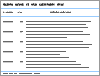
表1
早实和晚实核桃资源差异性指标的VIP值"
| 编号 No. | 指标名称 Trait name | VIP均值 Average VIP value | VIP临界值 VIP critical value (α=0.01) |
| No.1 | 混合芽着生位置 Mixed bud insertion position (MBIP) | 1.601 7 | 0.190 0 |
| No.2 | 坚果质量 Nut weight (NW) | 1.273 9 | 0.207 7 |
| No.3 | 核壳厚度 Nut shell thickness (NST) | 1.206 0 | 0.267 6 |
| No.4 | 基叶面积 Basal leaf area (BLA) | 1.156 2 | 0.097 9 |
| No.5 | 基叶长度 Basal leaf length (BLL) | 1.155 7 | 0.061 9 |
| No.6 | 基叶?叶柄夹角 Basal leaf-petiole angle (BLPA) | 1.147 6 | 0.261 7 |
| No.7 | 中叶?叶柄夹角 Second leaflet pair-petiole angle below terminal leaf (SLPPA2) | 1.120 4 | 0.248 7 |
| No.8 | 短枝节间长度 Short shoot internode length (SSIL) | 1.056 0 | 0.332 3 |
| No.9 | 小叶宽度 Leaflet leaf width (LLW) | 1.051 0 | 0.131 3 |
| No.10 | 顶叶面积 Terminal leaf area (TLA) | 1.048 0 | 0.173 5 |
| No.11 | 坚果横径 Nut transverse diameter (NTD) | 1.029 1 | 0.212 7 |
| No.12 | 小叶面积 Leaflet leaf area (LLA) | 1.025 0 | 0.120 8 |
| No.13 | 基叶宽度 Basal leaf width (BLW) | 1.019 3 | 0.081 7 |
表2
早实和晚实核桃差异指标的分层模型"
| 目标层A Target layer A | 约束层C Restrained layer C | 指标层P Trait layer P |
| 早、晚实核桃的差异性指标 Differential factors between precocious and normal walnut | C1:果实指标 Nut trait | P1:坚果质量 Nut weight/g;P2:坚果横径 Nut transverse diameter/mm; P3:核壳厚度Nut shell thickness/mm |
| C2:叶片指标 Leaf trait | P4:中叶–叶柄夹角Second leaflet pair-petiole angle below terminal leaf/(°);P5:小叶宽度Leaflet leaf width/mm;P6:基叶长度Basal leaf length/mm;P7:基叶面积Basal leaf area/mm2;P8:基叶–叶柄夹角Basal leaf-petiole angle/(°);P9:顶叶面积Terminal leaf area/mm2;P10:小叶面积Leaflet leaf area/mm2;P11:基叶宽度Basal leaf width/mm | |
| C3:茎枝指标 Stem and shoot trait | P12:短枝节间长度 Short shoot internode length/mm | |
| C4:混合芽指标 Mixed bud trait | P13:混合芽着生位置 Mixed bud insertion position (0/1) |
表3
判断矩阵及一致性检验①"
| A–Ci | |||||||||
| A | C1 | C2 | C3 | C4 | 权重Wi | ||||
| C1 | 1 | 1/8 | 1/4 | 1/3 | 0.052 5 | ||||
| C2 | 8 | 1 | 5 | 6 | 0.646 6 | ||||
| C3 | 4 | 1/5 | 1 | 2 | 0.184 8 | ||||
| C4 | 3 | 1/6 | 1/2 | 1 | 0.116 2 | ||||
| λmax = 4.121 5, CR = 0.045 5 < 0.100 0 | |||||||||
| C1–Pi | |||||||||
| C1 | P1 | P2 | P3 | 权重Wi | |||||
| P1 | 1 | 4 | 5 | 0.035 9 | |||||
| P2 | 1/4 | 1 | 2 | 0.010 5 | |||||
| P3 | 1/5 | 1/2 | 1 | 0.006 1 | |||||
| λmax = 3.024 6, CR = 0.052 5 < 0.100 0 | |||||||||
| C2–Pi | |||||||||
| C2 | P4 | P5 | P6 | P7 | P8 | P9 | P10 | P11 | 权重Wi |
| P4 | 1 | 1 | 1/2 | 1/3 | 1/2 | 2 | 2 | 1 | 0.061 9 |
| P5 | 1 | 1 | 1/2 | 1/3 | 1 | 2 | 2 | 2 | 0.073 7 |
| P6 | 2 | 2 | 1 | 1/2 | 1 | 3 | 3 | 2 | 0.111 2 |
| P7 | 3 | 3 | 2 | 1 | 2 | 3 | 4 | 3 | 0.174 1 |
| P8 | 2 | 1 | 1 | 1/2 | 1 | 2 | 3 | 2 | 0.097 0 |
| P9 | 1/2 | 1/2 | 1/3 | 1/3 | 1/2 | 1 | 1 | 1 | 0.041 6 |
| P10 | 1/2 | 1/2 | 1/3 | 1/4 | 1/3 | 1 | 1 | 1/2 | 0.035 0 |
| P11 | 1 | 1/2 | 1/2 | 1/3 | 1/2 | 1 | 2 | 1 | 0.052 1 |
| λmax = 8.134 6, CR = 0.013 6 < 0.100 0 | |||||||||
| C3–Pi | |||||||||
| C3 | P12 | 权重Wi | |||||||
| P12 | 1 | 0.116 2 | |||||||
| λmax = 1.00 0, CR = 0.000 0 < 0.100 0 | |||||||||
| C4–Pi | |||||||||
| C4 | P13 | 权重Wi | |||||||
| P13 | 1 | 0.184 8 | |||||||
| λmax = 1.00 0, CR = 0.000 0 < 0.100 0 | |||||||||
表4
核桃早实加权关联度的概率分级(3级)"
| 项目 Items | 分级级次 Grading level | ||
| Ⅰ级 Grade Ⅰ | Ⅱ级 Grade Ⅱ | Ⅲ级 Grade Ⅲ | |
| 分点值 Dividing point value (%) | 71.41 | 77.21 | |
| 区间值Interval value (%) | ≤ 60.49 | 60.49~67.19 | ≥ 67.19 |
| 出现概率(实际/理论) Occurrence probability (reality/theory) (%) | 38.46/30.00 | 16.66/40.00 | 44.87/30.00 |
表5
果实指标权重调整后的判断矩阵及一致性检验①"
| A–Ci | |||||||||
| A | C1 | C2 | C3 | C4 | 权重Wi | ||||
| C1 | 1 | 1/7 | 1 | 4 | 0.131 5 | ||||
| C2 | 2 | 1 | 7 | 9 | 0.693 3 | ||||
| C3 | 1 | 1/7 | 1 | 4 | 0.131 5 | ||||
| C4 | 1/4 | 1/9 | 1/4 | 1 | 0.043 7 | ||||
| λmax = 4.163 7, CR = 0.061 3 < 0.100 0 | |||||||||
| C1–Pi | |||||||||
| C1 | P1 | P2 | P3 | 权重Wi | |||||
| P1 | 1 | 4 | 5 | 0.089 9 | |||||
| P2 | 1/4 | 1 | 2 | 0.026 3 | |||||
| P3 | 1/5 | 1/2 | 1 | 0.015 4 | |||||
| λmax = 3.024 6, CR = 0.023 6 < 0.100 0 | |||||||||
| C2–Pi | |||||||||
| C2 | P4 | P5 | P6 | P7 | P8 | P9 | P10 | P11 | 权重Wi |
| P4 | 1 | 1 | 1/2 | 1/3 | 1/2 | 2 | 2 | 1 | 0.066 4 |
| P5 | 1 | 1 | 1/2 | 1/3 | 1 | 2 | 2 | 2 | 0.079 0 |
| P6 | 2 | 2 | 1 | 1/2 | 1 | 3 | 3 | 2 | 0.119 2 |
| P7 | 3 | 3 | 2 | 1 | 2 | 3 | 4 | 3 | 0.186 6 |
| P8 | 2 | 1 | 1 | 1/2 | 1 | 2 | 3 | 2 | 0.103 9 |
| P9 | 1/2 | 1/2 | 1/3 | 1/3 | 1/2 | 1 | 1 | 1 | 0.044 6 |
| P10 | 1/2 | 1/2 | 1/3 | 1/4 | 1/3 | 1 | 1 | 1/2 | 0.037 5 |
| P11 | 1 | 1/2 | 1/2 | 1/3 | 1/2 | 1 | 2 | 1 | 0.055 8 |
| λmax = 8.134 6, CR = 0.013 6 < 0.100 0 | |||||||||
| C3–Pi | |||||||||
| C3 | P12 | 权重Wi | |||||||
| P12 | 1 | 0.043 6 | |||||||
| λmax = 1.00 0, CR = 0.000 0 < 0.100 0 | |||||||||
| C4–Pi | |||||||||
| C4 | P13 | 权重Wi | |||||||
| P13 | 1 | 0.131 6 | |||||||
| λmax = 1.00 0, CR = 0.000 0 < 0.100 0 | |||||||||
|
白世践, 李 超, 王爱玲, 等. 吐鲁番地区无核葡萄主要品质性状因子分析与综合评价. 西北农业学报, 2016, 25 (1): 92- 102.
doi: 10.7606/j.issn.1004-1389.2016.01.013 |
|
|
Bai S J, Li C, Wang A L, et al. Factor analysis and comprehensive evaluation of seedless grape quality in Turpan. Acta Agriculturae Boreali-Occidentalis Sinica, 2016, 25 (1): 92- 102.
doi: 10.7606/j.issn.1004-1389.2016.01.013 |
|
|
贺 鹏, 张 涛, 宋海云, 等. 广西澳洲坚果果实品质分析与综合评价. 食品科学, 2021, 42 (24): 242- 251.
doi: 10.7506/spkx1002-6630-20201128-295 |
|
|
He P, Zhang T, Song H Y, et al. Quality analysis and comprehensive evaluation of the fruit of Macadamia integrifolia grown in Guangxi Province. Food Science, 2021, 42 (24): 242- 251.
doi: 10.7506/spkx1002-6630-20201128-295 |
|
|
黄闽敏, 张 强, 王国安, 等. 栽植密度对新疆早实核桃果实动态生长影响及其与光合特性的关系. 西南农业学报, 2016, 29 (12): 2812- 2816.
doi: 10.16213/j.cnki.scjas.2016.12.009 |
|
|
Huang M M, Zhang Q, Wang G A, et al. Effects of planting density on dynamic growth of early bearing walnut in Xinjiang and its relationship with photosynthetic characteristics. Southwest China Journal of Agricultural Sciences, 2016, 29 (12): 2812- 2816.
doi: 10.16213/j.cnki.scjas.2016.12.009 |
|
|
李 洋, 张赟齐, 温 玥, 等. 早实核桃坚果表型和内在品质的关联分析及模型构建. 南京林业大学学报(自然科学版), 2025, 49 (1): 119- 127.
doi: 10.12302/j.issn.1000-2006.202401005 |
|
|
Li Y, Zhang Y Q, Wen Y, et al. Correlation analysis and model construction of nut phenotype and kernel quality of early-fruiting walnuts (Juglans regia). Journal of Nanjing Forestry University (Natural Sciences Edition), 2025, 49 (1): 119- 127.
doi: 10.12302/j.issn.1000-2006.202401005 |
|
|
李少辉, 赵 巍, 刘松雁, 等. SDE-GC-MS结合OPLS-DA分析不同生态区谷子品种香气特征. 中国农业科学, 2023, 56 (13): 2586- 2596.
doi: 10.3864/j.issn.0578-1752.2023.13.012 |
|
|
Li S H, Zhao W, Liu S Y, et al. Aroma characteristics of foxtail millet varieties from different ecological regions by analysis of SDE-GC-MS combined with OPLS-DA. Scientia Agricultura Sinica, 2023, 56 (13): 2586- 2596.
doi: 10.3864/j.issn.0578-1752.2023.13.012 |
|
|
李文文, 陈金艳, 蔡 虎, 等. 胡桃科植物花发育研究进展. 果树学报, 2024, 41 (10): 2091- 2105.
doi: 10.13925/j.cnki.gsxb.20240265 |
|
|
Li W W, Chen J Y, Cai H, et al. Research progress on flower development of Juglandaceae plants. Journal of Fruit Science, 2024, 41 (10): 2091- 2105.
doi: 10.13925/j.cnki.gsxb.20240265 |
|
| 李因刚, 柳新红, 马俊伟, 等. 浙江楠种群表型变异. 植物生态学报, 2014, 38 (12): 1315- 1324. | |
| Li Y G, Liu X H, Ma J W, et al. Phenotypic variations in populations of Phoebe chekiangensis. Chinese Journal of Plant Ecology, 2014, 38 (12): 1315- 1324. | |
| 刘录祥, 孙其信. 灰色系统理论应用于作物新品种综合评估初探. 中国农业科学, 1989, 22 (3): 22- 27. | |
| Liu L X, Sun Q X. A preliminary study on application of grey system theory to comprehensive evaluation of new crop varieties. Scientia Agricultura Sinica, 1989, 22 (3): 22- 27. | |
| 刘思峰, 杨英杰, 吴利丰, 等. 2020. 灰色系统理论及其应用(第8版). 北京: 科学出版社. | |
| Liu S F, Yang Y J, Wu L F, et al. 2020. Grey system theory and its application (8th ed.). Beijing: Science Press. [in Chinese] | |
|
马 凯, 韩立群, 崔海洋, 等. 新疆与美国早实核桃品种生长结实与成花特性比较. 中国农业大学学报, 2018, 23 (10): 49- 56.
doi: 10.11841/j.issn.1007-4333.2018.10.06 |
|
|
Ma K, Han L Q, Cui H Y, et al. Analysis on the growth and fruiting and flower initiation characteristics of Xinjiang and American early fruiting walnut (Juglans regia L.). Journal of China Agricultural University, 2018, 23 (10): 49- 56.
doi: 10.11841/j.issn.1007-4333.2018.10.06 |
|
|
田胜平, 汪阳东, 陈益存, 等. 山苍子天然种群叶片和种实性状的表型多样性. 生态学杂志, 2012, 31 (7): 1665- 1672.
doi: 10.13292/j.1000-4890.2012.0309 |
|
|
Tian S P, Wang Y D, Chen Y C, et al. Phenotypic diversity of natural Litsea cubeba population’s leaf- and fruit traits. Chinese Journal of Ecology, 2012, 31 (7): 1665- 1672.
doi: 10.13292/j.1000-4890.2012.0309 |
|
|
王 磊, 曹亚龙, 孟海军, 等. 国内外核桃品种选育研究进展. 果树学报, 2022, 39 (12): 2406- 2417.
doi: 10.13925/j.cnki.gsxb.20220255 |
|
|
Wang L, Cao Y L, Meng H J, et al. Research progress in walnut variety breeding at home and abroad. Journal of Fruit Science, 2022, 39 (12): 2406- 2417.
doi: 10.13925/j.cnki.gsxb.20220255 |
|
| 王兆成, 王 磊, 周梦钰, 等. 3个薄壳山核桃品种叶片结构特征和枝条导水功能比较. 植物资源与环境学报, 2021, 30 (3): 38- 45. | |
| Wang Z C, Wang L, Zhou M Y, et al. Comparison on leaf structure characteristics and branch hydraulic function of three Carya illinoinensis cultivars. Journal of Plant Resources and Environment, 2021, 30 (3): 38- 45. | |
| 吴 晔. 2015. 去除二次雄花技术对早实核桃生理落果及单果质量的影响. 山西果树 (1): 8–10. | |
| Wu Y. 2015. Effects of removing secondary male flowers on physiological fruit drop and single fruit weight of early-bearing walnut. Shanxi Fruits, (1): 8–10. [in Chinese] | |
| 奚声珂. 我国胡桃属(Juglans L.)种质资源与核桃(Juglans regia L.)育种. 林业科学, 1987, 23 (3): 342- 350. | |
| Xi S K. Gene resources of Juglans and genetic improvement of Juglans regia in China. Scientia Silvae Sinicae, 1987, 23 (3): 342- 350. | |
|
张深梅, 奚建伟, 洪俊彦, 等. 大别山山核桃果实与叶片性状的表型多样性研究. 林业科学研究, 2020, 33 (1): 152- 161.
doi: 10.13275/j.cnki.lykxyj.2020.01.020 |
|
|
Zhang S M, Xi J W, Hong J Y, et al. A study on phenotypic diversity of fruit and leaf traits in Carya dabieshanensis. Forest Research, 2020, 33 (1): 152- 161.
doi: 10.13275/j.cnki.lykxyj.2020.01.020 |
|
|
张天云, 杨瑞成, 陈 奎. 基于层次分析法确定工程材料评价指标的权重. 兰州理工大学学报, 2007, 33 (2): 17- 19.
doi: 10.3969/j.issn.1673-5196.2007.02.005 |
|
|
Zhang T Y, Yang R C, Chen K. Determination of weighing values for assessment indexes of engineering materials based on analytic hierarchy procedure. Journal of Lanzhou University of Technology, 2007, 33 (2): 17- 19.
doi: 10.3969/j.issn.1673-5196.2007.02.005 |
|
| 张志华, 裴 东. 2018. 核桃学. 北京: 中国农业出版社. | |
| Zhang Z H, Pei D. 2018. Walnut science. Beijing: China Agriculture Press. [in Chinese] | |
|
赵 喆, 周志豪, 森巴特, 等. 焦叶症及其防控下的核桃坚果产量品质影响研究. 林业科学研究, 2025, 38 (1): 1- 13.
doi: 10.12403/j.1001-1498.20240472 |
|
|
Zhao Z, Zhou Z H, Sen B T, et al. Study on the influences of Juglans leaf necrosis and its control on the yield and quality of walnut nuts. Forest Research, 2025, 38 (1): 1- 13.
doi: 10.12403/j.1001-1498.20240472 |
|
| 中华人民共和国国家统计局. 2025. 中国统计年鉴. 北京: 中国统计出版社. | |
| China National Bureau of Statistics. 2025. China statistical yearbook. Beijing: China Statistics Press. [in Chinese] | |
|
朱春华. 如何运用SPSS软件进行简单随机抽样. 统计与决策, 2014, 30 (9): 71- 73.
doi: 10.13546/j.cnki.tjyjc.2014.09.005 |
|
|
Zhu C H. How to use SPSS software for simple random sampling. Statistics & Decision, 2014, 30 (9): 71- 73.
doi: 10.13546/j.cnki.tjyjc.2014.09.005 |
|
|
Andriyas T, Leksungnoen N, Uthairatsamee S, et al. Interspecific and environmental influence on the foliar metabolomes of Mitragyna species through recursive OPLSDA modeling. Plants, 2025, 14 (17): 2721.
doi: 10.3390/plants14172721 |
|
|
Anthony B M, Minas I S. Canopy architecture impact on peach tree physiology, vigor diffusion, productivity and fruit quality. Scientia Horticulturae, 2025, 342, 114025.
doi: 10.1016/j.scienta.2025.114025 |
|
| Deng J L. Introduction to grey system theory. The Journal of Grey System, 1989, 1 (1): 1- 24. | |
| Flexas J, Barbour M M, Brendel O, et al. 2012. Mesophyll diffusion conductance to CO2: an unappreciated central player in photosynthesis. Plant Science, 193/194: 70–84. | |
|
Flexas J, Niinemets Ü, Gallé A, et al. Diffusional conductances to CO2 as a target for increasing photosynthesis and photosynthetic water-use efficiency. Photosynthesis Research, 2013, 117 (1/2/3): 45- 59.
doi: 10.1007/s11120-013-9844-z |
|
| Furbank R T, Tester M. Phenomics–technologies to relieve the phenotyping bottleneck. Trends in Plant Science, 2011, 16 (12): 635- 644. | |
|
Gillaspy G, Ben-David H, Gruissem W. Fruits: a developmental perspective. The Plant Cell, 1993, 5 (10): 1439- 1451.
doi: 10.2307/3869794 |
|
|
Hassankhah A, Rahemi M, Mozafari M R, et al. Flower development in walnut: altering the flowering pattern by gibberellic acid application. Notulae Botanicae Horti Agrobotanici Cluj-Napoca, 2018, 46 (2): 700- 706.
doi: 10.15835/nbha46211183 |
|
|
Janković S, Stanković J, Janković D, et al. Morphology and morphogenesis of female reproductive organs in some walnut (Juglans regia L.) genotypes. Scientia Horticulturae, 2021, 289 (17): 110471.
doi: 10.1016/j.scienta.2021.110471 |
|
|
Lawson T, Blatt M R. Stomatal size, speed, and responsiveness impact on photosynthesis and water use efficiency. Plant Physiology, 2014, 164 (4): 1556- 1570.
doi: 10.1104/pp.114.237107 |
|
|
Li X W, Yang Y, Henry R J, et al. Plant DNA barcoding: from gene to genome. Biological Reviews, 2015, 90 (1): 157- 166.
doi: 10.1111/brv.12104 |
|
| Lorts C M, Briggeman T, Sang T. Evolution of fruit types and seed dispersal: a phylogenetic and ecological snapshot. Journal of Systematics and Evolution, 2008, 46 (3): 396- 404. | |
| Luchi N, Ma R, Capretti P, et al. Anatomical and physiological traits of cork formation in woody plants. Annals of Botany, 2005, 96 (4): 579- 593. | |
| Ma M, Zhang H P, Niu J X, et al. Genetic mapping and SCAR marker conversion of early-fruiting gene in walnut (Juglans regia L.). Molecular Breeding, 2023, 43 (5): 1- 15. | |
|
Moles A T, Ackerly D D, Webb C O, et al. A brief history of seed size. Science, 2005, 307 (5709): 576- 580.
doi: 10.1126/science.1104863 |
|
| Niinemets Ü, Portsmuth A, Tobias M. 2006. Leaf shape and venation pattern alter the photosynthetic responses of foliage to light intensity. Plant, Cell & Environment, 29(5): 854–867. | |
|
Osorio S, Costa F, Gibon Y, et al. Advances in fruit development and ripening. Journal of Experimental Botany, 2023, 74 (20): 6205- 6208.
doi: 10.1093/jxb/erad379 |
|
| Saaty T L. Decision making with the analytic hierarchy process. International Journal of Services Sciences, 2008, 1 (1): 83- 98. | |
|
Seymour G B, Østergaard L, Chapman N H, et al. Fruit development and ripening. Annual Review of Plant Biology, 2013, 64, 219- 241.
doi: 10.1146/annurev-arplant-050312-120057 |
|
|
Soler M, Serra O, Molinas M, et al. A genomic approach to suberin biosynthesis and cork differentiation. Plant Physiology, 2007, 144 (1): 419- 431.
doi: 10.1104/pp.106.094227 |
|
| Valladares F, Niinemets Ü. 2008. Shade tolerance, a key plant feature of complex nature and consequences. Annual Review of Ecology, Evolution, and Systematics, 39: 237–257. | |
| Yu D, Zhao Y, Han L Q, et al. Comparative study on flower bud differentiation of female and male early blooming type walnut varieties. Journal of Fruit Science, 2022, 39 (10): 1054- 1062. | |
| Yuan X, Quan S W, Liu J M, et al. 2022. Evolution of the PEBP gene family in Juglandaceae and their regulation of flowering pathway under the synergistic effect of JrCO and JrNF-Y proteins. International Journal of Biological Macromolecules, 223(Part A): 202–212. | |
| Zhang H P, Hu H F, Niu J X, et al. Early fruiting and its RAPD analysis of walnut in Xinjiang Uygur Autonomous. Acta Botanica Boreali-Occidentalia Sinica, 2005, 25 (11): 2157- 2162. | |
|
Zhang S B, Chen H, Pan C D. Effects of the source–sink relationship on walnut nut quality at the scale of the fruit–bearing branch. Forests, 2022, 13 (7): 1034.
doi: 10.3390/f13071034 |
| [1] | 田栋元,刘兆刚,姜立春,董灵波. 基于随机森林的大兴安岭中部天然林更新数量影响因素识别[J]. 林业科学, 2026, 62(5): 69-79. |
| [2] | 李银龙,梁志,何小龙,张瑞杰,张龙娃,王士娟. 黑缘平翅斑蚜的形态及生物学特性[J]. 林业科学, 2026, 62(4): 187-193. |
| [3] | 徐雅雯,徐永杰,谭作枰,王其竹,邹巧玲,陈万胜. 基于多因素分析的核桃园营养诊断与产量预测模型[J]. 林业科学, 2026, 62(3): 171-181. |
| [4] | 华夏辉,丁显印,吴绍泽,黄琴韵,刁姝,吴亚荻,栾启福. 基于生长因子的湿地松人工幼林地上生物量模型[J]. 林业科学, 2026, 62(3): 211-222. |
| [5] | 钟慧奇,柴静瑜,王开良,滕建华,毕文玉,王安妮,林萍. 基于CARS-PLSR的油茶种仁油脂含量和脂肪酸成分的近红外光谱预测模型构建[J]. 林业科学, 2026, 62(2): 111-125. |
| [6] | 崔王斌,周宏平,张洋,王艳艳,许林云,范高鸣. 基于点云建模的核桃树振动参数优化与试验[J]. 林业科学, 2026, 62(2): 186-203. |
| [7] | 竹万宽,王志超,许宇星,黄润霞,陶怡,钟源源,杜阿朋. 基于机器学习算法的雷州半岛桉树复层混交林土壤呼吸模拟[J]. 林业科学, 2026, 62(1): 67-82. |
| [8] | 周宏威,李永正,郭文辉,陈怡帆,胡浩昌,张思岩,崔迪,陈雨茉. 基于元胞自动机模型的松材线虫病小班尺度预测[J]. 林业科学, 2026, 62(1): 133-143. |
| [9] | 白永超,王卫雄,李宝鑫,杨静雅,王祺,周荣飞,牛犇,裴东. 新疆核桃焦叶症发生规律及其影响因子[J]. 林业科学, 2025, 61(3): 169-181. |
| [10] | 李琰,孙永江,齐建勋,史玉洁,宋健,陈永浩,翟长远,张俊佩,侯智霞,张赟齐. 核桃枝叶固废高效腐熟的菌剂筛选及堆肥过程变化[J]. 林业科学, 2025, 61(11): 102-115. |
| [11] | 马子威,赵瑞,蒋翔宇,普甜,潘悦,王娟,童美琪. 蒜头果半同胞家系苗期生长特性评价及配合选择[J]. 林业科学, 2025, 61(10): 96-110. |
| [12] | 朱诗豪,吴志伟,李政杰,李顺. 赣南马尾松林地表细小死可燃物含水率动态及模型[J]. 林业科学, 2024, 60(5): 158-168. |
| [13] | 姬新颖, 唐佳莉, 李敖, 郑旭, 王红霞, 张俊佩. 盐胁迫下不同基因型核桃实生幼苗生长及生理响应[J]. 林业科学, 2024, 60(2): 65-77. |
| [14] | 丁永全,李笑笑,赵凤君,司莉青,舒立福,闫凯达,张建华,彭志杰,周暖阳. 基于可燃物特征的塞罕坝林场人工林小班森林火险区划[J]. 林业科学, 2024, 60(11): 107-118. |
| [15] | 王茹,罗莎莎,王如月,杨梦思,孙雅丽,虎海防,张萍. 不同生长时期核桃叶片中挥发性有机物的GC-IMS分析[J]. 林业科学, 2023, 59(6): 57-73. |
| 阅读次数 | ||||||
|
全文 |
|
|||||
|
摘要 |
|
|||||

