
林业科学 ›› 2026, Vol. 62 ›› Issue (10): 208-220.doi: 10.11707/j.1001-7488.LYKX20260032
• 研究论文 • 上一篇
高康,郭子羽,赵旭*( )
)
收稿日期:2026-01-18
出版日期:2026-10-10
发布日期:2026-10-16
通讯作者:
赵旭
E-mail:zhaoxu@ctgu.edu.cn
基金资助:
Kang Gao,Ziyu Guo,Xu Zhao*()
Received:2026-01-18
Online:2026-10-10
Published:2026-10-16
Contact:
Xu Zhao
E-mail:zhaoxu@ctgu.edu.cn
摘要:
目的: 揭示林业碳汇项目参与主体的演化博弈规律,识别影响决策的关键参数,通过比较不同政策的边际效用探索最优政策组合,为化解林业碳汇项目违约风险提供理论依据和对策参考。方法: 构建涵盖企业、林农、核查机构和政府的四方演化博弈模型,分析项目开发不同阶段各参与主体的行为决策及其演化路径。在此基础上,结合已公示的林业碳汇项目数据和典型案例,利用MATLAB 2021a软件进行数值仿真。结果: 在项目开发不同阶段,博弈系统收敛于不同的稳定均衡。起步阶段,企业可能出于风险规避或投机目的,采取“圈地外包”的违约行为,同时,林农也可能因缺乏技术指导等选择提前采伐碳汇林。发展阶段,核查机构可能由于成本限制,仅审核申报资料的完整性。成熟阶段,随着碳汇方法学的逐步完善和监管体系的持续健全,企业和林农最终将趋向长期自觉合作,从而保障林业碳汇项目减排量的真实性和持续性。模型仿真结果表明:1) 收益分配不合理是各方违约的主要诱因,通过政策干预缓解企业与林农之间的信息不对称能够显著促进履约行为;2) 相比提高罚款金额,适当提升违约金额度对企业守约的促进作用更为明显,同时政府补贴能够有效提高核查机构的审核质量;3) 政府补贴等激励性政策可有效避免因监管缺位导致的项目质量下降。结论: 应完善全国自愿减排交易信息平台建设,缓解信息不对称;建立以“违约?赔偿”的市场化机制为主、政府奖惩为辅的监管机制;加强政府引导,持续推进碳汇方法学研究和规范制定。
中图分类号:
高康,郭子羽,赵旭. 基于演化博弈的林业碳汇项目建设违约风险防范机制[J]. 林业科学, 2026, 62(10): 208-220.
Kang Gao,Ziyu Guo,Xu Zhao. Mechanism for Preventing Default Risk in Forestry Carbon Sequestration Project Construction Based on Evolutionary Game Theory[J]. Scientia Silvae Sinicae, 2026, 62(10): 208-220.
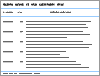
表1
参数描述"
| 参数Parameter | 参数含义 Description | 参数Parameter | 参数含义 Description | |
| Ra | 林业碳汇项目开发总收益 Total revenue from forest carbon sink project | 政府对核查机构的罚款 Government fines auditing agencies for lax verification | ||
| 企业获得的收益分配比例 Profit distribution ratio for enterprises | 政府对核查机构的补贴 Government incentives auditing agencies for rigorous verification | |||
| Ca | 项目开发成本 Project development costs | Rg | 项目开发后政府的碳减排收益 Government carbon emission reduction benefits following project development | |
| Cb | 项目申报成本 Project application costs | Cg | 政府监管成本 Government regulatory costs | |
| 企业负担的项目开发成本比例 Proportion of project development costs borne by enterprises | Tg | 上级主管部门行政处罚额度 Administrative penalty amount imposed by higher-level competent authorities | ||
| Rw | 企业违约圈地获得的合同转卖收入 Contract resale proceeds obtained by the enterprise through default | Re | 林农自愿认购碳汇的生态补偿量 The amount of ecological compensation voluntarily subscribed by forest landowners for carbon sinks | |
| Cm | 企业圈地支付给林农的违约金 Penalty fees paid by enterprises to forest landowners | 企业违约对减排效果的影响系数 Coefficient of the impact of enterprise default on emissions reduction effectiveness | ||
| Cn | 林农违约支付给企业的违约金 Penalty fees paid by forest landowners to enterprises | 林农违约对减排效果的影响系数 Coefficient of the impact of forest landowners’ breach of contract on emissions reduction effectiveness | ||
| 林农违约行为造成的项目价值损失 Project value loss caused by forest landowners’ breach of contract | 企业?林农共同违约的影响系数 Coefficient of the impact of joint breach of contract by enterprises and forest landowners | |||
| 林农额外木材收益的转化比例 Conversion ratio of forest landowners’ additional timber income | 企业守约开发的概率 Probability of enterprises contract compliance | |||
| R0 | 核查机构的审核收益 Revenue of auditing agencies | 林农守约开发的概率 Probability of forest landowners contract compliance | ||
| 核查机构全面审核成本 The cost of rigorous verification by auditing agencies | 核查机构全面审核的概率 Probability of rigorous verification by auditing agencies | |||
| 核查机构准入审核成本 The cost of lax verification by auditing agencies | 政府严格监管的概率 Probability of government involvement in regulation | |||
| 政府对圈地企业的罚款 Government fines for land-grabbing enterprises |
表2
四方主体支付矩阵"
| 主体策略选择 Strategy selection | 企业收益 Enterprise revenue | 林农收益 Forest landowners revenue | 机构收益 Agency revenue | 政府收益 Government revenue |
| (1,1,1,1) | ||||
| (1,1,0,1) | ||||
| (1,1,1,0) | ||||
| (1,1,0,0) | ||||
| (1,0,1,1) | ||||
| (1,0,0,1) | ||||
| (1,0,1,0) | ||||
| (1,0,0,0) | ||||
| (0,1,1,1) | ||||
| (0,1,0,1) | ||||
| (0,1,1,0) | ||||
| (0,1,0,0) | ||||
| (0,0,1,1) | ||||
| (0,0,0,1) | ||||
| (0,0,1,0) | ||||
| (0,0,0,0) |
表3
四方纯策略均衡解的稳定性分析①"
| 均衡点 Equilibrium points | 特征值 Eigenvalues | 正负性 Positive or negative | 稳定性及条件 Stability and conditions | 理想性 Idealism |
| ESS(条件1) ESS (condition 1) | 不理想 Not ideal | |||
| 不稳定 Unstable | 不理想 Not ideal | |||
| 不稳定 Unstable | 不理想 Not ideal | |||
| 不稳定 Unstable | 不理想 Not ideal | |||
| 不稳定 Unstable | 不理想 Not ideal | |||
| ESS(条件2) ESS (condition 2) | 不理想 Not ideal | |||
| ESS(条件3) ESS (condition 3) | 不理想 Not ideal | |||
| 不稳定 Unstable | 不理想 Not ideal | |||
| 不稳定 Unstable | 不太理想 Not quite ideal | |||
| 不稳定 Unstable | 不太理想 Not quite ideal | |||
| 不稳定 Unstable | 不太理想 Not quite ideal | |||
| ESS(条件4) ESS (condition 4) | 不太理想 Not quite ideal | |||
| ESS(条件5) ESS (condition 5) | 不太理想 Not quite ideal | |||
| 不稳定 Unstable | 不太理想 Not quite ideal | |||
| 不稳定 Unstable | 理想 Ideal | |||
| ESS(条件6) ESS (condition 6) | 理想 Ideal |

图1
稳定情形的演化路径"

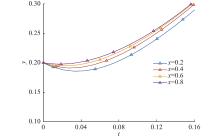
图2
企业违约概率变化"


图3
监管环境变化"
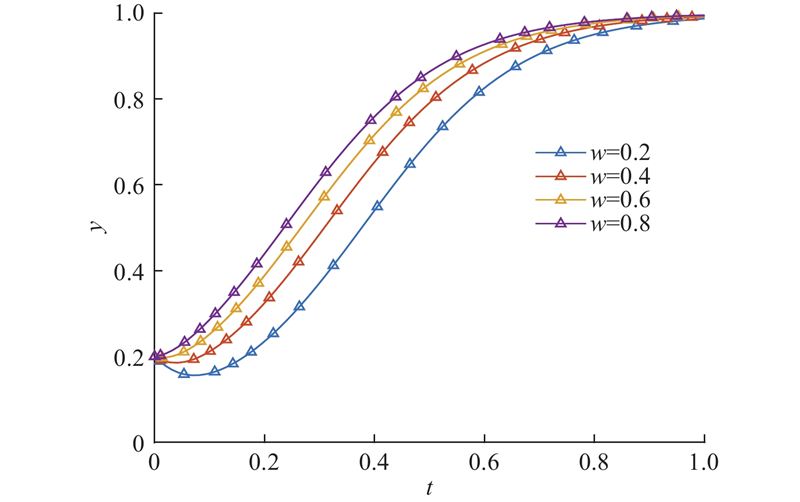

图4
企业不同违约金的演化结果(左:xyz视角;右:yzw视角)"
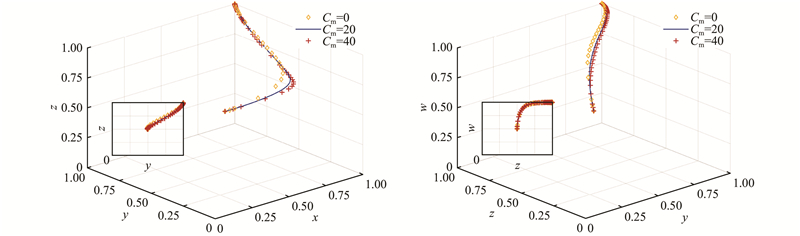

图5
林农不同违约金的演化结果(左:xyz视角;右:yzw视角)"


图6
不同罚款额度下企业的演化结果(左:xyz视角;右:yzw视角)"


图7
不同罚款额度下核查机构的演化结果(左:xyz视角;右:yzw视角)"
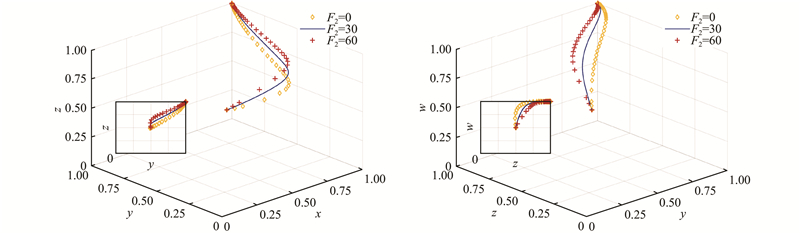

图8
不同补贴额度下核查机构的演化结果(左:xyz视角;右:yzw视角)"

| 白华兵. 2025. 《减碳绿途》发布: 林业碳汇开发需“降温”, 避免“跑马圈林”. 新京报. | |
| Bai H B. 2025. Carbon Reduction Green Path released: forestry carbon sink development needs to “cool down” to avoid “racing to seize forests”. The Beijing News. [in Chinese] | |
|
董 玮, 葛爱玲. 林农参与林业碳汇经营研究进展与展望. 世界林业研究, 2025, 38 (5): 17- 24.
doi: 10.13348/j.cnki.sjlyyj.2025.0076.y |
|
|
Dong W, Ge A L. Research progress and prospects of forest farmers’ participation in carbon sink oriented forest management. World Forestry Research, 2025, 38 (5): 17- 24.
doi: 10.13348/j.cnki.sjlyyj.2025.0076.y |
|
| 董芳慧, 王 斌. 未来气候变化下黑龙江省人工林碳储量预测. 森林工程, 2026, 42 (4): 694- 706. | |
| Dong F H, Wang B. Carbon storage projection of plantations in Heilongjiang Province under future climate change. Forest Engineering, 2026, 42 (4): 694- 706. | |
| 杜之利, 苏 彤, 葛佳敏, 等. 碳中和背景下的森林碳汇及其空间溢出效应. 经济研究, 2021, 56 (12): 187- 202. | |
| Du Z L, Su T, Ge J M, et al. Towards the carbon neutrality: the role of carbon sink and its spatial spillover effects. Economic Research Journal, 2021, 56 (12): 187- 202. | |
|
郭建龙, 余智涵, 王晓雯, 等. 国际林业碳信用与中国林业CCER核证机制比较. 世界林业研究, 2025, 38 (1): 92- 98.
doi: 10.13348/j.cnki.sjlyyj.2025.0008.y |
|
|
Guo J L, Yu Z H, Wang X W, et al. Comparison of certification mechanisms for international forest carbon credits and China’s forestry CCER. World Forestry Research, 2025, 38 (1): 92- 98.
doi: 10.13348/j.cnki.sjlyyj.2025.0008.y |
|
| 胡 原, 黄婉婷, 曾维忠. 森林碳汇项目对欠发达地区农民收入的影响研究: 来自四川省5 225个建档立卡户的实证证据. 中国农业资源与区划, 2024, 45 (2): 214- 222. | |
| Hu Y, Huang W T, Zeng W Z. Study on the impact of forest carbon sink project on the income of farmers in underdeveloped regions: empirical evidence from 5 225 households in Sichuan Province. Chinese Journal of Agricultural Resources and Regional Planning, 2024, 45 (2): 214- 222. | |
|
林禹岐, 吴 昂. 认购林业碳汇司法适用的实践检视与制度完善. 中国人口·资源与环境, 2023, 33 (12): 71- 82.
doi: 10.12062/cpre.20230606 |
|
|
Lin Y Q, Wu A. Practical review and institutional improvement of judicial application of the carbon offset purchase. China Population Resources and Environment, 2023, 33 (12): 71- 82.
doi: 10.12062/cpre.20230606 |
|
| 刘建敏, 高汇标. “双碳”背景下林业碳汇发展现状及实践探究. 智慧中国, 2024, (1): 56- 58. | |
| Liu J M, Gao H B. Exploring the current status and practices of forest carbon sinks development in the context of the “dual carbon” goals. Wisdom China, 2024, (1): 56- 58. | |
| 宋宇坤. 2025. 区块链技术下林业碳汇交易机制的演化博弈研究. 哈尔滨: 东北林业大学. | |
| Song Y K. 2025. Evolutionary game study of forestry carbon sink trading mechanism under blockchain technology. Harbin: Northeast Forestry University. [in Chinese] | |
|
孙 睿, 闫晶晶, 何大义, 等. 基于区块链技术的林业碳汇项目开发风险的演化博弈研究. 软科学, 2024a, 38 (9): 90- 100.
doi: 10.13956/j.ss.1001-8409.2024.09.12 |
|
|
(Sun R, Yan J J, He D Y, et al. Evolutionary game analysis of block chain preventing forestry carbon sink project development risks. Soft Science, 2024a, 38 (9): 90- 100.
doi: 10.13956/j.ss.1001-8409.2024.09.12 |
|
|
孙 睿, 何大义, 闫晶晶. 基于随机微分博弈的林业碳汇项目开发的风险化解机制研究. 系统工程理论与实践, 2024b, 44 (7): 2273- 2292.
doi: 10.12011/SETP2023-1649 |
|
|
Sun R, He D Y, Yan J J. Risk resolution mechanism for the development of forestry carbon sink projects based on stochastic differential game. Systems Engineering -Theory & Practice, 2024b, 44 (7): 2273- 2292.
doi: 10.12011/SETP2023-1649 |
|
| 徐干君. 林业碳汇开发亟待规范. 中国林业产业, 2024, (2): 1. | |
| Xu G J. The development of forestry carbon sinks urgently needs to be regulated. China Forestry Industry, 2024, (2): 1. | |
|
徐来仙, 何友均. 林业碳汇产品定价机制比较与启示. 林业科学, 2025, 61 (4): 231- 248.
doi: 10.11707/j.1001-7488.LYKX20240295 |
|
|
Xu L X, He Y J. Comparison and implications for pricing mechanisms of forestry carbon sink products. Scientia Silvae Sinicae, 2025, 61 (4): 231- 248.
doi: 10.11707/j.1001-7488.LYKX20240295 |
|
|
杨博文. “生态”何以“富农”: “双碳”目标下林业碳汇产品价值化规范的理路. 青海社会科学, 2023, (5): 37- 45.
doi: 10.14154/j.cnki.qss.2023.05.004 |
|
|
Yang B W. How to “enrich farmers” by “ecology”: the standardized way of valuing forestry carbon sequestration products under the carbon peaking and carbon neutrality goals. Qinghai Social Sciences, 2023, (5): 37- 45.
doi: 10.14154/j.cnki.qss.2023.05.004 |
|
|
杨 志. 公众参与交互型跨界污染治理补偿的四方博弈. 中国管理科学, 2024, 32 (8): 261- 273.
doi: 10.16381/j.cnki.issn1003-207x.2021.1416 |
|
|
Yang Z. Quadripartite evolutionary game of public participation in interactive transboundary pollution control compensation. Chinese Journal of Management Science, 2024, 32 (8): 261- 273.
doi: 10.16381/j.cnki.issn1003-207x.2021.1416 |
|
|
余红红, 杨加猛. 基于三方演化博弈的森林横向生态补偿策略及其稳定性: 以重庆市为例. 林业科学, 2025, 61 (3): 214- 232.
doi: 10.11707/j.1001-7488.LYKX20230342 |
|
|
Yu H H, Yang J M. Forest horizontal ecological compensation strategy and its stability based on three-party evolutionary game: a case of Chongqing City. Scientia Silvae Sinicae, 2025, 61 (3): 214- 232.
doi: 10.11707/j.1001-7488.LYKX20230342 |
|
|
曾维忠, 刘 胜, 杨 帆, 等. 扶贫视域下的森林碳汇研究综述. 农业经济问题, 2017, 38 (2): 102- 109.
doi: 10.13246/j.cnki.iae.2017.02.013 |
|
|
Zeng W Z, Liu S, Yang F, et al. A research review on poverty alleviation based on forest carbon sink projects. Issues in Agricultural Economy, 2017, 38 (2): 102- 109.
doi: 10.13246/j.cnki.iae.2017.02.013 |
|
| 张 楠, 储安婷, 杨红强. 碳交易机制下林业碳汇产品类别比较与价值核算模型甄别. 中国人口·资源与环境, 2022, 32 (11): 146- 155. | |
| Zhang N, Chu A T, Yang H Q. Forestry carbon sequestration products and their value accounting models under carbon trading mechanism. China Population. Resources and Environment, 2022, 32 (11): 146- 155. | |
|
张启航, 张亚连, 谭桂菲, 等. 中国林业碳汇效率时空演化特征: 基于三阶段超效率数据包络分析模型. 生态学报, 2024, 44 (15): 6769- 6782.
doi: 10.20103/j.stxb.202311172510 |
|
|
Zhang Q H, Zhang Y L, Tan G F, et al. Spatio-temporal evolutionary characteristics of forestry carbon sink efficiency in China based on a three-stage super-efficiency SBM-DEA model. Acta Ecologica Sinica, 2024, 44 (15): 6769- 6782.
doi: 10.20103/j.stxb.202311172510 |
|
|
张 颖, 孟 娜, 姜逸菲. 中国森林碳汇与林业经济发展耦合及长期变化特征分析. 北京林业大学学报, 2022, 44 (10): 129- 141.
doi: 10.12171/j.1000-1522.20220257 |
|
|
Zhang Y, Meng N, Jiang Y F. Coupling and long-term change characteristics analysis of forest carbon sequestration and forestry economic development in China. Journal of Beijing Forestry University, 2022, 44 (10): 129- 141.
doi: 10.12171/j.1000-1522.20220257 |
|
|
甄 贞, 黄 杰, 刘佳宇, 等. 中国东北地区森林碳源汇时空格局变化及对极端气候的响应. 森林工程, 2025, 41 (5): 969- 980.
doi: 10.7525/j.issn.1006-8023.2025.05.010 |
|
|
Zhen Z, Huang J, Liu J Y, et al. Changes in the spatiotemporal pattern of forest carbon sources and sinks in northeast China and their responses to extreme climate. Forest Engineering, 2025, 41 (5): 969- 980.
doi: 10.7525/j.issn.1006-8023.2025.05.010 |
|
| Ge J M, Zhang Z J, Lin B Q. 2023. Towards carbon neutrality: how much do forest carbon sinks cost in China? Environmental Impact Assessment Review, 98: 106949. | |
|
Halloway A H, Heath K D, McNickle G G. When does mutualism offer a competitive advantage? A game-theoretic analysis of host-host competition in mutualism. AoB Plants, 2022, 14 (2): plac010.
doi: 10.1093/aobpla/plac010 |
|
|
Ojha H, Maraseni T, Nightingale A, et al. Rescuing forests from the carbon trap. Forest Policy and Economics, 2019, 101, 15- 18.
doi: 10.1016/j.forpol.2019.01.007 |
|
| van Kooten G C, Nijnik M, Bradford K. 2019. Can carbon accounting promote economic development in forest-dependent, indigenous communities? Forest Policy and Economics, 100: 68−74. | |
|
Yang Y, Zhu Y, Zhao Y W. Improving farmers’ livelihoods through the eco-compensation of forest carbon sinks. Renewable and Sustainable Energy Reviews, 2024, 198, 114401.
doi: 10.1016/j.rser.2024.114401 |
|
|
Zhao N, Wang K Q, Yuan Y N. Toward the carbon neutrality: forest carbon sinks and its spatial spillover effect in China. Ecological Economics, 2023, 209, 107837.
doi: 10.1016/j.ecolecon.2023.107837 |
| [1] | 徐来仙,何友均. 林业碳汇产品定价机制比较与启示[J]. 林业科学, 2025, 61(4): 231-248. |
| [2] | 余红红,杨加猛. 基于三方演化博弈的森林横向生态补偿策略及其稳定性——以重庆市为例[J]. 林业科学, 2025, 61(3): 214-232. |
| [3] | 朱洪革,田雨辰,应闻,张宇彤. 重点国有林区森林旅游发展的演化博弈与协作机制[J]. 林业科学, 2025, 61(10): 221-235. |
| [4] | 卢峰,顾光同,曹先磊,吴伟光. 基于耦合效应的林业碳汇项目风险[J]. 林业科学, 2022, 58(5): 161-176. |
| [5] | 邹玉友,李金秋,齐英南,贯君,田国双. 碳交易背景下控排企业林业碳汇需求意愿及其影响因素——基于计划行为理论的探讨[J]. 林业科学, 2020, 56(8): 162-172. |
| [6] | 武曙红. CDM林业碳汇市场前景及碳信用的交易策略[J]. 林业科学, 2010, 46(11): 152-157. |
| [7] | 张佳薇 李明宝. 针叶材瞬态温度场的有限元数值仿真[J]. 林业科学, 2008, 44(1): 117-123. |
| 阅读次数 | ||||||
|
全文 |
|
|||||
|
摘要 |
|
|||||

