
林业科学 ›› 2026, Vol. 62 ›› Issue (10): 196-207.doi: 10.11707/j.1001-7488.LYKX20250678
• 研究论文 • 上一篇
胡乐超1,张梓泳1,杜雅琦2,冯科1,吴胜义2,王国锋2,*( )
)
收稿日期:2025-11-12
出版日期:2026-10-10
发布日期:2026-10-16
通讯作者:
王国锋
E-mail:435347751@qq.com
基金资助:
Lechao Hu1,Ziyong Zhang1,Yaqi Du2,Ke Feng1,Shengyi Wu2,Guofeng Wang2,*()
Received:2025-11-12
Online:2026-10-10
Published:2026-10-16
Contact:
Guofeng Wang
E-mail:435347751@qq.com
摘要:
目的: 探究内蒙古库布齐“光伏+生态治理”项目中生态产品价值实现面临的关键制约因素及其内在作用机制,提出针对性优化路径,以深化对相关实践困境的理论认知,为同类项目的可持续发展提供决策参考。方法: 采用质性研究范式和扎根理论方法,以库布齐“光伏+生态治理”项目为典型案例,对15位核心或直接利益相关者的半结构化访谈资料进行开放式编码、主轴编码和选择性编码,并结合政策文本、企业资料与实地观察信息进行交叉验证。结果: 库布齐“光伏+生态治理”项目已形成光伏发电、植被恢复、土地改良、生态农业、碳汇增益、生态景观等多重生态产品,但这些复合产品价值并未充分转化为稳定、可持续的经济收益。其制约因素主要集中在4方面:1) 政策与制度环境不完善,表现为顶层设计与基层执行存在落差、生态治理配比政策与资源承载力不匹配、生态产品产权界定模糊、产业支持政策缺位以及标准与认证体系不统一等系统性障碍;2) 自然与技术条件瓶颈,受限于库布齐地区严峻的水资源短缺和土壤贫瘠等自然本底条件,同时面临板下种植等技术不成熟、适配性差、成本效益失衡以及长期监测数据和科研支撑不足等技术性挑战;3) 多元主体协同与利益机制缺失,政府各部门间职能分割与协同不足,光伏企业核心动机(发电收益)与生态投入存在错位,社区/农户参与度低、受益方式单一,且缺乏公平透明的生态收益分配机制;4) 认知与能力局限,社会各界对生态产品价值存在认知偏差和误区,专业理论研究与一线实践需求存在脱节,基层执行单位面临专业人才和配套资源不足的困境。结论: 应着力拓宽多元化价值变现渠道,通过发展生态衍生产业、开发权益交易产品、健全生态补偿机制和打造生态旅游品牌等方式实现价值转化;需创新项目实施与运营管理,优化土地流转整合模式,探索适生的复合治理技术,并建立多维度的项目监管和验收机制。通过强化政策协同、技术创新和能力建设,构建起以多元主体协同治理为核心、能够实现治理向产业融合发展的“增值型治理”模式,推动生态产品价值实现的可持续和规模化。
中图分类号:
胡乐超,张梓泳,杜雅琦,冯科,吴胜义,王国锋. 基于扎根理论的生态产品价值实现制约因素与优化路径——以库布齐“光伏+生态治理”为例[J]. 林业科学, 2026, 62(10): 196-207.
Lechao Hu,Ziyong Zhang,Yaqi Du,Ke Feng,Shengyi Wu,Guofeng Wang. Constraints and Optimization Pathways for Realizing Ecological Product Value Based on Grounded Theory:a Case Study of Kubuqi’s “Photovoltaic + Ecological Governance” Initiative[J]. Scientia Silvae Sinicae, 2026, 62(10): 196-207.
表1
生态产品价值实现结构访谈样本"
| 序号 No. | 访谈对象 Interviewee role | 所属单位 Affiliated unit | 主要访谈内容涉及领域 Key interview domains | 数量 Count | 备注 Remarks |
| 1 | 分管领导 Supervising leader | 达拉特旗县林草局 Dalat Banner Forestry and Grassland Bureau | 光伏治沙项目整体情况、林草政策、本地生态产业实践、碳汇探索、土地流转 Overall situation of PV sand control projects, forestry/grassland policies, local ecological industry practices, carbon sink exploration, land transfer | 1 | 核心政策执行与项目管理者,提供宏观地方实践视角 Core policy implementer and project manager, providing a macro-level local practice perspective |
| 2 | 工程师 Engineer | 达拉特旗林草局 Dalat Banner Forestry and Grassland Bureau | 防沙治沙技术历程、“光伏+”模式的技术挑战与失败案例、水资源约束、产业困难 History of desertification control technology, technical challenges and failure cases of “PV+” models, water resource constraints, industrial difficulties | 1 | 资深技术专家,提供长期技术实践与基层视角 Senior technical expert, providing long-term technical practice and grassroots perspective |
| 3 | 项目主管 Project supervisor | 达拉特旗能源局 Dalat Banner Energy Bureau | 光伏项目审批流程、政府角色、项目管理与调度、企业沟通 PV project approval process, government role, project management and scheduling, communication with enterprises | 2 | 项目审批与监管方,提供政府内部运作视角 Project approval and regulatory side, providing a perspective on internal government operations |
| 4 | 部门负责人 Department head | 鄂尔多斯市林草局 Ordos City Forestry and Grassland Bureau | 全市光伏基地规划、政策导向、技术指导角色、产业瓶颈 City-wide PV base planning, policy orientation, technical guidance role, industry bottlenecks | 2 | 市级政策制定与协调者,提供区域性规划视角 Municipal-level policymaker and coordinator, providing a regional planning perspective |
| 5 | 主任 Director | 科研事业单位 Scientific research institution | 碳汇项目开发具体挑战(PDD设计、产权、证据链)、地方标准制定、新技术探索 Specific challenges in carbon sink project development (PDD design, property rights, evidence chain), local standard formulation, new technology exploration | 1 | 技术研发与创新中心负责人,聚焦碳汇方法论 Head of technology R&D and innovation center, focusing on carbon sink methodology |
| 6 | 科研人员 Researcher | 国家级科研机构 National-level scientific research institution | 生态产品价值核算理论、目录编制、技术路径、学术争议、宏观政策解读 Eco-product value accounting theory, catalog compilation, technical pathways, academic disputes, macro-policy interpretation | 5 | 参与相关研究与方案论证的研究人员,提供理论支撑与宏观分析视角Researchers involved in related studies and project scheme discussions, providing theoretical support and macro-analytical perspectives |
| 7 | 企业技术人员 Corporate technical staff | 企业 Enterprise | 生态产品价值核算评估、项目监测与规划、市场化运营挑战 Eco-product value accounting assessment, project monitoring and planning, market-oriented operation challenges | 1 | 市场服务提供方,提供商业化与应用落地视角 Market service provider, providing commercialization and application landing perspective |
| 8 | 技术人员 Technical staff | 达拉特旗林草局 Dalat Banner Forestry and Grassland Bureau | 碳汇交易、生态旅游、价值实现数据统计 Carbon trading, ecotourism, value realization data statistics | 1 | 自然本底资源数据统计与分析,聚集本底数据收集 Natural baseline resource data statistics and analysis, focusing on baseline data collection |
| 9 | 业务经理 Business manager | 企业 (能源国企) Enterprise (state-owned energy enterprise) | “光伏+生态治理”项目技术方案研究、生态监测体系、价值核算方法 Research on technical solutions for “PV + ecological governance” projects, ecological monitoring systems, value accounting methods | 1 | 企业侧项目管理者,提供技术实施具体方案,但对宏观及市场层面了解有限 Enterprise-side project manager, providing specific technical implementation plans, but with limited understanding of macro and market levels |
| 合计Total | 15 |
表2
开放式编码示例"
| 典型原始语句 Typical original statement | 概念化 Conceptualization | 范畴化 Categorization |
| 国家出台《关于建立健全生态产品价值实现机制的意见》, 方向是好的,但地方执行时缺乏具体细则 The state issued the “Opinions on Establishing and Improving the Mechanism for Realizing the Value of Ecological Products”, the direction is good, but localities lack specific and detailed rules for implementation | 顶层政策指导与执行落差 Gap between top-level policy guidance and execution | 顶层战略与考核压力 Top-level strategy and assessment pressure |
| 自治区要求1 GW光伏必须配套治理6 000 hm2沙地,但后续的 验收标准和资金支持不明确 The autonomous region requires that 1 GW of photovoltaics (PV) must be paired with the restoration of 6 000 hm2 of sandy land, but the subsequent acceptance standards and financial support are unclear | 生态治理配比政策不完善 Imperfect ecological restoration pairing policy | 生态治理配比政策 Ecological restoration pairing policy |
| 最头疼的是水,光伏板下想种点东西,但取水许可极难审批,被认为“浪费水” Water is the biggest headache. We want to plant things under the PV panels, but water withdrawal permits are extremely difficult to get approved, as it is considered “wasting water” | 水资源管理政策限制 Restrictions from water resource management policies | 资源管理政策 Resource management policy |
| 这片林子是集体的,但林子产生的碳汇归谁?没法说清,交易就无从谈起 This forest is collectively owned, but who owns the carbon sink it generates? It is unclear, so trading is out of the question | 生态产品产权界定模糊 Vague definition of ecological product property rights | 土地与产权制度 Land and property rights system |
| 我们想发展沙棘产业,但缺乏针对性的贷款和税收优惠,企业不敢投入 We want to develop the sea-buckthorn industry, but without targeted loans and tax incentives, companies are afraid to invest | 产业支持政策缺位 Lack of industrial support policies | 产业支持政策缺位 Lack of industrial support policies |
| 我们做的灌木碳汇方法学,因为“影响全国统一大市场” 被叫停了,无处说理 The shrub carbon sink methodology we developed was shut down because it “affects the national unified market”, and we have no channel for appeal | 地方标准认证受阻 Obstruction of local standard certification | 标准与认证障碍 Barriers to standards and certification |
| 年降雨量就200 mm,板下蒸发还强,种什么、怎么种都是大难题 Annual rainfall is only 200 mm, and evaporation under the panels is high. What to plant and how to plant it are major challenges | 自然本底条件约束 Constraints of natural baseline conditions | 自然本底约束 Natural baseline constraints |
| 板下种植技术不成熟,试种过黄芪、甘草,成活率低,成本太高 Under-panel cultivation technology is immature. We tried planting Astragalus and licorice, but the survival rate was low and the cost was too high | 技术不成熟与成本高 Immature technology and high costs | 技术不成熟与适配性 Technological immaturity and adaptability |
| 前期投入巨大,但生态产品的收益不确定、周期长,社会资本望而却步 The upfront investment is huge, but the returns from ecological products are uncertain and long-term, deterring private capital | 经济效益瓶颈 Economic benefit bottleneck | 成本与经济效益瓶颈 Cost and economic benefit bottleneck |
| GEP核算结果差异大,缺乏长期连续的监测数据支撑,市场不认 GEP (gross ecosystem product) accounting results vary widely, lack support from long-term continuous monitoring data, and are not recognized by the market | 数据与科研支撑不足 Insufficient data and scientific support | 数据与科研支撑不足 Insufficient data and scientific support |
| 我们林草局想推动治沙,但光伏指标是能源局批,用地是自然资源局管, 我们很被动,只能做后期技术指导 Our Forestry and Grassland Bureau wants to promote sand control, but the PV quotas are approved by the Energy Bureau, and land use is managed by the Natural Resources Bureau. We are passive and can only provide technical guidance afterward | 政府部门职能分割与协同不足 Functional fragmentation and insufficient coordination among government departments | 政府角色与部门协同 Government roles and inter-departmental synergy |
| 央企来投资,首要目标是完成光伏装机任务,生态治理是附带的社会责任,除非有硬性考核,否则投入意愿有限 When state-owned enterprises (SOEs) invest, their primary goal is to complete the PV installation quota. Ecological restoration is a secondary social responsibility. Unless there is a hard assessment, their willingness to invest is limited | 企业核心动机与生态投入的错位 Misalignment between corporate core motives and ecological investment | 企业动机与行为模式 Corporate motives and behavioral patterns |
| 土地流转后,农民除了拿租金,很难参与到板下种植或管护中, 技能不匹配,企业也嫌管理麻烦 After the land is transferred, farmers, apart from collecting rent, find it hard to participate in under-panel planting or maintenance. Their skills don’t match, and companies find it troublesome to manage them | 社区参与度低与 受益方式单一 Low community participation and singular benefit-sharing methods | 社区/农户参与受益 Community/farmer participation and benefits |
| 碳汇收益如果能下来,怎么分?给村集体多少?给农户多少钱?给管护企业多少?没有成熟方案,容易引发矛盾 If carbon sink revenues materialize, how will they be distributed? How much to the village collective? How much to the farmers? How much to the management company? There is no mature scheme, which easily leads to conflict | 生态收益分配机制缺失 Lack of an ecological benefit-sharing mechanism | 利益分配机制 Benefit-sharing mechanism |
| 我们想利用板下空间种高品质牧草,发展高端畜牧业,把“光伏羊”做成品牌 We want to use the space under the panels to grow high-quality forage and develop high-end animal husbandry, turning “PV sheep” into a brand | 开发生态衍生产业 Developing eco-derivative industries | 生态产业化路径 Ecological industrialization pathway |
| 最直接的就是做碳汇,虽然现在方法学有障碍, 但未来CCER市场重启是最大的变现希望 The most direct way is carbon sinks. Although there are methodological barriers now, the future restart of the CCER (China certified emission reduction) market is the biggest hope for monetization | 开发可交易的生态 权益产品 Developing tradable ecological rights products | 权益交易路径(碳汇等) Rights trading pathway (carbon sinks, etc.) |
| 谁保护,谁受益。下游受益地区应该对上游的生态保护者进行补偿, 这是最公平的 Whoever protects, benefits. Downstream beneficiary areas should compensate upstream ecological protectors. This is the fairest way | 建立保护补偿机制 Establishing a protection and compensation mechanism | 生态补偿路径 Ecological compensation pathway |
| 这片光伏基地很壮观,本身就成了景点,可以发展观光旅游,带动周边农家乐 This PV base is spectacular and has become an attraction in itself. We can develop sightseeing tourism, boosting nearby “agritainment” (farm-stay businesses) | 挖掘生态景观的 文化服务价值 Tapping the cultural service value of ecological landscapes | 生态旅游与品牌路径 Ecotourism and branding pathway |
| 我们通过地方国企统一从村民手中流转土地,做成“标准地”再交给光伏企业,避免了企业一家一户去谈判 We use a local SOE to uniformly transfer land from villagers, package it as “standard land”, and then hand it over to PV companies, avoiding company-by-household negotiations | 创新土地资源整合方式 Innovative methods for land resource integration | 土地流转与整合模式 Land transfer and integration model |
| 我们试验“光伏+枸杞”“光伏+耐阴牧草”, 寻找最适合板下环境的物种和种植模式 We are experimenting with “PV + Goji Berry” and “PV + shade-tolerant forage” to find the most suitable species and planting models for the under-panel environment | 探索适生的复合生态 治理技术 Exploring suitable composite ecological restoration technologies | 生态治理模式创新 Innovation in ecological restoration models |
| 项目三年后验收,不光看植被覆盖率,还要评估土壤改良、 生物多样性等综合生态效益 The project acceptance after three years not only looks at vegetation coverage but also assesses comprehensive ecological benefits like soil improvement and biodiversity | 建立多维度的生态成效 评估体系 Establishing a multi-dimensional ecological effectiveness evaluation system | 项目监管与验收机制 Project supervision and acceptance mechanism |
| 很多领导认为,投钱治沙只有生态效益,是纯支出,没意识到“绿水青山” 本身能变成“金山银山” Many leaders believe that investing money in sand control only has ecological benefits and is a pure expenditure. They do not realize that “lucid waters and lush mountains” can themselves become “gold and silver mountains” | 忽视生态产品的市场价值 Overlooking the market value of ecological products | 社会认知误区 Social misperceptions |
| 学者核算的GEP(生态系统生产总值)数字很大,但具体怎么变成 真金白银,缺乏可操作的商业模式 The GEP (gross ecosystem product) figures calculated by scholars are large, but there is a lack of operable business models to turn them into real money | 理论价值与市场 实践的脱节 Disconnect between theoretical value and market practice | 专业认知与实践差距 Gap between professional cognition and practice |
| 上面政策很好,但到我们基层,一没专业人才,二没配套资金,三怕做错被追责, 只好保守观望 The policies from above are very good, but when they reach our grassroots level, we lack professional talent, and supporting funds, and fear accountability for mistakes. Thus, we can only wait and see conservatively | 基层执行资源与 创新动力不足 Insufficient grassroots implementation resources and motivation for innovation | 地方执行与创新能力 Local implementation and innovation capacity |
表3
主轴编码结果"
| 轴心编码 Axial coding | 开放式编码 Open coding | 频次 Frequency |
| 政策与制度环境不完善(85) Imperfect policy and institutional environment | 顶层战略与考核压力 Top-level strategy and assessment pressure | 20 |
| 生态治理配比政策 Ecological restoration pairing policy | 14 | |
| 资源管理政策 Resource management policy | 9 | |
| 土地与产权制度 Land and property rights system | 13 | |
| 产业支持政策缺位 Lack of industrial support policies | 18 | |
| 标准与认证障碍 Barriers to standards and certification | 11 | |
| 多元主体协同与利益机制缺失(67) Lack of multi-stakeholder synergy and benefit mechanisms | 政府角色与部门协同 Government roles and inter-departmental synergy | 19 |
| 企业动机与行为模式 Corporate motives and behavioral patterns | 20 | |
| 社区/农户参与受益 Community/farmer participation and benefits | 16 | |
| 利益分配机制 Benefit-sharing mechanism | 12 | |
| 自然与技术条件瓶颈(57) Bottlenecks in natural and technical conditions | 自然本底约束 Natural baseline constraints | 11 |
| 技术不成熟与适配性 Technological immaturity and adaptability | 18 | |
| 成本与经济效益瓶颈 Cost and economic benefit bottleneck | 7 | |
| 数据与科研支撑不足 Insufficient data and scientific support | 21 | |
| 拓宽多元化价值变现渠道(50) Broadening diversified value realization channels | 生态产业化路径 Ecological industrialization pathway | 24 |
| 权益交易路径(碳汇等) Rights trading pathway (carbon sinks, etc.) | 16 | |
| 生态补偿路径 Ecological compensation pathway | 5 | |
| 生态旅游与品牌路径 Ecotourism and branding pathway | 5 | |
| 认知与能力局限(35) Cognitive and capacity limitations | 社会认知误区 Social misperceptions | 16 |
| 专业认知与实践差距 Gap between professional cognition and practice | 10 | |
| 地方执行与创新能力 Local implementation and innovation capacity | 9 | |
| 创新项目实施与运营管理(20) Innovation in project implementation and operation management | 土地流转与整合模式 Land transfer and integration model | 13 |
| 生态治理模式创新 Innovation in ecological restoration models | 4 | |
| 项目监管与验收机制 Project supervision and acceptance mechanism | 3 |
表4
选择性编码结果"
| 主范畴Main category | 作用关系Relationship | 关系结构内涵Connotation |
| 制约因素内部关系 Internal relations among constraints | 政策制度、自然技术、主体协同与认知能力等因素相互影响Policy, natural-technical, stakeholder coordination, and cognitive-capacity factors interact with each other | 4类制约因素相互强化,共同构成生态产品价值实现的基础障碍These constraints reinforce each other and jointly form the basic barriers to ecological product value realization |
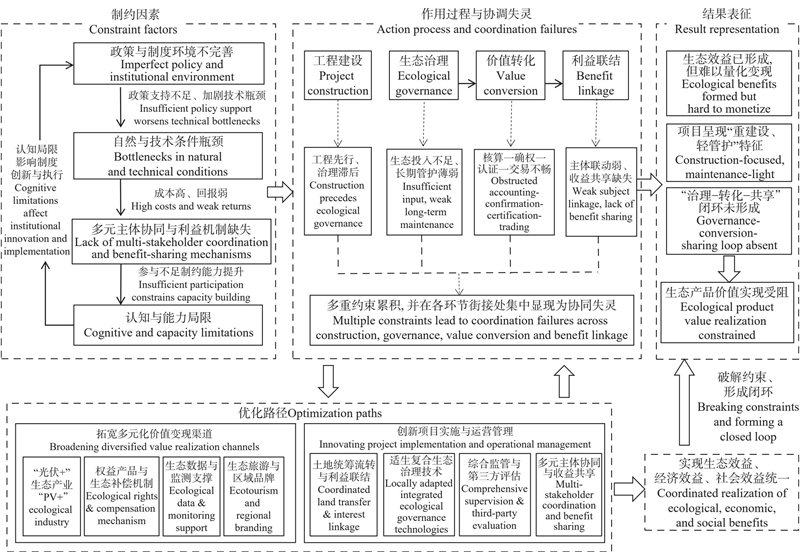
| 协同失灵过程 Coordination failure process | 制约因素作用于工程建设、生态治理、价值转化和利益联结过程Constraints affect project construction, ecological governance, value conversion, and benefit linkage | 多重约束在项目实施过程中集中表现为工程先行、治理滞后,核算交易不畅,主体联动弱和收益共享不足Multiple constraints lead to coordination failures, including construction preceding governance, weak accounting and trading, limited stakeholder linkage, and inadequate benefit sharing |
| 结果表征 Result representation | 协同失灵导致生态产品价值实现受阻 Coordination failures constrain ecological product value realization | 生态效益虽已形成,但难以量化变现;项目呈现“重建设、轻管护”特征,“治理?转化?共享”闭环尚未形成Ecological benefits have been generated but remain difficult to quantify and monetize; the project is “construction-focused and maintenance-light”, and the “governance-conversion-sharing” loop has not yet formed |
| 优化路径 Optimization pathways | 通过价值变现渠道拓展和运营管理创新破解约束Constraints are addressed by expanding value realization channels and innovating operational management | 通过拓宽多元化价值变现渠道和创新项目实施与运营管理,推动形成“治理?转化?共享”闭环,实现生态、经济和社会效益统一 By broadening diversified value realization channels and innovating project implementation and operational management, a “governance-conversion-sharing” loop can be formed to coordinate ecological, economic, and social benefits |

图1
“光伏+生态治理”生态产品价值实现的制约机制与优化路径"
|
陈倩茹, 吴曼玉, 谢花林. 湿地资源生态产品价值实现: 基本逻辑、核心机制与模式. 自然资源学报, 2023, 38 (10): 2490- 2503.
doi: 10.31497/zrzyxb.20231005 |
|
|
Chen Q R, Wu M Y, Xie H L. Value realization of ecological products of wetland resources: basic logic, core mechanism and mode. Journal of Natural Resources, 2023, 38 (10): 2490- 2503.
doi: 10.31497/zrzyxb.20231005 |
|
|
李川辉, 侯方淼, 吴成亮. 林长制助推森林生态产品价值实现的理论逻辑与实践路径. 世界林业研究, 2025, 38 (3): 92- 99.
doi: 10.13348/j.cnki.sjlyyj.2025.0045.y |
|
|
Li C H, Hou F M, Wu C L. Forest chief scheme to boost the value realization of forest-based ecological products: theoretical logic and practical pathways. World Forestry Research, 2025, 38 (3): 92- 99.
doi: 10.13348/j.cnki.sjlyyj.2025.0045.y |
|
| 李 森, 赵京东, 李泽东, 等. 沙漠、戈壁和荒漠地区光伏系统生态影响研究进展. 环境工程技术学报, 2025, 15 (2): 709- 716. | |
| Li S, Zhao J D, Li Z D, et al. Research progress on ecological impacts of photovoltaic systems in deserts, gobi and desertification lands. Journal of Environmental Engineering Technology, 2025, 15 (2): 709- 716. | |
|
李志刚. 扎根理论方法在科学研究中的运用分析. 东方论坛, 2007, (4): 90- 94.
doi: 10.3969/j.issn.1005-7110.2007.04.014 |
|
|
Li Z G. The study of grounded theory in business research. Oriental Forum, 2007, (4): 90- 94.
doi: 10.3969/j.issn.1005-7110.2007.04.014 |
|
| 林 凯, 顾 锋, 史玉民. 长江经济带生态保护和高质量发展研究: 基于扎根理论的分析. 华东经济管理, 2021, 35 (5): 12- 19. | |
| Lin K, Gu F, Shi Y M. Research on ecological protection and high-quality development of the Yangtze River economic belt: analysis based on grounded theory. East China Economic Management, 2021, 35 (5): 12- 19. | |
| 乔 琴, 林青霞, 李 依, 等. 浙江丽水生态产品总值核算创新实践及其应用探索. 中国科学院院刊, 2025, 40 (7): 1264- 1273. | |
| Qiao Q, Lin Q X, Li Y, et al. Innovative practices and application exploration of gross ecosystem product (GEP) accounting in Lishui City, Zhejiang Province. Bulletin of Chinese Academy of Sciences, 2025, 40 (7): 1264- 1273. | |
|
邱少俊, 徐淑升, 王浩聪. “生态银行” 实践对生态产品价值实现的启示: 以福建南平的试点探索为例. 中国土地, 2021, (6): 43- 45.
doi: 10.13816/j.cnki.ISSN1002-9729.2021.06.14 |
|
|
Qiu S J, Xu S S, Wang H C. Enlightenment of the practice of “eco-bank” on the value realization of eco-products: taking the pilot exploration in Nanping, Fujian as an example. China Land, 2021, (6): 43- 45.
doi: 10.13816/j.cnki.ISSN1002-9729.2021.06.14 |
|
|
任林静, 毛嘉宁, 宋 悦, 等. 全过程视角下森林生态产品价值实现的逻辑与困境. 林业经济问题, 2025, 45 (3): 263- 274.
doi: 10.16832/j.cnki.1005-9709.20250044 |
|
|
Ren L J, Mao J N, Song Y, et al. The logic and dilemmas of the value realization of forest ecological products from a whole-process perspective. Issues of Forestry Economics, 2025, 45 (3): 263- 274.
doi: 10.16832/j.cnki.1005-9709.20250044 |
|
|
石敏俊, 陈岭楠, 赵云皓, 等. 生态环境导向的开发(EOD)模式的理论逻辑与实践探索. 中国环境管理, 2024, 16 (2): 5- 14.
doi: 10.16868/j.cnki.1674-6252.2024.02.005 |
|
|
Shi M J, Chen L N, Zhao Y H, et al. Theoretical logic and practical exploration of the eco-environment oriented development (EOD) mode. Chinese Journal of Environmental Management, 2024, 16 (2): 5- 14.
doi: 10.16868/j.cnki.1674-6252.2024.02.005 |
|
|
苏凯文, 马 丽, 杨 光. 国家公园生态产品价值实现的理论阐释、机制解析与模式总结. 国家公园(中英文), 2025, 3 (2): 117- 125.
doi: 10.20152/j.np.202409190100 |
|
|
Su K W, Ma L, Yang G. Theoretical explanation, mechanism analysis, and model summary of the realization of ecosystem product value in national parks. Natinonal Park, 2025, 3 (2): 117- 125.
doi: 10.20152/j.np.202409190100 |
|
| 孙 荣, 安小兵, 李艳伟, 等. 2026. 高寒地区光伏板覆盖面积对人工草地恢复的影响. 中国水土保持科学(中英文), https://link.cnki.net/urlid/10.1449.S.20260313.0952.006. | |
| Sun R, An X B, Li Y W, et al. 2026. Effects of photovoltaic panel coverage area on artificial grassland restoration in alpine regions. Science of Soil and Water Conservation, https://link.cnki.net/urlid/10.1449.S.20260313.0952.006.[in Chinese] | |
|
魏宇帆, 金建峰, 丁 倩, 等. 农光互补电站的生态产品价值核算: 以正泰江山200 MW农光互补电站为例. 农业资源与环境学报, 2024, 41 (1): 197- 211.
doi: 10.13254/j.jare.2022.0870 |
|
|
Wei Y F, Jin J F, Ding Q, et al. Value accounting of ecological products in an agrophotovoltaic power station: a case study on the Zhengtai Jiangshan 200 MW agrophotovoltaic power station. Journal of Agricultural Resources and Environment, 2024, 41 (1): 197- 211.
doi: 10.13254/j.jare.2022.0870 |
|
| 吴 健, 韩东阳, 陈绍志. 基于政策文本的国家公园内部利益联结机制探析. 世界林业研究, 2024, 37 (6): 114- 120. | |
| Wu J, Han D Y, Chen S Z. An analysis of internal interest linkage mechanism within national parks based on policy texts. World Forestry Research, 2024, 37 (6): 114- 120. | |
|
谢贤胜, 陈绍志, 赵 荣. 生态产品价值实现的实践逻辑: 基于自然资源领域87个典型案例的扎根理论研究. 自然资源学报, 2023, 38 (10): 2504- 2522.
doi: 10.31497/zrzyxb.20231006 |
|
|
Xie X S, Chen S Z, Zhao R. The practical logic of ecological product value realization: a study of grounded theory based on 87 typical cases in the field of natural resources. Journal of Natural Resources, 2023, 38 (10): 2504- 2522.
doi: 10.31497/zrzyxb.20231006 |
|
| 徐 静, 王安茹, 田淑慧. 冰雪旅游目的地的游客选择意愿及影响因素研究: 基于扎根理论的质性分析. 价格理论与实践, 2021, (3): 118- 121, 167. | |
| Xu J, Wang A R, Tian S H. Study on tourists’ choice intention and influencing factors of ice and snow tourism destinations: qualitative analysis based on grounded theory. Price: Theory & Practice, 2021, (3): 118- 121, 167. | |
|
徐梦瑶, 张正峰, 谷晓坤, 等. 低效建设用地减量化对乡村转型发展的影响研究: 基于上海市的扎根理论分析. 中国土地科学, 2021, 35 (6): 65- 73.
doi: 10.11994/zgtdkx.20210531.082407 |
|
|
Xu M Y, Zhang Z F, Gu X K, et al. Research on the impacts of inefficiently used construction land reduction on rural transformation development: a grounded analysis based on Shanghai City. China Land Science, 2021, 35 (6): 65- 73.
doi: 10.11994/zgtdkx.20210531.082407 |
|
|
杨若婷, 庞秀岚, 马鸿元, 等. 松嫩平原固定式光伏方阵土壤水热盐时空分异特征. 中国水土保持科学(中英文), 2026, 24 (1): 149- 158.
doi: 10.16843/j.sswc.2025144 |
|
|
Yang R T, Pang X L, Ma H Y, et al. Spatiotemporal heterogeneity of soil water-heat-salt characteristics under fixed-mounted photovoltaic arrays in Songnen Plain. Science of Soil and Water Conservation, 2026, 24 (1): 149- 158.
doi: 10.16843/j.sswc.2025144 |
|
| 叶得力, 张嘉宸, 马鸿元. 荒漠变绿又生金的“青海方案”: 海南州示范区高寒荒漠化草原光伏产业与生态融合发展实践. 可持续发展经济导刊, 2025, (12): 55- 59. | |
| Ye D L, Zhang J C, Ma H Y. The “Qinghai solution” turning deserts green and profitable: photovoltaic-ecology integration in hainan’s highland grasslands. China Sustainability Tribune, 2025, (12): 55- 59. | |
| 张 璇, 高睿涓, 涂志刚, 等. 钱江源−百山祖国家公园钱江源片区生态产品价值实现路径. 国家公园, 2024, 2 (5): 342- 350. | |
| Zhang X, Gao R J, Tu Z G, et al. The value realization pathways for ecosystem products in the Qianjiangyuan area of Qianjiangyuan-Baishanzu National Park. National Park, 2024, 2 (5): 342- 350. | |
|
郑启伟. 美国“湿地银行”和南平“生态银行”比较及启示. 浙江经济, 2020, (1): 72- 75.
doi: 10.3969/j.issn.1005-1635.2020.01.026 |
|
|
Zheng Q W. Comparison and enlightenment of American wetland bank and Nanping ecological bank. Zhejiang Economy, 2020, (1): 72- 75.
doi: 10.3969/j.issn.1005-1635.2020.01.026 |
|
|
周申蓓, 李 颖, 孙晓文, 等. 基于扎根理论的水生态产品价值实现路径构建. 水利经济, 2024, 42 (2): 26- 33.
doi: 10.3880/j.issn.1003-9511.2024.02.005 |
|
|
Zhou S B, Li Y, Sun X W, et al. Construction of path to realize value of water ecological products based on grounded theory. Journal of Economics of Water Resources, 2024, 42 (2): 26- 33.
doi: 10.3880/j.issn.1003-9511.2024.02.005 |
|
|
Agostini A, Colauzzi M, Amaducci S. Innovative agrivoltaic systems to produce sustainable energy: an economic and environmental assessment. Applied Energy, 2021, 281, 116102.
doi: 10.1016/j.apenergy.2020.116102 |
|
| Ahmed S K. 2025. Sample size for saturation in qualitative research: debates, definitions, and strategies. Journal of Medicine, Surgery, and Public Health, 5: 100171. | |
| Corbin J, Strauss A. 2008. Basics of qualitative research: techniques and procedures for developing grounded theory. 3rd ed. Thousand Oaks, CA: SAGE Publications. | |
|
Dupraz C, Marrou H, Talbot G, et al. Combining solar photovoltaic panels and food crops for optimising land use: towards new agrivoltaic schemes. Renewable Energy, 2011, 36 (10): 2725- 2732.
doi: 10.1016/j.renene.2011.03.005 |
|
| Glaser B G, Strauss A L. 2017. The discovery of grounded theory: strategies for qualitative research. London: Routledge. | |
|
Wen J M, Rao S M, Liu W, et al. Research progress on the realization of rural ecological product value. Journal of Resources and Ecology, 2026, 17 (1): 14- 26.
doi: 10.5814/j.issn.1674-764x.2026.01.002 |
| [1] | 黄颖,连文绮,王荔英,刘璨. 可持续森林经营认证对林业生态产品价值实现的影响:机制与实证[J]. 林业科学, 2026, 62(5): 179-188. |
| [2] | 黄显乔,李敬烨,吴家欣,任月,曹玉昆. 提高森林生态产品价值实现效率的林业高质量发展评估——以东北、内蒙古重点国有林区为例[J]. 林业科学, 2025, 61(6): 209-223. |
| [3] | 徐来仙,何友均. 林业碳汇产品定价机制比较与启示[J]. 林业科学, 2025, 61(4): 231-248. |
| [4] | 廖文梅,郑希贤,蒋丽雯,王智鹏,高雪萍,孔凡斌. 林业新质生产力对森林生态产品价值实现效率的影响机制[J]. 林业科学, 2025, 61(12): 177-191. |
| [5] | 孔凡斌,陆雨,徐彩瑶. 数字经济发展、森林生态产品价值实现与城乡收入差距[J]. 林业科学, 2024, 60(5): 1-21. |
| [6] | 潘丰十,牛香,郭珂. 呼伦贝尔市典型生态产品禀赋与价值化实现路径优化[J]. 林业科学, 2024, 60(12): 146-157. |
| [7] | 肖文发,朱建华,曾立雄,简尊吉,雷蕾. 森林碳汇助力碳中和的几点认识[J]. 林业科学, 2023, 59(3): 1-11. |
| [8] | 徐彩瑶,王宁,孔凡斌,沈月琴. 森林生态产品价值实现对县域发展差距的影响: 以浙江省山区26县为例[J]. 林业科学, 2023, 59(1): 12-30. |
| [9] | 孔凡斌,崔铭烨,徐彩瑶,陆雨,沈月琴. 浙江省森林生态产品价值实现对城乡差距的影响[J]. 林业科学, 2023, 59(1): 31-43. |
| [10] | 孔凡斌,王宁,徐彩瑶,陆雨,沈月琴. 浙江省山区26县森林生态产品价值实现对城乡收入差距的影响[J]. 林业科学, 2023, 59(1): 44-58. |
| [11] | 窦亚权,杨琛,赵晓迪,王怀毅,李娅,何友均. 森林生态产品价值实现的理论与路径选择[J]. 林业科学, 2022, 58(7): 1-11. |
| [12] | 孔凡斌,王宁,徐彩瑶. "两山"理念发源地森林生态产品价值实现效率[J]. 林业科学, 2022, 58(7): 12-22. |
| 阅读次数 | ||||||
|
全文 |
|
|||||
|
摘要 |
|
|||||

