
Scientia Silvae Sinicae ›› 2026, Vol. 62 ›› Issue (2): 15-24.doi: 10.11707/j.1001-7488.LYKX20250256
• Frontiers and hot topics • Previous Articles
Huiling Tian1,Jianhua Zhu2,Xiao He1,Xinyun Chen3,Ran Wang4,Wenfa Xiao2,Xiangdong Lei1,*( )
)
Received:2025-04-27
Revised:2025-06-16
Online:2026-02-25
Published:2026-03-04
Contact:
Xiangdong Lei
E-mail:xdlei@ifrit.ac.cn
CLC Number:
Huiling Tian,Jianhua Zhu,Xiao He,Xinyun Chen,Ran Wang,Wenfa Xiao,Xiangdong Lei. Growth Model of Arbor Carbon Storage in Typical Forest Stands in the Mid-Subtropical Zone of China[J]. Scientia Silvae Sinicae, 2026, 62(2): 15-24.
Table 1
Summary statistics of stand variables for modeling samples"
| 起源Origin | 变量Variables | 平均值Mean | 最小值Min. | 最大值Max. | 标准差SD |
| 人工林 Plantation | 林分平均年龄Stand mean age (A)/a | 19.4 | 5 | 68 | 9.6 |
| 林分平均高Stand mean height (H)/m | 9.2 | 1.3 | 26 | 3.3 | |
| 平均胸径Mean diameter (Dg)/cm | 11.0 | 7.4 | 26.1 | 2.7 | |
| 林分密度指数Stand density index (SDI)/(tree·hm?2) | 639.5 | 43.1 | 3 226.1 | 398.0 | |
| 林分公顷蓄积量Stand stock volume/(m3·hm?2) | 74.5 | 0.1 | 595.9 | 63.1 | |
| 林分碳储量Stand carbon storage/(t·hm?2) | 31.1 | 0.2 | 116.1 | 17. 6 | |
| 天然林 Natural forest | 林分平均年龄Stand mean age (A)/a | 26.3 | 5 | 120 | 13.7 |
| 林分平均高Stand mean height (H)/m | 9.3 | 1.3 | 28 | 3.1 | |
| 平均胸径Mean diameter (Dg)/cm | 11.1 | 7.6 | 38 | 3.0 | |
| 林分密度指数Stand density index (SDI)/(tree·hm?2) | 554. 5 | 45.1 | 2 410. 6 | 312.8 | |
| 林分公顷蓄积量Stand stock volume/(m3·hm?2) | 76.5 | 0.3 | 567.9 | 62.4 | |
| 林分碳储量Stand carbon storage/(t·hm?2) | 36.8 | 0.6 | 261.1 | 25.7 |
Table 2
Classification criteria of site factor groups"
| 因子Factor | 划分条件Classification criteria |
| 海拔Elevation | 200 m一个等级 A class per 200 m |
| 坡度Slope | 10°一个等级 A class per 10° |
| 坡向Aspect | 北坡 North;东北坡 Northeast;东坡 East;东南坡Southeast;南坡 South; 西南坡 Southwest;西坡 West;西北坡 Northwest;无坡向 No aspect |
| 坡位Slope position | 脊部 Ridge;上坡 Upper;中坡 Middle;下坡 Lower;山谷(或山洼) Valley;平地 Flat |
| 土层厚度Soil depth | 20 cm一个等级 A class per 20 cm |
| 腐殖层厚度Humus depth | 薄Thin:<2 cm;中Moderate:2~5 cm;厚Thick:>5 cm |
Table 3
Parameter estimation and goodness of fit for stand mean height growth models for typical forest types by site classes"
| 起源 Origin | 森林类型 Forest type | 参数估计值 Parameter estimates | 评价指标 Evaluation indices | |||||||||
| a1 | a2 | a3 | a4 | a5 | b | c | R2 | RMSE | rRMSE(%) | |||
| 人工林 Plantation | 华山松 Pinus armandii | 16.5 | 13.0 | 10.5 | 7.70 | 5.01 | 0.050 00 | 0.762 | 0.955 | 0.691 | 8.46 | |
| 马尾松 Pinus massoniana | 44.6 | 34.7 | 27.6 | 21.30 | 14.50 | 0.007 00 | 0.589 | 0.958 | 0.760 | 7.84 | ||
| 湿地松 Pinus elliottii | 20.9 | 16.4 | 13.6 | 11.30 | 8.04 | 0.057 70 | 1.160 | 0.967 | 0.584 | 7.07 | ||
| 杉木Cunninghamia lanceolata | 22.4 | 17.5 | 13.8 | 10.70 | 7.42 | 0.043 40 | 0.790 | 0.953 | 0.707 | 7.93 | ||
| 柏木Cupressus funebris | 17.0 | 13.5 | 10.9 | 8.70 | 6.42 | 0.097 50 | 1.370 | 0.932 | 0.704 | 7.38 | ||
| 桉树 Eucalyptus spp. | 18.8 | 15.0 | 11.6 | 8.72 | 5.72 | 0.467 00 | 1.300 | 0.950 | 0.863 | 7.99 | ||
| 其他软阔类 Other soft broadleaf | 22.6 | 17.0 | 13.1 | 10.20 | 6.74 | 0.160 00 | 1.380 | 0.952 | 0.911 | 8.87 | ||
| 针叶混交林 Mixed coniferous | 18.7 | 14.9 | 12.2 | 9.75 | 7.19 | 0.052 30 | 0.757 | 0.950 | 0.663 | 7.00 | ||
| 阔叶混交林 Mixed broadleaf | 17.7 | 13.5 | 10.9 | 8.22 | 5.69 | 0.175 00 | 1.570 | 0.949 | 0.801 | 8.62 | ||
| 针阔混交林 Mixed coniferous and broadleaf | 23.3 | 18.1 | 14.6 | 11.50 | 7.86 | 0.014 00 | 0.365 | 0.931 | 0.736 | 8.29 | ||
| 天然林 Natural forest | 马尾松 Pinus massoniana | 44.3 | 34.6 | 27.6 | 21.20 | 14.70 | 0.007 79 | 0.592 | 0.944 | 0.884 | 8.61 | |
| 高山松 Pinus densata | 23.0 | 17.5 | 12.4 | 8.93 | 4.70 | 0.044 10 | 1.220 | 0.979 | 0.837 | 6.92 | ||
| 杉木 Cunninghamia lanceolata | 17.8 | 14.1 | 11.3 | 8.90 | 6.31 | 0.046 00 | 0.659 | 0.946 | 0.629 | 7.47 | ||
| 柏木 Cupressus funebris | 15.0 | 12.5 | 10.4 | 8.49 | 6.06 | 0.091 30 | 1.720 | 0.942 | 0.672 | 6.64 | ||
| 栎类 Quercus spp. | 23.4 | 17.3 | 13.7 | 10.80 | 7.56 | 0.013 80 | 0.448 | 0.952 | 0.800 | 8.85 | ||
| 其他硬阔类 Other hard broadleaf | 24.4 | 18.2 | 14.5 | 11.30 | 8.17 | 0.005 85 | 0.277 | 0.940 | 0.806 | 8.68 | ||
| 针叶混交林 Mixed coniferous | 31.6 | 24.2 | 19.4 | 15.30 | 10.90 | 0.010 90 | 0.529 | 0.943 | 0.717 | 7.51 | ||
| 阔叶混交林 Mixed broadleaf | 27.4 | 20.9 | 16.8 | 13.40 | 9.89 | 0.011 90 | 0.485 | 0.945 | 0.688 | 7.59 | ||
| 针阔混交林 Mixed coniferous and broadleaf | 35.4 | 27.0 | 21.1 | 16.50 | 12.00 | 0.008 31 | 0.521 | 0.943 | 0.687 | 7.63 | ||
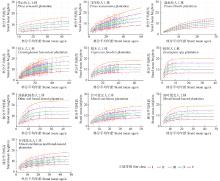
Fig.1
Relationships between stand mean height and stand mean age of plantations in 5 site classes in mid-subtropical zone"
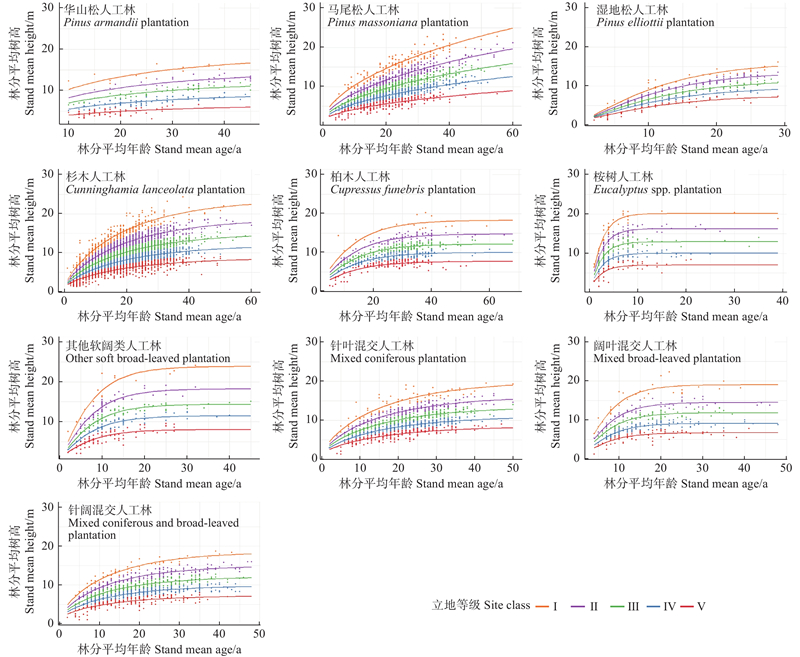
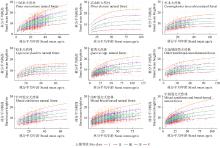
Fig.2
Relationships between stand mean height and stand mean age of natural forests in 5 site classes in mid-subtropical zone"
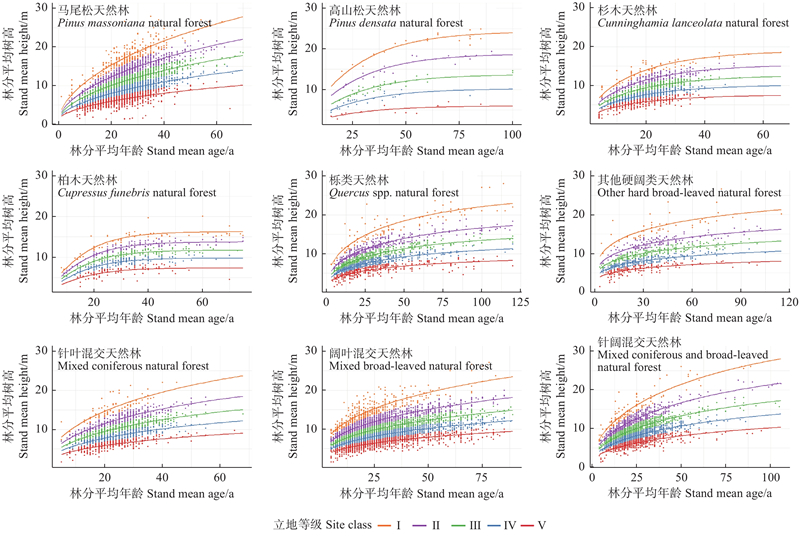
Table 4
Parameter estimation and goodness of fit of arbor carbon storage growth models for typical forest stands by site classes"
| 起源 Origin | 森林类型 Forest type | 样本数 Sample size | 参数估计值 Parameter estimates | 评价指标 Evaluation indices | ||||||||||
| a1 | a2 | a3 | a4 | a5 | b1 | b2 | c | R2 | RMSE | rRMSE(%) | ||||
| 人工林 Plantation | 华山松 Pinus armandii | 230 | 102.10 | 92.34 | 87.18 | 78.77 | 63.50 | 0.525 50 | 1.834 0 | 0.349 2 | 0.811 9 | 7.758 | 24.02 | |
| 马尾松 Pinus massoniana | 1 622 | 119.40 | 107.80 | 89.28 | 77.61 | 61.68 | 0.202 10 | 1.187 0 | 0.528 0 | 0.768 9 | 9.751 | 30.86 | ||
| 湿地松 Pinus elliottii | 374 | 70.84 | 65.58 | 61.12 | 57.57 | 42.79 | 1.754 00 | 1.762 0 | 0.408 2 | 0.777 1 | 5.588 | 25.95 | ||
| 杉木Cunninghamia lanceolata | 5 833 | 104.80 | 89.91 | 79.95 | 70.15 | 55.32 | 0.264 50 | 1.258 0 | 0.455 6 | 0.816 2 | 7.463 | 23.74 | ||
| 柏木Cupressus funebris | 631 | 52.09 | 54.93 | 50.29 | 47.63 | 44.87 | 0.938 70 | 1.359 0 | 0.366 9 | 0.695 6 | 6.274 | 19.55 | ||
| 桉树 Eucalyptus spp. | 302 | 51.53 | 47.39 | 38.04 | 28.04 | 26.26 | 2.538 00 | 1.130 0 | 0.531 7 | 0.758 4 | 5.659 | 28.48 | ||
| 其他软阔类 Other soft broadleaf | 269 | 64.81 | 59.33 | 49.34 | 45.39 | 37.53 | 1.764 00 | 1.002 0 | 0.701 9 | 0.656 2 | 10.02 | 34.00 | ||
| 针叶混交林 Mixed coniferous | 1 127 | 79.44 | 74.11 | 70.02 | 62.21 | 54.20 | 0.430 20 | 1.510 0 | 0.313 8 | 0.784 2 | 6.659 | 19.50 | ||
| 阔叶混交林 Mixed broadleaf | 355 | 110.10 | 96.48 | 85.34 | 76.64 | 56.96 | 0.432 20 | 1.218 0 | 0.552 4 | 0.670 9 | 11.270 | 42.79 | ||
| 针阔混交林 Mixed coniferous and broadleaf | 1 141 | 129.10 | 115.50 | 99.41 | 91.16 | 70.14 | 0.177 60 | 1.154 0 | 0.482 3 | 0.712 5 | 10.510 | 32.47 | ||
| 天然林 Natural forest | 马尾松 Pinus massoniana | 4 877 | 128.10 | 116.70 | 100.9 | 85.98 | 70.71 | 0.154 30 | 1.111 0 | 0.562 0 | 0.748 9 | 9.352 | 30.03 | |
| 高山松 Pinus densata | 112 | 123.80 | 103.40 | 79.90 | 72.34 | 53.46 | 0.277 40 | 1.214 0 | 0.449 6 | 0.906 1 | 7.423 | 14.06 | ||
| 杉木 Cunninghamia lanceolata | 1 508 | 76.05 | 71.85 | 64.18 | 56.45 | 48.54 | 0.268 30 | 1.070 0 | 0.529 6 | 0.795 2 | 6.021 | 24.71 | ||
| 柏木 Cupressus funebris | 554 | 47.80 | 46.77 | 43.61 | 39.75 | 33.74 | 0.584 40 | 0.931 9 | 0.534 6 | 0.633 0 | 7.196 | 22.26 | ||
| 栎类 Quercus spp. | 1 773 | 249.60 | 223.50 | 205.70 | 195.10 | 169.8 | 0.144 60 | 1.336 0 | 0.633 9 | 0.762 4 | 18.890 | 41.15 | ||
| 其他硬阔类 Other hard broadleaf | 847 | 262.60 | 230.10 | 219.50 | 187.90 | 174.30 | 0.060 45 | 1.407 0 | 0.442 4 | 0.768 0 | 14.170 | 31.52 | ||
| 针叶混交林 Mixed coniferous | 1 704 | 83.02 | 79.02 | 73.59 | 67.07 | 60.68 | 0.248 00 | 1.284 0 | 0.377 3 | 0.792 6 | 5.898 | 18.21 | ||
| 阔叶混交林 Mixed broadleaf | 8 290 | 233.50 | 207.00 | 181.70 | 162.90 | 139.40 | 0.096 58 | 0.992 7 | 0.707 6 | 0.729 5 | 15.560 | 37.21 | ||
| 针阔混交林 Mixed coniferous and broadleaf | 3 385 | 130.90 | 119.00 | 108.70 | 95.32 | 83.49 | 0.166 60 | 1.075 0 | 0.558 8 | 0.733 8 | 9.290 | 27.39 | ||
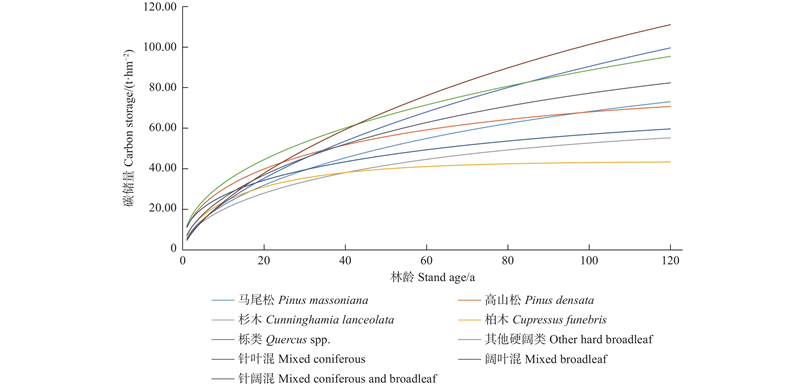
Fig.3
Growing process of carbon storage in plantations"
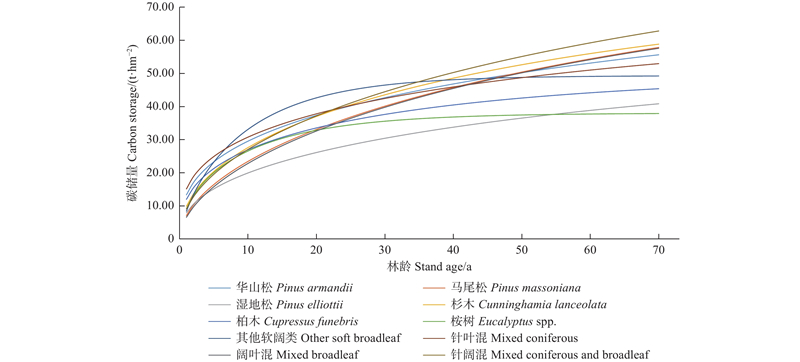
Fig.4
Growing process of carbon storage in natural forests"
| 曹 磊, 刘晓彤, 李海奎, 等. 广东省常绿阔叶林生物量生长模型. 林业科学研究, 2020, 33 (5): 61- 67. | |
| Cao L, Liu X T, Li H K, et al. Biomass growth models for evergreen broad-leaved forests in Guangdong. Forest Research, 2020, 33 (5): 61- 67. | |
|
陈 亮, 周国模, 杜华强, 等. 基于随机森林模型的毛竹林CO2通量模拟及其影响因子. 林业科学, 2018, 54 (8): 1- 12.
doi: 10.11707/j.1001-7488.20180801 |
|
|
Chen L, Zhou G M, Du H Q, et al. Simulation of CO2 flux and controlling factors in moso bamboo forest using random forest algorithm. Scientia Silvae Sinicae, 2018, 54 (8): 1- 12.
doi: 10.11707/j.1001-7488.20180801 |
|
| 付 晓, 张煜星, 王雪军. 2060年前我国森林生物量碳库及碳汇潜力预测. 林业科学, 2022, 58 (2): 32- 41. | |
| Fu X, Zhang Y X, Wang X J. Prediction of forest biomass carbon pool and carbon sink potential in China before 2060. Scientia Silvae Sinicae, 2022, 58 (2): 32- 41. | |
|
郭泽鑫, 胡中岳, 曹 聪, 等. 广东主要森林类型林分生物量和碳储量模型研建. 林业科学, 2023, 59 (12): 37- 50.
doi: 10.11707/j.1001-7488.LYKX20230039 |
|
|
Guo Z X, Hu Z Y, Cao C, et al. Stand-level models of biomass and carbon stock for major forest types in Guangdong. Scientia Silvae Sinicae, 2023, 59 (12): 37- 50.
doi: 10.11707/j.1001-7488.LYKX20230039 |
|
| 国家林业局. 2017a. 立木生物量模型及碳计量参数: 桦树(LY/T 2659—2016). 北京: 中国标准出版社. | |
| State Forestry Administration. 2017a. Tree biomass models and related parameters to carbon accounting for birch (LY/T 2659—2016). Beijing: China Standard Press. [in Chinese] | |
| 国家林业局. 2017b. 立木生物量模型及碳计量参数: 冷杉(LY/T 2656—2016). 北京: 中国标准出版社. | |
| State Forestry Administration. 2017b. Tree biomass models and related parameters to carbon accounting for fir (LY/T 2656—2016). Beijing: China Standard Press. [in Chinese] | |
| 国家林业局. 2017c. 立木生物量模型及碳计量参数: 栎树(LY/T 2658—2016). 北京: 中国标准出版社. | |
| State Forestry Administration. 2017c. Tree biomass models and related parameters to carbon accounting for Oak tree (LY/T 2658—2016). Beijing: China Standard Press. [in Chinese] | |
|
何 潇, 李海奎, 张逸如, 等. 天然次生林碳储量生长模型与固碳能力驱动力研究. 北京林业大学学报, 2023, 45 (1): 1- 10.
doi: 10.12171/j.1000-1522.20210265 |
|
|
He X, Li H K, Zhang Y R, et al. Growth model of carbon storage and driving force of carbon sequestration capacity of natural secondary forests. Journal of Beijing Forestry University, 2023, 45 (1): 1- 10.
doi: 10.12171/j.1000-1522.20210265 |
|
|
何 潇, 周超凡, 雷相东, 等. 长白落叶松人工林林分碳储量生长模型系研究. 北京林业大学学报, 2021, 43 (11): 1- 10.
doi: 10.12171/j.1000-1522.20210040 |
|
|
He X, Zhou C F, Lei X D, et al. Stand carbon stock growth model system for Larix olgensis plantation. Journal of Beijing Forestry University, 2021, 43 (11): 1- 10.
doi: 10.12171/j.1000-1522.20210040 |
|
|
贺 鹏, 陈振雄, 彭检贵. 湖南省主要树种单木相容性生物量模型系统研建. 北京林业大学学报, 2025, 47 (3): 61- 72.
doi: 10.12171/j.1000-1522.20240436 |
|
|
He P, Chen Z X, Peng J G. Development of a compatible biomass model system for individual trees of major tree species in Hunan Province of central China. Journal of Beijing Forestry University, 2025, 47 (3): 61- 72.
doi: 10.12171/j.1000-1522.20240436 |
|
|
黄金金, 刘晓彤, 张逸如, 等. 广东省含参数分级的阔叶林分生物量生长模型. 北京林业大学学报, 2022, 44 (5): 19- 33.
doi: 10.12171/j.1000-1522.20210403 |
|
|
Huang J J, Liu X T, Zhang Y R, et al. Stand biomass growth model of broadleaved forest with parameter classification in Guangdong Province of southern China. Journal of Beijing Forestry University, 2022, 44 (5): 19- 33.
doi: 10.12171/j.1000-1522.20210403 |
|
|
雷相东, 符利勇, 李海奎, 等. 基于林分潜在生长量的立地质量评价方法与应用. 林业科学, 2018, 54 (12): 116- 126.
doi: 10.11707/j.1001-7488.20181213 |
|
|
Lei X D, Fu L Y, Li H K, et al. Methodology and applications of site quality assessment based on potential mean annual increment. Scientia Silvae Sinicae, 2018, 54 (12): 116- 126.
doi: 10.11707/j.1001-7488.20181213 |
|
|
李海奎, 法 蕾. 基于分级的全国主要树种树高-胸径曲线模型. 林业科学, 2011, 47 (10): 83- 90.
doi: 10.11707/j.1001-7488.20111013 |
|
|
Li H K, Fa L. Height-diameter model for major tree species in China using the classified height method. Scientia Silvae Sinicae, 2011, 47 (10): 83- 90.
doi: 10.11707/j.1001-7488.20111013 |
|
|
李海奎, 宁金魁. 基于树木起源、立地分级和龄组的单木生物量模型. 生态学报, 2012, 32 (3): 740- 757.
doi: 10.5846/stxb201106300978 |
|
|
Li H K, Ning J K. Individual tree biomass model by tree origin, site classes and age groups. Acta Ecologica Sinica, 2012, 32 (3): 740- 757.
doi: 10.5846/stxb201106300978 |
|
| 唐守正, 郎奎建, 李海奎. 2009. 统计和生物数学模型计算: ForStat教程. 北京: 科学出版社. | |
| Tang S Z, Lang K J, Li H K. 2009. Statistical and biomathematics model calculation: ForStat course. Beijing: Science Press. [in Chinese] | |
| 王靖钰, 李国栋, 任晓娟, 等. 南北过渡带常绿落叶阔叶混交林碳通量特征及其对环境因子的响应. 生态学报, 2024, 44 (14): 6243- 6253. | |
| Wang J Y, Li G D, Ren X J, et al. Carbon flux characteristics and responses to environmental factors in the evergreen⁃deciduous broadleaf mixed forest of the north⁃south transitional zone. Acta Ecologica Sinica, 2024, 44 (14): 6243- 6253. | |
| 曾伟生, 王雪军, 陈振雄, 等. 林分起源对立木生物量模型的影响分析. 林业资源管理, 2014 (2): 40- 45. | |
| Zeng W S, Wang X J, Chen Z X, et al. Analysis of impacts of forest origin on single tree biomass models. Forest Resources Management, 2014 (2): 40- 45. | |
| 张瀚月. 2022. 中国主要树种生长量与碳汇量测计方法研究与应用. 北京: 北京林业大学. | |
| Zhang H Y. 2022. Research and application of measurement and statistics for the growth and carbon sink of major tree species in China. Beijing: Beijing Forestry University. [in Chinese] | |
| 张继平, 张林波, 刘春兰, 等. 井冈山中亚热带森林植被碳储量及固碳潜力估算. 生态环境学报, 2016, 25 (1): 9- 14. | |
| Zhang J P, Zhang L B, Liu C L, et al. Estimation of carbon stock and carbon sequestration potential of mid-subtropical forest in jinggang mountain national nature reserve. Ecology and Environmental Sciences, 2016, 25 (1): 9- 14. | |
|
赵 菡, 雷渊才, 符利勇. 江西省不同立地等级的马尾松林生物量估计和不确定性度量. 林业科学, 2017, 53 (8): 81- 93.
doi: 10.11707/j.1001-7488.20170810 |
|
|
Zhao H, Lei Y C, Fu L Y. Biomass and uncertainty estimates of Pinus massoniana forest for different site classes in Jiangxi Province. Scientia Silvae Sinicae, 2017, 53 (8): 81- 93.
doi: 10.11707/j.1001-7488.20170810 |
|
|
Cai W X, He N P, Li M X, et al. Carbon sequestration of Chinese forests from 2010 to 2060: spatiotemporal dynamics and its regulatory strategies. Science Bulletin, 2022, 67 (8): 836- 843.
doi: 10.1016/j.scib.2021.12.012 |
|
| Chai Z Z, Tan W. Impacts of close-to-nature management on the stand states of masson pine forests. Ecosystem Health and Sustainability, 2020, 6 (1): 45- 54. | |
|
Clark J S, Bell D M, Hersh M H, et al. Climate change vulnerability of forest biodiversity: climate and competition tracking of demographic rates: forests, clima te change, and competition. Global Change Biology, 2011, 17 (5): 1834- 1849.
doi: 10.1111/j.1365-2486.2010.02380.x |
|
| Contestabile M. A new policy field. Nature Climate Change, 2014, 4 (11): 954. | |
|
de Souza H J, Miguel E P, Nascimento R G M, et al. Thinning-response modifier term in growth models: an application on clonal Tectona grandis Linn F. stands at the Amazonian region. Forest Ecology and Management, 2022, 511, 120109.
doi: 10.1016/j.foreco.2022.120109 |
|
| Dong L H, Li F R, Jia W W. Development of a statistical approach for predicting the spatial distribution of branch size for planted larch (Larix olgensis) trees in northeast China. Journal of Forestry Research, 2016, 27 (2): 347- 355. | |
|
Forrester D I, Bauhus J. A review of processes behind diversity: productivity relationships in forests. Current Forestry Reports, 2016, 2 (1): 45- 61.
doi: 10.1007/s40725-016-0031-2 |
|
|
Jat M L, Chakraborty D, Ladha J K, et al. Conservation agriculture for sustainable intensification in south Asia. Nature Sustainability, 2020, 3 (4): 336- 343.
doi: 10.1038/s41893-020-0500-2 |
|
| Ketterings Q M, Coe R, van Noordwijk M, et al. Reducing uncertainty in the use of allometric biomass equations for predicting above-ground tree biomass in mixed secondary forests. Forest Ecology and Management, 2001, 146 (1/2/3): 199- 209. | |
|
Li H K, Zhao P X. Improving the accuracy of tree-level aboveground biomass equations with height classification at a large regional scale. Forest Ecology and Management, 2013, 289, 153- 163.
doi: 10.1016/j.foreco.2012.10.002 |
|
|
Luo Y J, Wang X K, Ouyang Z Y, et al. A review of biomass equations for China’s tree species. Earth System Science Data, 2020, 12 (1): 21- 40.
doi: 10.5194/essd-12-21-2020 |
|
|
Luo Y J, Wang X K, Zhang X Q, et al. Root: shoot ratios across China’s forests: forest type and climatic effects. Forest Ecology and Management, 2012, 269, 19- 25.
doi: 10.1016/j.foreco.2012.01.005 |
|
| Reineke L H. Perfecting a stand-density index for even-aged forests. Journal of Agricultural Research, 1933, 46 (7): 627- 638. | |
|
Sileshi G W. A critical review of forest biomass estimation models, common mistakes and corrective measures. Forest Ecology and Management, 2014, 329, 237- 254.
doi: 10.1016/j.foreco.2014.06.026 |
|
|
Wyss A B, Sofer T, Lee M K, et al. Multiethnic meta-analysis identifies ancestry-specific and cross-ancestry loci for pulmonary function. Nature Communications, 2018, 9 (1): 2976.
doi: 10.1038/s41467-018-05369-0 |
|
|
Xiang W, Lei X D, Zhang X Q. Modelling tree recruitment in relation to climate and competition in semi-natural Larix-Picea-Abies forests in northeast China. Forest Ecology and Management, 2016, 382, 100- 109.
doi: 10.1016/j.foreco.2016.09.050 |
|
|
Xu B, Guo Z D, Piao S L, et al. Biomass carbon stocks in China’s forests between 2000 and 2050: a prediction based on forest biomass-age relationships. Science China Life Sciences, 2010, 53 (7): 776- 783.
doi: 10.1007/s11427-010-4030-4 |
|
|
Zhang C H, Ju W M, Chen J M, et al. Sustained biomass carbon sequestration by China’s forests from 2010 to 2050. Forests, 2018, 9 (11): 689.
doi: 10.3390/f9110689 |
| [1] | Pingping Li,Yanhui Wang,Pengtao Yu,Yirui Wang,Wenbiao Duan,Yanfang Wan,Xiaocha Wei,Zaijun Shi. Growth Response of Black Locust Plantations to Site Quality and Stand Density on the Loess Plateau of China [J]. Scientia Silvae Sinicae, 2025, 61(7): 192-207. |
| [2] | Xiao He,Guangcheng Luo,Wenqiang Gao,Haikui Li,Weisheng Zeng,Fujun Duan,Xiangdong Lei. Carbon Sequestration Potentiality of Pinus tabuliformis Pure Forest in Zhongtiaoshan Forestry Bureau of Shanxi Province [J]. Scientia Silvae Sinicae, 2025, 61(5): 74-84. |
| [3] | Weisheng Zeng,Xueyun Yang,Ying Pu. Tree Crown Width Model, Stand Density Model and Their Relationships for Natural Larch [J]. Scientia Silvae Sinicae, 2025, 61(2): 93-100. |
| [4] | Xinsheng Han,Yanhui Wang,Pengtao Yu,Zhenhua Li,Yipeng Yu,Xiao Wang. Construction of Multi-Factor Response Coupling Models of Tree Height and DBH Growth of Larix principis-rupprechtii Plantations in Northern Liupan Mountains, Ningxia [J]. Scientia Silvae Sinicae, 2024, 60(11): 13-24. |
| [5] | Long Shisheng, Zeng Siqi, Yang Shengyang. Maximum Density-Size Line for Oak Natural Forest Based on Improved Stand Density Index [J]. Scientia Silvae Sinicae, 2023, 59(9): 13-22. |
| [6] | Haifei Lu,Wangshu Liu,Jianmin Xu,Guangyou Li,Chunjie Fan,Guojian Liang,Lei Zhang. Site Classification and Quality Evaluation of Eucalyptus urophylla×E. grandis Plantation in the South Central Guangxi, China [J]. Scientia Silvae Sinicae, 2021, 57(5): 13-24. |
| [7] | Wu Ju, Chen Yu, Liu Haixuan, Xu Lijuan, Jin Guixiang, Xu Chengyang. Effects of Stand Density and Mingling Intensity on Tree Morphology in Natural Scenic Forest in Changbai Mountain [J]. Scientia Silvae Sinicae, 2018, 54(12): 12-21. |
| [8] | Lei Xiangdong, Fu Liyong, Li Haikui, Li Yutang, Tang Shouzheng. Methodology and Applications of Site Quality Assessment Based on Potential Mean Annual Increment [J]. Scientia Silvae Sinicae, 2018, 54(12): 116-126. |
| [9] | Zhao Han, Lei Yuancai, Fu Liyong. Biomass and Uncertainty Estimates of Pinus massoniana Forest for Different Site Classes in Jiangxi Province [J]. Scientia Silvae Sinicae, 2017, 53(8): 81-93. |
| [10] | Du Jian, Liang Kunnan, Zhou Zaizhi, Huang Guihua, Li Bijun, Ma Huaming. Site Classification and Evaluation of Teak Plantation in Xishuangbanna, Yunnan Province, China [J]. Scientia Silvae Sinicae, 2016, 52(9): 1-10. |
| [11] | Tian Xinhui;Sun Rongxi;Li Jun;Zhao Changhai;Yang Minsheng. Effects of Stand Density on Growth of Populus×euramericana’Neva’ Plantations [J]. Scientia Silvae Sinicae, 2011, 47(3): 184-188. |
| [12] | Liu Qinghua;Zhou Zhichun;Zhang Kaiming;Lan Yongzhao;Wu Jifu;Nie Guoqin. Initial Stand Density and Provenance Effects on the Growth and Wood Basic Density of Masson Pine [J]. Scientia Silvae Sinicae, 2010, 46(9): 58-64. |
| [13] | Lei Xiangdong;Li Yongci;Xiang Wei. Individual Basal Area Growth Model Using Multi-Level Linear Mixed Model with Repeated Measures [J]. Scientia Silvae Sinicae, 2009, 12(1): 74-80. |
| [14] | Wu Jiyou;Wang Xujun;Liao Dezhi;Cheng Yong;Hou Boxin;He Caisheng. Performance Features and Evaluation of Compressive Strength of Urban Forest in the Ice-Snow Disaster [J]. Scientia Silvae Sinicae, 2008, 44(11): 59-64. |
| [15] | Jia Yun;Zhang Limin;Tan Xueren;Wang Wei;Zhang Huayou. Studies on Technique for Suitable Density Control of Pinus koraiensis Stand Used for Fruit and Wood [J]. Scientia Silvae Sinicae, 2006, 42(4): 51-56. |
| Viewed | ||||||
|
Full text |
|
|||||
|
Abstract |
|
|||||
