
Scientia Silvae Sinicae ›› 2026, Vol. 62 ›› Issue (1): 164-176.doi: 10.11707/j.1001-7488.LYKX20240786
• Research papers • Previous Articles Next Articles
Chunmeng Hui1,Pinbo Wang2,Haibin Zhou2,*( ),Zefang Xiao1,Yanjun Xie1
Received:2024-12-23
Revised:2025-02-24
Online:2026-01-25
Published:2026-01-14
Contact:
Haibin Zhou
E-mail:zhouhb@caf.ac.cn
CLC Number:
Chunmeng Hui,Pinbo Wang,Haibin Zhou,Zefang Xiao,Yanjun Xie. Effect of the North-South Orientation of Larix gmelinii var. principis-rupprechtii Border Trees on Its Physical and Mechanical Properties[J]. Scientia Silvae Sinicae, 2026, 62(1): 164-176.
Fig.1
Growing environment of sampling site for larch border trees sites (the sampling site is on a slope with a north-south orientation)"
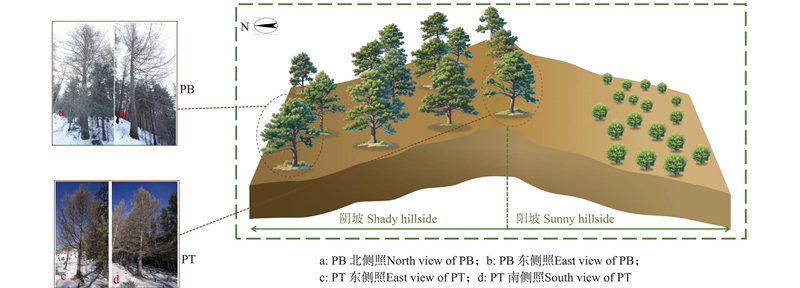
Fig.2
Physical and mechanical properties test specimen sampling locations"
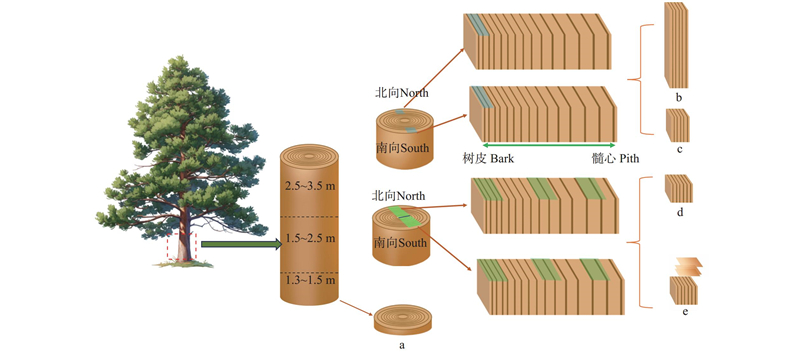
Table 1
Information of tree age corresponding to the three fetching locations"
| 编号No. | 树龄 Tree age/a | ||
| 近髓心Near pith | 中部Center | 近树皮Near bark | |
| PB1 | 10~20 | 55~65 | 79~89 |
| PT1 | 10~20 | 28~38 | 46~56 |
Table 2
Sawing solution of test material and specimen number"
| 方案Solution | PB2-1 | PB2-2 | PB3-1 | PB3-2 | PT2-1 | PT2-2 | PT3-1 | PT3-2 |
| 木柱对应树高位置 Wooden columns correspond to tree heights | PB2 0.8~2.7 m | PB2 2.7~5 m | PB3 0.8~2.7 m | PB3 2.7~5 m | PT2 0.8~2.7 m | PT2 2.7~5 m | PT3 0.8~2.7 m | PT3 2.7~5 m |
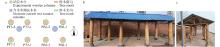
Fig.3
Outdoor drying and shrinkage test model floor plan and actual view"
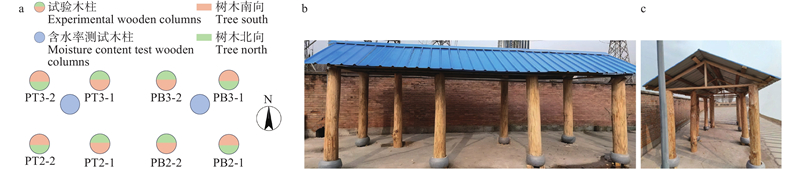
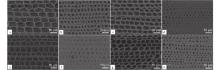
Fig.4
Microscopic structure of the cross-section"
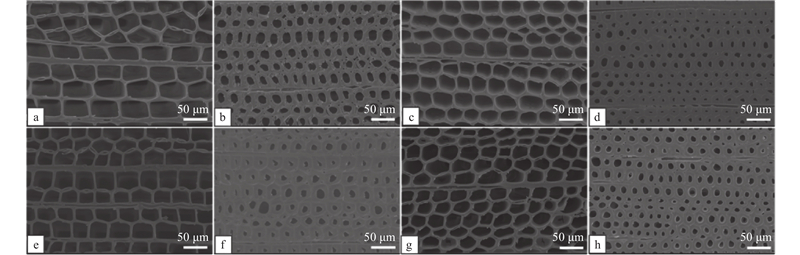
Table 3
Cell diameter and cell wall thickness of heartwood and sapwood in the north-south orientation"
| 组别Groups | 弦向细胞直径Tangential cell diameter/μm | 细胞壁厚度Cell wall thickness/μm | |||||||||
| 心材Heartwood | 边材Sapwood | 心材Heartwood | 边材Sapwood | ||||||||
| 早材 Earlywood | 晚材 Latewood | 早材 Earlywood | 晚材 Latewood | 早材 Earlywood | 晚材 Latewood | 早材 Earlywood | 晚材 Latewood | ||||
| PB1北向North | 33.5±2.2 | 18.9±3.5 | 44.2±1.2 | 14.8±2.2 | 2.1±0.5 | 5.3±0.5 | 3.2±0.3 | 9.4±0.2 | |||
| PB1南向South | 33.8±1.9 | 19.2±3.1 | 45.8±1.8 | 16.1±1.8 | 2.2±0.8 | 5.3±0.8 | 3.1±0.5 | 9.6±0.3 | |||
| PT1北向North | 31.2±2.4 | 19.5±4.1 | 40.2±1.9 | 13.5±2.3 | 2.0±0.7 | 5.2±0.5 | 2.8±0.2 | 8.5±0.2 | |||
| PT1南向South | 30.8±1.7 | 19.1±3.8 | 40.9±2.2 | 12.8±2.5 | 1.8±0.6 | 5.5±0.2 | 2.6±0.3 | 8.2±0.4 | |||

Fig.5
Annual ring width and latewood rate"

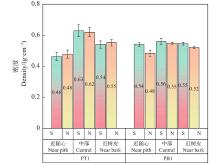
Fig.6
Density of specimens near pith, central, near bark"
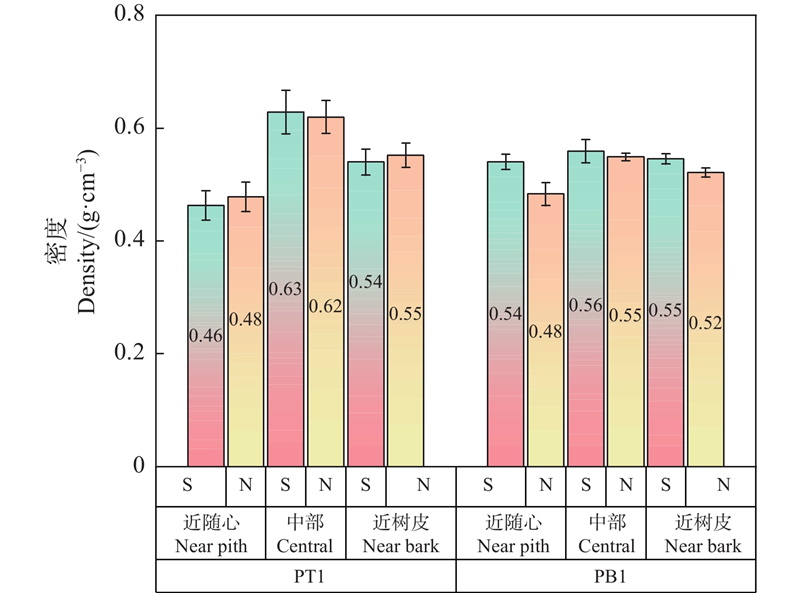
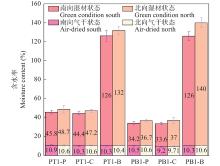
Fig.7
Green condition and air-dried moisture content"
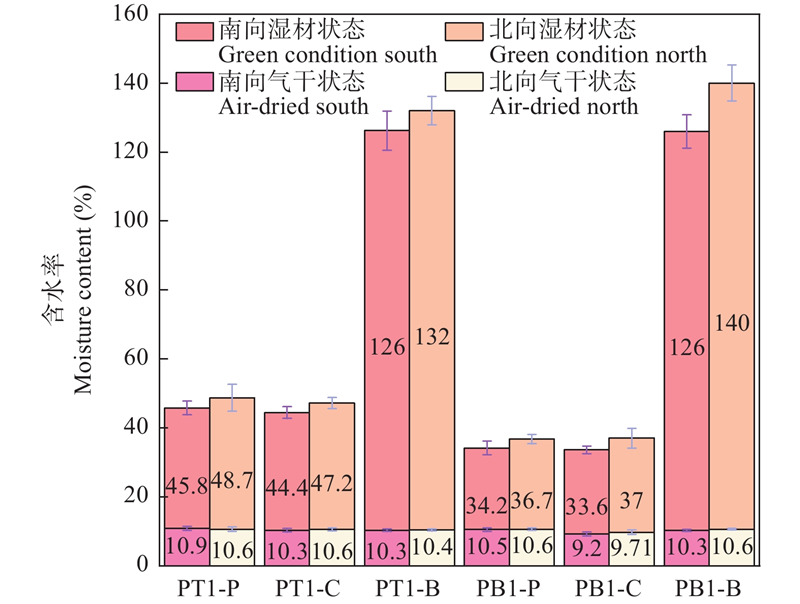
Fig.8
Tangential, radial and volumetric shrinkage of specimens from green condition to air-dried state"

Fig.9
Tangential, radial and volumetric shrinkage of specimens from green condition to absolute dry state"
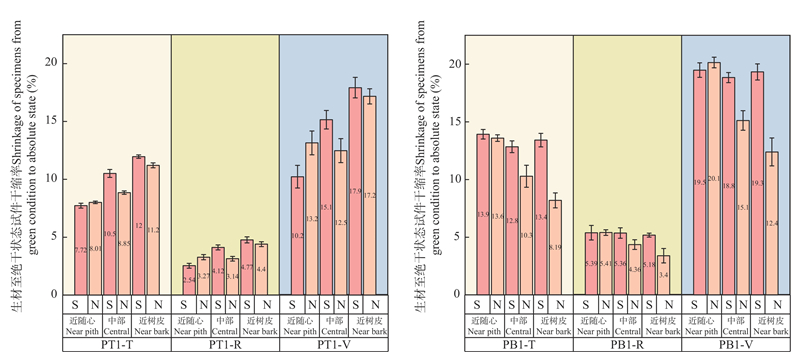
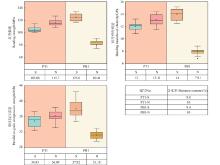
Fig.10
Specimen bending strength, bending modulus of elasticity, and parallel-to-grain compressive strength and moisture content of specimen"
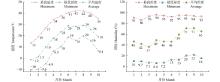
Fig.11
Temperature and humidity of outdoor drying and shrinkage test model from January to October"
Fig.12
PT4 and PB4 water content north-south orientation in each layer from January to October"
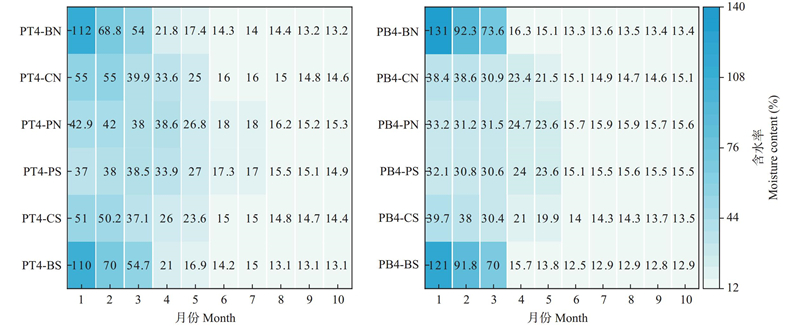
Fig.13
Wooden post crack information "
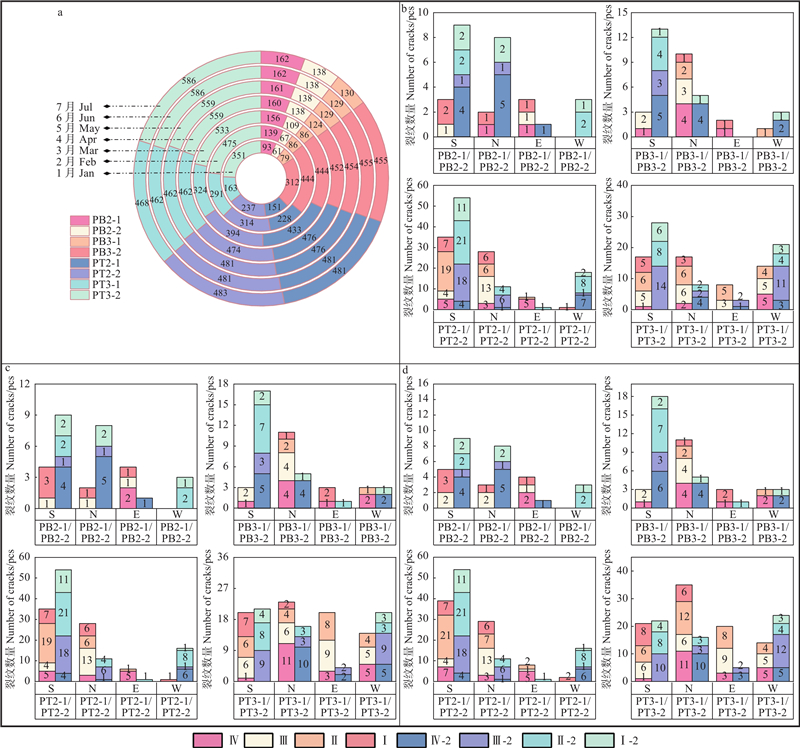
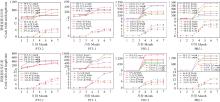
Fig.14
Changes in length and width of major cracks in each wood column from January to July Numbers in the figure are crack numbers; E, S, W, and N represent, in order, the east, south, west, and north orientation of the column face where the cracks are located."
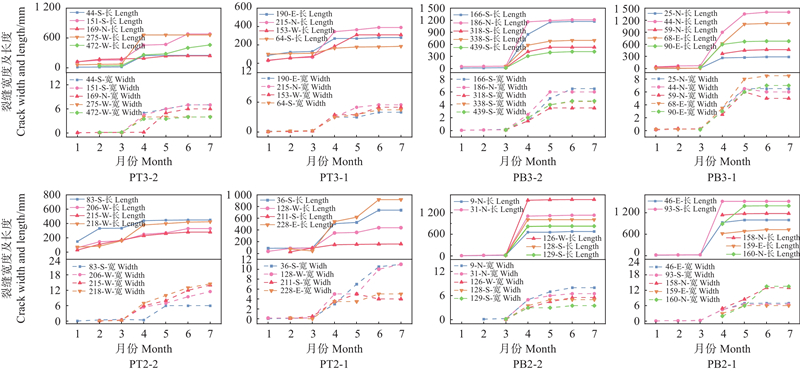
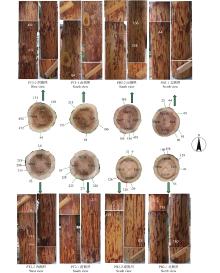
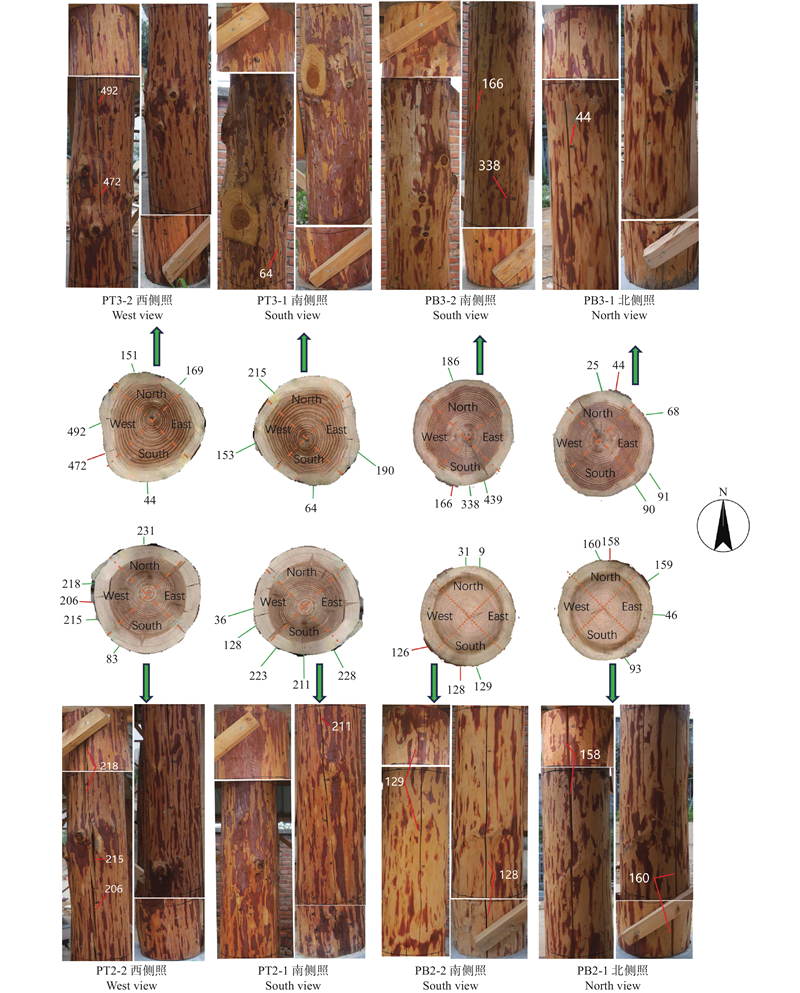
Fig.15
Location of major cracks in wood columns and column faces in July"
| 白晓彬, 吴婧姝, 杨 娜, 等. 山西落叶松古旧木材材料性能无损检测技术研究. 太原理工大学学报, 2023, 54 (6): 1101- 1108. | |
| Bai X B, Wu J S, Yang N, et al. Study on nondestructive testing technology of material properties for ancient larch wood in Shanxi. Journal of Taiyuan University of Technology, 2023, 54 (6): 1101- 1108. | |
| 陈 奎, 刘 衡, 王 钟, 等. 杉木无性系与实生苗木材物理力学性能差异研究. 西南林业大学学报(自然科学), 2024, 44 (2): 209- 215. | |
| Chen K, Liu H, Wang Z, et al. Comparison on the physical and mechanical properties between clone and seedling from Cunninghamia lanceolata. Journal of Southwest Forestry University (Natural Sciences), 2024, 44 (2): 209- 215. | |
|
方文静, 蔡 琼, 朱江玲, 等. 华北地区落叶松林的分布、群落结构和物种多样性. 植物生态学报, 2019, 43 (9): 742- 752.
doi: 10.17521/cjpe.2018.0244 |
|
|
Fang W J, Cai Q, Zhu J L, et al. Distribution, community structures and species diversity of larch forests in north China. Chinese Journal of Plant Ecology, 2019, 43 (9): 742- 752.
doi: 10.17521/cjpe.2018.0244 |
|
| 郭伊利, 李书恒, 王嘉川, 等. 芦芽山华北落叶松早晚材径向生长对气候变化响应的分离效应. 干旱区研究, 2022, 39 (5): 1449- 1463. | |
| Guo Y L, Li S H, Wang J C, et al. Response divergence of radial growth to climate change in earlywood and latewood of Larix principis-rupprechtii in Luya Mountain. Arid Zone Research, 2022, 39 (5): 1449- 1463. | |
| 郭宇航, 周淑容, 崔 佳, 等. 2017. 木节对轴心受压胶合木柱稳定承载力的影响. 土木建筑与环境工程, 39(3): 44-49. | |
| Guo Y H, Zhou S R, Cui J, et al. 2017. Effect of knot on stability of glulam column under axial compressive loading. Journal of Civil, Architectural & Environmental Engineering, 39(3): 44-49. [in Chinese] | |
| 韩 铭, 李 华, 蔡体久. 黑龙江太平沟国家级自然保护区森林群落植物多样性特. 森林工程, 2023, 39 (5): 40- 47. | |
| Han M, Li H, Cai T J. Plant diversity of forest community in Taipinggou National Nature Reserve, Heilongjiang Province. Forest Engineering, 2023, 39 (5): 40- 47. | |
| 黄广华, 陈瑞英. 阔叶黄檀木材解剖构造及其表面接触角. 森林工程, 2023, 39 (5): 85- 91. | |
| Huang G H, Chen R Y. Anatomical structure and contact angle of Dalbergia latifolia wood. Forest Engineering, 2023, 39 (5): 85- 91. | |
| 李 坚, 甘文涛, 陈志俊, 等. 向新出发, 木材科学前沿发展. 森林工程, 2025, 41 (1): 1- 39. | |
| Li J, Gan W T, Chen Z J, et al. Frontier advances in wood science towards a new departure. Forest Engineering, 2025, 41 (1): 1- 39. | |
| 刘方炎, 李 昆, 廖声熙, 等. 濒危植物翠柏的个体生长动态及种群结构与种内竞争. 林业科学, 2010, 46 (10): 23- 28. | |
| Liu F Y, Li K, Liao S X, et al. Interspecific competition, population structure and growth dynamics of endangered Calocedrus macrolepis. Scientia Silvae Sinicae, 2010, 46 (10): 23- 28. | |
| 刘一星, 赵广杰. 2012. 木材学. 2版. 北京: 中国林业出版社, 226−228. | |
| Liu Y X, Zhao G J. 2012. Wood science. 2nd ed. Beijing: China Forestry Publishing House, 226−228. [in Chinese] | |
| 骆秀琴, 管 宁, 张寿槐, 等. 杉木材性株内变异的研究Ⅰ. 木材力学性质和木材密度. 林业科学, 1997, 33 (4): 349- 355. | |
| Luo X Q, Guan N, Zhang S H, et al. Variation of mechanical properties and wood density within trees of Chinese-fir I. wood mechanical properties and wood density. Scientia Silvae Sinicae, 1997, 33 (4): 349- 355. | |
| 吕建雄, 林志远, 赵有科, 等. 杉木和I-72杨人工林木材干缩性质的研究. 林业科学, 2005, 41 (5): 127- 131. | |
| Lü J X, Lin Z Y, Zhao Y K, et al. Studies on the shrinkage properties of Chinese fir and I-72 poplar plantation wood. Scientia Silvae Sinicae, 2005, 41 (5): 127- 131. | |
| 朱忠漫. 2015. 干缩裂缝对历史建筑木构件受力性能影响的试验研究. 南京: 东南大学. | |
| Zhu Z M. 2015. Experimental research on mechanical properties of timber structural members with shrinkage cracks in historic buildings. Nanjing: Southeast University. [in Chinese] | |
| 韦 一, 范艳如, 邱勇斌, 等. 毛红椿生长、心材和材性性状遗传分析及家系选择. 林业科学研究, 2024, 37 (4): 33- 40. | |
| Wei Y, Fan Y R, Qiu Y B, et al. Genetic analysis and family selection of growth, heartwood and wood traits for Toona ciliata var. pubescens. Forest Research, 2024, 37 (4): 33- 40. | |
| 吴巩胜, 王政权. 水曲柳落叶松人工混交林中树木个体生长的竞争效应模型. 应用生态学报, 2000, 11 (5): 646- 650. | |
| Wu G S, Wang Z Q. Individual tree growth-competition model in mixed plantation of manchurian ash and dahurian larch. Chinese Journal of Applied Ecology, 2000, 11 (5): 646- 650. | |
| 武秀娟, 奥小平, 赵育鹏, 等. 芦芽山阴坡华北落叶松-云杉天然次生林林分空间结构特征. 浙江农林大学学报, 2021, 38 (1): 58- 64. | |
| Wu X J, Ao X P, Zhao Y P, et al. Spatial structure of Larix principis-rupprechtii-Picea spp. secondary forests on shady slope of Luyashan National Nature Reserve. Journal of Zhejiang A & F University, 2021, 38 (1): 58- 64. | |
| 武秀娟. 芦芽山阴坡典型天然次生林群落的种间联结性. 西北林学院学报, 2020, 35 (1): 54- 61. | |
| Wu X J. Interspecific association of the plant communities in natural secondary forests on north slope of Luya Mountain. Journal of Northwest Forestry University, 2020, 35 (1): 54- 61. | |
| 吴义强. 木材科学与技术研究新进展. 中南林业科技大学学报, 2021, 41 (1): 1- 28. | |
| Wu Y Q. Newly advances in wood science and technology. Journal of Central South University of Forestry & Technology, 2021, 41 (1): 1- 28. | |
| 谢 飞. 2022. 杉科4种木材薄壁组织比较研究. 合肥: 安徽农业大学. | |
| Xie F. 2022. Comparative study on wood parenchyma of 4 Taxodiaceae species. Hefei: Anhui Agricultural University. [in Chinese] | |
| 薛 峰, 江 源, 王明昌, 等. 芦芽山针叶林分布上下限土壤温度及含水量的季节差异. 生态学报, 2020, 40 (1): 141- 150. | |
| Xue F, Jiang Y, Wang M C, et al. Seasonal changes in soil temperature and water content at the upper and lower limits of coniferous forest on Luya Mountain, China. Acta Ecologica Sinica, 2020, 40 (1): 141- 150. | |
| 于永柱, 管 成, 张厚江, 等. 古建筑墙体木柱缺陷对其安全性影响数值模拟研究. 北京林业大学学报, 2022, 44 (1): 132- 145. | |
| Yu Y Z, Guan C, Zhang H J, et al. Numerical simulation on the influence of wall wood column defects on the safety of ancient building. Journal of Beijing Forestry University, 2022, 44 (1): 132- 145. | |
| 张文涛, 江 源, 王明昌, 等. 芦芽山阳坡不同海拔华北落叶松径向生长对气候变化的响应. 生态学报, 2015, 35 (19): 6481- 6488. | |
| Zhang W T, Jiang Y, Wang M C, et al. Responses of radial growth in Larix principis-rupprechtii to climate change along an elevation gradient on the southern slope of Luya Mountain. Acta Ecologica Sinica, 2015, 35 (19): 6481- 6488. | |
|
Bouslimi B, Koubaa A, Bergeron Y. Intra-ring variations and interrelationships for selected wood anatomical and physical properties of Thuja occidentalis L. Forests, 2019, 10 (4): 339.
doi: 10.3390/f10040339 |
|
|
Chen C J, Kuang Y D, Zhu S Z, et al. Structure-property-function relationships of natural and engineered wood. Nature Reviews Materials, 2020, 5 (9): 642- 666.
doi: 10.1038/s41578-020-0195-z |
|
|
Dias A, Gaspar M J, Carvalho A, et al. Within- and between-tree variation of wood density components in Pinus nigra at six sites in Portugal. Annals of Forest Science, 2018, 75 (2): 58.
doi: 10.1007/s13595-018-0734-6 |
|
|
Fu W L, Guan H Y, Kei S. Effects of moisture content and grain direction on the elastic properties of beech wood based on experiment and finite element method. Forests, 2021, 12 (5): 610.
doi: 10.3390/f12050610 |
|
|
Fu Z Y, Chen J X, Zhang Y Y, et al. Review on wood deformation and cracking during moisture loss. Polymers, 2023, 15 (15): 3295.
doi: 10.3390/polym15153295 |
|
|
Missanjo E, Matsumura J. Wood density and mechanical properties of Pinus kesiya Royle ex Gordon in Malawi. Forests, 2016, 7 (7): 135.
doi: 10.3390/f7070135 |
|
|
Mvondo R R N, Meukam P, Jeong J, et al. Influence of water content on the mechanical and chemical properties of tropical wood species. Results in Physics, 2017, 7, 2096- 2103.
doi: 10.1016/j.rinp.2017.06.025 |
|
| Oliver C D, Larson B C. 1996. Forest stand dynamics. New York: Wiley, 73−74. | |
|
Pulgar Lorenzo J Á, Riesco Muñoz G. Inter-tree and intra-tree variation in the physical properties of wood of laurel (Laurus nobilis). European Journal of Forest Research, 2018, 137 (4): 507- 515.
doi: 10.1007/s10342-018-1119-y |
|
| Startsev O V, Makhonkov A, Erofeev V, et al. Impact of moisture content on dynamic mechanical properties and transition temperatures of wood. Wood Material Science & Engineering, 2017, 12 (1): 55- 62. | |
|
Yavari N, Tripathi R, Wu B S, et al. The effect of light quality on plant physiology, photosynthetic, and stress response in Arabidopsis thaliana leaves. PLoS One, 2021, 16 (3): e0247380.
doi: 10.1371/journal.pone.0247380 |
| [1] | Shiji Yang,Yanfang Wan,Yushi Bai,Dongmei Wang,Pengtao Yu,Yanhui Wang,Weiyue Wang,Yujia Chen. Transpiration of Larix gmelinii var. principis-rupprechtii Plantations on Different Slope Aspects in Liupan Mountains in Response of Environmental Factors [J]. Scientia Silvae Sinicae, 2025, 61(3): 108-120. |
| [2] | Cuiping Wu,Caoliang Jin,Jianping Ying,Jinwei Suo,Jiasheng Wu,Yuanyuan Hu. Effects of Quota Water Addition on Anatomical Changes and Gene Expression in Aril Cracking of Torreya grandis cv. ‘Merrilii’ During Near Maturity Stage [J]. Scientia Silvae Sinicae, 2025, 61(1): 115-125. |
| [3] | Jiayi Shen,Cuiping Wu,Jia Yao,Jiasheng Wu,Rui Zhang,Yuanyuan Hu. Changes of Anatomic Structure and Cell Wall Metabolism of Torreya grandis cv. ‘Merrilii’ Aril during Cracking [J]. Scientia Silvae Sinicae, 2023, 59(2): 86-95. |
| [4] | Xiaowen Zhang,Qingjun Yu,Guisheng Luo,Xi Jia,Danni Wu,Zhongkui Jia. Site Classification and Site Quality Evaluation of Pinus tabulaeformis Plantation for Construction Timber in Pingquan, Hebei Province [J]. Scientia Silvae Sinicae, 2021, 57(9): 1-12. |
| [5] | Zhou Xianwu, Gao Yulei, Su Minglei, Zhao Rongjun, Lü Jianxiong. Progress of Research on Improvement of Genetic Engineering to Wood Properties [J]. Scientia Silvae Sinicae, 2018, 54(3): 152-160. |
| [6] | Song Yuqin, Li Jie, Fu Lijiao, Li Na, Li Liulin. Change of Fruit Surface Characteristics and Its Relationship with Water Absorption and Fruit Cracking in Ziziphus jujuba ‘Huping’ [J]. Scientia Silvae Sinicae, 2018, 54(12): 52-59. |
| [7] | Zhang Junpei, Wang Zi, Zhou Xianwu, Zhao Rongjun, Xu Huige, Jia Zhiming, Pei Dong. Wood Physical and Mechanical Properties of American Black Walnut of Different Strains [J]. Scientia Silvae Sinicae, 2016, 52(6): 108-114. |
| [8] | Liu Fangyan, Guo Minghui, Zhang Fan, Liu Yi, Zhang Yongming. Influence of Sugar Content of Ammonium Lignosulfonate on the Properties of Binderless Medium Density Fibreboard [J]. Scientia Silvae Sinicae, 2014, 50(6): 175-180. |
| [9] | Lin Lanying, He Sheng, Fu Feng, Zhou Yongdong. Evaluation of the Cracks in Microwave-Treated Lumbers Based on Image Processing [J]. Scientia Silvae Sinicae, 2014, 50(4): 84-89. |
| [10] | Ma Wenjun, Zhang Shougong, Wang Junhui, Zhai Wenji, Cui Yongzhi, Wang Qiuxia. Timber Physical and Mechanical Properties of New Catalpa bungei Clones [J]. Scientia Silvae Sinicae, 2013, 49(9): 126-134. |
| [11] | Zhao Xiping, Guo Pingping, Zhang Quanzhi. Spatial Distribution of Leaves, Branches and The Vessel Characteristics in Betula platyphylla [J]. Scientia Silvae Sinicae, 2013, 49(7): 69-74. |
| [12] | Shang Zhiyuan, Wang Jian, Zhao Xingyun, Zhang Maoheng, Cui Mingxing, Chen Zhenju. Orientation Difference of Tree Ring δ13C Response to Climatic Factors for Pinus sylvestris var. mongolica [J]. Scientia Silvae Sinicae, 2013, 49(6): 1-9. |
| [13] | Sun Xiaomei;Chu Xiuli;Zhang Shougong;Liu Junliang. Timber Evaluation on Physical and Mechanical Properties of Species and Hybrids of Larix [J]. Scientia Silvae Sinicae, 2012, 48(12): 153-159. |
| [14] | Wang Zhilong;Tan Zhiwen;He Yueqiu;Wang Guoliang. A New Koelreuteria bipinnata var. integrifoliola Disease—Bark Cracking and the Pathogen Identification [J]. Scientia Silvae Sinicae, 2012, 48(10): 95-100. |
| [15] | Gui Renyi;Shao Jifeng;Yu Youming;Zhu Yongjun;Dong Dunyi;Fang Wei. Influence of Obtruncation on Physical and Mechanical Properties of 5 Years Old Culms of Phyllostachys edulis [J]. Scientia Silvae Sinicae, 2011, 47(6): 194-198. |
| Viewed | ||||||
|
Full text |
|
|||||
|
Abstract |
|
|||||
