
Scientia Silvae Sinicae ›› 2025, Vol. 61 ›› Issue (12): 49-60.doi: 10.11707/j.1001-7488.LYKX20240402
• Research papers • Previous Articles
Yafei Wang1,2,Kai Wang1,2,Yang Liu1,2,Xiaofei Ding1,2,Kexin Xu1,2,Guoqing Zhang3,Liming Jia1,2,*( ),Benye Xi1,2
Received:2024-06-27
Revised:2025-02-28
Online:2025-12-25
Published:2026-01-08
Contact:
Liming Jia
E-mail:jlm@bjfu.edu.cn
CLC Number:
Yafei Wang,Kai Wang,Yang Liu,Xiaofei Ding,Kexin Xu,Guoqing Zhang,Liming Jia,Benye Xi. Effects of Thinning Intensity on Nutrient Content, Stoichiometric Characteristics and Nutrient Reabsorption of Various Organs of Populus tomentosa Plantations[J]. Scientia Silvae Sinicae, 2025, 61(12): 49-60.
Table 1
Growth status of Populus tomentosa forest under different thinning intensities"
| 间伐强度 Thinning intensity | 2023年3月March 2023 | 2023年11月November 2023 | |||
| 胸径DBH/cm | 树高Height/m | 胸径DBH/cm | 树高Height/m | ||
| NT | 13.81±0.44 | 14.17±0.43 | 14.57±0.46 | 17.68±0.61 | |
| T50 | 14.56±1.12 | 15.21±0.39 | 15.83±1.07 | 17.36±0.68 | |
| T75 | 13.63±0.81 | 14.49±0.25 | 15.17±0.85 | 16.94±0.26 | |
Table 2
Variance analysis (P value) of nutrient content and stoichiometric characteristic parameters of various organs of Populus tomentosa under different thinning intensities"
| 器官 Organ | 变异来源 Source of variation | 自由度 df | C | N | P | K | C/N | C/P | C/K | N/P | N/K | P/K |
| 叶Leaf | T | 2 | 0.815 | 0.127 | 0.010 | 0.554 | 0.105 | 0.027 | 0.271 | 0.005 | 0.065 | 0.958 |
| GP | 1 | 0.002 | 0.006 | <0.001 | <0.001 | 0.034 | 0.001 | <0.001 | 0.015 | 0.604 | 0.052 | |
| T×GP | 2 | 0.520 | 0.486 | 0.207 | 0.009 | 0.558 | 0.027 | <0.001 | 0.012 | 0.005 | 0.136 | |
| 枝Branch | T | 2 | 0.488 | 0.689 | 0.625 | 0.721 | 0.594 | 0.526 | 0.829 | 0.24 | 0.257 | 0.406 |
| GP | 1 | 0.064 | 0.003 | 0.163 | 0.010 | 0.002 | 0.395 | 0.004 | 0.421 | 0.159 | 0.013 | |
| T×GP | 2 | 0.512 | 0.040 | 0.389 | 0.755 | 0.003 | 0.232 | 0.404 | 0.562 | 0.219 | 0.402 | |
| 干Trunk | T | 2 | 0.044 | 0.806 | 0.254 | 0.681 | 0.377 | 0.367 | 0.957 | 0.431 | 0.606 | 0.858 |
| GP | 1 | 0.632 | 0.470 | 0.825 | 0.191 | 0.787 | 0.920 | 0.087 | 0.420 | 0.464 | 0.412 | |
| T×GP | 2 | 0.792 | 0.005 | 0.219 | 0.817 | 0.007 | 0.318 | 0.696 | 0.002 | 0.009 | 0.413 | |
| 根Root | T | 2 | 0.498 | 0.841 | 0.996 | 0.486 | 0.534 | 0.619 | 0.284 | 0.857 | 0.476 | 0.742 |
| GP | 1 | 0.360 | 0.011 | 0.412 | 0.267 | 0.027 | 0.211 | 0.067 | 0.965 | 0.353 | 0.913 | |
| T×GP | 2 | 0.767 | 0.961 | 0.505 | 0.225 | 0.893 | 0.800 | 0.090 | 0.616 | 0.185 | 0.243 |
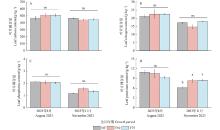
Fig.1
Effects of different thinning intensities on nutrient content of Populus tomentosa leaves in two periods"
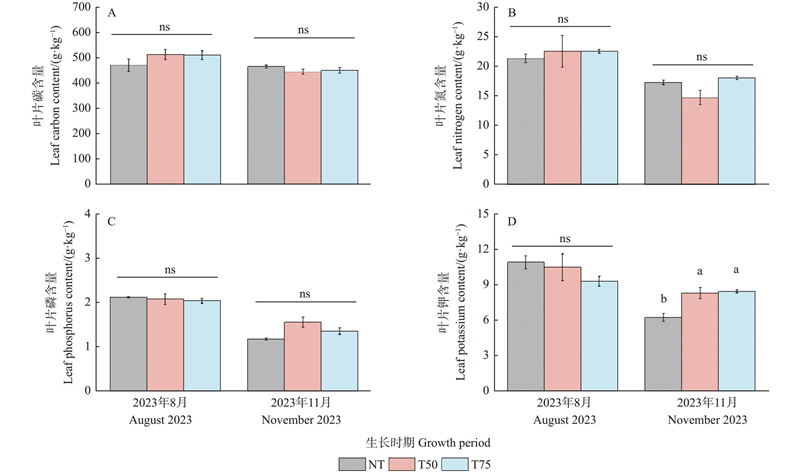
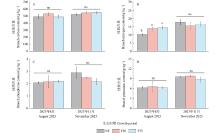
Fig.2
Effects of different thinning intensities on nutrient content of Populus tomentosa branches in two periods NT: non-thinning treatment; T50: 50% thinning of forest trees (alternating row thinning); T75: 75% thinning of forest trees (alternating row and tree thinning). Different lowercase letters indicate significant differences between different treatments (P<0.05), and ns indicates insignificant difference."
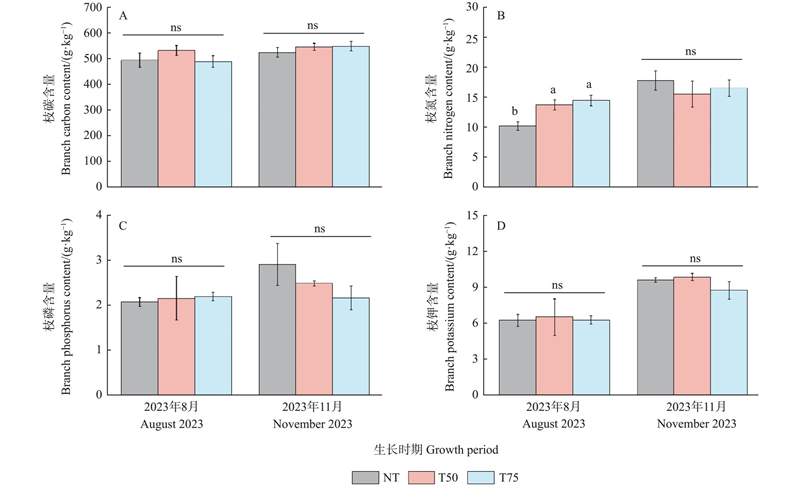
Fig.3
Effects of different thinning intensities on nutrient content of Populus tomentosa trunks in two periods"
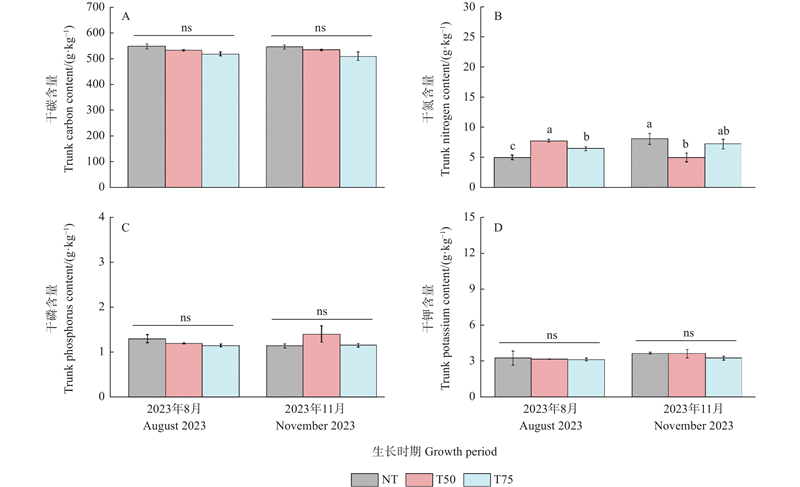
Fig.4
Effects of different thinning intensities on nutrient content of Populus tomentosa roots in two periods"
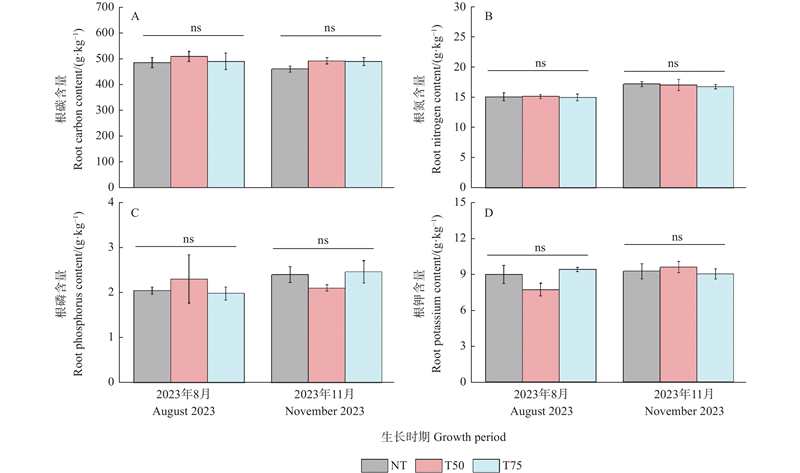
Table 3
Stoichiometry characteristics of various organs of Populus tomentosa in two periods under different thinning intensities"
| 生长时期 Growth period | 器官 Organ | 间伐强度 Thinning intensity | C/N | C/P | C/K | N/P | N/K | P/K |
| 2023年8月 August 2023 | 叶 Leaf | NT | 22.04±0.50 | 221.74±10.72 | 43.44±3.30 | 10.05±0.30 | 1.97±0.11 | 0.20±0.01 |
| T50 | 23.41±3.07 | 247.66±7.45 | 49.80±4.66 | 10.84±1.02 | 2.15±0.11 | 0.20±0.01 | ||
| T75 | 22.64±1.05 | 250.20±13.21 | 54.93±1.44 | 11.06±0.38 | 2.44±0.14 | 0.22±0.01 | ||
| 枝 Branch | NT | 48.76±2.84a | 238.99±2.75 | 79.62±2.30 | 4.94±0.31 | 1.64±0.10 | 0.33±0.01 | |
| T50 | 39.29±3.91ab | 270.20±51.47 | 89.73±17.28 | 6.85±1.12 | 2.28±0.41 | 0.33±0.01 | ||
| T75 | 34.15±3.46b | 223.24±3.02 | 78.33±4.93 | 6.67±0.67 | 2.33±0.20 | 0.35±0.02 | ||
| 干 Trunk | NT | 111.90±8.32a | 427.67±33.84 | 179.13±25.29 | 3.88±0.47b | 1.64±0.32b | 0.43±0.09 | |
| T50 | 69.28±1.95b | 447.74±5.28 | 169.76±1.39 | 6.47±0.20a | 2.46±0.09a | 0.38±0.01 | ||
| T75 | 81.67±4.95b | 453.60±10.63 | 167.79±4.11 | 5.58±0.27a | 2.08±0.17ab | 0.37±0.02 | ||
| 根 Root | NT | 32.14±1.63 | 237.71±7.07 | 54.77±3.88 | 7.41±0.16 | 1.70±0.08 | 0.23±0.01 | |
| T50 | 33.48±1.02 | 244.84±51.85 | 66.89±6.40 | 7.29±1.51 | 1.99±0.13 | 0.30±0.07 | ||
| T75 | 32.82±3.19 | 250.07±27.03 | 52.35±3.92 | 7.63±0.36 | 1.60±0.04 | 0.21±0.01 | ||
| 2023年11月 November 2023 | 叶 Leaf | NT | 26.91±0.88 | 395.91±10.21a | 75.37±4.67a | 14.73±0.52a | 2.80±0.10a | 0.19±0.01 |
| T50 | 30.58±2.68 | 290.00±27.42b | 53.84±2.27b | 9.49±0.34b | 1.80±0.22b | 0.19±0.02 | ||
| T75 | 24.93±0.44 | 332.99±10.78b | 53.39±1.35b | 13.37±0.61a | 2.14±0.06b | 0.16±0.01 | ||
| 枝 Branch | NT | 30.14±3.80 | 188.45±25.87 | 54.63±2.74 | 6.58±1.39 | 1.85±0.18 | 0.30±0.05 | |
| T50 | 36.69±5.44 | 220.55±7.85 | 55.67±3.06 | 6.28±0.93 | 1.57±0.18 | 0.25±0.01 | ||
| T75 | 33.82±3.71 | 263.26±37.17 | 63.91±6.94 | 7.73±0.45 | 1.89±0.00 | 0.25±0.01 | ||
| 干 Trunk | NT | 69.28±6.21b | 480.29±12.05 | 150.31±2.63 | 7.03±0.57a | 2.21±0.25 | 0.31±0.01 | |
| T50 | 113.41±15.47a | 395.02±49.97 | 151.82±14.18 | 3.66±0.73b | 1.36±0.07 | 0.40±0.08 | ||
| T75 | 74.16±12.07ab | 445.63±25.62 | 158.57±6.22 | 6.23±0.74a | 2.25±0.35 | 0.36±0.02 | ||
| 根 Root | NT | 26.65±1.08 | 193.38±11.97 | 50.25±2.42 | 7.30±0.67 | 1.90±0.17 | 0.26±0.01 | |
| T50 | 28.96±2.04 | 234.27±6.89 | 51.65±2.08 | 8.13±0.34 | 1.81±0.18 | 0.22±0.01 | ||
| T75 | 29.16±0.50 | 204.08±24.47 | 54.48±1.06 | 6.98±0.72 | 1.87±0.05 | 0.27±0.03 |
Table 4
Nutrient return characteristic parameters of Populus tomentosa leaves under different thinning intensities"
| 间伐强度Thinning intensity | NRE (%) | PRE (%) | KRE (%) | NRE/PRE | NRE/KRE | PRE/KRE |
| NT | 14.64±3.06 | 34.97±0.89 | 33.59±2.48a | 0.42±0.10 | 0.43±0.07 | 1.06±0.10 |
| T50 | 24.55±11.31 | 18.87±7.37 | 15.60±4.55b | 1.35±0.69 | 1.31±0.46 | 1.31±0.36 |
| T75 | 15.57±1.58 | 26.18±3.57 | 7.00±2.74b | 0.60±0.04 | 4.95±3.51 | 8.49±6.13 |
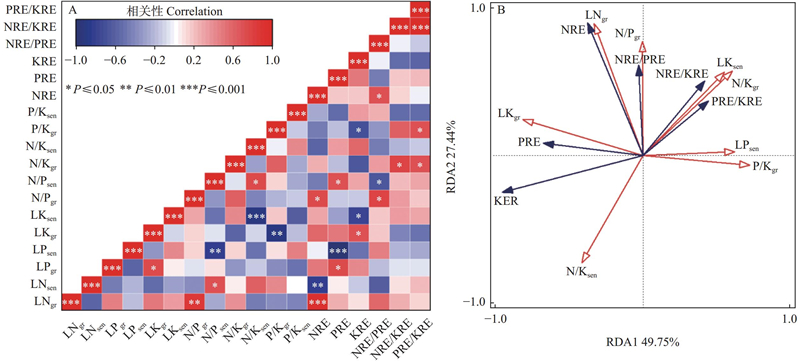
Fig.5
Correlation analysis of stoichiometric characteristics and nutrient reabsorption of Populus tomentosa NRE: nitrogen reabsorption efficiency; PRE: phosphorus reabsorption efficiency; KRE: potassium reabsorption efficiency; LNgr: nitrogen content of mature leaves in August; LNsen: nitrogen content of litter leaves in November; N/Pgr: the nitrogen and phosphorus ratio of leaves in August; N/Psen: the nitrogen and phosphorus ratio of leaves in November. Other elements are represented in the same way."
| 崔宁洁, 刘小兵, 张丹桔, 等. 不同林龄马尾松(Pinus massoniana)人工林碳氮磷分配格局及化学计量特征. 生态环境学报, 2014, 23 (2): 188- 195. | |
| Cui N J, Liu X B, Zhang D J, et al. The distribution pattern of carbon, nitrogen and phosphorus and the stoichiometry characteristics of Pinus massoniana plantation in different ages. Ecology and Environmental Sciences, 2014, 23 (2): 188- 195. | |
| 高宗宝, 王洪义, 吕晓涛, 等. 2017. 氮磷添加对呼伦贝尔草甸草原4种优势植物根系和叶片C: N: P化学计量特征的影响. 生态学杂志, 36(1): 80–88. | |
| Gao Z B, Wang H Y, Lü X T, et al. 2017. Effects of nitrogen and phosphorus addition on C: N: P stoichiometry in roots and leaves of four dominant plant species in a meadow steppe of Hulunbuir. Chinese Journal of Ecology, 2016, 36(1): 80–88. [in Chinese] | |
| 鞠 雯, 黄志群, 傅彦榕, 等. 亚热带幼林树木功能性状与叶片氮磷重吸收率的关系. 应用生态学报, 2022, 33 (12): 3229- 3236. | |
| Ju W, Huang Z Q, Fu Y R, et al. Relationships between tree functional traits and leaf nitrogen and phosphorus resorption efficiencies in subtropical young plantations. Chinese Journal of Applied Ecology, 2022, 33 (12): 3229- 3236. | |
| 李素新, 张芸香, 郭晋平. 氮添加对华北落叶松叶片化学计量与养分重吸收效率的影响. 水土保持学报, 2021, 35 (5): 249- 254, 263. | |
| Li S X, Zhang Y X, Guo J P. Effects of nitrogen addition on leaf stoichiometry and nutrients reabsorption efficiency of Larix principis-rupprechtii. Journal of Soil and Water Conservation, 2021, 35 (5): 249- 254, 263. | |
| 刘 莉, 蔡锰柯, 刘旭军, 等. 间伐对华北落叶松人工林叶、根及林下土壤C、N、P化学计量特征影响. 东北林业大学学报, 2019, 47 (8): 1- 7. | |
| Liu L, Cai M K, Liu X J, et al. Effects of thinning on ecological stoichiometry C, N and P in leaves, roots and soil of Larix principis-rupprechtii plantation. Journal of Northeast Forestry University, 2019, 47 (8): 1- 7. | |
| 陆姣云, 段兵红, 杨 梅, 等. 植物叶片氮磷养分重吸收规律及其调控机制研究进展. 草业学报, 2018, 27 (4): 178- 188. | |
| Lu J Y, Duan B H, Yang M, et al. Research progress in nitrogen and phosphorus resorption from senesced leaves and the influence of ontogenetic and environmental factors. Acta Prataculturae Sinica, 2018, 27 (4): 178- 188. | |
|
马玉珠, 钟全林, 靳冰洁, 等. 中国植物细根碳, 氮, 磷化学计量学的空间变化及其影响因子. 植物生态学报, 2015, 39 (2): 159- 166.
doi: 10.17521/cjpe.2015.0015 |
|
|
Ma Y Z, Zhong Q L, Jin B J, et al. Spatial changes and influencing factors of fine root carbon, nitrogen and phosphorus stoichiometry of plants in China. Chinese Journal of Plant Ecology, 2015, 39 (2): 159- 166.
doi: 10.17521/cjpe.2015.0015 |
|
| 任书杰, 于贵瑞, 陶 波, 等. 中国东部南北样带654种植物叶片氮和磷的化学计量学特征研究. 环境科学, 2007, 28 (12): 2665- 2673. | |
| Ren S J, Yu G R, Tao B, et al. Leaf nitrogen and phosphorus stoichiometry across 654 terrestrial plant species in NSTEC. Environmental Science, 2007, 28 (12): 2665- 2673. | |
|
田 地, 严正兵, 方精云. 植物生态化学计量特征及其主要假说. 植物生态学报, 2021, 45 (7): 682- 713.
doi: 10.17521/cjpe.2020.0331 |
|
|
Tian D, Yan Z B, Fang J Y. Review on characteristics and main hypotheses of plant ecological stoichiometry. Chinese Journal of Plant Ecology, 2021, 45 (7): 682- 713.
doi: 10.17521/cjpe.2020.0331 |
|
| 王丽娜, 吴俊文, 董 琼, 等. 抚育间伐对云南松非结构性碳和化学计量特征的影响. 北京林业大学学报, 2021, 43 (8): 70- 82. | |
| Wang L N, Wu J W, Dong Q, et al. Effects of tending and thinning on non-structural carbon and stoichiometric characteristics of Pinus yunnanensis. Journal of Beijing Forestry University, 2021, 43 (8): 70- 82. | |
| 王苗苗, 刘 勇, 李国雷, 等. 秋季施肥对毛白杨苗木质量、造林效果和养分回流的影响. 林业科学, 2021, 57 (7): 51- 60. | |
| Wang M M, Liu Y, Li G L, et al. Effects of autumn fertilization on quality, field performance and nutrient resorption of Populus tomentosa seedlings. Scientia Silvae Sinicae, 2021, 57 (7): 51- 60. | |
| 王亚飞, 杨红青, 周 欧, 等. 水氮耦合下高密度毛白杨纸浆林树木各器官化学计量特征. 北京林业大学学报, 2023, 45 (12): 68- 79. | |
| Wang Y F, Yang H Q, Zhou O, et al. Chemical stoichiometry characteristics of various organs of trees in high-density Populus tomentosa pulp forests under water-nitrogen coupling. Journal of Beijing Forestry University, 2023, 45 (12): 68- 79. | |
| 魏大平, 张 健, 张丹桔, 等. 不同林冠郁闭度马尾松(Pinus massoniana)叶片养分再吸收率及其化学计量特征. 应用与环境生物学报, 2017, 23 (3): 560- 569. | |
| Wei D P, Zhang J, Zhang D J, et al. Leaf carbon, nitrogen, and phosphorus resorption and the stoichiometry in Pinus massoniana plantations with various canopy densities. Chinese Journal of Applied and Environmental Biology, 2017, 23 (3): 560- 569. | |
| 闫媛媛, 郭 琪, 管俊泽, 等. 红松和水曲柳叶生态化学计量及养分重吸收特征的地理变异. 应用生态学报, 2023, 34 (4): 977- 984. | |
| Yan Y Y, Guo Q, Guan J Z, et al. Geographical variation of ecological stoichiometry and nutrient resorption in leaves of Pinus koraiensis and Fraxinus mandshurica. Journal of Applied Ecology, 2023, 34 (4): 977- 984. | |
| 张新洁, 陆天宇, 孙海龙, 等. 氮磷添加对水曲柳化学计量特征和养分再吸收的影响. 森林工程, 2019, 35 (5): 16- 21. | |
| Zhang X J, Lu T Y, Sun H L, et al. Effects of nitrogen and phosphorus addition on nutrient stoichiometry and resorption of Fraxinus mandshurica. Forest Engineering, 2019, 35 (5): 16- 21. | |
| 周丽丽, 钱瑞玲, 李树斌, 等. 滨海沙地主要造林树种叶片功能性状及养分重吸收特征. 应用生态学报, 2019, 30 (7): 2320- 2328. | |
| Zhou L L, Qian R L, Li S B, et al. Leaf functional traits and nutrient resorption among major silviculture tree species in coastal sandy site. Chinese Journal of Applied Ecology, 2019, 30 (7): 2320- 2328. | |
| Aerts R, Chapin III F S. The mineral nutrition of wild plants revisited: a re-evaluation of processes and patterns. Advances in Ecological Research, 1999, 30, 1- 67. | |
| Aerts R. 1996. Nutrient resorption from senescing leaves of perennials: are there general patterns? Journal of Ecology, 84: 597−608. | |
|
Ågren G I. The C: N: P stoichiometry of autotrophs–theory and observations. Ecology Letters, 2004, 7 (3): 185- 191.
doi: 10.1111/j.1461-0248.2004.00567.x |
|
|
Benedetti-Ruiz S, Loewe-Muñoz V, Del Río R, et al. Effect of thinning on growth and shape of Castanea sativa adult tree plantations for timber production in Chile. Forest Ecology and Management, 2023, 530, 120762.
doi: 10.1016/j.foreco.2022.120762 |
|
|
Bhandari S K, Veneklaas E J, McCaw L, et al. Effect of thinning and fertilizer on growth and allometry of Eucalyptus marginata. Forest Ecology and Management, 2021, 479, 118594.
doi: 10.1016/j.foreco.2020.118594 |
|
| Blanco J A, Imbert J B, Castillo F J. Influence of site characteristics and thinning intensity on litterfall production in two Pinus sylvestris L. forests in the western Pyrenees. Forest Ecology and Management, 2006, 237 (1/2/3): 342- 352. | |
|
Blanco J A, Imbert J B, Castillo F J. Thinning affects nutrient resorption and nutrient-use efficiency in two Pinus sylvestris stands in the Pyrenees. Ecological Applications, 2009, 19 (3): 682- 698.
doi: 10.1890/1051-0761-19.3.682 |
|
|
Bobbink R, Hicks K, Galloway J, et al. Global assessment of nitrogen deposition effects on terrestrial plant diversity: a synthesis. Ecological Applications, 2010, 20 (1): 30- 59.
doi: 10.1890/08-1140.1 |
|
|
Dang P, Gao Y, Liu J L, et al. Effects of thinning intensity on understory vegetation and soil microbial communities of a mature Chinese pine plantation in the Loess Plateau. Science of the Total Environment, 2018, 630, 171- 180.
doi: 10.1016/j.scitotenv.2018.02.197 |
|
|
Danger M, Gessner M O, Bärlocher F. Ecological stoichiometry of aquatic fungi: current knowledge and perspectives. Fungal Ecology, 2016, 19, 100- 111.
doi: 10.1016/j.funeco.2015.09.004 |
|
|
Drenovsky R E, Pietrasiak N, Short T H. Global temporal patterns in plant nutrient resorption plasticity. Global Ecology and Biogeography, 2019, 28 (6): 728- 743.
doi: 10.1111/geb.12885 |
|
|
Du E Z, Terrer C, Pellegrini A F A, et al. Global patterns of terrestrial nitrogen and phosphorus limitation. Nature Geoscience, 2020, 13 (3): 221- 226.
doi: 10.1038/s41561-019-0530-4 |
|
| Elser J J, Dobberfuhl D R, MacKay N A, et al. Organism size, life history, and N: P stoichiometry: toward a unified view of cellular and ecosystem processes. Bio Science, 1996, 46 (9): 674- 684. | |
|
Elser J J, Sterner R W, Gorokhova E, et al. Biological stoichiometry from genes to ecosystems. Ecology Letters, 2000a, 3 (6): 540- 550.
doi: 10.1111/j.1461-0248.2000.00185.x |
|
|
Elser J J, Fagan W F, Denno R F, et al. Nutritional constraints in terrestrial and freshwater food webs. Nature, 2000b, 408 (6812): 578- 580.
doi: 10.1038/35046058 |
|
|
Fang S Z, Lin D, Tian Y, et al. Thinning intensity affects soil-atmosphere fluxes of greenhouse gases and soil nitrogen mineralization in a lowland poplar plantation. Forests, 2016, 7 (7): 141.
doi: 10.3390/f7070141 |
|
|
Han W X, Fang J Y, Guo D L, et al. Leaf nitrogen and phosphorus stoichiometry across 753 terrestrial plant species in China. New Phytologist, 2005, 168 (2): 377- 385.
doi: 10.1111/j.1469-8137.2005.01530.x |
|
|
Han W X, Tang L Y, Chen Y H, et al. Relationship between the relative limitation and resorption efficiency of nitrogen vs phosphorus in woody plants. PLoS One, 2013, 8 (12): e83366.
doi: 10.1371/journal.pone.0083366 |
|
|
He M Z, Dijkstra F A. Drought effect on plant nitrogen and phosphorus: a meta-analysis. New Phytologist, 2014, 204 (4): 924- 931.
doi: 10.1111/nph.12952 |
|
| Huang J J, Wang X H, Yan E R. Leaf nutrient concentration, nutrient resorption and litter decomposition in an evergreen broad-leaved forest in eastern China. Forest Ecology and Management, 2007, 239 (1/2/3): 150- 158. | |
|
Kang H Z, Zhuang H L, Wu L L, et al. Variation in leaf nitrogen and phosphorus stoichiometry in Picea abies across Europe: an analysis based on local observations. Forest Ecology and Management, 2011, 261 (2): 195- 202.
doi: 10.1016/j.foreco.2010.10.004 |
|
|
Killingbeck K T. Nutrients in senesced leaves: keys to the search for potential resorption and resorption proficiency. Ecology, 1996, 77 (6): 1716- 1727.
doi: 10.2307/2265777 |
|
|
Li R S, Yang Q P, Zhang W D, et al. Thinning effect on photosynthesis depends on needle ages in a Chinese fir (Cunninghamia lanceolata) plantation. Science of the Total Environment, 2017, 580, 900- 906.
doi: 10.1016/j.scitotenv.2016.12.036 |
|
| Lu X K, Vitousek P M, Mao Q G, et al. Plant acclimation to long-term high nitrogen deposition in an N-rich tropical forest. Proceedings of the National Academy of Sciences of the United States of America, 2018, 115 (20): 5187- 5192. | |
|
Mo Q F, Zou B, Li Y W, et al. Response of plant nutrient stoichiometry to fertilization varied with plant tissues in a tropical forest. Scientific Reports, 2015, 5, 14605.
doi: 10.1038/srep14605 |
|
| Negishi Y, Eto Y, Hishita M, et al. Role of thinning intensity in creating mixed hardwood and conifer forests within a Cryptomeria japonica conifer plantation: a 14-year study. Forest Ecology and Management, 2020, 468 (3): 118184. | |
|
Park J, Kim T, Moon M, et al. Effects of thinning intensities on tree water use, growth, and resultant water use efficiency of 50-year-old Pinus koraiensis forest over four years. Forest Ecology and Management, 2018, 408, 121- 128.
doi: 10.1016/j.foreco.2017.09.031 |
|
|
Qiu X C, Wang H B, Peng D L, et al. Thinning drives C: N: P stoichiometry and nutrient resorption in Larix principis-rupprechtii plantations in North China. Forest Ecology and Management, 2020, 462, 117984.
doi: 10.1016/j.foreco.2020.117984 |
|
|
Reed S C, Townsend A R, Davidson E A, et al. Stoichiometric patterns in foliar nutrient resorption across multiple scales. New Phytologist, 2012, 196 (1): 173- 180.
doi: 10.1111/j.1469-8137.2012.04249.x |
|
|
Reich P B, Oleksyn J, Wright I J, et al. Evidence of a general 2/3-power law of scaling leaf nitrogen to phosphorus among major plant groups and biomes. Proceedings of the Royal Society B: Biological Sciences, 2010, 277, 877- 883.
doi: 10.1098/rspb.2009.1818 |
|
|
Schreeg L A, Santiago L S, Wright S J, et al. Stem, root, and older leaf N∶P ratios are more responsive indicators of soil nutrient availability than new foliage. Ecology, 2014, 95 (8): 2062- 2068.
doi: 10.1890/13-1671.1 |
|
|
Sistla S A, Appling A P, Lewandowska A M, et al. Stoichiometric flexibility in response to fertilization along gradients of environmental and organismal nutrient richness. Oikos, 2015, 124 (7): 949- 959.
doi: 10.1111/oik.02385 |
|
|
Tang L Y, Han W X, Chen Y H, et al. Resorption proficiency and efficiency of leaf nutrients in woody plants in eastern China. Journal of Plant Ecology, 2013, 6 (5): 408- 417.
doi: 10.1093/jpe/rtt013 |
|
| Tang Z Y, Xu W T, Zhou G Y, et al. Patterns of plant carbon, nitrogen, and phosphorus concentration in relation to productivity in China’s terrestrial ecosystems. Proceedings of the National Academy of Sciences of the United States of America, 2018, 115 (16): 4033- 4038. | |
|
Townsend A R, Cleveland C C, Asner G P, et al. Controls over foliar N: P ratios in tropical rain forests. Ecology, 2007, 88 (1): 107- 118.
doi: 10.1890/0012-9658(2007)88[107:COFNRI]2.0.CO;2 |
|
|
Vergutz L, Manzoni S, Porporato A, et al. Global resorption efficiencies and concentrations of carbon and nutrients in leaves of terrestrial plants. Ecological Monographs, 2012, 82 (2): 205- 220.
doi: 10.1890/11-0416.1 |
|
|
Yuan Z Y, Chen H Y H, Reich P B. Global-scale latitudinal patterns of plant fine-root nitrogen and phosphorus. Nature Communications, 2011, 2, 344.
doi: 10.1038/ncomms1346 |
|
|
Yuan Z Y, Chen H Y H. Global-scale patterns of nutrient resorption associated with latitude, temperature and precipitation. Global Ecology and Biogeography, 2009, 18 (1): 11- 18.
doi: 10.1111/j.1466-8238.2008.00425.x |
|
|
Yuan Z Y, Chen H Y H. Negative effects of fertilization on plant nutrient resorption. Ecology, 2015, 96 (2): 373- 380.
doi: 10.1890/14-0140.1 |
|
|
Zhao N, Yu G R, He N P, et al. Invariant allometric scaling of nitrogen and phosphorus in leaves, stems, and fine roots of woody plants along an altitudinal gradient. Journal of Plant Research, 2016, 129 (4): 647- 657.
doi: 10.1007/s10265-016-0805-4 |
|
|
Zhou L L, Addo-Danso S D, Wu P F, et al. Leaf resorption efficiency in relation to foliar and soil nutrient concentrations and stoichiometry of Cunninghamia lanceolata with stand development in southern China. Journal of Soils and Sediments, 2016, 16 (5): 1448- 1459.
doi: 10.1007/s11368-016-1352-2 |
| [1] | Chengwei Zhang,Xing Wang,Ke An,Zihao Wu,Jingyi Zhang,Zekun Zhong. Leaf-Soil Ecological Stoichiometric Characteristics and Plant Homeostasis Differences of Reclaimed Vegetation in the Loess Hilly Region [J]. Scientia Silvae Sinicae, 2025, 61(6): 61-74. |
| [2] | Yafei Wang,Yang Liu,Kai Wang,Xiaofei Ding,Kexin Xu,Liming Jia,Benye Xi. Effects of Water-nitrogen Coupling Treatment on Growth of Populus tomentosa Pulp Forest and the Soil Moisture-nutrient Characteristics [J]. Scientia Silvae Sinicae, 2025, 61(5): 85-97. |
| [3] | Wang Zejin, Ran Kun, Yu Miao, Zhang Bijia, Ji Li, Li Pin. Gradient Differences of Functional Traits, Eco-Stoichiometric Ratio and Nutrient Resorption Efficiency of Acer truncatum and Syringa oblata Leaves in Beijing [J]. Scientia Silvae Sinicae, 2024, 60(2): 42-54. |
| [4] | Meihong Liu,Qiming Yan,Longbo Zi,Yafang Lei,Li Yan. Physical and Mechanical Properties of Furfuryl Alcohol-Epoxidized Vegetable Oils Composite Modified Poplar Wood [J]. Scientia Silvae Sinicae, 2024, 60(11): 149-159. |
| [5] | Huang Mengyao, Zhang Runzhe, Shi Ce, Yang Hao, Wei Yifan, Zhang Zhaode, Zhu Lin, Song Lianjun, Nie Lishui, Wang Dengzhi. Dynamics of Soil Mineral Nitrogen in Populus tomentosa Stand under Different Nitrogen and Water Application Levels [J]. Scientia Silvae Sinicae, 2023, 59(9): 45-54. |
| [6] | Lingya Li,Nan Di,Jinqiang Liu,Xiaoning Zhao,Songyan Zou,Haiman Fu,Benye Xi. Water Consumption Pattern and Crop Coefficient Curve Construction of Short-rotation Populus tomentosa Plantations [J]. Scientia Silvae Sinicae, 2023, 59(10): 76-88. |
| [7] | Wenjie Wen,Dongmei Wang. Content and Stoichiometric Characteristics of Carbon, Nitrogen, and Phosphorus in Leaves of Four Typical Plantation Species in the Alpine Zone of the Loess Plateau in Qinghai [J]. Scientia Silvae Sinicae, 2022, 58(1): 22-31. |
| [8] | Yaxiong Zhang,Ye Wang,Guangde Li,Doudou Li,Yuelin He,Benye Xi,Lijuan Sun. Response of Branching Pattern of Triploid Populus tomentosa to Variation Soil Water Regime [J]. Scientia Silvae Sinicae, 2021, 57(3): 145-151. |
| [9] | Minghui Sun,Yong Liu,Changwei Wang,Guolei Li,Miaomiao Wang,Xiehai Song,Xiaochao Chang,Fangfang Wan,Huaishan Song. Effects of Density and Row Spacing on the Quality of Populus tomentosa Seedling [J]. Scientia Silvae Sinicae, 2021, 57(3): 152-160. |
| [10] | Rui Zhao,Chuankuan Wang,Xiankui Quan,Xingchang Wang. Ecological Stoichiometric Characteristics of Different Organs of Broadleaf Tree Species in a temperate Forest in Maoershan Area, Heilongjiang Province [J]. Scientia Silvae Sinicae, 2021, 57(2): 1-11. |
| [11] | Dong Qiao,Yong Liu,Shuyong Tian,Feng Zhang,Yajing Wang,Xiaoli Li,Xuejin Feng,Yanan Zhang. Effects of Water Management during Lignification on Morphology, Physiology and Afforestation Performance of Populus tomentosa Seedlings [J]. Scientia Silvae Sinicae, 2021, 57(11): 169-178. |
| [12] | Xu Ma,Zhiguo Cao,Chen Yue,Chuhan Jin,Jun Liu,Yang Liu,Guifang Xiu,Benye Xi. Changes of Particulate Matter Retention Characteristics and the Response of Physiological Characteristics of Poplar Leaves Under the Influence of Rainfall and Irrigation [J]. Scientia Silvae Sinicae, 2020, 56(8): 181-190. |
| [13] | Zhu Jialei, Bo Huijuan, Li Xuan, Wen Chunyan, Wang Jiang, Nie Lishui, Tian Ju, Song Lianjun. Long Term Water-Nitrogen Coupling Effect on Stand Volume of Different Clones of Populus tomentosa [J]. Scientia Silvae Sinicae, 2019, 55(5): 27-35. |
| [14] | An Shengnan, Ma Xiaojun, Zhu Lizhi. Preparation and Characterization of the P34HB Composite Reinforced by Wood Flour [J]. Scientia Silvae Sinicae, 2019, 55(3): 125-133. |
| [15] | Songyan Zou,Doudou Li,Jinsong Wang,Nan Di,Jinqiang Liu,Ye Wang,Guangde Li,Jie Duan,Liming Jia,Benye Xi. Response of Fine Roots to Soil Moisture of Different Gradients in Young Populus tomentosa Plantation [J]. Scientia Silvae Sinicae, 2019, 55(10): 124-137. |
| Viewed | ||||||
|
Full text |
|
|||||
|
Abstract |
|
|||||
