
Scientia Silvae Sinicae ›› 2025, Vol. 61 ›› Issue (12): 164-176.doi: 10.11707/j.1001-7488.LYKX20250130
• Research papers • Previous Articles
Heng Liu1,Haomeng Guo1,Huize Dai1,Zheming Chai2,3,Chunyu Li4,Jianhua Yang1,*( )
)
Received:2025-03-07
Revised:2025-06-18
Online:2025-12-25
Published:2026-01-08
Contact:
Jianhua Yang
E-mail:woodtesting@163.com
CLC Number:
Heng Liu,Haomeng Guo,Huize Dai,Zheming Chai,Chunyu Li,Jianhua Yang. Object Detection Method for Positively Skewed Distribution of Multi-Scale Defects on Particleboard Surface[J]. Scientia Silvae Sinicae, 2025, 61(12): 164-176.
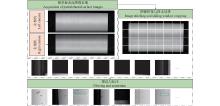
Fig.1
Image acquisition and preprocessing workflow"
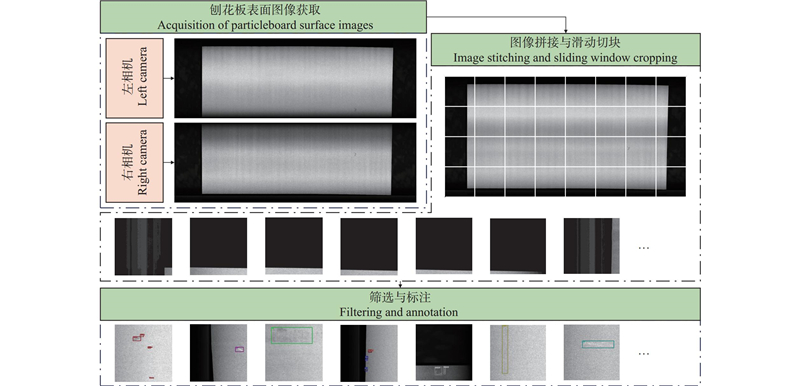
Fig.2
3D modeling diagram (left) and physical image (right) of the image acquisition device"
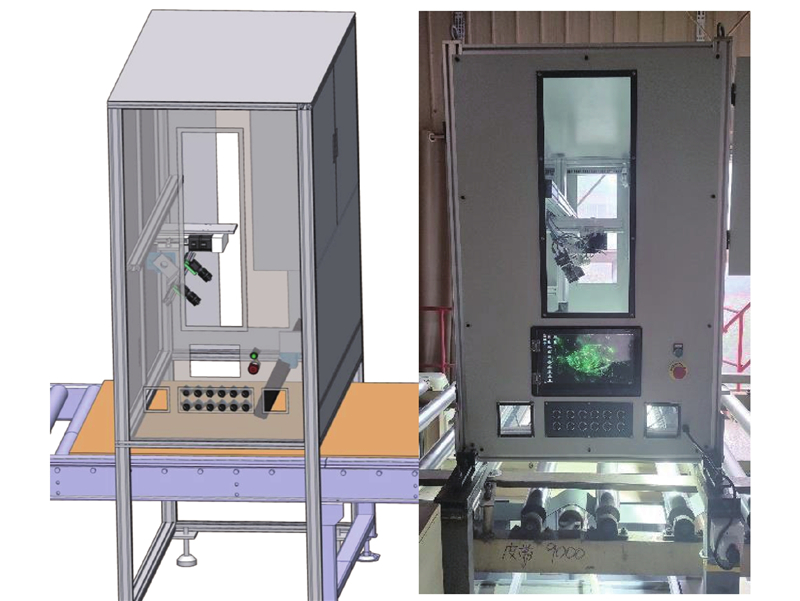
Fig.3
Types of surface defects on particleboard"
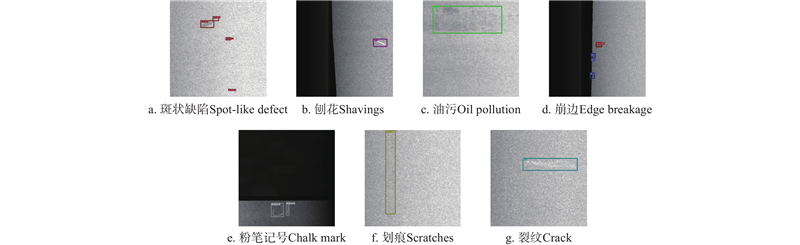
Fig.4
Schematic diagram of data augmentation methods"
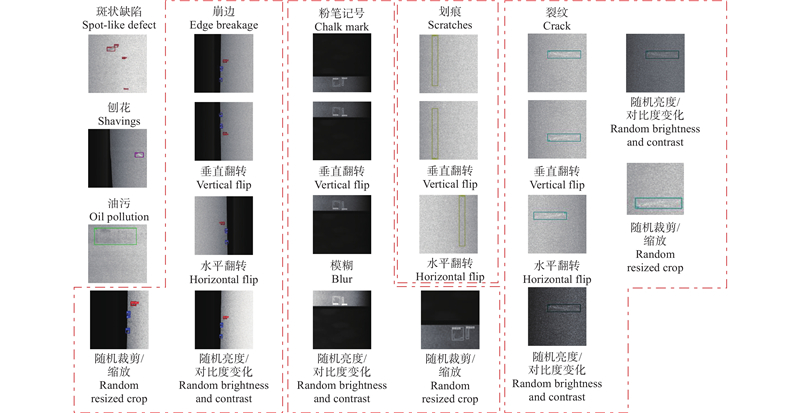
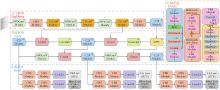
Fig.5
Architecture of the PBDNet"
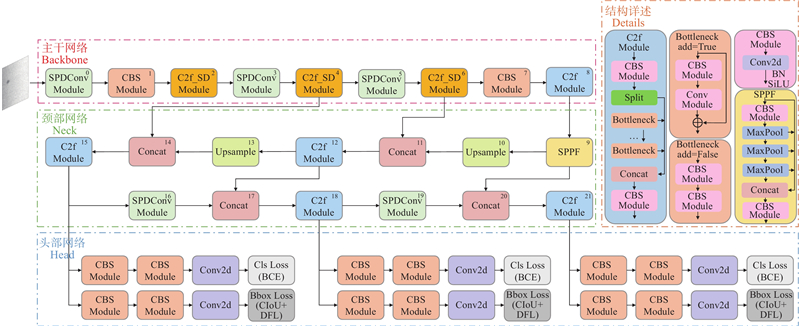
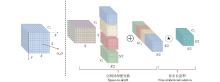
Fig.6
Structure diagram of the SPDConv module"
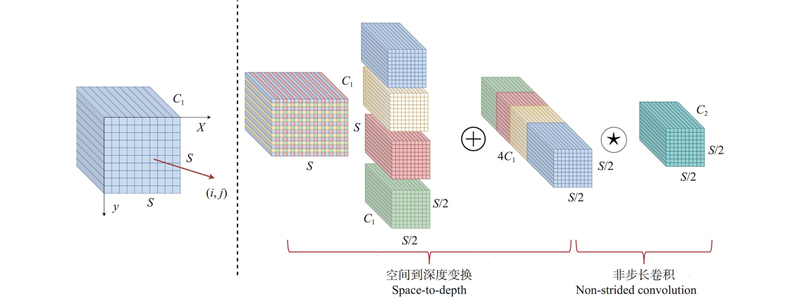
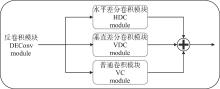
Fig.7
Structure diagram of the DEConv module"
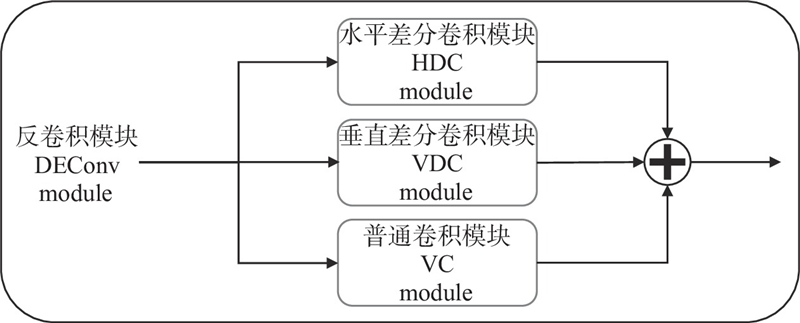
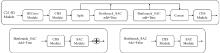
Fig.8
Structure of the improved C2f_SD module"
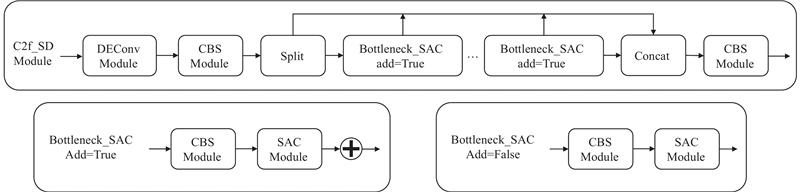

Fig.9
Structure of the SAConv module"

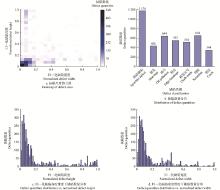
Fig.10
Distribution of defect sizes and quantities"
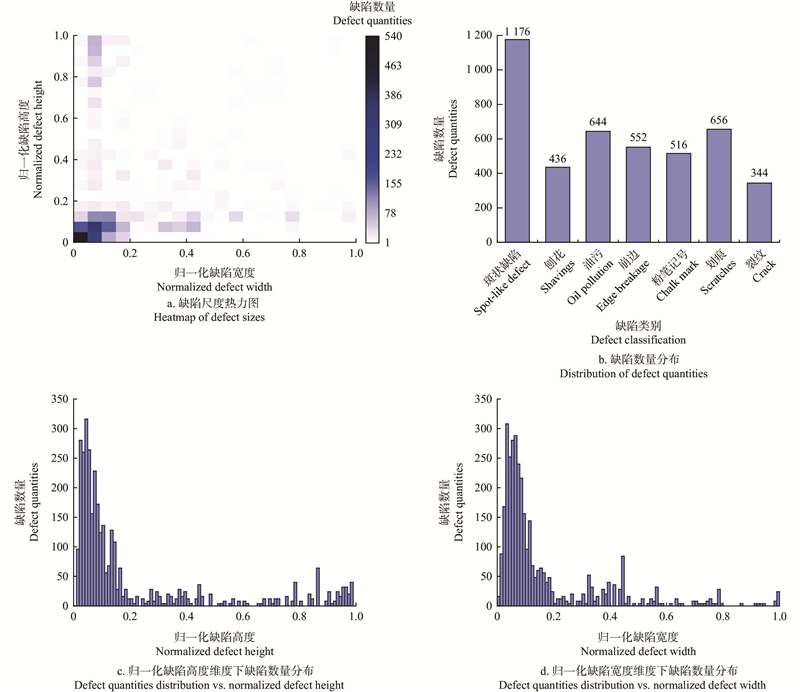
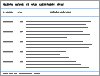
Table 1
Comparative experimental results"
| 模型名称 Model Name | mAP50 | mAP50-95 | 召回率 Recall | 参数量 Parameters (M) | 推理时间 Time/ms |
| Faster R-CNN | 0.702 | 0.445 | 0.541 | 84.70 | 25.10 |
| YOLOv8s | 0.833 | 0.619 | 0.776 | 11.14 | 2.49 |
| RTMDet-s | 0.836 | 0.566 | 0.676 | 39.00 | 54.20 |
| RT-DETR | 0.793 | 0.583 | 0.776 | 42.78 | 8.10 |
| YOLOv10s | 0.801 | 0.575 | 0.684 | 8.07 | 3.05 |
| PBDNet | 0.881 | 0.655 | 0.840 | 6.43 | 2.46 |
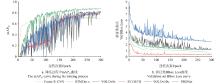
Fig.11
Comparative experimental curves of the models"
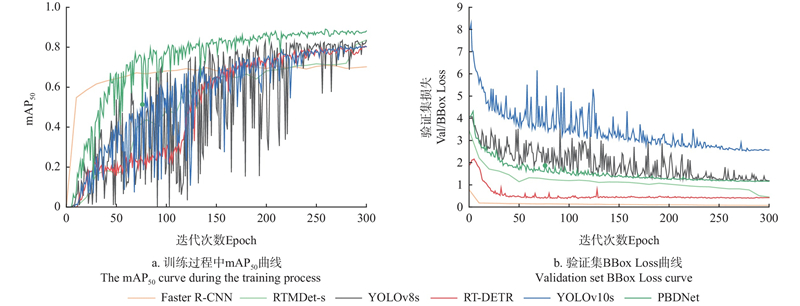
Fig.12
Visualized detection results of different models"
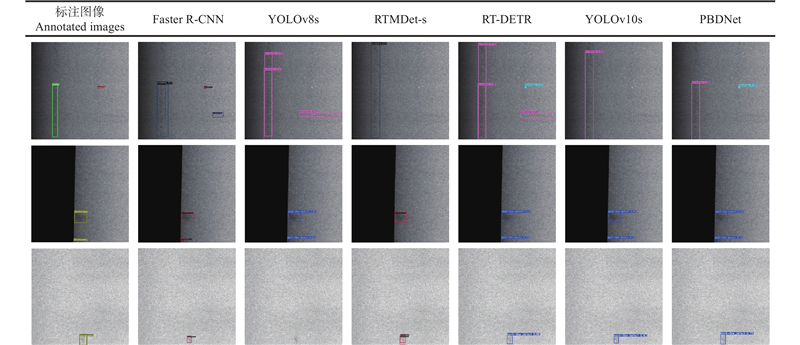
Table 2
Results of ablation experiment"
| 模型 Model | 通道裁剪 Slim | SPDConv | C2f_SD | mAP50 | mAP50-95 | 召回率 Recall | 参数量 Parameters(M) | 推理时间 Time/ms |
| A | — | — | — | 0.833 | 0.619 | 0.776 | 11.14 | 2.49 |
| B | — | √ | — | 0.828 | 0.61 | 0.747 | 10.11 | 2.51 |
| C | — | — | √ | 0.849 | 0.653 | 0.818 | 14.42 | 4.98 |
| D | — | √ | √ | 0.85 | 0.636 | 0.791 | 13.60 | 5.12 |
| E | √ | — | — | 0.845 | 0.634 | 0.785 | 8.48 | 2.39 |
| F | √ | √ | — | 0.857 | 0.623 | 0.823 | 5.50 | 1.65 |
| G | √ | — | √ | 0.867 | 0.648 | 0.804 | 6.94 | 2.34 |
| H | √ | √ | √ | 0.881 | 0.655 | 0.840 | 6.40 | 2.46 |
Table 3
Comparison of mAP50 for different defect categories in the ablation experiment"
| 缺陷类别 Defect class | mAP50 | |||||||
| A | B | C | D | E | F | G | H | |
| 斑状缺陷 Spot-like defect | 0.814 | 0.832 | 0.815 | 0.831 | 0.822 | 0.825 | 0.850 | 0.863 |
| 刨花 Shavings | 0.833 | 0.780 | 0.859 | 0.842 | 0.88 | 0.818 | 0.893 | 0.883 |
| 油污 Oil pollution | 0.462 | 0.530 | 0.523 | 0.541 | 0.484 | 0.589 | 0.543 | 0.618 |
| 崩边 Edge breakage | 0.973 | 0.958 | 0.971 | 0.943 | 0.971 | 0.969 | 0.972 | 0.958 |
| 粉笔记号 Chalk mark | 0.902 | 0.919 | 0.913 | 0.934 | 0.911 | 0.966 | 0.951 | 0.968 |
| 划痕 Scratch | 0.890 | 0.811 | 0.910 | 0.910 | 0.895 | 0.879 | 0.893 | 0.926 |
| 裂纹 Crack | 0.954 | 0.968 | 0.953 | 0.950 | 0.954 | 0.953 | 0.964 | 0.953 |
Table 4
Comparison of Recall for different defect categories in the ablation experiment"
| 缺陷类别 Defect class | 召回率Recall | |||||||
| A | B | C | D | E | F | G | H | |
| 斑状缺陷 Spot-like defect | 0.721 | 0.721 | 0.754 | 0.754 | 0.803 | 0.787 | 0.820 | 0.816 |
| 刨花 Shavings | 0.764 | 0.739 | 0.857 | 0.810 | 0.832 | 0.810 | 0.810 | 0.857 |
| 油污 Oil pollution | 0.402 | 0.325 | 0.500 | 0.400 | 0.359 | 0.566 | 0.428 | 0.575 |
| 崩边 Edge breakage | 0.967 | 0.933 | 0.967 | 0.933 | 0.967 | 0.945 | 0.967 | 0.933 |
| 粉笔记号 Chalk mark | 0.786 | 0.821 | 0.872 | 0.893 | 0.821 | 0.879 | 0.856 | 0.893 |
| 划痕 Scratch | 0.845 | 0.743 | 0.829 | 0.800 | 0.771 | 0.829 | 0.800 | 0.861 |
| 裂纹 Crack | 0.944 | 0.944 | 0.944 | 0.944 | 0.944 | 0.944 | 0.944 | 0.944 |
Table 5
Comparison of metrics for small defects in the ablation experiment"
| 模型 Model | mAP50 | mAP50-95 | 召回率 Recall | 模型 Model | mAP50 | mAP50-95 | 召回率 Recall | |
| A | 0.456 | 0.303 | 0.492 | E | 0.468 | 0.309 | 0.542 | |
| B | 0.385 | 0.246 | 0.429 | F | 0.627 | 0.371 | 0.700 | |
| C | 0.474 | 0.297 | 0.517 | G | 0.559 | 0.353 | 0.567 | |
| D | 0.472 | 0.296 | 0.521 | H | 0.705 | 0.427 | 0.746 |
Fig.13
Eigen-CAM heatmaps"
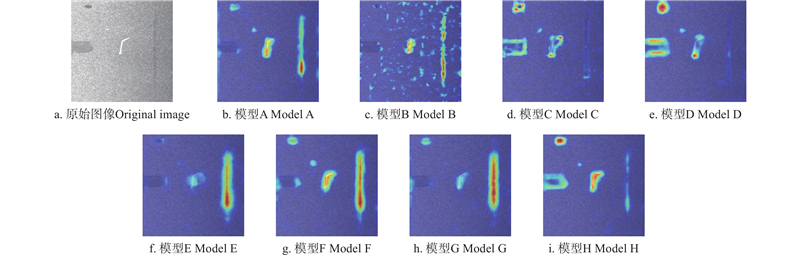
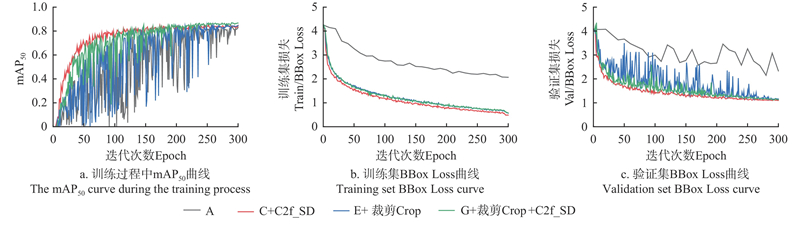
Fig.14
Different metric curves of the model during the training process"
| 关淯尹, 王文财, 沈 彤, 等. 基于改进YOLOv5s模型的刨花板表面缺陷检测方法. 智能制造, 2024, 31 (5): 104- 112. | |
| Guan Y, Wang W, Shen T, et al. Surface defect detection method of particleboard based on improved YOLOv5s model. Intelligent Manufacturing, 2024, 31 (5): 104- 112. | |
| 唐忠荣, 李素珍. 刨花板外观质量缺陷分析及对策. 林产工业, 2005, 42 (6): 26- 28. | |
| Tang Z R, Li S Z. External defects of particleboard and their countermeasures. China Forest Products Industry, 2005, 42 (6): 26- 28. | |
| 王文财, 党亚光, 朱 翔, 等. 基于Lite-YOLOv5s模型的刨花板表面缺陷检测方法. 木材科学与技术, 2023, 37 (3): 58- 67. | |
| Wang W, Dang Y, Zhu X, et al. Detecting method for particleboard surface defects based on the Lite-YOLOv5s model. Chinese Journal of Wood Science and Technology, 2023, 37 (3): 58- 67. | |
| 杨 龙, 毛顺国, 陆铜华, 等. 我国刨花板工业技术进步回顾与展望. 木材科学与技术, 2024, 38 (1): 1- 12. | |
| Yang L, Mao S, Lu T et al. Review and outlook of technology development in China’s particleboard industry. Chinese Journal of Wood Science and Technology, 2024, 38 (1): 1- 12. | |
| 杨 渊. 机器视觉在刨花板表面缺陷检测中的应用现状与建议. 中国人造板, 2024, 31 (5): 33- 37. | |
| Yang Y. Application of machine vision in particleboard surface defect detection: status and recommendations. China Wood-Based Panels, 2024, 31 (5): 33- 37. | |
| 由 佳, 胡生辉, 金 枝. 浅析我国人造板产业简况. 绿色中国, 2024, 21 (16): 56- 61. | |
| You J, Hu S, Jin Z. A brief analysis of China’s artificial board industry. Green China, 2024, 21 (16): 56- 61. | |
| 查 健, 陈先中, 王文财, 等. 基于改进的YOLOv5s刨花板表面小目标缺陷检测算法. 计算机工程与应用, 2024, 60 (17): 158- 166. | |
| Zha J, Chen X, Wang W, et al. Small defect detection algorithm of particle board surface based on improved YOLOv5s. Computer Engineering and Applications, 2024, 60 (17): 158- 166. | |
| 朱 豪, 周顺勇, 曾雅兰, 等. 基于改进YOLOv5s的木材表面缺陷检测模型. 木材科学与技术, 2023, 37 (2): 8- 15. | |
| Zhu H, Zhou S, Zeng Y et al. Detection model of wood surface defects based on improved YOLOv5s. Chinese Journal of Wood Science and Technology, 2023, 37 (2): 8- 15. | |
|
Bany Muhammad M, Yeasin M. Eigen-CAM: visual explanations for deep convolutional neural networks. SN Computer Science, 2021, 2 (1): 47.
doi: 10.1007/s42979-021-00449-3 |
|
| He K, Gkioxari G, Dollár P, et al. 2017. Mask R-CNN. 2017 IEEE International Conference on Computer Vision (ICCV). Venice, Italy, 2980–2988. | |
|
Hu W, Wang T, Wang Y, et al. LE–MSFE–DDNet: a defect detection network based on low-light enhancement and multi-scale feature extraction. The Visual Computer, 2022, 38 (11): 3731- 3745.
doi: 10.1007/s00371-021-02210-6 |
|
|
Jiao L, Zhang F, Liu F, et al. A survey of deep learning-based object detection. IEEE Access, 2019, 7, 128837- 128868.
doi: 10.1109/ACCESS.2019.2939201 |
|
| Lin T Y, Goyal P, Girshick R, et al. 2017. Focal loss for dense object detection. 2017 IEEE International Conference on Computer Vision (ICCV). Venice, Italy, 2999–3007. | |
| Liu W, Anguelov D, Erhan D, et al. 2016. SSD: single shot multibox detector. Computer Vision–ECCV 2016, 14th European Conference, Amsterdam, The Netherlands, Proceedings, Part I 14, Springer, 21−37. | |
| Luo W, Li Y, Urtasun R, et al. Understanding the effective receptive field in deep convolutional neural networks. Advances in Neural Information Processing Systems, 2016, 29, 4898- 4906. | |
| Lyu C, Zhang W, Huang H, et al. 2022. RTMDet: an empirical study of designing real-time object detectors. arXiv preprint arXiv, 2212.07784. | |
| Mehta S, Rastegari M. 2021. MobileViT: light-weight, general-purpose, and mobile-friendly vision transformer. arXiv preprint arXiv: 2110.02178. | |
| Peng C, Li X, Wang Y. TD-YOLOA: an efficient YOLO network with attention mechanism for tire defect detection. IEEE Transactions on Instrumentation and Measurement, 2023, 72, 1- 11. | |
| Redmon J, Divvala S, Girshick R, et al. 2016. You only look once: unified, real-time object detection. 2016 IEEE Conference on Computer Vision and Pattern Recognition (CVPR). Barcelona, Spain, 779–788. | |
|
Ren S, He K, Girshick R, et al. Faster R-CNN: towards real-time object detection with region proposal networks. IEEE Transactions on Pattern Analysis and Machine Intelligence, 2017, 39 (6): 1137- 1149.
doi: 10.1109/TPAMI.2016.2577031 |
|
| Sunkara R, Luo T. 2023. No more strided convolutions or pooling: a new CNN building block for low-resolution images and small objects. Machine Learning and Knowledge Discovery in Databases. Cham: Springer Nature Switzerland, 443–459. | |
| Wang A, Chen H, Liu L, et al. YOLOv10: real-time end-to-end object detection. Advances in Neural Information Processing Systems, 2024, 37, 107984- 108011. | |
| Zhang C, Wang C, Zhao L, et al. A method of particleboard surface defect detection and recognition based on deep learning. Wood Material Science & Engineering, 2025, 20 (1): 50- 61. | |
| Zhang Y, Li X, Wang F, et al. 2021. A comprehensive review of one-stage networks for object detection. 2021 IEEE International Conference on Signal Processing, Communications and Computing (ICSPCC). Xi’an, Shaanxi, China, 1–6. | |
|
Zhao C, Shu X, Yan X, et al. RDD-YOLO: a modified YOLO for detection of steel surface defects. Measurement, 2023, 214, 112776.
doi: 10.1016/j.measurement.2023.112776 |
|
| Zhao Y, Lv W, Xu S, et al. 2024. DETRs beat YOLOs on real-time object detection. 2024 IEEE/CVF Conference on Computer Vision and Pattern Recognition (CVPR). Seattle WA, USA, 16965–16974. | |
|
Zhao Z, Yang X, Zhou Y, et al. Real-time detection of particleboard surface defects based on improved YOLOV5 target detection. Scientific Reports, 2021, 11 (1): 21777.
doi: 10.1038/s41598-021-01084-x |
|
| Zhou W, Li C, Ye Z, et al. An efficient tiny defect detection method for PCB with improved YOLO through a compression training strategy. IEEE Transactions on Instrumentation and Measurement, 2024, 73, 1- 14. | |
|
Zou Z, Chen K, Shi Z, et al. Object detection in 20 years: a survey. Proceedings of the IEEE, 2023, 111 (3): 257- 276.
doi: 10.1109/JPROC.2023.3238524 |
| [1] | Zihan Huang,Qiaoling Han,Yue Zhao,Yandong Zhao,Meihui Song. Multi-Scale Fusion Method of Soil CT/SEM Images Based on CycleGAN [J]. Scientia Silvae Sinicae, 2025, 61(8): 116-128. |
| [2] | Yanling Tang,Qiaoling Han,Yue Zhao,Weiping Liu,Yili Zheng,Yandong Zhao,Shanshan Xu. A Forest Pest Detection Algorithm Based on Multi-scale Sequence Feature Fusion [J]. Scientia Silvae Sinicae, 2025, 61(2): 21-30. |
| [3] | Min Ji,Rui Gao,Xiaohuan Wang,Xingliang Diao,Jiakai Han,Yang Zhao,Guofu Wang,Wei Zhang. Online Detecting Method of Structural Lumber Knot Based on Deep Learning [J]. Scientia Silvae Sinicae, 2025, 61(11): 150-159. |
| [4] | Changchun Zhang,Xingchang Yang,Guohua Wang,Bingjing Wang,Shijie Li,Fangzhou Chen,Yongtai Ge,Juan Shi,Junguo Zhang. A Detection Method of Alien Forest Pests with Integrating Multi-scale Attention Features [J]. Scientia Silvae Sinicae, 2025, 61(10): 154-163. |
| [5] | Luxia Liu,Bo Hu,Guoqing Sang,Yuyu Liu. Assessing Forest Vegetation Diversity Using Forest Structure Indicators Based on LiDAR Remote Sensing: A Review [J]. Scientia Silvae Sinicae, 2025, 61(1): 176-196. |
| [6] | Wanying Xie,Wenping Liu,Han Wang. UAV Images of Pine Forests for Early Detection of Pine Wood Nematode Infestation [J]. Scientia Silvae Sinicae, 2024, 60(9): 124-133. |
| [7] | Wenhan Yang,Tianyu Liu,Junchi Zhou,Wenwu Hu,Ping Jiang. CNN-Swin Transformer Detection Algorithm of Forest Wildlife Images Based on Improved YOLOv5s [J]. Scientia Silvae Sinicae, 2024, 60(3): 121-130. |
| [8] | Bo Wang,Xueqing Yang,Chunying Jiang,Dong Liu,Feng Chen,Ye Bai,Xiaodong Liu. Forest Fire Spread Risk in Yanqing District of Beijing Based on GIS [J]. Scientia Silvae Sinicae, 2023, 59(8): 90-101. |
| [9] | Fangyu Yin,Bai Ouyang,Jiali Jiang,Zhu Li,Jianxiong Lü. Research Development of Shrinkage and Swelling of Wood with Multi-Scale Structures [J]. Scientia Silvae Sinicae, 2023, 59(7): 145-154. |
| [10] | Yan Zhou,Wenping Liu,Youqing Luo,Shixiang Zong. Small Object Detection for Infected Trees Based on the Deep Learning Method [J]. Scientia Silvae Sinicae, 2021, 57(3): 98-107. |
| [11] | Bochao Cui,Jianghua Zheng,Zhongjun Liu,Tao Ma,Jianglong Shen,Xuemi Zhao. YOLOv3 Mouse Hole Recognition Based on Remote Sensing Images from Technology for Unmanned Aerial Vehicle [J]. Scientia Silvae Sinicae, 2020, 56(10): 199-208. |
| [12] | Tian Xiaomin, Yan Haixia, Yuan Ye, Ge Zhaoxuan, Huang Xuanrui, Zhang Zhidong. Response of Species Richness to the Fragmentation of Vegetation Landscape and its Spatial Variation Scales in Saihanba Nature Reserve [J]. Scientia Silvae Sinicae, 2016, 52(12): 13-21. |
| [13] | Song Yuyang, Li Yuanyuan, Li Mingyan. Periodic Characteristics of Distribution Pattern of Haloxylon ammodendron in Gurbantunggut Desert Based on Eco-Used Wavelet [J]. Scientia Silvae Sinicae, 2014, 50(3): 1-9. |
| [14] | Shi Hao;Xian Mingrui;Xu Yannan;Xue Jianhui;Liu Haijuan. Developing Integrated Methods to Construct Urban Potential Green Corridors: A Case Study of Changzhou City [J]. , 2013, 49(5): 92-100. |
| [15] | Zhao Chunyan, Li Jiping, Ma Wenjun, Yuan Xiaohong, Zheng Liu. Multi-Scale Forest Landscape Classification Considering Coupling Effect [J]. Scientia Silvae Sinicae, 2013, 49(11): 183-188. |
| Viewed | ||||||
|
Full text |
|
|||||
|
Abstract |
|
|||||
