
林业科学 ›› 2026, Vol. 62 ›› Issue (7): 88-99.doi: 10.11707/j.1001-7488.LYKX20250725
魏光普1,张文君1,2,3,*( ),刘璐1,于晓燕1,2,3,张舒宇1
收稿日期:2025-12-03
出版日期:2026-07-10
发布日期:2026-07-16
通讯作者:
张文君
E-mail:376173827@qq.com
基金资助:
Guangpu Wei1,Wenjun Zhang1,2,3,*(),Lu Liu1,Xiaoyan Yu1,2,3,Shuyu Zhang1
Received:2025-12-03
Online:2026-07-10
Published:2026-07-16
Contact:
Wenjun Zhang
E-mail:376173827@qq.com
摘要:
目的: 构建融合温度阈值、根系分层与风险分区的造林优化框架,揭示中国北方半干旱区优势造林树种对400 mm等降水线北移的响应,为生态修复工程在气候变化影响下的科学建设提供理论支撑。方法: 基于MOD13Q1 V6.1数据(2000—2024年)构建kNDVI序列,结合Theil-Sen斜率与MK检验量化400 mm等降水线北移特征;采用随机森林和偏依赖分析,提取中国北方半干旱区优势树种油松、樟子松和柠条锦鸡儿的光合温度窗口(21.2~22.3 ℃);利用分层土壤含水量归因和交叉相关函数,计算优势树种对降水的滞后响应时间以及对温度的敏感性,并整合降水带迁移速率,构建林业风险指数(RFI)。结果: 1) 400 mm等降水线质心显著北移,移动速率为3.89 km·a?1,油松适生候选区面积扩张119.7%,樟子松适生候选区面积扩张27.5%,柠条锦鸡儿适生候选区面积缩减8.1%;2) 优势树种油松、樟子松和柠条锦鸡儿kNDVI指数的温度最适区分别为23.1~23.8、19.4~19.5和23.0~23.6 ℃,结合偏依赖曲线分析发现温度高于25 ℃时,kNDVI指数下降率分别为?11.03%、?10.54%和?13.55%;3) RFI空间分区精度达89%,识别出高风险区、中风险区和低风险区面积分别占总面积的12.3%、27.5%和60.2%,并提出不同风险区的差异化造林策略和建议。结论: 本研究阐明油松和樟子松对高温和0~1 m土壤中水分的敏感性以及柠条锦鸡儿的深根系抗旱特征,构建“温度阈值?根系分层?风险分区”的差异化造林区域策略,可为中国北方半干旱区生态修复工程建设和森林更新提供科学依据和实践路径。
中图分类号:
魏光普,张文君,刘璐,于晓燕,张舒宇. 中国北方半干旱区优势树种适生候选区对400 mm等降水线北移的响应(2000—2024年)[J]. 林业科学, 2026, 62(7): 88-99.
Guangpu Wei,Wenjun Zhang,Lu Liu,Xiaoyan Yu,Shuyu Zhang. Candidate Suitable Habitats for Dominant Tree Species in Semi-Arid Regions of Northern China in Response the Northward Shift of the 400 mm Precipitation Isoline (2000—2024)[J]. Scientia Silvae Sinicae, 2026, 62(7): 88-99.
表1
数据源与处理概要(2000—2024年;统一格网:1 km,MODIS 正弦投影)"
| 数据集 Dataset | 提供方/版本 Provider/version | 分辨率(空/时) Resolution (spatial/temporal) | 变量/用途 Variable/usage | 预处理 Preprocessing | 重采样 Resampling |
| MOD13Q1(NDVI) | NASA LP DAAC/v6.1 | 250 m/16 天 250 m/16 days | 植被指数 kNDVI Vegetation index | QA 筛选,SG 滤波 QA screening, SG filtering | 双线性 Bilinear |
| MOD11A2(LST) | NASA LP DAAC/v6.1 | 1 km/8 天 1 km/8 days | 地表温度 Land surface | QC 筛选,年度均值计算 QC screening, annual averaging | 基准格网 Reference grid |
| TerraClimate(P) | Univ. Idaho/最新版 Univ. Idaho/Latest version | 0.05°/月 0.05°/Monthly | 年降水量 Annual precipitation | 月?年聚合 Monthly-annual aggregation | 双线性 Bilinear |
| ERA5(RH) | ECMWFC3S/月平均值 ECMWF-C3S/Monthly average | 0.25°/月 0.25°/Monthly | 空气相对湿度 Air relative humidity | 月?年聚合 Monthly-annual aggregation | 双线性 Bilinear |
| GRACE | NASA JPL/RL06M | 0.25°/月 0.25°/Monthly | 陆地水储量变化 Terrestrial water storage changes | 去趋势,去均值, 尺度因子校正 Detrending, deseasonalizing, scaling-factor correction | 双线性 Bilinear |
| MCD12Q1(LC) | NASA LP DAAC/v6.1 | 500 m/年 500 m/Year | 土地覆盖 Land cover | 年度产品,重分类 Annual product, reclassification | 最近邻 Nearest neighbor |
| 行政区/胡焕庸线 Boundaries/Hu Huanyong Line | 中国科学院 RESDC CAS RESDC | 矢量/— Vector/— | 区域掩膜与对比 Regional masking and comparison | 标准化坐标 Standardized coordinates | — |
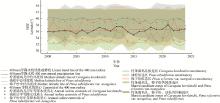
图1
2000—2024年400 mm等降水线迁移对主要造林树种适生候选区的影响"
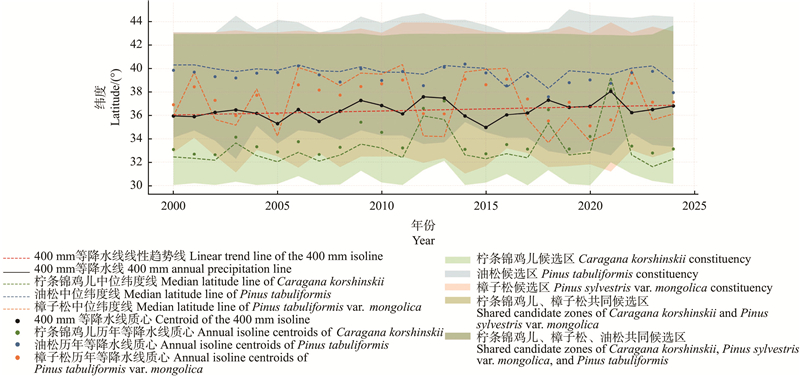
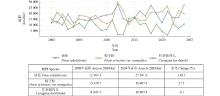
图2
主要造林树种候选区面积的时间序列(2000—2024)及2000和2024候选区面积对比"
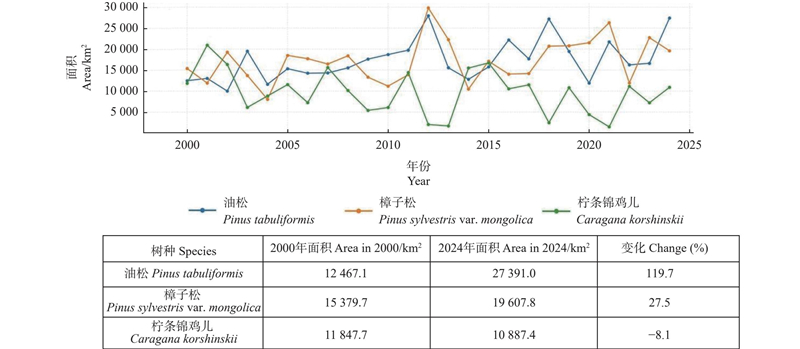
图3
kNDVI对年均温的偏依赖分析(区域与物种尺度)"
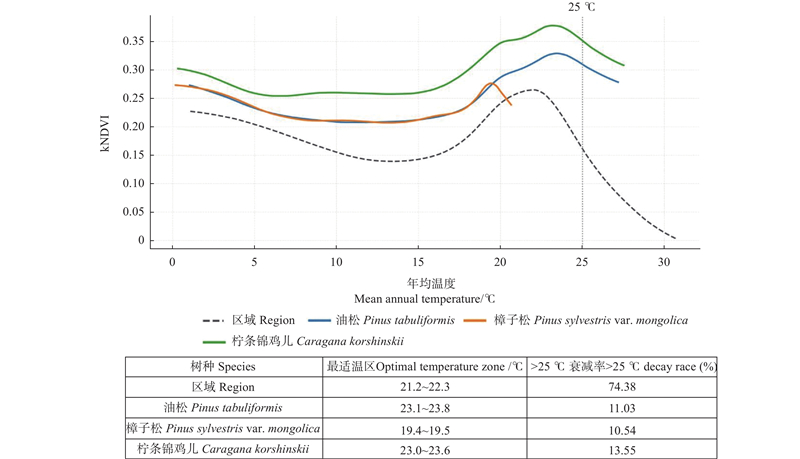
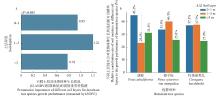
图4
分层土壤含水量对优势树种kNDVI指数的归因分析"
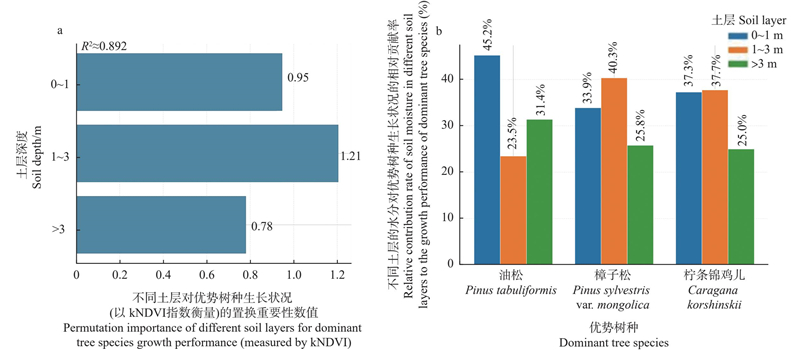
图5
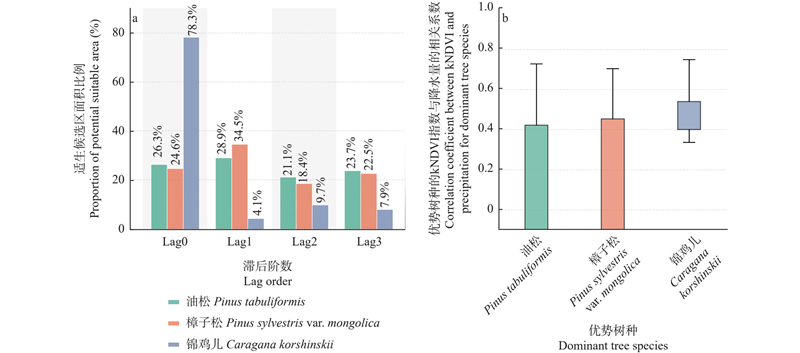
优势树种对降水的滞后响应和水文记忆分析(物种尺度)"
| 陈 峰, 王世杰, 赵晓恩, 等. 20世纪以来中国北方干旱半干旱区针叶树种径向生长动态变化. 地理学报, 2024, 79 (9): 2341- 2355. | |
| Chen F, Wang S J, Zhao X E, et al. Radial growth dynamics of coniferous species in arid and semi-arid areas of northern China since the 20th century. Acta Geographica Sinica, 2024, 79 (9): 2341- 2355. | |
| 陈 蔚, 管兆勇, 杨华栋, 等. 2022年夏季西太平洋副热带高压异常强盛且稳定维持与长江中下游持续性极端高温事件. 气象学报, 2025, 83 (1): 33- 45. | |
| Chen W, Guan Z Y, Yang H D, et al. The anomalously strong and persistent western Pacific subtropical high in summer 2022 in association with the extreme heatwaves in the middle and lower reaches of the Yangtze River. Acta Meteorologica Sinica, 2025, 83 (1): 33- 45. | |
| 陈 源, 蔡 震, 李金惠. 综合环境社会经济指标的优先污染物筛选方法研究: 以电子废物拆解为例. 环境科学, 2023, 44 (9): 5316- 5324. | |
| Chen Y, Cai Z, Li J H. Research on the screening method of priority pollutants with integrated environmental socio-economic indicators: example of E-waste dismantling. Environmental Science, 2023, 44 (9): 5316- 5324. | |
| 崔桂鹏, 党宏忠, 熊 伟, 等. 对“三北”工程区退化林修复策略的思考. 林业科学, 2025, 61 (1): 10- 16. | |
| Cui G P, Dang H Z, Xiong W, et al. Thoughts on restoration strategies of degraded plantations in the area of China’s Great Green Wall Project. Scientia Silvae Sinicae, 2025, 61 (1): 10- 16. | |
|
戴玉萍, 王璞玉, 张正勇, 等. 中国阿尔泰山冰川服务价值及其对未来气候情景的响应. 地理学报, 2025, 80 (7): 1954- 1972.
doi: 10.11821/dlxb202507015 |
|
|
Dai Y P, Wang P Y, Zhang Z Y, et al. Glacier service value in the Chinese Altai Mountains and its response to future climate scenarios. Acta Geographica Sinica, 2025, 80 (7): 1954- 1972.
doi: 10.11821/dlxb202507015 |
|
| 侯海潮, 丁 丽, 许中旗, 等. 燕山北部山地典型造林树种幼树根系分布特征. 林业资源管理, 2018, (4): 10- 16,68. | |
| Hou H C, Ding L, Xu Z Q, et al. Root distribution of young trees of typical species in the northern region of Yanshan Mountains. Forest Resources Management, 2018, (4): 10- 16,68. | |
| 黄 云, 徐黎亮, 郑博福, 等. 亚热带典型森林生产力及碳利用率的气候变化响应. 林业科学, 2025, 61 (3): 121- 134. | |
| Huang Y, Xu L L, Zheng B F, et al. Response of productivity and carbon use efficiency to climate change in typical subtropical forests. Scientia Silvae Sinicae, 2025, 61 (3): 121- 134. | |
|
康满春, 朱丽平, 许 行, 等. 基于Biome-BGC模型的北方杨树人工林碳水通量对气候变化的响应研究. 生态学报, 2019, 39 (7): 2378- 2390.
doi: 10.5846/stxb201805291179 |
|
|
Kang M C, Zhu L P, Xu H, et al. Modelling the responses of carbon and water fluxes with climate change for a poplar plantation in northern China based on the Biome-BGC model. Acta Ecologica Sinica, 2019, 39 (7): 2378- 2390.
doi: 10.5846/stxb201805291179 |
|
| 孔维远, 崔桂鹏, 高 攀, 等. “三北”工程的林草科技探索与实践. 林业科学, 2025, 61 (7): 72- 82. | |
| Kong W Y, Cui G P, Gao P, et al. Forestry science and technology innovation and application in the Great Green Wall Project of China. Scientia Silvae Sinicae, 2025, 61 (7): 72- 82. | |
| 李 严, 王家乐, 靳孟贵, 等. 运用水文时间序列分析识别济南泉域岩溶发育特征. 地球科学, 2021, 46 (7): 2583- 2593. | |
| Li Y, Wang J L, Jin M G, et al. Identification of karst development characteristics in Jinan spring area by hydrological time series analysis. Earth Science, 2021, 46 (7): 2583- 2593. | |
|
李蓝君, 宋孝玉, 夏 露, 等. 黄土高原沟壑区典型造林树种蒸散发对气候变化的响应. 农业工程学报, 2018, 34 (20): 148- 159.
doi: 10.11975/j.issn.1002-6819.2018.20.019 |
|
|
Li L J, Song X Y, Xia L, et al. Response of evaporation and transpiration of typical afforestation tree species to climate changes in Gully Region of Loess Plateau. Transactions of the Chinese Society of Agricultural Engineering, 2018, 34 (20): 148- 159.
doi: 10.11975/j.issn.1002-6819.2018.20.019 |
|
|
刘洪妍, 介冬梅, 刘利丹, 等. 温带地区表土植硅体对温度的响应. 应用生态学报, 2021, 32 (2): 467- 476.
doi: 10.13287/j.1001-9332.202102.006 |
|
|
Liu H Y, Jie D M, Liu L D, et al. Responses of phytoliths in topsoil samples to temperature variation in temperate region. Chinese Journal of Applied Ecology, 2021, 32 (2): 467- 476.
doi: 10.13287/j.1001-9332.202102.006 |
|
|
刘美君, 吕金林, 陈秋文, 等. 黄土丘陵区两典型造林树种生长季树干直径微变化动态及其影响因素. 应用生态学报, 2021, 32 (5): 1673- 1680.
doi: 10.13287/j.1001-9332.202105.005 |
|
|
Liu M J, lü J L, Chen Q W, et al. Dynamics and influencing factors of stem diameter micro-variations during the growing sea-son in two typical forestation species in the Loess Hilly Region, China. Chinese Journal of Applied Ecology, 2021, 32 (5): 1673- 1680.
doi: 10.13287/j.1001-9332.202105.005 |
|
| 刘 辛, 吴德旺. 2023. 雾霾污染、企业演化与宏观经济效率: 基于中国800毫米等降水线的证据. 产业经济研究 (4): 40-53, 127. | |
| Liu X, Wu D W. 2023. Haze pollution, enterprise evolution, and macroeconomic efficiency: evidence from the 800-mm isoline in China. Industrial Economics Research, (4): 40-53, 127. [in Chinese] | |
|
刘小情, 任 福, 岳韦霆, 等. 中国森林火灾驱动力及其空间异质性. 地球信息科学学报, 2025, 27 (5): 1214- 1227.
doi: 10.12082/dqxxkx.2025.240359 |
|
|
Liu X Q, Ren F, Yue W T, et al. Analyzing the driving forces and spatial heterogeneity of forest fires in China. Journal of Geo-Information Science, 2025, 27 (5): 1214- 1227.
doi: 10.12082/dqxxkx.2025.240359 |
|
|
栾鹿鸣, 王元鑫, 朱文彬. 1961—2015年中国饱和水汽压差的时空变化特征. 大气科学学报, 2024, 47 (6): 904- 916.
doi: 10.13878/j.cnki.dqkxxb.20230811001 |
|
|
Luan L M, Wang Y X, Zhu W B. Spatio-temporal variations of vapor pressure deficit in China from 1961 to 2015. Transactions of Atmospheric Sciences, 2024, 47 (6): 904- 916.
doi: 10.13878/j.cnki.dqkxxb.20230811001 |
|
|
乔鹏飞, 李传华, 钟诗瑶, 等. 2001—2020年气候时空相对变化对植被的影响: 以中国西北干旱半干旱区为例. 地理科学, 2025, 45 (5): 1105- 1117.
doi: 10.13249/j.cnki.sgs.20241103 |
|
|
Qiao P F, Li C H, Zhong S Y, et al. Effects of relative change of climate in time and space on vegetation from 2001 to 2020: a case study of arid and semi-arid regions of northwest China. Geographical Science, 2025, 45 (5): 1105- 1117.
doi: 10.13249/j.cnki.sgs.20241103 |
|
|
宋进喜, 齐贵增, 佘敦先, 等. 中国植被生产力对干湿变化的响应. 地理学报, 2023, 78 (7): 1764- 1778.
doi: 10.11821/dlxb202307015 |
|
|
Song J X, Qi G Z, She D X, et al. Response of vegetation productivity to dry-wet changes in China. Acta Geographica Sinica, 2023, 78 (7): 1764- 1778.
doi: 10.11821/dlxb202307015 |
|
| 田凯欣, 许郡元, 代 莉, 等. 山桐子幼苗对极端高温和高温干旱复合胁迫的生理响应. 林业科学, 2024, 60 (11): 84- 92. | |
| Tian K X, Xu J Y, Dai L, et al. Physiological response of Idesia polycarpa seedlings to extreme high temperature and high temperature plus drought stress. Scientia Silvae Sinicae, 2024, 60 (11): 84- 92. | |
| 王诗语, 孙从建, 陈 伟, 等. 基于水化学及径流组成的中国西北内陆河流域水资源风险评估. 地理学报, 2023, 78 (11): 2763- 2780. | |
| Wang S Y, Sun C J, Chen W, et al. Assessing water resource risks in inland river basins of northwest China from water chemistry and runoff. Acta Geographica Sinica, 2023, 78 (11): 2763- 2780. | |
|
王统荣, 纪旭波, 王江波, 等. 基于机器学习的隐式三维地质建模: 以牟乳成矿带腊子沟金矿为例. 地球科学, 2025, 50 (8): 3167- 3181.
doi: 10.3799/dqkx.2025.048 |
|
|
Wang T R, Ji X B, Wang J B, et al. Implicit 3D geological modeling based on machine learning: a case study of lazigou gold deposit in Muping-Rushan metallogenic belt. Earth Science, 2025, 50 (8): 3167- 3181.
doi: 10.3799/dqkx.2025.048 |
|
|
王子昊, 王 冰, 张秋良, 等. 基于KNDVI的大兴安岭生态功能区植被覆盖变化时空特征及驱动力分析. 环境科学, 2025, 46 (5): 3021- 3032.
doi: 10.13227/j.hjkx.202404062 |
|
|
Wang Z H, Wang B, Zhang Q L, et al. Spatial and temporal characteristics and driving force analysis of vegetation cover change in greater khingan mountains ecological functional area based on KNDVI. Environmental Science, 2025, 46 (5): 3021- 3032.
doi: 10.13227/j.hjkx.202404062 |
|
| 吴广霞, 刘绥华, 邓玲玲, 等. 基于KNDVI的贵州省植被时空变化及其驱动分析. 水土保持研究, 2025, 32 (3): 222- 230. | |
| Wu G X, Liu S H, Deng L L, et al. Analysis of spatiotemporal changes and driving factors of vegetation in Guizhou Province based on KNDVI. Research of Soil and Water Conservation, 2025, 32 (3): 222- 230. | |
| 吴田军, 李曼嘉, 骆剑承, 等. 耦合空间分布模式的复杂山区地块作物遥感分类方法. 测绘学报, 2025, 54 (7): 1215- 1229. | |
| Wu T J, Li M J, Luo J C, et al. Farmland-parcel-based crop remote sensing classification method in complex mountainous areas via coupling spatial distribution patterns. Acta Geodaetica et Cartographica Sinica, 2025, 54 (7): 1215- 1229. | |
| 杨红玲, 姚 博, 苏永中, 等. 北方农牧交错带人工林土壤理化性质分布格局. 中国沙漠, 2024, 44 (2): 283- 294. | |
| Yang H L, Yao B, Su Y Z, et al. Distribution pattern of soil physical and chemical properties of plantation forest in northern agro-pastoral ecotone. Journal of Desert Research, 2024, 44 (2): 283- 294. | |
|
杨剑洲, 龚晶晶, 王振亮, 等. 海南岛半干旱区农用地土壤重金属富集因素、健康风险及来源识别. 环境科学, 2022, 43 (10): 4590- 4600.
doi: 10.13227/j.hjkx.202201015 |
|
|
Yang J Z, Gong J J, Wang Z L, et al. Enrichment factors, health risk, and source identification of heavy metals in agricultural soils in semi-arid region of Hainan Island. Environmental Science, 2022, 43 (10): 4590- 4600.
doi: 10.13227/j.hjkx.202201015 |
|
| 尹 力, 魏 伟, 李泓锐, 等. 中国陆域国土空间格局演变的时空分异与影响因素: 基于胡焕庸线与博台线的对比分析. 地理研究, 2025, 44 (2): 552- 576. | |
| Yin L, Wei W, Li H R, et al. Spatio-temporal differentiation and influencing factors of territorial spatial pattern evolution in China’s land area: a comparative analysis based on the Hu Huanyong Line and the Bole-Taipei Line. Geographical Research, 2025, 44 (2): 552- 576. | |
| 余姝辰, 邹 娟, 徐质彬, 等. 基于多源遥感数据的近30年洞庭湖蓄水量变化及其保障程度分析. 地质论评, 2025, 71 (S1): 374- 376. | |
| Yu S C, Zou J, Xu Z B, et al. Analysis of water storage change and its guarantee degree in Dongting Lake over the past 30 years based on multi-source remote sensing data. Geological Review, 2025, 71 (S1): 374- 376. | |
| 张 晶, 王姝心, 吴兆飞, 等. 极端气候事件对中国温带森林秋季物候的影响. 地理学报, 2025, 80 (7): 1786- 1800. | |
| Zhang J, Wang S X, Wu Z F, et al. Effects of extreme climate events on autumn phenology of temperate forests in China. Acta Geographica Sinica, 2025, 80 (7): 1786- 1800. | |
|
张立伟, 傅伯杰, 吕一河, 等. 基于综合指标法的中国生态系统服务保护有效性评价研究. 地理学报, 2016, 71 (5): 768- 780.
doi: 10.11821/dlxb201605006 |
|
|
Zhang L W, Fu B J, Lü Y H, et al. The using of composite indicators to assess the conservational effectiveness of ecosystem services in China. Acta Geographica Sinica, 2016, 71 (5): 768- 780.
doi: 10.11821/dlxb201605006 |
|
|
张 强, 黄建平, 杨金虎, 等. 中国干旱、半干旱区气候变化及影响研究百年进展. 气象学报, 2025, 83 (3): 699- 715.
doi: 10.11676/qxxb2025.20240130 |
|
|
Zhang Q, Huang J P, Yang J H, et al. Advances in research on climate change and its effects on the arid and semi-arid regions of China over the past century. Acta Meteorologica Sinica, 2025, 83 (3): 699- 715.
doi: 10.11676/qxxb2025.20240130 |
|
|
张晓春, 况梦柯, 史良胜, 等. 基于多源遥感NDVI时序曲线特征的田区尺度冬小麦物候期提取. 农业工程学报, 2025, 41 (1): 181- 191.
doi: 10.11975/j.issn.1002-6819.202407066 |
|
|
Zhang X C, Kuang M K, Shi L S, et al. Extracting the phenological periods of winter wheat at field scale based on the characteristics of NDVI time series curves from multisource remote sensing images. Transactions of the Chinese Society of Agricultural Engineering, 2025, 41 (1): 181- 191.
doi: 10.11975/j.issn.1002-6819.202407066 |
|
|
张雪玲, 阿里木江·卡斯木, 魏柏浩, 等. 基于地表温度降尺度的植被物候与地表热环境的关系分析. 地理研究, 2024, 43 (7): 1891- 1910.
doi: 10.11821/dlyj020230874 |
|
|
Zhang X L, Alimujiang Kasimu, Wei B H, et al. Analysis of the relationship between vegetation phenology and the surface thermal environment based on the downscaling of land surface temperature. Geographical Research, 2024, 43 (7): 1891- 1910.
doi: 10.11821/dlyj020230874 |
|
|
Chen Z C, Zhang X F, Jiao Y H, et al. Investigating the spatio-temporal pattern evolution characteristics of vegetation change in Shendong coal mining area based on kNDVI and intensity analysis. Frontiers in Ecology and Evolution, 2023, 11, 1344664.
doi: 10.3389/fevo.2023.1344664 |
|
|
Fu Q Y, Zhou M J, Li Y G, et al. Flow spatiotemporal moran’s I: measuring the spatiotemporal autocorrelation of flow data. Geographical Analysis, 2024, 56 (4): 799- 824.
doi: 10.1111/gean.12397 |
|
|
Kong X S, Fu M X, Zhao X, et al. Ecological effects of land-use change on two sides of the Hu Huanyong Line in China. Land Use Policy, 2022, 113, 105895.
doi: 10.1016/j.landusepol.2021.105895 |
|
|
Kumar S, Parida B R. Hydroponic farming hotspot analysis using the Getis–Ord Gi* statistic and high-resolution satellite data of Majuli Island, India. Remote Sensing Letters, 2021, 12 (4): 408- 418.
doi: 10.1080/2150704X.2021.1895446 |
|
| Liu X, Zhou Q, Ma Y G, et al. Temporal and spatial variation characteristics of precipitation isohyets on the Qinghai-Tibet Plateau from 1961 to 2023. Atmosphere, 2025, 16 (6): 698. | |
| Luo M Y, Jia X, Zhao Y H, et al. Ecological vulnerability assessment and its driving force based on ecological zoning in the Loess Plateau, China. Ecological Indicators, 2024, 159, 111658. | |
| Marsick A, André H, Khelf I, et al. Benefits of Mann-Kendall trend analysis for vibration-based condition monitoring. Mechanical Systems and Signal Processing, 2024, 216, 111486. | |
| Mhawej M, Faour G, Adjizian-Gerard J. Establishing the wildland-urban interface building risk index (WUIBRI): the case study of Beit-Meri. Urban Forestry & Urban Greening, 2017, 24, 175- 183. | |
| Peng S S, Piao S L, Ciais P, et al. Asymmetric effects of daytime and night-time warming on northern Hemisphere vegetation. Nature, 2013, 501 (7465): 88- 92. | |
| Piao S L, Fang J Y, Zhou L M, et al. 2003. Interannual variations of monthly and seasonal normalized difference vegetation index (NDVI) in China from 1982 to 1999. Journal of Geophysical Research: Atmospheres, 108(D14): 2002JD002848. | |
| Vallianatos F. A non-extensive approach to risk assessment. Natural Hazards and Earth System Sciences, 2009, 9 (1): 211- 216. | |
| Wang Q M, Liu H Y, Liang B Y, et al. 2024. Will large-scale forestation lead to a soil water deficit crisis in China’s drylands? Science Bulletin, 69(10): 1506−1514. | |
| Wu Z T, Dijkstra P, Koch G W, et al. Responses of terrestrial ecosystems to temperature and precipitation change: a meta-analysis of experimental manipulation. Global Change Biology, 2011, 17 (2): 927- 942. | |
| Xie W F, Li J K, Peng K, et al. The application of local Moran’s I and Getis-Ord Gi* to identify spatial patterns and critical source areas of agricultural nonpoint source pollution. Journal of Environmental Engineering, 2024, 150 (5): 04024011. | |
| Zhang X L, Shen H W, Huang T B, et al. Improved random forest algorithms for increasing the accuracy of forest aboveground biomass estimation using Sentinel-2 imagery. Ecological Indicators, 2024, 159, 111752. | |
| Zhang Y T, Hao Z C, Chen Y, et al. Increases in global hot droughts across multiple timescales. Science China Earth Sciences, 2025, 68 (10): 3189- 3199. |
| [1] | 张芸香, 吕世琪, 刘泰瑞, 李晋芳, 郭晋平. 关帝山3个典型森林群落优势种的氮素利用策略差异[J]. 林业科学, 2024, 60(2): 12-20. |
| [2] | 侯玉平, 魏巍, 翟文婷, 初航, 殷吉林, 柏新富, 卜庆梅. 山东半岛丘陵生境优势树种凋落物对外来植物火炬树种子萌发和幼苗生长的影响[J]. 林业科学, 2016, 52(6): 28-34. |
| [3] | 张国斌;李秀芹;佘新松;胡茶青;胡国华. 安徽岭南优势树种(组)生物量特征[J]. 林业科学, 2012, 48(5): 136-140. |
| [4] | 王鹏程;肖文发 姚婧 张守攻 黄志霖 曾立雄 潘磊;. 三峡库区3种典型森林主要组成树种的种群结构及更新[J]. 林业科学, 2009, 12(7): 7-15. |
| [5] | 张家城 陈力. 亚热带多优势种森林群落演替现状评判研究[J]. 林业科学, 2000, 36(2): 116-121. |
| 阅读次数 | ||||||
|
全文 |
|
|||||
|
摘要 |
|
|||||

