
Scientia Silvae Sinicae ›› 2026, Vol. 62 ›› Issue (10): 221-233.doi: 10.11707/j.1001-7488.LYKX20260342
• Research papers • Previous Articles
Youliang Ning,Yuan Li*( )
Received:2026-06-03
Online:2026-10-10
Published:2026-10-16
Contact:
Yuan Li
E-mail:dlouly5205@163.com
CLC Number:
Youliang Ning,Yuan Li. Optimization of Incentive Mechanisms for State-Owned Forest Farms based on a Multitask Principal-Agent Approach[J]. Scientia Silvae Sinicae, 2026, 62(10): 221-233.
Table 1
Simulation parameters for different types of state-owned forest farms"
| 参数类别 Parameter category | 参数 符号 Parameter symbol | 国有林场单位性质 Type of state-owned forest farm | 参数设定依据 Basis for parameter settings | ||
| 公益一类 Public welfare category Ⅰ | 公益二类 Public welfare category Ⅱ | 企业性质 Enterprise nature | |||
| 生态保护外部激励强度 External incentive intensity for ecological protection | 0.70 | 0.60 | 0.55 | 随着单位性质变化,“生态保护外部激励强度”由强变弱The external incentive intensity for ecological protection weakens from the public welfare category Ⅰ to the enterprise nature | |
| 资源利用外部激励强度 External incentive intensity for resource utilization | 0.45 | 0.55 | 0.70 | 随着单位性质变化,“资源利用外部激励强度”由弱变强The external incentive intensity for resource utilization strengthens from public welfare category I to enterprise nature | |
| 生态保护内部激励系数 Internal incentive coefficient for ecological protection | 0.75 | 0.70 | 0.65 | 公益一类林场以生态保护为主,其次是公益二类林场,再次是企业性质林场Public welfare category Ⅰ farms focus on ecological protection, with the highest coefficient, followed by category Ⅱ and enterprise nature | |
| 资源利用内部激励系数 Internal incentive coefficient for resource utilization | 0.65 | 0.70 | 0.80 | 企业性质林场以资源利用为主,其次是公益二类林场,再次是公益一类林场Enterprise nature farms focus on resource utilization, with the highest coefficient, followed by public welfare category Ⅱ and category Ⅰ | |
| 生态保护边际成本系数 Marginal cost coefficient for ecological protection | 0.40 | 0.50 | 0.60 | 公益一类林场承担生态保护任务,生态保护成本系数相对较小Public welfare category Ⅰ farms bear heavier ecological protection tasks, hence a relatively smaller cost coefficient | |
| 资源利用边际成本系数 Marginal cost coefficient for resource utilization | 0.60 | 0.50 | 0.40 | 企业性质林场长期承担资源利用任务,资源利用成本系数相对较小Enterprise nature farms have long undertaken resource utilization tasks, hence a relatively smaller cost coefficient | |
| 资源利用收益兑现程度 Degree of realization of resource utilization income | τ | 0.65 | 0.70 | 0.80 | 表示资源利用收益向组织激励转化的程度This indicates the degree to which the benefits of resource utilization are converted into organizational incentives |
| 生态责任约束强度Ecological responsibility constraint strength | ψ | 0.30 | 0.25 | 0.15 | 2类不同任务在3类不同性质国有林场的生态责任约束强度The intensity of ecological responsibility constraints for different types of tasks in three different types of state-owned forest farms |
| 任务替代性参数 Task substitution parameter | 0.25 | 0.30 | 0.30 | 企业性质林场政策相对灵活,生态保护与资源利用任务可选空间较大、替代性较高Enterprise nature farms have more flexible policies and larger substitutable space between the two tasks, resulting in higher substitution | |
| 生态保护绩效不确定性 Uncertainty of ecological protection performance | 0.50 | 0.50 | 0.50 | 生态过程受自然条件和周期影响,3类林场均存在较高不确定性Ecological processes are influenced by natural conditions and cycles, and all three types of forest farms are subject to a high degree of uncertainty | |
| 资源利用绩效不确定性 Uncertainty of resource utilization performance | 0.50 | 0.30 | 0.20 | 企业性质林场长期承担资源利用任务,市场经营能力更强,资源利用绩效不确定性相对较低Enterprise nature farms have stronger market operation capabilities, hence lower uncertainty in resource utilization performance | |
| 信息衰减系数 Information attenuation coefficient | 0.50 | 0.50 | 0.50 | 无明显区别No significant difference | |
| 风险规避程度 Degree of risk aversion | 0.60 | 0.50 | 0.40 | 公益一类林场求稳心态强,风险厌恶程度高;企业性质林场更偏绩效导向,愿意在追求更高收益的目标下承受一定程度的风险Public welfare category Ⅰ farms are highly stability-oriented and risk-averse; enterprise nature farms are more performance-driven and willing to accept a certain level of risk | |
| 财政保障程度 Degree of fiscal guarantee | 1 | 0.50 | 0.20 | 公益一类林场原则上财政全额保障,公益二类其次,企业性质林场相对最低,政府部门一般采用林业项目、购买公益服务等方式予以适当支持 In principle, public welfare category Ⅰ farms receive full fiscal guarantees, category II farms receive a lower level, while enterprise nature farms receive the lowest level of support, typically through forestry projects or government purchases of public welfare services | |

Fig.1
Effects of key parameter changes on ecological protection effort"
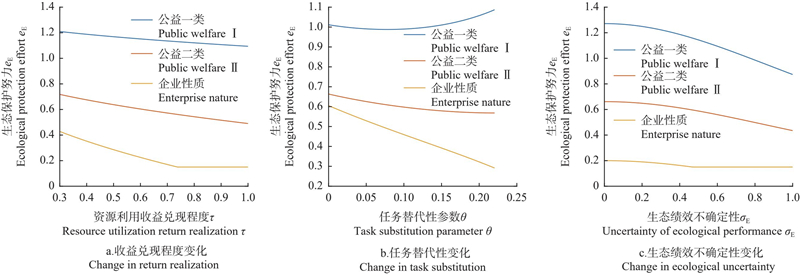
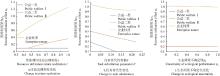
Fig.2
Effects of key parameter changes on resource utilization effort"

Table 2
Impact of different incentive mechanism optimizations on changes in the efforts of state-owned forest farms"
| 激励机制 Incentive mechanism | 国有林场单位性质 Type of state-owned forest farm | 生态保护 Ecological protection | 资源利用 Utilization of resources |
| 收益返还改革 Income return reform | 公益一类Public welfare category Ⅰ | 1.121 | 0.100 |
| 公益二类Public welfare category Ⅱ | 0.543 | 0.280 | |
| 企业性质Enterprise nature | 0.150 | 1.159 | |
| 考核权重优化 Assessment weight optimization | 公益一类Public welfare category Ⅰ | 1.098 | 0.100 |
| 公益二类Public welfare category Ⅱ | 0.514 | 0.328 | |
| 企业性质Enterprise nature | 0.150 | 1.232 | |
| 内部绩效改革 Internal performance reform | 公益一类Public welfare category Ⅰ | 1.123 | 0.100 |
| 公益二类Public welfare category Ⅱ | 0.538 | 0.291 | |
| 企业性质Enterprise nature | 0.150 | 1.194 |
Table 3
Monte Carlo robustness tests"
| 国有林场单位性质 Type of state-owned forest farm | 生态努力 均值Mean ecological effort | 标准差 Standard deviation | 生态努力95% 下界Lower bound of 95% ecological effort | 生态努力95% 上界Upper bound of 95% ecological effort | 资源努力 均值 Mean of resource effort | 标准差 Standard deviation | 资源努力95% 下界Lower bound of 95% resource effort | 资源努力95% 上界Upper bound of 95% resource effort |
| 公益一类 Public welfare category Ⅰ | 1.193 8 | 0.319 8 | 0.700 3 | 1.917 0 | 0.100 4 | 0.003 7 | 0.100 0 | 0.100 0 |
| 公益二类 Public welfare category Ⅱ | 0.624 5 | 0.235 0 | 0.231 7 | 1.136 2 | 0.227 1 | 0.141 5 | 0.100 0 | 0.587 4 |
| 企业性质 Enterprise nature | 0.245 3 | 0.135 6 | 0.150 0 | 0.597 4 | 1.081 8 | 0.459 3 | 0.394 2 | 2.202 0 |
| 陈永成, 陈光焱. 基于多任务委托代理模型的腐败行为分析. 当代财经, 2010, (5): 26- 31. | |
| Chen Y C, Chen G Y. An analysis of corruption based on the multi-task principal-agent model. Contemporary Finance & Economics, 2010, (5): 26- 31. | |
|
董静曦, 冷 华, 谢 晖, 等. 国有林场改革的理论与实践探索研究. 林业经济, 2017, 39 (3): 22- 26, 34.
doi: 10.13843/j.cnki.lyjj.2017.03.003 |
|
|
Dong J X, Leng H, Xie H, et al. Research on the theory and practice of the reform of state-owned forest farms in China. Forestry Economics, 2017, 39 (3): 22- 26, 34.
doi: 10.13843/j.cnki.lyjj.2017.03.003 |
|
|
高守荣, 洪 林. 深化国有林场改革 推进林场经济发展: 贵州省毕节市国有林场改革发展的经验与成效. 林业经济, 2014, 36 (11): 6- 9.
doi: 10.13843/j.cnki.lyjj.2014.11.002 |
|
|
Gao S R, Hong L. Deepening the reform of state-owned forest farm to promote forest economic development: the state-owned forest farm reform and development experience and achievements in Bijie, Guizhou. Forestry Economics, 2014, 36 (11): 6- 9.
doi: 10.13843/j.cnki.lyjj.2014.11.002 |
|
| 黄 颖, 温铁军, 范水生, 等. 规模经济、多重激励与生态产品价值实现: 福建省南平市“森林生态银行”经验总结. 林业经济问题, 2020, 40 (5): 499- 509. | |
| Huang Y, Wen T J, Fan S S, et al. Economics of scale, multi-incentives and realization of ecological product value: summary of experience of forest eco-bank in Nanping, Fujian. Problems of Forestry Economics, 2020, 40 (5): 499- 509. | |
| 黄新焕, 鲍艳珍, 蔡彬清. 双重委托代理关系下企业绿色发展的激励契约及其影响因素研究. 系统科学与数学, 2021, 41 (7): 1956- 1971. | |
| Huang X H, Bao Y Z, Cai B Q. Incentive contract and its influence factors for enterprises’ green development under the principal-agent-client relationship. Journal of Systems Science and Mathematical Sciences, 2021, 41 (7): 1956- 1971. | |
| 姜雪梅. 2006. 基于委托代理理论的国有森工企业绩效模型研究. 哈尔滨: 东北林业大学. | |
| Jiang X M. 2006. Research on the performance of the state-owned forestry industry enterprise based on the principal-agent theory. Harbin: Northeast Forestry University. [in Chinese] | |
| 蒋 峰. 后退耕时代退耕林管护激励机制研究: 基于对陕北的实地调查. 湖北农业科学, 2012, 51 (9): 1935- 1938. | |
| Jiang F. Study on the mechanism of encouraging the management and protection behavior of northern Shaanxi forestry returned from farmland. Hubei Agricultural Sciences, 2012, 51 (9): 1935- 1938. | |
| 李 冰, 王亚明, 张灵曼. 新时期推动国有林场绿色发展的路径研究. 林业资源管理, 2022, (suppl.1): 1- 7. | |
| Li B, Wang Y M, Zhang L M. Research on the path of promoting green development of state-owned forest farms in the new era. Forest Resources Management, 2022, (suppl.1): 1- 7. | |
| 林 进, 徐 冰, 衣旭彤, 等. 深化国有林场改革推动绿色发展路径探析. 林业资源管理, 2022, (suppl.1): 52- 58. | |
| Lin J, Xu B, Yi X T, et al. Brief analysis of deepening the reform of state-owned forest farms and promoting green development. Forest Resources Management, 2022, (suppl.1): 52- 58. | |
| 马 倩. 深化国有林场改革 探索绿色发展之路. 中国林业产业, 2024, (5): 73- 75. | |
| Ma Q. Deepen the reform of state-owned forest farms and explore the road of green development. China Forestry Industry, 2024, (5): 73- 75. | |
| 宁泽逵, 张 谦, 黄 超. 林业资源保护问题研究: 基于共同代理理论. 林业经济, 2008, 186 (1): 53- 57. | |
| Ning Z K, Zhang Q, Huang C. Research on the protection of forestry resources: based on the common agency theory. Forestry Economy, 2008, 186 (1): 53- 57. | |
|
田明华, 王自力, 李红勋. 试论我国国有林场体制改革. 北京林业大学学报(社会科学版), 2008, 7 (4): 54- 59.
doi: 10.13931/j.cnki.bjfuss.2008.04.014 |
|
|
Tian M H, Wang Z L, Li H X. The system reform of state-owned forest farms in China. Journal of Beijing Forestry University (Social Sciencs), 2008, 7 (4): 54- 59.
doi: 10.13931/j.cnki.bjfuss.2008.04.014 |
|
| 王小龙. 退耕还林: 私人承包与政府规制. 经济研究, 2004, (4): 107- 116. | |
| Wang X L. Returning farmland to forest: private contracting and government regulation. Economic Research, 2004, (4): 107- 116. | |
|
徐建博, 钱永坤. 利润与安全双目标下的国有企业安全激励机制: 基于国有煤矿的理论与实证研究. 华东经济管理, 2021, 35 (2): 112- 119.
doi: 10.19629/j.cnki.34-1014/f.200629003 |
|
|
Xu J B, Qian Y K. State-owned enterprise safety incentive mechanism under the dual objectives of profit and security: a theoretical and empirical research based on state-owned coal mines. East China Economic Management, 2021, 35 (2): 112- 119.
doi: 10.19629/j.cnki.34-1014/f.200629003 |
|
| 徐晋涛, 陶 然, 危结根. 信息不对称、分成契约与超限额采伐: 中国国有森林资源变化的理论分析和实证考察. 经济研究, 2004, 39 (3): 37- 46. | |
| Xu J T, Tao R, Wei J G. Information asymmetry, profit-sharing contract and over-the-quota harvesting: theory and empirical analysis of China’s state-owned forests. Economic Research Journal, 2004, 39 (3): 37- 46. | |
| 闫 平. 中国国有林场改革的进展与挑战. 林业资源管理, 2018, (3): 15- 18. | |
| Yan P. Progress and challenges of state-owned forest farm reform in China. Forest Resources Management, 2018, (3): 15- 18. | |
|
于立宏, 管锡展. 多委托人激励理论: 一个综述. 产业经济研究, 2005, (3): 54- 63.
doi: 10.3969/j.issn.1671-9301.2005.03.009 |
|
|
Yu L H, Guan X Z. A survey on multiprincipals incentive theory and its applications. Industrial Economics Research, 2005, (3): 54- 63.
doi: 10.3969/j.issn.1671-9301.2005.03.009 |
|
| 张 岚, 王俏荔. 基于多任务委托代理模型的公立医院激励机制优化研究. 中国医院, 2024, 28 (10): 16- 19. | |
| Zhang L, Wang Q L. Optimization of incentive mechanisms in public hospitals based on a multi-task principal-agent model. Chinese Hospitals, 2024, 28 (10): 16- 19. | |
| 张 延. 探索陕西国有林场进一步深化改革路径. 国家林业和草原局管理干部学院学报, 2023, 22 (suppl.1): 54- 58. | |
| Zhang Y. The path to deepen reform of state-owned forest farms in Shaanxi Province. State Academy of Forestry Administration Journal, 2023, 22 (suppl.1): 54- 58. | |
|
张臻玲. 财税激励政策下国有林场提升经营效益路径研究. 西部财会, 2023, (9): 21- 23.
doi: 10.3969/j.issn.1671-8771.2023.09.008 |
|
|
Zhang Z L. Research on the path of improving management benefit of state-owned forest farm under fiscal and tax incentive policy. Western Finance and Accounting, 2023, (9): 21- 23.
doi: 10.3969/j.issn.1671-8771.2023.09.008 |
|
| 赵 荣, 李 贺. 国有林场高质量发展对策建议. 林业资源管理, 2022, (suppl.1): 46- 51. | |
| Zhao R, Li H. Countermeasures and suggestions for high-quality development of state-owned forest farms. Forest Resources Management, 2022, (suppl.1): 46- 51. | |
| 朱 琪, 李燕冰, 曹文婷. 公平偏好下混改国企双委托人薪酬激励机制研究. 中国管理科学, 2023, 31 (10): 74- 84. | |
| Zhu Q, Li Y B, Cao W T. Research on compensation incentive mechanism of mixed state-owned enterprise’s double-principal under fairness preference. Chinese Journal of Management Science, 2023, 31 (10): 74- 84. | |
| de Figueiredo R J P. 1999. A theory of the political ‘firm’: a multi-task model of bureaucratic jurisdictions. Stanford: Department of Political Science, Stanford University. | |
|
Lin M X, Wen Z M. Contractual mechanisms in national park management: a multi-task principal–agent model. Land, 2024, 13 (7): 914.
doi: 10.3390/land13070914 |
| Viewed | ||||||
|
Full text |
|
|||||
|
Abstract |
|
|||||
