
Scientia Silvae Sinicae ›› 2026, Vol. 62 ›› Issue (10): 208-220.doi: 10.11707/j.1001-7488.LYKX20260032
• Research papers • Previous Articles
Kang Gao,Ziyu Guo,Xu Zhao*( )
Received:2026-01-18
Online:2026-10-10
Published:2026-10-16
Contact:
Xu Zhao
E-mail:zhaoxu@ctgu.edu.cn
CLC Number:
Kang Gao,Ziyu Guo,Xu Zhao. Mechanism for Preventing Default Risk in Forestry Carbon Sequestration Project Construction Based on Evolutionary Game Theory[J]. Scientia Silvae Sinicae, 2026, 62(10): 208-220.
Table 1
Description of parameters"
| 参数Parameter | 参数含义 Description | 参数Parameter | 参数含义 Description | |
| Ra | 林业碳汇项目开发总收益 Total revenue from forest carbon sink project | 政府对核查机构的罚款 Government fines auditing agencies for lax verification | ||
| 企业获得的收益分配比例 Profit distribution ratio for enterprises | 政府对核查机构的补贴 Government incentives auditing agencies for rigorous verification | |||
| Ca | 项目开发成本 Project development costs | Rg | 项目开发后政府的碳减排收益 Government carbon emission reduction benefits following project development | |
| Cb | 项目申报成本 Project application costs | Cg | 政府监管成本 Government regulatory costs | |
| 企业负担的项目开发成本比例 Proportion of project development costs borne by enterprises | Tg | 上级主管部门行政处罚额度 Administrative penalty amount imposed by higher-level competent authorities | ||
| Rw | 企业违约圈地获得的合同转卖收入 Contract resale proceeds obtained by the enterprise through default | Re | 林农自愿认购碳汇的生态补偿量 The amount of ecological compensation voluntarily subscribed by forest landowners for carbon sinks | |
| Cm | 企业圈地支付给林农的违约金 Penalty fees paid by enterprises to forest landowners | 企业违约对减排效果的影响系数 Coefficient of the impact of enterprise default on emissions reduction effectiveness | ||
| Cn | 林农违约支付给企业的违约金 Penalty fees paid by forest landowners to enterprises | 林农违约对减排效果的影响系数 Coefficient of the impact of forest landowners’ breach of contract on emissions reduction effectiveness | ||
| 林农违约行为造成的项目价值损失 Project value loss caused by forest landowners’ breach of contract | 企业?林农共同违约的影响系数 Coefficient of the impact of joint breach of contract by enterprises and forest landowners | |||
| 林农额外木材收益的转化比例 Conversion ratio of forest landowners’ additional timber income | 企业守约开发的概率 Probability of enterprises contract compliance | |||
| R0 | 核查机构的审核收益 Revenue of auditing agencies | 林农守约开发的概率 Probability of forest landowners contract compliance | ||
| 核查机构全面审核成本 The cost of rigorous verification by auditing agencies | 核查机构全面审核的概率 Probability of rigorous verification by auditing agencies | |||
| 核查机构准入审核成本 The cost of lax verification by auditing agencies | 政府严格监管的概率 Probability of government involvement in regulation | |||
| 政府对圈地企业的罚款 Government fines for land-grabbing enterprises |
Table 2
Payoffs matrix of four players"
| 主体策略选择 Strategy selection | 企业收益 Enterprise revenue | 林农收益 Forest landowners revenue | 机构收益 Agency revenue | 政府收益 Government revenue |
| (1,1,1,1) | ||||
| (1,1,0,1) | ||||
| (1,1,1,0) | ||||
| (1,1,0,0) | ||||
| (1,0,1,1) | ||||
| (1,0,0,1) | ||||
| (1,0,1,0) | ||||
| (1,0,0,0) | ||||
| (0,1,1,1) | ||||
| (0,1,0,1) | ||||
| (0,1,1,0) | ||||
| (0,1,0,0) | ||||
| (0,0,1,1) | ||||
| (0,0,0,1) | ||||
| (0,0,1,0) | ||||
| (0,0,0,0) |
Table 3
Stability analysis of quadratic pure strategy equilibrium solutions"
| 均衡点 Equilibrium points | 特征值 Eigenvalues | 正负性 Positive or negative | 稳定性及条件 Stability and conditions | 理想性 Idealism |
| ESS(条件1) ESS (condition 1) | 不理想 Not ideal | |||
| 不稳定 Unstable | 不理想 Not ideal | |||
| 不稳定 Unstable | 不理想 Not ideal | |||
| 不稳定 Unstable | 不理想 Not ideal | |||
| 不稳定 Unstable | 不理想 Not ideal | |||
| ESS(条件2) ESS (condition 2) | 不理想 Not ideal | |||
| ESS(条件3) ESS (condition 3) | 不理想 Not ideal | |||
| 不稳定 Unstable | 不理想 Not ideal | |||
| 不稳定 Unstable | 不太理想 Not quite ideal | |||
| 不稳定 Unstable | 不太理想 Not quite ideal | |||
| 不稳定 Unstable | 不太理想 Not quite ideal | |||
| ESS(条件4) ESS (condition 4) | 不太理想 Not quite ideal | |||
| ESS(条件5) ESS (condition 5) | 不太理想 Not quite ideal | |||
| 不稳定 Unstable | 不太理想 Not quite ideal | |||
| 不稳定 Unstable | 理想 Ideal | |||
| ESS(条件6) ESS (condition 6) | 理想 Ideal |

Fig.1
Evolutionary pathways of stable scenarios"

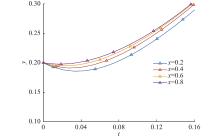
Fig.2
Changes in corporate default probability"


Fig.3
Changes in the regulatory environment"
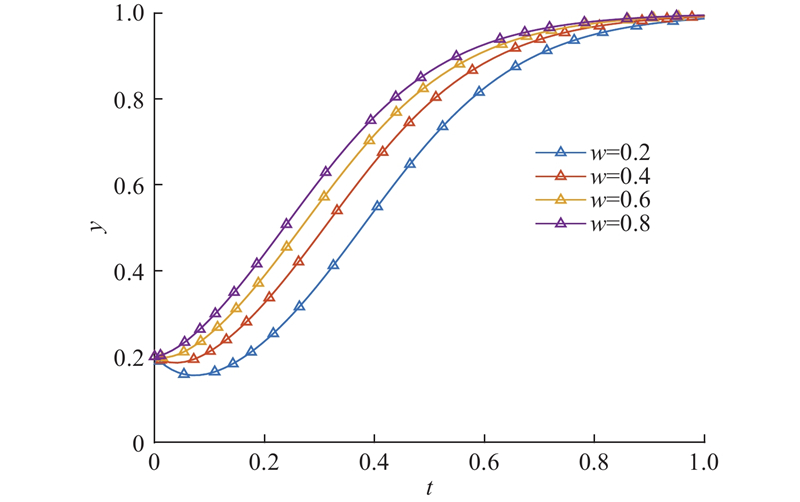

Fig.4
Evolutionary outcomes of different corporate penalties (left: xyz perspective; right: yzw perspective)"
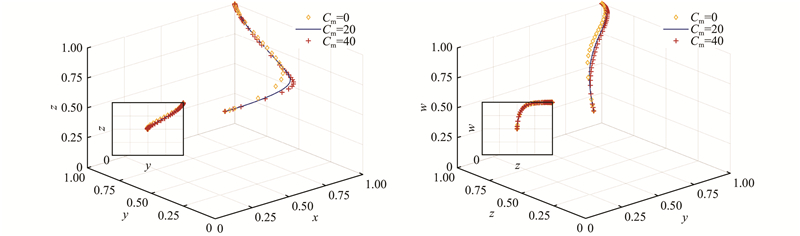

Fig.5
Evolutionary outcomes of different penalties for forest landowners (left: xyz perspective; right: yzw perspective)"


Fig.6
Evolutionary outcomes of enterprises under different fine levels (left: xyz perspective; right: yzw perspective)"


Fig.7
Evolutionary outcomes of auditing agencies under different fine levels (left: xyz perspective; right: yzw perspective)"
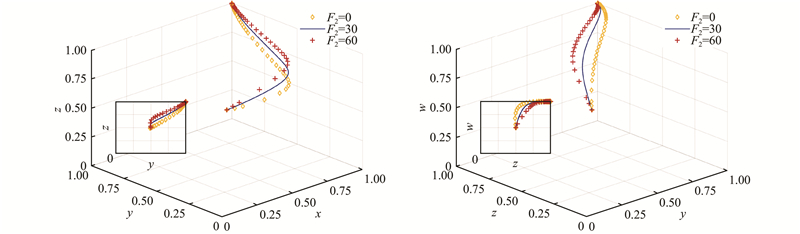

Fig.8
Evolutionary outcomes of auditing agencies under different reward levels (left: xyz perspective; right: yzw perspective)"

| 白华兵. 2025. 《减碳绿途》发布: 林业碳汇开发需“降温”, 避免“跑马圈林”. 新京报. | |
| Bai H B. 2025. Carbon Reduction Green Path released: forestry carbon sink development needs to “cool down” to avoid “racing to seize forests”. The Beijing News. [in Chinese] | |
|
董 玮, 葛爱玲. 林农参与林业碳汇经营研究进展与展望. 世界林业研究, 2025, 38 (5): 17- 24.
doi: 10.13348/j.cnki.sjlyyj.2025.0076.y |
|
|
Dong W, Ge A L. Research progress and prospects of forest farmers’ participation in carbon sink oriented forest management. World Forestry Research, 2025, 38 (5): 17- 24.
doi: 10.13348/j.cnki.sjlyyj.2025.0076.y |
|
| 董芳慧, 王 斌. 未来气候变化下黑龙江省人工林碳储量预测. 森林工程, 2026, 42 (4): 694- 706. | |
| Dong F H, Wang B. Carbon storage projection of plantations in Heilongjiang Province under future climate change. Forest Engineering, 2026, 42 (4): 694- 706. | |
| 杜之利, 苏 彤, 葛佳敏, 等. 碳中和背景下的森林碳汇及其空间溢出效应. 经济研究, 2021, 56 (12): 187- 202. | |
| Du Z L, Su T, Ge J M, et al. Towards the carbon neutrality: the role of carbon sink and its spatial spillover effects. Economic Research Journal, 2021, 56 (12): 187- 202. | |
|
郭建龙, 余智涵, 王晓雯, 等. 国际林业碳信用与中国林业CCER核证机制比较. 世界林业研究, 2025, 38 (1): 92- 98.
doi: 10.13348/j.cnki.sjlyyj.2025.0008.y |
|
|
Guo J L, Yu Z H, Wang X W, et al. Comparison of certification mechanisms for international forest carbon credits and China’s forestry CCER. World Forestry Research, 2025, 38 (1): 92- 98.
doi: 10.13348/j.cnki.sjlyyj.2025.0008.y |
|
| 胡 原, 黄婉婷, 曾维忠. 森林碳汇项目对欠发达地区农民收入的影响研究: 来自四川省5 225个建档立卡户的实证证据. 中国农业资源与区划, 2024, 45 (2): 214- 222. | |
| Hu Y, Huang W T, Zeng W Z. Study on the impact of forest carbon sink project on the income of farmers in underdeveloped regions: empirical evidence from 5 225 households in Sichuan Province. Chinese Journal of Agricultural Resources and Regional Planning, 2024, 45 (2): 214- 222. | |
|
林禹岐, 吴 昂. 认购林业碳汇司法适用的实践检视与制度完善. 中国人口·资源与环境, 2023, 33 (12): 71- 82.
doi: 10.12062/cpre.20230606 |
|
|
Lin Y Q, Wu A. Practical review and institutional improvement of judicial application of the carbon offset purchase. China Population Resources and Environment, 2023, 33 (12): 71- 82.
doi: 10.12062/cpre.20230606 |
|
| 刘建敏, 高汇标. “双碳”背景下林业碳汇发展现状及实践探究. 智慧中国, 2024, (1): 56- 58. | |
| Liu J M, Gao H B. Exploring the current status and practices of forest carbon sinks development in the context of the “dual carbon” goals. Wisdom China, 2024, (1): 56- 58. | |
| 宋宇坤. 2025. 区块链技术下林业碳汇交易机制的演化博弈研究. 哈尔滨: 东北林业大学. | |
| Song Y K. 2025. Evolutionary game study of forestry carbon sink trading mechanism under blockchain technology. Harbin: Northeast Forestry University. [in Chinese] | |
|
孙 睿, 闫晶晶, 何大义, 等. 基于区块链技术的林业碳汇项目开发风险的演化博弈研究. 软科学, 2024a, 38 (9): 90- 100.
doi: 10.13956/j.ss.1001-8409.2024.09.12 |
|
|
(Sun R, Yan J J, He D Y, et al. Evolutionary game analysis of block chain preventing forestry carbon sink project development risks. Soft Science, 2024a, 38 (9): 90- 100.
doi: 10.13956/j.ss.1001-8409.2024.09.12 |
|
|
孙 睿, 何大义, 闫晶晶. 基于随机微分博弈的林业碳汇项目开发的风险化解机制研究. 系统工程理论与实践, 2024b, 44 (7): 2273- 2292.
doi: 10.12011/SETP2023-1649 |
|
|
Sun R, He D Y, Yan J J. Risk resolution mechanism for the development of forestry carbon sink projects based on stochastic differential game. Systems Engineering -Theory & Practice, 2024b, 44 (7): 2273- 2292.
doi: 10.12011/SETP2023-1649 |
|
| 徐干君. 林业碳汇开发亟待规范. 中国林业产业, 2024, (2): 1. | |
| Xu G J. The development of forestry carbon sinks urgently needs to be regulated. China Forestry Industry, 2024, (2): 1. | |
|
徐来仙, 何友均. 林业碳汇产品定价机制比较与启示. 林业科学, 2025, 61 (4): 231- 248.
doi: 10.11707/j.1001-7488.LYKX20240295 |
|
|
Xu L X, He Y J. Comparison and implications for pricing mechanisms of forestry carbon sink products. Scientia Silvae Sinicae, 2025, 61 (4): 231- 248.
doi: 10.11707/j.1001-7488.LYKX20240295 |
|
|
杨博文. “生态”何以“富农”: “双碳”目标下林业碳汇产品价值化规范的理路. 青海社会科学, 2023, (5): 37- 45.
doi: 10.14154/j.cnki.qss.2023.05.004 |
|
|
Yang B W. How to “enrich farmers” by “ecology”: the standardized way of valuing forestry carbon sequestration products under the carbon peaking and carbon neutrality goals. Qinghai Social Sciences, 2023, (5): 37- 45.
doi: 10.14154/j.cnki.qss.2023.05.004 |
|
|
杨 志. 公众参与交互型跨界污染治理补偿的四方博弈. 中国管理科学, 2024, 32 (8): 261- 273.
doi: 10.16381/j.cnki.issn1003-207x.2021.1416 |
|
|
Yang Z. Quadripartite evolutionary game of public participation in interactive transboundary pollution control compensation. Chinese Journal of Management Science, 2024, 32 (8): 261- 273.
doi: 10.16381/j.cnki.issn1003-207x.2021.1416 |
|
|
余红红, 杨加猛. 基于三方演化博弈的森林横向生态补偿策略及其稳定性: 以重庆市为例. 林业科学, 2025, 61 (3): 214- 232.
doi: 10.11707/j.1001-7488.LYKX20230342 |
|
|
Yu H H, Yang J M. Forest horizontal ecological compensation strategy and its stability based on three-party evolutionary game: a case of Chongqing City. Scientia Silvae Sinicae, 2025, 61 (3): 214- 232.
doi: 10.11707/j.1001-7488.LYKX20230342 |
|
|
曾维忠, 刘 胜, 杨 帆, 等. 扶贫视域下的森林碳汇研究综述. 农业经济问题, 2017, 38 (2): 102- 109.
doi: 10.13246/j.cnki.iae.2017.02.013 |
|
|
Zeng W Z, Liu S, Yang F, et al. A research review on poverty alleviation based on forest carbon sink projects. Issues in Agricultural Economy, 2017, 38 (2): 102- 109.
doi: 10.13246/j.cnki.iae.2017.02.013 |
|
| 张 楠, 储安婷, 杨红强. 碳交易机制下林业碳汇产品类别比较与价值核算模型甄别. 中国人口·资源与环境, 2022, 32 (11): 146- 155. | |
| Zhang N, Chu A T, Yang H Q. Forestry carbon sequestration products and their value accounting models under carbon trading mechanism. China Population. Resources and Environment, 2022, 32 (11): 146- 155. | |
|
张启航, 张亚连, 谭桂菲, 等. 中国林业碳汇效率时空演化特征: 基于三阶段超效率数据包络分析模型. 生态学报, 2024, 44 (15): 6769- 6782.
doi: 10.20103/j.stxb.202311172510 |
|
|
Zhang Q H, Zhang Y L, Tan G F, et al. Spatio-temporal evolutionary characteristics of forestry carbon sink efficiency in China based on a three-stage super-efficiency SBM-DEA model. Acta Ecologica Sinica, 2024, 44 (15): 6769- 6782.
doi: 10.20103/j.stxb.202311172510 |
|
|
张 颖, 孟 娜, 姜逸菲. 中国森林碳汇与林业经济发展耦合及长期变化特征分析. 北京林业大学学报, 2022, 44 (10): 129- 141.
doi: 10.12171/j.1000-1522.20220257 |
|
|
Zhang Y, Meng N, Jiang Y F. Coupling and long-term change characteristics analysis of forest carbon sequestration and forestry economic development in China. Journal of Beijing Forestry University, 2022, 44 (10): 129- 141.
doi: 10.12171/j.1000-1522.20220257 |
|
|
甄 贞, 黄 杰, 刘佳宇, 等. 中国东北地区森林碳源汇时空格局变化及对极端气候的响应. 森林工程, 2025, 41 (5): 969- 980.
doi: 10.7525/j.issn.1006-8023.2025.05.010 |
|
|
Zhen Z, Huang J, Liu J Y, et al. Changes in the spatiotemporal pattern of forest carbon sources and sinks in northeast China and their responses to extreme climate. Forest Engineering, 2025, 41 (5): 969- 980.
doi: 10.7525/j.issn.1006-8023.2025.05.010 |
|
| Ge J M, Zhang Z J, Lin B Q. 2023. Towards carbon neutrality: how much do forest carbon sinks cost in China? Environmental Impact Assessment Review, 98: 106949. | |
|
Halloway A H, Heath K D, McNickle G G. When does mutualism offer a competitive advantage? A game-theoretic analysis of host-host competition in mutualism. AoB Plants, 2022, 14 (2): plac010.
doi: 10.1093/aobpla/plac010 |
|
|
Ojha H, Maraseni T, Nightingale A, et al. Rescuing forests from the carbon trap. Forest Policy and Economics, 2019, 101, 15- 18.
doi: 10.1016/j.forpol.2019.01.007 |
|
| van Kooten G C, Nijnik M, Bradford K. 2019. Can carbon accounting promote economic development in forest-dependent, indigenous communities? Forest Policy and Economics, 100: 68−74. | |
|
Yang Y, Zhu Y, Zhao Y W. Improving farmers’ livelihoods through the eco-compensation of forest carbon sinks. Renewable and Sustainable Energy Reviews, 2024, 198, 114401.
doi: 10.1016/j.rser.2024.114401 |
|
|
Zhao N, Wang K Q, Yuan Y N. Toward the carbon neutrality: forest carbon sinks and its spatial spillover effect in China. Ecological Economics, 2023, 209, 107837.
doi: 10.1016/j.ecolecon.2023.107837 |
| [1] | Laixian Xu,Youjun He. Comparison and Implications for Pricing Mechanisms of Forestry Carbon Sink Products [J]. Scientia Silvae Sinicae, 2025, 61(4): 231-248. |
| [2] | Honghong Yu,Jiameng Yang. Forest Horizontal Ecological Compensation Strategy and Its Stability Based on Three-Party Evolutionary Game: a Case of Chongqing City [J]. Scientia Silvae Sinicae, 2025, 61(3): 214-232. |
| [3] | Liyang Yao,Yue Zhu,Yaning Wang,Shuai Pang. Impact of Tire Size on the Driving Performance of Small Wheeled Mobile Platforms in Forest [J]. Scientia Silvae Sinicae, 2025, 61(2): 180-189. |
| [4] | Hongge Zhu,Yuchen Tian,Wen Ying,Yutong Zhang. Evolutionary Game and Cooperation Mechanism of Forest Tourism Development in Key State-Owned Forest Areas [J]. Scientia Silvae Sinicae, 2025, 61(10): 221-235. |
| [5] | Feng Lu,Guangtong Gu,Xianlei Cao,Weiguang Wu. Risk of Forestry Carbon Sink Project Based on Coupling Effect [J]. Scientia Silvae Sinicae, 2022, 58(5): 161-176. |
| [6] | Sun Xinglin, Zhang Yuqing, Zhang Jutao, Qin Shugao, Zhou Jinxing. Numerical Simulation on the Influence of Subgrade of Qinghai-Tibet Railway on Wind-Sand Movement [J]. Scientia Silvae Sinicae, 2018, 54(7): 73-83. |
| [7] | Zhang Shaoqun, Yan Jiaxiong, Cao Lei, Wang Haitao. Crack Propagation Simulation of Hot Mill Grinding with Wood Based on ADAMS and ABAQUS [J]. Scientia Silvae Sinicae, 2018, 54(12): 149-156. |
| [8] | Zhang Jiawei;Li Mingbao. Finite Element Numerical Simulation and Validation on Transient Temperature Distribution of Soft wood [J]. Scientia Silvae Sinicae, 2008, 44(1): 117-123. |
| [9] | Zhang Zhiqiang;Wang Lixian;Yu Xinxiao;Li Yaguang;E.Klaghofer. EFFECTIVE OVERLAND ROUGHNESS COEFFICIENT CALCULATION FOR FORESTED INFILTRATING SLOPE [J]. Scientia Silvae Sinicae, 2000, 36(5): 22-27. |
| Viewed | ||||||
|
Full text |
|
|||||
|
Abstract |
|
|||||
