
Scientia Silvae Sinicae ›› 2026, Vol. 62 ›› Issue (7): 1-11.doi: 10.11707/j.1001-7488.LYKX20250739
• Frontiers and hot topics • Previous Articles Next Articles
Qiyan Liu1,Yuting Zhang1,Kai Ding1,Yifan Zhou1,Xiaoming Chen2,Junhong Zhang1,*( ),Zaikang Tong1
Received:2025-12-09
Online:2026-07-10
Published:2026-07-14
Contact:
Junhong Zhang
E-mail:zhangjunhong@zafu.edu.cn
CLC Number:
Qiyan Liu,Yuting Zhang,Kai Ding,Yifan Zhou,Xiaoming Chen,Junhong Zhang,Zaikang Tong. Isolation and Function Analysis of Phosphate-Solubilizing Bacteria from the Rhizosphere of Phoebe bournei trees in Cunninghamia lanceolata–Phoebe bournei Mixed Forests[J]. Scientia Silvae Sinicae, 2026, 62(7): 1-11.
Fig.1
Phylogenetic tree of phosphate-solubilizing bacteria based on 16S rRNA gene sequences"
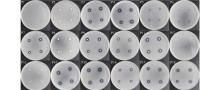
Fig.2
Phosphate solubilization zone of 18 preliminarily screened strains"
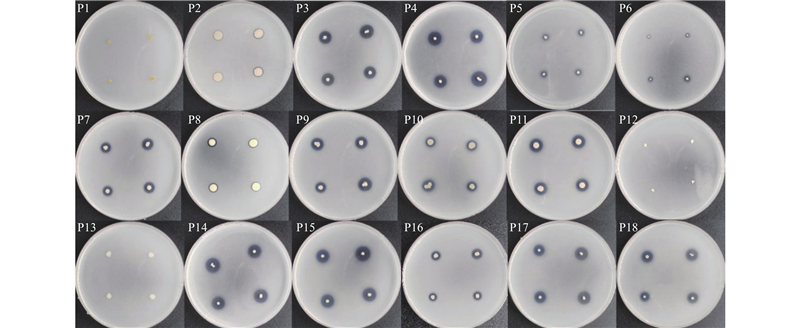
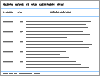
Table 1
Phosphate-solubilizing capacity of 18 preliminarily screened strains"
| 菌株 Strain | 溶磷圈D/d Phosphorus-solubilizing zone D/d value | 有效磷增量 Effective phosphorus increment/(mg·L?1) | 菌株 Strain | 溶磷圈D/d Phosphorus-solubilizing zone D/d value | 有效磷增量 Effective phosphorus increment/(mg·L?1) | |
| P1 | 1.00±0 | 40.94±2.10 | P10 | 1.15±0.08 | 841.66±8.41 | |
| P2 | 1.08±0.25 | 116.46±3.21 | P11 | 1.90±0.08 | 794.46±4.38 | |
| P3 | 2.39±0.70 | 54.67±4.38 | P12 | 1.00±0 | 148.21±1.21 | |
| P4 | 3.64±0.31 | 325.87±4.38 | P13 | 1.00±0 | 397.10±3.21 | |
| P5 | 1.28±0.22 | 579.90±9.93 | P14 | 3.76±0.06 | 103.59±3.21 | |
| P6 | 1.34±0.09 | 367.06±3.21 | P15 | 3.83±0.16 | 98.44±1.21 | |
| P7 | 2.20±0.09 | 47.80±3.21 | P16 | 1.91±0.31 | 358.48±5.29 | |
| P8 | 2.33±0.09 | 1 176.36±15.87 | P17 | 3.01±0.34 | 90.71±4.38 | |
| P9 | 1.36±0.14 | 161.09±6.76 | P18 | 2.48±0.16 | 62.39±1.21 |
Table 2
Growth-promoting indices of 18 phosphate-solubilizing bacterial strains"
| 菌株 Strain | IAA产量 Production of IAA /(μg·mL?1) | 生物膜形成能力 Biofilm-forming ability | 菌株 Strain | IAA产量 Production of IAA /(μg·mL?1) | 生物膜形成能力 Biofilm-forming ability | |
| P1 | 19.91±0.91 | 中等 Moderate | P10 | 22.49±2.54 | 中等 Moderate | |
| P2 | 15.84±1.26 | 中等 Moderate | P11 | 19.23±1.71 | 中等 Moderate | |
| P3 | 17.91±1.68 | 中等 Moderate | P12 | 14.61±1.89 | 较强 Strong | |
| P4 | 19.70±1.71 | 较强 Strong | P13 | 16.33±0.68 | 中等 Moderate | |
| P5 | 17.92±3.00 | 较强 Strong | P14 | 17.15±0.58 | 中等 Moderate | |
| P6 | 18.11±1.01 | 中等 Moderate | P15 | 19.89±2.18 | 较强 Strong | |
| P7 | 20.92±2.89 | 较强 Strong | P16 | 21.69±3.30 | 较强 Strong | |
| P8 | 18.55±0.39 | 中等 Moderate | P17 | 19.19±2.19 | 中等 Moderate | |
| P9 | 18.85±1.28 | 中等 Moderate | P18 | 20.22±1.56 | 中等 Moderate |
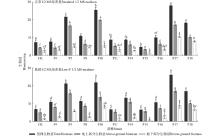
Fig.3
Effects of different strains on Arabidopsis thaliana biomass Different lowercase letters indicate significant differences among treatments (P < 0.05)."
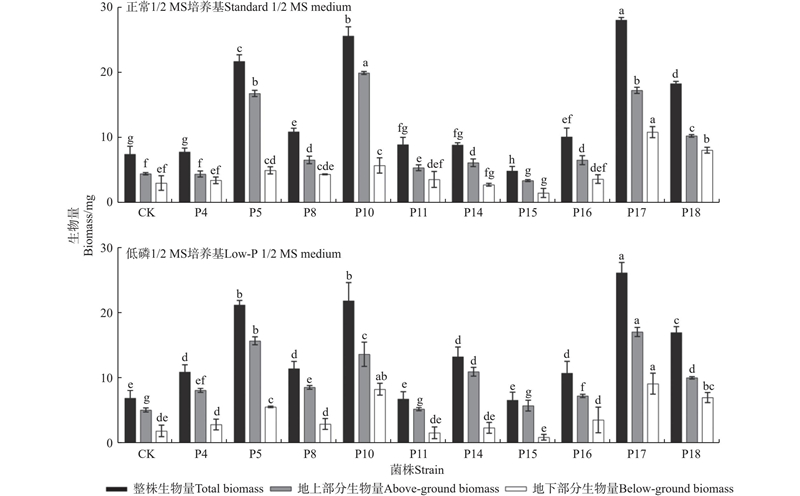
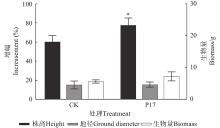
Fig.4
Statistical analyses of biomass, height increment, and ground diameter increment of Cunninghamia lanceolata seedlings"
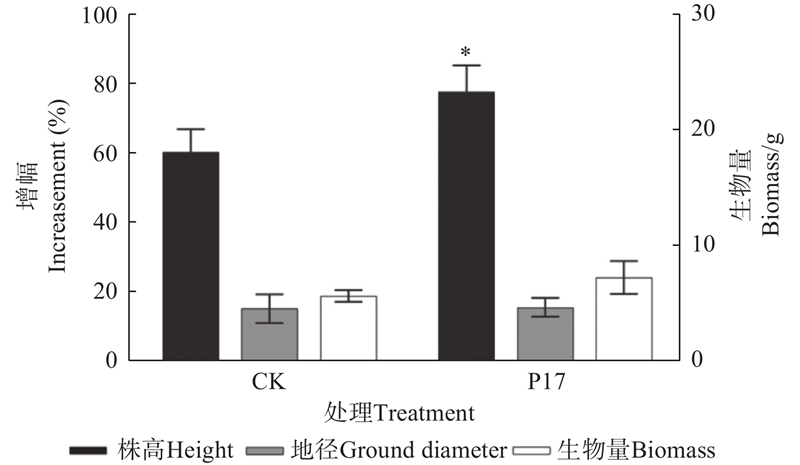
Fig.5
Effects of P17 strain on photosynthetic parameters of Cunninghamia lanceolata seedlings"
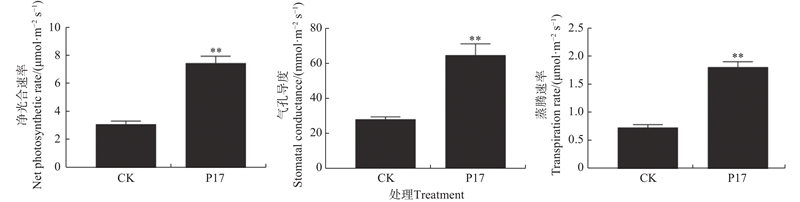
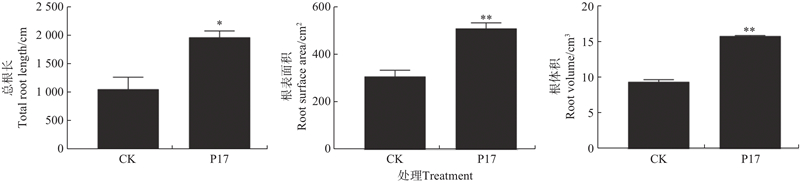
Fig.6
Effects of P17 strain on root morphology of Cunninghamia lanceolata seedlings"
| 阿拉木斯其其格. 2015. 内蒙古荒漠草原三种植物根际固氮菌的分离筛选及其促生效应研究. 呼和浩特: 内蒙古师范大学. | |
| Alamusiqiqige. 2015. Isolation, screening and growth-promoting effects of diazotrophs from the rhizosphere of three plants in desert grassland of Inner Mongolia. Hohhot: Inner Mongolia Normal University. [in Chinese] | |
|
车欣宇, 彭启超, 张志鹏, 等. 一株根际解磷菌的筛选鉴定及促生作用研究. 中国土壤与肥料, 2024, (1): 218- 225.
doi: 10.11838/sfsc.1673-6257.23002 |
|
|
Che X Y, Peng Q C, Zhang Z P, et al. Screening and identification of a rhizosphere phosphate-solubilizing bacteria and its growth-promoting effect. Soil and Fertilizer Sciences in China, 2024, (1): 218- 225.
doi: 10.11838/sfsc.1673-6257.23002 |
|
|
陈丹阳, 李汉全, 张炳火, 等. 两株解磷细菌的解磷活性及作用机制研究. 中国生态农业学报, 2017, 25 (3): 410- 418.
doi: 10.13930/j.cnki.cjea.160667 |
|
|
Chen D Y, Li H Q, Zhang B H, et al. Phosphate solubilization activities and action mechanisms of two phosphate-solubilizing bacteria. Chinese Journal of Eco-Agriculture, 2017, 25 (3): 410- 418.
doi: 10.13930/j.cnki.cjea.160667 |
|
| 房翠莲, 曹婷婷, 尹语申, 等. 毛竹根际多功能解磷菌zafu-111的分离及全基因组解析. 应用生态学报, 2025, 36 (10): 3175- 3186. | |
| Fang C L, Cao T T, Yin Y S, et al. Isolation and whole-genome analysis of a multifunctional strain zafu-111 for phosphate-solubilizing in the rhizosphere of Phyllostachys edulis. Chinese Journal of Applied Ecology, 2025, 36 (10): 3175- 3186. | |
| 姜焕焕, 祁佩时, 王 通, 等. 盐碱地解磷真菌的分离鉴定及性能研究. 土壤通报, 2018, 49 (4): 856- 861. | |
| Jiang H H, Qi P S, Wang T, et al. Isolation, identification and biological identification of phosphate-solubilizing fungi. Chinese Journal of Soil Science, 2018, 49 (4): 856- 861. | |
| 李海云, 姚 拓, 张 榕, 等. 红三叶根际溶磷菌株分泌有机酸与溶磷能力的相关性研究. 草业学报, 2018, 27 (12): 113- 121. | |
| Li H Y, Yao T, Zhang R, et al. Relationship between organic acids secreted from rhizosphere phosphate-solubilizing bacteria in Trifolium pratense and phosphate-solubilizing ability. Acta Prataculturae Sinica, 2018, 27 (12): 113- 121. | |
| 林国钦, 张 婷, 左 杰, 等. 产IAA根内生菌的分离鉴定及对小麦促生效果. 福建农业科技, 2022, 53 (4): 10- 17. | |
| Lin G Q, Zhang T, Zuo J, et al. Isolation and identification of IAA-producing endophytic bacteria and its growth-promoting effect on the growth of wheat. Fujian Agricultural Science and Technology, 2022, 53 (4): 10- 17. | |
|
刘浩蓝, 丁珊珊, 包小春, 等. 3株解磷菌的解磷机理及其对杉木幼苗的促生效应. 生态与农村环境学报, 2025, 41 (3): 378- 388.
doi: 10.19741/j.issn.1673-4831.2023.1078 |
|
|
Liu H L, Ding S S, Bao X C, et al. The phosphate-solubilizing mechanism of three phosphate-solubilizing bacteria and their promoting effect on Cunninghamia lanceolata. Journal of Ecology and Rural Environment, 2025, 41 (3): 378- 388.
doi: 10.19741/j.issn.1673-4831.2023.1078 |
|
|
刘 荣, 李兵杰, 王智烨. 植物响应缺磷胁迫的分子机制研究进展. 浙江大学学报(农业与生命科学版), 2024, 50 (3): 455- 468.
doi: 10.3785/j.issn.1008-9209.2023.10.311 |
|
|
Liu R, Li B J, Wang Z Y. Research progress on molecular mechanisms of phosphate starvation response in plants. Journal of Zhejiang University (Agriculture & Life Sciences), 2024, 50 (3): 455- 468.
doi: 10.3785/j.issn.1008-9209.2023.10.311 |
|
|
马骢毓, 张 英, 孙广正, 等. 披碱草根际促生菌筛选及其接种剂的促生作用. 植物营养与肥料学报, 2016, 22 (4): 1039- 1048.
doi: 10.11674/zwyf.15449 |
|
|
Ma C Y, Zhang Y, Sun G Z, et al. Identification of plant growth promoting rhizobacteria Elymus dahuricus and their effectives. Journal of Plant Nutrition and Fertilizers, 2016, 22 (4): 1039- 1048.
doi: 10.11674/zwyf.15449 |
|
|
任恺佳, 刘思雨, 明红霞, 等. 海水淡化系统中耐氯菌筛选及生物膜形成潜力探究. 工业水处理, 2025, 45 (5): 47- 53.
doi: 10.19965/j.cnki.iwt.2024-0418 |
|
|
Ren K J, Liu S Y, Ming H X, et al. Screening of chlorine-resistant bacteria and investigation of biofilm formation potential in seawater desalination system. Industrial Water Treatment, 2025, 45 (5): 47- 53.
doi: 10.19965/j.cnki.iwt.2024-0418 |
|
|
沈心涛, 涂保华, 刘朝阳, 等. 酸性逆境土壤中根际微生物调控植物根系构型的作用机制. 环境科学, 2025, 46 (1): 570- 578.
doi: 10.13227/j.hjkx.202312260 |
|
|
Shen X T, Tu B H, Liu C Y, et al. Mechanisms of rhizosphere microorganisms in regulating plant root system architecture in acidic soils. Environmental Science, 2025, 46 (1): 570- 578.
doi: 10.13227/j.hjkx.202312260 |
|
| 司春灿, 林 英, 尚天玉, 等. 油茶根际促生菌的筛选与促生特性. 中南林业科技大学学报, 2024, 44 (4): 28- 35. | |
| Si C C, Lin Y, Shang T Y, et al. Isolation and promoting characteristics of the rhizospheric bacteria of Camellia oleifera Abel. Journal of Central South University of Forestry & Technology, 2024, 44 (4): 28- 35. | |
|
田 江, 梁翠月, 陆 星, 等. 根系分泌物调控植物适应低磷胁迫的机制. 华南农业大学学报, 2019, 40 (5): 175- 185.
doi: 10.7671/j.issn.1001-411X.201905068 |
|
|
Tian J, Liang C Y, Lu X, et al. Mechanism of root exudates regulating plant responses to phosphorus deficiency. Journal of South China Agricultural University, 2019, 40 (5): 175- 185.
doi: 10.7671/j.issn.1001-411X.201905068 |
|
| 王志刚, 胡云龙, 徐伟慧, 等. 鞘氨醇单胞菌菌株CL01的分离鉴定及其对连作西瓜的促生效应. 农业生物技术学报, 2015, 23 (10): 1360- 1367. | |
| Wang Z G, Hu Y L, Xu W H, et al. Isolation and identification of Sphingomonas sp. CL01 and its promoting effects on watermelon (Citrullus lanatus) in continuous cropping soil. Journal of Agricultural Biotechnology, 2015, 23 (10): 1360- 1367. | |
|
杨安娜, 陆云峰, 张俊红, 等. 杉木人工林土壤养分及酸杆菌群落结构变化. 林业科学, 2019, 55 (1): 119- 127.
doi: 10.11707/j.1001-7488.20190114 |
|
|
Yang A N, Lu Y F, Zhang J H, et al. Changes in soil nutrients and acidobacteria community structure in Cunninghamia lanceolata plantations. Scientia Silvae Sinicae, 2019, 55 (1): 119- 127.
doi: 10.11707/j.1001-7488.20190114 |
|
|
杨 颖, 王国忠, 郑文华, 等. 杉木纯林转变为杉木和闽楠复层异龄混交林对土壤剖面氮磷组分的影响. 森林工程, 2025, 41 (6): 1230- 1241.
doi: 10.7525/j.issn.1006-8023.2025.06.013 |
|
|
Yang Y, Wang G Z, Zheng W H, et al. Effects of transforming pure Cunninghamia lanceolata plantations into multi-layered, uneven-aged mixed Cunninghamia lanceolata and Phoebe bournei plantations on soil profile nitrogen and phosphorus fractions. Forest Engineering, 2025, 41 (6): 1230- 1241.
doi: 10.7525/j.issn.1006-8023.2025.06.013 |
|
|
詹亚斌, 张 磊, 丁晓艳, 等. 一株堆肥高效解磷菌的筛选、鉴定及其溶磷特性. 科学技术与工程, 2022, 22 (3): 960- 966.
doi: 10.3969/j.issn.1671-1815.2022.03.012 |
|
|
Zhan Y B, Zhang L, Ding X Y, et al. Isolation, identification and its phosphate-solubilizing capacity of phosphate-solubilizing bacterial strain from compost. Science Technology and Engineering, 2022, 22 (3): 960- 966.
doi: 10.3969/j.issn.1671-1815.2022.03.012 |
|
|
张东艳, 刘 晔, 吴 越, 等. 花生根际产IAA菌的筛选鉴定及其效应研究. 中国油料作物学报, 2016, 38 (1): 104- 110.
doi: 10.7505/j.issn.1007-9084.2016.01.016 |
|
|
Zhang D Y, Liu Y, Wu Y, et al. Isolation and identification of IAA-producing strains from peanut rhizosphere and its promoting effects on peanut growth. Chinese Journal of Oil Crop Sciences, 2016, 38 (1): 104- 110.
doi: 10.7505/j.issn.1007-9084.2016.01.016 |
|
| 张珂飞, 钟永嘉, 孙丽莉, 等. 植物有益伯克霍尔德氏菌的研究进展及其在农业中的应用. 微生物学报, 2021, 61 (8): 2205- 2218. | |
| Zhang K F, Zhong Y J, Sun L L, et al. Plant-associated beneficial Burkholderia. Acta Microbiologica Sinica, 2021, 61 (8): 2205- 2218. | |
|
张漪曼, 路龙俊, 张毓婷, 等. 闽楠紫色酸性磷酸酶基因(PAPs)家族分析及3个PAPs在低磷胁迫下的功能. 林业科学, 2025, 61 (5): 146- 160.
doi: 10.11707/j.1001-7488.LYKX20240323 |
|
|
Zhang Y M, Lu L J, Zhang Y T, et al. Analysis of purple acid phosphatases genes (PAPs) family in Phoebe bournei and the functions of three PAPs under low phosphorus stress. Scientia Silvae Sinicae, 2025, 61 (5): 146- 160.
doi: 10.11707/j.1001-7488.LYKX20240323 |
|
| 周佳宇, 林雨辰, 付佳睿, 等. 亚热带典型人工林土壤磷组分特征及其影响因素. 生态学报, 2025, 45 (13): 6279- 6291. | |
| Zhou J Y, Lin Y C, Fu J R, et al. Characteristics of soil phosphorus fractions and their influencing factors in typical subtropical plantations. Acta Ecologica Sinica, 2025, 45 (13): 6279- 6291. | |
|
Asaf S, Khan A L, Khan M A, et al. Complete genome sequencing and analysis of endophytic Sphingomonas sp. LK11 and its potential in plant growth. Biotech, 2018, 8 (9): 389.
doi: 10.1007/s13205-018-1403-z |
|
|
Cataldi M P, Heuer S, Mauchline T H, et al. Effect of plant growth promoting bacteria on the growth of wheat seedlings subjected to phosphate starvation. Agronomy, 2020, 10 (7): 978.
doi: 10.3390/agronomy10070978 |
|
|
Chen C, Chen H Y H, Chen X L, et al. Meta-analysis shows positive effects of plant diversity on microbial biomass and respiration. Nature Communications, 2019, 10, 1332.
doi: 10.1038/s41467-019-09258-y |
|
|
Ding K, Zhang Y T, Liu H Y, et al. Soil bacterial community structure and functions but not assembly processes are affected by the conversion from monospecific Cunninghamia lanceolata plantations to mixed plantations. Applied Soil Ecology, 2023, 185, 104775.
doi: 10.1016/j.apsoil.2022.104775 |
|
|
Ding K, Zhang Y T, Yrjälä K, et al. The introduction of Phoebe bournei into Cunninghamia lanceolata monoculture plantations increased microbial network complexity and shifted keystone taxa. Forest Ecology and Management, 2022, 509, 120072.
doi: 10.1016/j.foreco.2022.120072 |
|
|
Feng Y H, Schmid B, Loreau M, et al. Multispecies forest plantations outyield monocultures across a broad range of conditions. Science, 2022, 376 (6595): 865- 868.
doi: 10.1126/science.abm6363 |
|
| Kim C G, Kang J P, Huo Y, et al. Paenibacillus panacihumi sp. nov. , a potential plant growth-promoting bacterium isolated from ginseng-cultivated soil. Archives of Microbiology, 2018, 200 (7): 1049- 1055. | |
|
Kim Y J, Park J Y, Balusamy S R, et al. Comprehensive genome analysis on the novel species Sphingomonas panacis DCY99T reveals insights into iron tolerance of ginseng. International Journal of Molecular Sciences, 2020, 21 (6): 2019.
doi: 10.3390/ijms21062019 |
|
|
Lambers H. Phosphorus acquisition and utilization in plants. Annual Review of Plant Biology, 2022, 73, 17- 42.
doi: 10.1146/annurev-arplant-102720-125738 |
|
|
Lin T F, Huang H I, Shen F T, et al. The protons of gluconic acid are the major factor responsible for the dissolution of tricalcium phosphate by Burkholderia cepacia CC-Al74. Bioresource Technology, 2006, 97 (7): 957- 960.
doi: 10.1016/j.biortech.2005.02.017 |
|
|
Lipton D S, Blanchar R W, Blevins D G. Citrate, malate, and succinate concentration in exudates from P-sufficient and P-stressed Medicago sativa L. seedlings. Plant Physiology, 1987, 85 (2): 315- 317.
doi: 10.1104/pp.85.2.315 |
|
|
Liu C, Bai Z, Luo Y, et al. Multiomics dissection of Brassica napus L. lateral roots and endophytes interactions under phosphorus starvation. Nature Communications, 2024a, 15, 9732.
doi: 10.1038/s41467-024-54112-5 |
|
|
Liu Y P, Xu Z H, Chen L, et al. Root colonization by beneficial rhizobacteria. FEMS Microbiology Reviews, 2024b, 48 (1): fuad066.
doi: 10.1093/femsre/fuad066 |
|
|
Luo Y, Zhou M, Zhao Q, et al. Complete genome sequence of Sphingomonas sp. Cra20, a drought resistant and plant growth promoting rhizobacteria. Genomics, 2020, 112 (5): 3648- 3657.
doi: 10.1016/j.ygeno.2020.04.013 |
|
|
Panhwar Q A, Naher U A, Jusop S, et al. Biochemical and molecular characterization of potential phosphate-solubilizing bacteria in acid sulfate soils and their beneficial effects on rice growth. Plos One, 2014, 9 (10): e97241.
doi: 10.1371/journal.pone.0097241 |
|
|
Pan L, Cai B Y. Phosphate-solubilizing bacteria: advances in their physiology, molecular mechanisms and microbial community effects. Microorganisms, 2023, 11 (12): 2904.
doi: 10.3390/microorganisms11122904 |
|
| Perin L, Martínez-Aguilar L, Paredes-Valdez G, et al. Burkholderia silvatlantica sp. nov. , a diazotrophic bacterium associated with sugar cane and maize. International Journal of Systematic and Evolutionary Microbiology, 2006, 56 (8): 1931- 1937. | |
| Preuss C P, Huang C Y, Tyerman S D. 2011. Proton-coupled high-affinity phosphate transport revealed from heterologous characterization in Xenopus of barley-root plasma membrane transporter, HvPHT1;1. Plant, Cell & Environment, 34(4): 681−689. | |
|
Satheesh V, Tahir A, Li J K, et al. Plant phosphate nutrition: sensing the stress. Stress Biology, 2022, 2 (1): 16.
doi: 10.1007/s44154-022-00039-0 |
|
|
Sawana A, Adeolu M, Gupta R S. Molecular signatures and phylogenomic analysis of the genus Burkholderia: proposal for division of this genus into the emended genus Burkholderia containing pathogenic organisms and a new genus Paraburkholderia gen. nov. harboring environmental species. Frontiers in Genetics, 2014, 5, 429.
doi: 10.3389/fgene.2014.00429 |
|
|
Seldin L, Rosado A S, da Cruz D W, et al. Comparison ofPaenibacillus azotofixansStrains isolated from rhizoplane, rhizosphere, and non-root-associated soil from maize planted in two different Brazilian soils. Applied and Environmental Microbiology, 1998, 64 (10): 3860- 3868.
doi: 10.1128/AEM.64.10.3860-3868.1998 |
|
|
Selvaraj S, Duraisamy V, Huang Z J, et al. Influence of long-term successive rotations and stand age of Chinese fir (Cunninghamia lanceolata) plantations on soil properties. Geoderma, 2017, 306, 127- 134.
doi: 10.1016/j.geoderma.2017.07.014 |
|
|
Song O R, Lee S J, Lee Y, et al. Solubilization of insoluble inorganic phosphate by Burkholderia cepacia DA23 isolated from cultivated soil. Brazilian Journal of Microbiology, 2008, 39, 151- 156.
doi: 10.1590/s1517-83822008000100030 |
|
|
Vance C P, Uhde-Stone C, Allan D L. Phosphorus acquisition and use: critical adaptations by plants for securing a nonrenewable resource. New Phytologist, 2003, 157 (3): 423- 447.
doi: 10.1046/j.1469-8137.2003.00695.x |
|
|
Vejan P, Abdullah R, Khadiran T, et al. Role of plant growth promoting rhizobacteria in agricultural sustainability: a review. Molecules, 2016, 21 (5): 573.
doi: 10.3390/molecules21050573 |
|
|
Wu H L, Chen L, Ouyang S, et al. Phosphorus cycling and supply-demand balance across a chronosequence of Chinese fir plantations. Catena, 2023, 228, 107117.
doi: 10.1016/j.catena.2023.107117 |
|
| Xin K Y, Li M H, Chen C Q, et al. 2017. Paenibacillus qinlingensis sp. nov. , an indole-3-acetic acid-producing bacterium isolated from roots of Sinopodophyllum hexandrum (Royle) Ying. International Journal of Systematic and Evolutionary Microbiology, 67(3): 589−595. | |
|
Yu C, Xu L, Li M X, et al. Phosphorus storage and allocation in vegetation on the Tibetan Plateau. Ecological Indicators, 2022, 145, 109636.
doi: 10.1016/j.ecolind.2022.109636 |
|
|
Zhang Y T, Ding K, Yrjälä K, et al. Introduction of broadleaf species into monospecific Cunninghamia lanceolata plantations changed the soil acidobacteria subgroups composition and nitrogen-cycling gene abundances. Plant and Soil, 2021, 467 (1): 29- 46.
doi: 10.1007/s11104-021-05014-8 |
|
| Zhang Y T, Liu Q Y, Ding K, et al. 2025. Coniferous-broadleaf mixed plantations reshape phosphorus-solubilizing bacterial communities and enhance soil phosphorus bioavailability in subtropical forests. Forestry Research, 5: e022. | |
|
Zhu D M, Liu Y, Chen J H, et al. Long-term successive rotation affects soil microbial resource limitation and carbon use efficiency in Chinese fir (Cunninghamia lanceolata) monoculture plantations. Forest Ecology and Management, 2023, 540, 121037.
doi: 10.1016/j.foreco.2023.121037 |
| Viewed | ||||||
|
Full text |
|
|||||
|
Abstract |
|
|||||
